Community Mental Health Treatment Plan Requirements & Examples
A community mental health treatment plan has to satisfy Medicaid reviewers, accreditation surveyors, and a multidisciplinary team, while still guiding real care for the client in front of you.


A community mental health treatment plan has to satisfy Medicaid reviewers, accreditation surveyors, and a multidisciplinary team, while still guiding real care for the client in front of you.
This guide explains community mental health treatment plan requirements, how to write person-centered goals and measurable objectives, and how treatment planning differs across outpatient therapy, psychiatric rehabilitation programs (PRP), case management, and psychiatric services. It also includes practical treatment plan examples, Medicaid documentation considerations, and audit-readiness guidance to help behavioral health teams connect assessed needs, interventions, progress, and outcomes.
What you'll learn
- What community mental health treatment plans typically need to document
- How to distinguish treatment goals from measurable objectives
- SMART treatment-plan examples for common mental health diagnoses
- How PRP and case-management goals differ from outpatient therapy goals
- How to connect treatment-plan goals to medical necessity and progress notes
- Common treatment-plan documentation problems that create audit risk
What Is a Community Mental Health Treatment Plan?
A community mental health treatment plan is the individualized document a public behavioral health provider, such as a community mental health center (CMHC), uses to record a client's diagnosis, goals, objectives, and the services intended to reach them. That's the community mental health treatment definition in plain terms. It looks similar to a private-practice treatment plan on the surface. It behaves differently in practice.
The population is different. CMHC clients are disproportionately Medicaid-enrolled, and many carry serious mental illness alongside co-occurring substance use, housing instability, or chronic medical conditions. According to CMS's Documentation Matters Fact Sheet for Behavioral Health Practitioners, documented behavioral health services must meet the specific Medicaid program rules of the state in question and must, to the extent state law requires it, reflect both medical necessity and active treatment. That single sentence is why a CMHC treatment plan can't just describe therapy goals. It has to justify a level of care, a service frequency, and a clinical rationale that a reviewer who has never met the client can evaluate on paper.
Depending on the state, you might see this same document called an individualized service plan (ISP), an individualized treatment plan (ITP), or a plan of care. The regulatory label varies. The underlying expectation doesn't: the plan has to be person-centered. The Joint Commission's Comprehensive Accreditation Manual for Behavioral Health Care and Human Services requires, under standard CTS.03.01.03, that an organization "develops a plan for care, treatment, or services that reflects the assessed needs, strengths, preferences, and goals of the individual served." SAMHSA's 2023 Certified Community Behavioral Health Clinic (CCBHC) Certification Criteria goes further, requiring person-centered and family-centered treatment planning as a distinct program criterion. In practice, that means the plan has to capture the client's own words about what recovery looks like to them, not just your clinical impressions.
Whenever possible, preserve the client's own language in the treatment goal. The clinician can then translate that recovery goal into measurable clinical or functional objectives.
For example:
“I want to be able to take the bus by myself so I can get back to work.”
“Within 60 days, client will independently plan and complete a round-trip bus route to one community destination on three occasions, documented through client report and rehabilitation staff observation.”
Core Components Every Community Mental Health Treatment Plan Must Include
Most of the components below will look familiar from any solid treatment plan template. What changes in a CMHC setting is how much weight each one has to carry once a surveyor or MCO auditor opens the chart.
A defensible community mental health treatment plan typically includes:
- Presenting problems across life domains. Psychiatric symptoms, but also medical, employment, substance use, legal, and family or social functioning, since CMHC clients often need services that touch more than one domain at once.
- Diagnosis. DSM-5-TR criteria, documented clearly enough to support the interventions you're proposing.
- Strengths, preferences, and cultural considerations. What the client brings to treatment, not just what's wrong.
- Barriers to treatment. Transportation, housing instability, limited literacy, or anything else that could explain a gap in engagement later.
- Goals in the client's own words. Recovery-oriented, not just clinician-authored.
- Measurable, time-limited objectives. The SMART framework (specific, measurable, achievable, relevant, time-bound) tied to each goal.
- Interventions matched to service type. Therapy, case management, psychiatric rehabilitation, medication management, peer support, or crisis services, each named specifically rather than lumped together as "counseling."
- Responsible staff, frequency, and duration for every intervention listed.
- Signatures and a review date. Client, clinician, and often a supervisor or prescriber, depending on the state.
Missing a required element can create an audit vulnerability, particularly when the omission affects medical necessity, person-centered planning, service authorization, or the ability to demonstrate progress. A well-built treatment plan template, one with these fields built in rather than left to free text, prevents most of that risk before you ever start typing.
How to Write a Community Mental Health Treatment Plan
A strong community mental health treatment plan should create a clear line from the client’s assessed needs to the services being delivered. Each problem identified in the assessment should lead to an individualized goal, each goal should be supported by measurable objectives, and each intervention should have a clear clinical or functional purpose.
The process can be broken into five steps.
Start With the Assessment and Identified Needs
Review the client's symptoms, diagnoses, functional limitations, strengths, preferences, risks, environmental stressors, and barriers to care.
Translate the Problem Into a Person-Centered Goal
Describe the broader outcome the client and treatment team are working toward, reflecting what improvement means to the client.
Break Each Goal Into Measurable Objectives
Define the specific steps that will demonstrate progress toward the larger goal using a SMART framework.
Match Interventions to the Goal and Service Type
Identify the interventions and services that will help the client reach the goal, each connected to an assessed need.
Establish How Progress Will Be Reviewed and the Plan Updated
Treat the plan as an active clinical document that is reviewed and updated with the client's changing needs.
1. Start With the Assessment and Identified Needs
Treatment planning begins with the assessment, not with a list of prewritten goals. Review the client’s symptoms, diagnoses, functional limitations, strengths, preferences, risks, environmental stressors, and barriers to care.
In a community mental health setting, that may include needs across several domains, such as:
- Psychiatric symptoms and emotional functioning
- Medication needs
- Activities of daily living
- Housing stability
- Employment or education
- Substance use
- Physical health
- Transportation
- Family and social supports
- Legal or financial concerns
- Community functioning
Prioritize the needs that are most clinically significant and most relevant to the services being provided. The treatment plan should make it possible for another clinician or reviewer to understand why each service is necessary based on the client’s current presentation.
2. Translate the Identified Problem Into a Person-Centered Goal
A treatment goal describes the broader outcome the client and treatment team are working toward. Whenever possible, the goal should reflect what improvement means to the client rather than relying only on clinical terminology.
For example, instead of:
Client will improve community functioning.
A more person-centered version might be:
“I want to be able to take the bus on my own so I can get back to work.”
The treatment team can then connect that recovery goal to the clinical or functional needs identified during assessment.
Goals should be individualized enough that they could not simply be copied into another client’s treatment plan without changing their meaning.
3. Break Each Goal Into Measurable Objectives
Objectives define the specific steps that will demonstrate progress toward the larger goal. A useful objective answers three questions:
- What will change or be accomplished?
- How will progress be measured?
- When should the objective be achieved or reviewed?
For example:
Client will increase independence in community transportation.
Within 60 days, client will independently plan and complete a round-trip bus route to one community destination on three occasions, documented through client report and rehabilitation staff observation.
Using a SMART framework — specific, measurable, achievable, relevant, and time-bound — can help prevent objectives from becoming vague statements such as “client will improve coping skills” or “client will work on anxiety.”
The measurement method should fit the objective. Depending on the service, progress might be tracked through a standardized rating scale, frequency count, attendance record, demonstrated skill, completed referral, behavioral observation, or another clearly documented outcome.
4. Match Interventions to the Goal and Service Type
Once the goal and objectives are established, identify the interventions and services that will help the client reach them. Each intervention should connect directly to an assessed need and treatment-plan objective.
The type of intervention should also reflect the purpose of the service.
For example:
- Outpatient therapy may use cognitive behavioral interventions, behavioral activation, exposure-based strategies, motivational interviewing, or other clinical approaches to address symptoms and emotional functioning.
- Psychiatric rehabilitation may focus on teaching and practicing independent living, social, vocational, transportation, medication self-management, or other functional skills.
- Case management may focus on referrals, resource linkage, advocacy, benefits access, housing, transportation, and coordination among providers.
- Psychiatric services may include medication evaluation, symptom monitoring, side-effect assessment, shared decision-making, and relapse-prevention planning.
For each intervention, document the responsible discipline or staff member and, when required, the planned frequency and duration of the service.
A useful check is to ask: If a reviewer saw this intervention by itself, could they tell which treatment-plan goal it is intended to address?
5. Establish How Progress Will Be Reviewed and the Plan Updated
A treatment plan should function as an active clinical document, not a form that is completed once and then copied forward.
At each required review, evaluate whether:
- The client is making measurable progress toward the objectives.
- The goals still reflect the client’s priorities and current needs.
- The interventions are producing the intended clinical or functional benefit.
- New barriers, risks, strengths, or needs have emerged.
- The current level, frequency, or type of service remains appropriate.
- Objectives should be continued, revised, replaced, or completed.
Treatment-plan review requirements vary by state, Medicaid program, managed care organization, service type, and level of care. In addition to scheduled reviews, the plan may need to be updated when there is a significant change in the client’s symptoms, functioning, services, living situation, level of care, or recovery goals.
Throughout treatment, progress notes should document which treatment-plan goal or objective was addressed and what occurred during the service. That creates a visible documentation thread from the original assessment through the treatment plan, intervention, progress note, and eventual outcome.
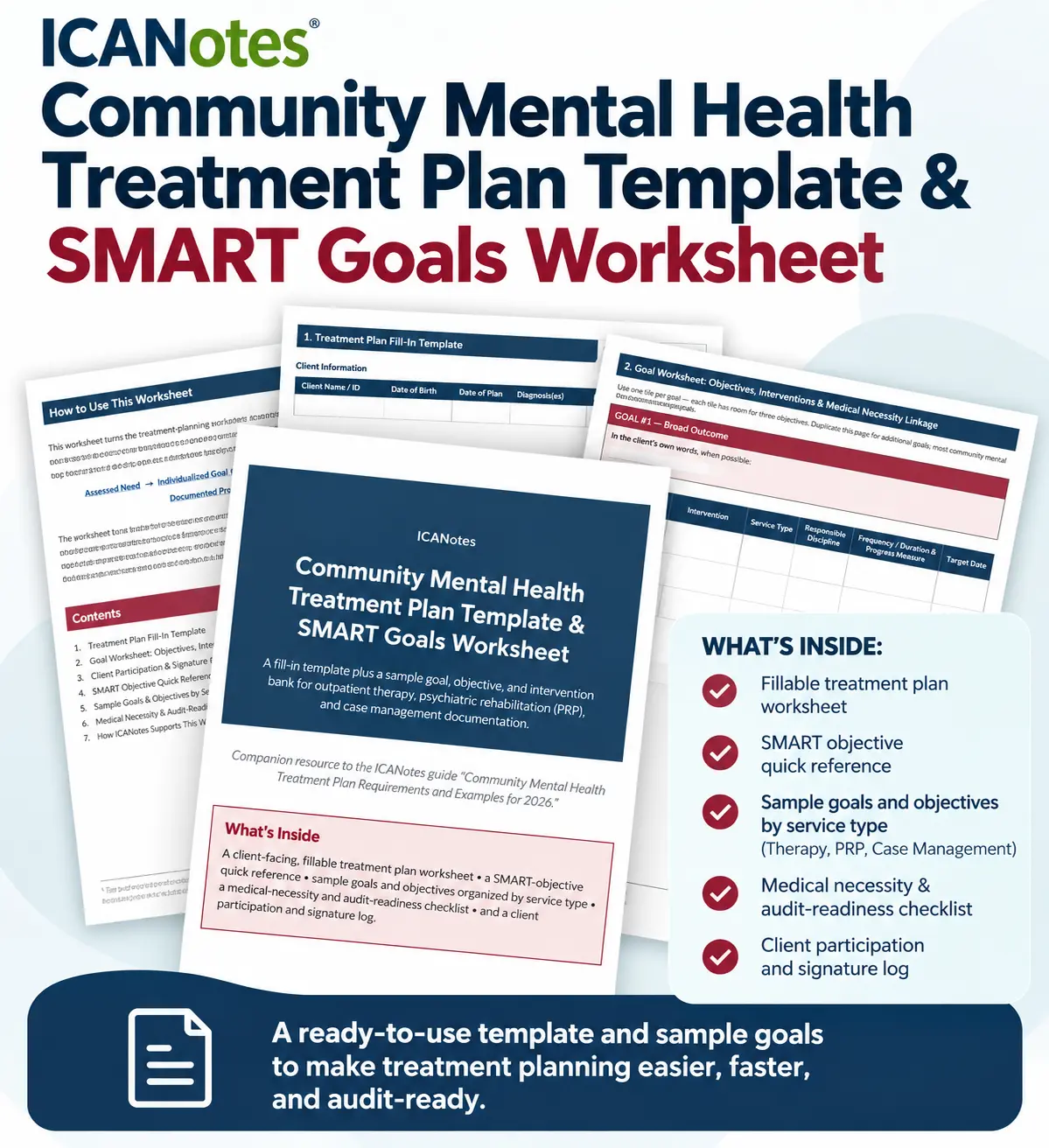
Create Stronger, More Audit-Ready Treatment Plans
Download the Community Mental Health Treatment Plan Template & SMART Goals Worksheet for practical tools you can use to strengthen treatment planning across therapy, PRP, and case management.
- Use a fill-in treatment plan worksheet to organize goals, objectives, interventions, and medical necessity
- Write clearer SMART objectives with a quick-reference guide and worked example
- Adapt sample goals and objectives for outpatient therapy, psychiatric rehabilitation, and case management
- Review plans against an audit-readiness checklist and document client participation and signatures appropriately
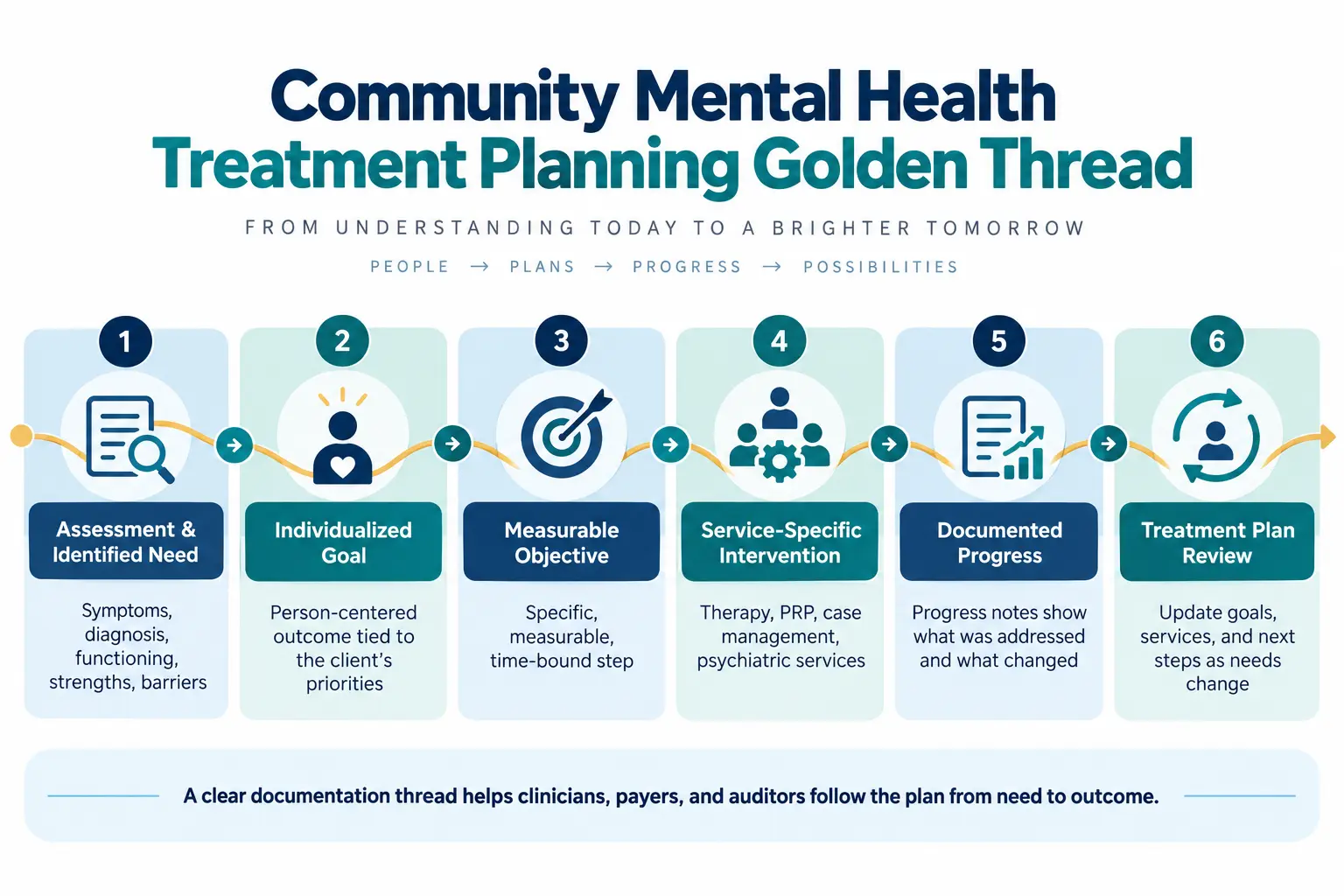
The Treatment Planning Golden Thread
A well-constructed community mental health treatment plan should make this sequence easy to follow:
Assessment and identified need → individualized goal → measurable objective → service-specific intervention → documented progress → treatment-plan review
When each part of that sequence connects logically to the next, the treatment plan becomes more useful to the treatment team and easier for a payer, auditor, or accreditation reviewer to understand.
The visual below shows the “golden thread” that should run through a strong community mental health treatment plan — from the initial assessment through treatment plan review.
Treatment Plan Goals vs. Objectives: What the Difference Actually Means
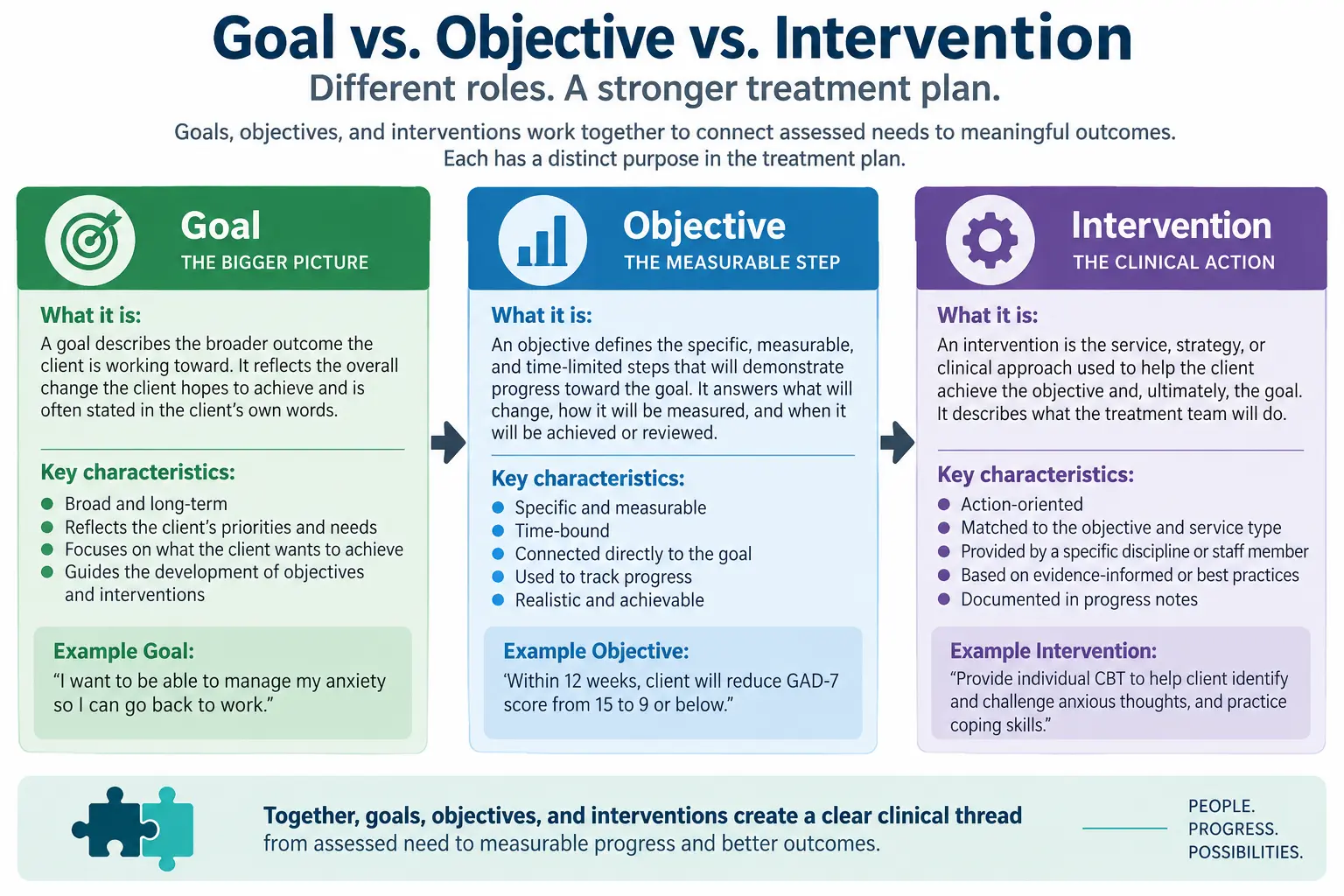
This distinction shows up constantly in People Also Ask searches, and it's worth being precise about, because auditors are precise about it too. A goal is the destination. An objective is the measurable, dated step that gets you there. Most mental health treatment plan objectives fail audit review not because they're wrong, but because they're actually goals wearing an objective's label.
The visual below shows how goals, objectives, and interventions serve different — but connected — roles in a community mental health treatment plan.
| Goal | Objective | |
|---|---|---|
| Definition | The broad outcome the client and clinician are working toward | A specific, measurable step that moves the client toward that goal |
| Timeframe | Long-term, often spanning the treatment episode | Short-term, typically reviewed every 30, 60, or 90 days |
| Measurement | Often qualitative or directional | Quantifiable and time-bound, following the SMART framework |
| Example | "Client will manage depressive symptoms effectively." | "Client will score 9 or below on the PHQ-9 within 90 days." |
Notice that the objective in that example doesn't just add a number. It adds a deadline and a named measurement tool, which is exactly what a reviewer needs to confirm the plan is being tracked rather than copied forward at each review.
Community Mental Health Treatment Plan Goals and Objectives by Service Type
Community mental health treatment plans often need to coordinate several types of services at once. A client may receive outpatient therapy, psychiatric rehabilitation, case management, and medication management from different members of the same treatment team.
That does not mean each service should use the same type of goal. The strongest treatment plans match each goal and objective to the problem being addressed, the service being delivered, and the outcome that service is intended to influence. A therapy objective may measure symptom improvement, while a psychiatric rehabilitation objective measures an independently demonstrated skill and a case management objective tracks completion of a concrete access or coordination milestone.
The examples below are starting points rather than language to copy directly into a chart. Goals and objectives should be individualized to the client's assessed needs, preferences, strengths, level of functioning, and treatment priorities.
Diagnosis-Based Clinical Treatment Goals and Objectives
Clinical treatment goals generally address psychiatric symptoms, emotional functioning, behavioral patterns, coping skills, and other problems that psychotherapy or other clinical interventions are intended to improve. Whenever possible, pair the goal with an objective that identifies what will change, how progress will be measured, and when the outcome will be reviewed.
Major Depressive Disorder
Major Depressive Disorder
Client reports persistent low mood, anhedonia, low energy, social withdrawal, and difficulty maintaining daily routines. Current PHQ-9 score is 16.
Client will reduce depressive symptoms and improve participation in meaningful daily activities.
Objectives:
- Client will reduce PHQ-9 score from 16 to 9 or below within 90 days, with the measure repeated according to the treatment team's established reassessment schedule.
- Client will identify at least three activities associated with pleasure, mastery, or social connection and complete at least one planned activity on five days per week for the next eight weeks.
- Client will identify two patterns of negative automatic thinking and use a treatment-plan coping strategy to challenge or respond to those thoughts in at least four of five identified situations.
Generalized Anxiety Disorder
Generalized Anxiety Disorder
Client reports excessive worry across multiple areas of life, difficulty concentrating, muscle tension, and avoidance of situations that trigger anxiety. Current GAD-7 score is 14.
Client will reduce the impact of anxiety on daily functioning and increase use of effective anxiety-management strategies.
Objectives:
- Client will reduce GAD-7 score below 10 within 90 days.
- Client will practice at least two anxiety-management techniques, such as diaphragmatic breathing, progressive muscle relaxation, grounding, or cognitive restructuring, at least four times per week.
- Client will gradually approach at least three previously avoided activities identified with the clinician, documenting distress level and coping strategy used after each attempt.
Post-Traumatic Stress Disorder
Post-Traumatic Stress Disorder
Client reports intrusive memories, hypervigilance, avoidance of trauma-related reminders, and difficulty participating in previously routine activities.
Client will reduce trauma-related distress and avoidance while increasing the ability to participate safely in daily activities.
Objectives:
- Within 30 days, client will identify at least five trauma-related triggers or avoided situations and collaborate with the clinician to rank them by level of distress.
- Within 60 days, client will use at least two grounding or emotion-regulation strategies during episodes of trauma-related distress and document their effectiveness in four of five identified episodes.
- Client will gradually resume at least two meaningful activities currently limited by trauma-related avoidance, using the agreed treatment approach and pace.
Schizophrenia or Schizoaffective Disorder
Schizophrenia or Schizoaffective Disorder
Client experiences persistent auditory hallucinations and social withdrawal that interfere with treatment engagement and community functioning.
Client will improve management of psychotic symptoms and participate more consistently in treatment and community activities.
Objectives:
- Client will identify at least three early warning signs associated with increased psychiatric symptoms within the next 30 days.
- Client will demonstrate use of at least two coping strategies from the relapse-prevention plan when hallucinations or other symptoms intensify.
- Client will attend at least 90% of scheduled behavioral health appointments during the next 90 days unless prevented by an identified barrier documented in the record.
- Client will participate in at least one personally meaningful community, social, vocational, or recovery-oriented activity each week for eight consecutive weeks.
Bipolar Disorder
Bipolar Disorder
Client has a history of manic and depressive episodes and reports difficulty recognizing early changes in mood, sleep, and activity level.
Client will improve mood stability and use the relapse-prevention plan when early warning signs of a mood episode emerge.
Objectives:
- Client will identify at least three personal early warning signs of mania and three early warning signs of depression within 30 days.
- Client will track sleep, mood, energy, or other agreed warning indicators at least five days per week for the next eight weeks.
- Client will follow the collaboratively developed medication and relapse-prevention plan and notify the treatment team when agreed warning signs or medication-related concerns occur.
- Client will identify at least two strategies for maintaining routines that support mood stability, such as consistent sleep, stress management, or reduction of identified triggers.
Substance Use Disorder and Co-Occurring Conditions
Substance Use Disorder and Co-Occurring Conditions
Client meets criteria for alcohol use disorder with a co-occurring depressive disorder and reports that alcohol use contributes to missed work, impaired relationships, and worsening mood.
Client will reduce alcohol-related impairment and work toward the mutually agreed recovery goal identified in the treatment plan.
Abstinence-focused objective:
- Client will remain alcohol-free for at least 30 consecutive days within the next 90 days, tracked through self-report, session review, and other clinically appropriate monitoring methods documented in the treatment plan.
Harm-reduction objective:
- Client will reduce alcohol use from daily use to no more than three days per week within 90 days and identify and use at least two strategies to reduce alcohol-related harm, such as avoiding alcohol before work, arranging safe transportation, or using coping skills during high-risk situations.
Additional objectives:
- Client will identify at least three situations, emotions, or environmental cues associated with increased substance use and develop an individualized response strategy for each.
- Client will participate in the agreed combination of individual, group, peer-support, medication, or other recovery services documented in the treatment plan.
- Client and clinician will review both substance-use patterns and depressive symptoms at each treatment-plan review to determine whether the current interventions remain appropriate.
Psychiatric Rehabilitation Program Treatment Plan Goals
Psychiatric rehabilitation program goals should generally emphasize functioning, skill development, independence, and community integration rather than simply restating clinical symptom goals. This distinction is important because PRP services are intended to help clients develop or restore abilities needed to function more independently in everyday life. The draft already distinguishes rehabilitation goals from outpatient therapy goals by focusing on functional outcomes and community integration.
A symptom may help explain why rehabilitation is medically necessary, but the PRP objective should usually describe the functional skill the client will learn, practice, or demonstrate.
Independent Living Skills
Independent Living Skills
Client's psychiatric symptoms and limited organizational skills interfere with meal planning, shopping, and management of basic household responsibilities.
Client will increase independence in completing essential household and daily living activities.
Objectives:
- Within 45 days, client will create a weekly grocery list and food budget with rehabilitation specialist support and then complete the task with no more than one verbal prompt on three consecutive occasions.
- Client will independently prepare at least two simple meals each week for six consecutive weeks using an agreed written or visual planning tool.
- Client will use a weekly household-task schedule to complete at least 80% of identified responsibilities during four consecutive weeks.
Medication Self-Management
Medication Self-Management
Client has difficulty organizing prescribed medications and remembering when to take them, limiting the ability to manage medications independently.
Client will develop the skills needed to participate safely and consistently in medication self-management.
Objectives:
- Within 30 days, client will accurately identify the purpose and scheduled time of each current psychiatric medication using an individualized medication list.
- Client will demonstrate use of an agreed medication-organization system, such as a pill organizer, calendar, reminder application, or written schedule, during three consecutive rehabilitation sessions.
- Client will identify whom to contact and what steps to take if a dose is missed, a refill is needed, or a possible side effect occurs.
Community Integration
Community Integration
Client experiences difficulty navigating public transportation and has become increasingly isolated from community activities.
"I want to be able to take the bus by myself so I can get back to work."
Objectives:
- Within 30 days, client will identify the appropriate bus route, schedule, transfer points, fare requirements, and backup transportation option for one selected community destination.
- Within 60 days, client will independently plan and complete a round-trip bus route to one community destination on three occasions, documented through client report and rehabilitation staff observation.
- Client will use transportation skills to attend at least one personally meaningful community, vocational, medical, or social activity per week for four consecutive weeks.
Vocational Readiness
Vocational Readiness
Client wants to return to employment but reports difficulty organizing job-search activities and communicating about work-related needs.
Client will improve the functional skills needed to pursue and maintain competitive or supported employment.
Objectives:
- Client will identify three realistic employment interests or job categories based on strengths, preferences, experience, and current functional capacity within 30 days.
- Client will complete or update a résumé and submit at least two employment applications within 60 days with decreasing staff assistance.
- Client will practice at least three workplace communication or problem-solving scenarios with rehabilitation staff and independently demonstrate the selected strategy in three consecutive practice sessions.
Social and Interpersonal Functioning
Social and Interpersonal Functioning
Client reports social isolation and difficulty initiating or maintaining appropriate interactions with others in community settings.
Client will strengthen social skills needed to participate more independently in community and interpersonal activities.
Objectives:
- Client will identify and practice three conversation, boundary-setting, or conflict-resolution skills during rehabilitation sessions within 45 days.
- Client will participate in at least one structured community or social activity per week for six weeks.
- Client will independently initiate an appropriate social interaction in at least three community situations and review the outcome with rehabilitation staff.
Case Management Treatment Plan Goals and Objectives
Case management goals focus primarily on access, linkage, coordination, advocacy, and removal of barriers to care. Unlike psychotherapy, the case manager is generally not treating the psychiatric symptom directly. And unlike PRP, the principal objective may not be teaching a skill. Instead, the case manager helps the client access services and resources necessary to support stability and recovery.
The distinction already established in this article is useful: therapy addresses clinical change, rehabilitation develops functional skills, and case management connects the client with resources and coordinates care.
Housing Stability
Housing Stability
Client is temporarily staying with friends and reports that unstable housing is interfering with treatment attendance and psychiatric stability.
Client will obtain and maintain safe, stable housing.
Objectives:
- Within 14 days, case manager and client will identify at least three housing programs or resources for which the client may be eligible.
- Client will submit at least two completed housing applications within 30 days, with case-management assistance as needed.
- Case manager will document follow-up with identified housing resources at least monthly until placement, in accordance with the client's preferences and program requirements.
- Once housing is obtained, client and case manager will identify any additional supports needed to maintain the placement.
Benefits and Financial Resources
Benefits and Financial Resources
Client currently has no reliable income and may qualify for public benefits but has difficulty completing applications and obtaining required documentation.
Client will improve access to eligible income, insurance, food, or other public benefits.
Objectives:
- Within 30 days, client and case manager will identify benefit programs for which the client appears potentially eligible.
- Client will submit the agreed benefit application and required supporting documentation within 45 days.
- Case manager will assist the client in responding to requests for additional information, scheduling eligibility appointments, or addressing documented barriers to completion.
Primary and Specialty Medical Care
Primary and Specialty Medical Care
Client has untreated medical needs and has not established consistent primary care, contributing to fragmented behavioral and physical healthcare.
Client will establish appropriate medical care and improve coordination between behavioral health and medical providers.
Objectives:
- Client will select or be linked with a primary care provider within 30 days.
- Client will schedule and attend an initial primary care appointment within 60 days, unless an access barrier is documented.
- With appropriate authorization, case manager will facilitate communication of relevant treatment information between the behavioral health and medical teams.
- Client and case manager will identify any transportation, insurance, scheduling, or communication barriers that could interfere with follow-up care and develop a plan to address them.
Transportation Access
Transportation Access
Lack of reliable transportation contributes to missed psychiatric, therapy, and medical appointments.
Client will establish reliable transportation options needed to access treatment and essential community services.
Objectives:
- Within 14 days, case manager and client will identify available Medicaid transportation, public transit, paratransit, family support, or community transportation resources.
- Client will complete any required transportation enrollment or eligibility application within 30 days.
- Client will use an identified transportation option to attend at least 90% of scheduled essential healthcare appointments over the following 60 days, with barriers documented when appointments are missed.
Care Coordination
Care Coordination
Client receives behavioral health, medical, rehabilitation, and social services from multiple organizations with limited communication between providers.
Client will experience more coordinated care across the services involved in the treatment plan.
Objectives:
- With the client's authorization, case manager will identify the primary providers involved in the client's care and maintain an updated care-coordination contact list.
- Case manager will facilitate communication among relevant providers when there is a significant change in services, level of care, medication, housing, or another issue affecting treatment.
- Client and treatment team will review outstanding referrals, unmet needs, and care-coordination barriers at each scheduled treatment-plan review.
Psychiatric and Medication Management Treatment Plan Goals
For clients receiving psychiatric services, treatment planning should address more than whether a medication was prescribed. Goals can incorporate symptom response, medication tolerability, adherence barriers, shared decision-making, relapse prevention, and the client's ability to recognize when additional psychiatric support is needed.
The psychiatric goal should still connect to the assessed condition and the client's broader recovery priorities. Medication is an intervention used to support the goal, not necessarily the goal itself.
Medication Effectiveness and Symptom Response
Medication Effectiveness and Symptom Response
Client continues to experience depressive symptoms despite current pharmacologic treatment and reports that symptoms interfere with work and daily functioning.
Client will achieve clinically meaningful improvement in depressive symptoms while maintaining an acceptable level of medication tolerability.
Objectives:
- Client and prescriber will monitor depressive symptom severity using an agreed clinical measure and review the result at treatment intervals appropriate to the client's condition.
- Client will report perceived medication benefit, adherence concerns, and possible adverse effects at each medication-management visit.
- Prescriber and client will review whether the current medication strategy remains appropriate when symptoms fail to improve as expected or adverse effects interfere with treatment.
Medication Adherence Barriers
Medication Adherence Barriers
Client reports missing multiple doses of prescribed medication because of forgetfulness and an inconsistent daily routine.
Client will reduce barriers that interfere with following the collaboratively agreed medication plan.
Objectives:
- Within 30 days, client will identify at least two factors contributing to missed doses and select an appropriate strategy for each barrier.
- Client will use an agreed medication reminder or organization system for at least four consecutive weeks.
- Client will discuss missed doses, concerns about medication, or decisions not to take medication openly with the prescriber so the treatment plan can be adjusted when appropriate.
Medication Side-Effect Monitoring
Medication Side-Effect Monitoring
Client reports possible medication-related fatigue and weight changes that may affect willingness to continue treatment.
Client and prescriber will identify and address clinically significant medication-related adverse effects while supporting continued treatment engagement.
Objectives:
- Client will report new or worsening adverse effects at each medication-management visit and sooner when instructed based on the medication or symptom involved.
- Prescriber will review relevant clinical findings and monitoring information according to the medication regimen and the client's individual risk factors.
- Client and prescriber will discuss the benefits, burdens, alternatives, and preferences relevant to continued medication treatment when significant side effects occur.
Relapse Prevention
Relapse Prevention
Client has a history of psychiatric hospitalization associated with escalating symptoms that were not recognized or reported early.
Client will recognize early warning signs and use the psychiatric relapse-prevention plan before symptoms reach crisis intensity.
Objectives:
- Within 30 days, client and treatment team will identify at least three individualized warning signs associated with psychiatric deterioration.
- Client will identify specific actions to take when each warning sign occurs, including when to contact the outpatient team, crisis service, prescriber, or other identified support.
- Client will review and update the relapse-prevention plan whenever there is a significant change in symptoms, treatment, living situation, or level of care.
Shared Decision-Making
Shared Decision-Making
Client reports uncertainty about the purpose and expected benefits of the current medication regimen and wants greater involvement in treatment decisions.
Client will participate actively in psychiatric treatment decisions based on an understanding of available options and personal recovery priorities.
Objectives:
- Client will identify at least two personal treatment priorities to discuss with the prescriber, such as symptom relief, sleep, cognitive functioning, energy, work performance, or medication side effects.
- Prescriber and client will review the expected benefits, significant risks, alternatives, and client preferences relevant to major medication decisions.
- Client will identify questions or concerns about medication before or during each scheduled medication-management visit and participate in decisions about the ongoing treatment plan.
Connecting Goals Across the Treatment Team
A client receiving several community mental health services may have goals in more than one category, but those goals should still support a coordinated plan.
For example, a client with major depressive disorder and housing instability might have:
- a therapy goal to reduce depressive symptoms and increase behavioral activation;
- a PRP goal to independently manage a weekly household routine;
- a case management goal to obtain stable housing; and
- a psychiatric goal to evaluate symptom response and medication tolerability.
Those goals should not exist as unrelated documentation. Each should trace back to an assessed need and fit within the client's overall recovery priorities. Progress notes should then show which treatment-plan goal or objective the service addressed and what progress, barrier, or change occurred.
That creates the documentation thread auditors and treatment teams need to follow: assessed need → individualized goal → measurable objective → appropriate intervention → documented progress → treatment-plan review.
Outpatient Therapy vs. PRP vs. Case Management Treatment Plan Goals
Although outpatient therapy, psychiatric rehabilitation, and case management may all appear within the same community mental health treatment plan, each service should use goal language that reflects its distinct purpose.
Outpatient therapy generally focuses on symptom reduction, emotional functioning, coping skills, and clinical change. Psychiatric rehabilitation focuses on functional skill-building, independence, and community integration. Case management focuses on linkage, coordination, advocacy, and helping clients access the services and resources needed to support stability and recovery.
The visual below highlights how treatment goals shift depending on the purpose of the service being delivered.
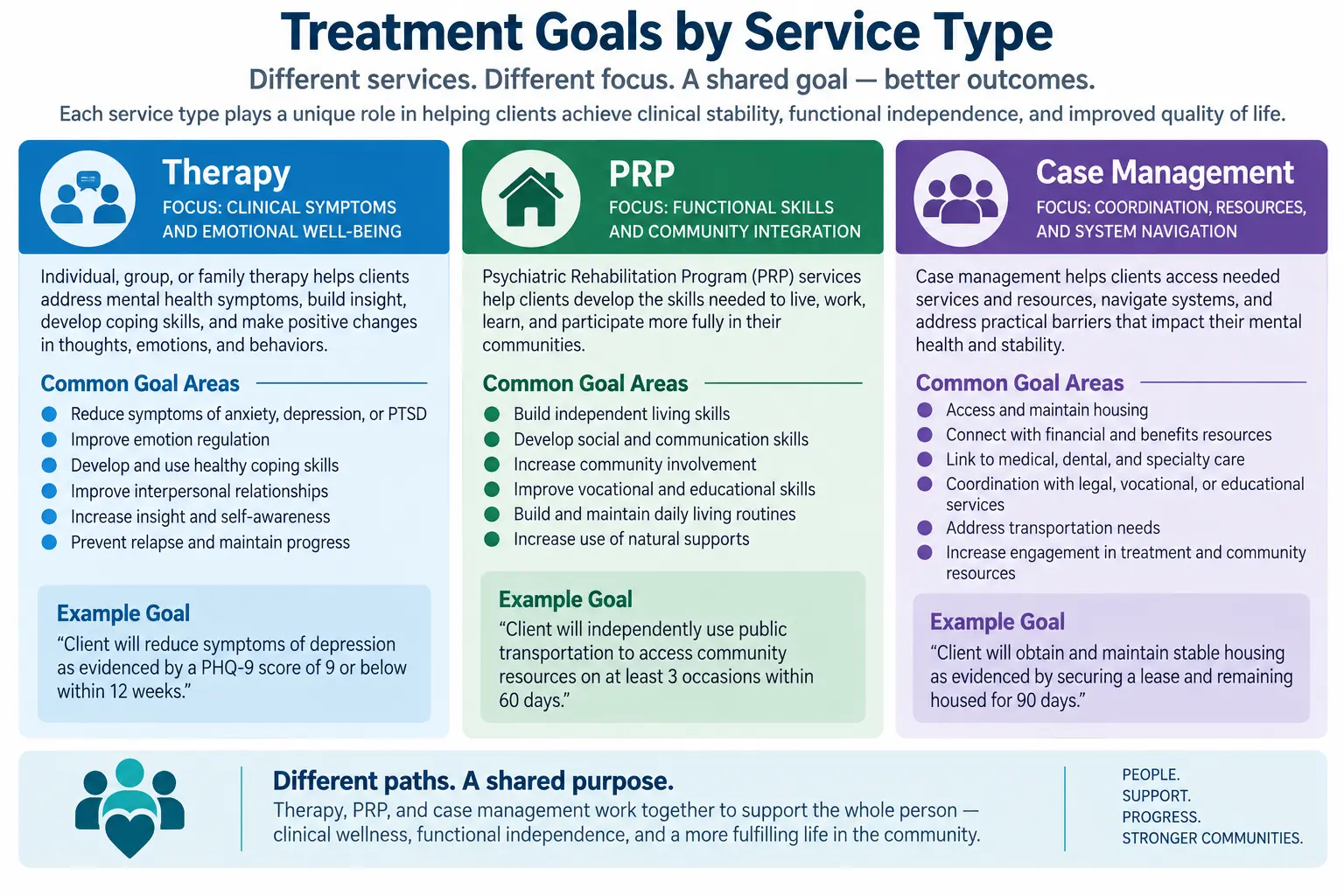
The comparison below shows how the same treatment-planning structure can look different depending on the service being delivered.
| Dimension | Outpatient Therapy | Psychiatric Rehabilitation Program (PRP) | Case Management |
|---|---|---|---|
| Primary focus | Symptom reduction and clinical insight | Functional skill-building and community integration | Resource linkage and care coordination |
| Sample goal | Client will reduce depressive symptoms to a mild range. | Client will independently prepare meals and manage a weekly budget. | Client will obtain stable, permanent housing. |
| Sample objective | Client will complete a thought record after 4 of 5 triggering events by the 60-day review. | Client will demonstrate a grocery list and budget plan within 45 days, with rehabilitation specialist coaching. | Client will submit a completed housing application within 30 days, with case manager support. |
| Primary measure | Standardized symptom scale (PHQ-9, GAD-7, or similar) | Direct behavioral observation and skill checklist | Milestone completion, such as an application submitted or appointment attended |
| Typical responsible discipline | Licensed therapist or counselor | Certified rehabilitation specialist | Case manager |
Whether these goals appear in one integrated individualized service plan or in separate service-specific plans depends on the state, payer, program, and licensing structure. Either way, the treatment team should review them as parts of the same overall recovery plan. A client's psychiatric symptoms, functional limitations, housing needs, and access to care often influence one another and should not be documented as isolated problems.
Medicaid Treatment Plan Review Requirements and Medical Necessity Documentation
This is the section most treatment planning content skips entirely, and it's the one that determines whether the goals you just wrote hold up during an audit.
There is no single federal review interval that applies to every Medicaid-funded community mental health treatment plan. Review and recertification requirements vary by state, payer, program type, and level of care. Many programs use 90-day treatment-plan review cycles, while higher-intensity services may require more frequent review. Clinicians should verify the applicable interval in their state Medicaid provider manual, MCO contract, licensing regulations, and accreditation requirements rather than relying on a universal schedule.
Medical necessity is the harder concept to pin down, mostly because CMS leaves the definition to each state. Per CMS's Documentation Matters Fact Sheet, documentation must, to the extent state law requires it, "reflect medical necessity and justify the treatment and clinical rationale." What that looks like in an actual chart is easier to see through a state Medicaid MCO's own language. Louisiana Healthcare Connections' behavioral health documentation policy (CP.BH.500) requires that every treatment record include support that "clearly outlines justification for the requested frequency, intensity, and duration of services" tied to the member's current clinical presentation. That's the sentence structure auditors are trained to look for: current symptoms, connected directly to a specific service, frequency, and duration.
ICANotes has written more extensively about medical necessity documentation elsewhere on this blog, including the exact phrasing patterns that hold up under review. The short version for treatment plans specifically: every goal and objective should trace back to a documented symptom or functional limitation, and every intervention should trace back to a goal. If a reviewer can't follow that chain in under a minute, the plan probably won't survive an audit.
Signature requirements vary the most by state. Most require the client's signature, the treating clinician's signature, and, when medication is part of the plan, the prescriber's signature. Some states also require a clinical supervisor's countersignature for plans written by associate-level clinicians. None of this is standardized nationally, so build your internal checklist around your specific state's requirements rather than a generic template.
Behavioral Health Treatment Plan Audit Readiness: Common Deficiencies and How to Avoid Them
A behavioral health treatment plan audit tends to surface the same handful of problems, over and over, across states and payers. Knowing the list in advance is most of the work.
Before reviewing the most common treatment-plan deficiencies, use the checklist below as a quick pre-audit screen for the core elements that should be complete, individualized, and internally consistent.
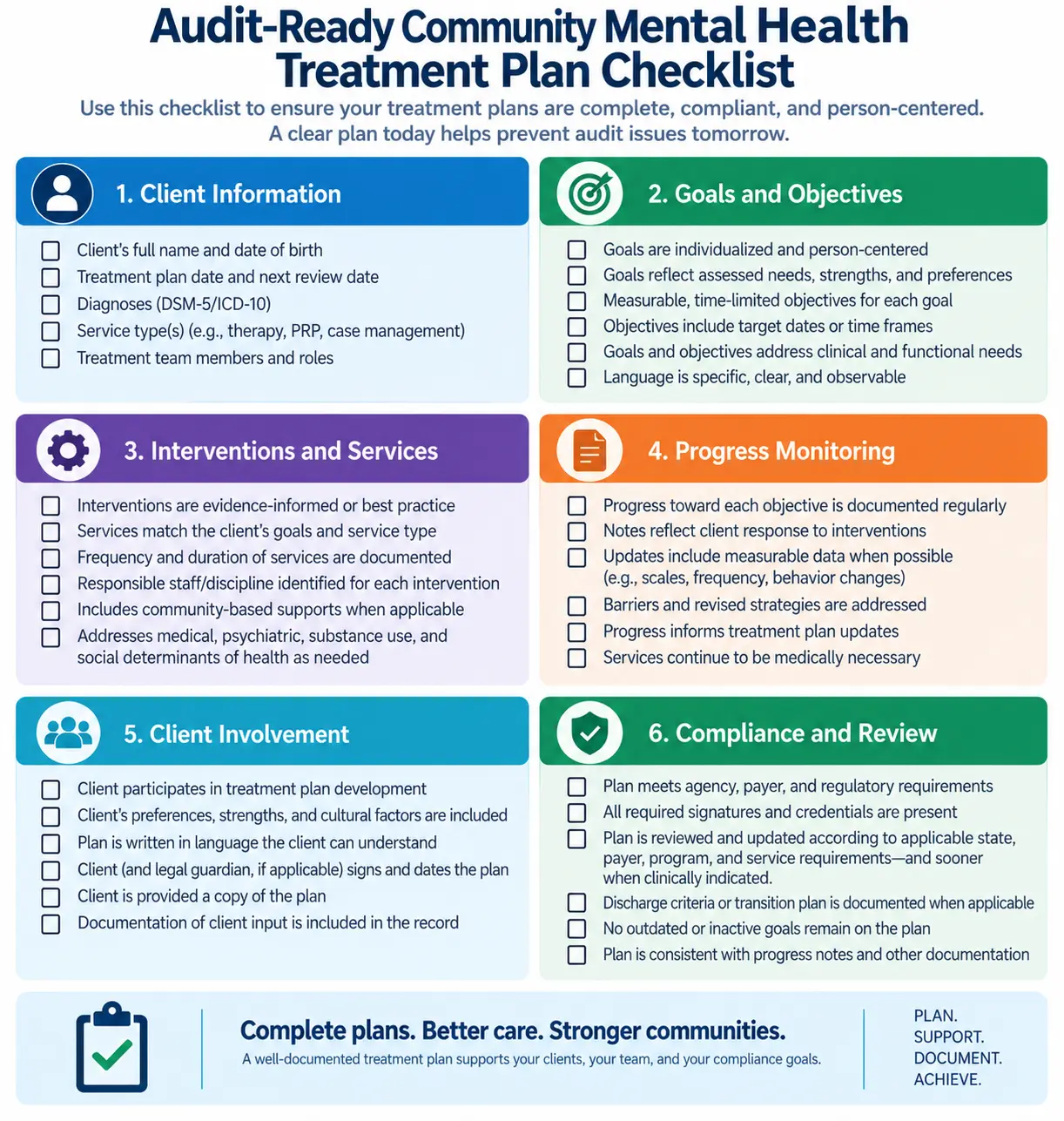
The checklist provides the broad framework; the following deficiencies are the specific issues that most often weaken treatment-plan clarity, consistency, and audit readiness.
- Goals that aren't individualized. Boilerplate language copied across multiple clients is one of the fastest ways to fail a CARF or Joint Commission review, both of which require, per CARF's general behavioral health program standards and Joint Commission standard CTS.03.01.03, that the plan reflect the specific person's needs, strengths, and preferences.
- Objectives that can't be measured. If an objective doesn't include a number, a frequency, or a deadline, it isn't an objective yet.
- Interventions with no clear link to a goal. Every service listed on the plan should map to a specific problem and goal, not sit there as a generic offering.
- Missing or expired signatures. A plan that's technically overdue for review can create a serious compliance or reimbursement issue.
- No documented evidence of client participation. SAMHSA's CCBHC certification criteria specifically call out person-centered and family-centered planning, which means the chart needs to show the client's voice, not just your summary of the conversation.
Two habits close most of this gap. First, make sure every progress note references the specific goal or objective it addresses, so the thread from assessment to treatment plan to progress note is visible to anyone reading the chart cold. Second, when a client declines to participate in planning or refuses to sign, document the refusal, the reason if one was given, and your continued efforts to engage them. A documented refusal is defensible. A silent gap in the chart is not.
Running an internal pre-audit checklist against these five points before an external review, rather than during one, is the difference between a clean survey and a corrective action plan.
Streamlining Community Mental Health Documentation with Purpose-Built Tools
Everything above describes a genuinely heavy documentation lift, one most CMHC clinicians and case managers are carrying on top of a full caseload. That's the administrative burden this whole guide is really about, and it's where a purpose-built EHR earns its place in the conversation.
Generic medical EHRs, adapted from primary care workflows, weren't built to track goal-to-objective-to-intervention chains, PRP-specific functional goals, or Medicaid review cycles by state. ICANotes was built specifically for behavioral health and includes dedicated Treatment Plan, Case Management, and Psychiatric Rehabilitation Program documentation workflows rather than relying on general medical documentation templates.
Because the required fields (measurable objectives, intervention-to-goal linkage, responsible staff, review dates, and signatures) are built into the template rather than left to free text, the platform helps prevent the specific audit findings described above before they happen. ICANotes also includes more than 100 built-in clinical rating scales, among them the PHQ-9 and GAD-7 referenced earlier in this guide, so the standardized baseline a SMART objective depends on is captured at the point of assessment rather than reconstructed later. The platform is ONC Cures Certified and HIPAA-compliant, with integrated billing and RCM that helps CMHC organizations connect treatment plan documentation to the Medicaid claims it's meant to support.
None of that replaces clinical judgment. It does mean less of your day goes to reconstructing a compliant plan from scratch and more of it goes to the client sitting across from you.
Key takeaways
- Community mental health treatment plans need to do more than list symptoms and goals. They should connect assessed needs, diagnoses, functional limitations, goals, measurable objectives, interventions, responsible staff, and review requirements in a clear clinical thread.
- Goals and objectives serve different purposes. Goals describe the broader outcome the client is working toward, while objectives define the specific, measurable, and time-limited steps used to track progress.
- Person-centered planning should reflect the client’s priorities and language. Whenever possible, treatment goals should capture what recovery or improved functioning means to the client and translate those priorities into measurable clinical or functional objectives.
- Treatment-plan language should match the service being delivered. Outpatient therapy may focus on symptom reduction, while psychiatric rehabilitation emphasizes functional skill development and community integration, and case management focuses on linkage, coordination, and access to resources.
- Medicaid treatment-plan requirements are not standardized nationwide. Review intervals, signatures, documentation elements, and authorization requirements can vary by state, payer, program, and level of care, so clinicians should verify the requirements that apply to their services.
- Audit-ready treatment planning depends on a visible connection between assessment, treatment, and progress. Each intervention should support a documented goal or objective, and progress notes should make it clear which part of the treatment plan was addressed.
- Treatment plans should evolve with the client. Review the plan at required intervals and update it when there are meaningful changes in symptoms, functioning, needs, level of care, services, or recovery goals.
Build audit-ready community mental health treatment plans faster
See how ICANotes' behavioral health-specific Treatment Plan, Case Management, and PRP workflows keep the golden thread intact. Start a free trial and document with purpose-built tools.
- Goal-to-objective-to-intervention fields built in
- 100+ rating scales including PHQ-9 and GAD-7
- Dedicated PRP and case management workflows
- Review dates and signatures tracked for audits
See how ICANotes can support your community mental health clinical workflows. Start your free 30-day trial, no credit card required.
Start Your Free 30-Day Trial
Frequently Asked Questions
How often must a Medicaid-funded community mental health treatment plan be reviewed?
Who is required to sign a community mental health treatment plan?
What's the difference between a treatment plan, an individualized service plan, and a plan of care?
How do you write treatment plan goals for a client with co-occurring mental health and substance use disorders?
What should you document if a client refuses to participate in or sign the treatment plan?
What's the difference between a PRP treatment plan and an outpatient therapy treatment plan?
Dr. October Boyles
Dr. October Boyles is a behavioral health expert and clinical leader with extensive expertise in nursing, compliance, and healthcare operations. With a Doctor of Nursing Practice (DNP) and advanced degrees in nursing, she specializes in evidence-based practices, EHR optimization, and improving outcomes in behavioral health settings. Dr. Boyles is passionate about empowering clinicians with the tools and strategies needed to deliver high-quality, patient-centered care.