Blog > Practice Management > Admin Burden in Behavioral Health: How Clinicians Get Time Back
Admin Burden in Behavioral Health: How Clinicians Are Getting Time Back
Administrative burden in behavioral health can quietly consume hours each week through documentation, billing, prior authorization, scheduling, and compliance tasks. For mental health clinicians, the problem is not simply “too much paperwork” — it is a workflow issue built into how therapy, psychiatry, and behavioral health billing are documented and reimbursed. This article breaks down where the time goes, why behavioral health admin is uniquely heavy, and how practices are using better templates, automation, integrated billing, and behavioral-health-specific EHR workflows to get time back.


Last Updated: July 16, 2026

Key Takeaways
- Behavioral health admin burden includes documentation, billing, scheduling, prior authorization, compliance, and patient communication.
- Documentation is often the most consistent daily time cost because every therapy or psychiatry session requires a complete note.
- Billing and prior authorization create additional workload when claims are denied, authorizations lapse, or payer rules change.
- Structured templates, integrated billing, automated reminders, and patient portals can reduce duplicated work.
- A behavioral-health-specific EHR can help by connecting clinical documentation, billing, scheduling, assessments, and compliance workflows.
Contents
- Why Behavioral Health Documentation and Paperwork Are So Heavy
- Where the Time Goes in a Mental Health Practice
- How Administrative Burden Contributes to Clinician Burnout
- How Clinicians are Reducing Paperwork in Mental Health Practice
- How a Behavioral Health EHR can Reduce Administrative Burden
- General EHR vs Behavioral Health EHR: What Changes?
- How to Evaluate Whether Your Current EHR is Creating More Admin Work
Administrative burden in behavioral health is the non-clinical work — documentation, billing, prior authorization, scheduling, and compliance reporting — that mental health clinicians complete outside of direct patient care. Psychiatrists spend roughly 20% of their working hours on administrative tasks, more than any other physician specialty, and therapists typically add 15 to 25 minutes of documentation to every session.
Ask a behavioral health clinician what they’d do with five extra hours a week, and very few say “see more clients.” Most say “leave the office on time” or “finally clear the note backlog from Tuesday.” That instinct is correct: the problem isn’t effort or time management. It’s structural.
A 2014 study published in the International Journal of Health Services found that psychiatrists spend 10.6 hours a week — 20.3% of their working time — on administrative tasks, the highest share of any physician specialty studied, ahead of internal medicine and family practice (Woolhandler & Himmelstein, 2014). More than a decade later, clinicians who track their own time report similar ratios: roughly 1 to 2 hours of charting, billing follow-up, and coordination for every hour spent face-to-face with a client.
None of this is because behavioral health clinicians are slower or less organized than colleagues in other specialties. It’s because mental health documentation, billing, and authorization requirements have built up, rule by rule, around a level of clinical and payer scrutiny that other specialties don’t carry in the same way. This piece breaks down why that’s true, where the time actually goes session by session and task by task, and what clinicians and practice owners are doing — with and without new software — to get some of it back.
5 Reasons for the Behavioral Health Documentation and Paperwork Burden
Every clinical specialty has paperwork. Behavioral health has more of it, attached to more encounters, with less room for error. Five factors compound on top of each other.
1. Every Session Requires a Detailed Clinical Note
Unlike many medical specialties, where routine visits can be documented briefly, behavioral health notes are expected to be substantial and specific — every session, not just complex ones. Federal guidance is explicit on this point: behavioral health documentation must be “complete, concise, and accurate,” reflect medical necessity and active treatment, and include the actual face-to-face time spent with the patient (Centers for Medicare & Medicaid Services, n.d.). A single missing element — an unclear treatment rationale, a note that looks too similar to the last one, a missing time stamp — can be enough to trigger a denial or an audit flag.
2. Prior Authorization Adds Delays and Follow-Up Work
Prior authorization is a documented burden across medicine, but mental health services carry it more consistently than most. A KFF analysis found that 84% of Medicare Advantage enrollees are in plans that apply prior authorization to at least one mental health service (Pestaina & Pollitz, 2022). That’s part of why the Mental Health Parity and Addiction Equity Act specifically requires insurers to document and justify how their prior authorization practices for behavioral health compare to medical and surgical care — a comparison regulators created because the gap was visible enough to legislate against.
Across medicine broadly, the burden is substantial: a December 2024 AMA survey of practicing physicians found they and their staff complete an average of 39 prior authorizations a week, totaling roughly 13 hours, and 40% have hired staff specifically to manage the process (American Medical Association, 2025). Ninety-three percent said prior authorization delays care their patients need.
3. Behavioral Health Claims are More Vulnerable to Denials
Behavioral health claims are denied more often than claims in general medicine — industry billing data puts the range at roughly 25–30%, compared with 8–12% across other specialties. Common drivers include mismatched CPT codes and modifiers, missing or expired prior authorization numbers, and documentation that doesn’t support the billed code. CPT 90837 (60-minute individual psychotherapy) is one of the most frequently audited codes in behavioral health, since payers can recoup payment if documented time falls short of the threshold. Every denial means staff time spent investigating, correcting, and resubmitting — work that doesn’t show up on a session calendar but consumes the same hours.
4. Medicaid and Medicare Documentation Rules Add Compliance pressure
Behavioral health practices, especially community mental health centers and agencies, serve a disproportionate share of Medicaid and Medicare patients — and both programs hold practitioners to specific documentation standards. A CMS fact sheet for behavioral health practitioners spells out the expectations directly: records must reflect medical necessity under each state’s own definition, demonstrate active treatment, and be legible, signed, and dated — able to survive a self-audit before a state or federal reviewer ever sees them (Centers for Medicare & Medicaid Services, n.d.). For practices with a high Medicaid caseload, this isn’t an occasional compliance task — it’s baked into every note.
Related: Mastering CMS Compliance in Mental Health: What Auditors Really Want To See
5. Mental Health Records Carry Additional Privacy and Audit Requirements
On top of session-level requirements, behavioral health records often carry heightened protections — particularly substance use disorder records, which can fall under additional federal confidentiality rules beyond standard HIPAA requirements. Audit trails, coordination-of-care documentation, and access controls all add steps that a routine primary care visit typically doesn’t require in the same depth.
Where the Time Goes in a Mental Health Practice
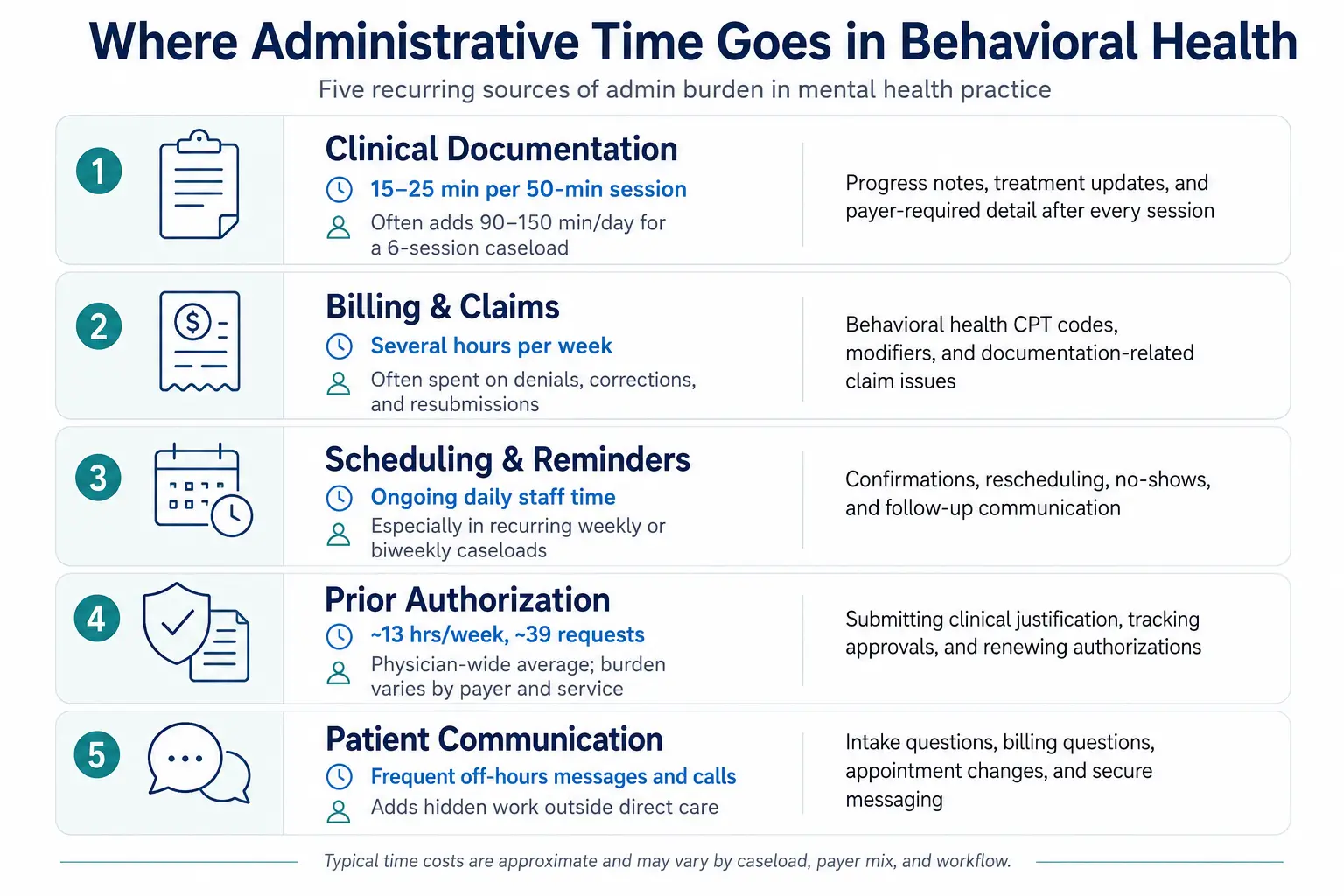
Add up documentation, billing, scheduling, prior authorization, and patient communication, and “admin burden” stops being an abstraction. In most behavioral health practices, administrative burden falls into five recurring categories: clinical documentation, billing and claims follow-up, scheduling, prior authorization, and patient communication. Documentation is usually the most consistent daily burden, while billing and prior authorization often create the most unpredictable delays. The infographic below summarizes where time is most commonly lost, followed by a table with typical time costs and workflow drivers.
Clinical Documentation
This is the largest and most universal line item. A 50-minute session typically generates 15 to 25 minutes of post-session documentation, depending on note format, payer requirements, and whether the clinician is also updating a treatment plan. For a full caseload — six sessions in a day is common — that’s 90 to 150 minutes of charting stacked on top of six hours of direct care, often pushed into evenings. An inefficient workflow looks like a blank text box, switching between a paper intake form and the EHR, and rewriting boilerplate language from scratch every time. A streamlined workflow looks like structured, menu-driven templates that carry forward relevant history and let the clinician focus on what’s clinically new.
Billing and Claims Follow-Up
Billing in behavioral health isn’t just submitting a claim — it’s managing CPT codes that vary by session length and service type, applying the right modifiers for telehealth or group formats, and following up on the share of claims that come back denied. Inefficient workflows mean re-keying the same diagnosis and session data from the clinical note into a separate billing system, then manually tracking which claims are stuck. Streamlined workflows connect documentation directly to claim generation, so data only has to be entered once and clearinghouse scrubbing catches formatting errors before a payer ever sees them.
Scheduling, Reminders, and No Shows
Behavioral health scheduling is recurring by nature — most clients are seen weekly or biweekly, which means a high volume of touch-points to confirm, reschedule, or follow up on no-shows. Manually calling or emailing every client ahead of every session consumes staff time that scales directly with caseload. Automated reminders — text, email, or both — shift that work from a recurring task to a one-time setup.
Prior Authorization
Even when a service doesn’t legally require pre-approval, many behavioral health benefits do — particularly for higher levels of care, extended sessions, or certain medications. The process means submitting clinical justification, waiting on a decision, and often repeating the process at renewal. Inefficient workflows track authorizations in a spreadsheet or a sticky note on a monitor; streamlined workflows flag authorization status against the schedule automatically, so a lapsed or missing authorization surfaces before the appointment, not after the claim is denied.
Patient Communication and Intake
Mental health clients often need more touch-points between sessions than the typical medical patient — appointment changes, intake paperwork, billing questions, and check-ins. Without a self-service option, all of that funnels through phone calls and unsecured email, often outside business hours. A secure patient portal — for forms, secure messaging, and billing — shifts a meaningful share of that traffic to a channel clients can use on their own time, without staff playing phone tag.
How Much Is Administrative Burden Costing Your Practice?
Administrative work does more than consume time — it carries a measurable cost. Use this free calculator to estimate how many clinician hours your practice spends on documentation, billing, prior authorization, scheduling, and patient communication each year.
- ✓ Calculate weekly administrative time per clinician
- ✓ Estimate your annual practice-wide administrative cost
- ✓ Compare your results with behavioral health benchmarks
- ✓ Identify which workflows to improve first
Get the Free Cost Calculator
Complete the form to download the editable Excel calculator.
How Administrative Burden Contributes to Clinician Burnout
Administrative burden does more than make the workday longer. It changes how the workday feels. When documentation, billing follow-up, prior authorization, and patient communication spill into evenings or weekends, clinicians lose the recovery time they need after emotionally demanding sessions.
For behavioral health professionals, this can be especially draining because the administrative work is not separate from clinical responsibility. A late note is not just an unfinished task; it may affect billing, compliance, continuity of care, treatment planning, and the clinician’s confidence that the record accurately reflects what happened in session. Over time, that pressure can create a sense that the work is never truly complete.
After-hours charting is one of the clearest examples. A clinician may finish a full day of therapy or psychiatric appointments only to face another hour or two of documentation, treatment plan updates, portal messages, billing questions, or authorization follow-up. Even when each task is small, the cumulative effect can make clinicians feel like they are constantly choosing between timely documentation, patient care, and personal time.
This is why reducing administrative burden is not just an efficiency goal. It is also a retention, quality-of-care, and clinician well-being issue. Workflows that reduce duplicate data entry, standardize documentation, connect notes to billing, automate reminders, and move intake tasks into a patient portal can help practices protect clinical time and reduce the amount of invisible work clinicians carry after the last session ends.
How Clinicians are Reducing Paperwork in Mental Health Practice
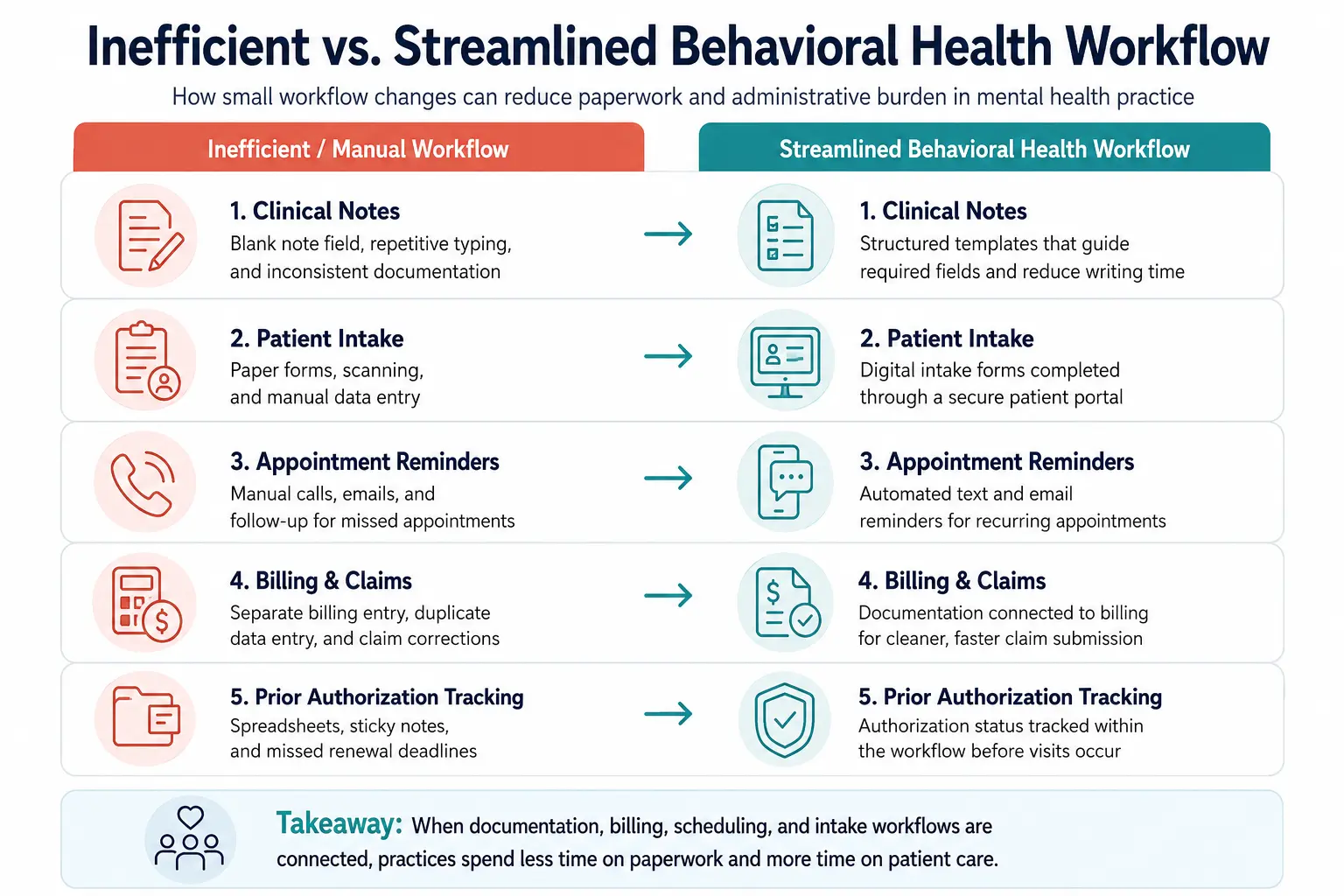
Clinicians and practice owners are not waiting for a perfect solution to administrative burden. Many are already using practical workflow changes to reduce paperwork, shorten documentation time, and keep more of the workday focused on patient care. These strategies may look simple on their own, but together they can make a meaningful difference in how much work follows clinicians home at the end of the day.
Use Structured Documentation Templates
One of the most effective ways to reduce clinical documentation time is to stop starting from a blank page. Structured documentation templates give clinicians a consistent framework for capturing the required elements of each note, such as presenting concerns, interventions used, client response, progress toward treatment goals, risk factors, and plan for follow-up.
For behavioral health practices, templates are most useful when they match how clinicians actually document therapy, psychiatry, and other mental health services. A generic free-text field may offer flexibility, but it can also lead to repetitive typing, missing details, or notes that vary too much from one session to the next. Structured or menu-driven templates can help clinicians document efficiently while still preserving the clinical detail needed for continuity of care, billing, and compliance.
Batch Notes Before the End of the Day
Some clinicians reduce documentation backlog by setting aside dedicated time to finish notes before leaving the office or logging off for the day. Even a short 20- or 30-minute documentation block can help prevent notes from piling up into evening or weekend work.
Batching is not always realistic in a full caseload, especially when crises, phone calls, or no-shows disrupt the schedule. But when it is built into the day intentionally, it can help clinicians close the loop on recent sessions while the clinical details are still fresh. The goal is not to rush documentation, but to protect a defined window for completing it before it becomes after-hours work.
Connect Documentation to Billing
In many practices, documentation and billing still function as separate workflows. A clinician completes the note, then someone else re-enters the diagnosis, CPT code, session time, modifier, or authorization information into a billing system. Every duplicate entry creates another opportunity for error, especially when behavioral health billing depends on service type, session length, payer rules, and documentation that supports medical necessity.
Practices can reduce this friction by connecting documentation and billing more directly. When completed notes flow into claim creation, staff spend less time transferring information between systems, correcting avoidable errors, or tracking down missing details after the fact. This is especially important in behavioral health, where claim denials are often tied to coding mismatches, missing authorization information, or documentation that does not clearly support the billed service.
Automate Appointment Reminders
Scheduling is another area where small automations can save significant staff time. Behavioral health practices often manage recurring weekly or biweekly appointments, which means a steady flow of confirmations, cancellations, no-shows, and rescheduling requests. When reminders are handled manually, front-office staff can spend hours each week making calls, sending emails, or following up with clients who miss appointments.
Automated text and email reminders reduce that repetitive work. They can also help lower no-show rates by giving clients a timely prompt before the appointment. For clinicians and staff, the benefit is not only fewer missed visits, but less time spent managing routine scheduling communication one client at a time.
Move Intake and Forms Into a Patient Portal
Intake paperwork, consent forms, insurance updates, screening tools, and demographic changes can create a large administrative burden before treatment even begins. When these tasks are handled on paper or through unsecured email, staff often have to print, scan, upload, re-enter, or chase missing information.
A patient portal can shift much of that work to a secure self-service workflow. Clients can complete forms, update information, review statements, send messages, or access appointment details without requiring a phone call for every task. For practices, this reduces front-desk volume and helps keep information organized in one place.
None of these strategies requires a complete operational overhaul. But they work best when they are supported by systems designed around behavioral health workflows. Structured notes, connected billing, automated reminders, and patient portal intake all become more powerful when they are part of the same platform rather than separate tools that still require manual coordination. That is where the EHR itself starts to matter more than many clinicians expect.
Clinicians and practice owners aren’t waiting for a perfect solution — most are already running a handful of practical fixes, often before they’ve changed software at all.
None of these strategies require switching software — but they all work better, and stack more effectively, on a platform actually built to support them. That’s where the EHR itself starts to matter more than most clinicians expect.
How a Behavioral Health EHR can Reduce Administrative Burden
Not every EHR was built with behavioral health in mind. Many started as general medical record systems and added mental-health-specific fields later — templates, billing codes, and compliance rules layered onto a structure designed for a different kind of visit. Others were built from the ground up around how therapists and psychiatrists actually document, bill, and coordinate care. The difference shows up in day-to-day workflow, not just feature lists.
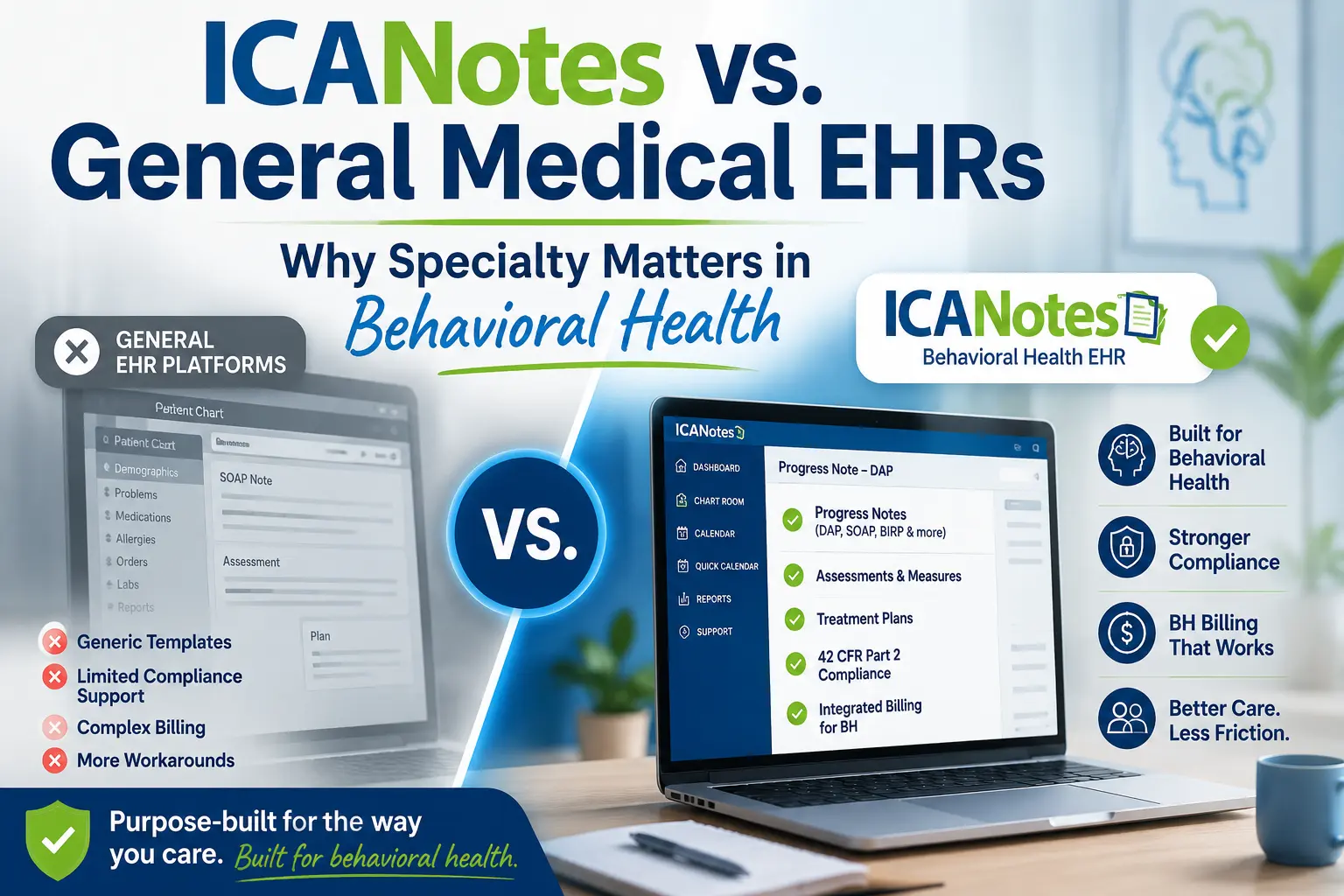
ICANotes is one example of the second category. It’s built exclusively for behavioral health, with menu-driven progress note templates, more than 100 built-in electronic assessment tools (including PHQ-9, GAD-7, and mental status exam formats), and automatic E&M coding that suggests a billing code based on what’s actually documented in the visit — reducing both undercoding and the back-and-forth that comes with it. On the billing side, the platform connects clinical documentation directly to claims, with integrated clearinghouse submission, electronic remittance processing, and built-in support for Medicaid and Medicare documentation requirements, so a completed note doesn’t have to be manually translated into billing data. None of this is unique to ICANotes by definition — but it illustrates the practical difference between an EHR retrofitted for behavioral health and one designed around it from the start.
The time difference clinicians report is sometimes dramatic. “I used to spend two or more hours per day on clinical documentation,” said Carl L. Stephens, LCPC, of Myersville, MD. “Since switching to ICANotes, I typically spend less than 30 minutes per day on documentation, which frees me to generate at least two additional billable sessions per day” (ICANotes, n.d.). Results vary by caseload, note complexity, and prior workflow — but the direction is consistent with what the structural data above would predict: less manual re-entry and fewer disconnected systems generally means less administrative time per session.
General EHR vs Behavioral Health EHR: What Changes?
In a general medical EHR, behavioral health workflows may require more manual adjustment. Templates may be built around problem lists, physical exams, lab results, and medical visit structures rather than therapy sessions, psychiatric evaluations, treatment plan reviews, risk documentation, or recurring behavioral health appointments. Clinicians may still be able to document what they need, but they often spend more time editing templates, adding missing details, or working around fields that were designed for a different kind of care.
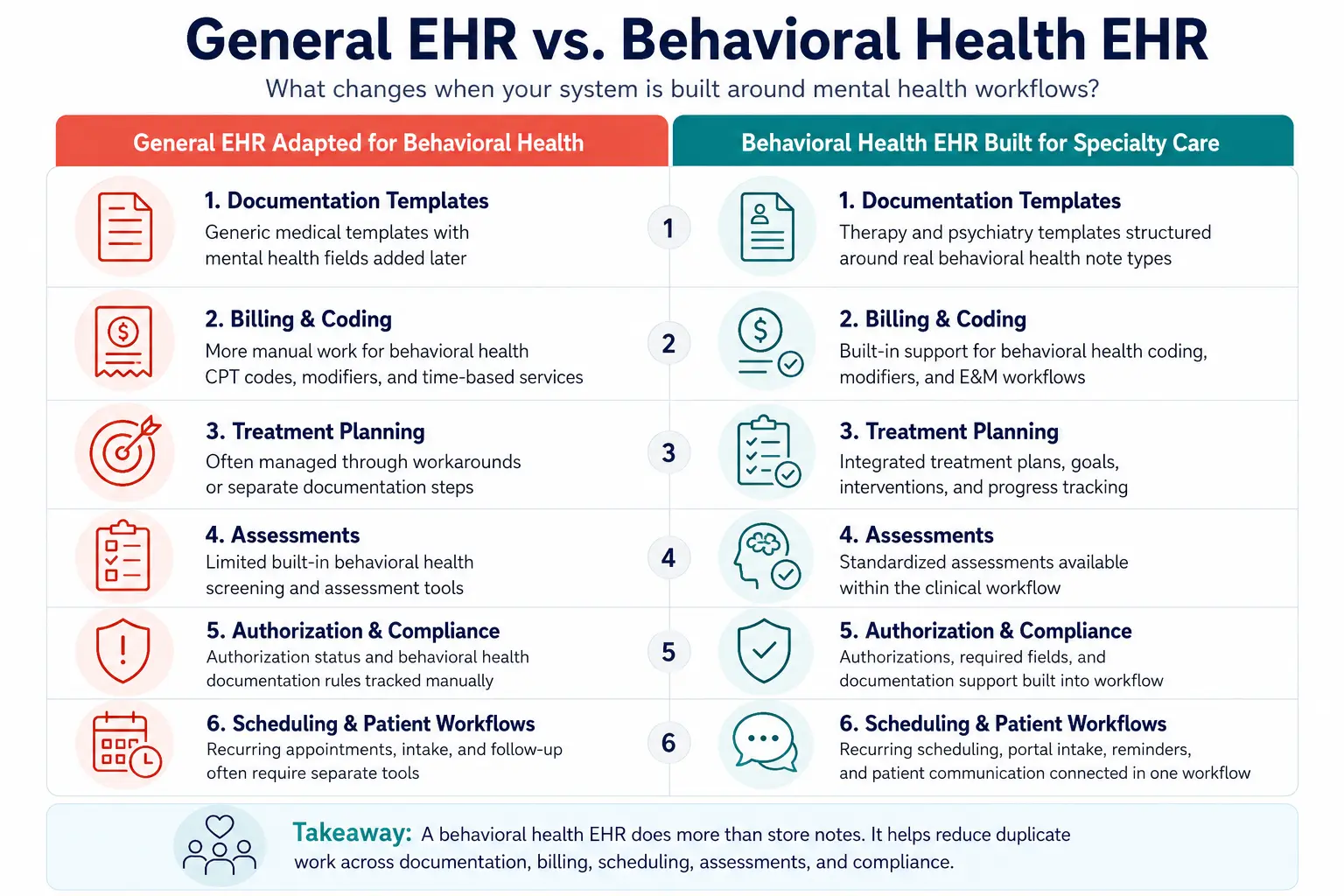
A behavioral health EHR is designed around the way mental health clinicians actually work. That typically means note templates for therapy and psychiatry, support for behavioral health CPT codes and modifiers, integrated treatment planning, built-in assessment tools, recurring appointment workflows, and billing processes that connect more directly to the documentation. Instead of forcing the practice to adapt to a medical-first system, the system is designed to support behavioral health workflows from the start.
That distinction matters because administrative burden is rarely caused by one major task. It builds through dozens of small inefficiencies: typing the same clinical history repeatedly, copying information from a note into a claim, tracking prior authorizations outside the system, searching for the right assessment, or manually confirming recurring appointments. A purpose-built behavioral health EHR can reduce that friction by keeping documentation, scheduling, billing, patient communication, and compliance workflows closer together.
For clinicians and practice owners, the question is not only whether an EHR can store a behavioral health note. The better question is whether the EHR helps reduce the work around the note. Does it make documentation faster without making notes generic? Does it support the codes and workflows behavioral health practices actually use? Does it reduce duplicate data entry between clinical and billing teams? Does it help staff catch missing information before it becomes a denial, delay, or after-hours follow-up task?
How to Evaluate Whether Your Current EHR is Creating More Admin Work
If your current system is contributing to the admin load rather than reducing it, a few questions tend to surface the gap quickly.
- How long does a typical note actually take, start to finish? Time yourself, or a clinician on your team, completing one real note from session-end to signed-and-submitted. If it’s routinely pushing past 20–25 minutes, the templates may be working against you rather than for you.
- What’s your claim denial rate, and why? If you don’t know this number, that’s itself a signal. Pull a denial report for the last quarter and look at the top three reasons — coding mismatches and missing authorization are both fixable at the system level.
- How long does prior authorization actually take, end to end? Track a handful of requests from submission to approval. If staff are tracking authorization status manually outside the EHR, that’s hours of duplicated work every week.
- Do your templates actually match how you document? Generic medical templates with mental-health fields added on tend to require more manual editing than templates built around therapy and psychiatric note structures from the start.
- How many tasks required entering the same information more than once? If diagnosis, session time, authorization status, or billing codes have to be entered into multiple systems, the EHR may be increasing administrative burden instead of reducing it.
Some practices also evaluate AI-assisted documentation tools, but the highest-impact starting point is usually the same: reducing duplicate data entry, standardizing note structure, and connecting documentation to billing.
If your current setup is falling short on more than one of these questions, it may be worth seeing what a behavioral-health-built EHR looks like in practice. ICANotes offers a 30-day free trial with no credit card required, or you can schedule a live demo to walk through documentation, billing, and scheduling workflows specific to your practice type.
Get More Time Back for Your Patients—and Yourself
ICANotes brings behavioral health documentation, scheduling, billing, assessments, and patient communication into one connected workflow. Behavioral-health-specific templates help you create complete clinical notes more efficiently while reducing duplicated work and the risk of missing required details.
- ✓ Complete documentation with less after-hours charting
- ✓ Connect clinical, billing, and scheduling workflows
- ✓ Support consistent, audit-ready behavioral health records
Start your free 30-day trial. No credit card required.
Try ICANotes Free for 30 Days
See how a behavioral-health-specific EHR can simplify your daily workflow.
Frequently Asked Questions About Admin Burden in Behavioral Health
Recent Posts




Dr. October Boyles
DNP, MSN, BSN, RN
About the Author
Dr. October Boyles is a behavioral health expert and clinical leader with extensive expertise in nursing, compliance, and healthcare operations. With a Doctor of Nursing Practice (DNP) and advanced degrees in nursing, she specializes in evidence-based practices, EHR optimization, and improving outcomes in behavioral health settings. Dr. Boyles is passionate about empowering clinicians with the tools and strategies needed to deliver high-quality, patient-centered care.