Substance Abuse Documentation Requirements: A Guide for Practice Owners
For substance use treatment programs, complete clinical records protect more than patient care. They support reimbursement, demonstrate medical necessity, satisfy regulatory requirements, and reduce organizational risk.


Running a substance use treatment program means balancing clinical quality, regulatory compliance, staffing, and financial performance. Documentation sits at the intersection of all four.
A clinician may view documentation as a record of what happened during treatment. For a practice owner or clinical director, that same record must also withstand scrutiny from Medicaid agencies, commercial insurers, licensing authorities, accreditation organizations, and federal privacy regulators.
When documentation falls short, the consequences extend beyond an individual chart. Incomplete assessments can delay authorizations. Outdated treatment plans can undermine medical necessity. Missing signatures can expose claims to repayment demands. Improper disclosure of substance use disorder records can create significant privacy and enforcement risks.
What are substance use documentation requirements? They are the records a substance use treatment program must maintain to demonstrate that each client was appropriately assessed, placed at a clinically justified level of care, treated according to an individualized plan, and protected under applicable privacy rules — and that services billed were actually delivered.
This guide explains who establishes those requirements, what records a substance use program should maintain throughout treatment, where documentation gaps create financial exposure, and how leadership can build consistent documentation practices across clinicians, locations, and programs.
Key Takeaways
- There is no single nationwide documentation checklist. Substance use programs must account for federal privacy regulations, state licensing requirements, payer policies, and applicable accreditation standards.
- Medical necessity begins with the assessment. Documentation should explain why a client needs treatment and why the recommended level of care is appropriate.
- Treatment plans and service records must align. Payers need evidence that billed services were delivered, clinically justified, and consistent with the client's treatment needs.
- 42 CFR Part 2 requirements changed in 2026. The updated federal confidentiality regulations became enforceable under the revised framework on February 16, 2026.
- Incomplete records create financial risk. Missing documentation, unsigned services, and treatment-plan deficiencies have contributed to findings in federal Medicaid audits.
- Compliance requires organization-wide oversight. Standardized workflows, staff training, internal chart reviews, and leadership visibility are more reliable than depending on individual clinicians to remember every requirement.
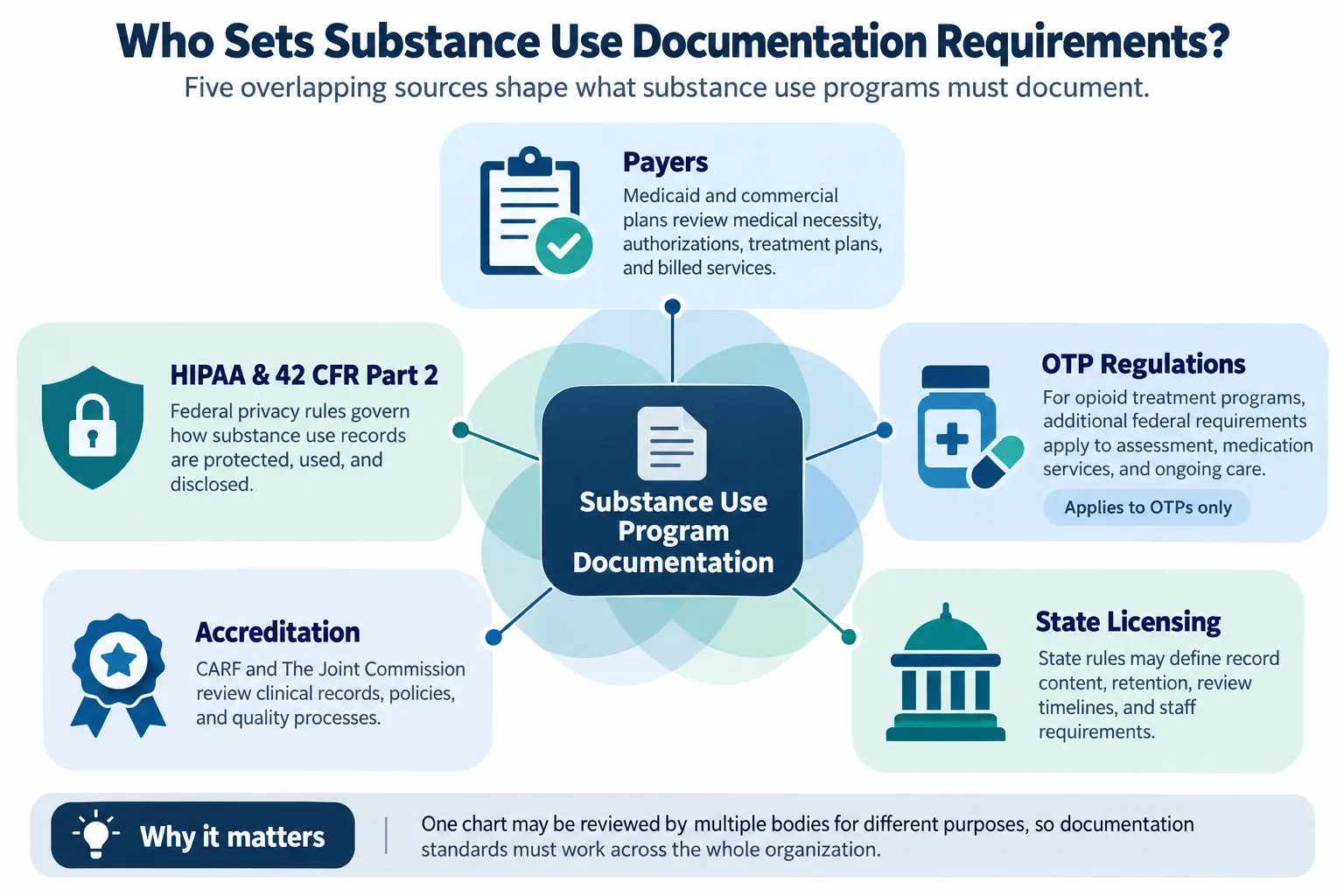
Who Sets Substance Use Documentation Requirements?
Substance use treatment programs operate within multiple overlapping regulatory and contractual frameworks. Understanding which rules apply is the first step toward building a defensible documentation process.
Medicaid and Commercial Insurance Requirements
Payers establish documentation requirements through provider agreements, coverage policies, medical necessity criteria, and billing rules.
Depending on the payer and service, these may address:
- Assessments establishing diagnosis and medical necessity
- Documentation supporting admission and level-of-care decisions
- Individualized treatment plans and review intervals
- Evidence supporting continued treatment
- Service dates, duration, interventions, and clinician credentials
- Prior authorization and concurrent review requirements
- Discharge and continuing care documentation
Medicaid requirements vary by state. A service reimbursable under one state's Medicaid program may have different documentation requirements in another.
Commercial insurers may establish additional rules regarding treatment authorization, provider qualifications, and covered services.
For organizations operating across multiple payer contracts, the challenge is ensuring that clinicians capture the information required by each applicable policy without creating unnecessary administrative complexity.
Federal Privacy Regulations: HIPAA and 42 CFR Part 2
The Health Insurance Portability and Accountability Act (HIPAA) establishes federal requirements for protecting health information held by covered entities and their business associates.
42 CFR Part 2 provides additional confidentiality protections for substance use disorder records maintained by federally assisted programs that meet Part 2's applicability requirements.
Part 2 governs how protected SUD records may be used and disclosed, including patient consent and certain disclosures involving treatment, payment, and health care operations.
The rules are not interchangeable. Organizations must determine whether Part 2 applies to their programs and implement procedures that satisfy both regulations where required.
Federal Requirements for Opioid Treatment Programs
Opioid treatment programs (OTPs) certified to provide medications for opioid use disorder under federal OTP regulations have additional responsibilities under 42 CFR Part 8.
Updated Part 8 regulations became effective in April 2024, with compliance required by October 2, 2024. These standards address areas including admission, assessment, treatment planning, medication services, and ongoing care.
These requirements are specific to federally regulated OTPs and should not be assumed to apply identically to every outpatient substance use counseling practice.
Accreditation and State Licensing
Accreditation organizations, including CARF and The Joint Commission, evaluate how behavioral health organizations plan, provide, monitor, and document services under their applicable standards.
For example, The Joint Commission recognizes that treatment-planning information may appear in multiple parts of the clinical record rather than in one dedicated document, provided the organization meets applicable requirements.
State licensing agencies may impose additional rules covering clinical assessments, documentation deadlines, personnel qualifications, treatment reviews, record retention, and discharge procedures.
A single treatment plan may be reviewed by a payer to establish medical necessity, an accreditor to evaluate quality of care, and a state regulator to assess licensing compliance. Documentation processes must account for all three.
Program leaders should maintain a current requirements matrix identifying applicable rules, the person responsible for each requirement, and how compliance is verified.
For related guidance on organizations providing broader behavioral health services, see our Community Mental Health Documentation Requirements guide.
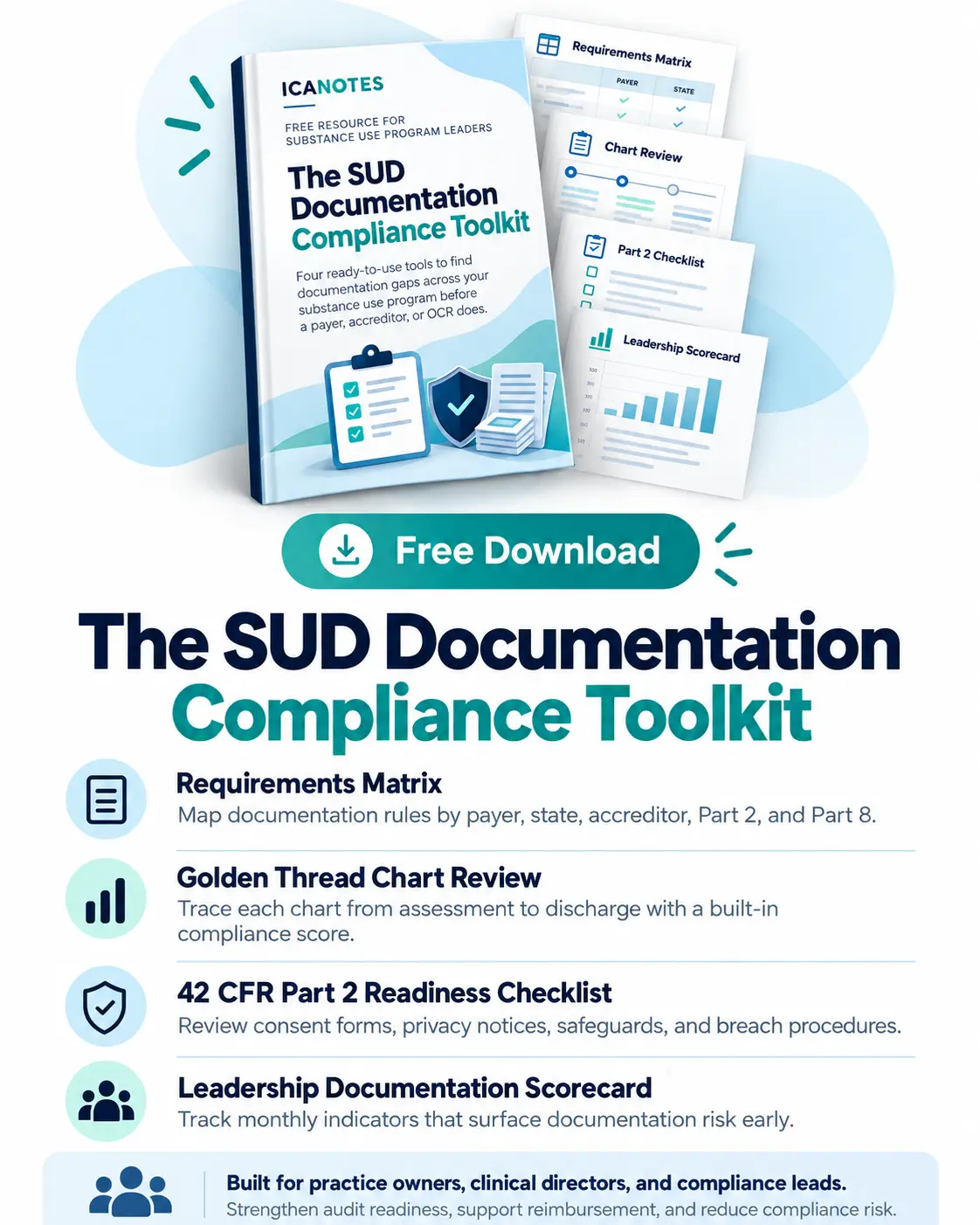
Is Your Substance Use Documentation Audit-Ready?
Get four practical tools to identify documentation gaps, strengthen compliance, and reduce reimbursement risk across your substance use treatment organization.
- Map your requirements across payers, state regulations, accreditation standards, and federal privacy rules.
- Identify gaps in clinical records with a structured chart review and compliance scoring worksheet.
- Assess 42 CFR Part 2 readiness with a checklist covering consent, privacy, and breach procedures.
- Monitor documentation risks with a leadership scorecard that tracks key compliance indicators.
Intake, Assessment, and Level-of-Care Documentation
An effective documentation process begins before treatment starts.
The intake and assessment record should establish the client's presenting needs, explain the clinical rationale for treatment, and support the recommended level of care.
For an organization, these records become the foundation for initial authorizations, continued-stay reviews, and reimbursement.
What Should a Substance Use Assessment Include?
A comprehensive assessment generally addresses:
- Substance use history: Substances used, patterns and frequency of use, duration, prior treatment, withdrawal history, and relevant consequences.
- Clinical diagnosis: Supported substance use disorder diagnoses and other relevant diagnostic findings.
- Medical needs: Physical health conditions, current medications, withdrawal concerns, and potential medical complications.
- Psychiatric needs: Co-occurring mental health conditions, symptoms, safety concerns, and cognitive functioning.
- Psychosocial factors: Housing, employment, family relationships, trauma history, social supports, and environmental risks.
- Treatment history: Previous interventions, response to treatment, and relevant recurrence of substance use.
- Risk assessment: Immediate safety concerns, overdose risk, withdrawal risk, and other clinically relevant factors.
- Level-of-care recommendation: A documented explanation of the intensity and setting of treatment recommended.
The precise information required depends on the program, patient population, payer, and applicable state rules.
A completed assessment should provide sufficient clinical evidence to support the treatment decision — not merely indicate that an assessment occurred.
Documenting Level of Care Using the ASAM Criteria
The American Society of Addiction Medicine's ASAM Criteria provide a widely used framework for assessing treatment needs and determining appropriate levels of care.
The ASAM Criteria Fourth Edition, released for adults in 2023, introduced significant changes to the assessment framework.
Its six dimensions are:
| Dimension | Assessment Focus |
|---|---|
| 1 | Intoxication, Withdrawal, and Addiction Medications |
| 2 | Biomedical Conditions |
| 3 | Psychiatric and Cognitive Conditions |
| 4 | Substance Use-Related Risks |
| 5 | Recovery Environment Interactions |
| 6 | Person-Centered Considerations |
Under the Fourth Edition, Dimensions 1 through 5 inform the initial level-of-care recommendation. Dimension 6 addresses patient preferences, barriers to care, and shared decision-making about the treatment setting in which the patient can realistically participate.
This distinction matters because the clinically recommended level of care and the level of care a patient can access or is willing to engage in may not always be identical.
Documentation should explain both the clinical recommendation and the relevant person-centered considerations affecting the final placement decision.
Managing the Transition Between ASAM Editions
Adoption of the Fourth Edition varies across payers and jurisdictions.
Some Medicaid programs and commercial insurers have transitioned to the updated framework, while others may continue to use earlier criteria or implement the new edition according to different schedules.
Practice leaders should confirm which edition each payer currently requires and ensure that assessment templates, authorization workflows, and staff training reflect those requirements.
A record built around an outdated assessment structure may fail to provide information expected during medical necessity review, even when the clinician made an appropriate treatment decision.
An assessment that does not clearly support level of care can contribute to denied admissions, delayed authorizations, unsuccessful concurrent reviews, or questions about continued treatment.
Standardizing the assessment process helps reduce variation between clinicians while preserving individualized clinical judgment.
ICANotes provides biopsychosocial assessments and substance use documentation options, including ASAM dimension progress notes. Examples are available in the Substance Abuse Sample Notes library. Organizations should verify that their configured documentation aligns with the ASAM edition required by their payers.
Treatment Plan Documentation Requirements
A substance use treatment plan connects the client's assessed needs with the services the organization intends to provide.
It also establishes the clinical rationale behind continued treatment and helps demonstrate that care is individualized rather than driven by a routine schedule of services.
What Must a Substance Use Treatment Plan Show?
Although specific requirements vary, an effective treatment plan should document:
- Diagnoses and problems identified during assessment
- Individualized recovery goals
- Measurable treatment objectives
- Planned clinical interventions and services
- Anticipated service frequency or intensity when required
- Responsible clinicians or treatment team members
- Patient participation in treatment planning
- Required signatures and acknowledgments
- Review dates and planned reassessment intervals
- Changes in needs, goals, interventions, or level of care
Goals should be meaningful to the individual and measurable enough to evaluate progress.
For example, a plan identifying relapse prevention as a goal should specify the skills, interventions, or measurable objectives that will be addressed during treatment.
For practical examples, see our Substance Abuse Treatment Plan guide.
Treatment Plans Must Remain Current
A treatment plan should evolve as the client's condition and treatment needs change.
Reviews may be necessary when:
- A client moves between levels of care
- New psychiatric or medical concerns emerge
- Treatment goals are achieved or require modification
- Substance use patterns or safety risks change
- The client experiences significant barriers to participation
- A payer, state regulator, or program policy requires scheduled reassessment
There is no universal treatment-plan review interval that applies to every substance use program.
Leadership should establish review schedules based on applicable requirements and ensure that overdue reviews are identified before they affect treatment or billing.
Connecting Treatment Plans to Services
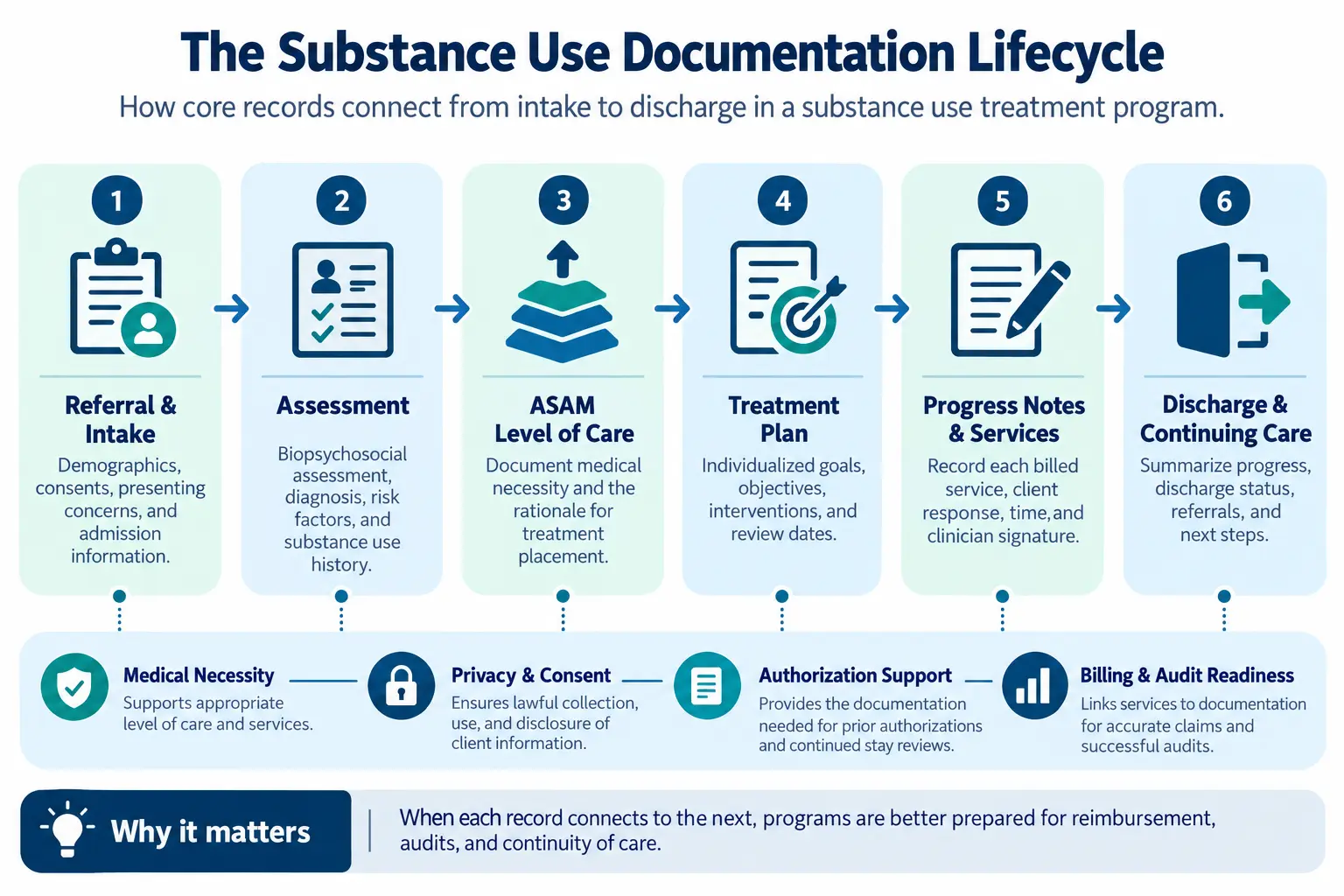
One of the most important documentation principles is maintaining a clear relationship between assessment findings, treatment goals, services delivered, and the client's response.
This is sometimes described as the golden thread of clinical documentation.
For example, if an assessment identifies significant relapse risk, the treatment plan should address that risk through appropriate goals and interventions. Subsequent service documentation should demonstrate how treatment addressed those needs.
The connection becomes especially important when a client receives multiple types of services, such as individual counseling, group therapy, medication management, and care coordination.
Services may be clinically appropriate but difficult to defend during an audit when they are absent from, or inconsistent with, the treatment plan.
In a federal audit of New York opioid treatment program claims, treatment-plan deficiencies were among the factors contributing to improper Medicaid reimbursement.
A current, individualized treatment plan is therefore both a clinical resource and an important part of reimbursement documentation.
Small documentation gaps can become larger compliance problems when they occur across multiple clinicians and programs. Use the Behavioral Health Documentation Audit Checklist to identify common weaknesses in medical necessity, treatment planning, signatures, and billing alignment. Review your documentation standards before an external auditor does.
Progress Notes and Service Documentation
Every billable service should have documentation sufficient to establish what occurred, why it was appropriate, and how it relates to the client's treatment.
This principle applies across individual counseling, group therapy, medication-related services, and other reimbursable interventions, subject to applicable payer and program requirements.
What Should Service Documentation Include?
Common documentation elements include:
- Client identification
- Date of service
- Service type and setting
- Start and stop times or total duration, when required
- Clinical intervention or service provided
- Relationship to treatment goals
- Relevant observations and client response
- Progress or barriers affecting treatment
- Next steps or follow-up recommendations
- Clinician identity, credentials, and required signatures
Documentation should support the service code billed and be completed within applicable deadlines.
An appointment appearing on a schedule does not, by itself, establish that the corresponding billable service was performed.
Similarly, an authorization establishes permission for specified services but does not replace the clinical documentation required to substantiate delivery.
Group Treatment Requires Individualized Documentation
Group therapy is common in substance use programs, but documenting the group session alone may not satisfy applicable payer requirements.
Organizations should verify whether each participant's record must separately establish attendance, individualized participation or response, and progress toward treatment goals.
A group-level summary can describe the session's overall purpose and interventions. Individual documentation helps demonstrate how the service applied to each client's clinical needs.
ICANotes supports group documentation workflows that produce individual client notes and offers coding assistance within its documentation process. These capabilities can help standardize records, although organizations remain responsible for verifying that documentation and claims meet payer requirements.
Additional Clinical Records
Depending on the services provided, programs may also need to maintain records of:
- Toxicology testing and clinically relevant results
- Medication prescribing, dispensing, or administration
- Withdrawal monitoring and safety assessments
- Referrals and collateral contacts
- Crisis interventions and incident reports
- Missed services or significant treatment interruptions
- Coordination with outside providers
Documentation of these activities should follow applicable clinical, privacy, and billing requirements. Not every activity is independently reimbursable.
For detailed SOAP and DAP examples, see our separate Substance Abuse Notes resource.
Missing, incomplete, or unsigned service notes can undermine payment even when clinicians delivered appropriate care.
Across a substantial caseload, recurring documentation deficiencies can expose multiple claims to denial or repayment requests.
Program leaders should monitor unsigned notes, missing service records, and coding discrepancies before claims are submitted whenever possible.
Consent, Privacy, and 42 CFR Part 2 Requirements
Substance use treatment records frequently contain sensitive information involving diagnoses, treatment history, substance use patterns, and personal circumstances.
Federal confidentiality requirements recognize the potential consequences of unauthorized disclosure.
For organizations subject to 42 CFR Part 2, privacy compliance must be built into daily documentation and information-sharing practices — not handled solely through an intake consent form.
How HIPAA and 42 CFR Part 2 Work Together
HIPAA establishes broad protections for health information maintained by covered entities and business associates.
Part 2 provides additional requirements for protected substance use disorder records maintained by federally assisted programs that meet the regulation's applicability criteria.
Not every provider treating a patient with a substance use disorder is automatically a Part 2 program. However, qualifying programs and certain recipients of Part 2 records have responsibilities under the regulation.
Organizations should formally determine which programs, records, and information-sharing activities fall under Part 2.
What Changed Under the 2024 Part 2 Final Rule?
The U.S. Department of Health and Human Services issued a major update to Part 2 in February 2024. Compliance with the updated requirements became mandatory on February 16, 2026.
Key changes include:
A Single Consent for Certain Routine Disclosures
Patients may provide a single consent authorizing future uses and disclosures of Part 2 records for treatment, payment, and health care operations.
This can simplify information sharing, but it does not eliminate consent requirements or authorize every type of disclosure.
Changes to Redisclosure Requirements
Part 2 records disclosed pursuant to qualifying consent for treatment, payment, and health care operations may be further used or disclosed by HIPAA covered entities and business associates in accordance with applicable HIPAA permissions, subject to Part 2 restrictions.
Organizations should update policies and train staff on the circumstances in which redisclosure is permissible.
Additional Protections for SUD Counseling Notes
The updated rule creates a separate category of SUD counseling notes that receive heightened protection.
These notes have a specific regulatory definition and are distinct from routine progress documentation. A separate consent is generally required for uses and disclosures of SUD counseling notes, subject to limited exceptions.
Updated Privacy Notices and Patient Rights
Covered organizations must address applicable changes to privacy notices and patient rights, including requirements affecting Part 2 records.
HHS provides updated model privacy notices that organizations can adapt.
New Breach Notification and Enforcement Provisions
The revised framework applies HIPAA-related breach notification and enforcement provisions to Part 2.
Beginning February 16, 2026, the HHS Office for Civil Rights (OCR) began accepting Part 2 complaints and breach notifications.
OCR may investigate violations, conduct compliance reviews, and impose civil monetary penalties where authorized.
These changes make Part 2 compliance an important organizational risk-management responsibility.
What Should Practice Owners Review?
Leadership should verify that the organization has:
- Current patient consent forms appropriate to the applicable disclosure.
- Updated privacy notices that meet applicable HIPAA and Part 2 requirements.
- Written policies governing access, disclosure, and redisclosure.
- Appropriate safeguards for SUD counseling notes.
- Defined breach identification, investigation, and notification procedures.
- Staff training addressing practical information-sharing scenarios.
- Procedures for responding to patient complaints and privacy requests.
Electronic record systems should support appropriate access permissions, secure information handling, and documentation of relevant consent and disclosure activity.
A privacy incident can generate legal expenses, investigation costs, corrective-action obligations, operational disruption, and reputational damage.
The 2026 enforcement changes make it particularly important for leadership to confirm that revised policies are functioning in practice.
For the official regulatory summary, review the HHS Part 2 Final Rule Fact Sheet.
Discharge and Transitions-of-Care Documentation
Documentation responsibilities continue when a client leaves a program or moves to another level of care.
Substance use treatment often involves transitions between outpatient counseling, intensive outpatient services, residential treatment, withdrawal management, medication services, and continuing recovery support.
Each transition should be supported by a clear clinical record.
What Should a Discharge Summary Include?
Depending on applicable requirements and the circumstances, a discharge summary may address:
- Admission and discharge dates
- Diagnoses and presenting treatment needs
- Services and interventions provided
- Progress toward treatment goals
- Clinical status at discharge
- Outstanding medical or psychiatric concerns
- Medications and relevant follow-up needs
- Reason for discharge
- Referrals and continuing care recommendations
- Relapse prevention and safety planning when appropriate
- Required clinician signatures
A discharge record should explain the patient's status and next steps rather than simply indicating that treatment ended.
Documenting Changes in Level of Care
When a client transitions to a different treatment intensity, the record should support the clinical reasoning.
For example, documentation supporting movement from intensive outpatient treatment to standard outpatient care should describe changes in clinical needs, risk, functioning, and the client's ability to participate safely at the new level.
If a client requires more intensive treatment, the record should explain the clinical concerns supporting that decision and describe the referral or transfer process.
Supporting Continuity of Care
Good transition documentation also identifies who is responsible for follow-up services and what information may be shared.
When Part 2 records are involved, disclosures must meet applicable consent requirements or another legally permissible basis.
For patients with co-occurring mental health conditions, medication needs, or significant social barriers, clearly documented care coordination can be especially important.
Missing transition records can complicate continued authorizations, create uncertainty about responsibility for follow-up care, and weaken the evidence supporting changes in treatment intensity.
Programs should establish discharge procedures that remain consistent even when a client leaves unexpectedly or does not complete treatment as originally planned.
Why Is Comprehensive Documentation Crucial for Substance Use Practices?
Documentation quality directly affects an organization's ability to support reimbursement, demonstrate compliance, and maintain reliable clinical operations.
The financial consequences are not hypothetical.
How Documentation Gaps Create Financial and Compliance Risk
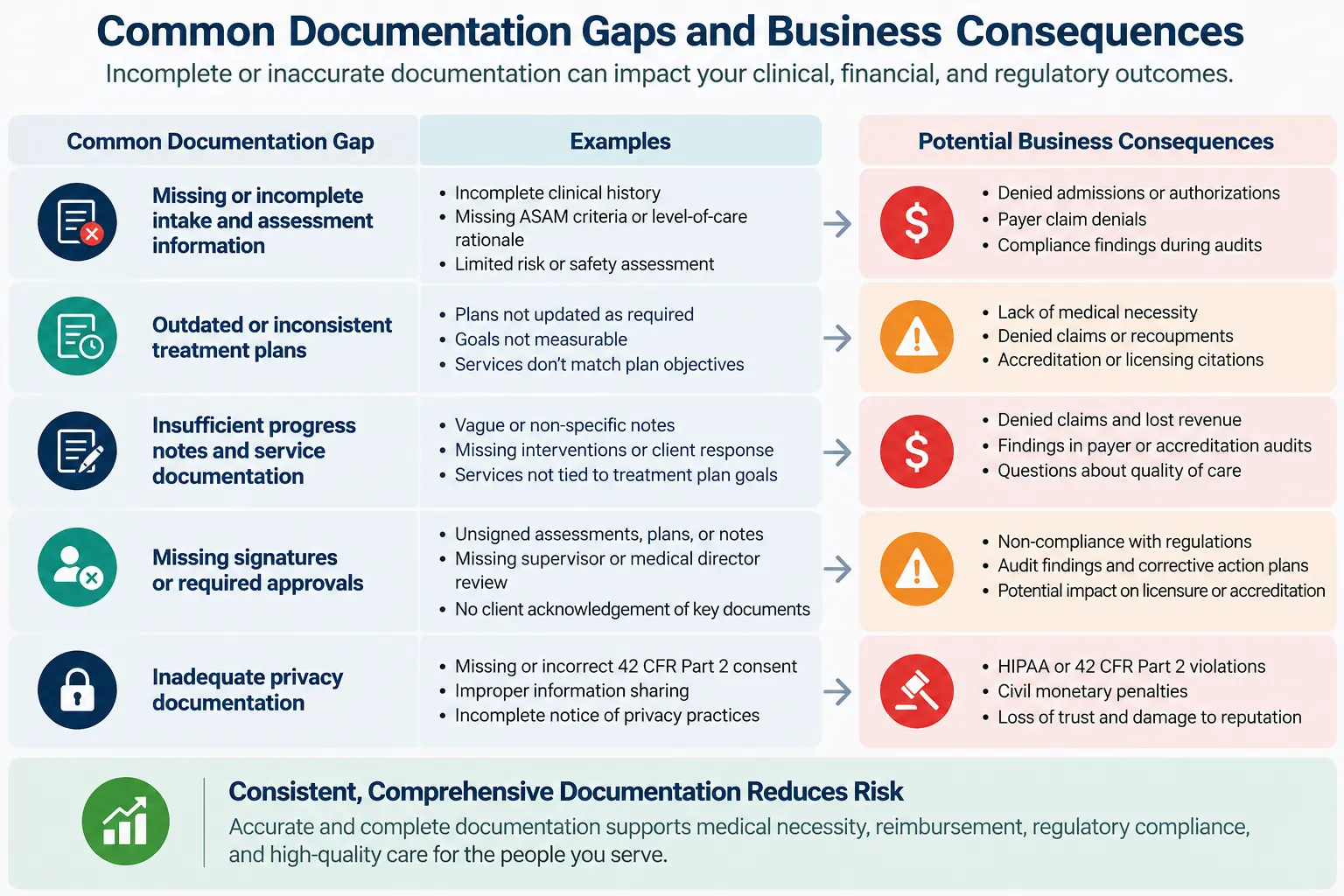
Reimbursement Denials and Recoupment
In 2020, the HHS Office of Inspector General published an audit titled New York Claimed Tens of Millions of Dollars for Opioid Treatment Program Services That Did Not Comply With Medicaid Requirements.
The audit examined claims from 2014 through 2017.
Among 150 randomly sampled claims, 35 did not comply with applicable Medicaid requirements.
The OIG estimated that New York improperly claimed at least $39.3 million in federal Medicaid reimbursement for OTP services during the audit period.
Identified problems included:
- Failure to maintain or provide required service documentation
- Services not supported by beneficiaries' treatment plans
- Missing signatures for OTP services
The $39.3 million figure represents the auditor's estimate of improper federal Medicaid reimbursement in that historical state audit, not the amount recovered from any particular provider. It should not be interpreted as a current national estimate.
Nevertheless, the findings illustrate how documentation weaknesses can translate into material financial exposure.
Accreditation and Licensing Findings
Accreditation reviews and licensing inspections examine whether organizations follow applicable clinical and operational standards.
Deficiencies may lead to findings, required corrective actions, additional monitoring, or other consequences depending on the circumstances and governing rules.
An isolated error may be addressed through routine correction. Repeated inconsistencies across multiple records can indicate a broader problem with organizational procedures, training, or oversight.
For example, a pattern of overdue treatment-plan reviews may suggest that the organization lacks an effective process for monitoring required deadlines.
Regular internal chart reviews can identify such patterns before an external review.
Privacy and Enforcement Exposure
The 2026 Part 2 enforcement framework adds another dimension of organizational risk.
Improper access or disclosure of protected SUD records can result in regulatory scrutiny and potential penalties.
Unlike deficiencies that can sometimes be corrected before a claim is submitted, an unauthorized disclosure cannot simply be reversed after the fact.
Prevention depends on staff training, appropriately configured systems, and consistent privacy procedures.
Operational Inefficiency and Staff Turnover
Documentation problems also create operational costs that may not appear directly on a compliance report.
Consider what happens when a clinician leaves an organization with incomplete records.
Supervisors may need to reconstruct treatment histories, resolve outstanding documentation, determine whether services can be billed, and coordinate ongoing care.
When each program or clinician follows different documentation conventions, those responsibilities become more difficult.
Standardized records make it easier for new employees to understand expectations, supervisors to review clinical work, and leadership to identify recurring problems.
Connecting Documentation to Financial Performance
Program leaders should monitor documentation-related operational indicators alongside clinical quality and revenue metrics.
Useful measures include:
- Percentage of notes signed within required deadlines
- Percentage of treatment plans reviewed on schedule
- Number of incomplete assessments
- Claims held for missing documentation
- Documentation-related denial rates
- Authorization renewals approaching expiration
- Internal audit findings and corrective-action closure
These measures can reveal problems early, before they affect a substantial portion of the organization's revenue.
The central lesson: Documentation quality is an organization-wide performance issue. The goal is not simply to produce complete charts, but to maintain records that support clinical decisions, demonstrate services delivered, protect privacy, and withstand external review.
Want to see how structured documentation can support consistent clinical records across your team? Schedule an ICANotes demo.
How to Build Documentation Compliance Across Your Program
Strong documentation standards should not depend on individual clinicians remembering every policy, signature, and review deadline.
Practice owners and clinical directors can strengthen organizational compliance by establishing a consistent system of expectations, monitoring, and accountability.
Use the following checklist to evaluate your current processes.
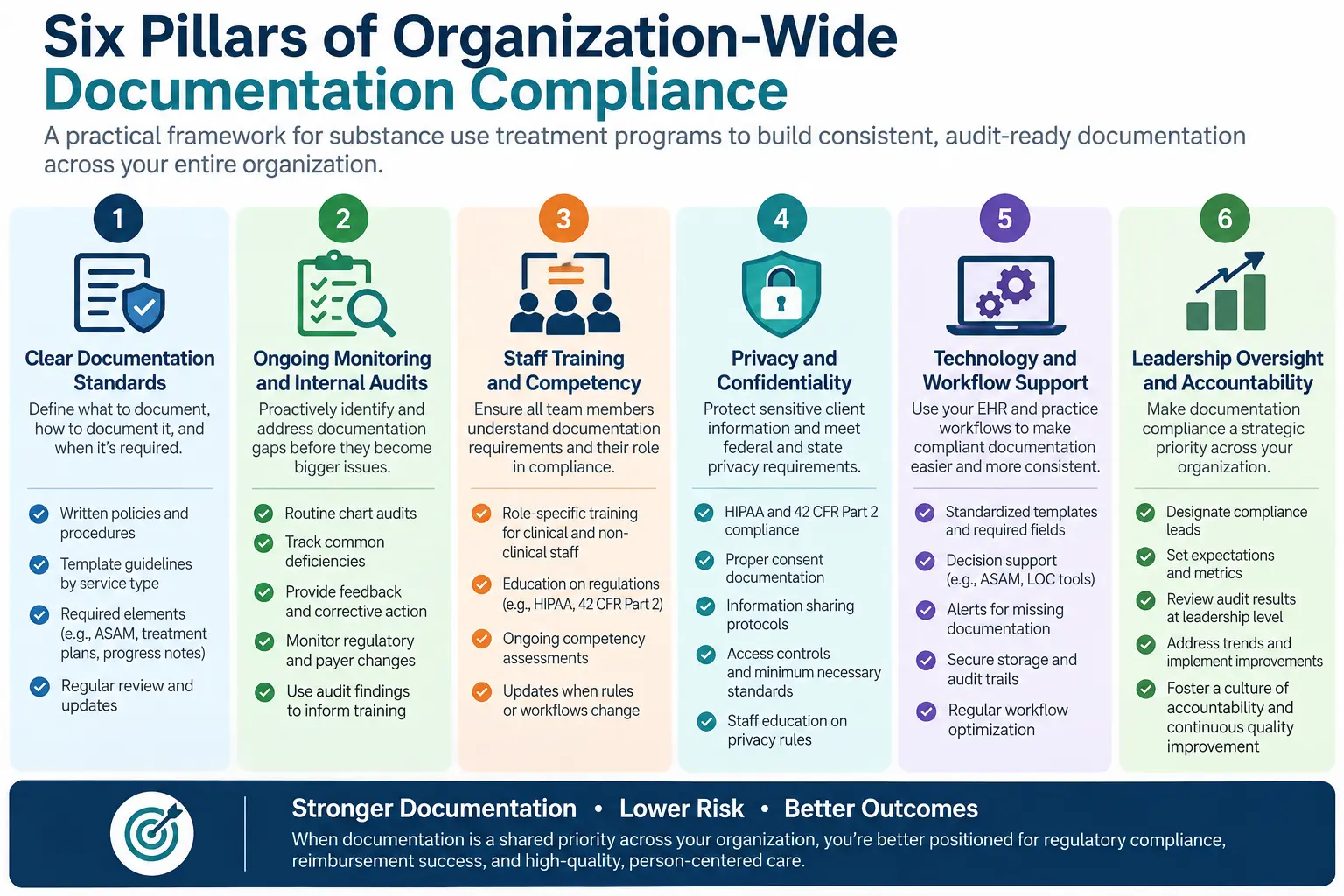
Effective substance use documentation compliance depends on six interconnected practices: standardized documentation requirements, routine internal audits, ongoing staff training, strong privacy protections, technology-supported workflows, and leadership accountability.
Establish Consistent Documentation Standards
Maintain written documentation policies covering each service line and location. Identify applicable Medicaid, commercial payer, licensing, and accreditation requirements. Verify that assessment templates reflect the required ASAM edition. Define required fields, signatures, and completion deadlines. Review standards whenever regulations or payer policies change.
Conduct Routine Internal Chart Reviews
Establish a recurring audit schedule using a representative sample of records. Evaluate medical necessity, treatment plans, service documentation, and billing alignment. Include privacy and consent documentation in applicable reviews. Document findings and assign responsibility for corrective action. Repeat reviews to determine whether identified problems have been resolved.
Standardize Staff Training
Include documentation requirements in onboarding for clinical and administrative personnel. Provide role-specific guidance for counselors, supervisors, prescribers, and billing staff. Train employees on Part 2 confidentiality requirements where applicable. Explain how clinical records support medical necessity and reimbursement. Refresh training following significant policy or regulatory changes.
Strengthen Privacy Controls
Verify current consent forms and privacy notices. Review access permissions and information-sharing procedures. Establish processes for handling SUD counseling notes when applicable. Maintain written breach response and notification procedures. Confirm that staff understand when disclosure is permitted.
Evaluate Your Documentation Systems
Use standardized templates where appropriate without eliminating individualized clinical judgment. Make required information easy to capture during normal workflows. Identify missing signatures and incomplete records. Support links between assessments, treatment plans, and service notes. Review access controls and security configurations. Confirm that documentation supports the services and billing codes used by the organization.
Create Leadership Visibility
Monitor overdue treatment-plan reviews. Identify incomplete or unsigned notes. Track upcoming authorization deadlines. Review recurring documentation-related claim denials. Assign accountability for resolving systemic issues. Report documentation compliance indicators to organizational leadership.
These activities should become part of routine operational oversight rather than preparations performed only before an audit.
Organizations evaluating new technology can also consult ICANotes' Guide to Evaluating an EHR Before Your Free Trial to develop practical evaluation criteria.
How ICANotes Supports Substance Use Documentation
For growing substance use organizations, documentation consistency becomes more challenging as the number of clinicians, service types, and locations increases.
An electronic health record can help reduce variation by providing structured workflows and centralized patient information.
ICANotes is designed specifically for behavioral health documentation and provides capabilities that can support substance use treatment workflows, including:
Structured clinical assessments
Biopsychosocial and substance use assessment documentation to organize relevant clinical findings.
Individualized treatment planning
Tools for recording treatment goals, interventions, and clinical progress.
Individual and group documentation
Clinical note workflows that help clinicians document services and maintain patient-specific records.
Integrated clinical and billing workflows
Documentation and coding tools that support alignment between recorded services and billing activity.
Shared clinical records
Access to relevant treatment information by authorized team members, subject to configured permissions and applicable privacy requirements.
These capabilities can help organizations establish more consistent documentation practices while allowing clinicians to document individualized care.
However, no EHR automatically guarantees compliance. Organizations remain responsible for configuring workflows appropriately, maintaining current policies, training staff, and verifying that records satisfy payer and regulatory requirements.
Learn more about ICANotes for substance use and addiction treatment providers.
Conclusion: Documentation Compliance Starts With Organizational Leadership
Effective substance use documentation supports quality treatment, protects patient confidentiality, and provides the evidence organizations need to substantiate clinical services and reimbursement.
The challenge for practice owners is ensuring that these requirements are met consistently across clinicians, programs, and locations.
That means looking beyond individual progress notes and establishing a coordinated documentation strategy — from initial assessment and level-of-care decisions through treatment planning, service delivery, privacy management, and discharge.
The most effective approach combines clear standards, ongoing training, internal review, accountable leadership, and technology that supports reliable workflows.
When these elements work together, substance use programs are better positioned to maintain audit-ready records, manage financial risk, and support high-quality, coordinated care.
Support Consistent, Audit-Ready Documentation Across Your Organization
Managing documentation across multiple clinicians and substance use programs should not require disconnected systems or inconsistent workflows. Discover how ICANotes can help your team maintain reliable, compliant records—start your free trial today.
- Structured biopsychosocial and ASAM-based assessments
- Individualized treatment plans and progress notes
- Individual and group documentation workflows
- Documentation and coding aligned for cleaner claims
See how ICANotes can support your substance use treatment workflows. Start your free 30-day trial, no credit card required.
Start Your Free 30-Day Trial
Frequently Asked Questions
What are the essential client records for substance use practices?
Does the ASAM Criteria Fourth Edition change documentation requirements?
What is the difference between HIPAA and 42 CFR Part 2?
What changed for 42 CFR Part 2 in 2026?
How long must substance use treatment records be kept?
What documentation do payers check in a substance use treatment audit?
How should progress notes be documented in substance use treatment?
How can practice owners keep documentation consistent across multiple programs?
References
- American Society of Addiction Medicine. The ASAM Criteria, Fourth Edition.
- U.S. Department of Health and Human Services. Fact Sheet: 42 CFR Part 2 Final Rule. Updated January 30, 2026.
- U.S. Department of Health and Human Services, Office for Civil Rights. Understanding Confidentiality of Substance Use Disorder Patient Records.
- Substance Abuse and Mental Health Services Administration. 42 CFR Part 8 Final Rule.
- HHS Office of Inspector General. New York Claimed Tens of Millions of Dollars for Opioid Treatment Program Services That Did Not Comply With Medicaid Requirements. 2020.
- The Joint Commission. Treatment Plans—Care Plan Requirements. Updated May 7, 2026.
- U.S. Department of Health and Human Services. Model Notices of Privacy Practices.
Dr. October Boyles
Dr. October Boyles is a behavioral health expert and clinical leader with extensive expertise in nursing, compliance, and healthcare operations. With a Doctor of Nursing Practice (DNP) and advanced degrees in nursing, she specializes in evidence-based practices, EHR optimization, and improving outcomes in behavioral health settings. Dr. Boyles is passionate about empowering clinicians with the tools and strategies needed to deliver high-quality, patient-centered care.