Blog > Treatment Strategies > Life Skills Group Activities for Adults: Ideas, Topics & Therapy Exercises
Life Skills Activities for Adults in Group Therapy (Examples + Session Ideas)
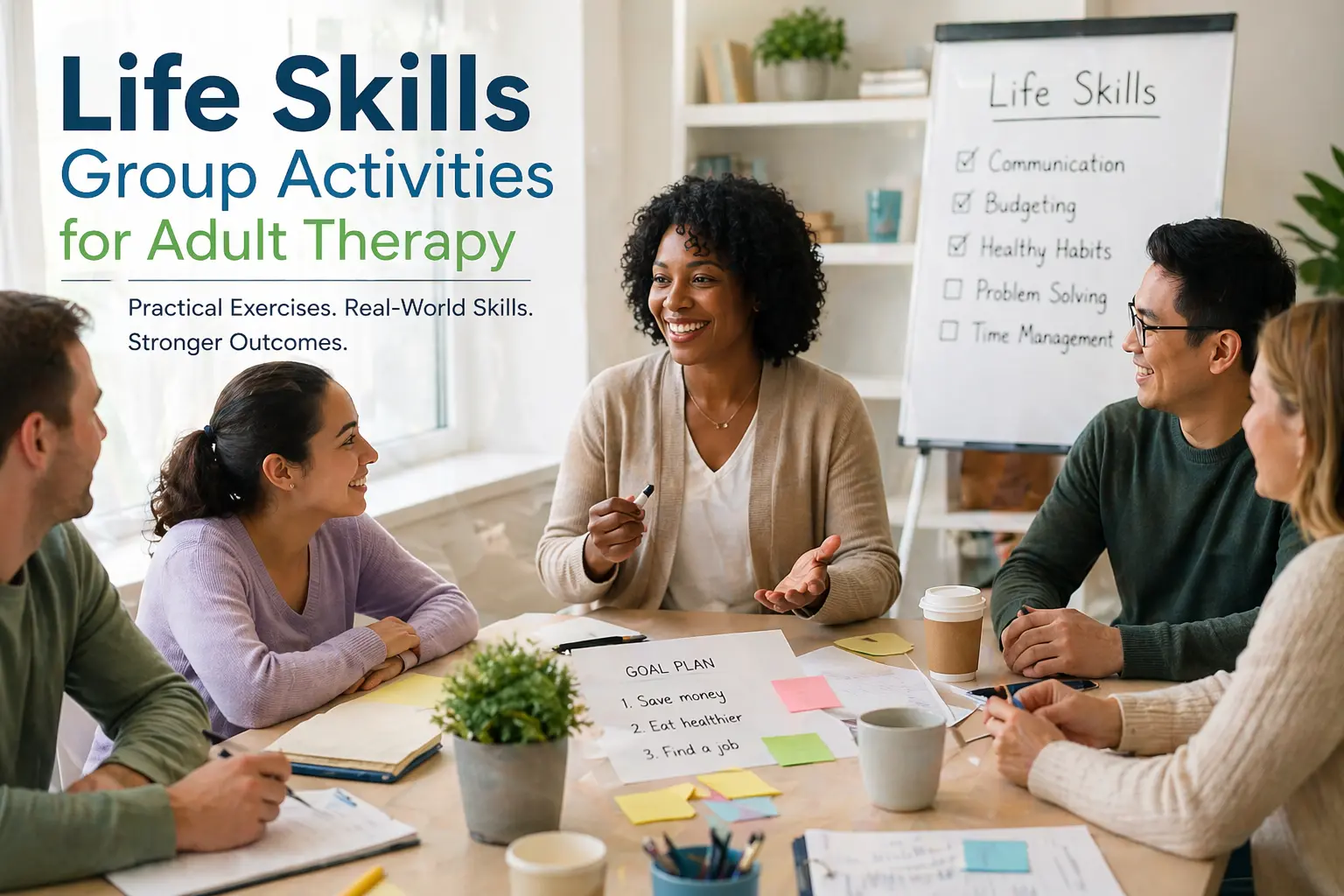
This blog post explores a variety of engaging life skills activities designed for use in adult group therapy settings. It covers exercises that promote communication, emotional regulation, problem-solving, and daily living skills, helping participants build confidence and independence. Clinicians will find practical, easy-to-implement ideas to foster growth and connection in a supportive group environment.


Last Updated: April 23, 2026
What You'll Learn
- How to structure life skills group activities for adults that build real-world independence
- Practical group therapy exercises that strengthen communication, coping, and emotional regulation
- A complete list of life skills group topics you can use for weekly sessions or full programs
- How to adapt life skills activities for different populations, including SMI and early recovery
- Proven ways to help clients apply life skills outside of therapy and sustain long-term progress
Contents
As a group therapist, you can help teach adult clients how to make daily tasks more manageable — which makes their lives more enjoyable and supports long-term recovery and wellbeing. Life skills activities for adults are an important topic for clients recovering from substance abuse and addiction, as well as for adults living with serious mental illness, transitioning out of residential care, or working to build greater independence in the community. Tackling these topics in group therapy allows individuals to unite over shared experiences and create a support system for each other.
Find out how life skills activities and mental health group activities for adults are connected, and discover session topics and activities to add to your group therapy practice.
Benefits of Using Life Skills Activities in Mental Health Group Therapy
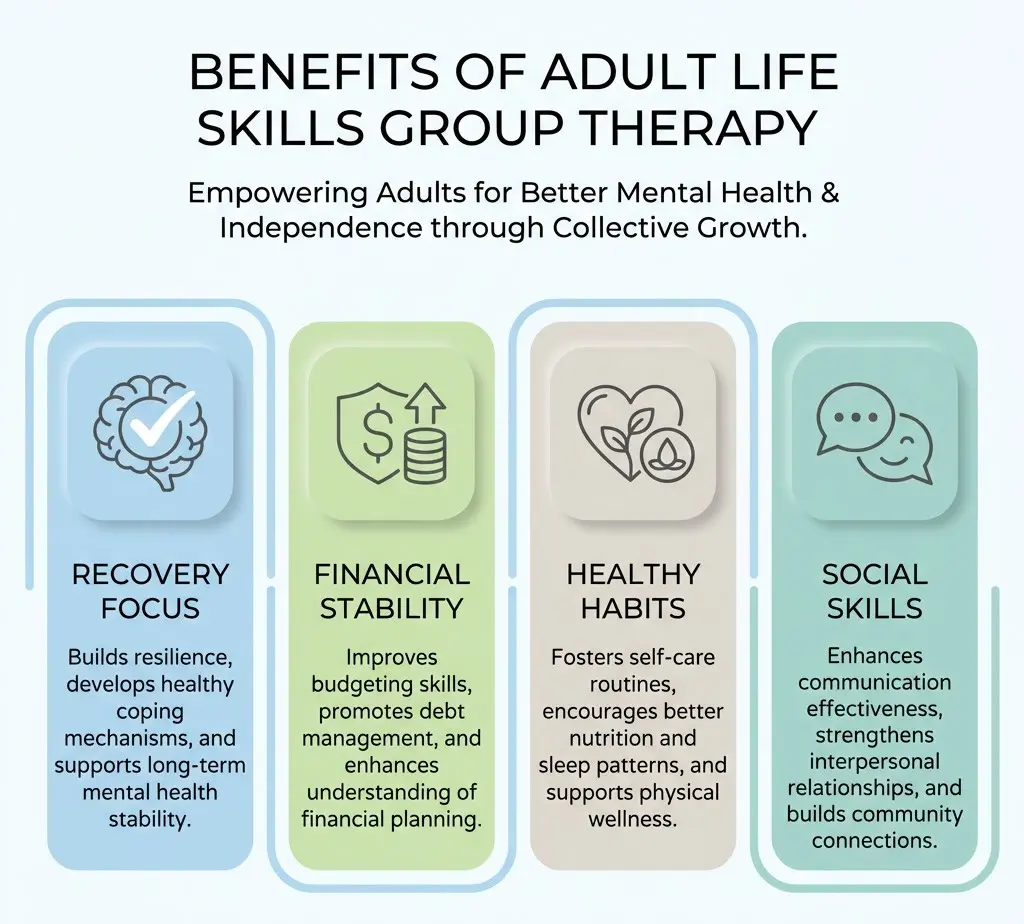
Active participation in life skills therapy is endlessly beneficial for individuals who are working through substance abuse recovery, mental health challenges, and major life transitions. While each individual benefits in their own way, here are some of the most common benefits of using life skills activities in group therapy.
Encourage a Focus on Recovery
People who struggle with substance abuse form a "bond" with the substances they're using, and it becomes the most important thing in their lives. Their other responsibilities and worries often get pushed to the back of their minds. Life skills activities help people recovering from addiction place more focus on the recovery process. It helps clear their minds and teaches them how to put their attention on other things.
Gain Financial Stability
Financial instability is common among adults who are managing addiction, mental illness, or significant life disruption. Life skills therapy can help clients develop concrete money management skills — budgeting, avoiding impulsive purchases, understanding bills and banking — that support greater independence and reduce the stress that often triggers relapse or crisis.
Promote Healthy Habits
There are numerous adverse health effects of addiction, including malnutrition and liver, heart, and lung issues. Additionally, addiction can have a significant effect on mental health. Mental health disorders like schizophrenia, anxiety, or depression may exist prior to substance abuse, though addiction can also worsen or trigger mental disorders. Life skills activities help clients learn healthy habits to help get their health back on track — including sleep hygiene, nutrition, exercise, and medication management.
Build Social Skills
Many clients use drugs or alcohol as a social crutch, finding it difficult to engage in social situations when sober. Others with serious mental illness or histories of trauma may have limited experience building and maintaining healthy relationships. Through life skills activities, clients learn communication methods that allow them to build a social network and navigate relationships more effectively.
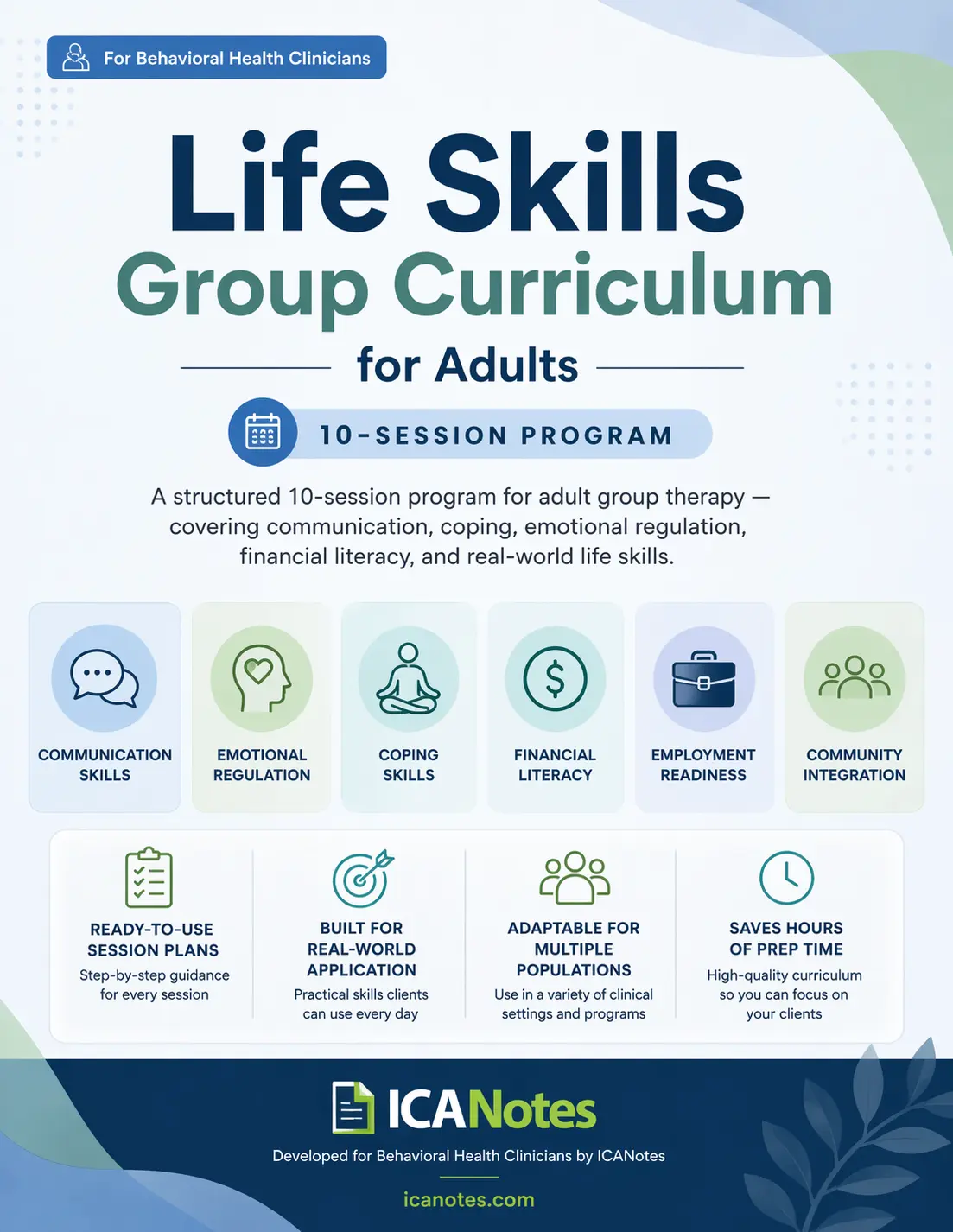
Download the 10-Session Life Skills Group Curriculum
Get a complete, ready-to-use curriculum designed for adult group therapy. Each session includes structured activities, discussion prompts, and facilitator guidance to help clients build real-world skills.
- ✔ Ready-to-use 10-session program
- ✔ Covers communication, coping, and emotional regulation
- ✔ Adaptable for SMI, recovery, and outpatient settings
- ✔ Saves hours of prep time
Life Skills Group Topics for Adults
One of the most practical things you can offer a group is a structured rotation of topics that build on each other over time. The following life skills group topics work well as weekly session themes, standalone modules, or as part of a longer-term curriculum. They are adaptable for adults in substance abuse recovery, community mental health programs, residential settings, and vocational rehabilitation.
Daily Living & Self-Care
- Personal hygiene and grooming routines
- Meal planning, grocery shopping, and basic cooking
- Household organization, cleaning, and maintaining a living space
- Managing medical appointments and medications
Financial Literacy
- Creating and following a personal budget
- Understanding bills, bank statements, and account management
- Avoiding impulsive spending and addressing debt
- Setting and working toward short-term financial goals
Communication & Relationships
- Active listening and clear verbal expression
- Assertiveness versus passivity versus aggression
- Setting and maintaining healthy boundaries
- Navigating conflict and disagreement in relationships
Emotional Regulation & Coping
- Identifying personal triggers and early warning signs
- Building a personalized coping toolkit
- Stress management strategies (grounding, breathing, pacing)
- Recognizing and challenging unhelpful thought patterns
Employment & Community
- Job search skills, resume basics, and interview preparation
- Workplace communication and professional conduct
- Using public transportation and accessing community resources
- Time management and punctuality
Health & Wellness
- Sleep hygiene and building a restorative rest routine
- Exercise and movement as mental health support
- Substance use awareness and relapse prevention planning
- Nutrition basics for daily functioning and mental health
Important Life Skills to Build
As a therapist, you help clients build important life skills so they can make progress toward their personal growth. Building critical life skills helps ensure clients are able to live a healthier, more successful life after treatment. There are numerous types of life skills activities you can incorporate into your group therapy sessions. Here are four areas of life skills that are a common focus in life skills therapy:
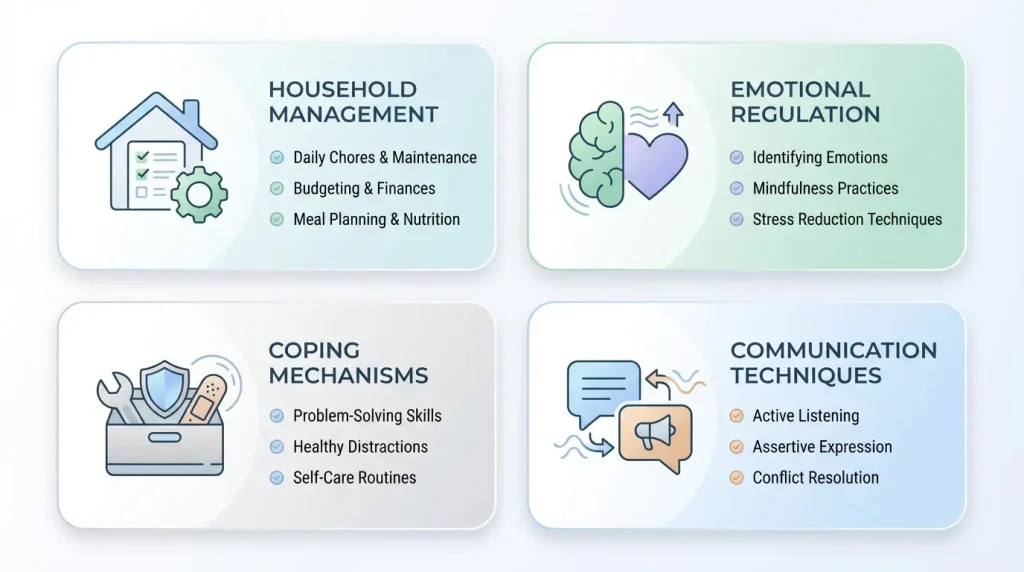
- Household responsibilities: Effectively running a household is typically not a focus for individuals fueling an addiction or managing acute mental illness. It's often easy to forget about cleaning and organizing when preoccupied with other challenges. Building the skills to handle common household responsibilities is crucial. In addition to learning how to do tasks like laundry, dishes, and cleaning, you can help your clients understand the importance of a clean, well-maintained living space.
- Emotional regulation: For many clients, recovery will be a stressful and emotional journey. It will be easy to get overwhelmed and worked up over seemingly small situations, and they may not have the skills to properly control their emotions under stress. During life skills therapy, it's important for clients to learn how to regulate their emotions. Building these skills helps individuals react appropriately to various situations.
- Coping mechanisms: To help prevent relapses from happening, your clients need to learn healthy coping mechanisms. Your life skills activity group therapy sessions can equip them with coping skills to deal effectively with relapse triggers and temptations — including how to identify triggers, avoid high-risk situations, and reduce stress with sober, constructive activities.
- Communication techniques: Many clients may have isolated themselves from family and friends during substance use or periods of illness. This can result in difficulty communicating effectively with loved ones. It's important to help them learn to express their feelings and needs rather than suppressing them, and to develop active listening skills so they can understand and consider other people's perspectives.
Life Skills Activities to Practice in Group Therapy
Life skills activities are facilitated exercises that encourage clients to think about and practice critical life skills in a real-time, social setting. Talking about life skills will naturally be the first step, but stopping there may leave clients feeling unprepared to use those skills in the real world. The activities below give clients an opportunity to practice valuable skills in a safe, supportive setting — and they range from simple discussion exercises to more hands-on, experiential work.
Communication Exercises
Practicing effective communication skills can be challenging without guidance. Communication exercises in group therapy allow clients to practice with your feedback and input alongside them.
Listen and Draw
Each person gets a piece of paper and a pen. Give verbal step-by-step instructions to draw an object, increasing in difficulty as you go. When done, compare drawings to see who listened most accurately. This helps clients practice active listening — paying close attention and internalizing what others communicate.
The Guessing Game
Much like "20 Questions," think of an object and have group members ask yes or no questions until they determine what you're thinking of. Use this activity to help clients learn the difference between closed and open-ended questions, and how each affects the quality of a conversation.
Assertiveness Scripts
Present three scenarios requiring pushback — a pushy salesperson, an intrusive family member, a coworker taking credit for their work. Members write and then practice delivering an assertive response. Debrief focuses on tone, body language, and the difference between assertive and aggressive responses.
Teamwork Exercises
Teamwork exercises encourage clients to work together and practice healthy communication with one another.
Written Instructions Swap
Ask partners to write detailed, step-by-step instructions for completing a simple task — like making a peanut butter and jelly sandwich. They swap instructions and complete the task using only what their partner wrote, with no improvisation. If a step is missing, that action can't be taken. This demonstrates the importance of clear, complete communication.
Cook a Meal Together
Space allowing, have small groups choose and cook a simple meal together. Cooking requires communication, division of labor, and navigation of a shared workspace — and also gives clients the opportunity to practice household skills in the kitchen. Follow-up can include a discussion of the experience and what each person contributed.
Coping Exercises
Coping exercises give clients concrete alternatives to unhealthy coping behaviors and help them build a personal toolkit they can use outside of group.
Healthy vs. Unhelpful Coping Sort
Prepare cards listing a range of coping behaviors (exercise, calling a friend, isolating, retail therapy, journaling, substance use, napping, etc.). Groups sort the cards into "healthy" and "unhelpful" categories and discuss nuance — when might isolation be okay? When does distraction become avoidance? This generates rich conversation and helps clients think critically about their own patterns.
Trigger Mapping
Using a simple worksheet, members map their personal triggers → emotional responses → typical behaviors → consequences, then identify one replacement behavior they could practice. Sharing within the group builds awareness that others share similar patterns.
Role-Playing Difficult Situations
Ask clients to act out challenging scenarios — under your direction — and have everyone identify what might be upsetting about it and how they could respond healthily. Talk through why negative coping mechanisms wouldn't be effective in each scenario.
Pros and Cons Brainstorming
Have group participants practice brainstorming solutions to upsetting events and listing the pros and cons of their potential responses. This helps clients see the consequences of their choices while identifying more constructive approaches.
Goal-Setting & Future-Focused Exercises
The 5-Year Letter
Participants write a letter from their future self, five years from now — describing what they've accomplished, how they feel, and what they're grateful for. These letters can be read aloud or kept private. This exercise reinforces hope, motivation, and a sense of agency over the future.
Values Auction
Give group members a fictional "budget" and a list of values (family, health, financial security, career, freedom, creativity, relationships, etc.). Each member allocates their budget across the values they care most about. Debrief explores why they prioritized what they did, where conflicts arose, and how their values connect to daily decisions.
Creative & Reflective Exercises
Painting Session
Painting sessions can be used in multiple ways — to help the group destress and be creative, or with specific prompts to visualize concepts. For example, ask clients to paint what their dream life looks like, or prompt them to imagine they're lost at sea and paint a lighthouse representing their sources of strength and guidance (family, faith, community, a therapist). They can add words to their depiction. These sessions help clients explore difficult topics from a new angle.
Sharing a Memory
Ask everyone to share one of their happiest memories. Set a timer for one to two minutes per person, and after each share, allow other group members to comment on memories or feelings that came up for them. This activity helps group members bond over positive experiences — which is especially valuable in a setting where conversation often centers on challenges and struggles.
Adapting Life Skills Activities for Different Populations
Life skills groups serve a wide range of adult populations, and the most effective facilitators adjust their approach based on the clinical and functional profile of their group. Here are some general guidelines for common populations.
Adults with cognitive or intellectual disabilities
Simplify activity instructions and break tasks into smaller steps. Use visual aids, printed materials, or demonstrations alongside verbal instructions. Allow more processing time and check for understanding frequently. Repetition across sessions reinforces learning more effectively than variety.
Adults with serious mental illness (SMI)
Keep sessions shorter and more structured. Lower-stimulation activities tend to work better than highly interactive or competitive ones. Build in regular grounding check-ins at the start and end of session. Concrete, practical activities — meal planning, hygiene, medication routines — are often more engaging than abstract or reflective exercises.
Adults in early recovery
Avoid activities that could be triggering (e.g., cooking exercises involving alcohol, financial exercises that highlight past losses). Focus heavily on coping skills and daily routines before moving to more advanced topics like employment or relationship skills. Peer support within the group is especially powerful in early recovery.
Mixed-diagnosis or general adult mental health groups
Lead with universal skills that are relevant across diagnoses. Offer multiple modes of participation — written, verbal, and hands-on — so that members can engage in whatever format suits them. Build in positive reinforcement throughout. Consistent structure across sessions helps all members feel safe and prepared.
Spend Less Time Documenting. More Time Running Effective Groups.
You’ve now seen what a structured, effective life skills group looks like. ICANotes helps you document those sessions just as efficiently — so you can focus on your clients, not your notes.
✔ Document life skills group sessions in minutes with pre-built menu-driven group note templates
✔ Capture progress, goals, and participation without starting from scratch
✔ Keep treatment plans, session notes, and billing fully aligned
✔ Reduce documentation time while improving compliance and completeness
✔ Built specifically for behavioral health clinicians — not generic EHR workflows
Join thousands of behavioral health clinicians who use ICANotes to document faster and run more effective sessions.
Simplify Group Therapy Documentation
Running life skills, psychoeducational, or process groups is hard enough. ICANotes helps you document group sessions faster with workflows built for behavioral health — so you can spend less time writing notes and more time facilitating meaningful care.
Use ICANotes to streamline common group therapy documentation tasks, including attendance, participation, progress toward goals, interventions used, and follow-up planning — all within a system designed specifically for mental and behavioral health clinicians.
- ✔ Document group sessions more efficiently with behavioral health-specific workflows
- ✔ Support life skills, coping skills, psychoeducation, and other structured group formats
- ✔ Keep notes aligned with treatment goals, compliance needs, and billing requirements
- ✔ Reduce documentation time without sacrificing detail or clinical quality
Start Your Free Trial
See how ICANotes can help you manage group therapy documentation more efficiently.

Frequently Asked Questions About Life Skills Group Activities for Adults
Related Group Therapy Resources
Explore additional guidance on group therapy for behavioral health clinicians.
Recent Posts



Dr. October Boyles
DNP, MSN, BSN, RN
Dr. October Boyles is a behavioral health expert and clinical leader with extensive expertise in nursing, compliance, and healthcare operations. With a Doctor of Nursing Practice (DNP) and advanced degrees in nursing, she specializes in evidence-based practices, EHR optimization, and improving outcomes in behavioral health settings. Dr. Boyles is passionate about empowering clinicians with the tools and strategies needed to deliver high-quality, patient-centered care.