
Behavioral Health Billing Software
Built for Mental Health Practices
Simplify Billing. Maximize Revenue.
Stay Compliant.
Running a behavioral health practice shouldn’t mean juggling spreadsheets, clearinghouses, and disconnected billing tools. ICANotes is purpose-built behavioral health billing software that simplifies the revenue cycle for mental health professionals — from clinical documentation and insurance eligibility checks to claims submission, payment posting, and patient billing.
Whether you’re looking for psychology billing software, psychiatry billing software, or a mental health EHR with billing and insurance claims functionality, ICANotes brings clinical and financial workflows together in one platform designed specifically for behavioral health.

Schedule a Live Demo
Fully Integrated Mental Health Billing Software — No More Handoffs
ICANotes connects clinical documentation with billing and practice management so your team can move from a completed encounter to an insurance claim without managing disconnected systems.
For behavioral health practices, billing accuracy begins with accurate clinical documentation. Individual psychotherapy, group therapy, psychiatric evaluations, and medication management visits carry different CPT codes, documentation requirements, and payer rules.
ICANotes helps clinicians and billing teams manage these requirements within a shared EHR environment, reducing the need to transfer information between clinical records and standalone billing applications.
The platform supports:
- Documentation-connected billing: Keep encounter documentation, diagnosis information, and billing activities within the same EHR.
- Behavioral health coding: Manage claims for psychotherapy, group therapy, psychiatric services, and evaluation and management visits.
- Insurance verification: Check eligibility and track authorizations before claims are submitted.
- Electronic claims processing: Submit claims, process electronic remittances, and maintain accounts receivable.
- Patient financial management: Generate statements, track balances, and coordinate insurance and self-pay responsibilities.
For practice owners and administrators, the result is a more connected billing process, with visibility into the work required to move an encounter toward reimbursement.
Key Mental Health Medical Billing Software Features
Superbills, Patient Statements,
& CMS Forms
Generate and manage billing documents directly within ICANotes, including superbills for patients seeking out-of-network reimbursement, patient statements, and standard claim forms.
Eligibility Checks & Authorization Tracking
Verify insurance coverage and track prior authorization information before claim submission. Identifying coverage or authorization issues early helps your billing team address problems that could otherwise delay payment.
Electronic & Paper Claims Submission with Auto-Posting
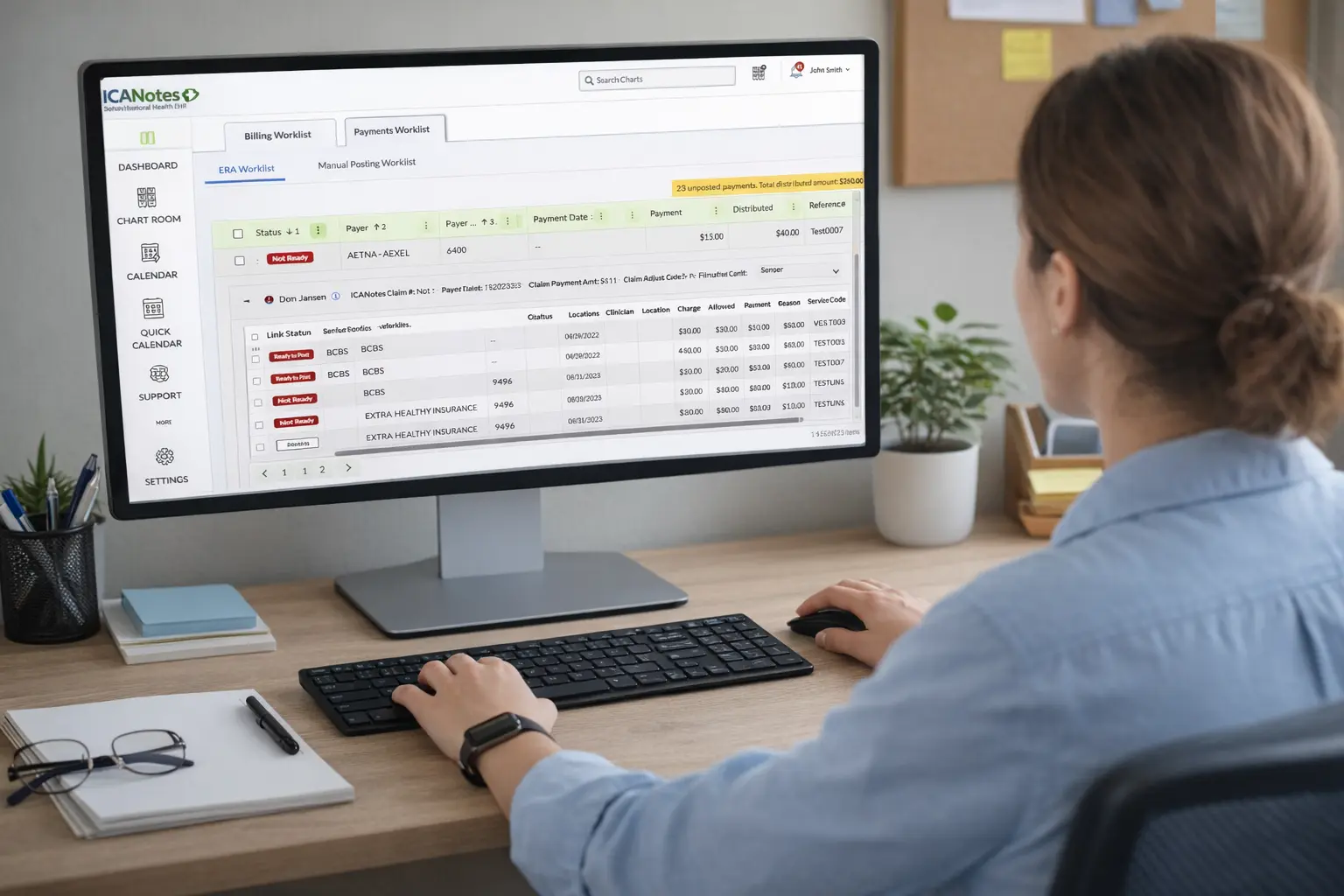
Submit electronic or paper claims and process electronic remittance advice (ERA). Automatic remittance posting helps keep payments, adjustments, and accounts receivable aligned with payer responses.
Statement Customization & Batch Processing
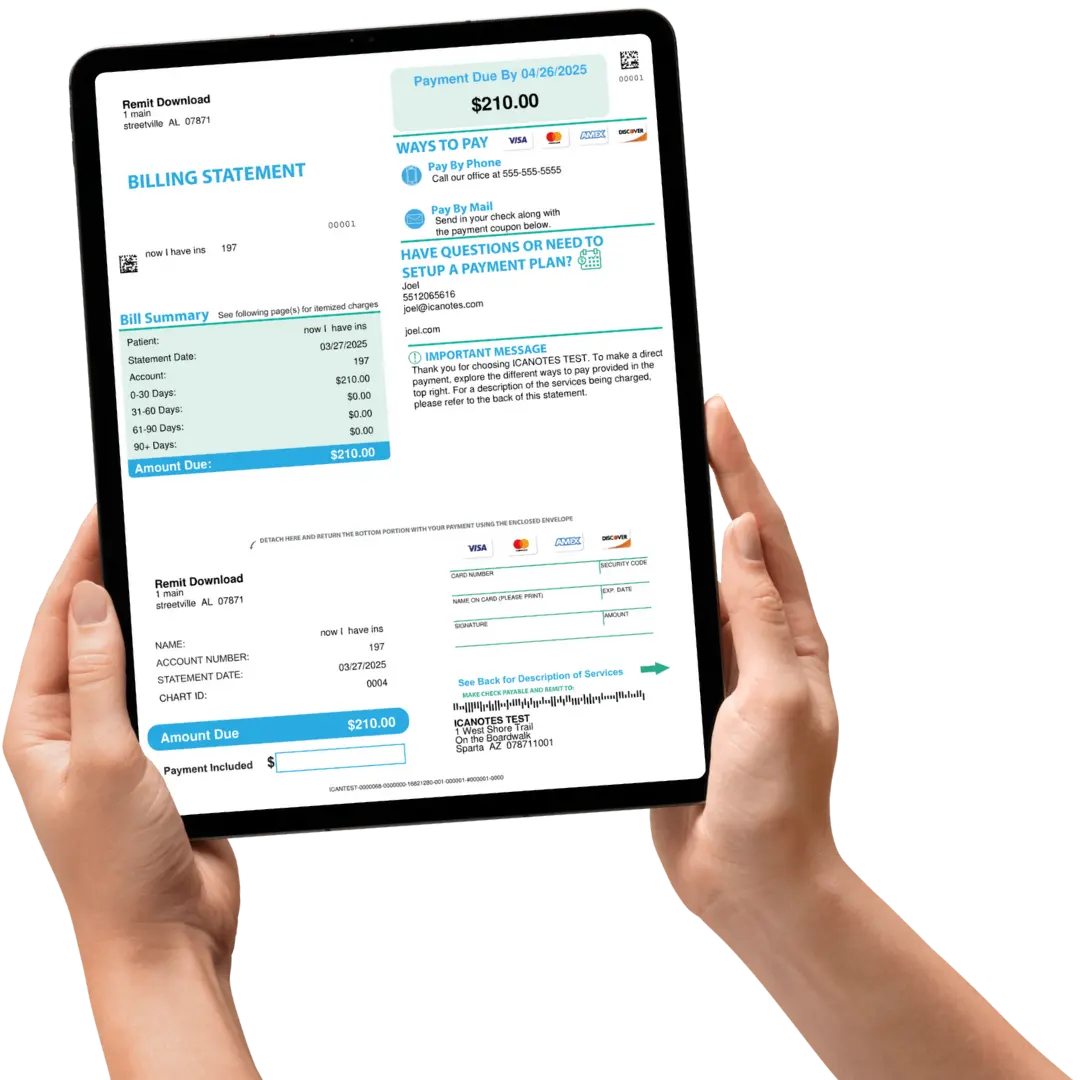
Customize patient statements and generate them in batches, making it easier to communicate outstanding balances and manage recurring billing activities.
Self-Pay & Patient Billing
Tools
Manage private-pay patients with statements, payment tracking, and batch processing tools. Maintain visibility into patient responsibility alongside insurance receivables.
Secondary Claim Submission & Coordination of Benefits
Submit and track secondary insurance claims when patients have multiple coverage sources. Coordinate primary and secondary billing while maintaining visibility into remaining balances.
ICANotes gives behavioral health teams the tools to manage billing from documented services through reimbursement, whether they process a small number of claims or support multiple clinicians and payer relationships.
Behavioral Health CPT Coding That Connects Documentation and Claims
Behavioral health billing requires more than selecting a service code from a list. The CPT code reported on a claim must accurately reflect the service provided, the documented encounter, and applicable payer requirements.
ICANotes supports billing workflows for common behavioral health services, including:
CPT 90837 — Individual Psychotherapy
CPT code 90837 is used for a 60-minute psychotherapy service. ICANotes allows clinicians to document the encounter in their EHR and use the corresponding service information in the billing workflow.
Accurate time documentation and appropriate clinical records help billing teams review the claim against payer requirements before submission.
CPT 90853 — Group Psychotherapy
CPT code 90853 is used for group psychotherapy. Practices offering individual and group services need a billing process that distinguishes between different encounter types, service codes, and patient records.
ICANotes supports group therapy documentation and billing workflows, allowing teams to manage these services within the same clinical and practice management environment.
CPT 99213–99215 — Established Patient E&M Visits
Psychiatrists and psychiatric mental health nurse practitioners frequently bill evaluation and management (E&M) services for established patients.
CPT codes 99213, 99214, and 99215 represent different levels of E&M service. ICANotes includes medical decision-making documentation and coding assistance to help clinicians determine an appropriate E&M level based on documented encounter complexity.
The appropriate code depends on applicable coding rules, clinical documentation, and payer requirements. Clinicians and billing staff remain responsible for reviewing coding accuracy.
Why This Matters
A behavioral health EHR that connects clinical documentation, coding, and billing gives your team a consistent source of encounter information when preparing claims, correcting errors, or responding to payer documentation requests.
Insurance Claims Management: From Submission to Payment
ICANotes supports the steps required to move behavioral health claims through the reimbursement process.
Prepare Claims Using Clinical Encounter Information
Use documentation and patient information maintained in ICANotes to support claim preparation. Keeping clinical and billing information in the same system reduces the need to manually transfer encounter details between separate applications.
Verify Eligibility and Authorization Requirements
Check patient coverage and track authorizations as part of the billing workflow. These checks help identify common problems before claims reach the payer, including inactive coverage or missing authorization information.
Submit Claims Through an Integrated Clearinghouse
ICANotes supports electronic insurance claims through its clearinghouse integration. Claim validation can identify missing information, formatting issues, and other submission errors that require attention before payer processing.
This helps billing teams correct preventable errors earlier in the revenue cycle.
Process Remittances and Reconcile Payments
Electronic remittance processing and automatic posting help keep payer payments, contractual adjustments, and outstanding balances current.
For practices handling a mix of insurance and self-pay patients, these capabilities provide a more consistent view of financial activity across accounts.
Claim Denial Management and Resubmission for Behavioral Health
Denied claims create additional administrative work and delay reimbursement. A structured denial management process helps billing teams identify unresolved claims, investigate payer responses, correct errors, and pursue payment.
A 2025 article from Core Solutions, citing 2023 claims data, reported that 30% of mental health claims were denied, compared with 19% of other claims. Although these figures do not describe ICANotes customers or predict an individual practice's denial rate, they illustrate why denial follow-up is an important part of behavioral health revenue cycle management.
ICANotes connects clinical documentation and billing activities, while its full-service Revenue Cycle Management option provides dedicated denial follow-up by behavioral health billing specialists.
Identify Claims Requiring Attention
Billing teams can use claim-processing information and payer remittance responses to investigate rejected, denied, or unpaid claims. Reviewing these responses helps distinguish submission problems from denials issued after payer adjudication.
Review Denial Reasons
Common reasons for behavioral health claim denials include:
- Eligibility or coverage problems
- Missing or expired prior authorizations
- Incorrect CPT or diagnosis codes
- Missing patient or provider information
- Coordination-of-benefits issues
- Documentation or medical necessity requirements
Organizing follow-up by denial reason helps staff determine which corrections or payer communications are needed.
Correct Claim or Documentation Errors
Because ICANotes connects billing with the clinical record, authorized staff can review relevant encounter information when investigating an issue.
Corrections may involve updating claim details, checking documentation, verifying coverage information, or confirming the appropriate procedure code before further action.
Resubmit Corrected Claims or Follow Up With the Payer
Depending on the payer response, resolution may require a corrected claim, claim resubmission, reconsideration request, or appeal.
Practices managing billing internally remain responsible for their claim follow-up activities. ICANotes' full-service RCM team can manage denial follow-up and other revenue cycle tasks for practices that prefer to outsource this work.
Monitor Unresolved Balances
Reviewing outstanding claims and accounts receivable helps administrators identify reimbursement delays and prioritize follow-up.
Consistent monitoring is particularly valuable for growing group practices that manage claims across multiple clinicians, service types, and insurers.
Source: Core Solutions, "Denial Management for Behavioral Health: Strategies That Work" (September 2025), citing 2023 denial data.
ICANotes is billing software for mental health professionals who want fewer billing headaches and more predictable cash flow.
Flexible Billing Workflows for Behavioral Health Teams
Every practice runs differently. ICANotes supports multiple billing paths, allowing solo practitioners, group practices, and behavioral health organizations to choose how they manage their revenue cycle.
Psychology, Psychiatry & Therapist Billing Software — Your Way
This flexibility makes ICANotes a powerful option for anyone seeking billing software for behavioral health that adapts as their practice grows.
In-House Billing Software
Manage billing internally using ICANotes' built-in tools. Your staff can handle eligibility checks, claim submission, payment posting, patient statements, and accounts receivable within the same system used for clinical documentation.
This approach works well for practices that want direct control over billing operations and have the staff resources to manage payer follow-up.
Export to Your Existing Billing System
Prefer another clearinghouse or billing solution? ICANotes allows you to export billing data using its Billing Productivity Report.
This flexibility gives practices the option to maintain an established external billing workflow while using ICANotes for clinical documentation and practice management.
Integrated Billing Partners
Connect with pre-integrated billing services for a coordinated approach that combines ICANotes clinical and practice management capabilities with outside billing support.
Practices can select the billing arrangement that fits their staffing, operational requirements, and existing relationships.
Billing Software That Supports Self-Pay and Insurance
Behavioral health and psychotherapy practices rarely operate on a single payment model. ICANotes supports insurance billing, self-pay billing, and secondary claim submission in one unified system.
- Generate patient statements for private-pay clients
- Manage partial insurance coverage and client responsibility
- Submit secondary claims to capture remaining reimbursement
- Maintain accurate accounts receivable across payers and patients
For example, when an insurance claim leaves a patient-responsibility balance, billing staff can use ICANotes' patient billing tools to manage the amount owed. Practices can also prepare statements for clients who pay privately or receive out-of-network services.
ICANotes supports these different payment arrangements without requiring a separate system for each billing scenario.
Practices looking to expand their patient billing capabilities can also explore ICANotes Patient Statements for additional statement management options.
Full-Service Revenue Cycle Management for Mental Health Practices
Want to offload billing entirely? ICANotes also offers a full-service RCM option tailored to behavioral health.
Behavioral Health RCM, Done for You
End-to-End Psychiatric & Mental Health Billing Support
Eligibility verification, claims submission, denial follow-up, and accounts receivable posting are handled by billing specialists experienced in behavioral health reimbursement.
Higher Clean Claim Rates & Faster Reimbursements
ICANotes RCM specialists work to identify claim errors, address payer requirements, and resolve reimbursement issues. The service is designed to improve claims processing and payment follow-up without requiring your practice to manage every billing activity internally.
Reclaim Hours Every
Week
Reduce the administrative responsibilities placed on your clinicians and office staff by transferring routine billing activities, payer follow-up, and receivables management to a dedicated team.
For practices evaluating outsourced billing, behavioral health credentialing services can also support the provider enrollment and payer participation requirements that affect reimbursement.
Why ICANotes Is the Right Billing Software for Mental Health
ICANotes combines behavioral health-specific documentation with billing and revenue cycle capabilities designed for the way mental health practices operate.
| Benefit | What It Means for Your Practice |
|---|---|
| Built for Behavioral Health | Supports psychotherapy, psychiatry, medication management, and group practice workflows. |
| Secure & Compliant | HIPAA-compliant, cloud-based clinical and billing software with connected workflows. |
| Scales With You | Supports billing needs across solo clinicians, group practices, and growing organizations. |
| Revenue Visibility | Monitor claims, reimbursements, and accounts receivable through built-in reporting. |
| Integrated Documentation & Billing | Keep encounter information and billing activity connected within the EHR. |
| Flexible Billing Options | Manage billing internally, use an external billing solution, or select full-service ICANotes RCM. |
One Billing Platform.
Two Powerful Options.
Choose the approach that fits your practice:
-
In-House Mental Health Billing Software
Use ICANotes to manage billing directly within your behavioral health EHR. Keep documentation, claims processing, patient statements, and payment activity together while maintaining control over your billing operations.
-
Outsourced Billing with ICANotes RCM
Let ICANotes' behavioral health billing specialists manage the revenue cycle, including claims submission, denial follow-up, and payment posting.
Whether your practice has one clinician or a growing team, ICANotes provides a connected approach to behavioral health documentation and billing.
Explore ICANotes pricing or schedule a demonstration to see how the billing workflow fits your practice.

Frequently Asked Questions