Blog > Treatment Strategies > Emotion Regulation Checklist, Worksheets & Questionnaire Guide
Emotion Regulation Checklist: Questionnaires, Worksheets, and Strategies for Clinical Practice
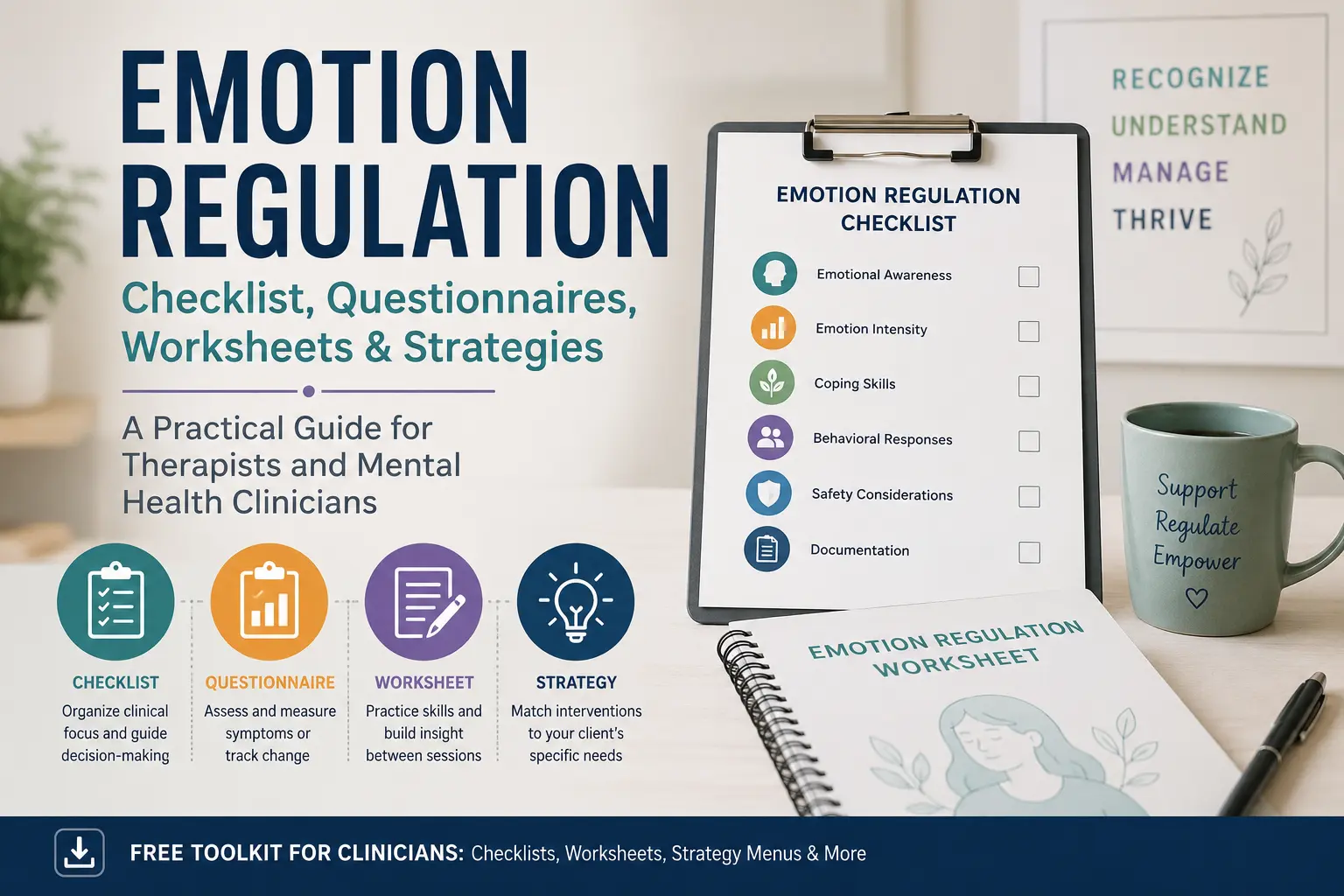
Emotion regulation challenges appear across anxiety, depression, trauma, ADHD, personality disorders, substance use, and child/adolescent presentations. For clinicians, the challenge is not just identifying dysregulation, but choosing the right assessment tool, worksheet, intervention, and documentation approach. This guide explains how to use an emotion regulation checklist alongside emotional regulation questionnaires, worksheets, and evidence-informed emotion management strategies to support assessment, treatment planning, skill-building, and progress note documentation.


Last Updated: August 14, 2026

Key Takeaways
-
An emotion regulation checklist helps clinicians review patterns in awareness, intensity, coping, behavior, safety, and documentation without replacing a validated assessment tool.
-
Emotional regulation questionnaires, such as the ERQ and DERS, are better suited for baseline measurement, reassessment, and tracking change over time.
-
Emotional regulation worksheets help clients practice skills between sessions, including trigger tracking, emotion labeling, intensity scaling, coping planning, and after-episode reflection.
-
Emotion management strategies should be matched to the client’s clinical need, such as anxiety, depression, trauma, anger, impulsivity, or child/adolescent regulation challenges.
-
Strong documentation connects the client’s emotion regulation goal, the intervention used, the client’s response, assigned practice, and measurable progress over time.
Quick Answer: What Is an Emotion Regulation Checklist?
An emotion regulation checklist is a clinician-facing tool used to review how a client notices, understands, tolerates, and responds to emotional experiences. Unlike a scored emotional regulation questionnaire, such as the ERQ or DERS, a checklist does not produce a formal score. Instead, it helps clinicians identify priority treatment targets, select appropriate emotion management strategies, assign emotional regulation worksheets, and document progress over time.
Emotion dysregulation rarely shows up as a diagnosis of its own — it shows up inside almost every diagnosis clinicians treat. It's present in the racing, catastrophic thinking of generalized anxiety, the flattened affect and behavioral withdrawal of depression, the hyperarousal and numbing that follow trauma, the impulsivity of ADHD, the intensity and instability at the center of borderline personality disorder, and the escalation patterns that bring children and families into treatment. Emotion dysregulation is increasingly understood as a transdiagnostic dimension — a feature that cuts across ADHD, borderline personality disorder, mood disorders, and trauma-related conditions rather than belonging to any single diagnostic category (Waltereit et al., 2019). The overlap is substantial: emotional dysregulation is present in an estimated 40% to 70% of adults with ADHD, and ADHD symptoms appear in 30% to 40% of adults with borderline personality disorder, with the combination associated with greater impulsivity and symptom severity than either condition alone (Ditrich et al., 2021).
For clinicians, that overlap creates a practical challenge: how do you assess a construct that shows up everywhere, choose the right intervention for a given presentation, and document all of it in a way that supports medical necessity and payer review? This guide walks through three distinct but related tools — clinical checklists, validated questionnaires, and skill-building worksheets — and where each one fits in assessment, treatment planning, and session work, along with practical emotion management strategies organized by clinical need.
What Is Emotion Regulation?
Emotion regulation is the ability to notice, understand, tolerate, and shift emotional responses in ways that support a person's goals and relationships, rather than being driven entirely by the emotion itself (Gross, 1998). It isn't the absence of strong emotion — clients with excellent emotion regulation still feel anger, fear, and grief. What changes is what happens next: whether the emotion is accurately identified, whether its intensity is proportional to the situation, and whether the person's response moves them toward their goals or away from them.
Gross's process model of emotion regulation describes this as happening at several points along the emotional timeline — selecting or modifying the situation, directing attention, changing the interpretation of what's happening (cognitive reappraisal), and modulating the physiological or behavioral response once the emotion has already started. Different clinical approaches tend to target different points in that sequence: CBT and cognitive reappraisal work upstream, at interpretation; DBT's distress tolerance and opposite action skills work downstream, once the emotion and urge are already present. Understanding where a given intervention targets the emotional process is part of what makes it possible to sequence treatment deliberately rather than reaching for whichever skill comes to mind first.
When to Use an Emotion Regulation Checklist in Therapy
An emotion regulation checklist is a clinical decision aid, not a diagnostic instrument. It doesn't produce a score or a cutoff — it structures your clinical attention so that a recurring pattern doesn't get missed between sessions. Common points to use one include:
- Intake: A structured way to survey emotional functioning across domains before selecting an assessment tool or intervention.
- Treatment planning: Translating what the checklist surfaces into specific, measurable goals and objectives.
- Skills selection: Matching a client's specific regulation difficulty (awareness, intensity, impulse control) to the skill most likely to help.
- Progress monitoring: Re-running the checklist periodically to see whether specific domains — not just overall symptoms — are improving.
- Relapse prevention: Identifying early warning signs (rising intensity, returning avoidance) before a full relapse.
- Parent/child work: Assessing co-regulation needs and caregiver involvement alongside the child's own emotional skills.
- Between-session practice: Deciding which worksheet or homework assignment fits a client's specific gap, rather than assigning a generic handout.
Emotion Regulation Checklist vs. Formal Assessment Tools
In this guide, the term “emotion regulation checklist” refers to a practical clinical review tool that helps clinicians organize observations across domains such as emotion awareness, intensity, coping skills, behavioral responses, safety concerns, and documentation needs. It is not a scored diagnostic instrument, and it should not be used as a substitute for a validated emotional regulation questionnaire or formal psychological assessment.
That distinction matters because clinicians may encounter different types of emotion regulation tools in practice. Some tools are designed to support session planning and clinical decision-making. Others, such as the Emotion Regulation Questionnaire (ERQ) or Difficulties in Emotion Regulation Scale (DERS), are validated measures used to assess specific aspects of regulation and track change over time. Clinicians working with children and adolescents may also encounter formal parent- or caregiver-report tools that evaluate emotional lability, regulation capacity, or related behavioral patterns.
A checklist is most useful when you need to identify what to focus on next: Does the client struggle to name emotions? Do emotions escalate quickly? Are avoidance, reassurance-seeking, aggression, substance use, or shutdown behaviors maintaining the problem? Is safety a concern during periods of emotional escalation? The answers can help guide treatment planning, worksheet selection, skills practice, and progress note documentation.
When a baseline score, symptom tracking, diagnostic clarification, or outcome measurement is needed, a validated questionnaire is usually the better fit. In many cases, clinicians may use both: a questionnaire to measure change over time and a checklist to guide the clinical conversation, select emotion management strategies, and document session-to-session progress.
Which Emotion Regulation Tool Should You Use?
Different emotion regulation tools serve different clinical purposes. A checklist can help structure your clinical attention during intake or treatment planning, while a questionnaire can provide a baseline score or help track change over time. Worksheets are better suited for client practice between sessions, and strategy menus can help clinicians match interventions to the client’s specific presentation.
| Clinical Question | Best Tool to Use | Why It Helps |
|---|---|---|
| What areas of emotion regulation should I assess in session? | Emotion regulation checklist | Helps organize clinical observations across awareness, intensity, coping, behavior, safety, and documentation needs. |
| Do I need a baseline score or a way to measure change? | Emotional regulation questionnaire | Provides a structured, scored measure that can support reassessment, outcome tracking, and treatment planning. |
| Does the client need between-session practice? | Emotional regulation worksheets | Gives the client a concrete way to practice skills such as trigger tracking, emotion labeling, intensity scaling, or coping planning. |
| Which intervention should I use for this presentation? | Emotion management strategy menu | Helps match strategies to clinical needs such as anxiety, depression, trauma, anger, impulsivity, or child/adolescent regulation challenges. |
| How do I document this work clearly? | Progress note prompts and treatment plan language | Connects the client’s target emotion, intervention, response, homework, and measurable progress over time. |
Once you know that a checklist is the right tool for the clinical question in front of you, the next step is to review the domains that most often shape emotion regulation work in therapy.
The comparison below shows how each type of emotion regulation tool fits into assessment, treatment planning, skills practice, and intervention selection.

Emotion Regulation Checklist for Clinicians
Use this checklist as a scannable review during intake or a treatment plan update. It's organized by clinical domain, not by diagnosis, since emotion dysregulation cuts across presentations.

Free Clinical Resource
Download the Emotion Regulation Clinical Toolkit
Get practical tools to assess emotion dysregulation, select appropriate interventions, build clients’ coping skills, and document treatment progress clearly.
- ✓ Clinician emotion regulation checklist
- ✓ Client worksheets and emotion intensity scale
- ✓ Coping strategies organized by clinical need
- ✓ DBT-informed skill selection guidance
- ✓ Progress note prompts and treatment plan language
Get your free toolkit
Complete the form to receive your downloadable clinical toolkit.
Emotional Regulation Questionnaire Options Clinicians Commonly Use
A checklist and a validated questionnaire serve different purposes. An emotion regulation checklist is a clinical review tool: it structures your attention across domains such as awareness, intensity, coping skills, behavioral responses, safety considerations, and documentation needs. It does not produce a score, and it is not intended to function as a formal assessment instrument.
An emotional regulation questionnaire, by contrast, is a structured measure designed to assess specific aspects of emotion regulation, emotion dysregulation, or coping style. Some questionnaires are used to establish a baseline, some help track change over time, and others help clarify which regulation patterns may be most relevant to treatment planning.
Clinicians should always use validated tools according to the authors’ instructions, scoring guidance, population fit, and licensing requirements. The examples below are included to help clarify what different questionnaires are designed to measure, not to reproduce the instruments themselves.
| Questionnaire | Best Used For | What It Measures | Clinical Considerations |
|---|---|---|---|
| Emotion Regulation Questionnaire (ERQ) | Understanding a client’s typical regulation style | Cognitive reappraisal and expressive suppression | Useful when treatment focuses on how clients interpret, reframe, or suppress emotional responses. It is narrower than broader dysregulation measures. |
| Difficulties in Emotion Regulation Scale (DERS) | Assessing broader emotion dysregulation | Nonacceptance of emotions, difficulty with goals when distressed, impulse control difficulties, emotional awareness, access to strategies, and emotional clarity | Often useful when dysregulation is more pervasive, such as in trauma histories, borderline personality disorder, substance use, or high-impulsivity presentations. |
| Cognitive Emotion Regulation Questionnaire (CERQ) | Exploring cognitive coping patterns after stressful events | Cognitive strategies such as rumination, catastrophizing, acceptance, positive refocusing, planning, and reappraisal | Helpful when the clinical focus is how the client mentally responds to distressing or stressful experiences. |
| Emotion Regulation Checklist (ERC) | Assessing emotion regulation patterns in children | Emotional lability, negativity, and regulation-related behaviors | Typically used in child/adolescent contexts and often relies on parent, caregiver, or observer report. It should not be confused with a general clinician-created checklist. |
Emotion Regulation Questionnaire (ERQ)
The Emotion Regulation Questionnaire, developed by Gross and John, is a brief self-report measure focused on two common emotion regulation strategies: cognitive reappraisal and expressive suppression. Cognitive reappraisal involves changing how a situation is interpreted in order to change its emotional impact. Expressive suppression involves inhibiting the outward expression of emotion after the emotional response has already begun.
The ERQ can be useful when you want to understand a client’s default regulation style, especially in CBT-oriented treatment where cognitive reframing, interpretation, and coping patterns are central. However, it is important to recognize its limits. The ERQ does not measure emotion dysregulation broadly. It does not fully assess impulse control, emotional awareness, distress tolerance, or access to coping strategies. For clients with more complex regulation difficulties, a broader measure may be more appropriate.
Difficulties in Emotion Regulation Scale (DERS)
The Difficulties in Emotion Regulation Scale, developed by Gratz and Roemer, assesses multiple dimensions of emotion dysregulation. These include difficulty accepting emotional responses, difficulty staying goal-directed when distressed, impulse control difficulties, limited emotional awareness, limited access to effective regulation strategies, and lack of emotional clarity.
Because the DERS captures a wider range of emotion regulation difficulties than the ERQ, it may be especially useful when clients present with trauma histories, borderline personality traits, substance use, self-harm risk, impulsivity, or repeated difficulty tolerating emotional distress. In these cases, the clinical concern is often not just which strategy the client tends to use, but whether the client can recognize, tolerate, and respond to emotion without escalating into avoidance, shutdown, unsafe behavior, or impairment.
Cognitive Emotion Regulation Questionnaire (CERQ)
The Cognitive Emotion Regulation Questionnaire focuses on the cognitive strategies people use after experiencing stressful or negative events. These strategies may include rumination, catastrophizing, self-blame, acceptance, positive refocusing, planning, putting events into perspective, and cognitive reappraisal.
The CERQ may be useful when treatment focuses on how a client thinks about distressing experiences after they occur. For example, a client who repeatedly ruminates after interpersonal conflict, catastrophizes after minor setbacks, or blames themselves for events outside their control may benefit from assessment and intervention focused on cognitive coping patterns.
Emotion Regulation Checklist (ERC)
Clinicians working with children and adolescents may encounter the formal Emotion Regulation Checklist, or ERC. This tool is different from the general clinician-facing checklist described in this guide. The ERC is typically used to assess emotion regulation patterns in children, often through caregiver or observer report, and may focus on areas such as emotional lability, negativity, and adaptive regulation.
This distinction matters because “emotion regulation checklist” can refer either to a practical clinical review tool or to a specific formal instrument, depending on the context. When working with children, adolescents, or caregiver-report measures, clinicians should confirm which tool they are using and follow the appropriate scoring and administration guidance.
Choosing Between a Checklist and a Questionnaire
In many cases, clinicians may use both a checklist and a questionnaire. A questionnaire can help establish a baseline, identify measurable areas of difficulty, and track progress over time. A checklist can help guide session-to-session clinical decision-making, worksheet selection, intervention planning, and progress note documentation.
For example, a clinician might use the DERS during intake to identify broad areas of dysregulation, then use an emotion regulation checklist during treatment planning to decide whether the immediate clinical priority is emotional awareness, impulse control, coping skills, safety planning, or between-session practice. The questionnaire helps measure the problem. The checklist helps organize the clinical response.
Emotion Regulation Questionnaire vs. Emotion Regulation Checklist
An emotion regulation questionnaire and an emotion regulation checklist are often used together, but they serve different clinical purposes. A questionnaire is best when you need a structured way to measure symptoms, identify baseline patterns, or track change over time. A checklist is better suited for organizing clinical observations, selecting interventions, assigning worksheets, and documenting what happens from session to session.
| Tool | Best For | Format | Clinical Use |
|---|---|---|---|
| Questionnaire | Baseline assessment and measurement | Scored items | Helps identify patterns and track change over time |
| Checklist | Session planning and clinical decision-making | Practical review list | Helps select interventions and document clinical focus |
| Worksheet | Skill-building and homework | Client-facing exercise | Helps clients practice strategies between sessions |
In practice, many clinicians use a questionnaire periodically to measure change and a checklist more frequently to guide treatment planning, worksheet selection, emotion management strategies, and progress note documentation.
Emotional Regulation Worksheets for Therapy: What to Include
Rather than treating worksheets as an undifferentiated pile of downloads, it helps to organize them by what they're actually training. Common types include:
- Emotion identification worksheet — Building vocabulary and precision around what a client is feeling, beyond “good” or “bad.”
- Trigger tracking worksheet — Logging the situation, thought, and emotion together to surface recurring patterns.
- Body cues worksheet — Connecting physical sensations (tight chest, clenched jaw) to emotional states before they escalate.
- Thought-emotion-behavior worksheet — Mapping the sequence from thought to feeling to action, a foundational CBT structure.
- DBT “Check the Facts” worksheet — A DBT emotion regulation skill for evaluating whether an emotional reaction fits the actual facts of a situation.
- Opposite action worksheet — Practicing a response opposite to the emotion's action urge when the emotion doesn't fit the facts.
- Coping plan worksheet — Pre-identifying which strategies to use for which emotional states, built collaboratively with the client.
- Emotion intensity scale — A simple 0–10 scale clients use to track escalation and de-escalation across an episode.
- After-episode reflection worksheet — Reviewing what worked, what didn't, and what to try differently next time, right after an emotional episode.
- Relapse prevention worksheet — Identifying early warning signs and a specific response plan before the next high-risk situation.
Several DBT skills show up repeatedly across these worksheet types and are worth naming directly. Check the Facts asks clients to examine whether an emotional reaction matches the actual situation, rather than an interpretation of it. Opposite Action teaches clients to act contrary to an emotion's urge when the emotion doesn't fit the facts or doesn't serve the client's goals — approaching instead of avoiding, being gentle instead of aggressive. The PLEASE skill addresses vulnerability to emotional dysregulation at the physiological level, prompting attention to physical illness, balanced eating, avoidance of mood-altering substances, sleep, and exercise. Cope Ahead has clients mentally rehearse an upcoming difficult situation and the coping response they plan to use, reducing the likelihood of being caught off guard (Linehan, 2015).
Emotion Management Strategies by Clinical Need
Emotion management strategies aren't one-size-fits-all. The right intervention depends heavily on which clinical presentation is driving the dysregulation.

For Anxiety
Grounding techniques, cognitive reappraisal of catastrophic predictions, and exposure-aligned coping (approaching rather than avoiding feared situations) address the anticipatory, future-focused quality of anxious dysregulation. Cognitive reappraisal in particular is well-supported as a regulation strategy associated with better long-term affective outcomes than avoidance-based coping (Gross & John, 2003).
For Depression
Behavioral activation, values-based action, and opposite action address the withdrawal and inertia that maintain depressive episodes. Behavioral activation has strong evidence behind it: a meta-analysis of 26 randomized controlled trials found it superior to control conditions and comparable in effectiveness to full CBT as a standalone treatment (Ekers et al., 2014).
For Trauma
Grounding, paced breathing, and sensory orientation help clients recognize and work within their window of tolerance — the zone of arousal in which a person can process information and respond flexibly without tipping into hyperarousal (fight/flight, panic) or hypoarousal (shutdown, dissociation) (Siegel, 1999). Trauma histories are strongly associated with a narrowed window, which is part of why trauma-focused work often needs to build regulation capacity before processing the trauma itself.
For Anger
Pause plans, body-cue awareness, structured problem-solving, and communication scripts interrupt the fast escalation curve typical of anger. Because anger often moves from trigger to action faster than other emotions, strategies that create a deliberate pause — before the cognitive or behavioral response — tend to be the most useful starting point.
For Impulsivity
Urge surfing (observing an urge without acting on it, since urges peak and subside on their own), delay strategies, and collaborative safety planning target the gap between urge and action that's often the actual point of clinical intervention in impulse-driven presentations.
For Children and Adolescents
Emotion labeling, caregiver co-regulation, parent coaching, and visual intensity scales meet younger clients where their emotional vocabulary and self-monitoring capacity actually are. Much of the work with this population happens through the caregiver system rather than the child alone, since a dysregulated child often needs a regulated adult to co-regulate with before self-regulation skills can take hold.
The workflow below shows how emotion regulation work can move from assessment and pattern identification to intervention, worksheet practice, progress note documentation, and reassessment.

How to Document Emotion Regulation Work in Progress Notes
Emotion regulation interventions are only as defensible as the documentation behind them. A payer or auditor reviewing a claim needs to see the target emotion or behavior, the specific intervention used, the client's response, and the plan going forward — not just “discussed coping skills.”
Progress Note Example: Anger Escalation and In-Session Regulation
“Client identified anger escalation from 4/10 to 8/10 during conflict with partner. Therapist used emotion labeling, cognitive reappraisal, and paced breathing practice. Client demonstrated ability to reduce intensity to 5/10 in session and agreed to complete trigger log before next visit.”
Treatment Plan Example: Emotion Regulation Goal
“Client will reduce emotional escalation during interpersonal conflict from 8/10 to 5/10 or lower using at least two practiced regulation strategies.”
Progress Note Example: Connecting the Goal to Session Work
“Client reviewed recent conflict with spouse and identified escalation from 3/10 to 8/10. Therapist used Check the Facts and paced breathing. Client reduced intensity to 5/10 in session and agreed to complete an after-episode reflection worksheet before next session.”
Writing notes at this level of specificity for every emotion-regulation intervention, every session, adds up to real documentation time — which is where a behavioral-health-specific EHR can help. ICANotes connects diagnosis, treatment plan goals, and progress notes in a single workflow: once an emotion-regulation goal (for example, reducing reassurance-seeking or increasing use of a specific coping skill) is built into the treatment plan, it carries forward and can be referenced directly in progress notes, regardless of whether your practice documents in SOAP, BIRP, DAP, GIRP, or PIRP format. Outcome measures like the PHQ-9, GAD-7, and PCL-5 can be administered through the platform and feed directly into the treatment plan, so a change in a client's regulation-related symptoms shows up as a documented trend rather than a note buried in last month's chart.
That connection matters most during utilization review or an audit: a reviewer can see the emotion-regulation goal, the interventions used to address it, and the client's measured response in one continuous record, rather than needing to reconstruct the story across disconnected notes.
Frequently Asked Questions About Emotion Regulation Assessment and Documentation
What's the difference between an emotion regulation checklist and a questionnaire?
+
A checklist is a clinical review tool that structures your attention across domains like awareness, intensity, and behavioral response — it doesn't produce a score. A questionnaire like the ERQ or DERS is a validated, scored instrument designed for baseline measurement and tracking change over time. Most clinicians use a checklist during session-to-session clinical decision-making and reserve a formal questionnaire for intake and periodic reassessment.
Is the DERS or ERQ better for assessing emotion dysregulation?
+
It depends on what you're trying to measure. The ERQ is narrow and specific — it tells you whether a client leans on cognitive reappraisal or expressive suppression. The DERS is broader, covering six dimensions of emotion dysregulation, and is generally the better fit for clients with more pervasive regulation difficulties, including trauma histories, borderline personality disorder, or co-occurring substance use.
Can emotion regulation worksheets be used without a formal diagnosis?
+
Yes. Emotion regulation difficulties show up across diagnoses and in clients without a formal diagnosis at all — the worksheets themselves aren't diagnosis-specific. What should guide worksheet selection is the client's specific presentation (awareness, intensity, impulse control, avoidance) rather than a diagnostic label.
How do I choose which DBT skill to teach a client for emotion regulation?
+
Match the skill to where the client's difficulty actually shows up. If a client's baseline vulnerability to dysregulation is high due to poor sleep, irregular eating, or substance use, PLEASE addresses that foundation. If the emotion doesn't fit the facts of the situation, Check the Facts and Opposite Action are the more direct fit. If a client is heading into a known high-risk situation, Cope Ahead is built specifically for that scenario.
What is the best emotional regulation questionnaire for therapy?
+
The best emotional regulation questionnaire depends on what you need to measure. The Emotion Regulation Questionnaire (ERQ) is useful when you want to understand a client’s typical use of cognitive reappraisal and expressive suppression. The Difficulties in Emotion Regulation Scale (DERS) is broader and may be a better fit when clients struggle with impulse control, emotional awareness, distress tolerance, or access to coping strategies. For children and adolescents, clinicians may need tools designed for caregiver or observer report. In practice, the best choice depends on the client’s age, presenting concern, treatment goals, and whether you need a baseline score, outcome tracking, or treatment planning support.
What should be included in emotional regulation worksheets?
+
Effective emotional regulation worksheets should help clients identify what they are feeling, what triggered the emotion, how intense it became, what thoughts or body cues appeared, how they responded, and what coping strategy they used. Common worksheet elements include trigger tracking, a 0–10 emotion intensity scale, thought-emotion-behavior mapping, coping plan prompts, DBT-informed skills practice, and after-episode reflection. The goal is not just to complete a worksheet, but to help the client recognize patterns, practice skills between sessions, and bring useful information back into therapy.
What are examples of emotion management strategies used in therapy?
+
Examples of emotion management strategies used in therapy include grounding techniques, paced breathing, cognitive reappraisal, behavioral activation, opposite action, urge surfing, problem-solving, communication scripts, caregiver co-regulation, and DBT skills such as Check the Facts, PLEASE, and Cope Ahead. The best strategy depends on the clinical need. For example, anxiety may call for grounding and exposure-aligned coping, depression may call for behavioral activation, trauma may require window-of-tolerance work, and impulsivity may require delay strategies or safety planning.
How often should emotion regulation be reassessed during treatment?
+
A common pattern is administering a validated questionnaire at intake and then again at meaningful treatment milestones — every 4 to 8 sessions, or at scheduled treatment plan reviews — while using the clinical checklist more frequently, session to session, to track which specific domains are shifting.
Are emotion regulation checklists appropriate for children and adolescents?
+
The domains — awareness, intensity, cognitive patterns, behavioral response — still apply, but the checklist should be adapted to account for developmentally appropriate emotional vocabulary and the central role of caregiver co-regulation. Much of the useful clinical information with younger clients comes from caregiver report alongside the child's own responses.
How does ICANotes support documentation of emotion regulation interventions?
+
ICANotes connects diagnosis, treatment plan goals, and progress notes in one workflow, so an emotion-regulation goal set during treatment planning carries forward into progress notes automatically, in whatever note format your practice uses (SOAP, BIRP, DAP, and others). Outcome measures like the PHQ-9, GAD-7, and PCL-5 can be built into that same workflow, so changes in a client's regulation-related symptoms are documented as a measurable trend.
Recent Posts






Katie Cox
MA, LPCC
About the Author
Katie Cox, MA, LPCC is a Licensed Professional Clinical Counselor with over 10 years of clinical experience working with adolescents and adults. Her areas of expertise include anxiety, depression, OCD, life transitions, self-esteem, career concerns, and women's mental health. Katie utilizes evidence-based, client-centered approaches to help individuals develop practical coping skills, increase emotional awareness, and achieve their personal goals. Through her clinical work and writing, she is committed to making mental health information accessible, practical, and empowering.