
Complete Guide to Psychiatric Documentation for Psychiatrists and PMHNPs
A comprehensive guide to psychiatric documentation for psychiatrists and PMHNPs, covering initial evaluations, medication management, risk assessments, clinical decision-making, and audit-ready records.

Psychiatric documentation is the clinical record of assessment, diagnosis, treatment decisions, monitoring, and follow-up throughout psychiatric care. For psychiatrists and psychiatric-mental-health nurse practitioners (PMHNPs), it includes much more than progress notes: initial evaluations, mental status examinations, medication management, safety assessments, diagnostic reasoning, and records supporting medical necessity. Clear documentation helps the next clinician understand not only what happened, but why a decision was made.
This guide explains how to build a consistent psychiatric record across the treatment continuum, offers clinically oriented examples and an audit-readiness checklist, and highlights documentation considerations for prescribing, coding, and controlled substances.
Key takeaways
- Psychiatric documentation is a connected record: the initial evaluation establishes the baseline, and subsequent encounters explain changes in symptoms, risk, functioning, treatment, and clinical judgment.
- An effective record distinguishes patient-reported symptoms from observed findings and explicitly links the assessment to the treatment plan.
- Medication-management documentation should explain efficacy, adherence, adverse effects, monitoring, patient preferences, and the rationale for each prescribing decision.
- Risk assessment, diagnostic coding, E/M coding, and controlled-substance workflows require accurate encounter-specific documentation; requirements vary by service, payer, and jurisdiction.
- Structured workflows and templates can improve consistency, but copied-forward language and automatically populated findings should never substitute for an assessment performed at the encounter.
What Psychiatric Documentation Includes
Psychiatric documentation is not one note or one format. It is the longitudinal account of how a clinician evaluated a patient, established or revised a diagnosis, selected treatment, monitored outcomes, and responded to changing clinical circumstances. The content required for an encounter depends on the service performed and the applicable clinical, legal, payer, and organizational standards.
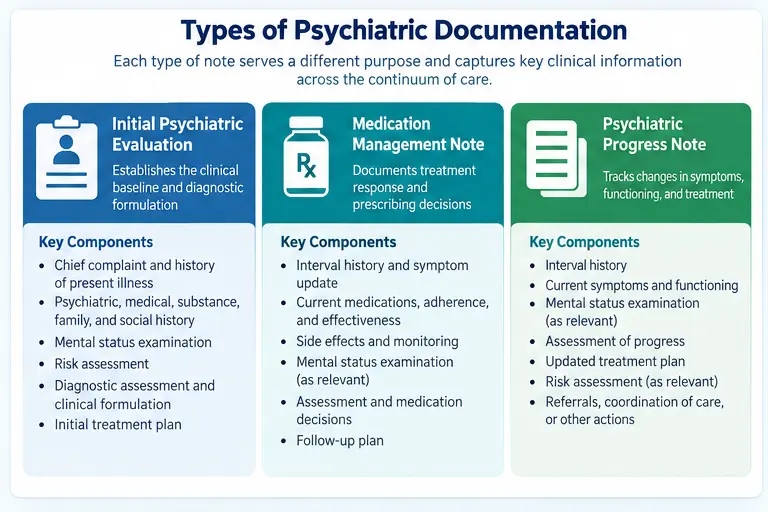
| Record component | Principal clinical purpose | Typical information |
|---|---|---|
| Initial psychiatric evaluation | Establish baseline and diagnostic formulation | Presenting concerns, histories, MSE, risk, differential diagnosis, initial plan |
| Medication-management encounter | Explain prescribing and monitoring decisions | Target symptoms, medication reconciliation, adherence, benefits, adverse effects, monitoring, plan |
| Follow-up/progress documentation | Track care over time | Interval change, functioning, updated assessment, treatment response and next steps |
| Supporting records | Preserve evidence of treatment and decisions | Rating scales, informed consent, referrals, orders, safety plans and relevant communications |
Psychiatric evaluations, medication-management records, and ordinary clinical progress notes generally belong in the medical record. Under HIPAA, separately maintained psychotherapy notes have a narrower definition and do not include medication prescribing and monitoring, diagnosis, treatment plans, symptom summaries, or progress summaries. Clinicians should distinguish the two rather than assume that all notes about mental health treatment receive the same treatment under HIPAA. [1]
Is Your Psychiatric Documentation Audit-Ready?
Strengthen your clinical documentation with our free Psychiatric Documentation Audit Kit. Get practical checklists, worksheets, and tools to help you identify documentation gaps, support clinical decision-making, and prepare for payer reviews.
- Evaluation and medication-management checklists to document clinical decisions with confidence.
- MSE phrase bank and risk assessment worksheets to capture clear, defensible clinical findings.
- Medical necessity and E/M documentation tools to strengthen coding and treatment rationale.
- 10-chart self-audit scorecard to uncover documentation gaps before they become problems.
Initial Psychiatric Evaluation Documentation
The initial evaluation establishes the reference point for subsequent care. An incomplete baseline makes later changes in diagnosis, treatment, risk, and medical necessity more difficult to explain. The evaluation should be sufficiently detailed for another qualified clinician to understand the working formulation and why the initial plan was chosen.
A comprehensive initial psychiatric evaluation generally addresses:
- Reason for evaluation, chief concern, history of present illness, symptom onset, course, severity, context, and effects on functioning.
- Past psychiatric diagnoses, hospitalizations, self-harm history, psychotherapy, medication trials, prior response and adverse effects.
- Medical and surgical history, allergies, current prescribed and nonprescribed medications, and relevant potential medical contributors.
- Alcohol, nicotine and other substance use, including withdrawal or interaction concerns when relevant.
- Family psychiatric history and relevant psychosocial context, including supports, housing, work, relationships, trauma and legal factors as clinically appropriate.
- Mental status examination and risk assessment, including history and present concerns.
- Diagnostic formulation, differential considerations, ICD-10-CM code(s) when applicable, and baseline measures when clinically useful.
- Treatment options discussed, informed consent or shared decision-making, referrals, monitoring, follow-up, and any safety actions.
Connect findings to the clinical formulation
A diagnosis label alone does not show why it fits. For example, a patient presenting with depression, reduced concentration and insomnia may warrant consideration of bipolar-spectrum symptoms, substance effects, medications, medical conditions, and situational contributors. Document which alternatives were evaluated to the extent appropriate, the findings supporting the working diagnosis, and any uncertainty that still requires follow-up.
The initial plan should be linked to the presentation: What symptoms or impairments are being targeted? Why is the proposed treatment appropriate now? What potential benefits, risks and alternatives were discussed? What will be monitored, and when will the patient be reassessed? Objective descriptions and clearly dated addenda also support a trustworthy clinical record. [2]
Mental Status Exam Documentation, With Examples
The mental status examination (MSE) records findings from the encounter. Document domains actually assessed or observed, distinguish the patient’s report from clinical observation, and avoid inserting a uniform “normal” exam when examination conditions or clinical findings differ.
| MSE domain | Less informative | More specific when actually assessed |
|---|---|---|
| Appearance/behavior | “Appropriate” | “Clean clothing; cooperative; intermittent eye contact during interview.” |
| Psychomotor activity | “Normal” | “Mild psychomotor slowing observed; no tremor noted.” |
| Speech | “Normal speech” | “Reduced rate and volume; responses relevant, with brief latency.” |
| Mood and affect | “Depressed” | “Reports mood as ‘drained’; observed affect constricted and congruent.” |
| Thought process | “Normal thoughts” | “Linear and goal-directed; no derailment observed.” |
| Thought content | “No SI/HI” | “On direct questioning, denies current suicidal or homicidal thoughts; no delusional content elicited.” |
| Perception | “No hallucinations” | “Denies auditory/visual hallucinations; no apparent response to internal stimuli during interview.” |
| Cognition | “Intact” | “Alert, oriented to person, place, time and situation; attention sustained throughout conversation.” |
| Insight/judgment | “Fair” | “Recognizes symptoms and need for care; describes feasible plan for obtaining help if symptoms worsen.” |
These examples are illustrative, not required wording. A specific cognitive test result should appear only if that task was actually administered. During telepsychiatry, note material limitations of remote observation when they affect the assessment. An unchanged finding may be summarized accurately, but copying the exact same MSE across repeated visits can obscure whether a fresh assessment occurred.
Medication-Management Documentation: Recording the Prescribing Decision
For psychiatric prescribers, medication-management documentation must show more than the drug and dose. The note should explain how the patient is responding, which risks and alternatives were considered, and why the medication is being started, continued, adjusted, or discontinued.
Include an interval history focused on target symptoms and functioning; current medication names and doses; adherence and missed or self-adjusted doses; benefit and adverse effects; relevant vital signs, laboratory tests or other monitoring; clinically relevant MSE and safety findings; patient preferences; and the rationale for the next step. Document follow-up plans and any pending monitoring or coordination.
Medication-specific monitoring
| Medication class | Examples of relevant documentation considerations |
|---|---|
| Antidepressants | Target symptoms, tolerability, activation or mood switching concerns, response and follow-up. |
| Antipsychotics | Symptom response, movement effects, weight/metabolic indicators and other monitoring when indicated. |
| Mood stabilizers | Response, adverse effects, interaction or reproductive safety considerations, and medication-specific laboratory monitoring. |
| Stimulants | Attention or functional response, sleep/appetite, blood pressure or pulse when relevant, and misuse/diversion concerns. |
| Benzodiazepines | Indication, functional benefit, sedation, interactions, ongoing need, and taper or discontinuation considerations. |
Not every monitoring item applies to every patient or drug; the clinical situation and current prescribing guidance determine what is appropriate.
Instead of: “Continue medication; doing well.” Consider: “Since the last visit, the patient reports improved concentration and daily functioning, no missed doses, and transient nausea that has resolved. After reviewing residual symptoms, tolerability and preferences, continue the present dose and reassess in four weeks.” The second version makes the decision understandable without adding unnecessary narrative.
Psychiatric Progress Notes and SOAP Notes in the Broader Record
Psychiatric progress notes document the course of care between evaluations. They update interval symptoms, functional status, relevant mental status findings, risk, the clinical assessment, and treatment decisions. A psychiatric medication-management encounter and a progress note commonly overlap; a practice need not document the same assessment twice if one encounter note adequately supports the care provided.
SOAP (Subjective, Objective, Assessment, Plan) is a widely used structure, while DAP and BIRP are other recognized behavioral health formats. The format is less important than a coherent, encounter-specific record. Readers looking for detailed progress-note structures, examples, or templates should use ICANotes’s dedicated psychiatric progress note and SOAP note resources rather than treating this comprehensive guide as a template library. [3]
Documenting Psychiatric Risk and Safety Assessments
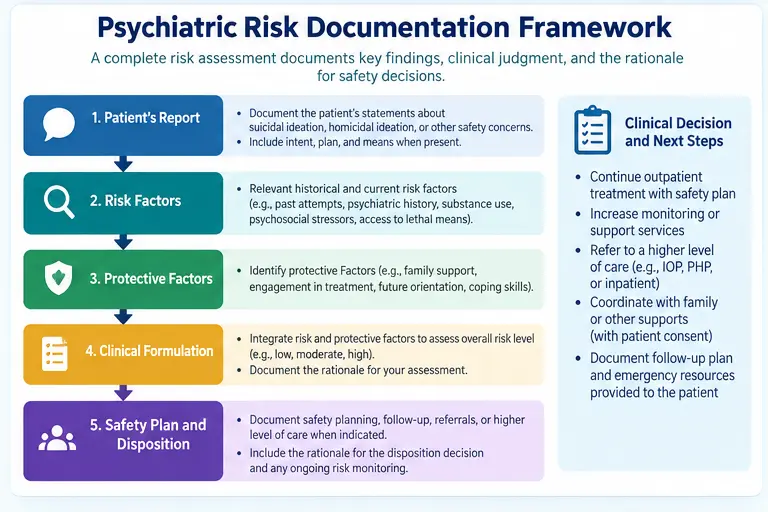
Risk documentation should show what was evaluated, how the clinician interpreted the information, and why a particular response was selected. A simple statement such as “denies suicidal ideation” may be relevant, but it is not a complete risk formulation when the presentation calls for a broader assessment.
- Describe current suicidal or violent thoughts and relevant details when disclosed, using the patient’s words where they clarify the assessment.
- Identify pertinent current and historical risk factors, including prior behavior, symptom changes, substance use, acute stressors and access to lethal means where relevant.
- Document protective factors and available supports without assuming they eliminate risk.
- State the clinical formulation and rationale for disposition, treatment intensity, consultation, safety planning, or escalation.
- Record safety planning and means-safety counseling when indicated, the patient’s response, and specific follow-up or crisis instructions.
A tool such as the Columbia-Suicide Severity Rating Scale (C-SSRS) can organize information about suicidal ideation and behavior, but no score replaces a full clinical assessment. [4] For example, “patient denies SI” conveys less than an assessment that also explains the recent change in symptoms, prior history, supports, access-to-means discussion, and the reason outpatient follow-up is appropriate.
Prescribing-related risks — including sedating combinations, misuse potential, adverse reactions, and adherence concerns — should also be assessed and documented when relevant. Section 9 covers the separate workflow for PDMP review and electronic controlled-substance prescriptions.
Diagnoses, Rating Scales, and Medical Necessity
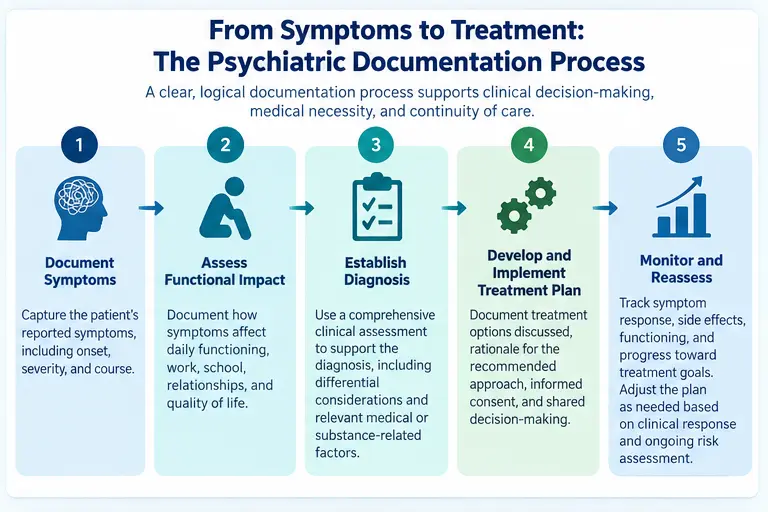
Psychiatric documentation supports medical necessity by linking the patient’s presentation with assessment and a clinically appropriate service or treatment plan. The useful reasoning chain is: symptoms and duration → effect on functioning → diagnostic formulation → treatment decision → observed response and next steps.
Symptoms and duration
Characterize presenting symptoms and how long they have persisted.
Effect on functioning
Document concrete functional impact on work, sleep, daily tasks or relationships.
Diagnostic formulation
Identify the condition, supporting findings and relevant differential diagnoses.
Treatment decision
Select and justify a clinically appropriate service or treatment plan.
Observed response and next steps
Record response to treatment and the plan for reassessment.
DSM-5-TR provides diagnostic criteria, while ICD-10-CM is the U.S. diagnosis coding classification used to report conditions. A clinically useful assessment identifies the condition under consideration, supporting findings, relevant differential diagnoses, degree of certainty, and any appropriate specifier. Confirm codes against current ICD-10-CM guidance rather than relying on an outdated diagnosis list. [5]
Use measurement tools to inform — not replace — assessment
Measurement tools such as PHQ-9 or GAD-7 can help characterize symptom severity and change over time. If used, document the instrument, date, score, change from the prior result, and interpretation in context. A patient’s PHQ-9 falling from 19 to 11 can support an assessment of improvement but does not, by itself, establish a diagnosis or dictate a medication change. C-SSRS has a different purpose in suicide-risk assessment, while CIWA-Ar is used for alcohol-withdrawal severity monitoring; these tools are not interchangeable. [4, 6]
Functional impact should be concrete: missed work, interrupted sleep, difficulty completing daily tasks, reduced self-care or impaired interpersonal functioning, as relevant to the individual. This provides a clearer clinical rationale than generic phrases such as “continues to require treatment.”
Psychiatric E/M Documentation and Common Coding Pitfalls
When a psychiatric service is reported using an applicable office/outpatient evaluation-and-management (E/M) code, the record should support code selection by medical decision-making (MDM) or eligible total time. History and examination remain medically appropriate components of care, but they do not determine the office/outpatient visit level. Specific coding rules vary by service and payer; verify current CMS, CPT and payer guidance before applying them. [7]
What supports medical decision-making?
The three MDM elements are the number and complexity of problems addressed, the amount and complexity of data reviewed and analyzed, and the risk of complications or morbidity/mortality associated with management decisions. In general, the MDM level is determined by meeting the requirements of two of the three elements; avoid assuming that every medication adjustment automatically supports a particular code level. [7]
| Pitfall | More defensible documentation habit |
|---|---|
| Copied-forward assessment | Describe what has and has not changed and the current rationale. |
| Diagnosis not tied to plan | Identify the problem addressed and why the treatment matches it. |
| Time-based code with unclear support | Record the total qualifying time on the date of service and follow applicable activity and exclusion rules. |
| MDM level asserted but not evident | Describe problems addressed, relevant data and management risk without artificially inflating complexity. |
| Prescribing decision without context | Document efficacy, safety, monitoring and decision rationale. |
If psychotherapy is provided during the same visit as a separately reported E/M service, documentation must support the distinct service and applicable psychotherapy time; do not count psychotherapy time again toward time used to select an E/M level. Verify the current rules for psychotherapy add-on codes and the payer involved. [7]
Payer documentation rules may add service-specific requirements. For example, Noridian publishes examples of information it looks for in mental health documentation review and notes that its list is not exhaustive. Commercial plans may publish their own record-review standards. These references are guides for checking the applicable policy, not a universal checklist for all psychiatric services. [8]
Controlled-Substance Documentation: EPCS and PDMP
Electronic prescribing of controlled substances (EPCS) and prescription drug monitoring program (PDMP) review are related but distinct workflows. Applicable PDMP query obligations, timing rules, exceptions, and documentation expectations vary by jurisdiction and clinical situation; do not assume one nationwide review schedule.
- Check applicable state PDMP obligations and review the information when required or clinically indicated.
- Document material findings, concerns and how the information influenced prescribing, without copying unnecessary sensitive details into the narrative.
- Reconcile other prescribed controlled medications or relevant sedating drugs and document the clinical assessment of interactions or risk when appropriate.
- When using EPCS, comply with current identity-proofing, credentialing, and two-factor signing rules; signing authentication is distinct from a narrative clinical risk assessment.
- Explain any relevant dose change, early refill, replacement prescription request, consultation, refusal, monitoring plan or departure from routine practice.
Federal DEA regulations address EPCS signing requirements, including two-factor authentication, while additional state rules can apply. [9] A purpose-built behavioral health EHR may help align prescribing tasks with the encounter record, but the clinician remains responsible for accurate review, clinical judgment and compliance.
Audit-Ready Psychiatric Documentation Checklist
An audit-ready psychiatric record is one another clinician or authorized reviewer can understand without guessing what was assessed, decided, or planned. Use the checklist below as a quality-control aid, not as a claim that every element is mandatory for every encounter.
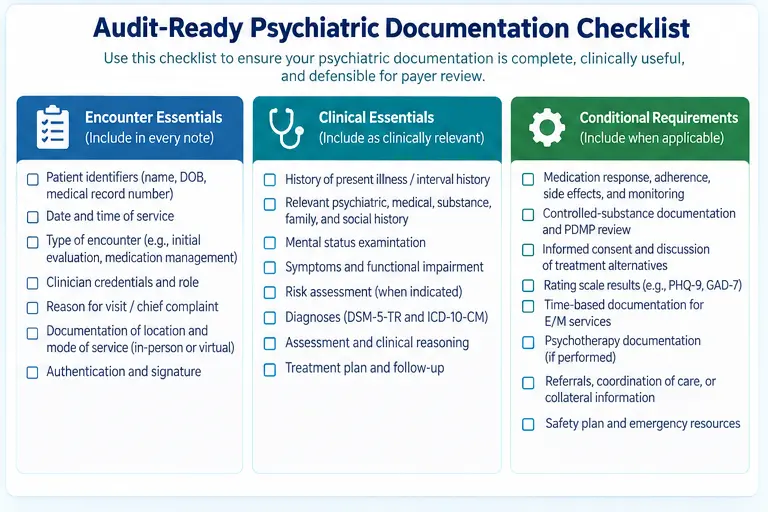
| Category | Quality check |
|---|---|
| Encounter identification | Correct patient, date of service, relevant encounter details, clinician identity and authentication. |
| Clinical presentation | Reason for visit, interval or baseline history, current symptoms and functioning. |
| Examination and assessment | Clinically relevant MSE findings, diagnostic reasoning and problems addressed. |
| Risk and safety | Assessment appropriate to the presentation, disposition reasoning and safety steps when indicated. |
| Treatment decisions | Medication reconciliation, response, monitoring, consent or alternatives when relevant, and plan rationale. |
| Continuity | Follow-up timing, referrals, tests and responsibilities for pending actions. |
| Service-specific support | Appropriate time/MDM, psychotherapy add-on details, controlled-substance review or payer-specific elements when applicable. |
| Record integrity | No inaccurate auto-populated findings; amendments clearly identified and dated. |
Three Educational Examples Across the Treatment Continuum
The following fictional, abbreviated examples illustrate how clinically relevant information carries forward over time. They are not complete encounter records or prescribing recommendations. Actual notes require the assessment, individualized care, and documentation appropriate to each patient and service.
Example A: Initial psychiatric evaluation (excerpt)
Example A: Initial psychiatric evaluation (excerpt)
“Adult patient reports four months of persistent low mood, loss of interest, impaired concentration and disrupted sleep, with reduced work performance after a recent job loss. PHQ-9 today: 19. Reports no prior psychiatric treatment; medical, medication and substance histories reviewed. On examination: cooperative, mildly slowed speech and psychomotor activity, constricted affect, linear thought process. Current suicidal thoughts denied on direct questioning; additional risk and protective factors evaluated separately. Working assessment: depressive syndrome with significant functional impairment; further assessment of relevant differential and medical contributors documented. Plan: discuss treatment options, risks and benefits, shared preferences, safety contingencies, baseline monitoring and follow-up.”
It records reported symptoms, observed findings, functional effects, diagnostic uncertainty and the reasoning needed for a personalized plan, rather than treating a screening score as a stand-alone diagnosis.
Example B: Medication-management follow-up (excerpt)
Example B: Medication-management follow-up (excerpt)
“Four-week follow-up after starting the selected treatment. Reports improved energy and attention with residual low mood; PHQ-9 decreased from 19 to 11. Patient reports consistent use and transient nausea now resolved. MSE: affect more reactive; thought process organized. Current safety assessment completed; no new acute concern identified. Medication reconciliation includes a benzodiazepine supplied by another prescriber; interaction and sedation risks reviewed, and PDMP review documented as appropriate to applicable rules. Assessment: partial symptom response with acceptable reported tolerability. Plan and dose decision made through shared discussion; monitoring, precautions and follow-up documented.”
Symptom change, tolerability and concurrent medication information are connected directly to the rationale for treatment and monitoring. The example does not imply that a PDMP check is uniformly required for every antidepressant visit.
Example C: Later longitudinal reassessment (excerpt)
Example C: Later longitudinal reassessment (excerpt)
“At a later follow-up, patient reports improved sleep, restored work functioning and no current anhedonia. PHQ-9 today: 6, compared with 19 at baseline. Reports adherence and no new adverse effects. MSE: reports mood ‘good’; affect full range; organized thought process. Safety reviewed in context of current symptoms and history. Assessment: substantial improvement with residual symptoms to be evaluated against the appropriate diagnostic course or remission specifier. Plan: continue individualized maintenance approach, review relapse warning signs and monitoring, and schedule follow-up based on clinical stability.”
The same outcome measure is interpreted alongside functional improvement and clinical findings. The note avoids claiming a definite remission specifier without sufficient support.
Building a Consistent Psychiatric Documentation Workflow
Effective documentation systems organize information in the sequence clinicians actually use: assess, formulate, decide, act, and reassess. Templates should cue essential fields without forcing irrelevant statements or suggesting a finding was assessed when it was not. The strongest workflow preserves longitudinal context while keeping each encounter-specific assessment current.
Begin with purpose
Begin with the purpose of the encounter and relevant baseline information.
Separate report from observation
Capture patient-reported change and observed findings separately.
Review relevant information
Review medication, risk, rating-scale and diagnostic information appropriate to that visit.
Require a current assessment
Require a current clinical assessment and explain significant changes in decisions.
Close with a plan
Close with an actionable plan, follow-up responsibilities and authentication.
ICANotes supports behavioral health documentation with structured, menu-driven psychiatric evaluation and treatment note workflows, alongside prescribing and practice-management capabilities. Clinicians can use structured prompts to improve consistency while retaining control over the final clinical content. Confirm the configuration and availability of specific integrations, features and regulatory functions for your practice before relying on them.
Make Documentation Clinically Useful at Every Visit
The strongest psychiatric documentation is not necessarily the longest. It is a consistent, accurate record of what the clinician learned, how that information shaped the assessment, and why the next step makes sense. By connecting evaluations, prescribing decisions, safety assessments and follow-up over time, psychiatrists and PMHNPs can support continuity, clinical quality and defensible records without duplicating unnecessary narrative.
Explore structured psychiatric documentation in ICANotes
Explore how ICANotes can support structured psychiatric documentation, medication-management workflows and integrated practice operations. Start a 30-day free trial.
- Menu-driven psychiatric evaluation and MSE templates
- Medication-management notes with prescribing rationale
- Built-in rating scales like PHQ-9, GAD-7 and C-SSRS
- EPCS and PDMP-ready prescribing workflows
See how ICANotes can support your psychiatric workflows. Start your free 30-day trial, no credit card required.
Start Your Free 30-Day Trial
Frequently Asked Questions
What is psychiatric documentation?
What must be included in a psychiatric evaluation?
How is psychiatric documentation different from a psychiatric progress note?
Do psychiatric records need standardized rating scales?
How can psychiatric documentation support medical necessity?
How does EPCS affect the psychiatric record?
References
- U.S. Department of Health and Human Services. HIPAA guidance on psychotherapy notes. https://www.hhs.gov/hipaa/for-professionals/faq/2088/does-hipaa-provide-extra-protections-mental-health-information/index.html
- Psychiatric News (2022). “Documentation: Your Very Best Defense.” https://psychiatryonline.org/doi/full/10.1176/appi.pn.2022.04.3.36
- Podder V, et al. SOAP Notes. StatPearls. https://www.ncbi.nlm.nih.gov/books/NBK482263/
- Posner K, et al. The Columbia–Suicide Severity Rating Scale: Initial validity and internal consistency findings. https://pmc.ncbi.nlm.nih.gov/articles/PMC3893686/
- American Psychiatric Association. DSM-5-TR. https://www.psychiatry.org/dsm ; CDC/NCHS. ICD-10-CM. https://www.cdc.gov/nchs/icd/icd-10-cm/index.html
- Kroenke K, et al. PHQ-9 validity. https://pmc.ncbi.nlm.nih.gov/articles/PMC1495268/ ; Spitzer RL, et al. GAD-7. https://pubmed.ncbi.nlm.nih.gov/16717171/ ; Sullivan JT, et al. CIWA-Ar. https://pubmed.ncbi.nlm.nih.gov/2597811/
- Centers for Medicare & Medicaid Services. Evaluation and Management Services (MLN006764). https://www.cms.gov/files/document/mln006764-evaluation-management-services.pdf
- Noridian Healthcare Solutions. Mental health documentation requirements. https://med.noridianmedicare.com/web/jeb/topics/documentation-requirements/mental-health ; BCBSRI. Behavioral health medical record documentation standards. https://bcbsri.com/providers/support/pdf/documentation-standards-0
- Drug Enforcement Administration. EPCS Q&A. https://www.deadiversion.usdoj.gov/faq/epcs-faq.html ; DEA EPCS rule, Federal Register (2010). https://www.govinfo.gov/content/pkg/FR-2010-03-31/pdf/2010-6687.pdf
Dr. October Boyles
Dr. October Boyles is a behavioral health expert and clinical leader with extensive expertise in nursing, compliance, and healthcare operations. With a Doctor of Nursing Practice (DNP) and advanced degrees in nursing, she specializes in evidence-based practices, EHR optimization, and improving outcomes in behavioral health settings. Dr. Boyles is passionate about empowering clinicians with the tools and strategies needed to deliver high-quality, patient-centered care.