Blog > Documentation > Golden Thread Documentation in Mental Health: Complete Guide
Golden Thread Documentation in Mental Health: What It Is and How to Maintain It
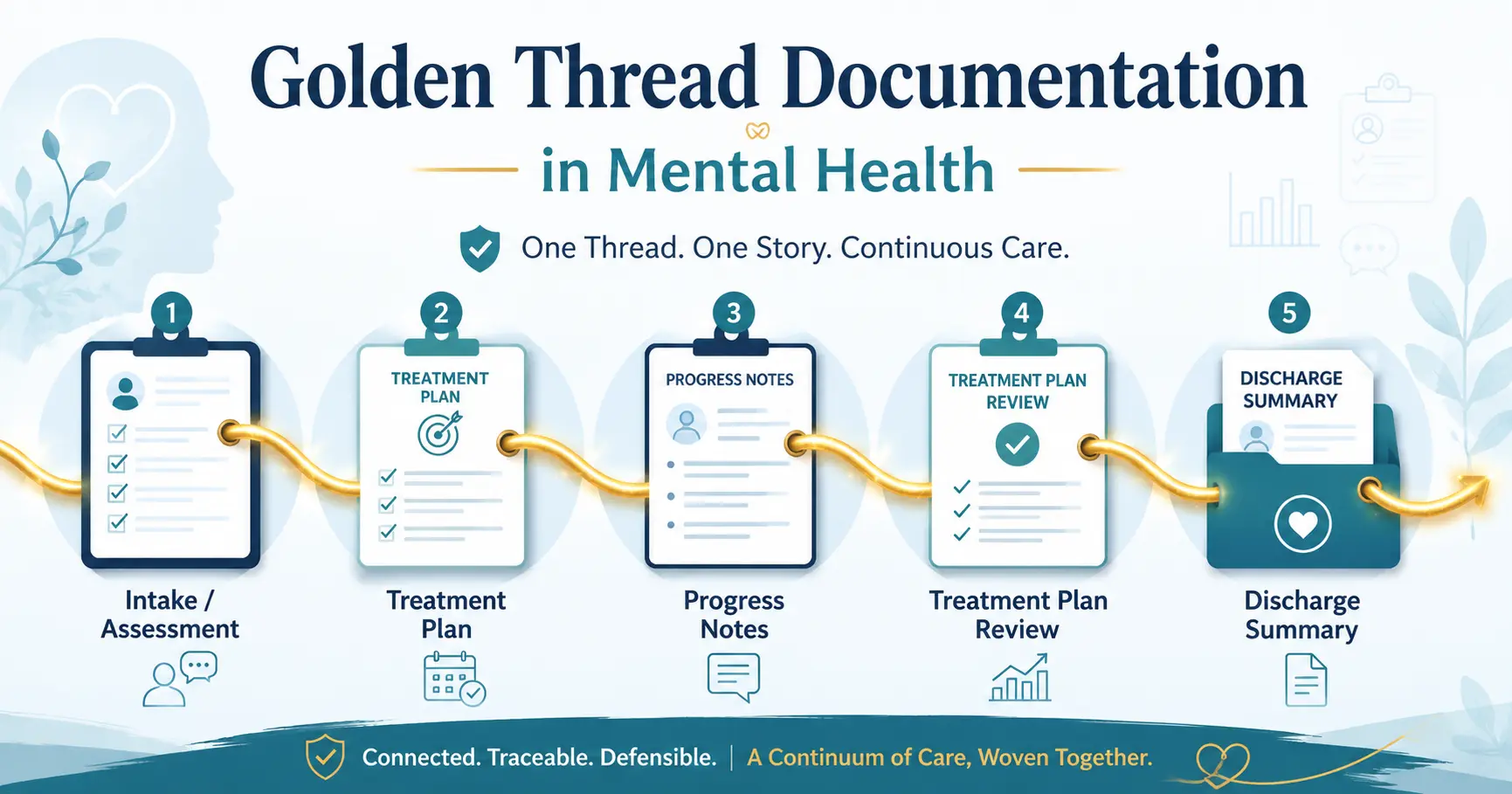
Golden thread documentation connects a client’s intake assessment, diagnosis, treatment plan, progress notes, treatment plan reviews, and discharge summary into one traceable clinical story. In mental health care, maintaining the golden thread helps demonstrate medical necessity, support continuity of care, and create records that can stand up to payer, supervisor, or audit review.


Sharon Miller, LCSW-R, CCM, CDP
Last Updated: June 25, 2026

What You'll Learn
- What golden thread documentation means in mental health care
- How the intake assessment, treatment plan, progress notes, treatment plan reviews, and discharge summary should connect
- Why broken documentation can create medical necessity, audit, legal, and continuity-of-care risks
- What auditors look for when reviewing progress notes and treatment plans
- How to maintain the golden thread across outpatient therapy, psychiatry, group therapy, and community mental health settings
Contents
- The Five Documents That Form the Golden Thread
- What Does the Golden Thread Mean for Progress Notes?
- The Golden Thread Approach to Treatment Planning
- What Breaks the Golden Thread?
- The Golden Thread in Different Clinical Settings
- FAQs: Golden Thread Documentation
- How ICANotes Helps Maintain the Golden Thread
If you’ve ever had a chart audited, received a claim denial citing “lack of medical necessity,” or been asked by a supervisor to explain why your progress notes don’t connect to your treatment plan, you’ve encountered a golden thread problem.
The golden thread is one of the most important concepts in behavioral health documentation. It’s also one of the most misunderstood. This guide explains what it is, why it matters, how auditors use it to evaluate your records, what breaks it, and how to maintain it from the first session through discharge.
What Is the Golden Thread in Mental Health Documentation?
The golden thread is the principle that every document in a client's clinical record should be internally consistent and traceable — from the initial intake assessment all the way through the final discharge summary.
Think of it as a single continuous thread running through every document in the chart. An auditor, supervisor, or covering clinician should be able to pick up that thread at any point and follow it forward or backward through the record without losing the clinical story.
When the golden thread is intact, your documentation answers three questions at every stage of treatment:
- Where is this client? (clinical status, symptoms, functional impairment)
- What are we working on? (treatment goals tied directly to the diagnosis)
- How is treatment progressing? (evidence that interventions are having impact)
The Golden Rule of Clinical Documentation
“If it is not documented, it did not happen.”
No matter how skilled your intervention, how thorough your risk assessment, or how significant the client’s breakthrough — if it is not in the record, it is as though it never occurred. The golden thread ensures that what happened is not only documented, but connected.
Why the Golden Thread Matters: More Than a Buzzword
The golden thread is not just a documentation best practice. In mental health care, it helps show why treatment is needed, what services were provided, how the client responded, and whether care should continue. When that connection is clear, the clinical record is easier to defend, easier to review, and more useful to every provider involved in the client’s care.
Medical Necessity and Insurance Compliance
The most immediate practical consequence of a broken golden thread is claim denial. When a payer audits your records — whether for a routine review or a targeted audit — they are looking for a clear line connecting your client's documented diagnosis to their treatment goals to the services you billed. If that line is hard to trace or doesn't exist, the services appear unjustified regardless of how good your clinical work was.
Every payer has medical necessity criteria. Your documentation must demonstrate that:
- The client has a documented diagnosis with supporting criteria
- The level and type of service is clinically appropriate to the client's needs
- Continued treatment is supported by documented progress or ongoing clinical need
Legal Protection
Your clinical record is a legal document. In any disciplinary proceeding, malpractice claim, or licensing board investigation, your notes are the primary evidence of the care you provided and why. Courts and licensing boards apply the same principle as auditors: if it isn't documented, it didn't happen.
A thorough, connected record — one where your intake justifies your diagnosis, your diagnosis drives your treatment goals, and your progress notes document movement toward those goals — demonstrates competent, standard-of-care treatment.
Related: Mental Health Malpractice: Common Lawsuit Triggers and How to Protect Your Practice
Continuity of Care
A clinician covering for you, an inpatient team receiving a crisis referral, or a prescriber coordinating on medication management should be able to read your record and understand where the client is and how they got there. The golden thread is not just a compliance tool — it is a communication tool.
The Five Documents That Form the Golden Thread
The golden thread runs through five key documents in the clinical record. Each one must connect logically to the next.

Free PDF Checklist
Does your clinical record tell a defensible story?
Download the Golden Thread Audit Checklist to spot documentation gaps, identify audit red flags, and review whether your intake, treatment plan, progress notes, reviews, and discharge summary connect clearly from start to finish.
The Golden Thread in Practice: A Clinical Example
Abstract principles are easier to apply when you can see them traced through a real record. The following example follows a fictional client through each golden thread document.
Step 1 — Intake Assessment
Client presents with depressed mood most of the day, nearly every day for 8 weeks. Reports anhedonia, hypersomnia (10-12 hrs/night), fatigue, feelings of worthlessness, and diminished concentration. Five of nine DSM-5 criteria met; duration exceeds 2 weeks; functional impairment documented across occupational and social domains. No history of manic or hypomanic episodes. Diagnosis: Major Depressive Disorder, Single Episode, Moderate (F32.1).
Step 2 — Treatment Plan (directly tied to Step 1 diagnosis and symptoms)
Goal 1: Client will reduce frequency of passive suicidal ideation from daily to no more than 2x/week as measured by C-SSRS and self-report within 90 days. Goal 2: Client will demonstrate use of at least two behavioral activation strategies per week to address anhedonia and social withdrawal, as measured by activity log review, within 90 days. Intervention: CBT, including behavioral activation and cognitive restructuring.
Step 3 — Progress Note (linked to Step 2 goals)
Goal addressed: Goal 2 — Behavioral activation for anhedonia. Clinician introduced behavioral activation model; client identified two avoided activities (evening walk, weekly call with sister). Client generated behavioral experiment: walk three times this week and rate mood before/after. Client engaged actively; rated confidence at 7/10. PHQ-9 score: 14 (down from 17 at intake). Progress: moderate. Goal remains active.
Step 4 — Treatment Plan Review (90-day update connecting Steps 1-3)
Goal 2 partially met: client completing 2-3 behavioral activation activities per week consistently. PHQ-9 score 9 (mild range; intake score 17). Goal modified: client will independently initiate behavioral activation strategies without clinician prompting and maintain PHQ-9 below 10 for 4 consecutive weeks. Rationale for continued treatment: residual concentration difficulties and occupational impairment persist.
Step 5 — Discharge Summary (closing the thread)
Goal 1 met: no passive SI reported in final 6 weeks; C-SSRS score 0. Goal 2 met: client independently initiating behavioral activation 4-5x/week; PHQ-9 score 5 (minimal) at discharge. Clinical status: significant improvement from baseline; functional impairment resolved in social domain; occupational functioning improved. Aftercare: monthly maintenance sessions recommended; PCP notified.
Notice how an auditor, supervisor, or covering clinician could trace a complete clinical story from that intake diagnosis straight through to discharge — without any gaps, contradictions, or unexplained detours. That is the golden thread working correctly.
What Does the Golden Thread Mean for Progress Notes Specifically?
Progress notes are where most golden thread failures occur — and where auditors spend the most time. The golden thread requirement for progress notes means that every note should:
- Reference at least one specific treatment plan goal
- Name the interventions used (not just "provided therapy" or "discussed issues")
- Document the client's response to those interventions
- Reflect clinical progress, barriers, or changes in status toward the referenced goal
- Include a safety statement, however brief, in every note
What Auditors Look for in Progress Notes
Reviewers flag notes that: (1) contain no reference to a treatment plan goal, (2) describe interventions vaguely (“supportive therapy provided”), (3) omit client response, (4) are identical or nearly identical to prior notes, or (5) cannot be traced to a documented diagnosis. Any one of these can trigger a medical necessity denial.
How Strong Are Your Progress Notes?
Take our free 5-minute Progress Note Self-Assessment Tool to see how your documentation stacks up. Identify gaps, reduce compliance risk, and get practical insight into whether your notes are audit-ready.
It’s a quick way to spot documentation weaknesses before they become billing or compliance problems.
Take the 5-Minute Self-Assessment
The Role of ICANotes in Supporting Golden Thread Documentation
Maintaining the golden thread can be challenging when juggling full caseloads and compliance standards. ICANotes was designed to make that process effortless.
Here’s how ICANotes helps clinicians create defensible, cohesive, and efficient documentation:
- Built-In Golden Thread Logic: Every assessment, goal, and note is automatically connected for continuity.
- Evidence-Based Templates: Structured prompts guide you to include all medically necessary elements.
- AI Readability Enhancer: Clarifies note language and ensures documentation is client-centered and professional.
- AI Scribe: Captures session dialogue in real time and drafts clinically accurate progress notes.
- Audit-Ready Formatting: Notes meet payer and compliance standards without extra effort.
- Concurrent Documentation Tools: Reduce the need for copy-pasting and help you complete notes before your next session.
By using ICANotes, clinicians can focus on the therapeutic relationship while ensuring every piece of documentation supports the golden thread, from intake to discharge.
The Golden Thread Approach to Treatment Planning
Your treatment plan is the spine of the golden thread. If it's weak, everything connected to it is weak. The most common treatment planning failures that break the golden thread are:
- Goals that don't connect to the diagnosed condition
- Objectives that aren't measurable ("improve coping skills" rather than "reduce PHQ-9 score from 17 to below 10 within 90 days")
- Interventions listed generically ("individual therapy") rather than specifically ("CBT with behavioral activation and cognitive restructuring")
- Plans that are never updated — the same goals at every review regardless of client progress
- No client signature, which many payers and accreditation bodies require
The SMART framework — Specific, Measurable, Achievable, Relevant, Time-bound — is the standard for writing treatment goals that will hold up to audit scrutiny. Every goal should name the exact symptom or behavior being targeted, define how progress will be measured, and include a target timeframe.
What Breaks the Golden Thread?
The golden thread can be broken in several ways, most of which happen gradually through documentation shortcuts or habits that build over time.
The Golden Thread in Different Clinical Settings
The golden thread applies across mental health settings, but the places where it breaks often differ depending on the type of care being provided. Outpatient therapy, psychiatric medication management, group therapy, and community mental health programs each require documentation that connects the client’s presenting problems, treatment goals, interventions, and progress in a clear, setting-specific way.
Outpatient Therapy
In outpatient settings, the golden thread most commonly breaks at the progress note level. Therapists writing under time pressure default to vague, repetitive notes that don’t reference treatment goals. Quarterly treatment plan reviews get skipped or are completed without genuinely updating goals. The fix is building the habit of goal-referencing into every note — ideally using a note format like GIRP (Goal, Intervention, Response, Plan) that structures this connection explicitly.
Psychiatric / Medication Management
For prescribers, the golden thread extends to the prescribing rationale. Documentation must connect the symptoms identified in the intake to the medications prescribed, and subsequent notes must document symptom response, side effects, and the clinical reasoning behind any changes. An undocumented dosage change or a prescription written without documented rationale is a golden thread failure.
Group Therapy
Group therapy documentation must maintain an individual golden thread for each group member while also documenting the group as a whole. Each member’s individual progress note should reference their personal treatment plan goals — not just the group topic. A common audit failure in group settings is cloned notes where every member’s record says essentially the same thing.
Community Mental Health and Case Management
In high-caseload settings, documentation often lags behind the clinical work, and treatment plans may be completed as administrative requirements rather than active clinical tools. The golden thread fails when case management notes document activities without connecting them to goal-directed outcomes, or when treatment plans are so generic they could apply to any client on the caseload.
How ICANotes Helps Maintain the Golden Thread
Once clinicians understand what the golden thread requires, the next challenge is maintaining that connection consistently across a full caseload. That is where structured documentation workflows can make the difference between knowing the standard and applying it reliably.
Maintaining the golden thread manually — across every note, every review, every client — requires discipline and a documentation system that supports the connection between documents. ICANotes was built by a psychiatrist specifically for behavioral health, with a documentation model designed around exactly this clinical logic.
- Every note template is structured to connect to the treatment plan
- Shrub-based charting populates clinically accurate narrative language automatically, reducing the temptation to copy-paste
- Treatment plan goals are accessible from within the progress note workflow, making goal-referencing the default — not an afterthought
- Built-in assessment tools (PHQ-9, GAD-7, C-SSRS, and others) integrate directly into the note, creating measurable progress documentation
- Discharge summaries pull from the treatment history, making it easier to close the record with a complete golden thread intact
The result is documentation that is faster to write, clinically richer, and built to withstand audit scrutiny — because the golden thread is woven into the system, not bolted on after the fact.
See the Golden Thread in Action
Build audit-ready mental health documentation from intake through discharge
ICANotes helps clinicians maintain the golden thread by connecting assessments, treatment plans, progress notes, reviews, and discharge summaries in one behavioral health EHR workflow.
- Reference treatment goals directly in the note-writing workflow
- Document interventions, client response, and measurable progress
- Create connected records that support medical necessity and continuity of care
Start your free 30-day trial and see how ICANotes supports defensible clinical documentation.
Frequently Asked Questions About Golden Thread Documentation
Key Takeaways for Clinicians
- Golden thread documentation means every part of the clinical record connects clearly from intake through discharge.
- A strong golden thread shows how the client’s diagnosis, treatment goals, interventions, progress, and continuing need for care fit together.
- The most common breaks happen when treatment goals are vague, progress notes do not reference the plan, or documentation is copied forward without showing individualized clinical progress.
- Maintaining the golden thread supports medical necessity, continuity of care, audit readiness, and a more defensible clinical record.
Related Posts






Sharon Miller
LCSW-R, CCM, CDP
About the Author
Sharon Miller is a licensed clinical social worker and healthcare operations leader with more than 16 years of experience in behavioral health, care management, and telehealth service delivery. She has directed large-scale mental health programs in hospital and digital health settings, developed EHR documentation standards, and trained clinicians in evidence-based practices including CBT, DBT, and motivational interviewing.
As Vice President of Clinical Operations at UCM Digital Health, Sharon led the integration of mental health services into digital care, creating psychosocial assessment, treatment plan, and discharge summary templates that advanced clinical documentation quality. Her work has consistently focused on improving outcomes, compliance, and continuity of care through well-designed workflows and clinician education—principles at the heart of the golden thread concept.
Sharon holds a Master of Social Work from Columbia University, a Master’s in Psychology from New York University, and is a Certified Case Manager and Certified Dementia Planner.
Free PDF Checklist
Does your clinical record tell a defensible story?
Download the Golden Thread Audit Checklist to spot documentation gaps, identify audit red flags, and review whether your intake, treatment plan, progress notes, reviews, and discharge summary connect clearly from start to finish.