Blog > Treatment Strategies > Safety Planning Intervention (SPI): Stanley-Brown Template & Clinical Guide
Safety Planning Intervention (SPI): How to Create an Evidence-Based Stanley-Brown Safety Plan
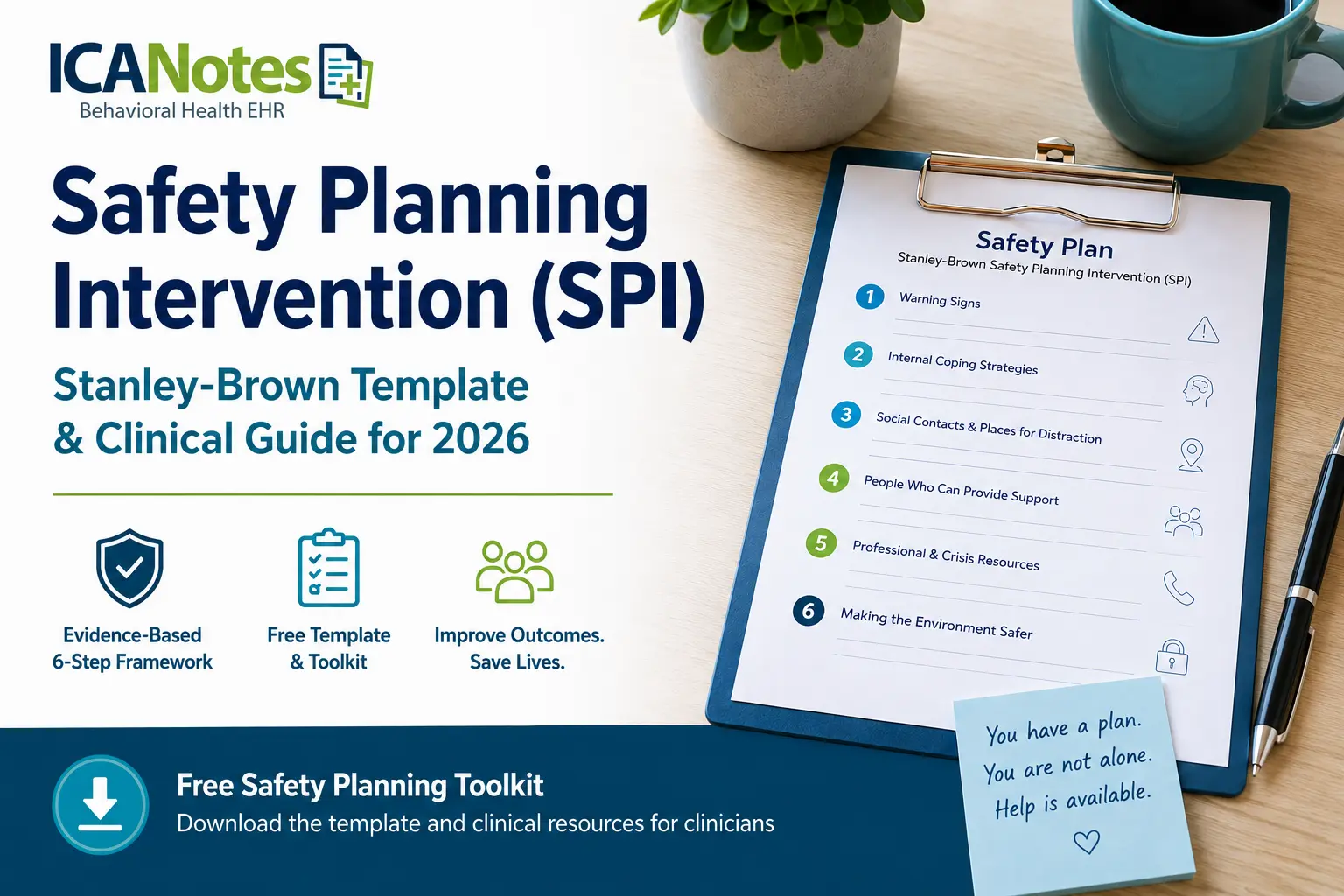
The Safety Planning Intervention (SPI), developed by Stanley and Brown, is one of the most effective evidence-based tools for reducing suicide risk and improving treatment engagement. Unlike outdated no-suicide contracts, the Stanley-Brown Safety Plan helps clinicians and clients collaboratively identify warning signs, coping strategies, support resources, and steps for reducing access to lethal means. In this guide, you'll learn how to create a mental health safety plan using the six-step SPI framework, review current research, and access a free Safety Planning Toolkit with a fillable template and clinical documentation examples.

Last Updated: October 5, 2026
What You'll Learn
- What the Safety Planning Intervention (SPI) is and why it is considered the gold standard in suicide prevention
- How to create an evidence-based Stanley-Brown Safety Plan using the six-step SPI framework
- The essential components every mental health safety plan should include
- How safety plans differ from no-suicide contracts and why national organizations recommend SPI instead
- Best practices for documenting safety plans, crisis resources, and means safety discussions
- Common mistakes clinicians make when implementing the Stanley-Brown SPI — and how to avoid them
- How to use a free mental health safety plan template in both in-person and telehealth settings
- How ICANotes helps clinicians complete, document, and share safety plans within their clinical workflow
Contents
- The Stanley-Brown Safety Planning Intervention
- How to Create a Stanley-Brown Safety Plan: The 6-Step SPI Template
- What the Research Shows About Safety Planning
- Six Common Mistakes Clinicians Make with the Stanley-Brown SPI
- Safety Planning in Practice: A Clinical Scenario
- Why Safety Planning is Clinical Work, Not Paperwork
- Why the Stanley-Brown Model Stands Out
- Bringing the Stanley-Brown Safety Plan Into Everyday Workflow
- Making Safety Planning a Standard of Care
- FAQs: Mental Health Safety Plans
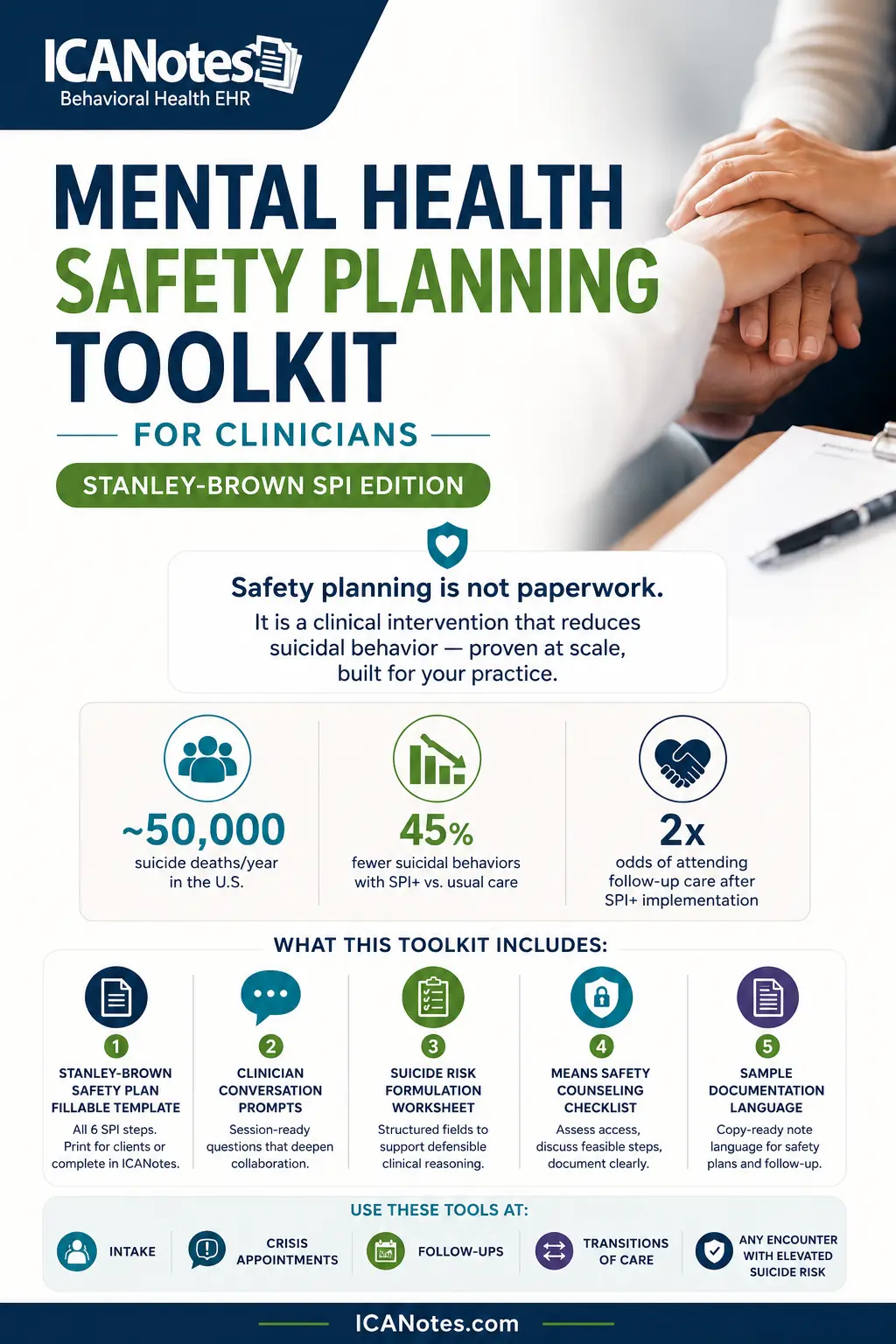
In 2022, an estimated 49,476 people died by suicide in the United States and self-harm was the primary reason for over 600,000 emergency room visits in a single year. [1].
Each of these deaths is preventable. Together we can save lives through more efficient workflows and safety planning. Safety planning saves lives and helps prevent suicide events. Safety planning is a clinical intervention, an intervention that is now more accessible through your electronic health record.
Behind each of these deaths are family, friends, and community members — making each loss all the more tragic. We know that many of the individuals we care for think about suicide. In fact, about 20% of high school students seriously consider suicide each year [2], and some of those individuals will try to die by suicide.
Behind every one of those numbers is a patient you have sat with. The one who says “I’m fine” with flat affect. The one who shrugs when you ask about tomorrow. The one who has a plan, access to means, and a very small window where your intervention actually matters.
In that window, what you put on paper matters.
This is where safety planning stops being a checkbox and becomes a core treatment intervention.
What is a Mental Health Safety Plan?
What Is a Safety Plan?
A mental health safety plan is a personalized, written document that helps individuals recognize warning signs of a crisis and follow a series of predetermined steps to stay safe. Created collaboratively by a clinician and client, a safety plan typically includes coping strategies, supportive contacts, crisis resources, and steps for reducing access to lethal means. The most widely used evidence-based approach is the Stanley-Brown Safety Planning Intervention (SPI), a six-step framework designed to reduce suicide risk and improve treatment engagement.
A mental health safety plan is a brief, personalized, and collaborative document that outlines exactly what a client will do when suicidal thoughts or self-harm urges intensify. Unlike outdated verbal “no-harm contracts,” a safety plan provides concrete, step-by-step strategies that help clients recognize their unique warning signs, use internal coping skills, reach out to supportive people, access professional and crisis resources, and reduce access to lethal means. A well-constructed safety plan becomes a lifeline during moments of acute distress — offering structure when executive functioning is compromised and decision-making is impaired. It is both a therapeutic tool and an evidence-based intervention that has been shown to reduce suicidal behavior and increase engagement in treatment.
Why Written Safety Plans Are More Effective Than Verbal No-Harm Contracts
Many of us were trained in an era of “no-suicide contracts.” We asked patients to promise they would not harm themselves and documented that they agreed.
The evidence has not been kind to that practice.
No-suicide contracts do not reliably reduce suicidal behavior, and they do little to teach a patient how to survive the next wave of suicidal intensity. They also do not demonstrate that you have given your patient a usable, skills-based tool when risk is high [3].
A collaborative, written safety plan is different.
Safety planning interventions teach patients to:
- Notice escalating warning signs
- Use internal coping strategies first
- Reach out to safe people and places
- Access professional and crisis resources
- Reduce access to lethal means
- Anchor themselves in reasons to live
In other words, a safety plan is not “don’t do it.” It is “here is exactly what you will do when the urge spikes.”
Safety Plan vs. No-Suicide Contract vs. Crisis Plan: What's the Difference?
Clinicians use these three terms inconsistently, and the distinctions matter. Each tool has a different purpose, a different evidence base, and different implications for your documentation and liability. Here is a direct comparison.
A Note on Crisis Plans vs. Safety Plans
Crisis plans and safety plans are sometimes used interchangeably, but they serve different functions. A crisis plan is typically a care coordination document that outlines how clinicians, family members, or support systems should respond when a crisis occurs. A safety plan, by contrast, is a client-facing coping tool designed to help the individual recognize warning signs, use coping strategies, access support, and stay safe. Both can play an important role in comprehensive care, but the safety plan is the document the client needs to have readily available when distress escalates.
What a Safety Plan Includes: Essential Components
A well-designed mental health safety plan is structured, practical, and easy for clients to follow during moments of heightened distress. While formats may vary, evidence-based models like the Stanley-Brown Safety Planning Intervention consistently include six core components. These elements help clients recognize early warning signs, apply coping strategies, stay connected to support, and limit access to potentially lethal means. These components work together to create a written roadmap clients can rely on when their ability to problem-solve is impaired. By walking through each step collaboratively, clinicians can tailor the plan to the client’s strengths, environment, and real-world needs — making it far more likely to be used effectively in a crisis.
The Stanley-Brown Safety Planning Intervention (SPI): A Gold-Standard, Evidence-Based Model
The Safety Planning Intervention (SPI), developed by psychologists Barbara Stanley, PhD, and Gregory K. Brown, PhD, is one of the most widely adopted evidence-based approaches to suicide prevention. Unlike traditional no-suicide contracts, which ask clients to promise they will not harm themselves, the Stanley-Brown model provides a practical, collaborative framework that helps clients recognize escalating distress and take specific steps to stay safe. Today, SPI is recommended by organizations including the Substance Abuse and Mental Health Services Administration (SAMHSA), the Department of Veterans Affairs (VA), the 988 Suicide & Crisis Lifeline, and the Zero Suicide initiative [4].
Research consistently demonstrates that safety planning works. Studies have found that clients who participate in a Safety Planning Intervention combined with follow-up support experience significantly fewer suicide attempts and greater engagement in outpatient treatment compared to those who receive standard care alone. Rather than relying on a client's commitment not to act on suicidal thoughts, SPI equips them with personalized coping strategies, support contacts, crisis resources, and a plan for reducing access to lethal means.
The strength of the Stanley-Brown model lies in its simplicity and practicality. In approximately 20 to 30 minutes, clinicians and clients can work together to create a written, individualized plan that serves as a roadmap during periods of heightened risk. The six-step framework below outlines the essential components of an effective safety plan and provides a structured process clinicians can use in outpatient, inpatient, crisis, and telehealth settings.
How to Create a Stanley Brown Safety Plan: The 6-Step SPI Template
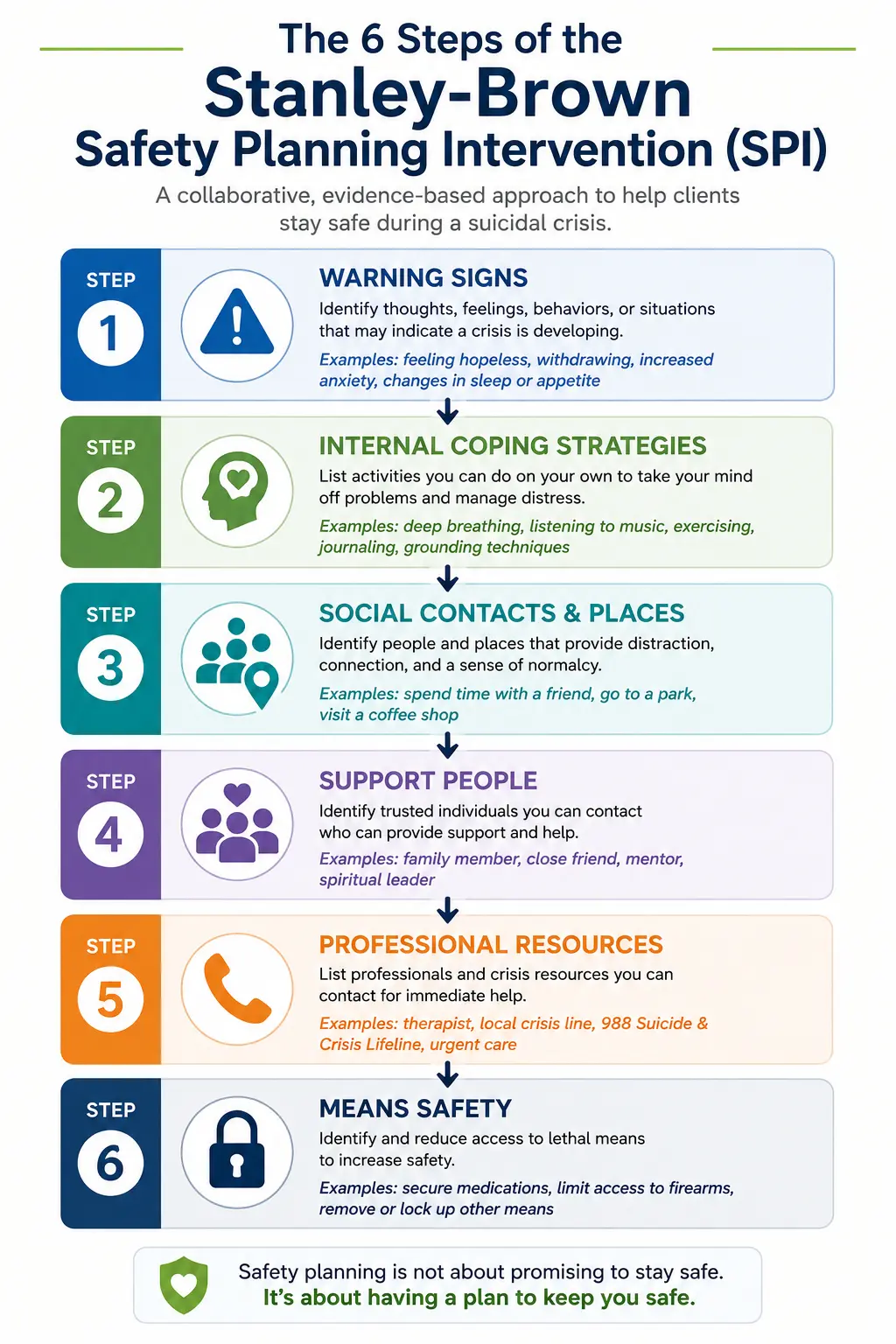
The most effective safety plans are completed collaboratively with clients using a structured, evidence-based framework. The Stanley-Brown Safety Planning Intervention (SPI) provides a six-step process clinicians can use to create individualized plans that clients can access during times of distress.
Below is the full step-by-step template, including what to ask, what good answers look like, and what clinicians commonly miss at each step.
Identify Personal Warning Signs
Ask the client: "What do you notice in yourself — thoughts, feelings, behaviors, or situations — that tell you your distress is building?" Document specific, individualized signs rather than generic ones. Examples: increasing social withdrawal, a particular intrusive thought returning, not sleeping for two nights, driving past a specific location. The more specific, the more useful. Avoid vague language like "feeling sad" — it won't activate the plan at 2 a.m.
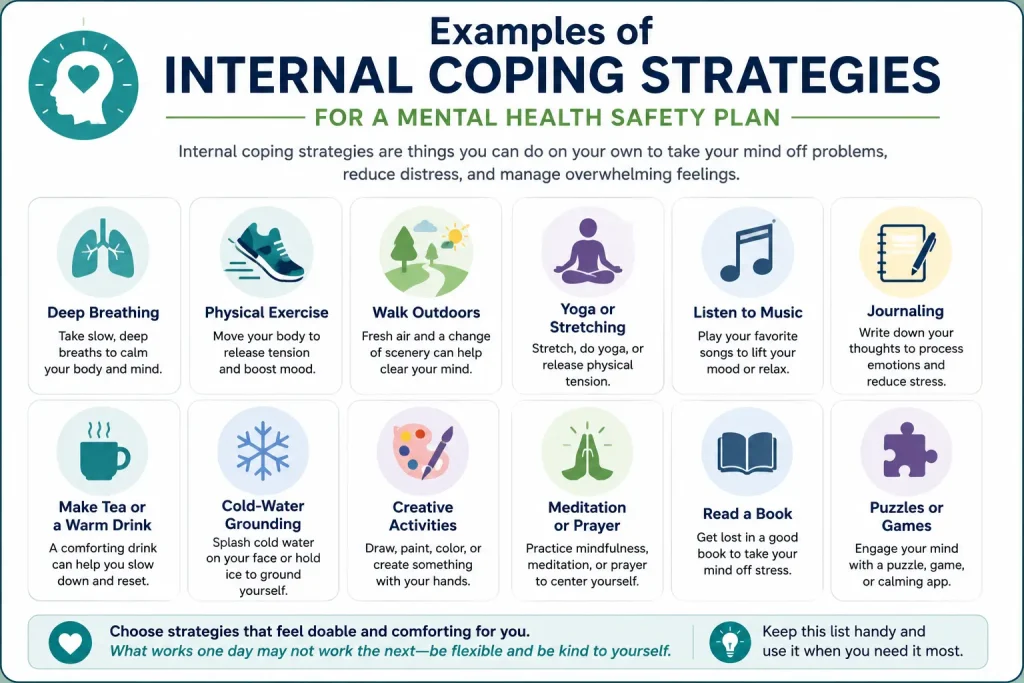
Identify Internal Coping Strategies
Ask: "What can you do on your own — without contacting anyone — to manage the urge and lower your distress?" These are self-directed strategies: paced breathing, intense physical exercise, cold water on the face, engaging in a specific activity such as music, cooking, or walking. Document what actually works for this client, not what should work in theory. Avoid strategies that require another person or access to a device that might also be a trigger.
Social Contacts and Places for Distraction
Ask: "Who could you spend time with, or where could you go, to take your mind off these thoughts — without necessarily telling them what's happening?" This step is about interrupting the thought spiral through connection or environmental change. Document specific names and places, not categories. "My sister" is more actionable than "a family member." "The coffee shop on 5th" is more actionable than "a public place."
People Who Can Provide Support in a Crisis
Ask: "Who do you trust enough to tell them you're struggling, and who would actually help?" This is different from Step 3 — these are people the client can turn to for direct emotional support or safety assistance. Document names and current contact numbers. Revisit this list regularly; contact information changes and relationships shift. If no trusted person exists, this is clinically significant information that should inform your risk formulation.
Professional and Crisis Resources
Document your direct contact information, your after-hours instructions, the 988 Suicide and Crisis Lifeline, the local mobile crisis team contact, and the nearest emergency department. Make sure the client has this information in a format they can access without the internet. Discuss what to do if they cannot reach you. This step should never feel like fine print — walk through it with the client explicitly.
Reducing Access to Lethal Means
Ask: "What in your home or environment could be used to harm yourself?" Then ask: "What is a realistic plan to secure, remove, or limit access to it?" Address firearms, such as storage outside the home or trigger locks; medications, such as whether a family member can hold them or whether prescriptions can be written in smaller quantities; and any other means the client identifies. This step is often handled minimally or not at all. It should be explicit, specific, and documented.
Together, these steps guide clients from early detection to concrete action, improving their ability to stay safe during high-risk moments.
Why the Stanley-Brown Model Works
The strength of SPI lies in how it is designed and delivered:
- Brief: It can be completed within 20–30 minutes in most clinical settings.
- Collaborative: It is built with the client, not imposed on them, enhancing engagement and strengthening the therapeutic alliance.
- Concrete: The final plan is a concise, one-page document written in clear language, making it easy to reference during moments of distress.
- Portable: Clients leave the session with a physical or digital copy, ensuring support is available when they are outside the clinician's office.
What the Research Shows About Safety Planning
This is where the conversation shifts from “good idea” to evidence-based intervention. Over the last decade, a growing body of evidence has confirmed what clinicians often observe in practice: a structured, collaborative safety plan can significantly reduce suicidal behavior and improve clinical outcomes.
Large VA Study: 45% Reduction in Suicidal Behaviors
One of the most influential studies comes from the Veterans Health Administration, where researchers compared usual care to the Stanley-Brown Safety Planning Intervention combined with follow-up contacts (SPI+)
In a large cohort comparison study of 1,640 suicidal patients seen in Veterans Health Administration emergency departments, clinicians used the Stanley-Brown Safety Planning Intervention plus structured follow-up calls (SPI+).
The findings were striking:
- 45% fewer suicidal behaviors in the 6 months after discharge
- About double the odds of attending at least one outpatient mental health visit in that period [5]
This is not a small effect. For every 44 patients who received SPI+ instead of usual care, one suicidal behavior event was prevented [6]. These improvements occurred across a large, diverse sample of high-risk individuals, demonstrating the intervention’s scalability and real-world impact.
Meta-Analyses Supporting Safety Planning Interventions
Meta-analyses and systematic reviews reinforce these results. A meta-analysis of safety planning type interventions (SPTIs) found that these approaches were associated with a 43% reduction in suicidal behavior, even when delivered as relatively brief interventions [7].
Another systematic review of 22 studies concluded that suicide safety planning interventions are generally effective at reducing suicidal behavior and ideation, and can also improve mental health symptoms, resilience, and service use [8].
The pattern is consistent:
When you actually sit down with patients, co-create a plan, write it out, practice it, and revisit it ... suicidal behavior goes down and engagement in treatment goes up.
Even when delivered as a brief intervention, a well-constructed safety plan increases a client’s ability to regulate distress, access support, and choose safer behaviors during a crisis. The evidence is clear: safety planning is not a symbolic gesture — it is an effective, actionable clinical tool.
How Safety Planning Improves Treatment Engagement
Safety planning does more than reduce immediate risk, it strengthens the therapeutic process in ways that directly improve treatment adherence and engagement. Because the plan is created collaboratively, clients experience the intervention as something done with them instead of to them. This strengthens rapport and signals that the clinician understands the client’s lived reality, fears, strengths, and struggles. When clients feel heard and empowered, they are more likely to remain engaged in therapy, attend follow-up sessions, and reach out before a crisis escalates.
Safety planning also increases engagement by giving clients a sense of agency and mastery. Instead of feeling overwhelmed by suicidal thoughts, clients gain a structured set of tools they can use independently. This fosters hope and self-efficacy, two essential drivers of continued treatment participation. Additionally, because the plan identifies specific people, places, and professional supports, it naturally builds a network of engagement beyond the therapy session. Clients know whom to call, what to do, and how to access care between sessions, reducing dropout and promoting continuity.
Finally, using a structured model like the Stanley-Brown SPI signals clinical consistency and reliability. Clients benefit when they see that their clinician follows an evidence-based process and revisits the safety plan regularly. This routine instills predictability and reinforces the idea that safety is part of the ongoing treatment, not only something addressed in moments of crisis. As a result, clients often become more open, cooperative, and proactive in therapy, leading to better outcomes over time.
Safety planning can also be integrated into ongoing suicide-focused psychotherapy. For practical guidance on connecting the safety plan with case conceptualization, coping-skills development, and relapse prevention, explore our guide to CBT for suicidal ideation.
What Goes Wrong: Six Common Mistakes Clinicians Make with the Stanley-Brown SPI
The research on safety planning is clear. The translation to practice is not. The majority of safety plan failures are not failures of the model — they are failures of implementation. After examining common patterns in safety planning documentation and outcome data, the same mistakes appear repeatedly. Here is what to watch for.
Treating It as Paperwork Rather Than a Clinical Interaction
The most common failure is completing the safety plan as an end-of-session administrative task rather than as the intervention itself. When a clinician prints a template, asks the client to fill in the blanks, and tucks it into the chart, the therapeutic value is almost entirely lost.
The safety plan is a conversation. The value comes from exploring each step collaboratively — asking follow-up questions, testing whether the coping strategy actually works for this client, and practicing the steps out loud before the client leaves. The written document is the artifact of that conversation, not a substitute for it.
Accepting Vague Answers
"I'll call a friend" is not a coping strategy. "I'll go somewhere safe" is not a crisis resource. When clients offer vague answers, clinicians often accept them to move the session forward, but vagueness is dangerous. A plan that says "contact a support person" will not be used at 11 p.m. on a Tuesday. A plan that says "text Marcus at 555-0147" might be.
At each step, push for specificity. Ask: "Which friend? Do you have their number in your phone right now? What would you say to them?" This level of detail feels slow in session. It saves lives after hours.
Skipping or Softening Step 6 (Means Safety)
Lethal means counseling — Step 6 of the Stanley-Brown model — is the step most frequently handled inadequately. Clinicians often ask a general question about firearms, receive a "no" or a vague affirmative, and move on without exploring medications, sharp objects, height, or other means the client may not have volunteered.
Means safety counseling is not optional. It is one of the most empirically supported components of suicide prevention. A specific, documented plan for securing or removing means — even if imperfect — is significantly more protective than a nonspecific acknowledgment. If a client is reluctant, that reluctance is clinically important information.
Building the Plan During a Crisis
The Stanley-Brown model is most effective when built before a client reaches acute decompensation — not during it. When a client is in the middle of a crisis, their capacity for planning, problem-solving, and new learning is significantly impaired. Building the plan then produces a document that was completed under distress and may not reflect the client's actual coping resources.
Introduce safety planning proactively, at any point when risk factors are present — not only after a disclosure or a crisis call. Then update the plan as circumstances change.
Not Providing a Copy
A safety plan the client cannot access is not a safety plan. The document should leave the session with the client — printed, photographed, or sent via the patient portal. Clients should know where it is and be able to retrieve it without logging into a system or calling the office.
In ICANotes, the completed Stanley-Brown form can be shared via the patient portal or printed directly from the chart. This step takes under two minutes and is one of the most concrete things you can do to increase the plan's real-world utility.
Never Revisiting It
A safety plan created at intake and never reviewed again is a missed clinical opportunity. Warning signs change. Coping strategies that worked last year may not work now. Trusted contacts move away. Means safety situations evolve.
The plan should be revisited at any transition in care, after an exacerbation of symptoms, and periodically as a standard part of treatment. Documenting this review — even briefly — reflects clinical engagement and strengthens the record.
Safety Planning in Practice: A Clinical Scenario
Note: The following scenario is a clinical composite. Identifying details have been changed.
A 34-year-old client — a nurse working night shifts — presents in her sixth therapy session following a divorce. She has a history of depression and one prior suicide attempt seven years ago. She discloses that suicidal thoughts have returned over the past two weeks. She describes them as "passive" but says they are more frequent than before.
Her clinician does not wait for a crisis. At the end of the session, they open the Stanley-Brown template together.
Warning signs: The client identifies three: not eating before a shift, crying in her car after work, and a specific thought — "no one would notice" — that has appeared before prior low periods. She knows this thought. She has language for it now.
Internal coping: She is a runner. They document: put on shoes, go outside, run at least 15 minutes. If it's raining, yoga video on her phone. She pauses and says, "but I probably won't do that at 3 a.m. after a shift." They add a second option: cold shower, then make tea.
Social contacts: Her sister is the only person she names. They confirm the number is saved correctly. They discuss what she would actually say: "I'm having a rough night. Can we talk?" She practices saying it out loud.
Means safety: She has access to medications through work. Her clinician asks directly about what is accessible at home. She has a full bottle of sleep medication. They agree her sister will hold it. She texts her sister during the session to confirm. The clinician documents this.
The session runs eight minutes over. The client leaves with a printed copy and a photo of it on her phone. At her next appointment two weeks later, she describes using the plan once — the cold shower, then the call to her sister. She did not go to the emergency room. She came back.
Why This Worked
The clinician did not wait for a crisis to introduce the plan. The plan was specific — not "call a friend," but her sister's number and a rehearsed opening line. Means safety was addressed directly and a concrete step was taken in session. The client left with the document in hand. None of this required extra software. It required structure, specificity, and the deliberate allocation of eight minutes.
Why Safety Planning Is Clinical Work, Not Paperwork
Clinically, a strong safety plan does several things at once.
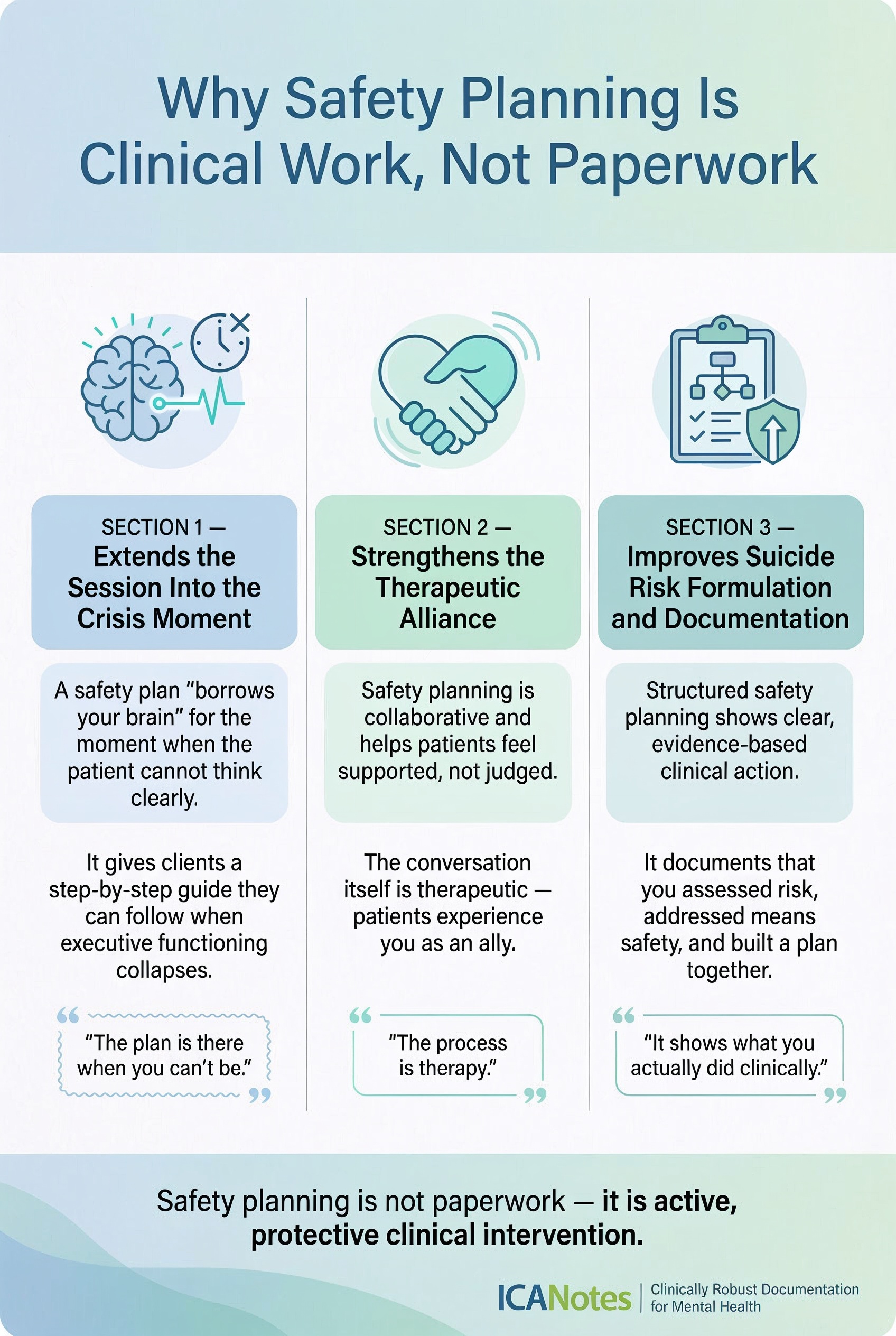
1. It Extends the Session Into the Crisis Moment
The reality is that you are not in the room when the suicidal urge peaks. The plan is.
A well-constructed safety plan “borrows your brain” for the moment when executive functioning collapses and the patient cannot think clearly. Instead of needing to remember coping skills, they can follow the steps you built together.
2. It Strengthens the Therapeutic Alliance
Safety planning is inherently collaborative. You are asking:
- “What actually helps you, not in theory but on Tuesday night at 1:00 a.m.?”
- “Who do you genuinely feel safe calling?”
- “What do you need removed from your environment to get through this alive?”
Done well, the conversation itself is therapeutic. Patients experience you as an ally, not a gatekeeper. That alliance is protective.
3. It Improves Your Suicide Risk Formulation and Liability-Safe Documentation
From a documentation and liability perspective, a plan like Stanley-Brown lets you show:
- You assessed risk
- You engaged the patient in concrete, evidence-based safety planning
- You addressed means safety
- The patient received a copy and practiced key steps
- You arranged follow-up and coordination of care
In fact, best-practice suicide documentation often includes language such as:
“Safety plan: Completed Stanley-Brown with patient; reviewed Steps 1–3 in session; patient received a copy; lethal means safety addressed.” [9]
That is not just defensive charting. It is a record that you did meaningful, evidence-aligned work.
For deeper legal context on liability considerations when suicidal ideation or imminent risk is present, see Legal Liability Issues in Suicide Care.
Why the Stanley-Brown Model Stands Out From Other Safety Plans
Many safety plans used in clinical practice today are pieced together from older templates, borrowed from outdated “no-harm contract” formats, or created informally within agencies. While well intentioned, these versions often lack essential components, do not follow an evidence-based protocol, and fail to address lethal means safety in a structured way. The Stanley-Brown Safety Planning Intervention (SPI) stands apart because it is grounded in research, clinically rigorous, and designed to be applied consistently across settings. Below are the key reasons this model remains the gold standard.
A Structured, Evidence-Based Clinical Protocol
Unlike generic safety plan templates, the Stanley-Brown model is tied directly to a clearly defined clinical protocol: the Safety Planning Intervention (SPI) [10]. This protocol outlines how clinicians should introduce, develop, and rehearse the safety plan collaboratively with clients. The process is explicit, evidence-based, and designed to support clinical reasoning rather than rely on intuition alone. Because SPI is standardized, clinicians across disciplines and settings can deliver the intervention in a way that is consistent, measurable, and grounded in best practices.
Proven Effective in High-Risk, Real-World Settings
One of the strongest arguments for the Stanley-Brown model is its extensive research base. SPI has been tested at scale in some of the most high-risk clinical environments, including Veterans Health Administration emergency departments — settings where patients often present with acute suicidal crises [11]. Studies show that when SPI is implemented, clients experience significant reductions in suicidal behaviors and increased engagement with outpatient care. This level of empirical support is rare among safety planning tools and is a major reason the model has become standard practice across large health systems.
Endorsed by National Organizations and Integrated with Lethal Means Counseling
The Stanley-Brown plan is recognized and disseminated by national suicide prevention organizations, crisis services, public health agencies, and hospital systems throughout the U.S. [12] Its widespread adoption reflects both its clinical effectiveness and its alignment with national guidelines for suicide prevention.
A distinguishing feature of the model is its explicit integration of lethal means counseling — a critical component often overlooked or minimized in other safety plans [13]. By embedding means safety directly into the step-by-step structure, SPI ensures that clinicians proactively address access to firearms, medications, and other potentially lethal items as part of the intervention, not as an optional add-on.
Together, these strengths mean that when clinicians use the Stanley-Brown model, they are not simply filling out a form — they are applying a validated, research-backed intervention with a clear lineage, defined procedures, and documented outcomes.
Bringing the Stanley-Brown Safety Plan Into Everyday Workflow with ICANotes
Here is the part that matters for your day to day practice:
You can believe in safety planning and still feel like you do not have the time or structure to do it well, especially if your documentation system makes it clunky.
ICANotes has made a different choice.
Built-In Safety Plan Template for Mental Health
Within ICANotes, the Stanley-Brown Safety Plan is available as a built-in safety plan template form, alongside other risk and self-harm tools. [14]
That means you can:
- Pull up the standardized Stanley-Brown layout inside the record
- Walk through each step collaboratively in session
- Capture patient-specific warning signs, coping strategies, supports, professional contacts, and means safety actions
- Save the plan in the chart and provide a copy to the patient (printed or via portal, depending on your configuration)
- Reference the plan directly in your progress notes, crisis notes, and discharge summaries
It moves safety planning from “extra work” to a natural extension of your clinical workflow. This approach closely parallels Step 6 of the crisis intervention process, where clinicians and clients collaborate to develop an actionable plan that promotes safety, stability, and continuity of care after a crisis.
How Clinicians Use the Safety Plan Inside ICANotes
Clinicians often pair the Stanley-Brown form with:
- A structured suicide risk assessment
- A clear risk formulation statement
- Follow-up plans (phone check, early return visit, outreach after no-show)
- Documentation that specific steps of the safety plan were practiced in session
The result is a chart that tells a coherent story:
We identified risk. We used an evidence-based safety plan. We addressed means safety. We provided a written plan. We arranged and documented follow-up.
That story matters to patients, to families, to payers, and to regulators. Most importantly, it can matter to whether your patient survives the week.
Bringing It All Together: Making Safety Planning a Standard of Care
You cannot control every variable in a patient’s life. You cannot single-handedly reverse national suicide trends, although I am sure you wish you could.
But you can control this:
- You can stop relying on outdated “no-harm contracts.”
- You can make safety planning a standard part of care for patients at elevated risk.
- You can use a model that has actual data behind it ... the Stanley-Brown Safety Planning Intervention.
- You can embed that work directly in your documentation system so it is repeatable, reviewable, and easy to teach across your team.
In a world where suicide deaths continue to climb, doing the “bare minimum” is not enough. Safety planning is not busywork. It is suicide prevention in real time.
If you are already using ICANotes, the Stanley-Brown Safety Plan is ready for you inside the system. If you are not using it yet, this is the moment to decide that every patient you identify as at risk will leave your care with more than a warning ... they will leave with a plan.
Related Resources
Looking for additional guidance on suicide prevention, crisis intervention, self-harm treatment, and clinical risk management? Explore these evidence-based resources for behavioral health clinicians.
Suicidal Ideation: Assessment, Risk Factors, and Clinical Response
Learn how to recognize suicidal ideation, assess risk, document findings, and implement appropriate interventions in behavioral health settings.
Legal Liability Issues in Suicide Care
Understand documentation requirements, standards of care, and practical strategies for reducing liability while providing effective suicide prevention services.
Self-Harm Treatment Plan Interventions and Goals
Explore evidence-based treatment goals, interventions, and documentation approaches for clients who engage in self-harm behaviors.
The 6-Step Crisis Intervention Model Explained
Review the six stages of crisis intervention and how clinicians can respond effectively during acute behavioral health emergencies.
FAQs: Mental Health Safety Plans
+
What is the difference between a safety plan and a no-suicide contract?
A no-suicide contract asks a client to promise they will not harm themselves — but research consistently shows this approach does not reduce suicidal behavior and may create a false sense of clinical security. A safety plan is fundamentally different: it is a structured, collaborative tool that teaches a client exactly what to do when suicidal urges escalate. It includes personalized warning signs, coping strategies, trusted contacts, crisis resources, and a means safety plan. Unlike a no-suicide contract, a safety plan gives the client a concrete, portable resource they can use independently during a crisis. The Stanley-Brown Safety Planning Intervention (SPI) is the evidence-based gold standard and is endorsed by the VA, SAMHSA, 988 Lifeline, and other national organizations.
+
Can I download a free mental health safety plan template?
Yes. ICANotes offers a free Safety Planning Toolkit for clinicians that includes a fillable Stanley-Brown SPI template, sample documentation language for clinical notes, and a step-by-step guide for completing the plan collaboratively in session. You can download it using the form on this page. Clinicians using ICANotes also have access to the Stanley-Brown Safety Plan as a built-in form inside the EHR, allowing them to complete, save, and share the plan directly from the client's chart.
+
How should a safety plan be handled in telehealth sessions?
Safety planning in telehealth requires extra attention to two elements: verifying the client's physical location and ensuring they can receive a copy of the completed plan. Before completing a safety plan remotely, confirm the client's current address and nearest emergency facility — this information should be updated in the chart if the client has relocated. Walk through each step of the Stanley-Brown model as you would in person, using screen share if helpful. After completing the plan, send a copy via your patient portal so the client has immediate access. Document that the plan was completed via telehealth, that location and emergency resources were confirmed, and that a copy was provided. Clinicians transitioning a client to a new geographic area should update the safety plan to reflect local crisis resources before the first telehealth session in the new location.
+
What is a mental health safety plan?
A mental health safety plan is a written, step-by-step strategy that helps individuals recognize warning signs, use coping skills, contact supportive people, and restrict access to lethal means during moments of heightened suicide risk. It is a collaborative, evidence-based clinical intervention — not a verbal promise or “no-harm contract.”
+
When should clinicians create a mental health safety plan?
A safety plan should be created whenever a client is experiencing suicidal ideation, has a history of self-harm, or presents with risk factors such as major depressive episodes, hopelessness, or significant psychosocial stressors. Plans should be updated as risk levels change.
+
How often should a mental health safety plan be reviewed?
Safety plans should be reviewed regularly — especially during elevated risk, after a crisis, at transitions of care, or any time new information emerges about the client’s safety or environment. Reviewing plans helps reinforce coping strategies and ensures accuracy.
+
How does ICANotes support safety planning?
ICANotes includes the Stanley-Brown Safety Plan as a built-in form, allowing clinicians to complete the plan collaboratively in session, save it to the chart, and share a copy with the client. The plan can be referenced directly in progress notes, crisis intervention notes, and discharge summaries to ensure thorough, consistent documentation.
+
Can I download a mental health safety planning PDF?
Many clinicians prefer a printable PDF version of the safety plan to share with clients. ICANotes’ built-in Stanley-Brown Safety Plan can be printed or shared via the portal, making it easy to provide clients with a usable, portable plan during times of crisis.
Recent Posts






About the Authors

Dr. October Boyles
DNP, MSN, BSN, RN
Dr. October Boyles is a behavioral health expert and clinical leader with extensive expertise in nursing, compliance, and healthcare operations. With a Doctor of Nursing Practice (DNP) and advanced degrees in nursing, she specializes in evidence-based practices, EHR optimization, and improving outcomes in behavioral health settings. Dr. Boyles is passionate about empowering clinicians with the tools and strategies needed to deliver high-quality, patient-centered care.
Dr. Virna Little is a distinguished leader in behavioral health integration. She is the co-founder of Concert Health, a behavioral health medical group that provides Collaborative Care to organizations across 21 states. Dr. Little is also the Co-Founder and CEO of Zero Overdose, a national non-profit focused on overdose safety planning to reduce unintentional overdose events and deaths. Dr. Little has served as a member of the national Zero Suicide faculty and a consultant who fostered the development of integrated delivery systems nationally in all 50 states and internationally. Dr. Little holds a Doctoral degree in Psychology and a Master's in Social Work. A nationally and internationally recognized speaker, Dr. Little has presented on suicide prevention strategies at the White House. She has received numerous awards for her work in integrating primary care and behavioral health and serves on multiple boards.