CBT for Suicidal Ideation: Clinician Strategies
How suicide-focused CBT uses conceptualization, chain analysis, and skill-building after immediate safety needs are addressed.


Cognitive behavioral therapy can help clinicians address the thinking patterns, behavioral withdrawal, problem-solving difficulties, and coping deficits that contribute to suicidal crises. This guide explains how suicide-focused CBT uses case conceptualization, chain analysis, cognitive restructuring, behavioral activation, problem solving, coping skills, and relapse prevention after immediate safety needs have been addressed.
Once risk assessment and immediate safety planning are complete, cognitive behavioral therapy gives clinicians a structured way to reduce suicidal thinking and behavior over time.
This article is written for licensed and trained behavioral health clinicians. It does not replace your organization's protocols, clinical supervision, emergency evaluation, or crisis services. If you or a client is in immediate danger, contact the 988 Suicide & Crisis Lifeline or local emergency services.
Key Takeaways
- CBT for suicidal ideation should complement — not replace — risk assessment, safety planning, lethal-means safety, and ongoing reassessment.
- Suicide-focused case conceptualization helps clinicians identify the beliefs, triggers, emotions, behaviors, and coping patterns contributing to a client's suicidal crisis.
- Chain analysis reveals multiple intervention points before a crisis reaches its peak.
- Cognitive restructuring, behavioral activation, problem solving, coping skills, and urge-management strategies address different points in the suicidal crisis pathway.
- CBT-SP, brief CBT for suicide prevention, and individual CBT techniques are related but are not interchangeable protocols.
- Relapse prevention helps clients recognize warning signs and rehearse how they will respond to future high-risk situations.
How Does CBT Help with Suicidal Ideation?
CBT for suicidal ideation focuses directly on the thoughts, beliefs, behaviors, emotional responses, and coping patterns that contribute to suicidal crises. Rather than treating suicidal thinking only as a symptom of another diagnosis, suicide-focused CBT helps clinicians identify the client's individual “suicide mode,” map triggers and vulnerabilities, challenge rigid or hopeless thinking, strengthen problem-solving and coping skills, increase engagement in meaningful activity, and rehearse responses to future high-risk situations. Risk assessment, safety planning, and appropriate crisis intervention remain ongoing parts of care.
Where CBT Fits in the Suicide Care Workflow
CBT techniques are introduced after immediate safety needs have been addressed and the clinician determines that CBT-informed treatment is appropriate for the client's current level of care. Risk assessment and safety planning continue throughout treatment as risk changes. If you need a refresher on screening tools such as the C-SSRS, SAFE-T, or PHQ-9, or on documenting suicidal ideation under ICD-10, see Assessing and Documenting Suicidal Ideation. That groundwork determines whether a client is appropriate for outpatient, CBT-informed work at all.
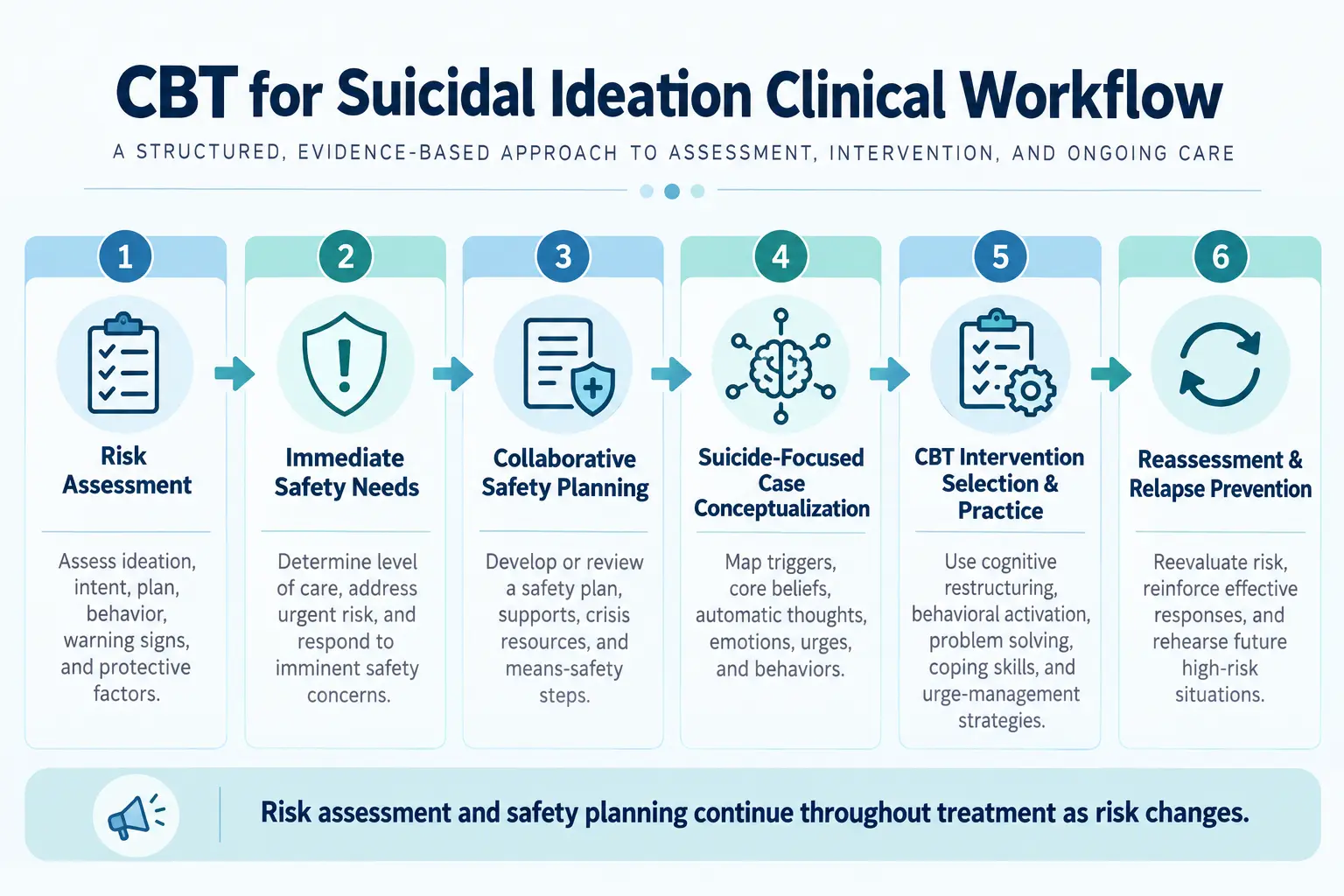
Safety planning is the second required foundation. The full six-step Stanley-Brown Safety Planning Intervention, including warning signs, internal coping strategies, social contacts, professional resources, and lethal-means safety, is covered in Mental Health Safety Planning. This article treats a completed safety plan as a prerequisite, then shows how CBT techniques become part of that plan and how a clinician rehearses them with the client.
Illustrative teaching example: Maria
Maria, a 32-year-old teacher who presents with suicidal thoughts triggered by divorce and financial strain. This is an illustrative teaching example, not a published case.
The therapist identifies passive suicidal ideation, a prior attempt five years earlier, access to prescription medication, and limited social support. Maria denies current intent or a plan.
The therapist and Maria build a safety plan together: recognizing warning signs of isolation and insomnia, using journaling and deep breathing as internal coping strategies, listing her sister and therapist as contacts, and securing her medication with a friend. Only after that plan is in place does the work described in the rest of this article begin.
One point worth stating plainly: no-suicide contracts, sometimes called contracts for safety, are not recommended by national suicide-prevention organizations as a stand-in for risk assessment, safety planning, lethal-means counseling, or follow-up. A signed promise not to attempt suicide does not reduce risk and can create a false sense of security for the clinician. Current guidance, including the VA/DoD Clinical Practice Guideline, centers risk assessment, safety planning, and structured follow-up instead (Department of Veterans Affairs & Department of Defense, 2024).
Building a Suicide-Focused Case Conceptualization
Suicidal behavior is rarely explained by a single wish to die. A case conceptualization gives you language for what is actually driving the client toward suicide as an option, and it becomes the foundation for everything that follows.
Shneidman's Ten Commonalities
Psychologist Edwin Shneidman, founder of the American Association of Suicidology, described ten features that recur across suicidal presentations. Reviewing them with a client in mind helps you see past "wanting to die" to the specific pain underneath:
- A purpose of seeking a solution to an unbearable problem
- A goal of cessation of consciousness rather than death itself
- A stimulus of intolerable psychological pain
- A stressor of frustrated psychological needs, such as belonging
- Emotion marked by helplessness and hopelessness
- A cognitive state of ambivalence between wanting to die and wanting help
- A perceptual state of constriction, where only two options seem to exist
- An interpersonal act that communicates distress or intent
- An action aimed at escape from an intolerable situation
- Consistency with the person's lifelong coping patterns, often withdrawal and isolation
Beck's Suicide Mode and the Matthews CBT Model
Aaron Beck, the founder of cognitive therapy, described an activated cognitive, emotional, physiological, and behavioral state he called the suicide mode. Clinicians building on Beck's model, including a CBT model of suicide developed by Matthews, describe how that mode gets triggered. Core beliefs about self, others, and the future, formed early in life, act as the first domino. Beliefs like "I am worthless" or "my future is hopeless" set the stage for dichotomous thinking and cognitive rigidity, an all-or-nothing style that leaves a client seeing only two options: keep suffering or die.
That rigidity feeds an attentional bias, a narrowing of memory and attention toward evidence that confirms hopelessness while evidence to the contrary gets filtered out. Problem-solving ability drops as a result. What remains is what clinicians sometimes call the three I's: pain experienced as inescapable, intolerable, and interminable. The more a client experiences pain this way, the deeper the hopelessness, and the more the suicide mode takes over as the dominant state.
Mapping the Conceptualization: The Marcus Case
The following is an illustrative teaching example built from training material, not a published case report. Marcus, a 37-year-old man, presents after a suicide attempt involving alcohol and medication following the end of a relationship, a job loss, and an eviction notice. His conceptualization ties together relevant history (a father who modeled emotional suppression), core beliefs ("I am inadequate," "I am a burden"), intermediate beliefs ("if I rely on others, I'll be rejected"), compensatory strategies (withdrawal, perfectionism), an activating event (the eviction notice), automatic thoughts ("everyone would be better off without me"), and resulting emotions of shame, despair, and numbness that he manages through alcohol use and isolation.
A useful discipline here, drawn from Beck's own recommendation, is to write this conceptualization as a one- to two-paragraph narrative and share it with the client rather than keeping it as an internal clinical note. Reviewing the formulation together gives the client a coherent account of how they arrived at the suicide mode, which is itself a form of psychoeducation.
Chain Analysis: From Vulnerability to Crisis Point
A chain analysis maps how a suicidal crisis builds, link by link, rather than treating it as a sudden event. The chain starts with vulnerability factors: depression, trauma history, social isolation, and access to lethal means all lower the threshold at which a trigger produces escalation. A trigger, whether a rejection, a loss, or a stressful life event, then activates automatic thoughts and core beliefs, which produce emotional and physical responses, which produce urges and impulses, which can lead to behaviors and, without intervention, a crisis or breaking point. Chain analysis is also a core component of the manualized CBT-SP treatment model (Stanley et al., 2009).
Vulnerability factors
Depression, trauma history, social isolation, and access to lethal means all lower the threshold at which a trigger produces escalation.
Trigger
A rejection, a loss, or a stressful life event activates automatic thoughts and core beliefs.
Thoughts and beliefs
Automatic thoughts and core beliefs produce emotional and physical responses.
Urges and impulses
Emotional and physical responses produce urges and impulses, which can lead to behaviors.
Crisis point
Without intervention, the chain reaches a crisis or breaking point.
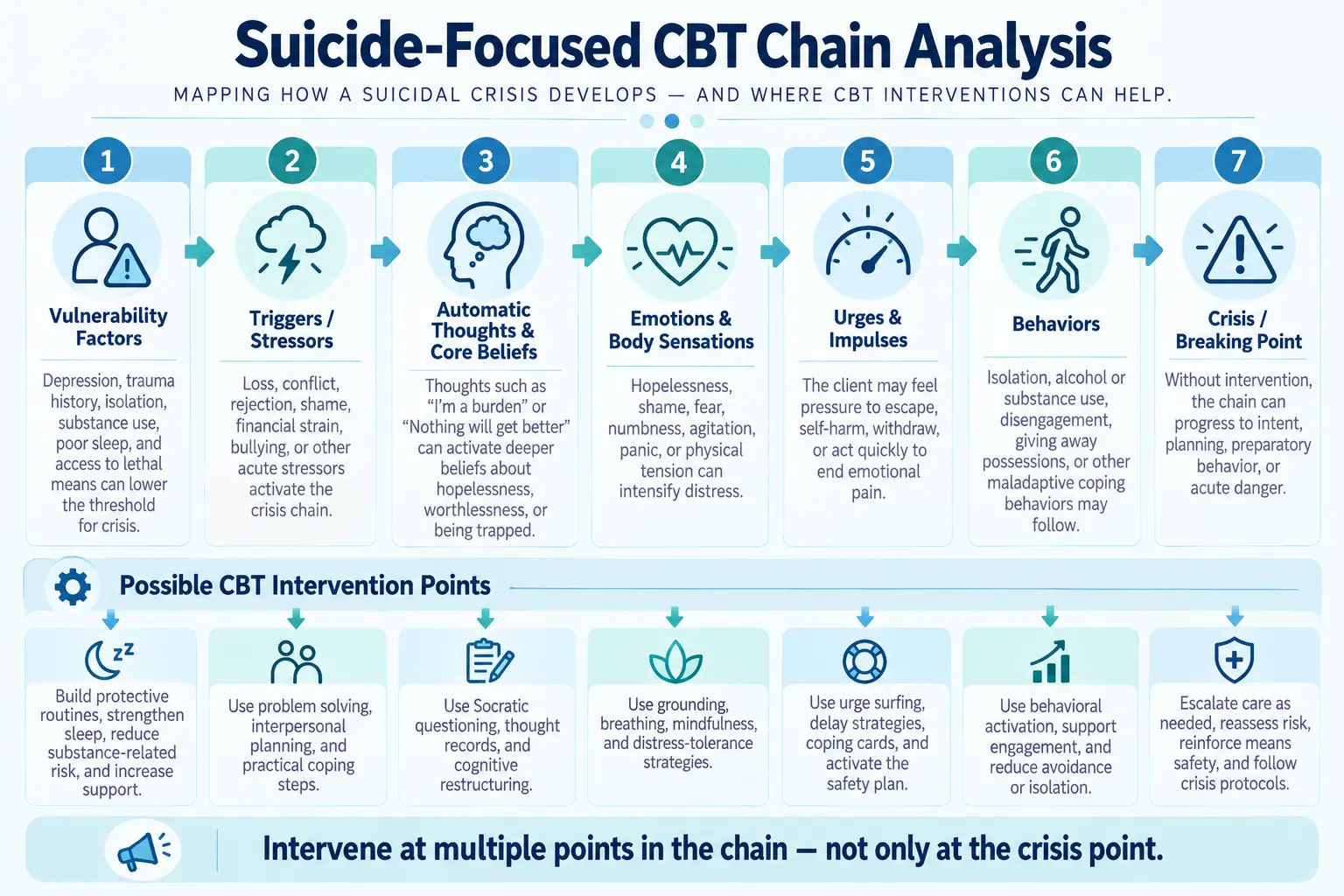
The value of mapping the chain is that it creates several places to intervene instead of one. Working with situational triggers calls for problem-solving and interpersonal skills. Automatic thoughts respond to Socratic questioning and thought records. Core beliefs need slower, schema-level work. Emotional and physical escalation responds to grounding and mindfulness. Urges and impulses respond to urge surfing and an activated safety plan. The earlier in the chain you intervene, the more options remain available to the client and the lower the intensity of response required.
Put Suicide-Focused CBT Tools Into Practice
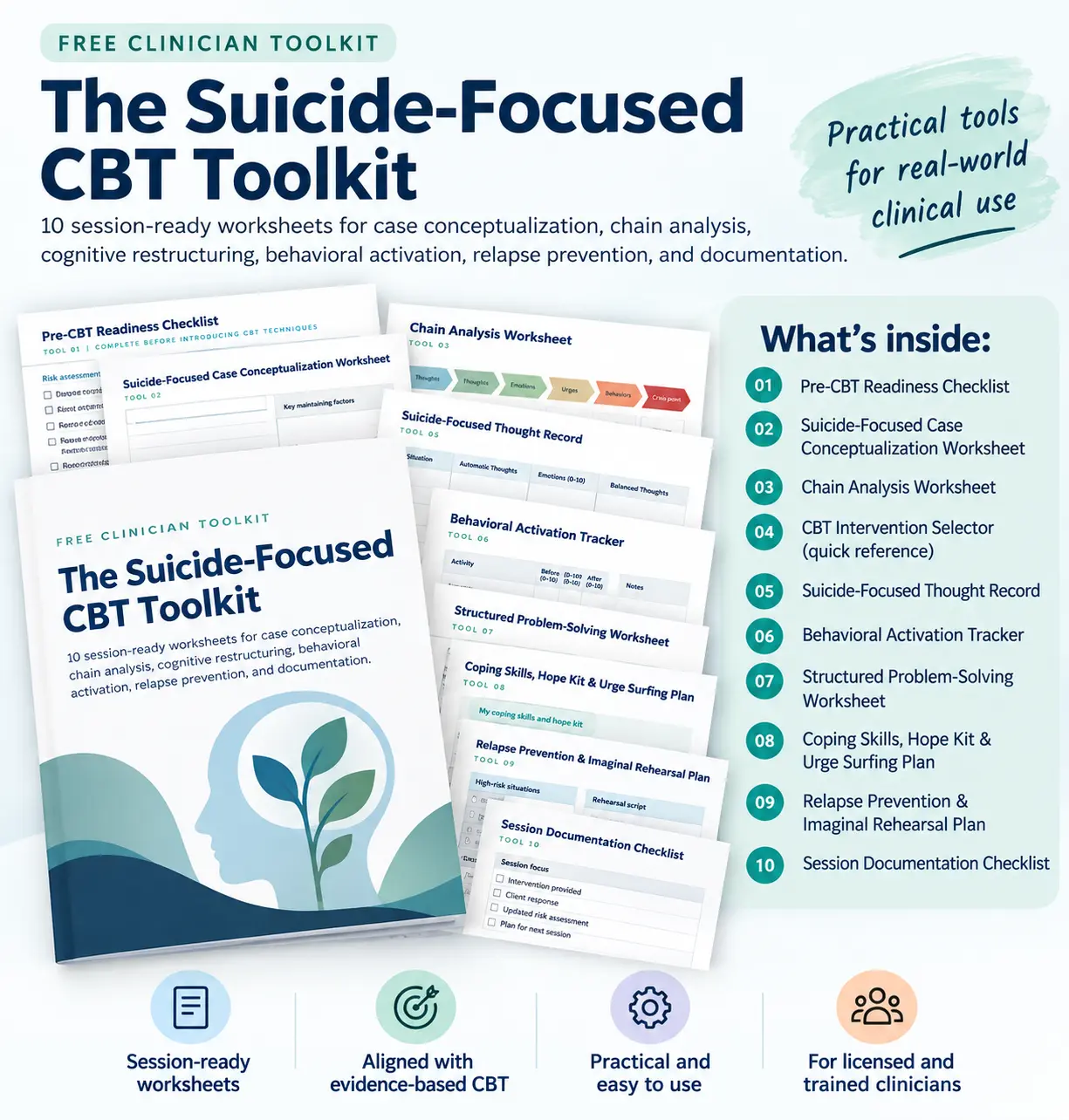
Download 10 session-ready worksheets designed to help clinicians move from case conceptualization and chain analysis to intervention selection, skill practice, relapse prevention, and documentation.
- Use practical worksheets for case conceptualization, chain analysis, and CBT technique selection
- Apply tools for cognitive restructuring, behavioral activation, problem solving, and urge management
- Support relapse prevention, imaginal rehearsal, and ongoing risk reassessment
- Strengthen documentation with a session checklist for formulation, intervention, response, risk, and follow-up
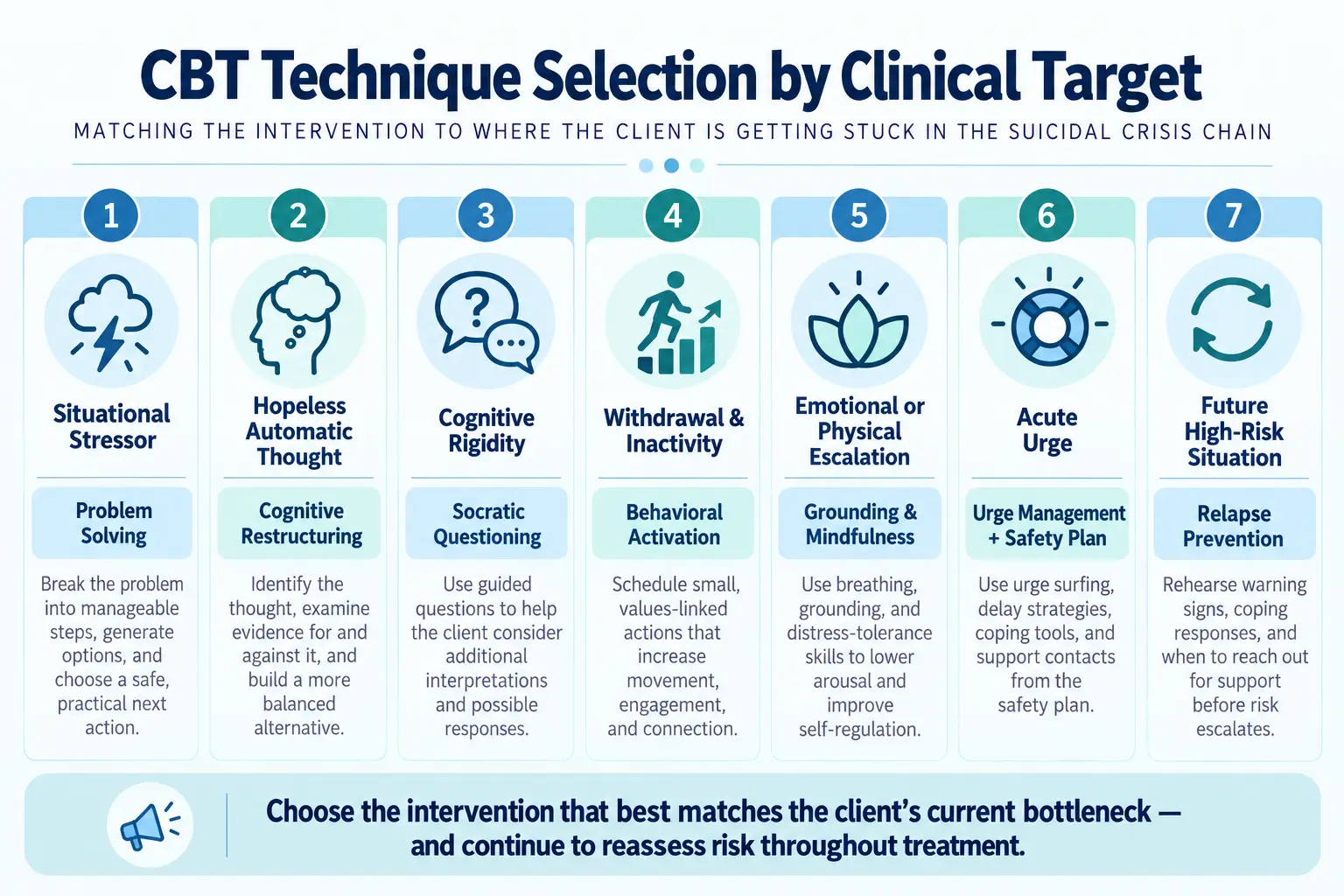
Choosing a CBT Intervention Based on the Clinical Target
The most appropriate CBT technique depends on where the client is getting stuck in the suicidal crisis chain. Rather than applying the same intervention to every presentation, clinicians can use the case conceptualization and chain analysis to identify the primary clinical target and select a strategy that addresses that point while continuing to monitor risk.
| Clinical target | CBT strategy | Example |
|---|---|---|
| Situational stressor | Problem solving | Break an overwhelming problem into manageable next steps |
| Automatic hopeless thought | Cognitive restructuring | Examine “Nothing will ever get better” using evidence and balanced alternatives |
| Cognitive rigidity | Socratic questioning | Explore additional interpretations and possible options |
| Withdrawal and inactivity | Behavioral activation | Schedule small, values-based activities |
| Emotional or physiological escalation | Grounding, breathing, mindfulness | Reduce arousal enough to access other coping strategies |
| Acute urge | Urge-management skills + safety plan | Delay action, use coping strategies, and contact supports |
| Recurring crisis pattern | Chain analysis | Identify vulnerabilities, triggers, thoughts, emotions, urges, and behaviors |
| Future high-risk situation | Relapse prevention / imaginal rehearsal | Practice how the client will recognize and respond to warning signs |
Psychoeducation: Teaching the Client Their Own Model
Once you have a conceptualization and a sense of the chain, the next step is teaching the client how their own thoughts, urges, feelings, behaviors, and core beliefs connect. This can take several forms: walking through a diagram of the suicide mode, sharing the written case conceptualization, or using examples suited to the client's age and reading level. With adolescents, this often means simpler language and more visual tools than you would use with an adult client. The goal is for the client to see their crisis as something with a recognizable structure, which itself starts to counter the sense that the pain is interminable.
How to Use Cognitive Restructuring for Suicidal Ideation
Cognitive restructuring is one of the central techniques used in CBT-informed treatment of suicidal thoughts and behaviors. The clinician helps the client identify an automatic thought tied to suicidal thinking, such as "I am a burden" or "things will never get better," names the cognitive distortion at work (commonly all-or-nothing thinking or catastrophizing), and works with the client to weigh evidence for and against the thought before arriving at a more balanced alternative. Cognitive restructuring and cognitive reappraisal are incorporated into suicide-focused CBT approaches to help clients respond more flexibly to distressing thoughts and situations.
Socratic questioning is the method, not a separate technique. Rather than telling the client their thought is wrong, you ask questions that let them examine the evidence and reach their own conclusion. Scaling helps make the shift visible: ask the client to rate how strongly they believe the original thought and the alternative thought, both before and after the restructuring work. Small movement, even a single point on a ten-point scale, is a meaningful result worth naming.
A Thought Record in Practice: The Jason Case
The following is an illustrative exercise from training material, not a controlled outcome. Jason, a graduate student, arrives with escalating suicidal thoughts tied to academic pressure and a recent breakup. His automatic thought is "I am a complete failure, and things will never get better," which he rates as producing 85% hopelessness, 80% worthlessness, and 65% self-rated suicidality.
| Element | Jason's entry |
|---|---|
| Situation | Rejected from a job he wanted |
| Emotion intensity | Hopeless 85%, worthless 80%, suicidal 65% |
| Automatic thought | "I'm a failure. Nothing will ever get better. People will be better off without me." |
| Distortions identified | All-or-nothing thinking, catastrophizing |
| Evidence against | Past academic successes, supportive relationships |
| Balanced thought | "I am struggling right now, but I have overcome challenges before and can ask for help." |
| Result after repeated practice | Self-rated suicidality dropped from 65% to 15% |
In the webinar example, repeated practice and self-monitoring were emphasized as important parts of cognitive restructuring. The change in Jason's ratings is an illustrative teaching example and should not be interpreted as an expected treatment effect.
Behavioral Activation for Suicidal Ideation
Behavioral activation can be especially useful when a client is not ready or able to engage in cognitive restructuring. Rather than beginning by examining thoughts directly, the clinician helps the client take small, values-linked actions that may reduce withdrawal, increase engagement, and create momentum for later cognitive work.
The Lena Case
This illustrative example describes Lena, a 27-year-old graphic designer who reports persistent suicidal thoughts tied to depression, loneliness, and low motivation, spending most days in bed. Rather than beginning with thought records, the therapist and Lena identify small, values-linked activities: a morning walk, a daily shower, texting one friend by the end of the week. They track her mood before and after each activity. The goal is to test whether small, values-linked activities change mood, energy, connection, or hopelessness and to use those observations to guide the next intervention. For clients like Lena, behavioral activation, well supported by depression research, can be a more accessible entry point than cognitive work, and the two often combine well once some momentum builds.
Problem-Solving CBT for Suicidal Ideation
Problem solving targets the specific, situational triggers that feed the chain described earlier. The clinician helps the client define the problem precisely, generate options, choose a safe and realistic option, practice it, and then review what worked.
The Maya Case
Maya, age 15, is referred to therapy after expressing suicidal ideation connected to bullying and family conflict. This is an illustrative teaching example. The therapist helps her identify two specific stressors: avoiding certain classmates and recurring arguments at home. Together they break these into manageable steps: contacting a trusted teacher, practicing assertive communication through role play, and building toward a conversation with her parents about how she is feeling. The role play matters here. Rehearsing the conversation before having it lowers the barrier to actually reaching out, which is often the hardest part for a teenager already feeling isolated.
Coping Skills, Hope Kits, and Urge Surfing
Alongside cognitive and behavioral techniques, clients need concrete tools for the moments when distress spikes. Grounding, breathing exercises, mindfulness, distraction, and somatic techniques all have a place here, and DBT-informed skills combine well within a broader CBT-for-suicidal-ideation approach.
Two tools deserve specific mention. A hope kit is a tactile, personalized collection of items, photos, or reminders that a client can turn to when hopelessness spikes. It functions as a physical extension of the safety plan rather than a replacement for it. Urge surfing teaches the client to notice a suicidal or self-harm urge, observe it rise and fall like a wave, and ride it out using distraction, the safety plan, or a support contact, without acting on it. Urge surfing is a skill for tolerating an urge in the moment. It is not a substitute for the risk assessment and safety plan that should already be in place.
Relapse Prevention and Imaginal Rehearsal
CBT for suicide prevention does not end when acute symptoms improve. Relapse prevention asks the client to identify their own early warning signs, the specific vulnerabilities and triggers most likely to reactivate the suicide mode. Imaginal rehearsal takes this a step further: the clinician asks the client to picture a realistic future high-risk situation and walk through how they would recognize it, which coping skills they would use, and when they would reach out for support. Relapse-prevention work is also an explicit component of CBT-SP (Stanley et al., 2009)
The goal is to catch the chain early the next time it starts, rather than waiting for it to reach a breaking point again. This is also where the case conceptualization, the chain analysis, and the safety plan come together as one integrated tool the client has practiced, not three separate documents.
CBT-SP, Brief CBT, and General CBT-Informed Techniques: Related but Not Interchangeable
CBT-SP, Brief CBT/BCBT, and general CBT-informed techniques share important principles, but they differ in structure, target populations, evidence base, and how they are used in clinical practice.
| Approach | What it is | Population/evidence context | Typical components |
|---|---|---|---|
| CBT-SP | Manualized Cognitive Behavioral Therapy for Suicide Prevention | Originally developed/tested with adolescents following a suicide attempt | Chain analysis, safety planning, case conceptualization, skill building, relapse prevention |
| Brief CBT / BCBT | Suicide-focused brief cognitive behavioral protocols | Studied in populations including military personnel and hospitalized patients | Crisis-response planning, emotion regulation, cognitive and behavioral skills, relapse prevention |
| CBT-informed techniques | Individual CBT strategies incorporated into broader treatment | Used according to clinical formulation rather than as one standardized protocol | Cognitive restructuring, behavioral activation, problem solving, coping skills |
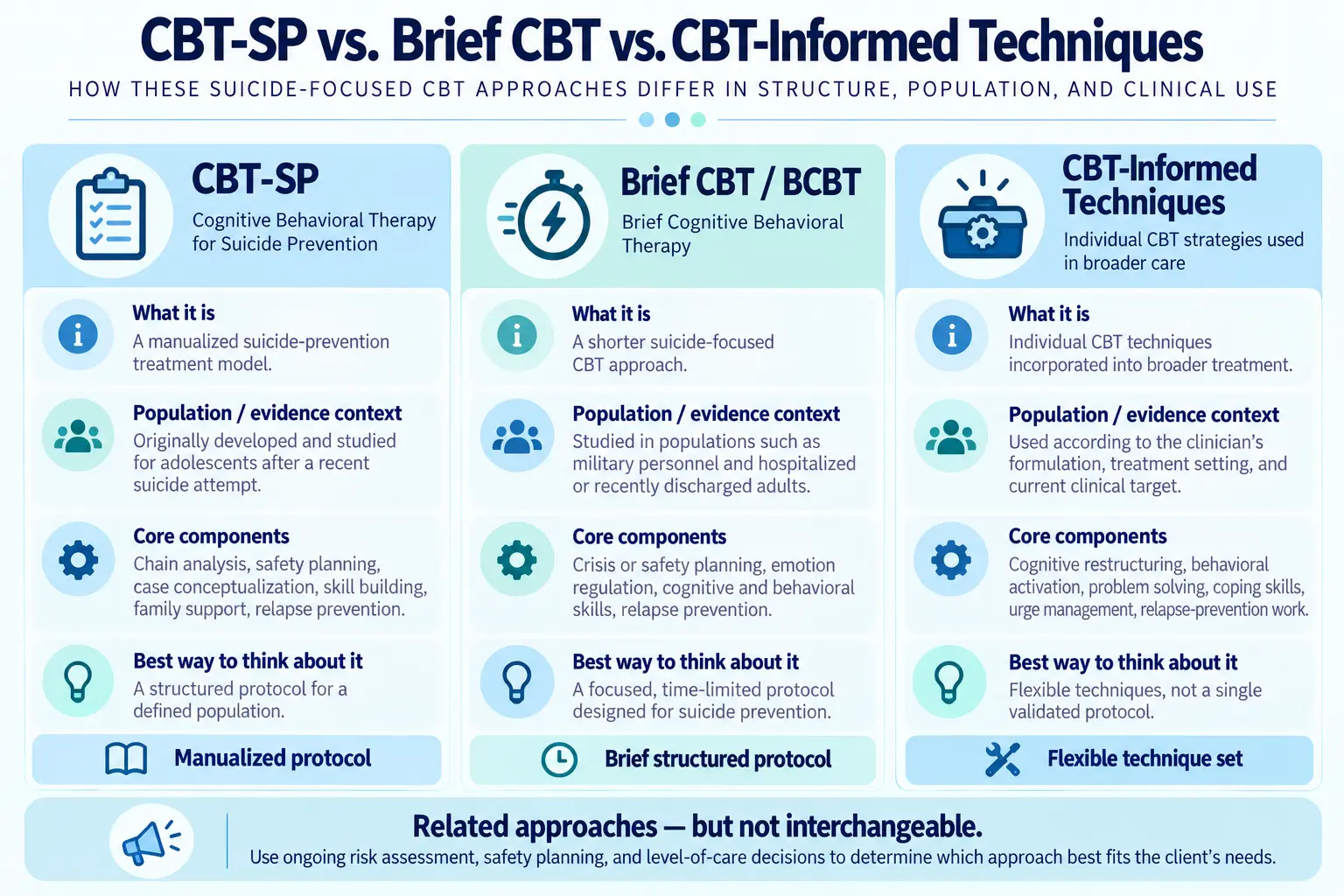
These terms get used loosely, and it is worth being precise. Cognitive Behavioral Therapy for Suicide Prevention, or CBT-SP, is a manualized protocol developed and tested specifically for adolescents following a recent suicide attempt. In the model's feasibility study, 110 adolescents were enrolled and 72.4% completed 12 or more sessions, with the protocol built around chain analysis, safety planning, skills training, and relapse prevention across defined treatment phases (Stanley et al., 2009).
Brief CBT for suicidal ideation refers to shortened protocols tested in specific populations. Rudd and colleagues found that a brief cognitive-behavioral protocol reduced post-treatment suicide attempts in a military sample compared with treatment as usual (Rudd et al., 2015). More recently, Diefenbach and colleagues tested an inpatient adaptation of brief CBT delivered in up to four sessions. The intervention reduced suicide attempts over the six months after discharge when added to treatment as usual, although effects on suicidal ideation were less clear (Diefenbach et al., 2024). That distinction matters: reducing suicide attempts and reducing the intensity of suicidal thinking are related but not identical outcomes.
General CBT-informed techniques, the cognitive restructuring, behavioral activation, problem solving, and coping skills covered in this article, draw on the same underlying model but are not a substitute for a validated protocol when a client's presentation matches the population that protocol was built for. The strongest single data point for cognitive therapy's effect on reattempts remains the original 2005 randomized trial: 24.1% of adults who received cognitive therapy after a suicide attempt made a subsequent attempt within 18 months, compared with 41.6% of those receiving enhanced usual care, a hazard ratio of 0.51 (Brown et al., 2005). A 2022 umbrella review of nine systematic reviews and meta-analyses concluded that CBT shows a consistently positive, though mostly medium-quality, evidence base across suicidal ideation and attempts, and called for more research across diverse populations (Wu et al., 2022). A newer systematic review and meta-analysis of 28 randomized controlled trials involving 5,883 adults found that CBT produced a significant short-term reduction in suicidal ideation and reduced suicidal and self-harming behaviors across short-, medium-, and long-term follow-up periods. However, the advantage for suicidal ideation itself was not statistically significant at medium- or long-term follow-up, reinforcing the importance of distinguishing changes in suicidal thoughts from changes in suicidal behavior (Tong et al., 2025).
Emerging evidence also suggests that CBT benefits may extend to online delivery in selected populations. In a 2026 randomized controlled trial of 50 adults with depression who had attempted suicide within the previous six months, a 20-session online CBT program was associated with lower suicidal ideation and hopelessness and greater cognitive flexibility compared with standard psychiatric treatment alone. The between-group benefit for suicidal ideation was evident at one and three months but was no longer statistically significant at six months, while improvements in cognitive flexibility and hopelessness were maintained (Aslan & Arslantaş, 2026).
The VA/DoD Clinical Practice Guideline and the VA MIRECC both recommend offering CBT-based psychotherapy focused on suicide prevention to patients with a history of suicidal behavior within the past six months, delivered alongside safety planning, means counseling, and ongoing reassessment rather than in place of them (Department of Veterans Affairs & Department of Defense, 2024, and VA MIRECC, n.d.).
Documenting CBT-Informed Suicide Care
Every session that touches suicide risk needs a documentation trail that shows your clinical reasoning, not just the technique used. At minimum, a note should capture the current formulation, the specific technique applied (cognitive restructuring, behavioral activation, problem solving, and so on), the client's response, the updated risk level, and the follow-up plan. This documentation habit supports continuity of care and clinical reasoning. For duty-to-warn obligations, malpractice exposure, and documentation practices built specifically for risk management, see Legal and Liability Issues in Suicide Care.
In practice, this kind of structured note takes time to write well, especially across a caseload where several clients need active risk monitoring. This is where a behavioral-health-specific documentation platform like ICANotes helps. Its menu-driven templates prompt for formulation, intervention, client response, and updated risk in a consistent structure, which helps clinicians document assessment, intervention, client response, and follow-up in a consistent structure..
Document CBT-informed suicide care with confidence
See how ICANotes helps you capture formulation, intervention, and updated risk in a consistent structure across every session.
- Prompt for formulation and updated risk each note
- Menu-driven templates for CBT interventions
- Capture client response and follow-up plans
- Track active risk across a full caseload
See how ICANotes can support your clinical workflow. Start your free 30-day trial, no credit card required.
Start Your Free 30-Day Trial
Frequently Asked Questions
What's the difference between CBT-SP, brief CBT, and general CBT-informed work for suicidal ideation?
Is CBT appropriate for a client with passive suicidal ideation?
What CBT techniques are used for suicidal ideation?
Can behavioral activation come before cognitive restructuring?
Does CBT replace a safety plan or risk assessment?
How long does brief CBT for suicidal ideation typically take?
A Final Note
CBT gives clinicians a structured, evidence-grounded way to address suicidal thoughts and behaviors after immediate safety needs have been addressed and CBT-informed treatment is appropriate for the client's current level of care. Risk assessment and safety planning should continue as the client's risk changes. The techniques covered here, conceptualization, chain analysis, cognitive restructuring, behavioral activation, problem solving, coping skills, and relapse prevention, work best as a coordinated plan built with the client, documented clearly, and revisited as risk changes.
References
- Brown GK, Ten Have T, Henriques GR, et al. "Cognitive therapy for the prevention of suicide attempts: a randomized controlled trial." JAMA, 2005. https://pubmed.ncbi.nlm.nih.gov/16077050/
- Rudd MD, Bryan CJ, Wertenberger EG, et al. "Brief cognitive-behavioral therapy effects on post-treatment suicide attempts in a military sample." American Journal of Psychiatry, 2015. https://pubmed.ncbi.nlm.nih.gov/25677353/
- Stanley B, Brown G, Brent D, et al. "Cognitive Behavior Therapy for Suicide Prevention: Treatment Model, Feasibility and Acceptability." Journal of the American Academy of Child & Adolescent Psychiatry, 2009. https://pmc.ncbi.nlm.nih.gov/articles/PMC2888910/
- Diefenbach et al. "Brief Cognitive Behavioral Therapy for Suicidal Inpatients: A Randomized Clinical Trial." JAMA Psychiatry, 2024. https://jamanetwork.com/journals/jamapsychiatry/fullarticle/2823589
- Tong F, Zhang Y, Jiao Y. “The efficacy of cognitive behavioral therapy on reducing suicidal symptoms among adults: a systematic review and meta-analysis.” Frontiers in Psychology. 2025;16:1672957. https://www.frontiersin.org/journals/psychology/articles/10.3389/fpsyg.2025.1672957/full
- Aslan R, Arslantaş H. “The Efficacy of Online Cognitive Behavioral Therapy on Suicidal Ideation, Cognitive Flexibility, and Hopelessness in Persons Diagnosed with Depression who Attempted Suicide: Randomized Controlled Trial.” Cognitive Therapy and Research. 2026. https://doi.org/10.1007/s10608-026-10748-9
- Baker JC, Starkey A, Ammendola E, et al. “Telehealth Brief Cognitive Behavioral Therapy for Suicide Prevention: A Randomized Clinical Trial.” JAMA Network Open. 2024;7(11):e2445913. https://jamanetwork.com/journals/jamanetworkopen/fullarticle/2826055
- Wu H, Lu L, Qian Y, et al. "The significance of cognitive-behavioral therapy on suicide: An umbrella review." Journal of Affective Disorders, 2022. https://doi.org/10.1016/j.jad.2022.08.067
- Department of Veterans Affairs & Department of Defense. VA/DoD Clinical Practice Guideline for Assessment and Management of Patients at Risk for Suicide, Version 3.0, 2024. https://healthquality.va.gov/HEALTHQUALITY/guidelines/MH/srb/VADOD-CPG-Suicide-Risk-Full-CPG-2024_Final_508.pdf
- VA Mid Atlantic Mental Illness Research, Education and Clinical Center (VA MIRECC). "Cognitive Behavioral Therapy for Suicide Prevention." Clinical recommendation. https://www.mirecc.va.gov/visn19/cpg/recs/5/
- SAMHSA. "Safety Plan." https://www.samhsa.gov/resource/988/safety-plan
- SAMHSA. "988 Suicide & Crisis Lifeline." https://www.samhsa.gov/mental-health/988
Diane Bigler
Diane Bigler, LCSW, LSCSW, is a Licensed Clinical Social Worker in Missouri and Kansas with over 25 years of experience in the mental health field. She has held clinical positions as an outpatient and in-home therapist and clinical supervisor in diverse settings. Diane was an Adjunct Professor of Social Work for 10 years at The University of Kansas, School of Social Welfare and a Field Liaison and Field Instructor. She has also held administrative positions as a Program Director and Coordinator. Diane is a popular local and national trainer on a wide variety of mental health and workplace development topics for clinicians and corporations and has facilitated over 500 training courses in the last few years.