Using Metaphors in Therapy: A Clinician's Guide to Therapeutic Metaphors
How well-chosen therapeutic metaphors help clients express and reframe anxiety, grief, trauma, and more — plus how to introduce and document them.


Metaphors in therapy are figurative comparisons — stories, images, or objects — that clinicians use to help clients express and reframe difficult internal experiences. Also called therapeutic metaphors, they translate abstract feelings like anxiety, grief, or shame into concrete images that are easier to talk about, understand, and eventually change.
What you'll learn
- Why metaphors can make difficult experiences easier to express and understand
- How to recognize and develop metaphors clients introduce naturally
- When to use therapist-introduced, visual, and object-based metaphors
- Examples of therapeutic metaphors for anxiety, grief, trauma, depression, and addiction
- How to connect metaphor-based interventions to treatment goals and progress notes
A client says their anxiety feels “like I'm drowning.” Another describes grief as “a brick I can't put down.” A third calls their intrusive thoughts “a bully on the playground.” Clinicians hear language like this constantly, and it's rarely accidental. When clients reach for a metaphor, they're often communicating something they can't yet say directly.
Therapeutic metaphors have a long history across CBT, Acceptance and Commitment Therapy (ACT), narrative therapy, and trauma-informed care, and for good reason: every culture uses story, analogy, and symbol to make sense of experience. In clinical work, a well-chosen metaphor can do what a direct question sometimes can't — it lowers defenses, gives clients a shared vocabulary with their therapist, and turns an overwhelming feeling into something that can be examined, discussed, and eventually reshaped.
This guide walks through why metaphors work clinically, the different types you can draw on, concrete examples organized by presenting concern, and practical guidance for introducing, developing, and documenting metaphor-based interventions in session.
Why Therapeutic Metaphors Work
Metaphors aren't just a communication device — they do specific clinical work. Research on the use of metaphor in psychotherapy points to several consistent benefits.
They help clients express what's otherwise hard to articulate. Clients often struggle to describe grief, trauma, shame, craving, or emotional pain directly. A metaphor provides a safer, more accessible way to communicate a complex internal experience without having to name it head-on (Salih, 2025).
They strengthen the therapeutic alliance. When a therapist picks up a client's own metaphor and reflects it back — rather than replacing it with clinical language — clients tend to feel more understood. That sense of being heard on their own terms deepens rapport and engagement in treatment.
They function as an informal assessment tool. The images clients choose aren't random. A client who describes their addiction as “a storm” versus “a demanding passenger” versus “quicksand” is revealing something about how they experience control, blame, and hope. Listening for these images can surface beliefs and coping styles that don't always come out through direct questioning.
They make cognitive and emotional reframing concrete. Change often becomes visible in therapy when a client revises their own metaphor — shifting from “I am broken” to “I am healing,” or from “grief is a prison” to “grief is a journey.” That shift in language is frequently a marker of a shift in perspective.
They can bypass resistance. Because metaphors are indirect, they let clients explore painful material without feeling directly confronted. This is particularly useful with clients who are guarded, ambivalent about treatment, or not yet ready to discuss a topic in plain terms.
They support meaning-making in grief and externalization in addiction treatment. Bereaved clients often generate their own metaphors for loss; helping them expand, revise, or reconstruct that imagery can support adaptation after a death, divorce, or major life change. In addiction and substance use treatment, framing the struggle as an external force — a storm, a monster, a tug-of-war — can reduce shame and help clients see recovery as a process rather than a personal failing.
Metaphors can also make clinical ideas more memorable. Stories, analogies, symbols, and parables have long been used across cultures and traditions to communicate meaning because they allow people to engage with an idea on more than one level. In therapy, an image may help a client understand a concept intellectually while also connecting with it emotionally. This can make the insight easier to recall and apply outside the session.
Types of Therapeutic Metaphors Used in Mental Health Care
Not all therapeutic metaphors work the same way. Broadly, they fall into a few categories, and most clinicians end up using a mix of all four depending on the client and the moment.
| Type | What It Looks Like | Best Used For |
|---|---|---|
| Client-generated | A metaphor the client offers spontaneously ("I feel like I'm drowning") that the therapist reflects and builds on | Any presenting concern; especially powerful because it uses the client's own language |
| Therapist-introduced verbal metaphors | A story, image, or analogy the clinician offers to reframe a pattern (Passengers on the Bus, the Poisoned Parrot, Tug of War with a Monster) | Psychoeducation, cognitive defusion, normalizing symptoms |
| Guided imagery / visual metaphors | A longer, scripted metaphor delivered as an imagery exercise, often used in grief or trauma work (releasing a symbolic “brick” of grief) | Processing loss, trauma integration, values clarification |
| Object and worksheet metaphors | A physical prop (an eraser, an elastic band) or structured worksheet (a matching exercise, the Sailboat Metaphor, the Tree of Life) | Client education, homework, group therapy, work with children and adolescents |
Client-generated metaphors tend to carry the most weight because they come from the client's own frame of reference. But therapist-introduced metaphors are valuable precisely because they offer a client a new lens they may not have arrived at independently — one reason ACT, in particular, relies so heavily on a standard library of metaphors (quicksand, passengers on the bus, tug of war with a monster) to teach acceptance and defusion.
Get Your Free Therapeutic Metaphors Toolkit
Find practical ways to introduce, explore, and document therapeutic metaphors. Get a metaphor bank, guided session scripts, client worksheets, and documentation prompts—all in one free resource.
Examples of Therapeutic Metaphors by Presenting Concern
The following examples are drawn from common clinical practice and continuing-education training on the topic. They're meant as a starting point, not a script — the most effective metaphor is usually the one that grows out of a client's own language.
Anxiety
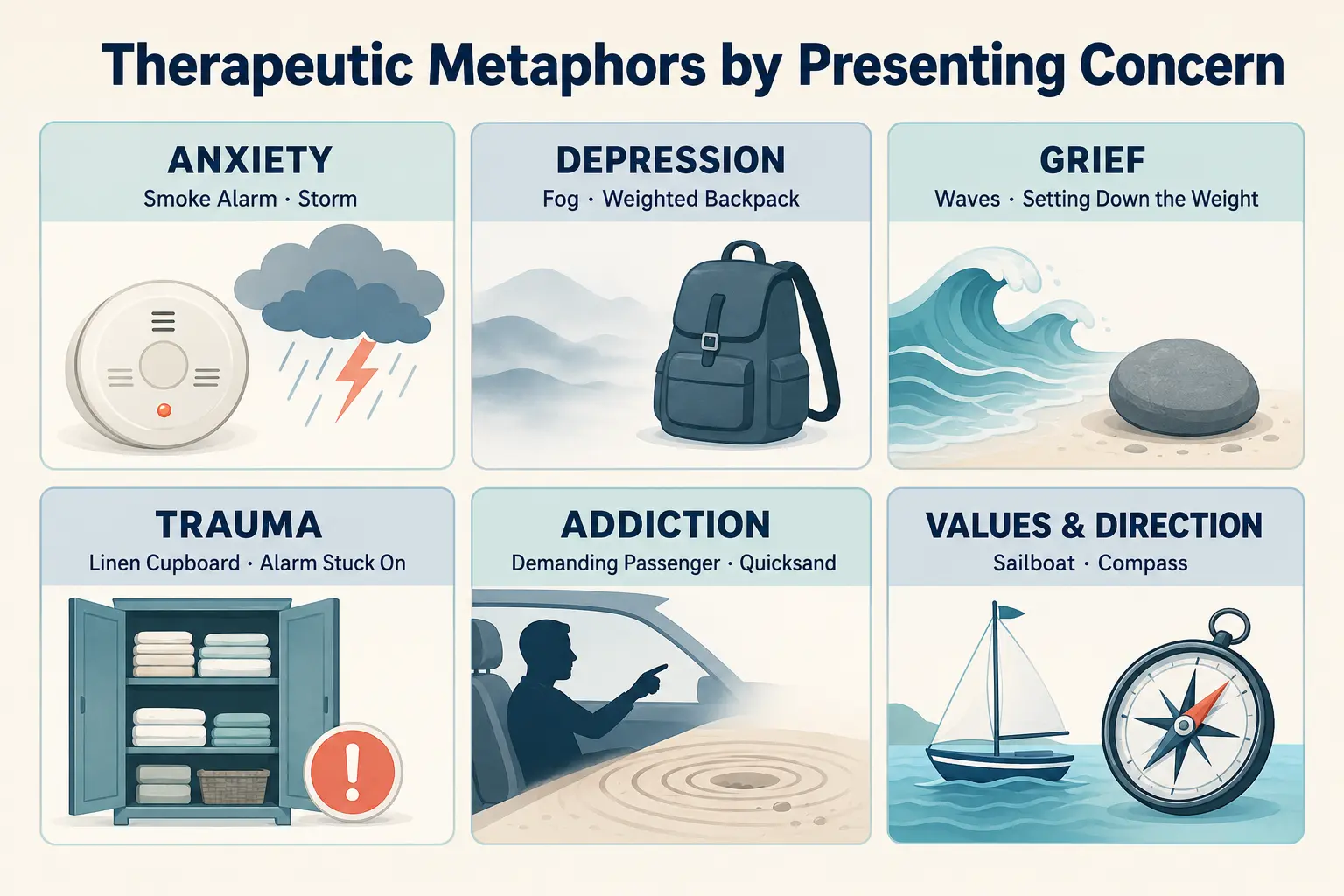
The "loaded die" metaphor (used in ACT) helps clients understand anxiety as a rigged game they can't win by fighting harder, shifting the goal from control to acceptance. The "overprotective smoke alarm" metaphor, often paired with CBT, reframes anxiety as a protective system that's become oversensitive — useful for helping clients evaluate whether a given worry is a "real fire" or "burnt toast." "Passengers on the Bus" (Hayes et al., 1999) helps clients keep driving toward their values while anxious thoughts shout from the back seat.
Depression
The "Dead Sea" metaphor, used to help a client understand why unexpressed emotion accumulates and "stagnates" when there’s no outlet, can open up conversations about emotional suppression and its role in a depressive episode. Metaphors of weight and heaviness (a backpack, a stone, deadwood) are common because they match how many clients already describe depression somatically.
Grief
Metaphors of weight, waves, journeys, and continuing bonds can help clients express how loss changes over time. In a guided-imagery exercise, a client might visualize setting down a heavy object associated with grief, not throwing it away permanently, but allowing themselves to rest from carrying it for a moment. The Tree of Life narrative exercise uses roots, trunk, branches, and storms to help clients locate loss within the broader context of their identity, relationships, strengths, and continuing story.
Trauma
The "linen cupboard" metaphor describes trauma memories as items stuffed haphazardly into an overcrowded closet — explaining why the door can "burst open" (flashbacks, nightmares) and why trauma-focused treatment involves carefully taking memories out, looking at them, and refolding them so there’s more room to think about other things. This kind of imagery can make trauma processing feel less abstract and less frightening to clients new to the work. The goal is not to erase what happened or empty the cupboard. Instead, carefully examining and reorganizing what it contains may make the memories feel more contained — and create more psychological room for relationships, enjoyment, education, work, family, and other parts of life that trauma previously crowded out.
Addiction and substance use
Externalizing metaphors — addiction as a storm, a demanding passenger, or a tug-of-war with a monster — help separate the client's identity from the compulsion, which can reduce shame and support a recovery-oriented frame rather than a deficit-oriented one.
Additional Ways to Use Therapeutic Metaphors
Therapeutic metaphors can do more than help clients describe symptoms or presenting concerns. They can also support values clarification, illuminate the therapeutic relationship, and turn abstract clinical concepts into concrete experiences through guided imagery and everyday objects.
Values and life direction.
The Sailboat Metaphor maps eight elements of ACT (water, steering wheel, destination, leak, sails, compass, weather, other boats) onto a boat journey. The related lighthouse metaphor can help clarify the therapist’s role. A lighthouse illuminates the boat’s current position, identifies possible hazards, and offers temporary guidance, but it does not take control of the wheel or determine the destination. Similarly, the clinician works in service of the client’s goals and values while helping the client see circumstances and possibilities more clearly.
Using physical objects as therapeutic metaphors.
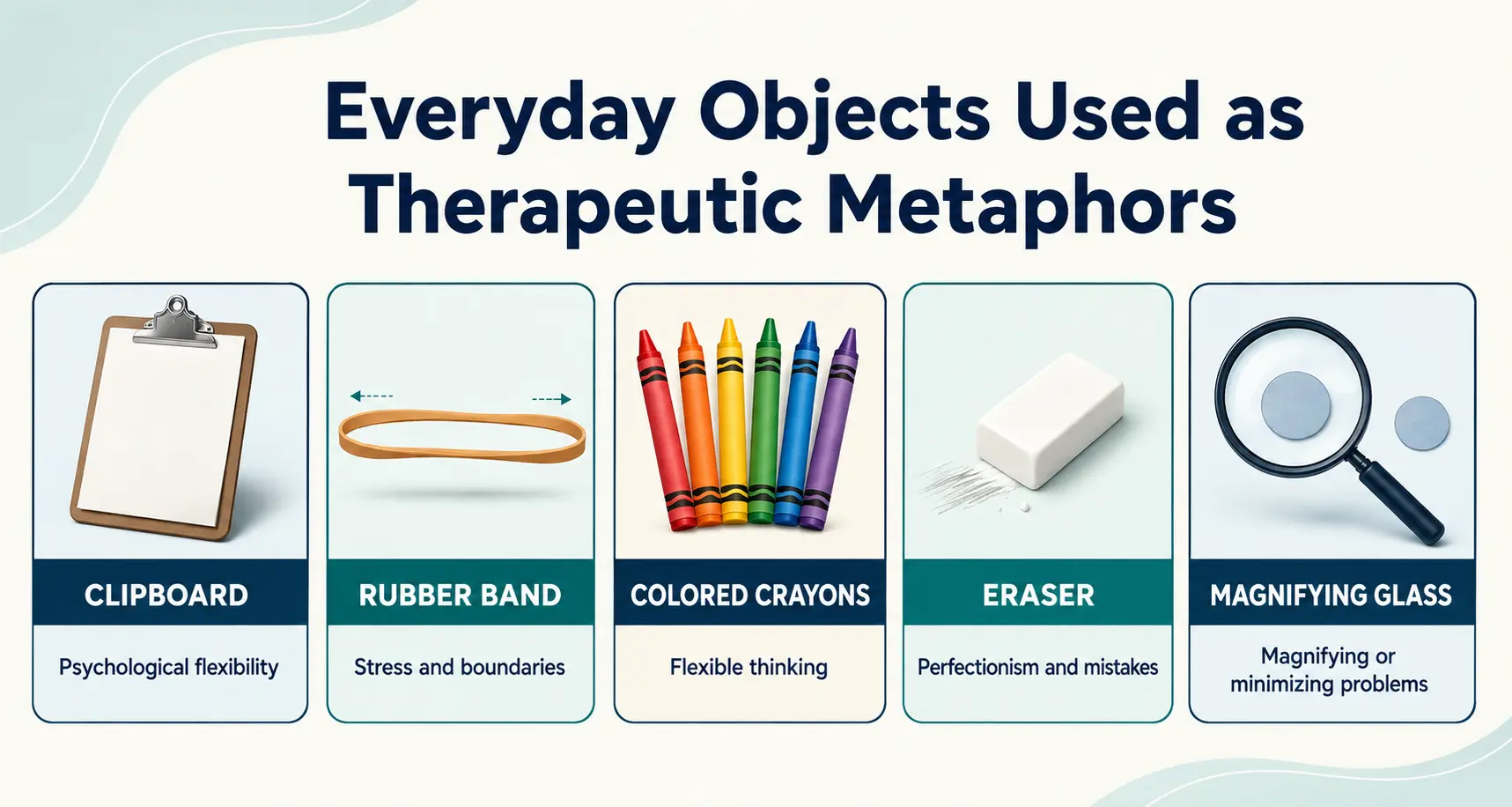
Therapeutic metaphors do not have to remain verbal. A clipboard, book, rubber band, crayon, eraser, or other everyday object can make an internal experience visible and tangible. In the ACT-based clipboard exercise, the clinician asks the client to imagine that a clipboard represents anxiety, conflict, or another difficult experience. The client holds it in front of their face and extends their arms while noticing the physical effort and everything the object prevents them from seeing or engaging with. The clipboard is then placed on the client’s lap or beside them. The problem has not disappeared, but it is no longer blocking their view or controlling their interaction with the environment. This exercise illustrates psychological flexibility: a difficult thought, feeling, or symptom can remain present without occupying the client’s entire field of attention. Before using the exercise, screen for shoulder, neck, back, or mobility limitations, and do not ask the client to hold the object long enough to cause more than mild, temporary discomfort.
| Object | Therapeutic Idea | Potential Application |
|---|---|---|
| Rubber band | Some tension creates energy, but too much causes strain | Stress management, boundaries, burnout |
| Colored crayons | Experiences are rarely entirely black or white | Cognitive distortions, flexible thinking |
| Eraser | Mistakes can be corrected without defining the person | Perfectionism, performance anxiety, self-compassion |
| Magnifying glass | Problems can be magnified or minimized | Cognitive restructuring, balanced appraisal |
| Binder or folder | A container becomes less useful when it is overfilled | Stress, emotional overload, organization |
| Natural object | A personally selected object can represent an internal experience | Mindfulness, emotional expression, grief work |
How to Introduce a Metaphor in Session
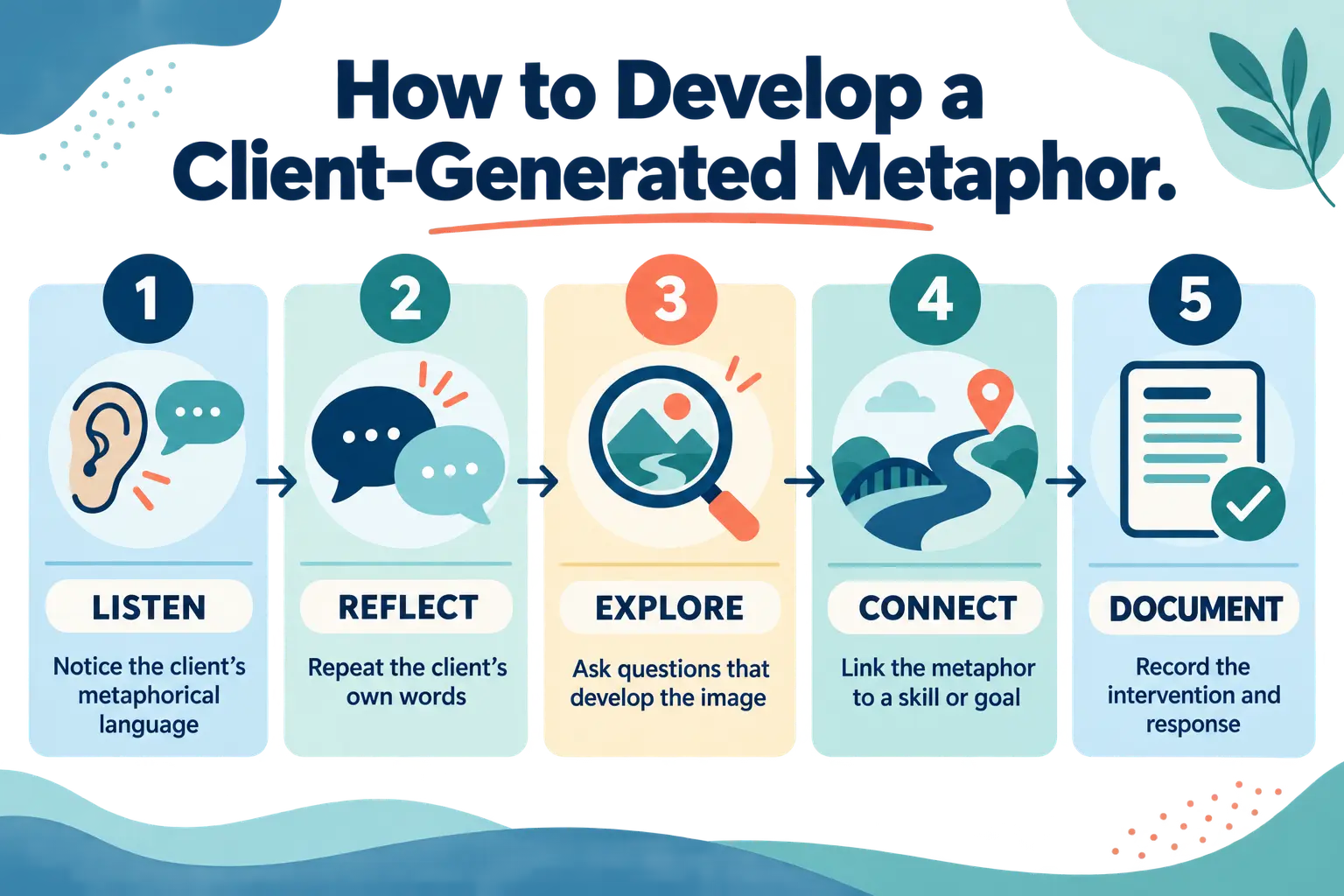
When introducing a guided visualization or a more developed therapist-generated metaphor, ask permission first: “Would you be open to exploring that image for a moment?” This keeps the exercise collaborative and gives the client an opportunity to decline, modify the image, or approach it in a different way. Metaphors that emerge collaboratively tend to land better than ones a therapist announces out of nowhere. A useful sequence:
Listen for the client's own language first.
Before introducing anything new, notice the images a client already reaches for — "funk," "deadwood," "drowning," "a fog." These offhand phrases are often the seed of a metaphor worth developing.
Reflect it back and ask the client to build on it.
Rather than interpreting the image for the client, ask questions that let them extend it: What does the storm look like? Is there ever a moment when the clouds part? What would it take to build a shelter?
Invite the client to find their own object.
As an optional between-session exercise, invite the client to look around their home, outdoors, or another familiar environment for an object that represents the experience they are working on. It might symbolize their anxiety, grief, shame, trauma, self-esteem, or another concern. At the next session, ask the client to describe what they selected and why: What qualities does the object share with the experience? What happens to it under pressure? What would the object need in order to change, recover, or function differently? Because the client chooses the object, the resulting metaphor is grounded in their own meaning rather than the clinician’s interpretation.
Consider the client’s interests, culture, and frame of reference.
Effective therapeutic metaphors often draw from experiences the client already understands. A client’s work, hobbies, family life, spiritual traditions, cultural background, or areas of expertise may provide imagery that feels more relevant than a standard clinical analogy. In the webinar example, a therapist working with an earth sciences student used the difference between the Dead Sea and other bodies of water to explore what happens when emotions have no outlet. The metaphor worked because it connected the clinical insight to a subject the client already knew well.
Let the metaphor evolve across sessions.
In practice, a single metaphor can be introduced, deepened, and revised over several sessions as a client’s understanding shifts — for example, a client who starts by describing anxiety as an unwinnable game may, over time, begin identifying the specific moments they’re "picking the dice back up," giving both client and clinician a shared shorthand for a recurring pattern.
Connect the image back to concrete skills.
A metaphor is most useful when it leads somewhere actionable. If a client identifies “shelter” as what they need from a storm of anxiety, the next clinical step is translating that into specific coping strategies — grounding, breathing exercises, values-based action — that operationalize the metaphor.
Watch for fit, not just cleverness.
The goal isn't to introduce the most elegant metaphor available; it's to introduce one the client can actually use. A metaphor that doesn't land, or that a client actively resists, isn't worth pushing.
Client-Generated vs. Therapist-Introduced: When to Use Each
Both approaches have a place, and skilled clinicians move between them depending on where the client is in treatment.
Client-generated
Client-generated metaphors are often the strongest entry point because they’re already emotionally accurate for that person. A client who describes a parent as "smothering" them, for instance, has handed the therapist language that can be explored directly: What would it look like to change that metaphor? Would you want your mother far away, or just a little more room to breathe? This kind of question lets the client, not the therapist, determine what change should look like, which tends to increase buy-in.
Therapist-introduced
Therapist-introduced metaphors are more useful when a client is stuck, when a concept needs normalizing (many clients are relieved to hear anxiety compared to an overly sensitive smoke alarm rather than a personal failing), or when a structured framework like ACT calls for a specific, well-tested image. The tradeoff is that an introduced metaphor has to actually fit the client's experience — offered at the wrong moment, or forced onto a client who isn't receptive, it can feel like the therapist imposing their own narrative rather than reflecting the client's.
Matching ACT Metaphors to the Therapeutic Process
Acceptance and Commitment Therapy uses an extensive collection of metaphors organized around its six core processes: acceptance, cognitive defusion, present-moment awareness, self-as-context, values, and committed action. Rather than choosing an ACT metaphor simply because it sounds engaging, clinicians should match it to the process being addressed. A tug-of-war metaphor may support acceptance and willingness, for example, while a bus, boat, compass, or journey metaphor may help clients clarify values and continue moving in a chosen direction.
Cautions and Limitations
Metaphors are a clinical tool, not a universal one, and they come with some real limitations worth keeping in mind:
- Overreliance. Leaning on metaphor too heavily can pull a session away from more direct exploration of a client's experience, or away from the social and systemic context of their problem.
- Timing matters. A metaphor introduced while a client is silent or emotionally raw can feel intrusive rather than illuminating; some clinicians consider a poorly timed metaphor to be actively disruptive to the therapeutic relationship.
- Not every client wants to engage this way. Some clients find figurative language frustrating rather than clarifying, and metaphor work should never be forced.
- Cognitive fit. Clients with certain cognitive impairments or limited capacity for abstract thinking may struggle to engage with metaphor the way it's intended.
- Metaphors can also be used to avoid. A client can hide behind figurative language just as easily as they can use it to open up—clinical judgment is needed to tell the difference.
- Not everyone visualizes internally. Some clients experience guided imagery as a feeling, physical sensation, intuition, thought, or word rather than a mental picture. Avoid treating visual detail as evidence that the exercise is, or is not, working, and allow clients to engage through whichever form of internal experience feels natural.
Documenting Metaphor-Based Interventions in Your Notes
Metaphor work is a real clinical intervention, which means it needs to show up in documentation the same way any other technique does — tied to a diagnosis, a goal, and a measurable outcome, not just noted as an interesting moment in session.
A complete note should identify the metaphor or exercise, its clinical purpose, the client’s response, and the next step it supported. For example: “Clinician reflected the client’s description of anxiety as a storm and used the image to support emotional identification and coping-skills development. Client identified contacting a support person and using paced breathing as components of their ‘shelter’ and agreed to practice both before the next session.”
This is where a behavioral health-specific EHR makes a practical difference. ICANotes' treatment planning tools connect a client's diagnosis to individualized goals, objectives, and interventions, and those interventions carry forward automatically into progress notes — so once you document a metaphor-based cognitive reframing technique as part of a CBT or trauma-focused treatment plan, it doesn't have to be re-typed from scratch every session. ICANotes supports specialty-specific planning for CBT and trauma-focused care (including cognitive restructuring and EMDR phase tracking), among other modalities, and it's built to work with whatever note format your practice already uses — SOAP, BIRP, DAP, GIRP, or PIRP — so a metaphor-based intervention you document today stays consistent with how you document everything else.
Because ICANotes lets you customize goal and intervention libraries rather than relying on generic templates, clinicians who use metaphor regularly in their practice — narrative therapists, ACT practitioners, grief counselors—can build their own reusable language for it (for example, “used client-generated metaphor to externalize presenting problem and support cognitive reframing”) and have that language populate future notes automatically as treatment progresses. That combination of individualized clinical content and connected documentation is worth exploring if progress notes are currently where good in-session work goes to get lost.
Turn in-session metaphor work into connected documentation
See how ICANotes' treatment planning software connects diagnosis, goals, and progress notes — so a metaphor-based intervention you document today carries forward automatically. Start your free trial.
- Notes completed in under 3 minutes
- 30-day free trial, no credit card required
- Fully integrated billing, scheduling, and practice management
- Live support from behavioral health specialists
Frequently Asked Questions
What are metaphors in therapy?
Why do therapists use metaphors with clients?
What is an example of a therapeutic metaphor for anxiety?
Can metaphors be used in trauma therapy?
Are there risks to using metaphors in therapy?
How do you introduce a metaphor to a client?
What's the difference between a client-generated and a therapist-introduced metaphor?
How should metaphor-based interventions be documented in progress notes?
References
- Salih, A. A. (2025). The power of metaphors in psychotherapy: Enhancing therapeutic communication, emotional expression, and transformative change. International Journal of Humanities and Education Development (IJHED), 7(2). https://doi.org/10.22161/jhed.7.2.9
- Mallinson, T., Kielhofner, G., & Mattingly, C. (1996). Metaphor and meaning in a clinical interview. American Journal of Occupational Therapy, 50(5), 338–346.
- Hayes, S. C., Strosahl, K. D., & Wilson, K. G. (2012). Acceptance and Commitment Therapy: The Process and Practice of Mindful Change (2nd ed.). Guilford Press.
- Vivyan, C. (2009–2015). Therapy metaphors. Get Self Help. https://www.getselfhelp.co.uk/docs/Metaphors.pdf
- Ncube, N., & Denborough, D. The Tree of Life project. Dulwich Centre Foundation / REPSSI.
Diane Bigler
Diane Bigler, LCSW, LSCSW, is a Licensed Clinical Social Worker in Missouri and Kansas with over 25 years of experience in the mental health field. She has held clinical positions as an outpatient and in-home therapist and clinical supervisor in diverse settings. Diane was an Adjunct Professor of Social Work for 10 years at The University of Kansas, School of Social Welfare and a Field Liaison and Field Instructor. She has also held administrative positions as a Program Director and Coordinator. Diane is a popular local and national trainer on a wide variety of mental health and workplace development topics for clinicians and corporations and has facilitated over 500 training courses in the last few years.