
Blog > Treatment Strategies > 12 Trauma-Informed Therapy Techniques for Clinicians (+ PDF)
Trauma-Informed Therapy Techniques: A Practical Guide for Clinicians
Trauma-informed therapy is a clinical approach that weaves safety, choice, collaboration, trustworthiness, empowerment, and cultural humility into every interaction — so clients can process traumatic experiences without being re-traumatized. Trauma-informed therapy techniques are the specific, evidence-based practices clinicians use in session to put that approach to work. This guide covers the twelve trauma-informed therapy techniques clinicians rely on most, how to adapt them to childhood and adult trauma survivors, and the documentation practices that keep your notes both clinically defensible and client-centered. A free printable Trauma-Informed Care Cheat Sheet is linked below.


Last Updated: April 19, 2026


What You'll Learn
- The 6 core principles of trauma-informed care (and how to apply them in session)
- 12 trauma-informed therapy techniques you can use immediately with clients
- How to adapt techniques for adults, adolescents, and complex trauma
- Sample trauma-informed questions and scripts you can use verbatim
- How to document sessions in a way that supports compliance, clarity, and clinical integrity
- When to use trauma-informed vs. trauma-focused therapy approaches
Contents
- Trauma-Informed vs. Trauma-Focused Therapy
- Six Principles of Trauma-Informed Care
- The Impact of Trauma on Mental Health
- 12 Evidence-Based Trauma-Informed Therapy Techniques
- Adapting Trauma-Informed Techniques by Population
- Integrating Trauma Informed Therapy Techniques into Clinical Settings
- Addressing Secondary Trauma and Burnout
- Ethical Considerations in Trauma-Informed Therapy
- Documentation Best Practices for Trauma-Informed Therapy
- FAQs: Trauma-Informed Therapy Techniques
- Building a Trauma Informed Practice
What is Trauma-Informed Therapy?
Trauma-informed therapy isn’t a single modality — it’s a clinical stance. Rather than asking “What’s wrong with you?”, the trauma-informed clinician asks, “What happened to you, and how did you survive?” That shift changes everything downstream: how you conduct intake, how you explain documentation, how you pace exposure work, and how you respond when a client becomes dysregulated mid-session.
The approach recognizes three realities most clinicians already know intuitively but don’t always build sessions around:
- Trauma is common. An estimated 70% of U.S. adults have experienced at least one traumatic event in their lives.
- Trauma shapes the nervous system. Its impact shows up as hypervigilance, numbing, dysregulation, and somatic symptoms — not only as classic PTSD presentation.
- Standard therapy techniques can re-traumatize. Without pacing and explicit consent, even well-intentioned interventions can overwhelm a client whose window of tolerance is narrow.
Trauma-informed therapy techniques are how you operationalize that stance in the 50-minute hour.
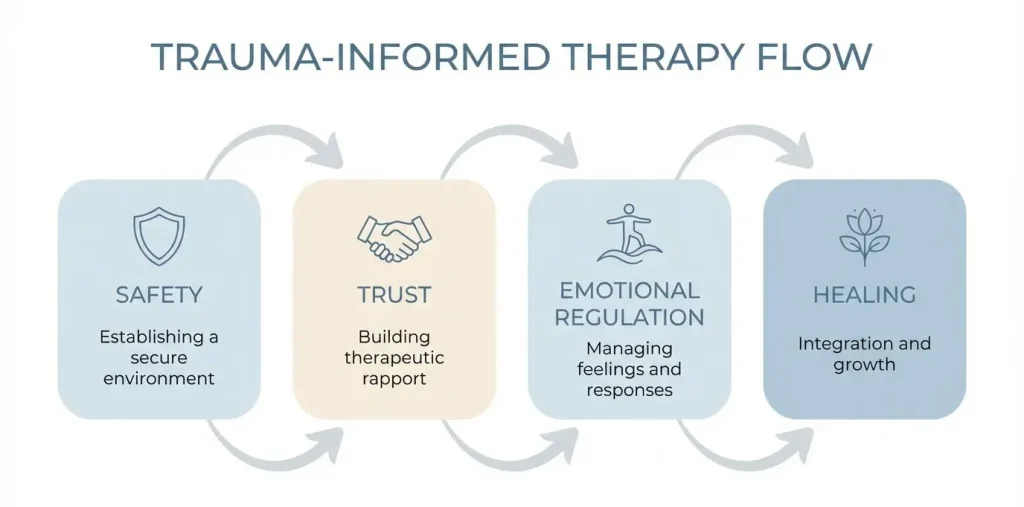
Bring Trauma-Informed Care Principles to Life in Every Session
Download our Trauma-Informed Care Cheat Sheet — a practical, clinician-designed reference that helps you:
✅ Ensure safety, trust, and empowerment in every interaction
✅ Prevent retraumatization with structured, evidence-based care
✅ Integrate cultural awareness and collaboration into treatment
✅ Stay grounded with self-reflection prompts and session checklists
It’s a quick, printable guide that turns theory into actionable practice — so you can deliver trauma-informed care with confidence, compassion, and clinical precision.
Trauma-Informed vs. Trauma-Focused Therapy
These terms are often used interchangeably, but they aren’t the same.
- Trauma-informed is a universal stance applied to every client, regardless of whether trauma has been disclosed or diagnosed. You bring it to intake paperwork, your office layout, your consent forms, and your default language. It prioritizes safety, stability, and prevention — creating the conditions that make deeper therapeutic work possible.
- Trauma-focused treatment is an active, directive intervention for clients with a documented trauma diagnosis. Modalities include EMDR, Trauma-Focused CBT, Cognitive Processing Therapy, Prolonged Exposure, and Narrative Exposure Therapy. This approach moves into processing and integration, using targeted interventions to help clients work through traumatic experiences.
Every clinician should be trauma-informed. Only clinicians with specific training should deliver trauma-focused treatment.

| Comparison Area | Trauma-Informed | Trauma-Focused |
|---|---|---|
| Applies to | Every client, regardless of whether trauma has been disclosed. | Clients with a known trauma history or trauma-related diagnosis. |
| Primary goal | Build safety, trust, and regulation while preventing re-traumatization. | Process and resolve traumatic memories and symptoms. |
| Clinical approach | A foundational stance shaping all interactions, communication, and care delivery. | A targeted treatment approach addressing trauma directly. |
| Training required | Core competency expected of all behavioral health clinicians. | Specialized training in modalities such as EMDR, TF-CBT, CPT, or PE. |
| Examples | Grounding, collaborative pacing, transparency, client choice, predictable structure. | EMDR, Trauma-Focused CBT, Cognitive Processing Therapy, Prolonged Exposure. |
| Risk if misapplied | Clients may feel unsafe, disempowered, or misunderstood. | Clients may become overwhelmed or re-traumatized without proper stabilization. |
| Duration | Continuous and integrated across all care. | Often structured and time-limited depending on the modality. |
Bottom line: Every trauma-focused therapy should be trauma-informed, but not every trauma-informed clinician provides trauma-focused treatment.
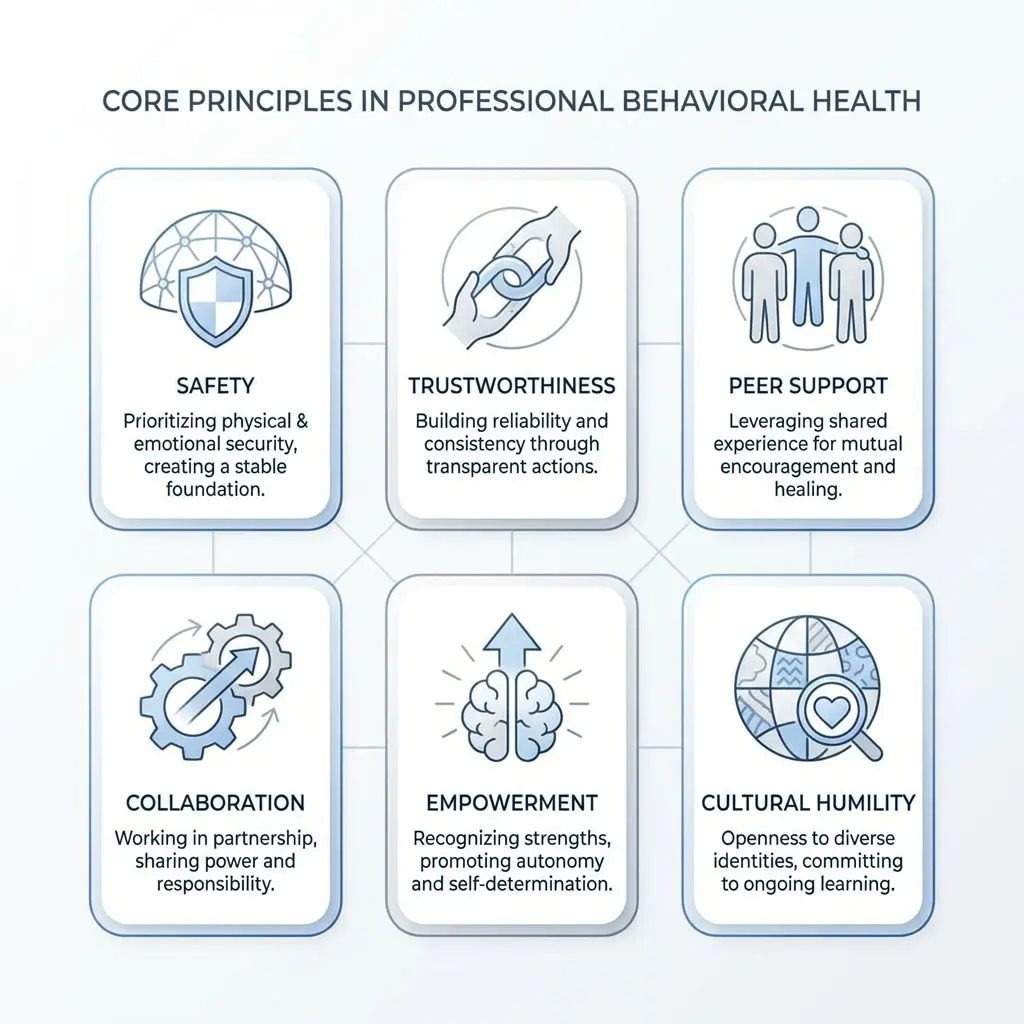
The Six Principles of Trauma-Informed Care (SAMHSA Framework)
SAMHSA’s six principles are the scaffolding of every trauma-informed therapy technique that follows.
| Principle | Clinical Application | Therapist Reminder |
|---|---|---|
| Safety | Create a physically and emotionally safe environment; set clear boundaries and predictable routines. | “How can I help my client feel safe today?” |
| Trust & Transparency | Explain what you’re documenting, why questions are asked, and how information will be used. | “Did I communicate expectations clearly?” |
| Peer Support | Offer referrals to peer networks or support groups; integrate lived-experience perspectives when appropriate. | “Am I offering opportunities for connection?” |
| Collaboration | Share decision-making power; invite clients to set pace, goals, and intervention choices. | “Am I partnering or directing?” |
| Empowerment | Highlight strengths and resilience; reinforce skills that increase autonomy and self-efficacy. | “Did I highlight what’s working?” |
| Cultural Humility | Respect cultural, gender, and identity differences in trauma expression and healing; adapt care accordingly. | “Am I aware of my own biases?” |
Each principle translated into session-level practice:
Safety
Both physical and emotional. Predictable routines, visible exits, consistent start and end times, and clinician supervision to contain your own stress. Begin each session with a version of: “What does this client need to feel safe today?” Safety is never assumed — it’s rebuilt at the start of every session.
Trustworthiness and Transparency
Narrate what you’re doing: “I’m going to write this down in your chart,” “I’d like to pause here because I’m noticing your breathing has changed.” When treatment decisions are needed, explain the rationale and invite the client into the choice rather than handing it down.
Peer Support
Healing doesn’t happen only in session. Keep a current, specific list of peer support options — in-person groups, online communities, faith-based circles — so referrals are actionable, not generic. Normalize lived experience as a legitimate therapeutic resource.
Collaboration and Mutuality
Most traumas involve a power differential. Therapy shouldn’t replicate that. Invite clients to set pace, goals, and intervention choices. Over time, deliberately shift more decision-making power toward the client as a marker of stabilization.
Empowerment, Voice, and Choice
Highlight strengths, reinforce autonomy, and close sessions with a moment of client-led reflection: “What felt helpful today? What did I miss?” Agency is itself therapeutic — the opposite of the powerlessness that defines trauma.
Cultural Humility
Trauma is experienced and expressed through cultural, gender, and identity contexts. Stay curious about your own biases, adapt language and metaphors to match the client’s frame, and acknowledge the limits of your own cultural standpoint. Humility — not mastery — is the goal.
The Impact of Trauma on Mental Health
Trauma sources vary widely — acute events like an assault or accident, chronic exposures like combat or domestic abuse, or “compound trauma” built from multiple layers. Responses are equally varied. Two childhood sexual abuse survivors can present in opposite ways: one leery and avoidant, one extroverted and sexually activated. Dr. Bruce Perry documented this pattern in The Boy Who Was Raised as a Dog.
For clinicians, the implication is that trauma shows up as far more than classic post-traumatic stress disorder. Common downstream impacts include:
- Mistrust and hypervigilance
- Anxiety, phobias, and social withdrawal
- Relational difficulty and attachment ruptures
- Mood disorders including major depression and bipolar
- Cognitive and occupational limitations
- Somatic complaints without clear medical origin
Symptoms can emerge immediately after the trauma or surface years later through a developmental or situational trigger. Clinicians who screen with a trauma lens — even in clients who present for something else — tend to catch these patterns earlier and treat them more effectively.
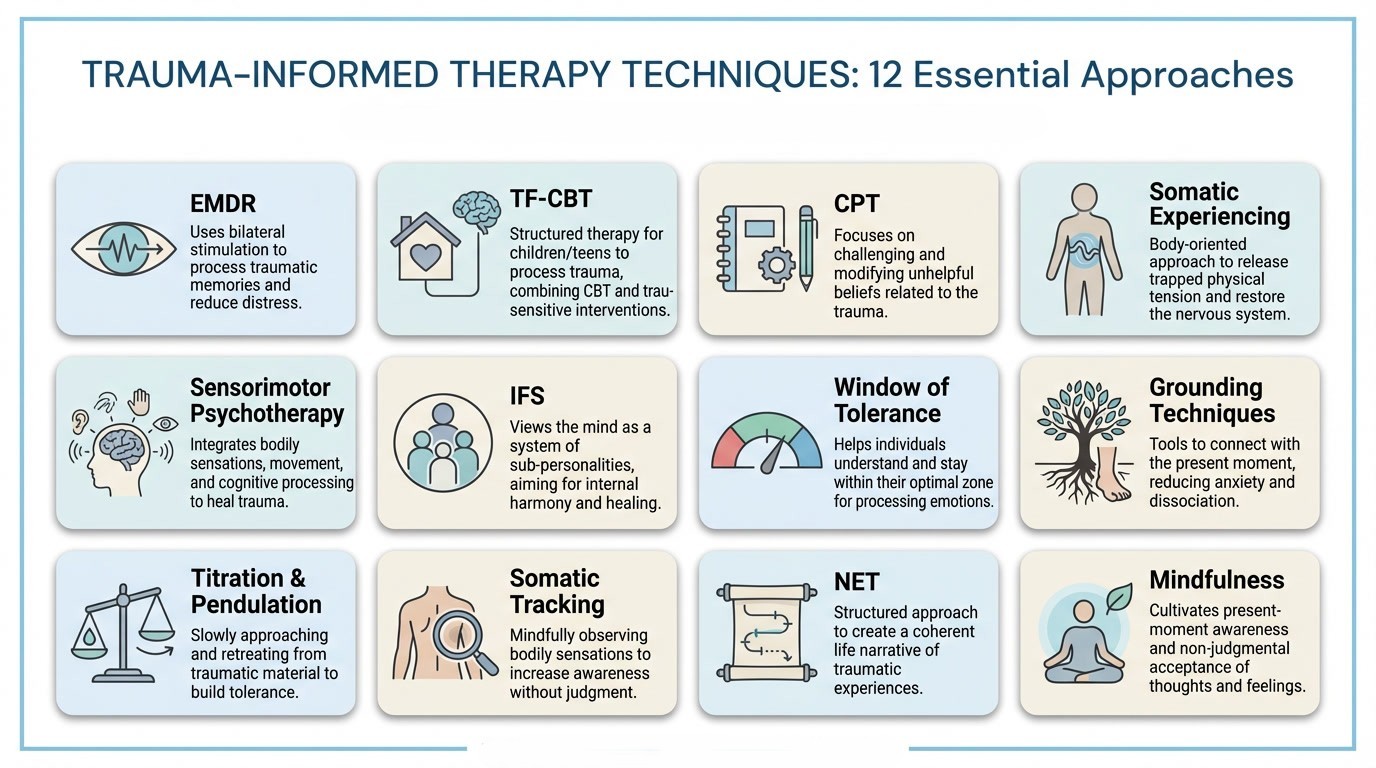
12 Evidence-Based Trauma-Informed Therapy Techniques
Each of the techniques below can be delivered in a trauma-informed way. We’ve included a one-line in-session prompt for every technique so you can try the language verbatim with the next client who needs it.
Eye Movement Desensitization and Reprocessing (EMDR)
Uses bilateral stimulation — eye movements, alternating taps, or auditory tones — to help clients reprocess traumatic memories with less verbal disclosure than traditional talk therapy.
Trauma-Focused Cognitive Behavioral Therapy (TF-CBT)
Combines psychoeducation, relaxation training, cognitive processing, and gradual trauma-narrative exposure. Particularly strong with pediatric populations and caregiver involvement.
Cognitive Processing Therapy (CPT)
Helps clients identify and challenge the “stuck points” — unhelpful beliefs — that develop after trauma. A 12-session protocol with strong VA-endorsed evidence.
Somatic Experiencing
Tracks bodily sensations to release trauma energy stored in the nervous system. Pacing is determined by the client’s window of tolerance, not a fixed protocol.
Sensorimotor Psychotherapy
Integrates body awareness with talk therapy. Helps clients notice automatic physical responses — posture, gesture, breath — and use them as entry points for processing.
Internal Family Systems (IFS) / Parts Work
Treats the psyche as a collection of “parts” — protectors, exiles, managers — with a core Self capable of leading healing conversations between them.
Window-of-Tolerance Psychoeducation
Teaching clients the concept of hyperarousal, hypoarousal, and the optimal zone in between is itself therapeutic. Clients can then name what’s happening in their body and begin to regulate with more autonomy.
Grounding Techniques
A family of brief interventions — 5-4-3-2-1, orienting to the room, temperature shifts, bilateral tapping — that anchor a dysregulated client in the present. Skill-build grounding early so it’s available during harder sessions.
Titration and Pendulation
Intentionally titrating how much trauma material is processed at once, and pendulating between activation and resource states. A core Peter Levine contribution that applies across modalities.
Somatic Tracking and Dual Awareness
Client holds awareness of a bodily sensation and an “observer” perspective at the same time. Builds self-regulation capacity and reduces identification with symptoms.
Narrative Exposure Therapy (NET)
Constructs a coherent life narrative that interweaves traumatic and positive events. Developed for refugee and complex-trauma populations; often used in short-term settings.
Mindfulness and Present-Moment Anchoring
Brief, secular mindfulness practices — breath awareness, body scan, labeling — offered as skills rather than assignments. Avoid closed-eye practices with highly dissociative clients.
Utilizing these evidence-based trauma-informed techniques can enhance the therapeutic relationship and support clients in their recovery journey. Each approach offers unique benefits, and often, integrating multiple methods yields the best outcomes. A trauma-informed therapist may integrate multiple approaches to best meet the needs of each client, considering the specific nature and effects of their trauma.
| Technique | Focus Area | Ideal Client | Therapist Role | Example |
|---|---|---|---|---|
| EMDR | Memory reprocessing | Single-incident PTSD | Facilitator | Bilateral eye movement |
| TF-CBT | Cognitive reframing + exposure | Children and adolescents | Instructor | Trauma-narrative writing |
| CPT | Stuck-point reframing | Adults with PTSD | Guide | Impact statement |
| Somatic Experiencing | Body-based discharge | Dissociative clients | Co-regulator | Pendulation |
| Sensorimotor Psychotherapy | Mind-body integration | Chronic tension, dissociation | Observer-guide | Tracking posture and movement |
| IFS / Parts work | Internal system work | Complex trauma, self-criticism | Facilitator of Self | Protector dialogue |
| Grounding | Stabilization | Flashbacks, dissociation | Coach | 5-4-3-2-1 |
| Titration / pendulation | Pacing | Narrow window of tolerance | Pacer | Alternating activation and resource |
| Mindfulness | Present awareness | Anxiety, rumination | Coach | Three breaths, body scan |
| NET | Life-narrative coherence | Sequential / refugee trauma | Co-author | Lifeline stones and flowers |
Adapting Trauma-Informed Techniques by Population
The technique is the same; the delivery changes.
Adults and Adult Survivors
Autonomy and pacing dominate. Long-standing avoidance patterns usually mean stabilization comes first and processing second. Re-contract goals every six to eight sessions and invite the client to rename what they’re working on as meaning shifts. Re-traumatization risk is highest when pacing is outpaced by protocol pressure — let the client lead depth.
Children and Adolescents
Developmental attunement matters more than protocol fidelity. TF-CBT is first-line for many presentations; caregiver involvement is usually non-negotiable. Grounding and psychoeducation need concrete metaphors — a stoplight for arousal levels, “weather inside” for emotion language. Expect nonlinear progress and build play, art, or movement into sessions where appropriate.
Complex and Compound Trauma
Plan an extended stabilization phase — sometimes months. Parts work, titration, and relational repair are the workhorses. Avoid pressurizing direct memory processing until the window of tolerance is reliable. Clinicians working with complex-trauma caseloads need more supervision and tighter self-care boundaries than typical.
Integrating Trauma Informed Care into Clinical Settings
Beyond technique selection, a trauma-informed practice is visible in how the environment and processes are arranged:
- Assume every client may have a trauma history, regardless of chief complaint
- Normalize trauma responses during assessment and feedback
- Be transparent about your scope and training limits — and refer out when a case exceeds your competence
- Maintain a current list of peer support groups and community referrals
- Shift decision-making weight toward the client as treatment progresses
- Use intake and consent forms that are readable and explain documentation choices
- Make the room itself trauma-informed: visible clock, predictable seating, no strong scents, minimal visual clutter

Case Vignette: Applying Trauma-Informed Techniques in Session
Client: “Maria,” a 35-year-old survivor of childhood abuse, experiences panic when discussing her past.
Clinician response: Instead of pressing for disclosure, the clinician applies trauma-informed therapy techniques grounded in choice and pacing:
-
Opens with grounding: “Let’s start by noticing your feet on the floor.”
-
As affect rises, tracks somatically: “Where do you feel that tension right now?”
- Pendulates back to a resource state before deepening further.
-
Closes with empowerment: “You controlled how deep we went today — well done.”
Maria leaves the session more regulated than she arrived, which is the single best predictor of returning for the next one.
Sample Trauma-Informed Questions and Session Scripts
Exact-language prompts clinicians can use verbatim. These aren’t scripts to memorize — they model the underlying structure: name what’s happening, offer choice, pace the interaction, and hand agency back to the client.
During Intake
“Some of the things I’ll ask you about can be heavy. You’re in charge of what you share and when. Just tell me if you want to skip a question or take a break.”
Before a Memory-Processing Block
“We don’t have to go all the way into the memory today. We can just touch the edge and see what feels manageable.”
When a Client Dissociates
“I’m right here with you. Can you look at the clock on the wall? What time does it say?”
When a Session Runs Long Emotionally
“We have about ten minutes left. Let’s use them to come back to something grounding before you head out.”
When Rupture Occurs
“I said something a moment ago that didn’t land right. Can you tell me what you heard, so we can repair this together?”
Addressing Secondary Trauma and Burnout
Clinicians doing trauma work are at real risk of secondary traumatic stress, vicarious trauma, and burnout. Three protective practices should be in place before you take on a substantial trauma caseload.
Self-Care and Boundaries
A balanced caseload, firm hour limits, and consistent personal restoration practices aren’t luxuries — they’re clinical infrastructure. Most clinicians underestimate how much trauma exposure they’re carrying until their bodies remind them. Read our related guides on self-care for mental health professionals and setting boundaries in therapy.
Clinical Supervision
Weekly consultation with a supervisor competent in trauma work, plus peer consultation where feasible. Trauma therapy should never be practiced in a vacuum. Supervision is where blind spots, countertransference, and scope-of-practice questions get examined before they harm the work.
Continuous Training
The evidence base evolves. Building skill in EMDR, TF-CBT, or CPT reduces the uncertainty that drives much clinician stress. Continuing education is also how you grow the breadth needed to work with the next client whose trauma doesn’t look like the last one.
Ethical Considerations in Trauma-Informed Therapy
Four ethical anchors deserve explicit attention:
Confidentiality
Record only what is clinically necessary; use EHR templates that flag sensitive content and give you control over what level of detail is preserved.
Learn more about client confidentiality best practices
Informed Consent
Explain the risks and rewards of trauma-focused interventions before initiating them — not retroactively. Revisit consent as treatment evolves.
Professional Boundaries
Predictable, consistent boundaries are themselves a trauma-informed intervention — they model the safety that may have been absent in the original trauma context.
Cultural Humility
Acknowledge the limits of your own cultural standpoint. Ethical decision-making in trauma work is iterative — build reflection into supervision, not just into review.
Trauma therapy is a specialty, not an add-on. Clients deserve clinicians who have trained specifically for this work and who know when to refer out.
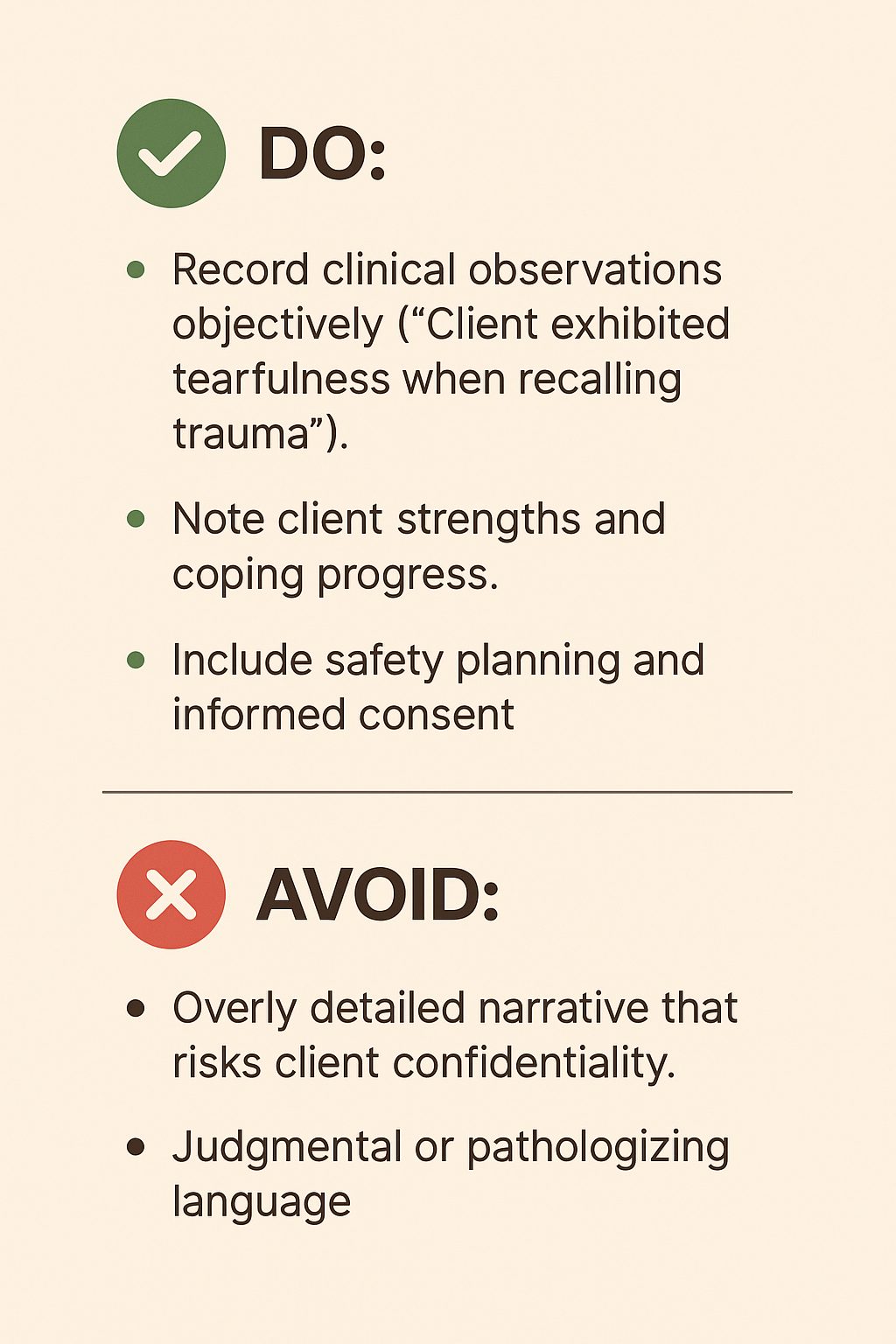
Documentation Best Practices for Trauma-Informed Therapy
Trauma-informed documentation protects both the client and the clinician.
- Record observations objectively, not interpretively
- Note client strengths and coping progress alongside symptoms
- Document safety planning and informed-consent conversations
- Avoid overly detailed trauma narratives that could breach confidentiality if records are subpoenaed
- Use structured templates that prompt for the right fields without requiring narrative every time
- Separate factual observation from clinical hypothesis
ICANotes gives behavioral health clinicians the tools to practice trauma-informed care with confidence.
✅ Menu-driven note templates for trauma therapy and crisis interventions
✅ Evidence-based rating scales for PTSD and anxiety
✅ AI Scribe to capture session details accurately without breaking rapport
✅ Built-in compliance features to protect client confidentiality
Start your free 30-day trial of ICANotes, no credit card required!

Frequently Asked Questions About Trauma-Informed Therapy Techniques
Conclusion: Building a Trauma Informed Practice
Trauma-informed therapy techniques are how you translate the SAMHSA principles into the 50-minute hour. Start with safety and pacing, layer in modality-specific interventions as your training allows, and build the administrative infrastructure — supervision, documentation, peer referrals — that lets you stay in this work for the long run.
Keep your skills sharp — download our Trauma Informed Care Cheat Sheet for a one-page refresher you can reference in session. Pair it with ICANotes, the behavioral health EHR that helps you document trauma-informed sessions faster and more accurately — without breaking rapport.
Related Posts






Kaylee Kron
LMSW
About the Author
Kaylee Kron, LMSW, GC-C, is a certified grief counselor with over a decade of experience. She has worked extensively in nonprofit hospice care, helping individuals navigate their grief journeys. As an author, speaker, and advocate, Kaylee brings a wealth of knowledge and compassion to her work, creating spaces for acknowledgment and healing.