Blog > Treatment Strategies > Group Therapy Rules: Examples, Templates & Ground Rules
Group Therapy Rules: Key Examples, Ground Rules & Free Template
Effective group therapy rules create the safety, trust, and structure needed for productive group sessions. This guide includes 10+ group therapy rules examples, key ground rules for group therapy, and a free printable template clinicians can use to establish clear expectations. You'll also learn how to adapt rules for family therapy, support groups, telehealth, and other specialized populations.


Eric Patterson, MSCP, NCC, LPC
Last Updated: June 15, 2026


What You'll Learn
- The essential group therapy rules every clinician should establish from the first session
- 10 practical group therapy rules examples you can adapt for your own groups
- The difference between group norms and ground rules — and why both matter
- How to tailor rules for family therapy, support groups, telehealth, and specialized populations
- Common mistakes to avoid when creating group therapy expectations
- How to use our free printable Group Therapy Ground Rules Template with clients
Contents
- Key Elements of Effective Group Rules for Group Therapy
- Group Norms vs. Ground Rules
- 10 Group Therapy Ground Rules Examples
- Avoiding Vague or Overly Complicated Group Therapy Rules
- Tailoring Ground Rules to Your Group's Needs
- Ground Rules for Family Therapy
- Ground Rules for Support Groups
- Implementing Ground Rules for Group Therapy Effectively
- Evaluating and Adjusting Group Therapy Rules
- FAQ: Ground Rules for Group Therapy
Therapy groups greatly benefit from a foundation of trust, respect, and consistency. Some groups develop this culture naturally over time, but most require a clear set of rules to guide the process and set the tone from the start. Establishing effective group therapy rules helps create a safe, supportive, and productive experience for both clients and clinicians — and group cohesion, which clear structure helps foster, is one of the most reliable predictors of positive group therapy outcomes.
This article covers the key elements every group therapy rule set should include, a full list of examples you can use or adapt, and guidance for tailoring rules to specific populations including family therapy and support groups. A free downloadable template is available below.
Understanding the Purpose of Group Therapy Ground Rules
A therapy group without rules will quickly devolve into a messy, inconsistent, and unproductive series of meetings. Group therapy ground rules help clarify that all participants are expected to act within certain boundaries — and those boundaries aren't hidden or assumed. They are actively discussed and presented to clients, often in writing, before or during the first session.
Group rules may be introduced during a client's first session or required as part of the screening process. Though specific rules differ by group and population, they all share the same goal: creating a balanced therapeutic environment where clients feel understood, respected, and safe enough to do meaningful work.
Additionally, ground rules for group therapy help prevent, minimize, and resolve conflict. By clearly stating what is and isn't acceptable, rules shift behavior and shape expectations before problems arise rather than after.

Free Download
Get the Group Therapy Ground Rules Template
Establish clear expectations, build trust, and create a safer group environment with this free printable template for behavioral health clinicians. Includes in-person and telehealth versions you can customize for your group.
- 12+ clinician-friendly group therapy rules
- Separate telehealth version for virtual groups
- Editable sections for population-specific expectations
Key Elements of Effective Ground Rules for Group Therapy
Effective group therapy ground rules will look different depending on the specific group, but certain themes and values appear across virtually all of them — rooted in the ethical principles of psychology, counseling, and social work.
Some of the essential elements of ground rules include:
Confidentiality
What happens in group stays in group. Members should not share intimate details of the group process, or the identities of other members, with anyone outside of sessions. breaches of confidentiality damage trust and make members reluctant to be honest.
Privacy and Respect
Even with confidentiality in place, no client should feel pressured to disclose. Group members and therapists should show respect for each person's privacy and pace of self-disclosure.
Empathy and Active Listening
Clients may come to group thinking their only job is to tell their own story — but their ability to listen attentively and respond with empathy is equally essential. Without this, the group cannot sustain itself.
Attendance and Engagement
Consistent attendance and genuine engagement are what allow a group to build the rhythm and trust that enables therapeutic work. Rules should address expectations around punctuality, presence, and sobriety during sessions.
Exclusive Relationships
Though unpopular with some members, avoiding romantic or close personal relationships with fellow group members is essential for protecting the group's integrity. Outside relationships introduce dynamics that can destabilize the group for everyone.
Each group may use different language to address these themes, but there should be some clear understanding of these issues in nearly every therapy group.
Group Norms vs. Ground Rules
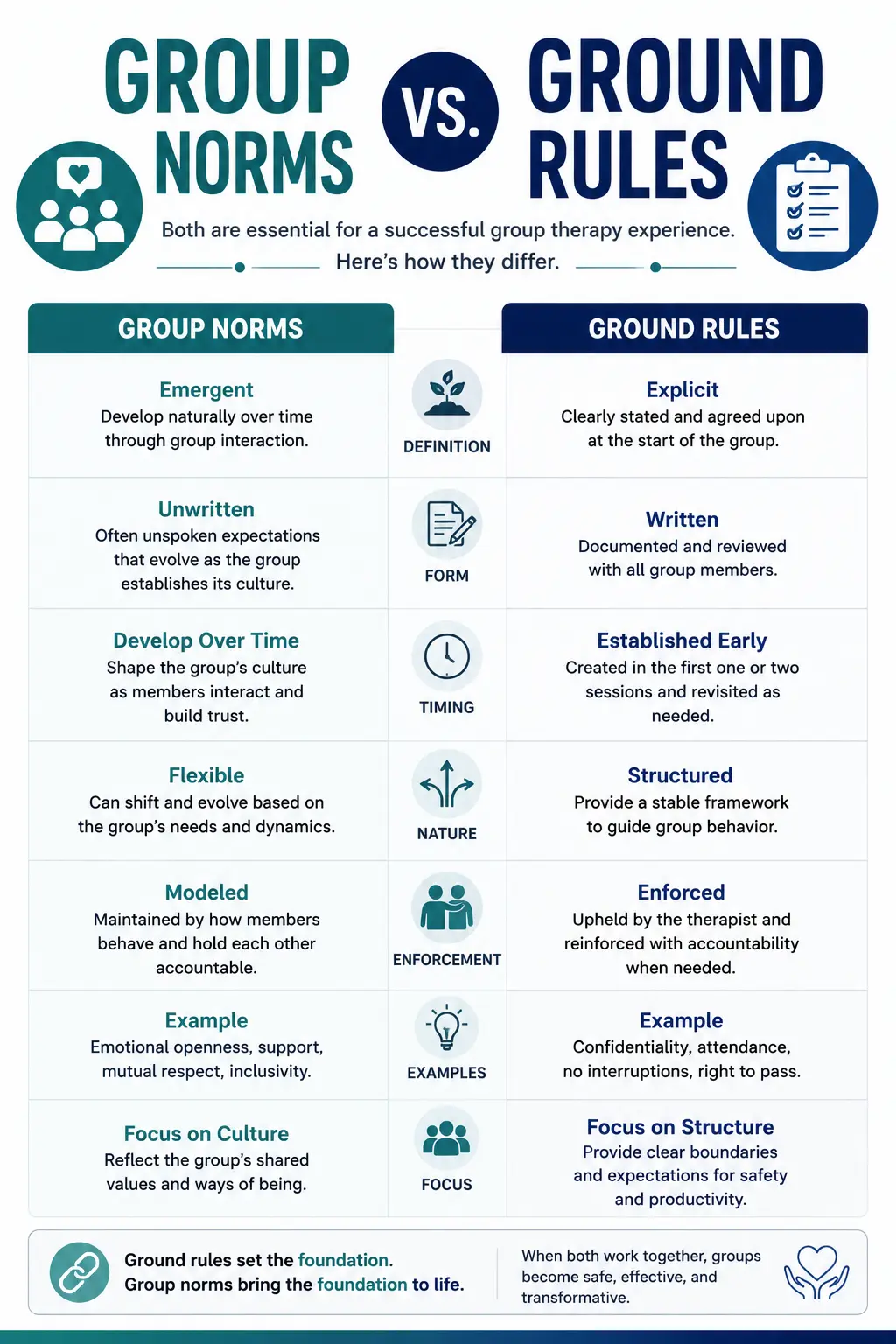
Understanding the distinction between group norms and ground rules helps clinicians build a more complete therapeutic environment — one that's both structured and organically alive.
Ground rules are explicit agreements established at the outset of a group. They are stated, discussed, often written down, and agreed upon. Group norms, by contrast, emerge over time through the group's collective behavior. They are the unspoken patterns that develop naturally as members settle into working together.
For example, a ground rule might state "arrive on time"; the group norm that develops might be that members greet each other warmly and check in informally before the therapist formally opens the session. A ground rule addresses confidentiality; the norm that develops might be a culture of deep, mutual trust where members feel comfortable sharing things they've never said aloud before.
Both matter. Ground rules provide the explicit structure that makes members feel safe, especially in early sessions when trust hasn't been established. Group norms build on that foundation as the group matures, creating an implicit culture that members internalize rather than consult.
As a group therapy facilitator, you can support healthy norm development by modeling the behavior you want to see, naming positive norms as they emerge, and addressing negative informal norms — such as members habitually minimizing each other's experiences — before they become entrenched.
10 Group Therapy Ground Rules Examples
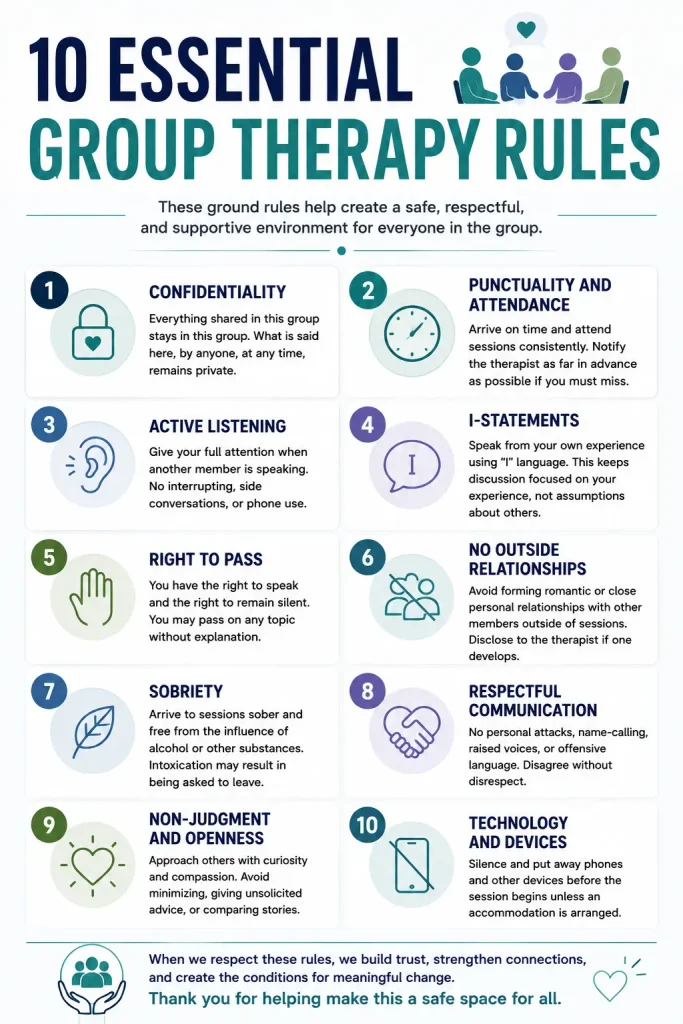
The following examples cover the most essential rules for nearly any therapy group. They can be used as-is, adapted for specific populations, or used as a starting point for collaborative rule-setting with members. Each rule is written to be read aloud or handed to clients at intake.
Confidentiality
Everything shared in this group stays in this group. Members agree not to discuss other members' disclosures, identities, or personal details outside of sessions — including with friends, family, or on social media. Confidentiality is the foundation of trust in this group.
Punctuality and Attendance
Members are expected to arrive on time and attend sessions consistently. Consistent attendance is essential to maintaining the group's rhythm and trust. If you need to miss a session, notify the therapist as far in advance as possible.
Active Listening
Give your full attention when another member is speaking. Do not interrupt, engage in side conversations, or use your phone during the session. Listening is one of the most important contributions you can make to the group.
I-Statements
Speak from your own experience using "I" language rather than making assumptions about others. This keeps discussion grounded in personal experience and reduces defensiveness.
Right to Pass
Every member has the right to speak and the right to remain silent. You may pass on any topic without explanation, and that choice will be respected without judgment.
No Outside Relationships
Members are asked not to form romantic or close personal relationships with other group members outside of sessions. If a relationship develops, disclose it to the therapist promptly.
Sobriety
Members are expected to arrive at sessions sober and free from the influence of alcohol or other substances. Participating while intoxicated may result in being asked to leave the session.
Respectful Communication
Personal attacks, name-calling, raised voices, and offensive language are never acceptable. Disagreement is welcome; disrespect is not.
Non-Judgment and Openness
Approach other members' experiences with curiosity and compassion rather than judgment. Avoid minimizing struggles, offering unsolicited advice, or comparing experiences in a dismissive way.
Technology and Devices
Phones and other devices should be silenced and put away before the session begins unless a specific accommodation has been arranged in advance with the therapist.
Avoiding Vague or Overly Complicated Group Therapy Rules
Therapists should work to find the right balance — rules that are too vague invite misinterpretation and conflict, while too many rules dilute each one's importance and overwhelm clients.
A useful benchmark: your group's ground rules should fit on one page. They should be simple, clear, and concrete enough that a new member can read them in under five minutes and understand exactly what is expected.
When rules are vague ("be respectful"), clients often disagree about what respectful behavior looks like, which creates exactly the conflict the rule was meant to prevent. When a rule list is excessively long, members stop reading carefully and the rules lose their authority.
Tailoring Ground Rules to Your Group's Needs
No two therapy groups are the same, and a one-size-fits-all rule set will only go so far. Therapists who want to create the safest, most effective environments possible will tailor their rules to the specific population, setting, and goals of each group.
Groups that typically benefit from a specialized or augmented set of rules include:
- Sexual abuse survivors
- People in early recovery from alcohol or substance use disorders
- People experiencing or exiting domestic violence situations
- Those with sex or relationship addictions
- Sexual offenders
- People with specific phobias or anxiety disorders
- Veteran groups
- Groups focused on sexuality and gender identity
For example, a group for survivors of sexual trauma might include an explicit rule about avoiding graphic descriptions of events to prevent re-traumatization of other members. A group for people in addiction recovery might require members to disclose any relapse before attending a session. A veteran group might address how to discuss combat experiences in a way that doesn't trigger others.
Even groups that don't fall into these categories benefit from customization. Think about your group's specific composition, setting, and therapeutic goals — and let those inform which rules you include, how you word them, and which you invite members to help shape.

Ground Rules for Family Therapy
Family therapy presents a unique set of relational dynamics that standard group therapy rules don't fully address. When family members — who have deep, complex, and sometimes fraught histories with each other — come together in a therapeutic setting, additional structure is often essential from the very first session.
The following rules are particularly important in a family therapy context:
Speak for Yourself, Not Your Family
Each member speaks only for their own thoughts, feelings, and experiences. Statements like "We all feel that..." or "Everyone in this family knows you..." are often inaccurate and frequently escalate conflict. Use "I" language even when describing shared experiences.
No Relitigating Old Arguments
The therapy room is not the place to re-argue past conflicts in their original form. If a past event is relevant, discuss how it made you feel and what it means now — not who was right. This rule keeps sessions focused on healing rather than winning.
The Therapist Is Not on Anyone's Side
Family members may be tempted to recruit the therapist to their position or form coalitions against another member. Make it clear from the start that the therapist's role is to facilitate understanding, not to judge or arbitrate disputes.
Structured Turn-Taking
Power imbalances within families — generational, relational, or rooted in past conflict — can easily lead to certain voices dominating the room. Structured turn-taking ensures every family member, including children, has uninterrupted space to share.
Every Voice Counts
In sessions involving children or adolescents, establish explicitly that their perspectives are valid and will be heard. Adults agree not to speak over, dismiss, or minimize what children express in session.
Confidentiality Within and Outside the Family
Clarify what elements of the therapeutic conversation — particularly another family member's disclosures — should remain private even within the family unit. This is more nuanced in family therapy than in group therapy.
Family therapy ground rules work best when they are reviewed and agreed upon by all members at the outset, and revisited whenever a new family member joins the process or a significant relational shift occurs.
Ground Rules for Support Groups
Support groups differ from clinical group therapy in several important ways: they are often peer-facilitated, may have open or rotating membership, and focus on shared experience and emotional support rather than structured therapeutic intervention. These differences require a tailored approach to ground rules.
- No advice unless asked. The default posture in a support group should be empathy and acknowledgment, not problem-solving. Members should resist the impulse to immediately offer solutions when someone shares a struggle. Advice is appropriate only when explicitly invited.
- Shared responsibility. In peer-led groups, the responsibility for upholding the group's norms belongs to all members, not just the facilitator. Ground rules should make this explicit and encourage members to gently redirect the group when it drifts off course.
- Welcoming new members. Unlike clinical groups with defined membership, many support groups are open to newcomers at any time. Ground rules should address how new members are welcomed and oriented, and how the group preserves its culture across changing membership.
- No diagnosis or clinical advice. Support group facilitators and members are not clinicians. Ground rules should specify that members will not attempt to diagnose each other or recommend specific medications or treatments — but may encourage each other to seek professional help when appropriate.
- Voluntary disclosure. Members never have to share more than they're comfortable with, and attendance and listening are equally valuable contributions. This is especially important in support groups that attract people who may not be working with a therapist.
- Commitment to the group. Even in open groups, consistency builds trust. Ground rules about reasonable attendance expectations and notifying the group of extended absences help maintain cohesion over time.
Implementing Ground Rules for Group Therapy Effectively
In a group that is newly formed, it is the role of the therapist to share the group rules, but this might not be the case for all groups. In groups that are established with a core of consistent members, long-time members may lead the way in discussing and teaching the rules to newer members.
Not only are the rules for the clients, they apply to the therapists as well. If the therapist acknowledges this and emphasizes the benefits of the rules, they will set a positive example for the members to follow.
Effective implementation of group therapy ground rules will find balance for the members. They will feel enough structure to feel secure in the sessions while still experiencing enough flexibility and freedom to have a sense of power and ownership over the group.
Along these lines, rules for successful group therapy will outline the consequences of repeated rule-breaking and line-crossing. Whether it is a brief suspension of group sessions or a complete removal from the service, holding people accountable for these rules will be the task of clients and therapists alike.
Evaluating and Adjusting Group Therapy Rules
A good set of ground rules at the beginning of a group may not serve the group as well at session 50. Groups evolve — members change, trust deepens, new challenges emerge. Using the same rules indefinitely can limit a group's growth.
Make rule review a regular practice. If ongoing rule discussion feels like it's taking too much session time, establish dedicated "rule check-in" intervals — every three months or every 15 sessions, for example — during which the full list is reviewed and members can propose additions or deletions.
This process itself can be therapeutically valuable. The discussion of what rules to keep, change, or add gives members a tangible opportunity to practice the very skills group therapy is developing: communication, negotiation, mutual respect, and shared decision-making.
Frequently Asked Questions About Ground Rules for Group Therapy
How do you handle ground rules for virtual or online group therapy sessions?
+
Virtual group therapy requires additional rules covering technology use, environmental setup, and digital privacy. Members must ensure they have a private space, stable internet connection, and appropriate lighting and background. Rules should address camera expectations, muting protocols, the prohibition on recording, and procedures for handling technical disruptions. Many therapists also require a backup communication method in case of connection failures. A separate telehealth-specific ground rules template is available in our download above.
Should group members be involved in creating the ground rules?
+
Collaborative rule-setting often increases member buy-in and compliance. Many successful groups use a hybrid approach: the therapist establishes non-negotiable core rules, such as confidentiality, safety, and attendance, and invites member input on additional guidelines. This collaborative process gives members a sense of ownership while ensuring therapeutic standards are maintained.
How do you address cultural differences when establishing group therapy ground rules?
+
Cultural sensitivity in rule-setting requires understanding diverse communication styles, concepts of privacy, and relationships to authority. Effective approaches include openly discussing cultural norms early in the group's life, allowing flexible communication styles within safety parameters, and ensuring rules do not inadvertently exclude or marginalize certain cultural backgrounds or practices.
What happens if a group member consistently breaks the ground rules?
+
Most group therapy programs use a progressive consequence structure. First violations typically result in a private conversation with the therapist to address concerns and reinforce expectations. Repeated violations may lead to temporary suspension from sessions. Severe or persistent rule-breaking, particularly anything that threatens the safety of other members, can result in removal from the group.
What are the most important ground rules for group therapy?
+
The most important group therapy ground rules usually include confidentiality, respectful communication, active listening, punctuality, consistent attendance, the right to pass, sobriety, and clear boundaries around outside relationships. These rules help create the trust and structure needed for effective group work.
What is the difference between group norms and group therapy ground rules?
+
Ground rules are explicit agreements introduced and discussed at the start of a group. Group norms are the informal patterns and expectations that develop over time. Effective groups need both: rules provide structure, while healthy norms reinforce trust, participation, and accountability.
Related Resources
Explore more ICANotes resources for planning, facilitating, documenting, and improving group therapy sessions.
Conflict Resolution in Group Therapy
Learn strategies for managing conflict and protecting group cohesion.
How to Run a Group Therapy Session
Review practical steps for planning, leading, and closing effective groups.
How to Increase Participation in Group Therapy
Discover ways to encourage engagement, trust, and meaningful participation.
Life Skills Activities for Group Therapy
Find activity ideas that support practical skill-building in group settings.
How to Create a Group Therapy Note
Get guidance on documenting group therapy sessions clearly and efficiently.
Benefits of Group Therapy
Explore how group therapy supports connection, skill-building, and client growth.
Final Thoughts
A productive, healing therapy group doesn't happen by accident. It's built on a clear set of ground rules that protect members, create structure, and build the trust that allows meaningful therapeutic work to take place.
Whether you're launching a new group, onboarding new members into an established one, or simply refreshing the norms that have developed over time, the rules you establish — and how you establish them — will shape the entire therapeutic experience.
A therapist who involves members in creating and revisiting their group's rules gives them more than structure. They give them ownership, accountability, and a shared investment in each other's growth.
ICANotes helps group therapy facilitators spend less time documenting and more time focusing on their clients. With specialized group therapy documentation tools, clinicians can efficiently record attendance, participation levels, interventions used, treatment progress, and individual client responses while maintaining documentation that supports medical necessity and reimbursement requirements. Instead of creating separate notes from scratch for every participant, ICANotes streamlines the process with customizable templates and workflows designed specifically for behavioral health providers. Whether you're leading psychoeducational groups, process groups, substance use treatment groups, or skills-based interventions, ICANotes makes it easier to create accurate, compliant group therapy notes while reducing administrative burden. Experience it firsthand with a free 30-day trial.
Free 30-Day Trial
Document Group Therapy Sessions Faster
Clear ground rules help groups run smoothly. ICANotes helps you document what happens next with behavioral health templates built for group therapy notes, individual client responses, attendance, participation, interventions, and progress toward treatment goals.
- Create accurate group therapy notes without starting from scratch
- Document attendance, engagement, and client-specific progress
- Support compliance, medical necessity, and reimbursement workflows
Related Posts






Eric Patterson
MSCP, NCC, LPC
About the Author
Eric Patterson is a professional counselor who has been working for over a decade to help children, adolescents, and adults in western Pennsylvania reach their goals and improve their well-being.
Along the way, Eric worked as a collaborating investigator for the field trials of the DSM-5 and completed an agreement to provide mental health treatment to underserved communities with the National Health Service Corp.
Free Download
Get the Group Therapy Ground Rules Template
Establish clear expectations, build trust, and create a safer group environment with this free printable template for behavioral health clinicians. Includes in-person and telehealth versions you can customize for your group.
- 12+ clinician-friendly group therapy rules
- Separate telehealth version for virtual groups
- Editable sections for population-specific expectations