Community Mental Health Documentation Requirements
How to build records that connect clinical needs, treatment goals, services, interventions, outcomes, and medical necessity while meeting privacy, program, and state-specific rules.


Community mental health documentation requirements help ensure that assessments, treatment plans, progress notes, and other clinical records clearly connect patient needs, services, interventions, outcomes, and medical necessity. This guide explains what community mental health providers should document, including key considerations for Medicaid, CCBHCs, HIPAA, 42 CFR Part 2, treatment planning, and audit-ready progress notes.
Key Takeaways
- Community mental health documentation should show a clear connection between assessment findings, diagnoses, functional needs, treatment goals, interventions, and outcomes.
- There isn’t one nationwide documentation checklist that applies identically to every community mental health center. Medicaid programs, states, payers, grants, and accreditation programs may add their own requirements.
- Your progress notes should document what service was provided, why it was clinically appropriate, what you did, how the person responded, and what happens next.
- Treatment plans should be individualized, measurable, clinically relevant, and updated when the person’s needs or course of treatment changes.
- Documentation must support medical necessity when medical necessity is required by the applicable payer or program.
- HIPAA distinguishes routine clinical documentation from separately maintained psychotherapy notes, which receive additional privacy protections under 45 CFR 164.501 and 164.508.
- Programs subject to 42 CFR Part 2 must follow additional federal confidentiality requirements for substance use disorder records. Compliance with the 2024 Part 2 Final Rule was required beginning February 16, 2026, according to HHS.
- Strong documentation systems can reduce duplicated work by helping clinicians capture required clinical, billing, and program information during the normal care workflow.
What Are Community Mental Health Documentation Requirements?
Community mental health documentation requirements are the clinical, administrative, billing, privacy, and program standards that govern how your organization records behavioral health services.
If you work in a community mental health center, your documentation often serves several purposes at once.
It provides a clinical record of the person’s care. It helps other members of an interdisciplinary team understand the treatment plan. It supports continuity when clients transition between providers or levels of care. It may demonstrate medical necessity to a payer. It also creates evidence that your organization delivered the service it billed or reported.
That makes community mental health documentation more complicated than simply writing a therapy note after an appointment.
Your requirements may come from several sources, including:
- Federal privacy regulations
- State Medicaid requirements
- State behavioral health agency regulations
- Medicare requirements when applicable
- Managed care organization contracts
- Commercial payer policies
- Certified Community Behavioral Health Clinic requirements
- Grant or contract requirements
- Professional licensing boards
- Accreditation standards
- Your organization’s clinical policies
CMS has specifically advised behavioral health practitioners participating in Medicaid that documented services must meet the applicable state’s Medicaid rules. CMS also notes that each state establishes its own definition of medical necessity.
That distinction matters.
A documentation element required by one Medicaid program shouldn’t automatically be treated as a nationwide federal requirement.
Your organization should therefore maintain a documentation matrix that identifies which requirements apply to each program, payer, service, and clinician type.
What Should Community Mental Health Documentation Include?
Although exact requirements vary, strong community mental health documentation follows a consistent clinical thread.
You should be able to read the record and answer:
- Why does this person need behavioral health care?
- What problems or functional limitations are being addressed?
- What outcomes are treatment and services intended to achieve?
- What did the clinician or care team actually do?
- How did the person respond?
- Is the current treatment plan working?
- Why should treatment continue, change, step down, or end?
This relationship between assessment, planning, intervention, and outcome is sometimes described as the golden thread of documentation.
The specific forms may change, but the clinical logic should remain visible throughout the chart.
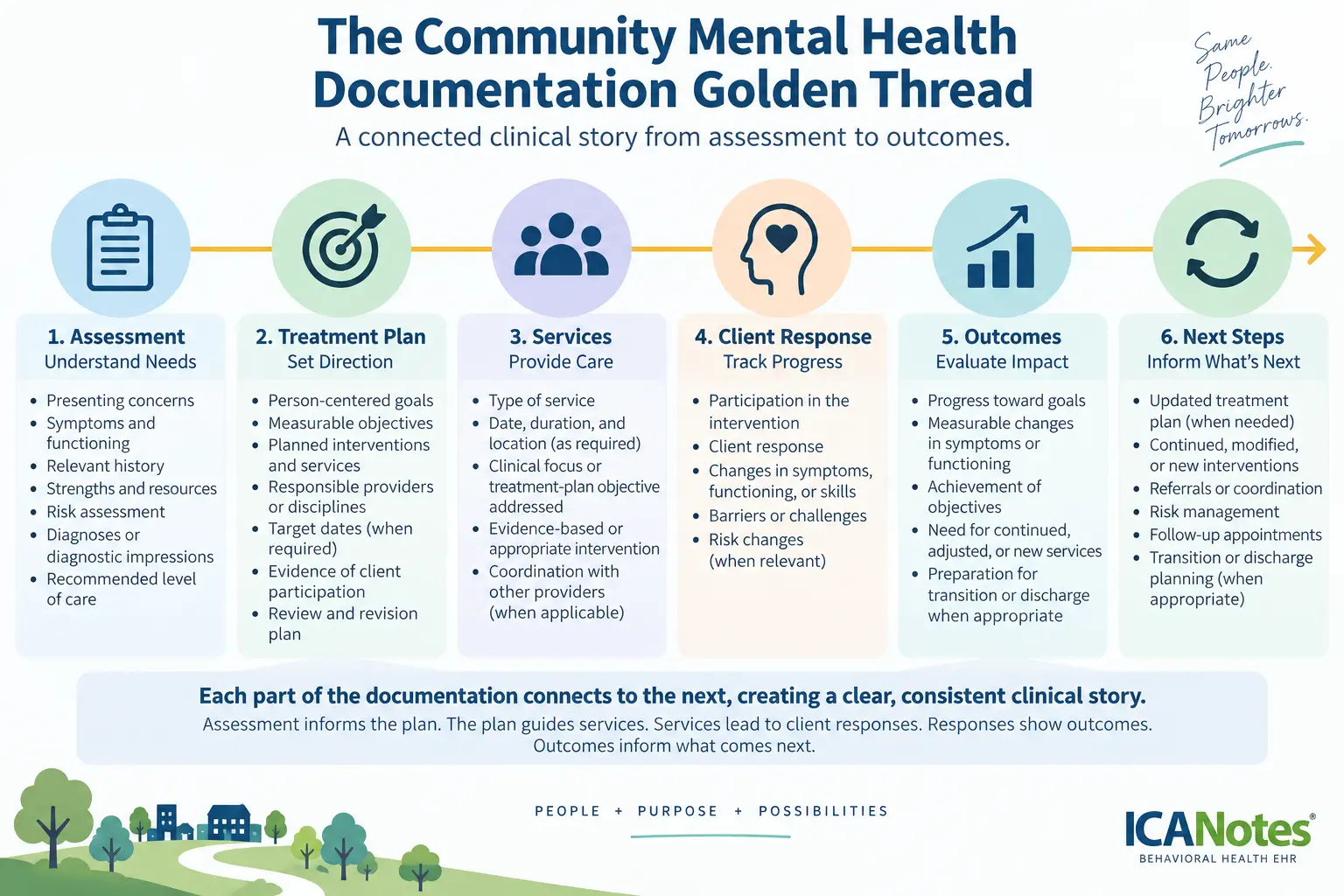
Assessment and diagnostic documentation
Your initial assessment establishes the clinical foundation for the remainder of the record.
Depending on the service and program, an assessment may document:
- Presenting concerns
- Current symptoms
- Psychiatric history
- Medical history
- Medication history
- Substance use history
- Trauma history when clinically appropriate
- Family and social history
- Developmental history when relevant
- Housing and environmental factors
- Employment or educational functioning
- Legal or justice-system involvement
- Strengths and protective factors
- Functional limitations
- Mental status findings
- Suicide and safety risk
- Diagnoses or diagnostic impressions
- Recommended level of care
- Initial treatment recommendations
The depth of your assessment should reflect the service you’re providing rather than simply filling every available field.
Documentation should be comprehensive without becoming clinically irrelevant.
Individualized treatment plans
The treatment plan should convert assessment findings into an organized plan for care.
For community mental health populations, that may involve much more than symptom reduction.
Goals may address:
- Psychiatric symptom stability
- Independent living skills
- Medication adherence
- Social functioning
- Employment
- Education
- Substance use recovery
- Family relationships
- Housing stability
- Community integration
- Safety
- Physical health coordination
- Crisis prevention
The important point is individualization.
A treatment plan should explain what this person needs and how your team’s services will address those needs.
For Certified Community Behavioral Health Clinics, SAMHSA’s 2023 CCBHC Certification Criteria specifically require person- and family-centered treatment planning. SAMHSA also requires CCBHC care coordination to be based on a person-centered and family-centered treatment plan.
Progress notes
Each progress note should move the clinical story forward.
Your note typically needs enough information to establish:
- Date of service
- Type of service
- Location or modality when required
- Duration when relevant to the billed service
- Clinical problem or treatment-plan objective addressed
- Intervention provided
- Client participation and response
- Progress, barriers, or change
- Safety concerns when relevant
- Coordination activities when applicable
- Next steps
- Clinician identity and credentials
- Signature and date according to applicable requirements
For Medicare-covered psychiatric and psychological services subject to an applicable Medicare Administrative Contractor policy, CMS guidance commonly requires documentation sufficient to establish medical necessity, including relevant clinical history and evidence supporting the service provided. Specific requirements can differ by jurisdiction and service.
Your note doesn’t have to repeat the entire treatment plan.
It should demonstrate how today’s work relates to it.
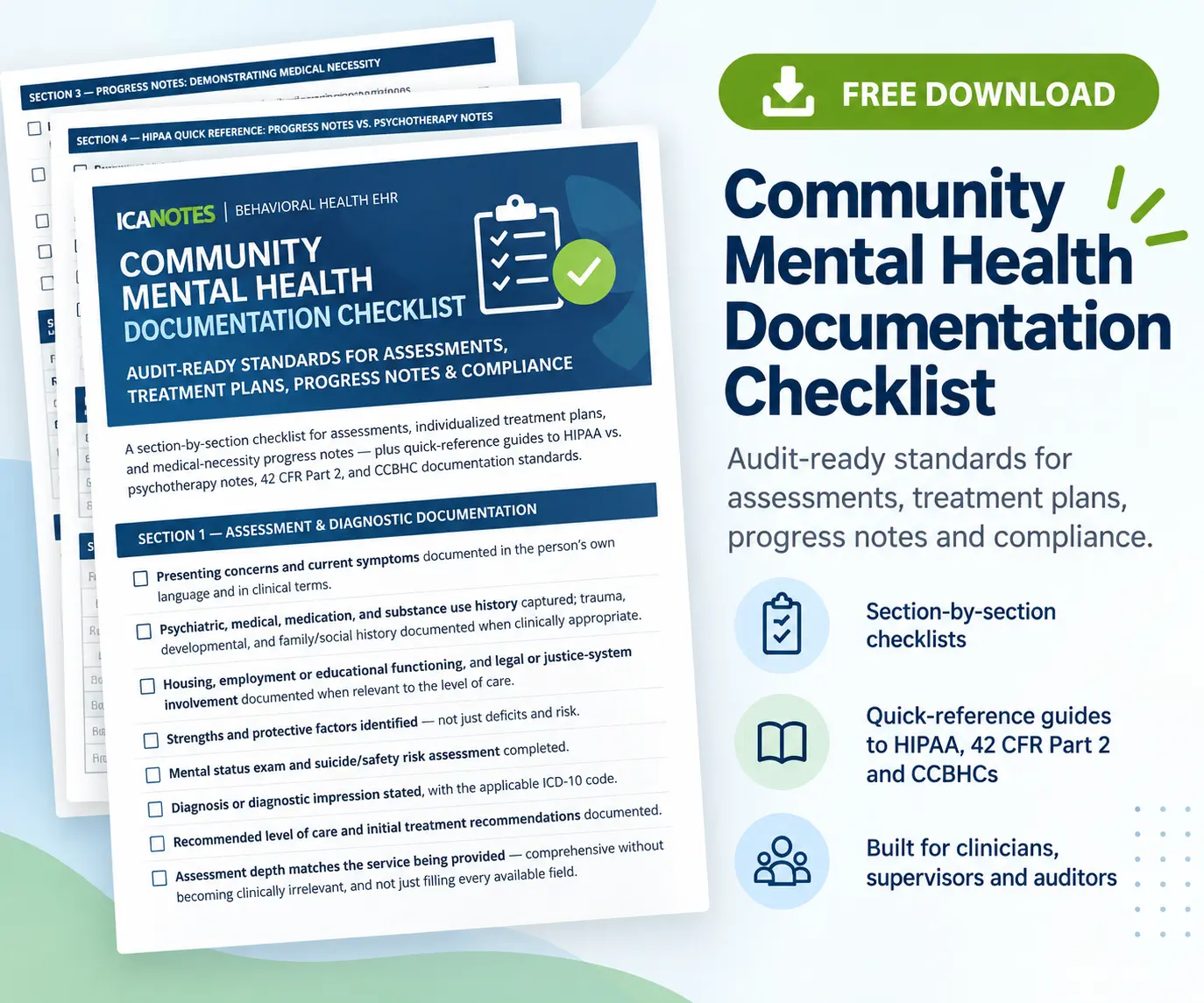
Make Community Mental Health Documentation Easier to Get Right
Download this practical checklist to help your team strengthen assessments, treatment plans, progress notes, and compliance workflows before documentation reaches an auditor or payer reviewer.
- Review assessment and diagnostic documentation for completeness and clinical relevance
- Strengthen treatment plans and progress notes to better support medical necessity and continuity of care
- Use quick-reference guidance for HIPAA, 42 CFR Part 2, and CCBHC documentation
- Catch common documentation pitfalls with a final pre-sign audit checklist
How Should Progress Notes Demonstrate Medical Necessity?
Medical necessity is one of the most important concepts in behavioral health documentation.
It’s also one of the most misunderstood.
A diagnosis alone doesn’t necessarily explain why a particular service, frequency, duration, or level of care is clinically appropriate.
Your documentation should create that connection.
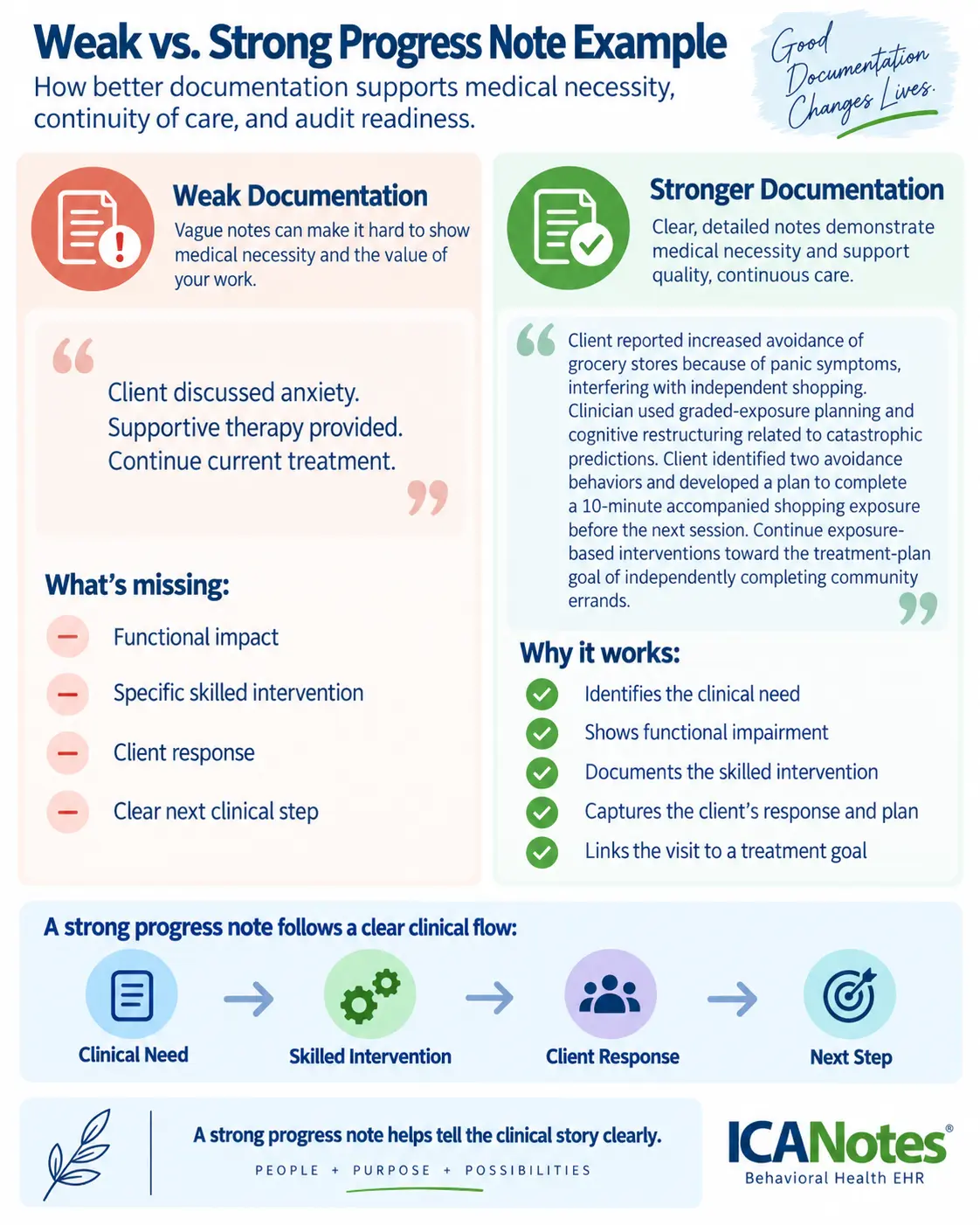
A strong progress note generally demonstrates:
Clinical need
Establish the symptom, problem, or functional impairment being addressed.
Planned goal
Tie the encounter to a defined treatment-plan objective.
Skilled intervention
Document the skilled service the clinician provided.
Patient response
Capture how the person participated and responded.
Next clinical decision
State what happens next in the course of treatment.
For example, compare these two entries.
Weak documentation:
Client discussed anxiety. Supportive therapy provided. Continue current treatment.
Stronger documentation:
Client reported increased avoidance of grocery stores because of panic symptoms, interfering with independent shopping. Clinician used graded-exposure planning and cognitive restructuring related to catastrophic predictions. Client identified two avoidance behaviors and developed a plan to complete a 10-minute accompanied shopping exposure before the next session. Continue exposure-based interventions toward the treatment-plan goal of independently completing community errands.
The second note provides a reviewer with clinical reasoning.
It establishes the symptom or impairment, explains what skilled service occurred, identifies the patient’s response, and links the encounter to an ongoing objective.
CMS Medicare coverage guidance similarly indicates that psychotherapy documentation should identify target symptoms, treatment goals, methods of monitoring outcomes, and how treatment is expected to improve health status or functioning.
Document the intervention, not just the topic
One common documentation problem is describing what the client talked about without documenting what the clinician did.
Consider the difference:
Topic: “Discussed argument with mother.”
Clinical intervention: “Used cognitive restructuring to identify all-or-nothing interpretations contributing to escalating conflict with mother. Practiced assertive communication using role-play.”
The second version documents skilled clinical work.
Your note should answer, “What required the knowledge, judgment, or intervention of this clinician?”
Community Mental Health Treatment Plan Documentation Requirements
Treatment plans are especially important in community mental health because multiple professionals may contribute to the person’s care.
A psychiatrist, therapist, psychiatric rehabilitation worker, case manager, peer support specialist, nurse, and substance use counselor may all address different aspects of one coordinated plan.
Your treatment plan needs enough structure to keep those services connected.
A strong treatment plan typically includes
- Diagnoses or clinical problems
- Symptoms and functional impairments
- Strengths and resources
- Person-centered goals
- Measurable objectives
- Planned interventions or services
- Frequency or anticipated intensity when required
- Responsible disciplines or providers
- Target dates when required
- Evidence of patient participation
- Signatures or approvals required by the applicable program
- Periodic review and revision
Goals should describe meaningful outcomes rather than administrative activities.
For example:
Less useful: “Client will attend therapy weekly.”
More useful: “Client will use at least two identified coping strategies to reduce panic-related avoidance and independently complete two community errands per week.”
Attendance may be necessary for treatment, but attendance isn’t usually the clinical outcome you’re trying to achieve.
When should a treatment plan be updated?
There isn’t one universal federal update interval for every community mental health service.
Your required schedule may come from your state, payer, program, accreditation standard, or contract.
You should also revise the plan when clinical circumstances make the existing plan inaccurate.
That may include:
- A significant change in symptoms
- A new diagnosis
- Psychiatric hospitalization
- A major safety event
- New functional impairment
- Significant improvement
- A change in treatment modality
- Addition or discontinuation of services
- A change in level of care
- A new patient goal or priority
Don’t wait for the calendar when the clinical picture has materially changed.
Community Mental Health Documentation Across Different Services
One documentation template rarely works equally well for every community mental health service.
The structure should reflect the clinical purpose of the service.
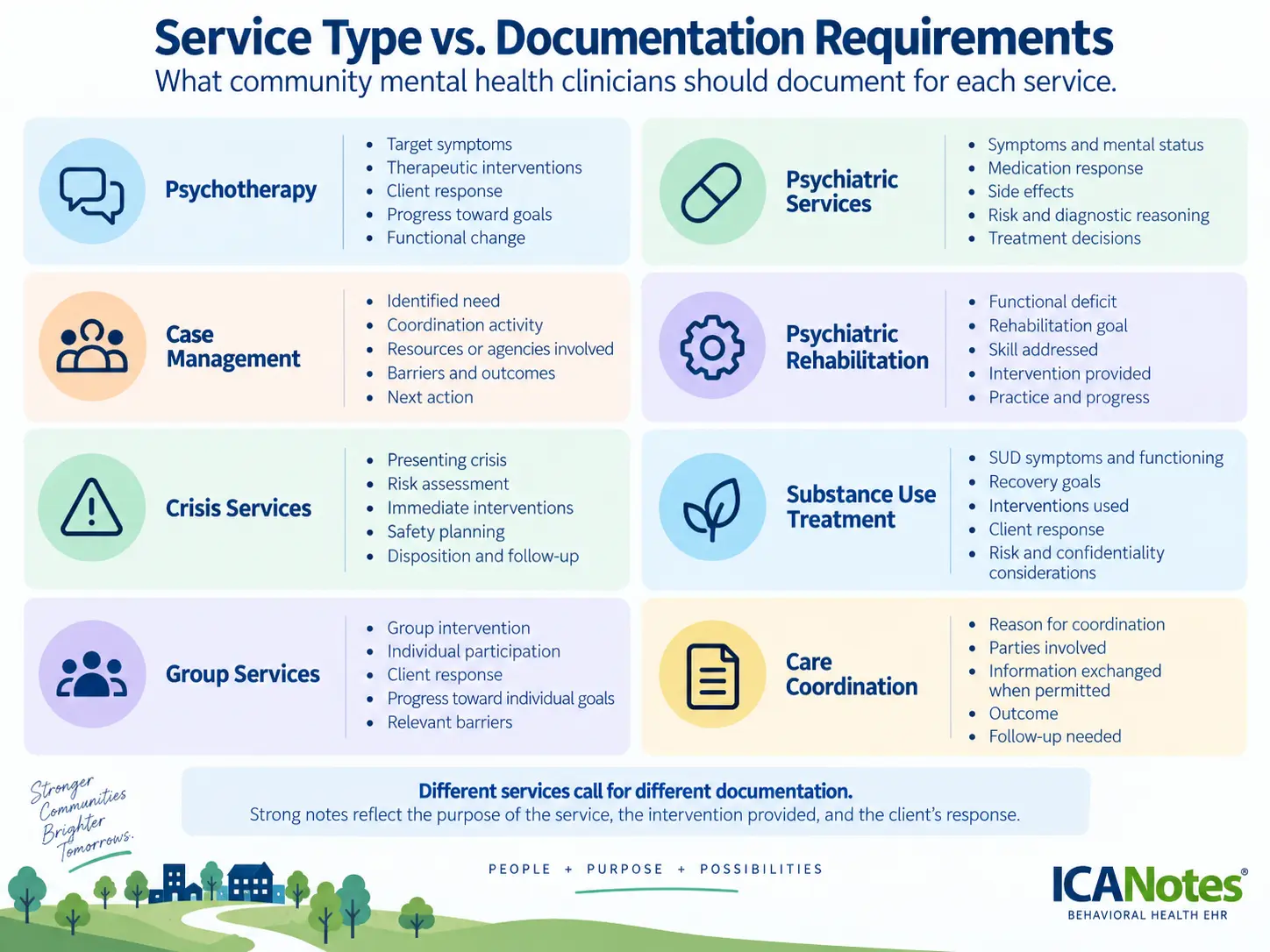
| Service | Documentation Should Emphasize |
|---|---|
| Psychotherapy | Target symptoms, therapeutic interventions, patient response, progress toward goals, functional change |
| Psychiatric services | Symptoms, mental status, medication response, adverse effects, risk, diagnostic reasoning, treatment decisions |
| Case management | Identified need, coordination activity, agencies or resources involved, barriers, outcome, next action |
| Psychiatric rehabilitation | Functional deficit, rehabilitation goal, skill addressed, intervention, practice or response, progress |
| Crisis services | Presenting crisis, risk assessment, immediate interventions, safety planning, disposition, follow-up |
| Substance use treatment | SUD-related symptoms and functioning, interventions, response, recovery goals, risk, appropriate Part 2 protections |
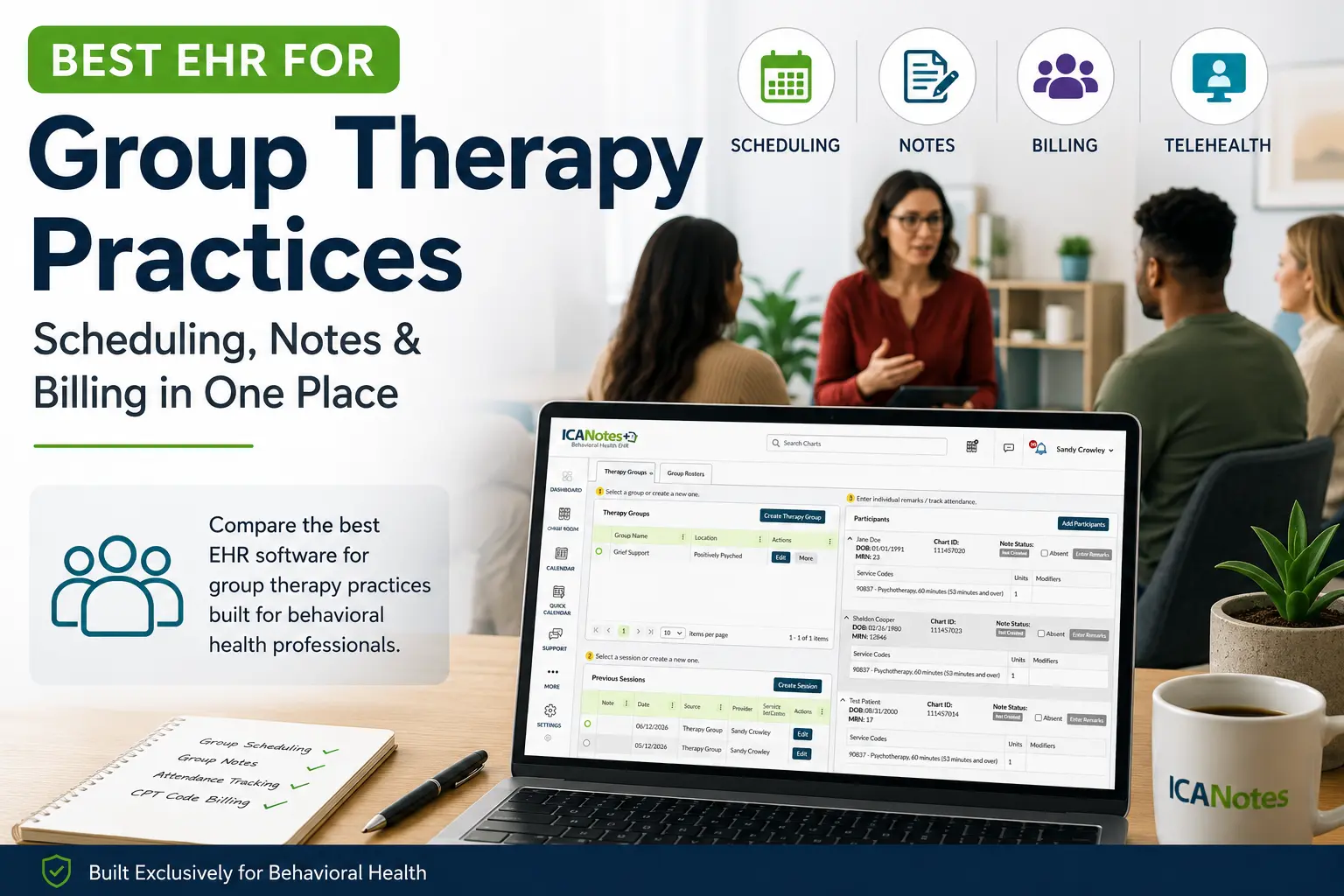
| Group services | Group intervention plus individualized documentation of each participant’s involvement, response, and progress |
| Care coordination | Reason for coordination, parties involved, information exchanged when permitted, outcome, unresolved needs, follow-up |
This is why copying a psychotherapy template and relabeling it “case management” often produces weak documentation.
The underlying clinical question differs.
For case management documentation, reviewers need to understand why the coordination activity was needed and what it accomplished.
For psychiatric rehabilitation documentation, the record should demonstrate a functional skill deficit and the intervention used to build capacity.
For crisis care, immediate risk, stabilization, disposition, and follow-up become central.
Group documentation must remain individualized
You can document common information about the group intervention, but each participant’s record should reflect that person’s involvement and response.
CMS has instructed Medicaid behavioral health practitioners to document patient-specific information for each participant when group therapy is furnished.
A cloned group therapy note that says every group member “participated appropriately and made progress” doesn’t demonstrate individualized care.
Instead, document information such as:
- Degree of participation
- Skill practiced
- Relevant contribution
- Response to the intervention
- Identified barrier
- Progress toward the individual’s goal
HIPAA Documentation Requirements for Community Mental Health Centers
HIPAA affects how behavioral health records are created, maintained, accessed, and disclosed, but it doesn’t establish the entire clinical content standard for your progress notes.
Under the HIPAA Privacy Rule, most mental health information receives the same general protections as other protected health information. HHS identifies psychotherapy notes as an important exception that receives additional protection.
Progress notes and psychotherapy notes are not the same thing
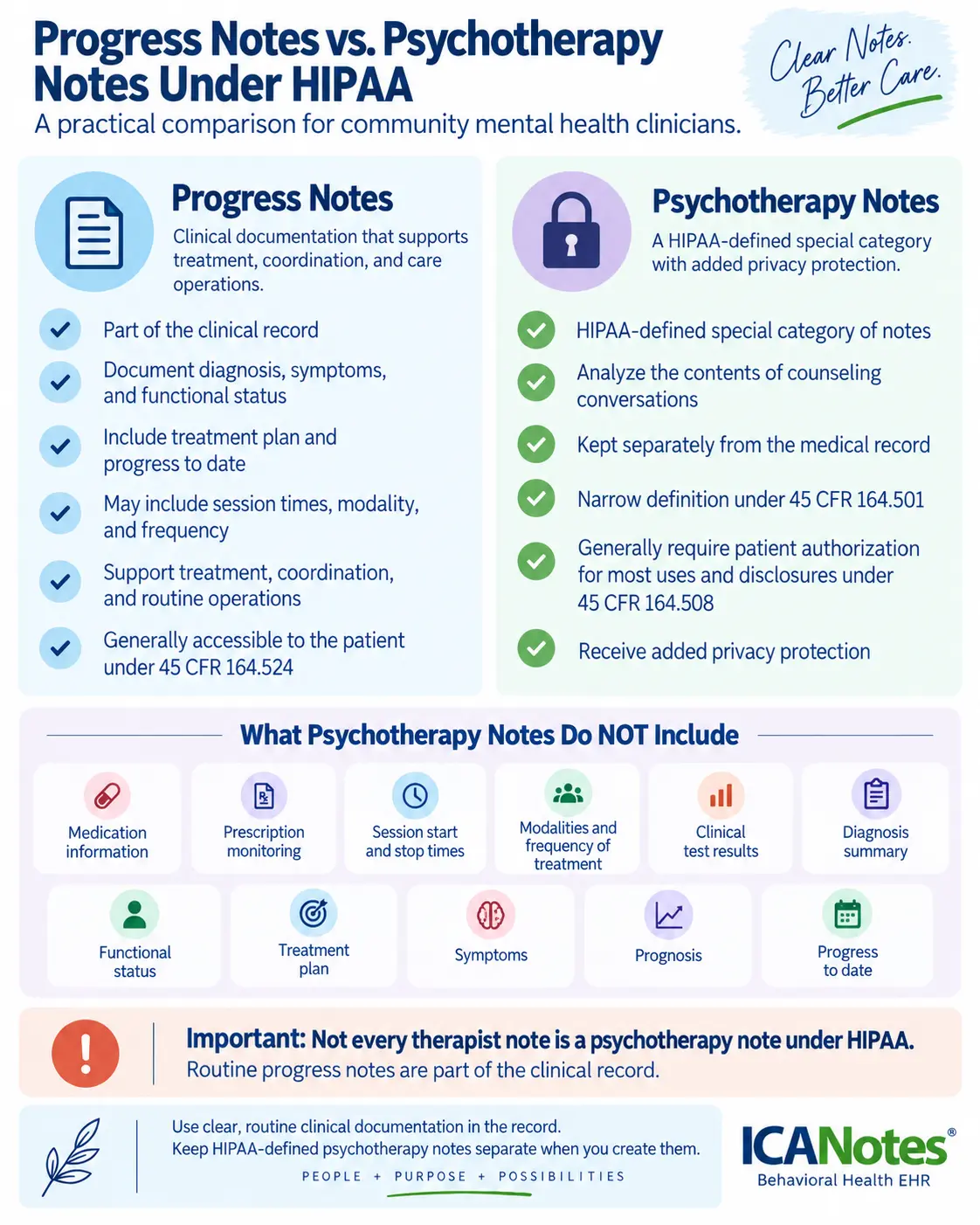
This distinction between progress notes and psychotherapy notes causes considerable confusion.
Under 45 CFR 164.501, psychotherapy notes are notes created by a mental health professional documenting or analyzing the contents of counseling conversations that are maintained separately from the medical record.
The federal definition specifically excludes information such as:
- Medication prescription and monitoring
- Counseling session start and stop times
- Modalities and frequency of treatment
- Clinical test results
- Diagnosis summaries
- Functional status
- Treatment plans
- Symptoms
- Prognosis
- Progress to date
Those items normally belong in the clinical record rather than being treated as protected psychotherapy notes.
Under 45 CFR 164.508, HIPAA generally requires patient authorization before psychotherapy notes can be used or disclosed, subject to specific regulatory exceptions.
Patients generally have access to their clinical records
Under 45 CFR 164.524, individuals generally have the right to access protected health information in a designated record set, subject to defined exceptions. HHS explains that this can include clinical case notes and SOAP notes but not separately maintained psychotherapy notes as defined by HIPAA.
That is another reason to write routine clinical documentation with clarity and professionalism.
Write the record with the understanding that the person receiving care may read it.
42 CFR Part 2 Requirements for Substance Use Disorder Records
Community mental health organizations frequently provide both mental health and substance use services.
That means you may need to consider 42 CFR Part 2 in addition to HIPAA.
According to HHS, Part 2 applies to certain records relating to the identity, diagnosis, prognosis, or treatment of patients maintained in connection with federally assisted substance use disorder programs or activities covered by the regulation.
The 2024 Part 2 Final Rule aligned several aspects of Part 2 more closely with HIPAA while retaining protections specific to substance use disorder information.
HHS states that compliance with the revised requirements was required beginning February 16, 2026.
Among the changes described by HHS, the rule permits a single patient consent for future treatment, payment, and health care operations uses and disclosures. It also allows certain HIPAA covered entities and business associates receiving records under that consent to redisclose the records in accordance with HIPAA.
At the same time, important protections remain.
According to the HHS Part 2 Final Rule Fact Sheet, Part 2 records generally can’t be used to investigate or prosecute a patient without written patient consent or an appropriate court order. The rule also establishes additional protections concerning use of SUD records in legal proceedings.
The rule also requires separate consent for the use and disclosure of SUD counseling notes in circumstances addressed by the regulation.
If your organization provides SUD treatment, don’t assume that ordinary HIPAA workflows automatically satisfy Part 2.
Your policies, consent workflows, record segmentation, release-of-information procedures, and EHR configuration should reflect the requirements that apply to your program.
Documentation Requirements for CCBHCs
If your community mental health center is a Certified Community Behavioral Health Clinic, documentation supports a broader model of integrated and coordinated care.
SAMHSA identifies nine required CCBHC service areas, including crisis services, outpatient mental health and substance use services, person- and family-centered treatment planning, targeted care management, psychiatric rehabilitation, screening and diagnosis, and primary care screening and monitoring.
CCBHC documentation therefore needs to support more than isolated therapy encounters.
The record may need to demonstrate:
- Timely access to services
- Comprehensive assessment
- Person- and family-centered treatment planning
- Crisis planning
- Care coordination
- Physical health screening and monitoring
- Substance use services
- Psychiatric rehabilitation
- Peer and family supports
- Veteran-specific services when applicable
- Quality measurement
- Follow-up and transitions of care
SAMHSA’s 2023 CCBHC Certification Criteria state that CCBHCs must maintain documentation necessary to satisfy HIPAA, 42 CFR Part 2, and other applicable federal and state privacy requirements.
The criteria also address a problem clinicians regularly encounter: obtaining consent for coordination.
If a CCBHC can’t obtain required consent after reasonable attempts for certain care-coordination activities, SAMHSA’s criteria direct the clinic to document those attempts and revisit the issue periodically.
That means “coordination didn’t happen” may not be sufficient documentation.
The record should demonstrate what you attempted, what prevented the coordination, and what needs to happen next.
Common Documentation Problems in Community Mental Health
The pressure to complete large numbers of notes can make documentation increasingly templated.
Templates aren’t inherently a problem.
Templates that replace clinical reasoning are.
Copying Forward Outdated Information
Carry-forward features can save clinicians substantial time, but copied information should remain accurate.
If a note says the patient continues to deny suicidal ideation three weeks after a documented suicide attempt, the contradiction creates both clinical and documentation concerns.
Review carried-forward information before signing.
Writing Identical Notes Across Encounters
Repeated wording may make ongoing services difficult to distinguish.
You don’t need to reinvent your writing style after every encounter.
You do need to document what actually changed, what intervention occurred, and how the person responded.
Documenting Activity Without Purpose
“Called housing agency.”
“Discussed coping skills.”
“Provided support.”
Each may describe something you did.
None independently explains why the activity was clinically necessary.
Connect the activity to the identified treatment need.
Failing to Document the Patient’s Response
Intervention alone doesn’t tell you whether treatment is working.
Capture what happened after the intervention.
- Did the patient demonstrate a skill?
- Reject a recommendation?
- Identify a barrier?
- Report reduced symptoms?
- Remain unchanged?
- Require escalation?
The response helps determine your next clinical decision.
Allowing the Treatment Plan and Notes to Drift Apart
Your progress notes shouldn’t describe months of work on problems that don’t appear anywhere in the active treatment plan.
When priorities change, update the plan.
Reducing Community Mental Health Documentation Burden Without Sacrificing Quality
Community mental health clinicians often face a difficult balance.
You need enough documentation to support safe clinical care, reimbursement, coordination, regulatory compliance, and quality reporting.
You also need enough time to actually provide care.
The answer shouldn’t be making every note longer.
It’s making documentation more structured, relevant, and reusable.
Standardize what can be standardized
Your organization can define:
- Required assessment elements
- Note structures by service
- Treatment-plan conventions
- Risk documentation workflows
- Review intervals
- Signature requirements
- Common scales
- Discharge requirements
- Care-coordination fields
Clinicians shouldn’t have to memorize dozens of payer and program rules while seeing patients.
Keep clinical documentation and administrative reporting connected
A frequent source of burden is documenting the same information in several places.
For example, a clinician might record a functional limitation in the assessment, manually convert it into a treatment-plan objective, restate it in every progress note, and later enter it again for reporting.
A behavioral health-specific EHR can reduce this duplication when assessment findings, treatment plans, progress notes, outcome measures, billing, and reporting share structured information.
This is where a system such as ICANotes can become part of the operational solution.
ICANotes is designed specifically for behavioral health workflows, including community mental health services. Menu-driven clinical documentation helps clinicians build individualized narrative notes while maintaining consistent documentation structures.
Treatment planning, progress documentation, diagnostic information, rating scales, prescribing, billing, and reporting can remain connected within the same clinical workflow.
The goal isn’t simply to document faster.
It’s to make the required documentation easier to complete correctly while preserving the clinical story across the record.
Build compliance into the workflow
The best documentation policy is one clinicians can realistically follow.
Instead of relying entirely on retrospective audits, consider tools and processes that prompt clinicians before the note is signed.
For example:
- Required fields for critical documentation elements
- Alerts for missing signatures
- Treatment-plan review reminders
- Standardized risk assessments
- Service-specific templates
- Outcome-measure tracking
- Documentation completion reports
- Role-based access to sensitive information
- Audit trails
- Structured consent workflows
Documentation quality becomes easier to sustain when the system helps clinicians recognize what’s missing.
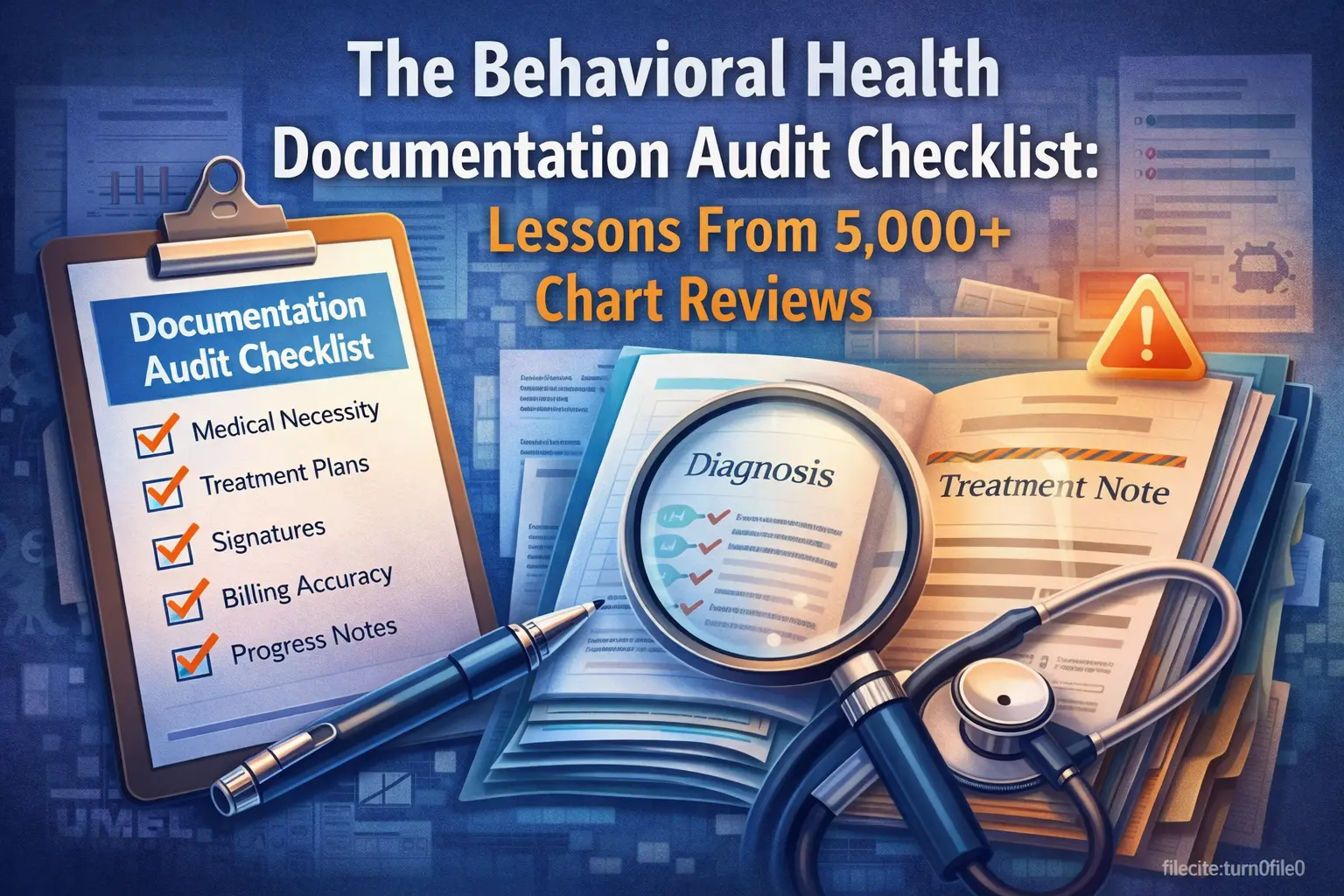
A Practical Community Mental Health Documentation Checklist
Before signing a note, ask yourself whether another clinician, payer reviewer, or auditor could understand the encounter without asking you to explain it.
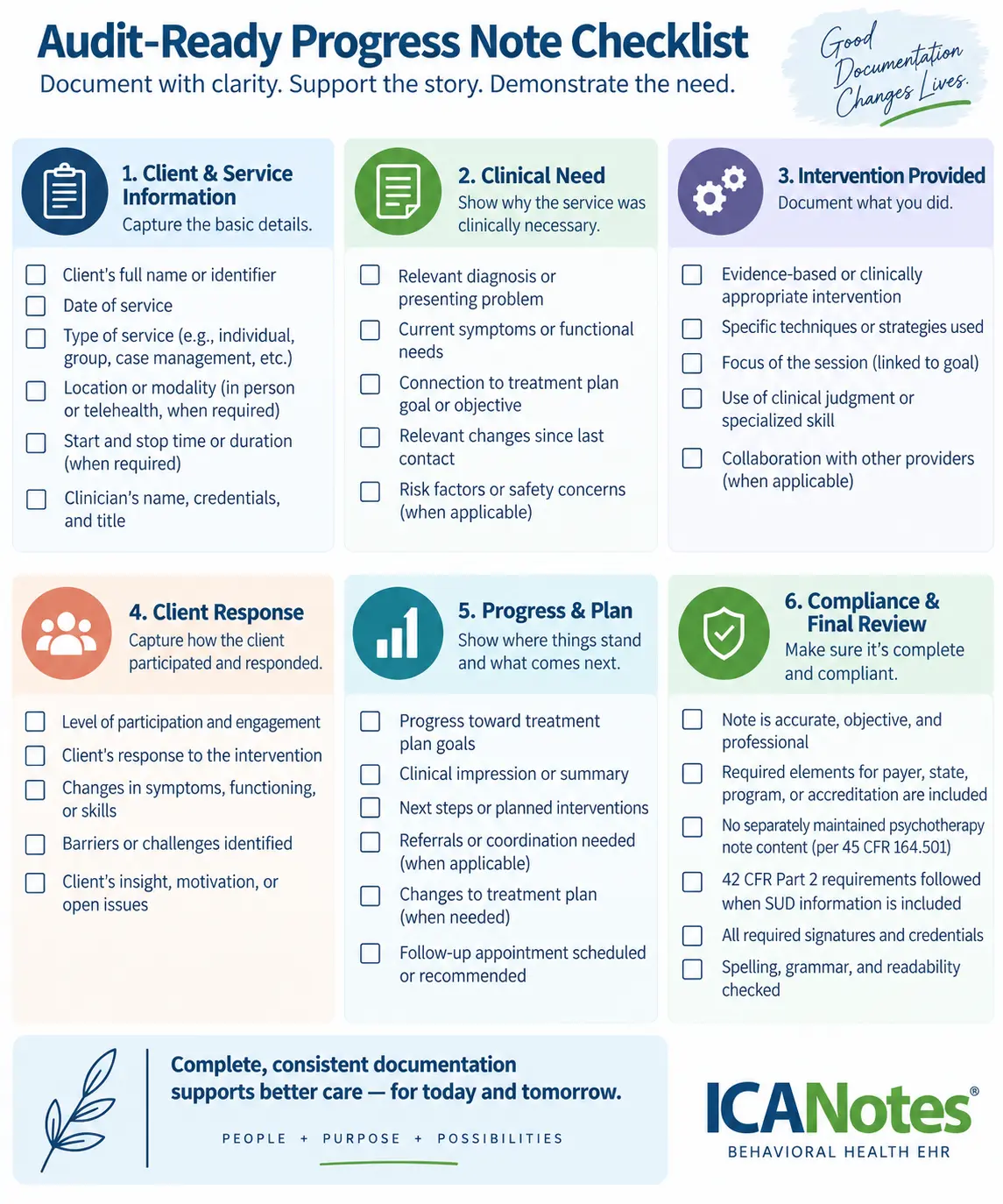
Clinical need
- Is the problem, symptom, or functional need clear?
- Does the service relate to an active diagnosis, treatment-plan problem, or documented need?
- Is the appropriate level of risk documented when relevant?
Service provided
- Is the service accurately identified?
- Is the date documented?
- Is duration documented when required?
- Is the modality or location recorded when required?
Intervention
- Did I document what I actually did?
- Does the note describe a skilled intervention rather than only a conversation topic?
- Does the intervention relate to a treatment goal?
Patient response
- Did I explain how the patient participated or responded?
- Did I document progress, lack of progress, or barriers?
- Is any meaningful change in functioning captured?
Plan
- Is the next clinical step clear?
- Does the current treatment plan still reflect the patient’s needs?
- Does anything require follow-up, referral, coordination, or escalation?
Compliance
- Is the note signed and dated according to applicable requirements?
- Did I avoid unnecessarily including separately protected psychotherapy-note content?
- If SUD information is involved, have I followed applicable 42 CFR Part 2 requirements?
- Have I followed my state, payer, program, contract, and organizational documentation rules?
Make Community Mental Health Documentation Easier to Manage
ICANotes is built specifically for mental health organizations, with structured clinical documentation, customizable treatment planning, and compliance-focused tools that support complex community mental health services. Start a 30-day free trial and see how a behavioral health-specific EHR can simplify documentation across your organization.
- Menu-driven notes that keep the golden thread visible
- Individualized, measurable treatment plans by service
- Compliance prompts for signatures and required fields
- Structured consent workflows for HIPAA and Part 2
See how ICANotes can support your clinical workflow. Start your free 30-day trial, no credit card required.
Start Your Free 30-Day Trial
Frequently Asked Questions About Community Mental Health Documentation
What are the basic documentation requirements for community mental health services?
What should be included in a community mental health progress note?
Does every progress note have to show improvement?
What is the difference between a progress note and a psychotherapy note under HIPAA?
Are community mental health documentation requirements different for Medicaid?
How often must community mental health treatment plans be updated?
What documentation is required for a CCBHC?
Does 42 CFR Part 2 apply to every mental health record?
References
- Centers for Medicare & Medicaid Services (CMS). Medicaid Documentation for Behavioral Health Practitioners. This CMS fact sheet addresses Medicaid behavioral health documentation, state-specific Medicaid requirements, medical necessity, signatures, dates, coding, and documentation needed to support billed services. CMS Medicaid Documentation for Behavioral Health Practitioners
- Centers for Medicare & Medicaid Services (CMS), Medicare Coverage Database. Billing and Coding: Psychiatry and Psychology Services (A56937). Used for Medicare-related behavioral health documentation and medical-necessity guidance discussed in the post. CMS Billing and Coding: Psychiatry and Psychology Services
- Centers for Medicare & Medicaid Services (CMS), Medicare Coverage Database. Outpatient Psychotherapy, LCD L39853. Used for the discussion of psychotherapy progress and documentation supporting continued treatment. CMS Outpatient Psychotherapy LCD
- U.S. Department of Health and Human Services, Office for Civil Rights. Does HIPAA Provide Extra Protections for Mental Health Information Compared With Other Health Information? Used for the distinction between routine clinical records and HIPAA-defined psychotherapy notes, including what psychotherapy notes exclude. HHS Guidance on Mental Health Information and Psychotherapy Notes
- U.S. Department of Health and Human Services, Office for Civil Rights. What Personal Health Information Do Individuals Have a Right Under HIPAA to Access? Used for the discussion of patient access to clinical records and the exception for separately maintained psychotherapy notes. HHS Guidance on Individual Access to Health Information
- U.S. Department of Health and Human Services. Standards for Privacy of Individually Identifiable Health Information: Regulation Text. Used for the HIPAA authorization requirements applicable to psychotherapy notes under 45 CFR 164.508. HHS Privacy Rule Regulation Text
- U.S. Department of Health and Human Services, SAMHSA and Office for Civil Rights. Fact Sheet: 42 CFR Part 2 Final Rule. Used for the article's discussion of substance use disorder records, patient consent, redisclosure, SUD counseling notes, legal-proceeding protections, and the February 16, 2026 compliance date. The HHS fact sheet was updated January 30, 2026. HHS 42 CFR Part 2 Final Rule Fact Sheet
- Substance Abuse and Mental Health Services Administration (SAMHSA). Certified Community Behavioral Health Clinic Certification Criteria. Used for the CCBHC discussion, including required service areas, care coordination, accessibility, treatment planning, and quality requirements. SAMHSA CCBHC Certification Criteria
- Substance Abuse and Mental Health Services Administration (SAMHSA). Certified Community Behavioral Health Clinic Certification Criteria, 2023. Used for specific CCBHC requirements regarding individualized, person- and family-centered treatment planning, comprehensive evaluation, monitoring progress, care coordination, releases of information, and health-record documentation. SAMHSA 2023 CCBHC Certification Criteria PDF
Dr. October Boyles
Dr. October Boyles is a behavioral health expert and clinical leader with extensive expertise in nursing, compliance, and healthcare operations. With a Doctor of Nursing Practice (DNP) and advanced degrees in nursing, she specializes in evidence-based practices, EHR optimization, and improving outcomes in behavioral health settings. Dr. Boyles is passionate about empowering clinicians with the tools and strategies needed to deliver high-quality, patient-centered care.