
Multidisciplinary Behavioral Health EHR: One System for Therapy and Psychiatry
Discover how a multidisciplinary behavioral health EHR connects therapy, psychiatry, medication management, and billing in one shared system while supporting each clinician's unique workflows.


When therapists and psychiatric prescribers treat the same patient, they need more than shared scheduling. A multidisciplinary behavioral health EHR should connect clinical documentation, treatment planning, medication management, and billing while giving each team member appropriate access to the record.
A multidisciplinary behavioral health EHR is an electronic health record designed to support multiple clinical specialties, such as psychotherapy and psychiatric medication management, within one coordinated system. It combines role-specific clinical documentation, shared treatment planning, medication management, scheduling, and billing while maintaining appropriate access controls for each care team member.
Key takeaways
- A multidisciplinary behavioral health EHR supports distinct therapy and psychiatric workflows in a coordinated clinical record, rather than forcing every clinician to document the same way.
- Shared treatment plans and configurable access can help therapists and prescribers coordinate care while protecting sensitive information.
- Administrative burden is a documented problem: in a 2026 ICANotes survey of 416 licensed U.S. mental health professionals, 40.14% reported spending 11 or more hours a week on documentation, billing, and other non-clinical tasks.
- Workforce shortages increase the importance of efficient prescriber workflows. HRSA projects a shortage of more than 36,000 adult psychiatrist full-time equivalents by 2038 under its status quo scenario.
- Mixed teams need billing workflows for psychotherapy and psychiatric evaluation and management (E/M) services, with documentation and coding appropriate to each encounter.
- Evaluate systems using a realistic patient journey: intake, therapy, psychiatric evaluation, medication management, outcomes, telehealth, and billing.
What Is a Multidisciplinary Behavioral Health EHR?
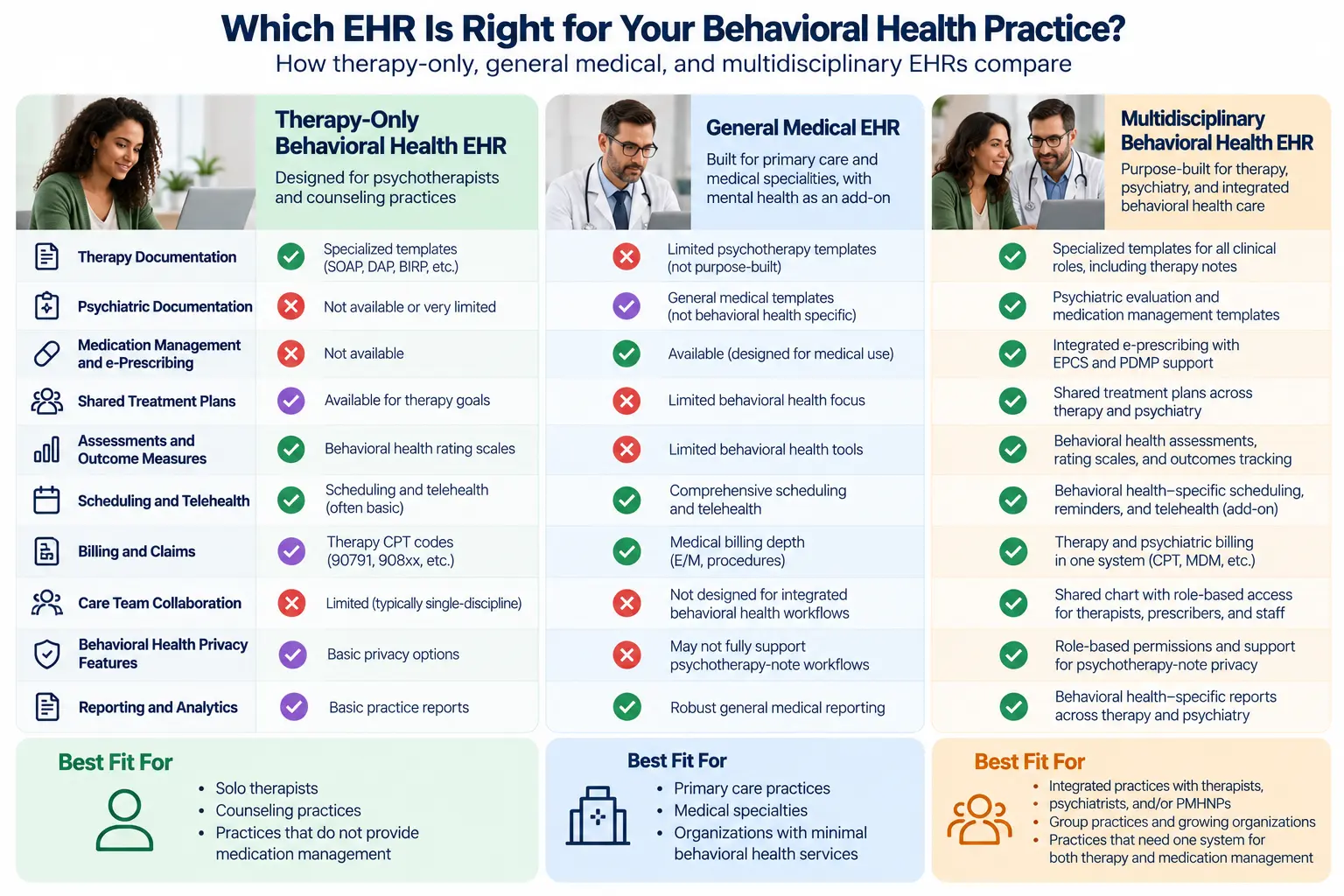
A multidisciplinary behavioral health EHR is an electronic health record designed to support more than one behavioral health discipline within the same practice. For a group offering psychotherapy and psychiatric medication management, that means purpose-built clinical notes, treatment plans, medication workflows, rating scales, scheduling, and billing tools that support each clinician’s role.
Therapy-centered practice management software may support sessions, scheduling, and progress notes but lack prescribing tools or psychiatric evaluation workflows. General medical EHRs may offer prescribing and extensive billing functions but require additional configuration for behavioral health documentation. The goal is not simply to find the longest feature list; it is to find a system that supports how your team actually provides care.
For practices with therapists, psychiatrists, and psychiatric-mental-health nurse practitioners (PMHNPs), the central question is whether those specialties can coordinate care without duplicating data or compromising appropriate access.
| System type | Typical strengths | Common gap for mixed teams |
|---|---|---|
| Therapy-centered practice management software | Sessions, scheduling, and progress notes | May lack prescribing tools or psychiatric evaluation workflows |
| General medical EHRs | Prescribing and extensive billing functions | Require additional configuration for behavioral health documentation |
| Multidisciplinary behavioral health EHR | Purpose-built notes, treatment plans, medication workflows, rating scales, scheduling, and billing | Supports how your team actually provides care across disciplines |
Why General EHR Comparisons Miss the Mixed-Team Problem
Most comparisons of the best behavioral health EHR options treat therapists and prescribers as separate buyer personas, then list features for each one. That works fine for a solo therapist or a solo psychiatrist shopping alone. It falls apart for a practice where a licensed clinical social worker and a psychiatric-mental-health nurse practitioner treat the same client and need to see, at different levels of detail, what the other clinician has documented.
The practical questions in an integrated practice look different from a standard feature list:
- Can the therapist's progress note and the prescriber's medication-management note live in one chart without forcing both clinicians onto the same template.
- Can the prescriber see the treatment plan, diagnosis history, and relevant risk information without opening every psychotherapy process note the therapist has written.
- Can a supervisor or biller see scheduling and billing information without reading clinical detail they don't need for their job.
Those questions rarely show up in a feature-by-feature vendor comparison. You mostly find the answer by opening a real chart in a demo and walking through it yourself.
Compare Behavioral Health EHRs With Confidence
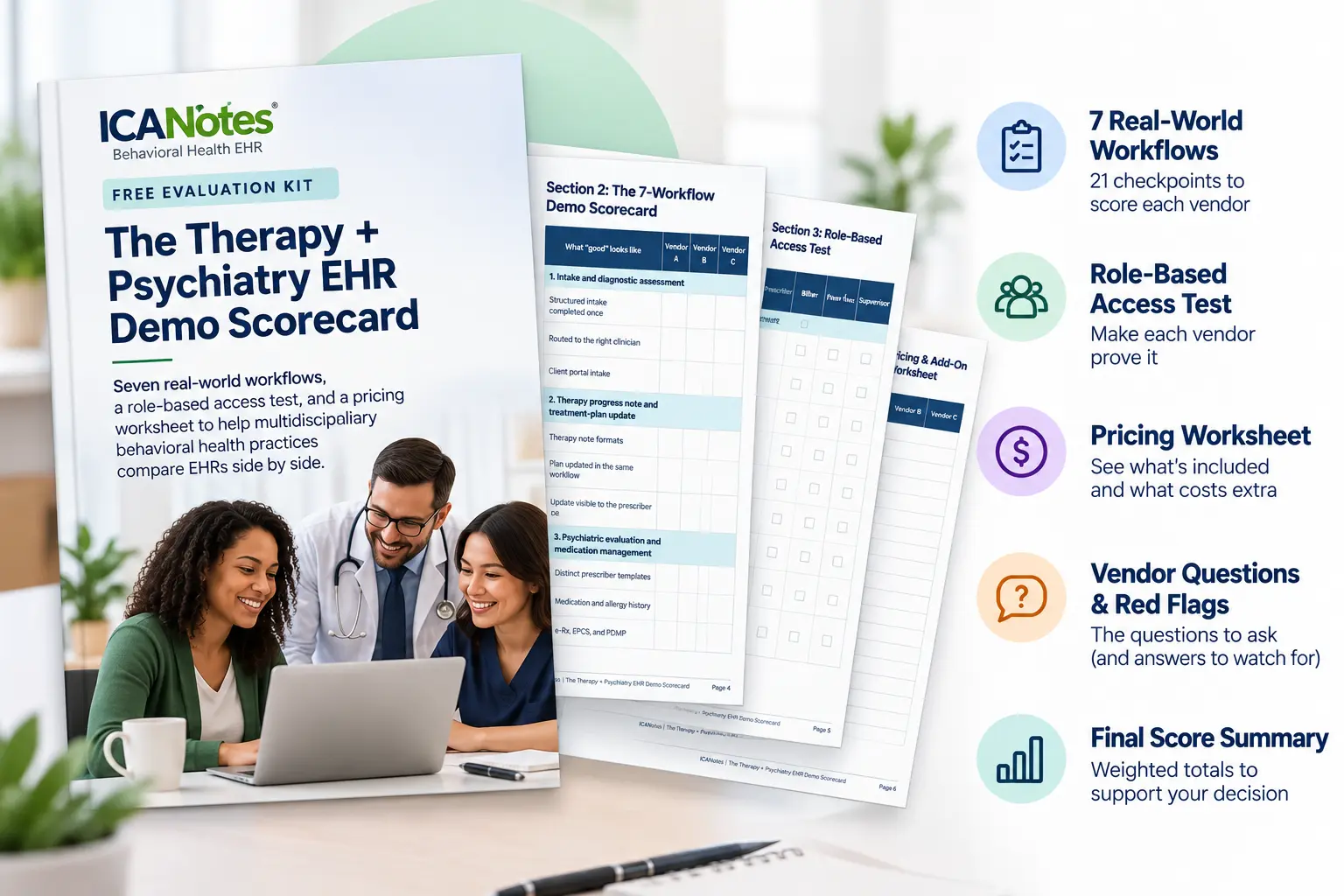
Choosing an EHR for a multidisciplinary practice? Get our free Therapy + Psychiatry EHR Demo Scorecard to compare vendors, evaluate essential workflows, and find the right fit for your clinical team.
- 21 evaluation checkpoints across seven real-world therapy, psychiatry, and administrative workflows.
- Role-based access checklist to evaluate how each EHR protects sensitive patient information.
- Pricing comparison worksheet to uncover add-on fees and compare total costs.
- Vendor questions and scoring tools to identify red flags and confidently compare up to three EHR systems.
What Coordinated Therapy and Psychiatry Care Requires
A shared chart and a shared treatment plan
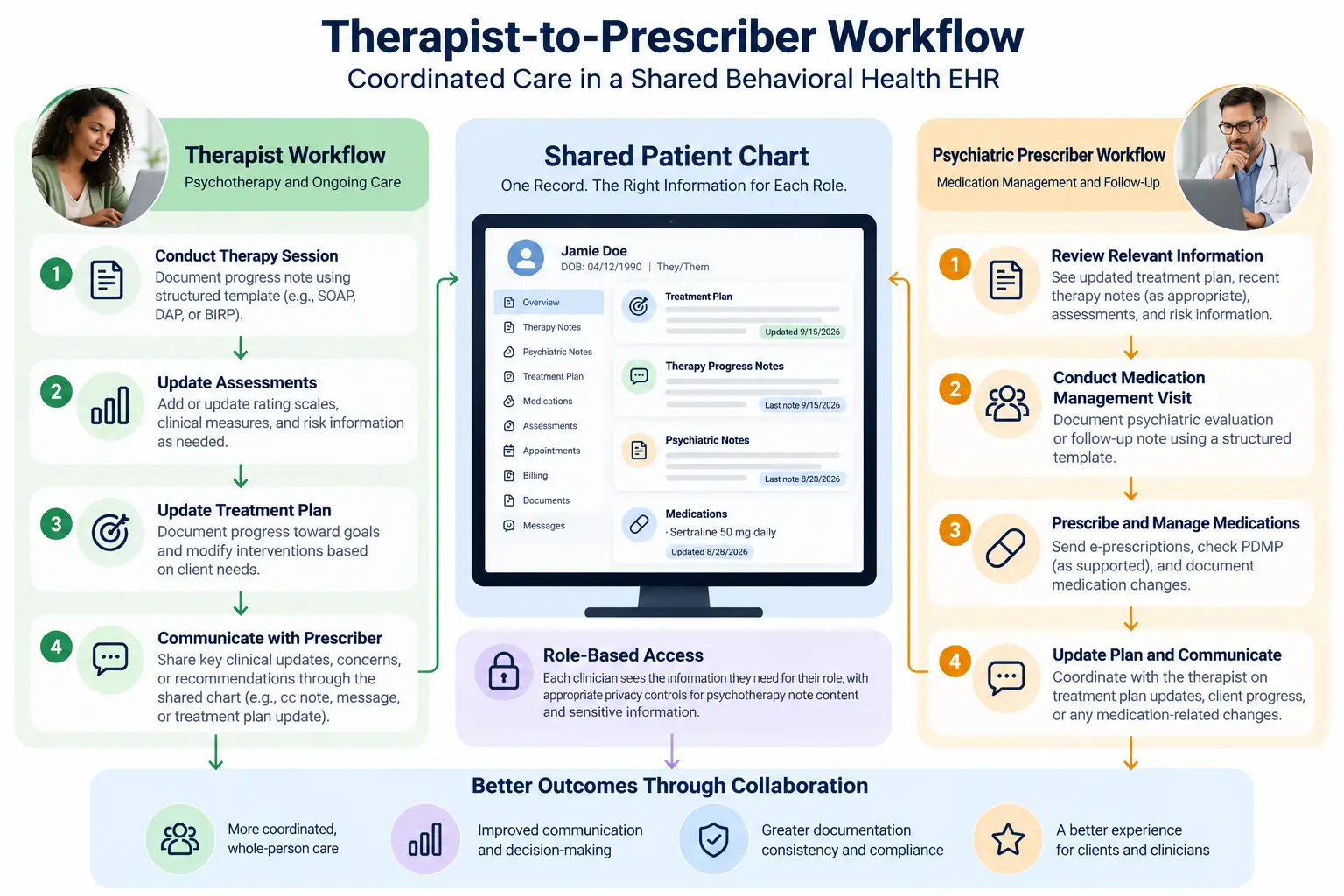
When a therapist updates a treatment-plan goal, the prescriber should be able to review the relevant change before the next medication-management visit. Ask vendors to demonstrate who can edit the plan, how changes are displayed, and whether clinicians are alerted to clinically important updates. A shared chart helps, but effective coordination also depends on the practice’s communication protocols.
Therapist-to-prescriber handoffs
A referral or follow-up request between clinicians should communicate its purpose, urgency, and relevant background. Ask whether the EHR supports internal messaging, tasks, or clinical handoffs, and whether the receiving clinician can review appropriate history without duplicate entry. Do not assume that a shared chart automatically creates an alert or referral workflow.
Medication history, e-prescribing, EPCS, and PDMP access
Prescribers typically need medication and allergy histories, electronic prescribing, and — where applicable — electronic prescribing of controlled substances (EPCS) and access to state prescription drug monitoring program (PDMP) information. During a demo, confirm which functions are embedded, which use an integrated third-party service, and which require separate credentials or fees.
Role-Based Permissions and Sensitive Notes
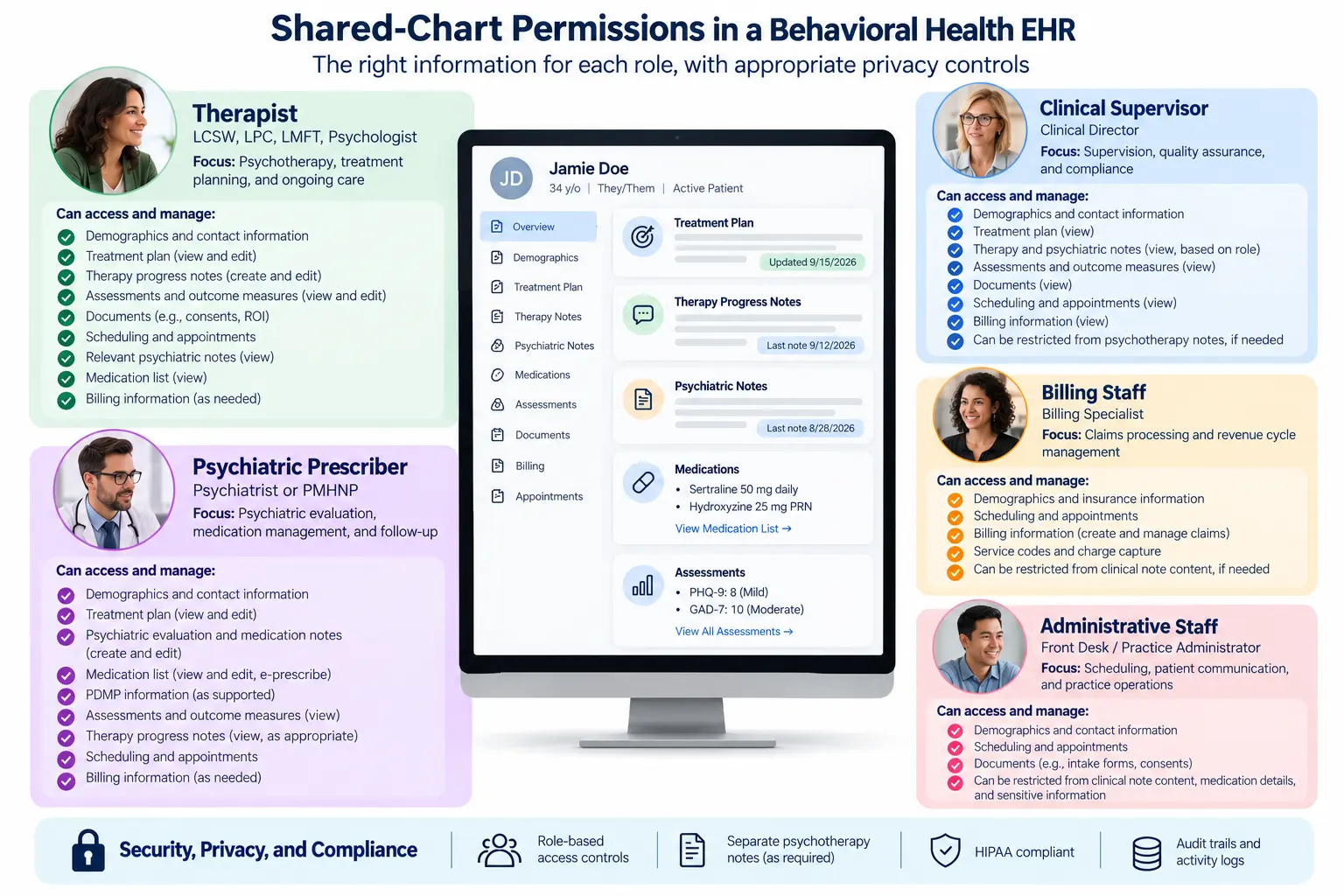
Clinical progress notes are generally part of the medical record. Under HIPAA, separately maintained psychotherapy notes — personal notes documenting or analyzing a counseling conversation — receive additional protections and are distinct from ordinary progress notes, diagnoses, and treatment plans. Some substance use disorder records may also be subject to 42 CFR Part 2. Ask vendors to demonstrate how they separate protected content, manage user permissions, log access, and support your practice’s privacy policies; legal requirements depend on the circumstances and applicable law.
A shared patient chart doesn't mean every team member should have access to every piece of information. Role-based permissions help practices give clinicians and administrative staff access to the information needed for their responsibilities while protecting sensitive clinical records.
Why Shared Workflows Matter to Growing Practices
Documentation, claims, prior authorizations, and coordination can create substantial administrative work. In a mixed team, disconnected systems may also require clinicians and staff to re-enter information or search across applications.
According to a 2026 ICANotes survey of 416 licensed U.S. mental health professionals across solo, group, and community mental health settings, 40.14% of respondents reported spending 11 or more hours a week on documentation, billing, and other non-clinical administrative tasks. More than a quarter, 26.20%, said they had reduced their client caseload over the past year specifically to manage that administrative load.
Staffing pressure compounds that challenge. HRSA’s 2025 behavioral health workforce report projects a shortage of approximately 36,780 adult psychiatrist full-time equivalents by 2038 under its status quo scenario, or 86,430 under an elevated-need scenario. The same report estimated that about 137 million people lived in a Mental Health Professional Shortage Area as of December 2, 2025 — not as of the second quarter of fiscal year 2026.
These data do not prove that a particular EHR saves a specific number of hours. They do explain why practices should test whether shared documentation and coordinated workflows reduce avoidable steps for clinicians and staff.
The following workflow illustrates how therapists and psychiatric prescribers can coordinate care through a shared behavioral health EHR while maintaining distinct clinical responsibilities and appropriate access to patient information.
Seven Real-World Workflows to Test in an EHR Demo
Rather than compare specification sheets, walk a demo through the sequence a real client follows in an integrated practice, from intake through the first billed claim.
- Intake and diagnostic assessment. Does the system support a structured intake that a therapist or an intake coordinator can complete once and route to the right clinician, without re-keying demographic or insurance data later.
- Therapy progress note and treatment-plan update. Can a therapist document a session and update a shared treatment-plan goal in the same workflow, without a second data-entry step for the plan itself.
- Psychiatric evaluation and medication-management follow-up. Can a prescriber use distinct templates for initial assessments and follow-up visits, capture clinical decision-making, and complete appropriate prescribing steps?
- Rating scales and longitudinal outcomes. Can both clinicians see the same PHQ-9, GAD-7, or other validated scale trended over time, instead of each running a separate outcomes tool that the other never sees.
- Group therapy and recurring appointments. Can staff document the group encounter and each participant’s attendance and individual clinical record, with billing aligned to payer requirements?
- Telehealth and patient communication. Can patients join visits easily, and can clinicians document and bill them within their usual workflow? Confirm whether telehealth is included or an add-on.
- Billing, claims, ERAs, and denials. Can the practice submit psychotherapy and psychiatric E/M claims without unnecessary re-entry, track denials, and reconcile electronic remittance advice (ERAs)?
Ask to see each of these live, in a real or realistic sample chart, rather than as a slide in a sales deck.
How Billing Works When Therapists and Prescribers Share a Practice
Psychotherapy and psychiatric visits often follow different coding requirements. For example, individual psychotherapy may use CPT 90834, family psychotherapy 90847, and group psychotherapy 90853. Psychiatric evaluation and medication-management visits may use psychiatric diagnostic evaluation codes or appropriate E/M codes, depending on the service and billing rules. Code selection, modifiers, documentation, and payer policies require review for each encounter.
Three billing questions matter more than most vendor pitches address directly.
- Does the system prevent duplicate entry between clinical documentation and the claim? A therapy note and a psychotherapy claim, or a psychiatric evaluation and an E/M claim, should draw from the same encounter rather than requiring a biller to re-key diagnosis and service codes by hand.
- Does the system support payer-specific requirements? Ask about telehealth place-of-service codes, modifiers, credentialing and rendering-provider information, and any rules relevant to the practice. Do not assume a configuration works for every payer.
- Can administrative staff prepare and monitor claims using permissions appropriate to their duties while clinicians retain control of clinical documentation and signatures?
An integrated billing workflow can reduce duplicate entry and make it easier to trace a claim back to an encounter. It does not replace coding review, payer policy checks, or audit preparation.
Multidisciplinary Behavioral Health EHR Feature Checklist
Use this table as a checklist for a demo, not as a final scorecard. The goal is to confirm a system supports both sides of an integrated practice, not just the side you know best.
| Capability | Why Integrated Practices Need It | What to Confirm in a Demo |
|---|---|---|
| Therapy documentation | Therapists need fast, structured notes (SOAP, DAP, BIRP) that still meet payer and licensing-board standards. | Can a therapist complete a full progress note without leaving the chart or duplicating entry into a separate module. |
| Psychiatric documentation | Prescribers need psychiatric evaluation and medication-management templates distinct from psychotherapy notes. | Are the templates menu-driven and specific to psychiatric evaluation and follow-up visits. |
| Shared treatment plan | Both roles need the same up-to-date goals and progress, not two separate plans living in two places. | Does an update from either clinician appear immediately in the shared plan. |
| EPCS and PDMP access | Prescribers need controlled-substance e-prescribing and state monitoring data without a separate application. | Is EPCS built into the same e-prescribing workflow, and does PDMP data appear in context. |
| Rating scales | Longitudinal outcome tracking supports clinical decisions and payer reporting alike. | How many validated scales are built in, and do results trend automatically over time. |
| Group therapy | Group sessions need individual attendance and billing tied to a shared group note. | Does one group note generate individual attendance and billing records without manual duplication. |
| Integrated telehealth | Clinicians and clients shouldn't have to manage a separate video tool alongside the chart. | Is telehealth available on every plan, or does it require an add-on or a separate login. |
| Role-based permissions | Therapists, prescribers, billers, and supervisors need different views of the same chart. | Can you configure exactly what each role sees, and can you test that configuration before go-live. |
| Billing and RCM | Mixed CPT and E/M billing needs to run from one claims engine. | Does the system handle eligibility, claims, ERAs, and denials for both service types. |
| AI scribe governance | Ambient or AI-assisted notes still need clinician review and sign-off before they become part of the legal record. | Who reviews and edits an AI-generated note before it's signed, and how are edits tracked. |
| Client portal and intake | Clients interact with one practice, even when they see two different clinicians there. | Does the portal route intake, forms, and messages to the correct clinician automatically. |
Use the checklist to test practical workflows and to identify features that may require an additional subscription.
How EHR Priorities Change as a Practice Grows
The right behavioral health EHR for a two-person team isn't automatically right for a twenty-clinician group, and enterprise features that make sense for a hospital system can slow down a small practice with no IT staff to manage them.
Small mixed team: one or two therapists and one prescriber. Prioritize simple scheduling, distinct note types, secure access to shared clinical information, and billing that a small administrative team can manage. Compare licensing and add-on costs for each role.
Growing group practice: multiple therapists and prescribers, often 11–50 clinicians. Standardized yet customizable documentation, supervision controls, role-based reporting, group scheduling, billing oversight, and onboarding become increasingly important. Ask vendors to demonstrate the workflow for adding a clinician and monitoring incomplete notes or unbilled encounters.
Multi-location organization. Look closely at permissions across sites, centralized reporting, scheduling, migration, and interoperability. More extensive functionality can increase setup and training requirements, so ask for a demo that reflects your actual organization — not just an enterprise showcase.
What Should Growing Behavioral Health Group Practices Prioritize?
As a behavioral health practice grows from a handful of clinicians to a multidisciplinary team of 11–50 providers, its EHR requirements change. What worked for a solo therapist or small psychiatry practice may no longer support the scheduling, documentation, billing, and oversight needs of a larger organization.
For group practices offering both psychotherapy and psychiatric medication management, the challenge isn't simply adding more users. It's ensuring that different clinical roles can work efficiently within the same system while maintaining consistent documentation standards, appropriate access to patient information, and coordinated care.
When evaluating a multidisciplinary behavioral health EHR, growing practices should prioritize five capabilities.
1. Standardized Documentation Without Sacrificing Clinical Flexibility
Therapists, psychiatrists, and psychiatric mental health nurse practitioners (PMHNPs) have different documentation requirements. A multidisciplinary EHR should accommodate those differences while helping the organization maintain consistent clinical standards.
Look for configurable templates, required fields, and documentation workflows that support psychotherapy progress notes, psychiatric evaluations, medication management, and treatment planning. The system should make it easier to establish documentation expectations across the practice without forcing every clinician to use the same note format.
2. Shared Scheduling and Care Coordination
As provider rosters expand, coordinating appointments, referrals, and follow-up care becomes more complicated.
An integrated EHR should provide visibility into clinician availability, patient appointments, and relevant treatment information. For practices with multiple locations or telehealth providers, centralized scheduling and access to shared patient records can reduce administrative duplication and improve coordination between therapists and prescribers.
Ask vendors to demonstrate what happens when a therapist refers an existing patient for a psychiatric evaluation. Can the prescriber access the relevant history and treatment plan without repeating the intake process or requesting records from another system?
3. Role-Based Permissions and Clinical Oversight
A growing group practice typically includes clinicians, supervisors, billing personnel, intake coordinators, and administrative staff. Not everyone needs access to the same patient information.
A multidisciplinary EHR should support configurable permissions, appropriate clinical oversight, and audit trails that document activity within the record.
Practices should also evaluate whether supervisors can review documentation, monitor unsigned notes, and support clinicians who require supervision. Separately maintained psychotherapy notes and records subject to additional confidentiality protections require particular attention when configuring access.
4. Integrated Billing Across Therapy and Psychiatry
Mixed-specialty practices often manage different service types, coding requirements, provider credentials, and payer contracts.
The EHR should support psychotherapy CPT codes, psychiatric evaluation and management (E/M) services, and other applicable behavioral health services within a coordinated billing workflow.
As the practice grows, eligibility verification, claims tracking, payment posting, denial management, and reporting become increasingly important. Evaluating how clinical documentation connects to claims can help identify unnecessary administrative steps before they become larger operational problems.
5. Reporting, Training, and Scalability
Practice leaders need visibility into both clinical operations and business performance.
Look for reporting that helps administrators monitor appointment utilization, documentation completion, claim status, and other relevant operational measures across providers and locations.
Implementation support matters just as much as functionality. Ask vendors how they train different clinical roles, migrate existing patient records, configure documentation standards, and onboard new employees.
The goal is to choose an EHR that supports the practice you operate today without creating new workflow problems as your team grows. For multidisciplinary behavioral health groups, that means balancing clinical flexibility with consistent operations, coordinated care, and financial visibility.
Questions to Ask Every Multidisciplinary EHR Vendor
- Can a therapist and a prescriber work from the same client chart with different, configurable permissions?
- Can therapists and prescribers use distinct progress-note, psychiatric evaluation, and medication-management workflows while sharing appropriate clinical information?
- How does the system handle psychotherapy CPT codes and psychiatric E/M codes in the same practice, from one claims engine?
- Are telehealth, e-prescribing, rating scales, and billing included in the base subscription, or gated behind a higher plan or an add-on fee?
- How are AI-generated or ambient notes reviewed, corrected, signed, and stored, and who is accountable for what the finished note says?
- What data migrates from your current system during implementation, and what training does the vendor provide for a mixed team of therapists and prescribers?
- Will the vendor walk you through a live role-based access configuration, rather than just describe it in general terms?
Common Mistakes When Choosing a Multidisciplinary Behavioral Health EHR
Choosing an EHR for a multidisciplinary behavioral health practice requires more than finding software with a long feature list. A system may work well for individual clinicians but introduce unnecessary complexity when therapists, psychiatric prescribers, supervisors, and administrative staff need to coordinate care.
Avoid these four common mistakes when evaluating potential EHR platforms.
Mistake 1: Choosing an EHR Around One Specialty Instead of the Entire Practice
A therapy-focused EHR may offer excellent progress note templates but limited psychiatric medication management capabilities. Conversely, a general medical EHR may support prescribing and E/M billing while lacking the behavioral health documentation workflows therapists rely on.
What to do instead: Evaluate the complete patient journey, from intake and psychotherapy to psychiatric evaluation, medication management, treatment planning, and billing. Include representatives from each clinical discipline in product demonstrations to ensure the software meets their respective needs.
Mistake 2: Assuming a Shared Chart Means Everyone Should See Everything
A shared patient record can improve coordination, but unrestricted access may expose sensitive information to staff who don't need it for their responsibilities. For example, ordinary psychotherapy progress notes and separately maintained psychotherapy notes are treated differently under HIPAA. Certain substance use disorder records may also be subject to additional confidentiality requirements.
Ask vendors to demonstrate role-based permissions using realistic clinician, supervisor, and billing staff accounts. Confirm that your organization can configure access appropriately and maintain audit trails for sensitive information.
Mistake 3: Confusing Integrations With Seamless Workflows
An EHR may advertise integrations for telehealth, e-prescribing, billing, and patient communication without offering a truly coordinated experience. If clinicians must repeatedly log into separate applications, re-enter patient information, or manually transfer documentation, the practice may still experience many of the inefficiencies it hoped to eliminate.
Ask vendors to demonstrate complete workflows rather than isolated features. Follow a patient from scheduling through documentation, prescribing, claim submission, and payment posting. Identify every manual step and determine whether the workflow meets your practice's needs.
Mistake 4: Underestimating Implementation and Training Requirements
Selecting an EHR is only part of a successful transition. Migrating records, configuring templates, establishing user permissions, and training clinicians can affect productivity and patient care if not planned carefully. Multidisciplinary practices face additional complexity because therapists, prescribers, and billing staff may require different workflows and training.
Request a detailed implementation plan that identifies which records can be migrated, how workflows will be configured, what training is available for each role, and how the vendor handles questions after launch.
A successful EHR decision should be based on how well the system supports everyday clinical and administrative work — not simply how many features appear on its website.
Before committing to a platform, request a live demonstration involving both a psychotherapy encounter and a psychiatric medication management visit using the same patient record. This practical test can reveal whether the EHR truly supports multidisciplinary care.
How ICANotes Supports a Therapy-and-Psychiatry Team
Consider a fictional group practice with a therapist, Maria, and a PMHNP, Jordan, who both treat the same patient. This scenario illustrates questions to test in an ICANotes demonstration; specific configurations and add-ons should be confirmed for your practice.
A shared-chart scenario to test in a demo
Completes a weekly therapy visit and updates the patient’s treatment plan. Before Jordan’s medication-management appointment, the clinical team needs to review relevant goals, symptoms, medications, and assessment results — without treating a therapist’s separately maintained psychotherapy notes as ordinary shared progress notes.
For the prescribing visit, Jordan needs the psychiatric evaluation or follow-up documentation workflow, medication history, e-prescribing, and any applicable EPCS and PDMP steps.
Can each clinician document appropriately, coordinate care, and hand work off to administrative staff without unnecessary duplication? Ask to see that process using a sample patient with both therapy and psychiatry visits.
Maria completes a weekly therapy visit and updates the patient’s treatment plan. Before Jordan’s medication-management appointment, the clinical team needs to review relevant goals, symptoms, medications, and assessment results — without treating a therapist’s separately maintained psychotherapy notes as ordinary shared progress notes.
ICANotes provides behavioral-health-focused, menu-driven documentation for therapy and psychiatric workflows, and its Plus platform offers an optional AI Scribe to draft certain note types from a session. Clinicians remain responsible for reviewing, editing, and signing the finished note. AI Scribe is an add-on, not a requirement for using structured templates.
For the prescribing visit, Jordan needs the psychiatric evaluation or follow-up documentation workflow, medication history, e-prescribing, and any applicable EPCS and PDMP steps. ICANotes also offers clinical rating scales and billing capabilities. In a live demo, ask how information is presented across roles and which access controls, prescribing connections, and workflows are available in your chosen configuration.
If the practice provides virtual care, ICANotes offers integrated telehealth as an optional service rather than a feature included in every subscription. For financial workflows, the team should examine how psychotherapy and E/M encounters become claims, how remittances are handled, and what staff can view based on their permissions.
ICANotes Plus offers role-based subscription options for prescribing and non-prescribing clinicians, including notes-only options for eligible non-prescribers. Pricing and optional features vary by role; confirm the complete cost for your clinical and administrative team.
The best test is straightforward: can each clinician document appropriately, coordinate care, and hand work off to administrative staff without unnecessary duplication? Ask to see that process using a sample patient with both therapy and psychiatry visits. To evaluate ICANotes for your mixed team, schedule a demonstration tailored to your clinical roles and billing workflows.
See one chart serve therapists and prescribers
Start a free trial and walk a sample patient through therapy, psychiatric evaluation, and medication management in a single coordinated record.
- Distinct therapy and psychiatric note templates
- E-prescribing with EPCS and PDMP access
- Shared treatment plans with role-based permissions
- One claims engine for psychotherapy and E/M
See how ICANotes can support your multidisciplinary clinical workflows. Start your free 30-day trial, no credit card required.
Start Your Free 30-Day Trial
Frequently Asked Questions
What is an integrated behavioral health EHR?
Can one EHR support both therapists and psychiatrists?
What should an EHR for therapy and psychiatry include?
How does role-based access protect sensitive behavioral health records?
Can one EHR bill therapy and medication-management services together?
How is a behavioral health EHR different from a general medical EHR?
References
- ICANotes, 2026 clinician survey: https://www.icanotes.com/2026/06/26/ai-in-behavioral-health
- HRSA, State of the Behavioral Health Workforce (2025): https://bhw.hrsa.gov/sites/default/files/bureau-health-workforce/data-research/Behavioral-Health-Workforce-Brief-2025.pdf
- HHS, HIPAA protections for psychotherapy notes: https://www.hhs.gov/hipaa/for-professionals/faq/does-hipaa-provide-extra-protections-mental-health-information-compared-other-health.html
- ICANotes current plans and optional features: https://www.icanotes.com/pricing/
- AMA behavioral health coding resource: https://www.ama-assn.org/system/files/behavioral-health-coding-resource.pdf
Dr. October Boyles
Dr. October Boyles is a behavioral health expert and clinical leader with extensive expertise in nursing, compliance, and healthcare operations. With a Doctor of Nursing Practice (DNP) and advanced degrees in nursing, she specializes in evidence-based practices, EHR optimization, and improving outcomes in behavioral health settings. Dr. Boyles is passionate about empowering clinicians with the tools and strategies needed to deliver high-quality, patient-centered care.