Best EHR for Psychiatric Nurse Practitioners (2026)
A PMHNP-focused buyer's guide to choosing an EHR that supports psychiatric evaluation, prescribing, coding, and practice growth.

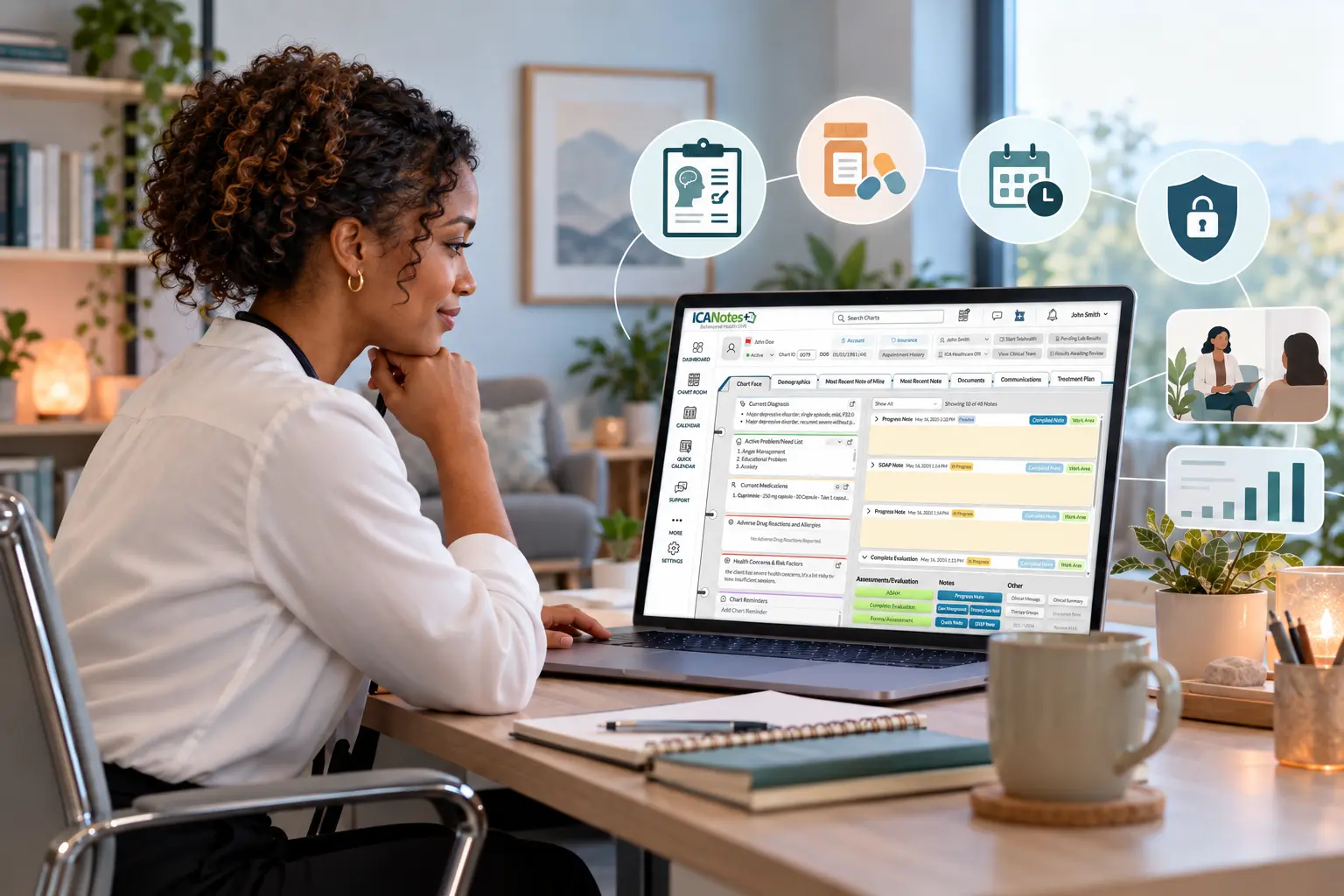
If you're a PMHNP weighing whether to open your own practice, the EHR decision often arrives right after the credentialing, prescribing, and payer setup questions — and it deserves nearly as much scrutiny.
A psychiatric-mental health nurse practitioner in private practice needs software that can support a defensible psychiatric evaluation, medication-management documentation, controlled-substance prescribing workflows, and coding that matches what the record supports. A study indexed in the National Library of Medicine's PMC archive found that psychiatric providers can spend up to 35% of a clinical day on documentation (PMC5801881). That makes documentation efficiency important, but speed cannot come at the expense of clinical detail or compliance.
The best EHR for psychiatric nurse practitioners should support the workflows that distinguish PMHNP practice: psychiatric evaluations, medication-management notes, e-prescribing with EPCS and PDMP access, E&M coding support, labs, and ongoing treatment monitoring. For PMHNPs in private practice, the right system also depends on prescribing volume, payer mix, practice size, supervision or collaboration requirements, and whether therapy or interventional services are part of the practice.
Key takeaways
- A strong PMHNP EHR should reduce friction across documentation, prescribing, coding, and practice operations without forcing you to assemble core workflows from disconnected tools.
- Look for psychiatric-specific templates for evaluations, MSEs, medication-management follow-ups, risk assessment, and treatment planning - not only generic SOAP notes.
- Confirm EPCS and PDMP capabilities separately from standard e-prescribing, including state coverage, identity-proofing steps, and any additional fees.
- Compare total cost, not only the base subscription. Prescribing, telehealth, claims, implementation, migration, and additional clinicians may be priced separately.
- Choose for your practice model. A solo medication-management practice, therapy-plus-prescribing practice, growing group, and interventional psychiatry practice may need different capabilities.
- Test the workflow before you commit: build a psychiatric evaluation, run through prescribing setup, review coding support, and export a completed chart.
What Should a PMHNP Look for in an EHR in 2026?
The short answer: look for an EHR that supports psychiatric prescribing and documentation as core workflows rather than treating them as extensions of a therapy-first or general medical system.
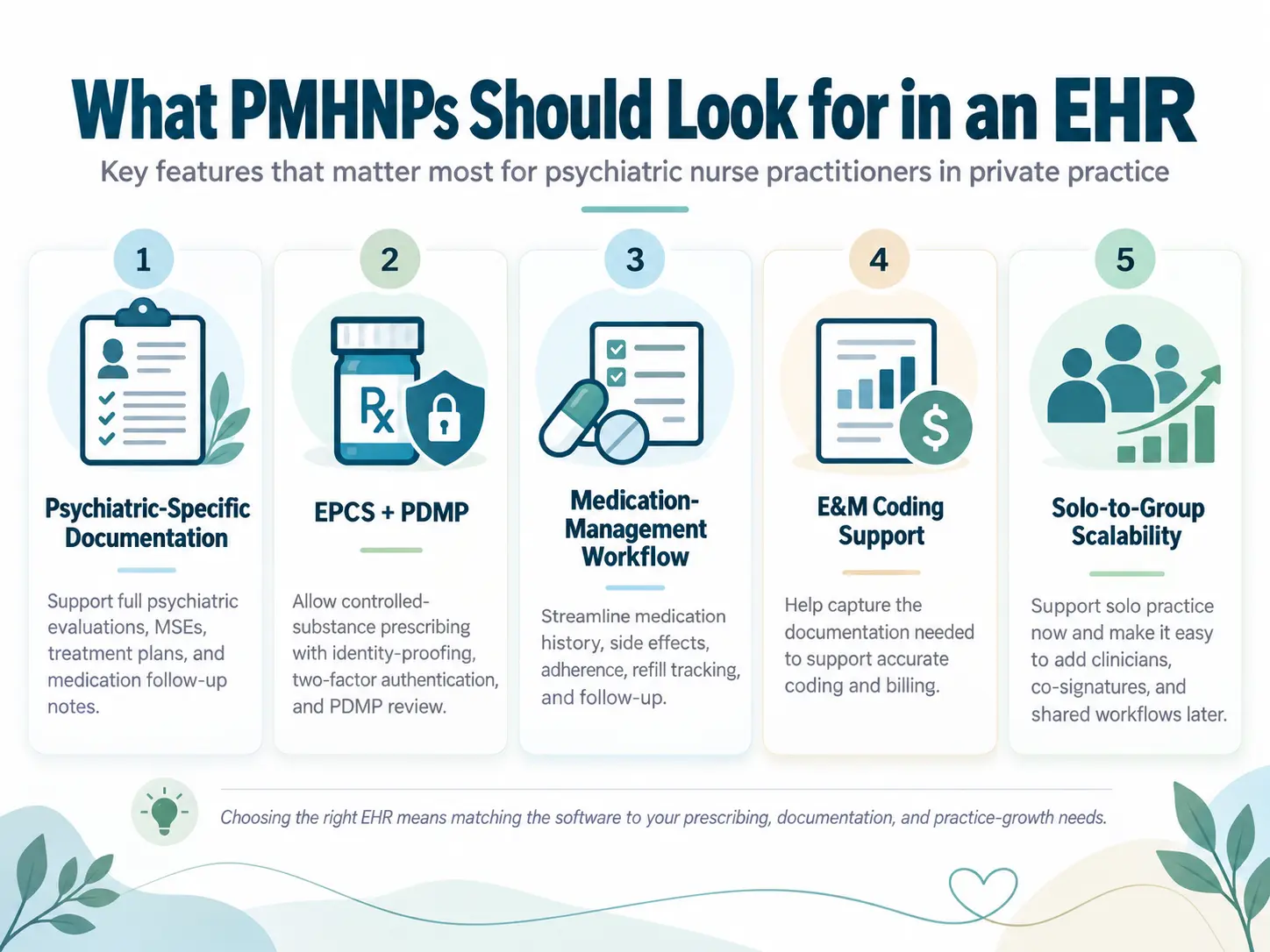
Psychiatric-specific documentation.
Templates should support a full psychiatric evaluation, mental status exam, medication-management follow-up, treatment-plan update, risk assessment, and controlled-substance follow-up.
EPCS with practical PDMP access.
Ask whether the PDMP can be accessed inside the prescribing workflow, whether your state is covered, and whether EPCS carries a separate fee.
E&M coding support tied to documentation.
The system should help you capture the medical decision-making or time elements that substantiate the code selected.
Medication-management workflow.
Medication history, allergies, interactions, adherence, response, side effects, refill handling, lab monitoring, and dose-change rationale should be easy to document.
Transparent pricing.
Understand the total monthly cost for prescribing, telehealth, claims, billing, additional clinicians, and implementation before you sign.
A path from solo to group.
Even if you are launching alone, role-based permissions, co-signature or supervision workflows, shared scheduling, and predictable additional-user pricing may matter later.
How We Evaluated EHRs for Psychiatric Nurse Practitioners
This guide compares platforms using criteria that directly affect PMHNP private-practice workflows. Feature and pricing information reflects vendor-published materials and the research reviewed in September 2026. Where a feature was not documented in the materials reviewed, it is identified as not confirmed rather than assumed to be available.
- PMHNP and psychiatric-prescriber fit
- Psychiatric evaluation, MSE, and medication-management documentation
- E-prescribing, EPCS, and PDMP workflow
- E&M coding and psychiatric billing support
- Telehealth, rating scales, labs, and patient engagement
- Supervision, co-signature, and growth from solo to group practice
- Pricing transparency and notable add-on fees
- Independent usage evidence where available
Search visibility, reported usage, and product fit are different measurements. The Single Aim Health survey of 234 solo PMHNPs is useful as a signal of what clinicians report using, but it does not measure documentation quality, EPCS coverage, price, or clinical fit.
Quick Comparison: EHR Options for PMHNP Private Practice
The table below summarizes how leading options differ from a PMHNP buyer perspective. It is not a universal ranking; the right fit depends on your clinical model and operating priorities.
| Vendor | PMHNP / psychiatric fit | EPCS / PDMP | Documentation | Pricing snapshot | Best-fit profile |
|---|---|---|---|---|---|
| ICANotes | Purpose-built for behavioral health and psychiatry | Built-in EPCS and PDMP, per ICANotes | Menu-driven psychiatric evaluation, MSE, med-management, narrative output; automated E&M coding, per ICANotes | Non-Prescribing $75/mo; Part-Time Prescribing $138/mo; Full-Time Prescribing $213/mo | PMHNPs prioritizing psychiatric documentation, prescribing, and coding in one workflow |
| Valant | Behavioral-health EHR with dedicated PMHNP content | Real-time PDMP integration and EPCS, per Valant | Structured psychiatric documentation; integrated psychiatric CPT/E&M services, per Valant | Quote required; third-party comparisons cited in research place typical cost roughly $75-$300/provider/mo | PMHNPs planning to scale from solo into a behavioral-health group |
| Osmind | Psychiatry-specific, with strong measurement-based and interventional focus | Mobile e-prescribing with state-specific PDMP access, per Osmind | Customizable templates including MSE; 50+ validated questionnaires | Osmind One starts at $249/clinician/mo; telehealth, labs, and e-prescribing priced separately | Practices adding interventional psychiatry such as TMS or SPRAVATO |
| SimplePractice | Therapy-first platform used by many solo PMHNPs | ePrescribe add-on with identity proofing and PDMP module | General clinical templates; not psychiatry-specific in reviewed materials | Starter $49/mo; Essential $79/mo; Plus $99/mo; ePrescribe add-on $49/mo/clinician + setup fee | PMHNPs combining therapy and prescribing or prioritizing a familiar solo-practice platform |
| CharmHealth | Appeared as the second-most reported platform in the Single Aim solo PMHNP sample | Not verified in supplied research | Not verified in supplied research | Not verified in supplied research | Worth evaluating because of PMHNP usage signal; verify current prescribing and psychiatric-workflow capabilities directly |
| Practice Fusion | General medical EHR adapted for psychiatry | Controlled-substance e-prescribing available in select states, per Practice Fusion | Psychiatry exam templates and customizable notes | $199/provider/mo with annual commitment | General medical practices adding psychiatric services |
| Headway | Insurance-native platform bundled with credentialing and claims support | E-prescribing coverage described less specifically in reviewed materials | Mental-health templates and assessments; primary value extends beyond the clinical record | Free EHR; revenue model tied to insurance billing and credentialing services | PMHNPs whose biggest operational priority is insurance participation and claims administration |
| TherapyNotes | Therapy-oriented behavioral-health platform | ePrescribe add-on $65/mo/prescriber, per TherapyNotes | General behavioral-health notes; integrated outcome measures | Solo $69/mo; Group $79/mo first clinician + $50/mo/additional clinician | Therapy-oriented practices that need prescribing as an add-on |
| Tebra | General practice-management platform with EHR and billing | Not confirmed in supplied research | Psychiatric-specific templates not confirmed in reviewed materials | Research cites pricing ranging roughly $49-$799/provider/mo depending on bundle; quote may be required | Practices prioritizing bundled EHR, billing, RCM, and patient-engagement services |
Popularity Is Not the Same as Clinical Fit
Single Aim Health analyzed EHR use among 234 solo PMHNPs and found SimplePractice was the most commonly reported platform at 23.1%, followed by CharmHealth at 9.4%, Tebra at 8.1%, and Headway and PracticeQ/IntakeQ at 7.7% each. ICANotes was reported by 5.1% of respondents. The survey found that solo PMHNPs used 31 different EHRs and services, underscoring how fragmented the market remains. The survey also reported that 75% of solo PMHNPs use at least one mental-health-specific platform.
That is useful adoption evidence, but it answers a different question from product fit. A commonly used platform may still require add-ons for prescribing, may not offer psychiatry-specific templates, or may fit a therapy-heavy practice better than a medication-management practice. Use popularity as a shortlist signal, then evaluate the actual workflow you need.
A True Clinical Record vs. a Bundled Payer Platform
Not every product in this market is solving the same job. A primary clinical record documents the encounter, supports coding, and stores the medical record. A payer or credentialing platform may focus on insurance paneling, claims, and patient acquisition. Headway is the clearest example in the reviewed set: its EHR is free to use, while the broader business model centers on insurance billing and credentialing services. Some PMHNPs may therefore use a platform like Headway alongside a separate clinical record.
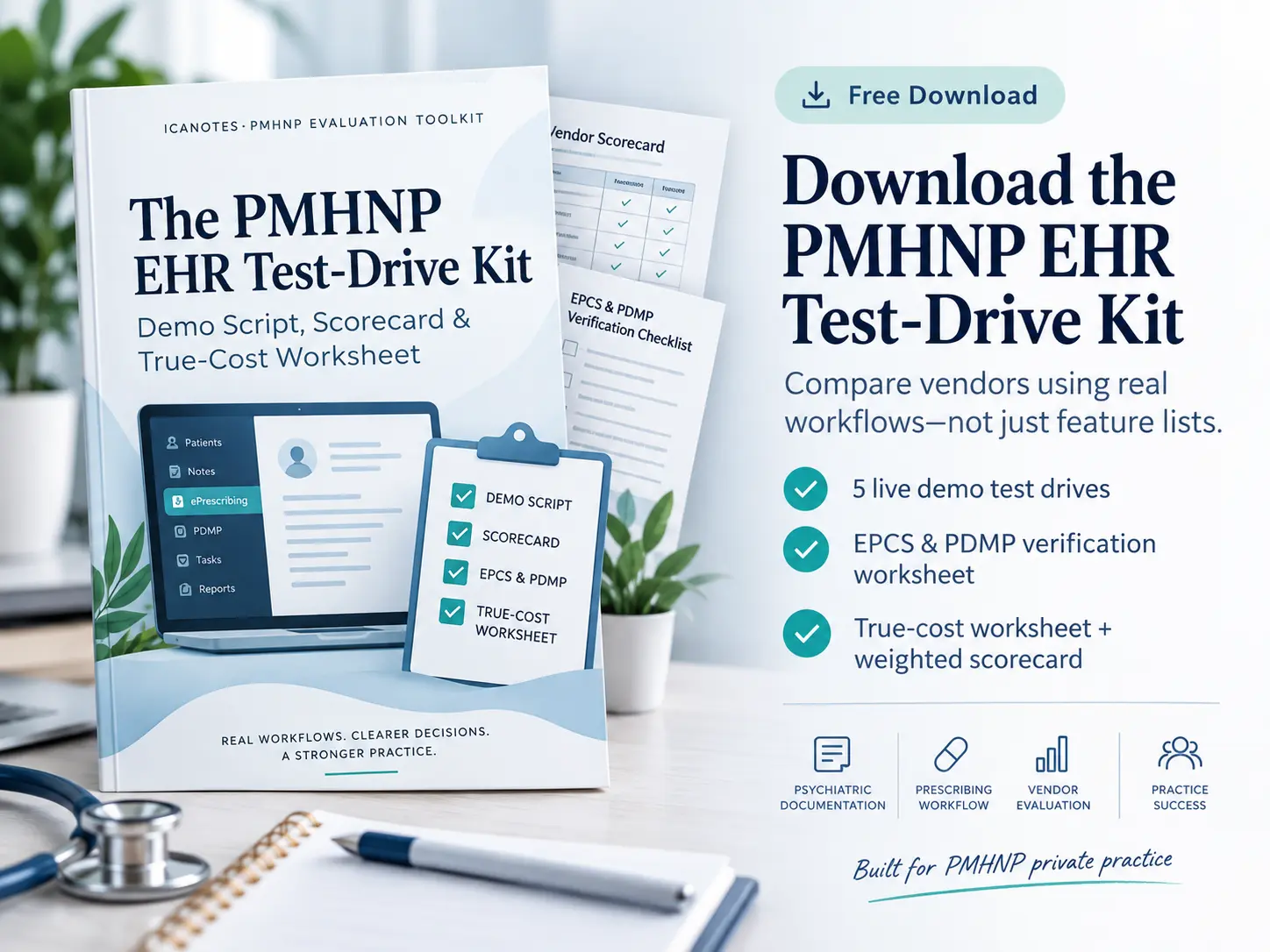
Put EHR Vendors to the Test Before You Commit
Download the free PMHNP EHR Test-Drive Kit to compare platforms using real psychiatric workflows, prescribing requirements, costs, and growth needs.
- Run 5 realistic PMHNP demo test drives with every vendor
- Verify EPCS and PDMP capabilities, setup, and fees
- Compare true monthly and first-year costs side by side
- Score each platform with a weighted vendor scorecard and go-live checklist
The EPCS, PDMP, and Controlled-Substance Workflow
Controlled-substance prescribing is one of the most important areas to test during an EHR evaluation. Standard e-prescribing and EPCS are not the same, and vendors differ in how much of the setup and PDMP workflow is integrated. The controlled-substance prescribing process involves several distinct steps, and a well-designed EHR should help keep them connected in a single workflow.
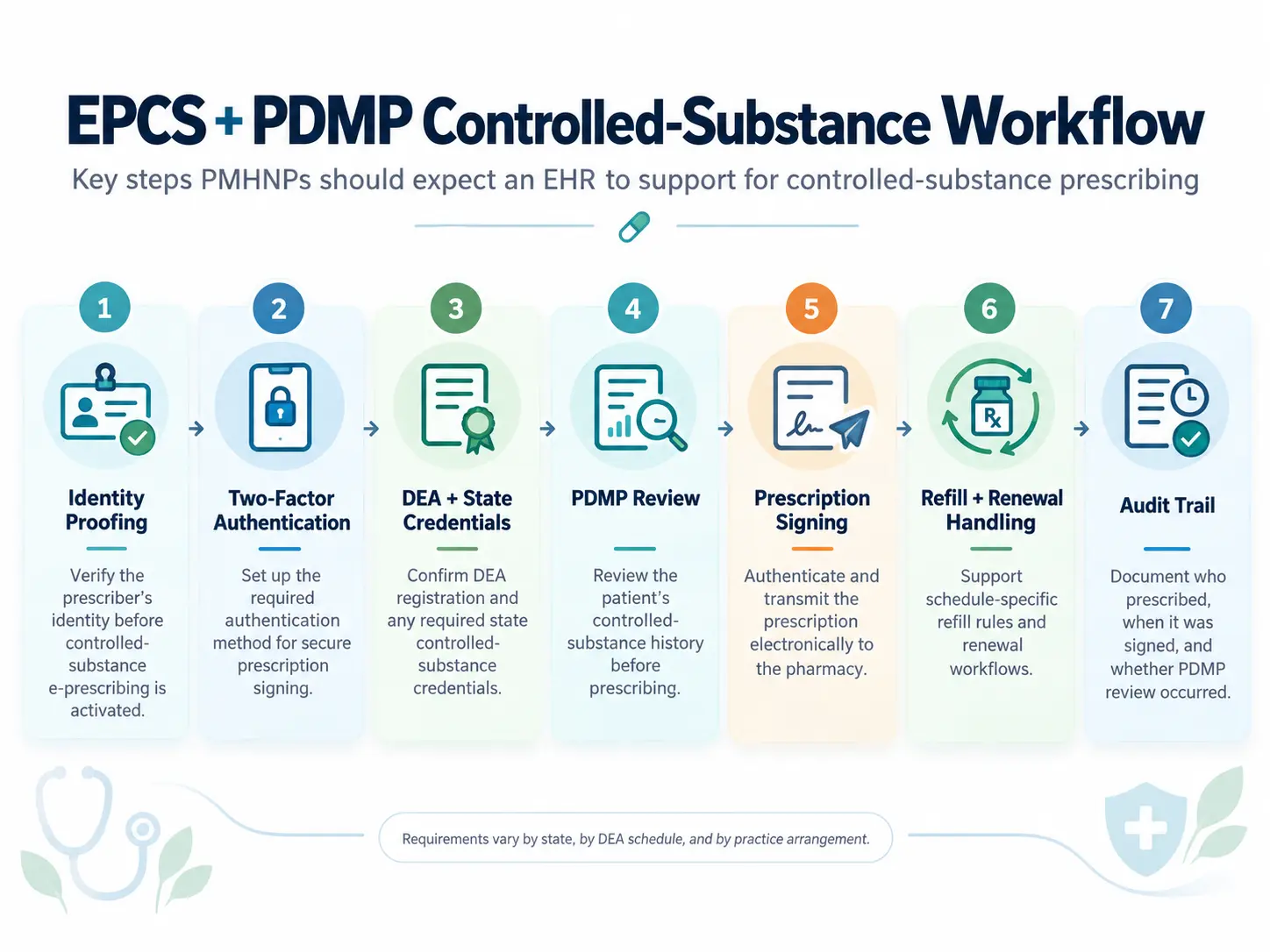
Identity proofing.
Before controlled-substance prescriptions can be signed electronically, the prescriber must complete identity proofing through the vendor or its service partner.
Two-factor authentication setup.
Federal regulation (21 CFR 1311.115) requires two of three authentication factors when signing a controlled-substance prescription electronically.
DEA and state credential verification.
Confirm how the vendor validates DEA registration and any state-specific controlled-substance credentialing requirements.
PDMP review.
Ask whether your state PDMP can be accessed inside the prescribing workflow or requires a separate portal and login.
Prescription signing.
Confirm which authentication method is used and whether the workflow changes by controlled-substance schedule.
Refill and renewal handling.
Schedule II medications generally require a new prescription rather than a refill; other schedules have different refill rules.
Audit trail.
The system should preserve a reliable record of prescribing activity and related workflow steps.
Requirements vary by state, controlled-substance schedule, and practice arrangement. Confirm current requirements with your state board of nursing, board of pharmacy, and the DEA before prescribing controlled substances in a new practice.
What PMHNPs Should Look for in a Medication-Management EHR Workflow
For many PMHNP practices, medication management is the center of the clinical workflow. An EHR should make the following information easy to review, update, and carry forward accurately without burying clinical reasoning in a generic note template. During a medication-management visit, the EHR should support the clinical decision-making process from symptom review through medication changes, patient education, and follow-up.
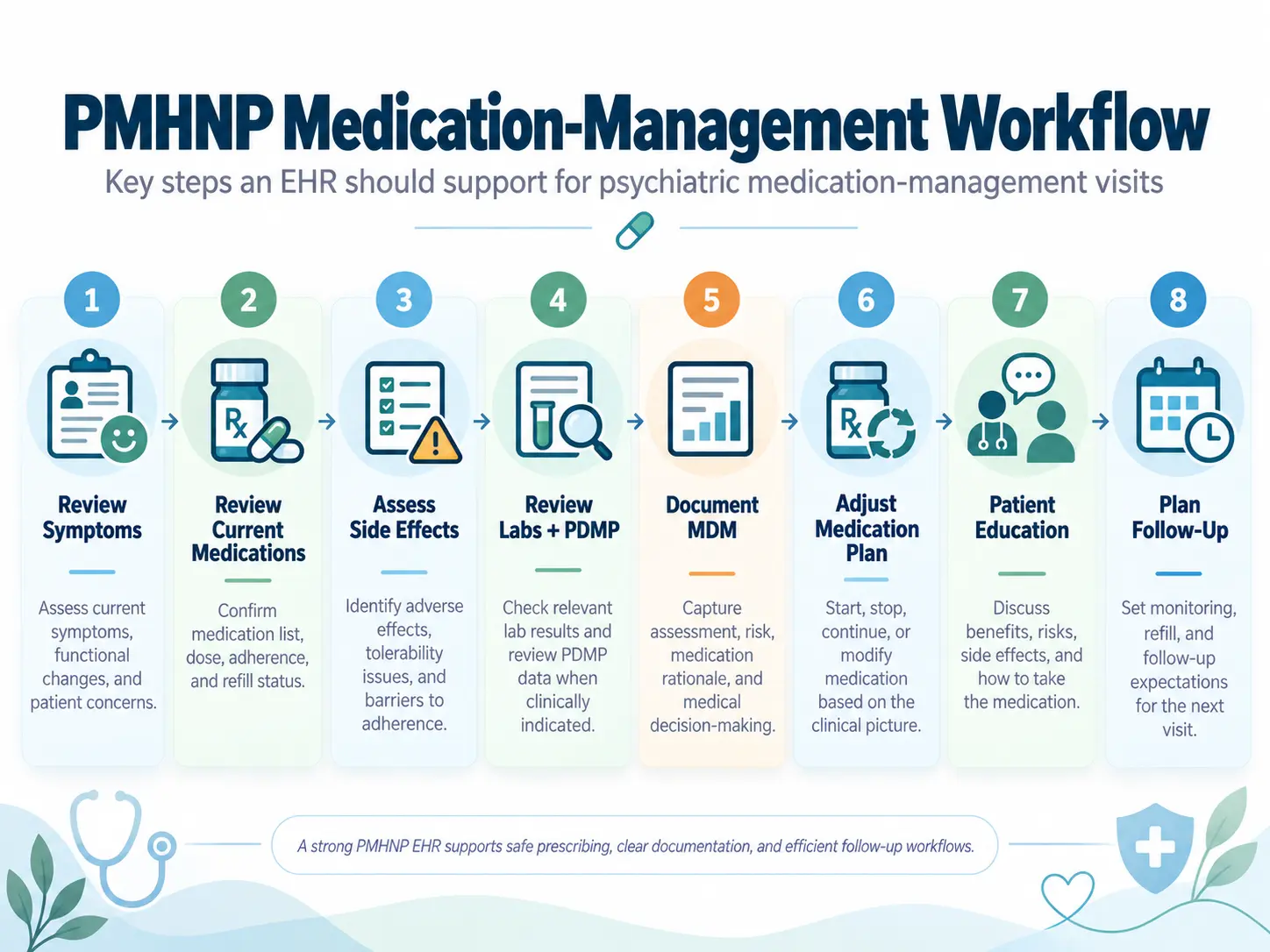
- Current medication list, medication history, allergies, and clinically relevant interaction information
- Adherence, response to treatment, side effects, and patient-reported concerns
- Dose changes and the clinical rationale for starting, stopping, or adjusting medication
- Relevant labs and monitoring needs, such as metabolic testing or lithium levels when clinically indicated
- PDMP review and controlled-substance documentation when applicable
- Risk assessment updates and changes in safety planning when clinically indicated
- Follow-up interval, refill or renewal plan, and patient education
- Medical decision-making or time elements needed to support the reported E&M service
Do not settle for a vendor showing you that a medication-management template exists. Ask the rep to complete a realistic follow-up visit from start to finish and show you the final note, the prescribing workflow, and the coding support that results.
Psychiatric Evaluation, MSE, and Medication-Management Note Templates
A psychiatric template earns its place by doing two things at once: helping the clinician document efficiently and capturing enough detail for another clinician, payer, or reviewer to understand the assessment and plan.
- Initial psychiatric evaluation: chief complaint, HPI, psychiatric and medical history, substance-use history, MSE, risk assessment, diagnosis, and initial treatment plan.
- Mental status exam: appearance, behavior, speech, mood, affect, thought process, thought content, perception, cognition, insight, and judgment.
- Medication-management follow-up: interval history, medication changes and rationale, side effects, adherence, response to treatment, updated risk assessment, and follow-up plan.
- Treatment-plan update: progress toward goals, diagnosis or medication changes, and the clinical reasoning supporting those changes.
- Controlled-substance follow-up: standard medication-management elements plus documentation of PDMP review and other applicable monitoring.
Structured menus and checkboxes can speed charting, but the final note should still communicate the clinician's assessment and reasoning in readable language. When you demo a system, evaluate both the data-entry experience and the narrative record it produces.
E&M Coding and Billing Workflow
Coding support matters because the medical record needs to substantiate the services reported on the claim. An EHR can help by prompting for the clinical elements that support medical decision-making or time-based coding, but the software should not replace the clinician's understanding of coding requirements.
- Number and complexity of problems addressed
- Data reviewed, such as labs, collateral information, or PDMP information
- Risk associated with the condition, medication management, or treatment decisions
- Medication changes, adverse effects, and clinically meaningful changes in status
- Total time, when the service is coded based on time rather than medical decision-making
A brief note such as "med check, patient stable, continue meds" documents much less than a note that identifies symptoms reviewed, response to medication, side effects, risk status, treatment decisions, and the rationale for the plan. The best coding-support workflow helps capture those elements during documentation rather than asking the clinician to reconstruct them later.
Payer policies vary, and no EHR can guarantee a specific code or reimbursement outcome. Treat coding tools as documentation support, not as a substitute for CPT and E&M knowledge or certified coding guidance when needed.
Choosing an EHR for a Solo PMHNP Practice vs. a Growing Group
A solo PMHNP usually needs a different operating model from a growing psychiatric group. Choose for the practice you have now, but make sure the system will not force a disruptive migration as soon as you add another clinician or collaborator.
| Solo PMHNP priorities | Growing practice priorities |
|---|---|
| Simple implementation and template customization | Role-based permissions and shared templates |
| EPCS and PDMP under the prescriber's own credentials | Multiple prescriber credentials and delegated workflows |
| Predictable monthly cost | Predictable additional-clinician pricing |
| Basic scheduling, portal, and telehealth | Multi-provider scheduling and centralized practice management |
| Direct billing, superbills, or straightforward claims workflow | More advanced claims management, billing, or RCM support |
| Easy chart export and portability | Supervision, collaboration, and co-signature workflows |
These differences become more important as a PMHNP practice grows, especially around scheduling, permissions, prescribing, billing, collaboration, and standardized documentation.
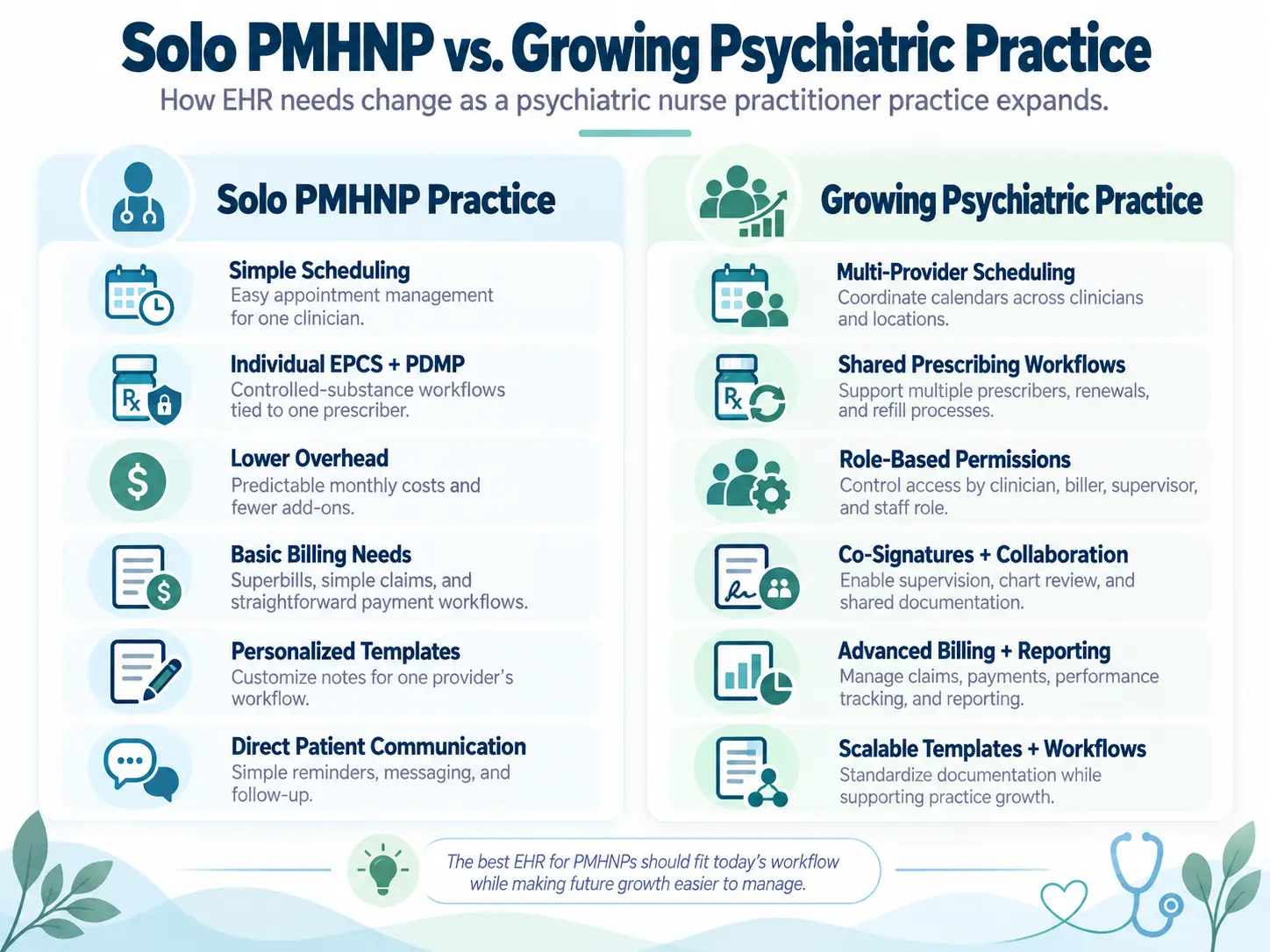
Choosing an EHR that can support both your current workflow and realistic future growth can help you avoid a disruptive platform change later.
Collaboration and supervision requirements vary by state and by clinician circumstances. If you need a collaborating physician, trainee supervision, or co-signature workflow, verify that the EHR supports distinct user roles and auditable review rather than relying on shared credentials.
How Much Does an EHR for Psychiatric Nurse Practitioners Cost?
In the September 2026 research reviewed for this guide, publicly available pricing ranged from free insurance-subsidized platforms to roughly $250 per clinician per month before optional prescribing, telehealth, billing, or implementation fees.
Because plans and fees change, confirm current pricing directly with each vendor before you commit. The more useful comparison is total monthly cost for the workflow you actually need.
| Vendor | Publicly observed base price | Notable add-ons / notes |
|---|---|---|
| ICANotes | Non-Prescribing $75/mo; Part-Time Prescribing $138/mo; Full-Time Prescribing $213/mo | Research notes EPCS as included in the cited ICANotes configuration; verify current plan details. |
| Valant | Not publicly listed in reviewed materials | Quote required. Third-party comparisons cited in the research place typical costs roughly $75-$300/provider/mo; verify directly. |
| Osmind | Osmind One starts at $249/clinician/mo | Telehealth $49/mo; lab ordering $15/mo; e-prescribing $4/encounter in reviewed pricing. |
| SimplePractice | Starter $49/mo; Essential $79/mo; Plus $99/mo | ePrescribe add-on $49/mo/clinician plus $89 one-time setup fee in reviewed pricing. |
| Practice Fusion | $199/provider/mo with annual commitment | Controlled-substance e-prescribing described as available in select states. |
| Headway | Free EHR | Business model is tied to insurance billing and credentialing services rather than a standalone software subscription. |
| TherapyNotes | Solo $69/mo; Group $79/mo first clinician + $50/mo per additional clinician | ePrescribe $65/mo/prescriber; Premium Telehealth +$15/mo; electronic claims $0.14 each in reviewed pricing. |
| Tebra | Research cites roughly $49-$799/provider/mo depending on bundle | Billing and patient-engagement modules may be bundled or priced separately; quote may be required. |
Ask every vendor about implementation timelines, data migration, historical chart imports, chart-export formats, prescribing setup fees, contract terms, and the cost of adding clinicians. A low base price can become expensive if core PMHNP workflows require multiple add-ons.
Product-by-Product Considerations for PMHNPs
ICANotes
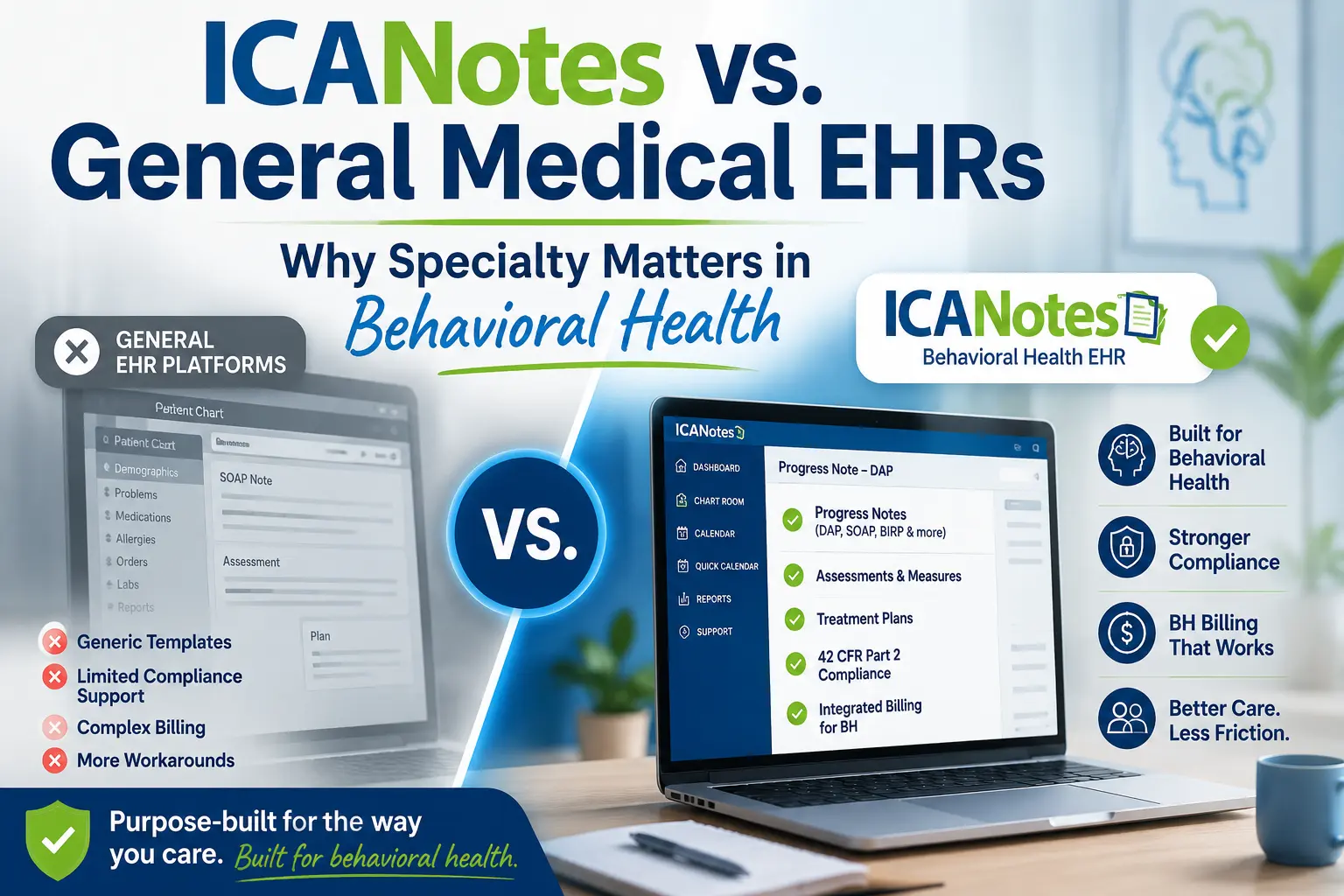
ICANotes is a strong fit for PMHNPs who want psychiatric-specific documentation, EPCS and PDMP, medication-management workflows, and automated E&M coding support in one platform. It also has a strong growth story, with workflows that can support a solo prescriber, small group, and larger behavioral health organization through multi-clinician scheduling, role-based access, supervision and co-signatures, billing, and practice-management tools.
Valant
Valant is a behavioral-health EHR with dedicated PMHNP educational content and a strong growth story from solo to group practice. Its reviewed materials emphasize EPCS, real-time PDMP access, psychiatric documentation, and billing support.
Osmind
Osmind is particularly relevant to practices that combine standard psychiatric care with measurement-based or interventional services. The reviewed materials highlight telepsychiatry, validated questionnaires, mobile e-prescribing, PDMP access, and workflows for treatments such as TMS and SPRAVATO.
SimplePractice
SimplePractice is a therapy-first private-practice platform with strong visibility among solo PMHNPs in the Single Aim survey. It may appeal to clinicians who combine psychotherapy and prescribing, but e-prescribing is an add-on and the reviewed templates are less psychiatry-specific than purpose-built psychiatric systems.
CharmHealth
CharmHealth deserves consideration because it was the second-most reported platform in the Single Aim solo PMHNP sample. The supplied research did not verify its current PMHNP-specific documentation, EPCS/PDMP, or pricing details, so those items should be checked directly before including it on a final shortlist.
Practice Fusion
Practice Fusion is a general medical EHR adapted for psychiatry and small practices. The reviewed materials include psychiatry exam templates and customizable notes, but controlled-substance e-prescribing is described as available only in select states.
Headway
Headway is different from a conventional standalone EHR purchase because its broader value proposition centers on insurance credentialing, billing, and administrative support. It may be attractive when payer participation is the biggest operational challenge, but PMHNPs should separately assess whether its clinical documentation and prescribing workflow meets their needs.
TherapyNotes
TherapyNotes is a behavioral-health platform with broad therapy workflows and e-prescribing available as a paid add-on. It may fit therapy-oriented practices that also prescribe, especially when predictable group pricing is important.
Tebra
Tebra emphasizes practice management, billing, RCM, and patient engagement. It may fit practices that want those operational functions under one vendor, but the supplied research did not confirm the same level of PMHNP-specific documentation or EPCS detail as some psychiatric-focused platforms.
Use Realistic PMHNP Encounters to Test the EHR
A vendor demo is more useful when you test the system with the encounters you actually document. The examples below are synthetic and illustrative; they do not represent an actual patient and should not be copied into a real chart.
Initial psychiatric evaluation
Patient is a 34-year-old presenting for initial evaluation of depressed mood and poor concentration over the past three months following a job loss. Denies prior psychiatric treatment. No current suicidal ideation, plan, or intent. Family history notable for depression in a first-degree relative.
Major Depressive Disorder, single episode, moderate.
Initiate sertraline 50 mg daily, weekly check-in for two weeks, referral to therapy, safety plan reviewed.
Mental status exam
appropriately groomed, adequate eye contact.
Mood: "tired." Affect: constricted, congruent with mood.
Thought process: linear and goal-directed. Thought content: no delusions, no suicidal or homicidal ideation.
Cognition: alert and oriented x4. Insight: fair. Judgment: intact.
Medication-management follow-up
Patient reports improved sleep and modest improvement in mood since starting sertraline four weeks ago. Denies side effects. PHQ-9 decreased from 18 to 12. No changes in risk status.
Increase sertraline to 100 mg daily, continue therapy referral, follow up in four weeks.
Controlled-substance follow-up with PDMP documentation
Patient presents for follow-up on lisdexamfetamine for ADHD. PDMP reviewed prior to prescribing; no additional controlled-substance prescriptions identified from other providers. Patient reports improved focus, no diversion concerns identified, appetite mildly decreased but tolerable.
Cntinue current dose and document follow-up according to applicable state requirements.
10 Questions PMHNPs Should Ask During an EHR Demo
- Does EPCS work in every state where I currently practice?
- Can I access the PDMP inside the prescribing workflow, and is my state supported?
- Is standard e-prescribing, EPCS, or PDMP access an additional monthly fee?
- Can you show me a complete psychiatric evaluation from data entry through the final signed note?
- Can you show me a medication-management follow-up, including a dose change and side-effect documentation?
- How does the system support E&M code selection, and what note elements does it use?
- Can a collaborating or supervising clinician review and co-sign notes with a distinct user role?
- Which psychiatric rating scales and outcome measures are included?
- What will my monthly cost be if I add another prescriber, telehealth, claims, or billing support?
- Can I export a complete patient chart in a readable, usable format before I sign a long-term agreement?
Solo-Practice Implementation Checklist
- Confirm your payer mix and which insurance panels, if any, you plan to join.
- Document any collaboration or supervision arrangement required for your circumstances and state.
- Verify DEA registration and any applicable state controlled-substance credential.
- Activate EPCS and complete identity proofing before your first controlled-substance prescribing visit.
- Confirm PDMP access for every state where you practice.
- Build or customize psychiatric evaluation, MSE, and medication-management templates before go-live.
- Set up lab ordering and results connections if you order monitoring labs.
- Configure billing for the E&M and psychiatric CPT codes you expect to use.
- Plan data migration from any prior EHR and test a sample chart import or export early.
- Configure patient portal, intake forms, scheduling, and telehealth.
- Export a completed chart before fully committing so you understand the portability of your records.
Final Recommendation
For a PMHNP in private practice, the most useful EHR comparison is not simply which platform has the longest feature list. It is whether the system fits the way you evaluate, prescribe, document, code, bill, and grow your practice.
ICANotes is designed around behavioral-health and psychiatric workflows, including narrative documentation, EPCS and PDMP access, and E&M coding support. PMHNPs who prioritize those functions in one system may want to evaluate it alongside the other platforms in this guide. Practices with different priorities may reasonably favor a therapy-first system, an interventional-psychiatry platform, or an insurance-administration model instead.
Whichever direction you lean, test the workflow before you commit.
Whichever direction you lean, test the workflow before you commit. Build a realistic psychiatric evaluation, complete a medication-management follow-up, walk through prescribing setup, inspect the final note, and export a chart. If you want to evaluate ICANotes specifically, you can start a 30-day free trial with no credit card required or book a live demo of the psychiatric workflow.
See How ICANotes Fits Your PMHNP Practice
Start a 30-day free trial and explore psychiatric documentation, medication-management workflows, EPCS and PDMP access, E&M coding support, and the tools you need to grow from solo practice to a larger team.
- Psychiatric evaluation, MSE & med-management templates
- Built-in EPCS and PDMP prescribing workflow
- Automated E&M coding tied to your documentation
- Readable narrative notes you can export anytime
Test workflows designed to scale from solo PMHNP to group practice. Start your free 30-day trial, no credit card required.
Start Your Free 30-Day Trial
Frequently Asked Questions
What is the best EHR for PMHNP private practice?
What should I look for in an EHR for a PMHNP practice?
Is e-prescribing for NPs the same as EPCS?
Does every EPCS EHR for nurse practitioners include PDMP access?
What should a PMHNP EHR include for medication management?
Can a psychiatric EHR help with E&M coding?
How much does an EHR for psychiatric nurse practitioners cost?
Can one EHR support both a solo PMHNP and a growing group practice?
References
- ICANotes — EHR for Psychiatric Nurse Practitioners. https://www.icanotes.com/features/charting/psychiatry/psychiatric-nurse-practitioners/
- Valant — EHR for PMHNP Prescribers https://www.valant.io/resources/blog/ehr-for-pmhnp/osm
- Osmind — Psychiatry EHR https://www.osmind.org/psychiatry-ehr
- Practice Fusion — Psychiatry and Mental Health EHR https://www.practicefusion.com/psychiatry-mental-health-ehr/
- Headway — Best EHR Systems for Psychiatry https://headway.co/resources/best-ehr-for-psychiatry
- TherapyNotes - https://www.therapynotes.com/features/eprescribe/
- Tebra - https://www.tebra.com/specialties/psychology
- SimplePractice - https://www.simplepractice.com/specialty/psychiatric-emr/
- CharmHealth - https://www.charmhealth.com/ehr/psychiatry/psychiatry-emr.html
- Single Aim Health — Best EHR for PMHNP Private Practice - https://singleaimhealth.com/article/best-ehr-for-pmhnp-private-practice
- HIPAA Journal — Best EHR for Mental Health - https://www.hipaajournal.com/best-ehr-for-mental-health/
- Ben White — Psychiatry EHR Comparison - https://www.benwhite.com/medicine/psychiatry-ehr-comparison/
- Reddit private-practice EHR discussions under r/PMHNP and r/Psychiatry
- U.S. Drug Enforcement Administration / 21 CFR Part 1311
- National Library of Medicine / PubMed Central - PMC5801881
- State boards of nursing / pharmacy and state PDMP programs
Dr. October Boyles
Dr. October Boyles is a behavioral health expert and clinical leader with extensive expertise in nursing, compliance, and healthcare operations. With a Doctor of Nursing Practice (DNP) and advanced degrees in nursing, she specializes in evidence-based practices, EHR optimization, and improving outcomes in behavioral health settings. Dr. Boyles is passionate about empowering clinicians with the tools and strategies needed to deliver high-quality, patient-centered care.