Blog > Emerging Trends > AI in Behavioral Health: National Clinician Survey Report
AI in Behavioral Health 2026: What 416 Clinicians Reveal About Administrative Burden, Insurance Friction, and Patient AI Use
Administrative burden and insurance complexity are reducing clinician capacity and limiting access to behavioral healthcare for many patients. As a result, some patients are increasingly turning to AI tools for mental health support. Data gathered from 416 licensed US mental health professionals across solo practices, group practices, and community mental health centers reveals a crisis cascade whereby paperwork overload and complex insurance systems reduce clinical capacity, create gaps in access to care, and contribute to growing reliance on commercial AI tools for mental health support.
This national behavioral health clinician survey explores the interconnected challenges of administrative burden, insurance friction, patient access, and patient use of AI in behavioral healthcare in 2026.


Last Updated: June 26, 2026

Key Takeaways
-
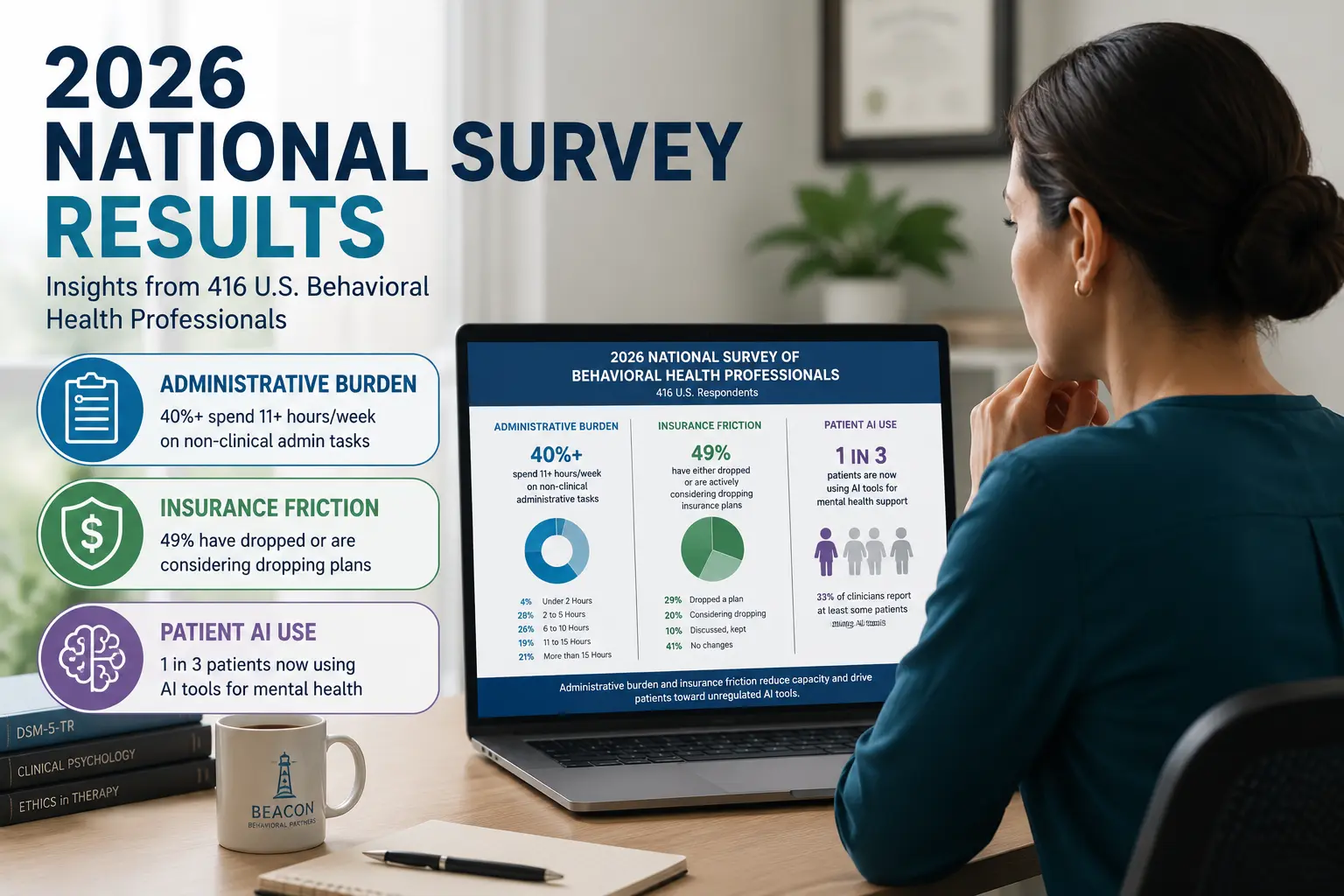
Administrative burden is limiting clinician capacity. More than 40% of surveyed behavioral health providers spend 11 or more hours each week on documentation, billing, and other non-clinical administrative tasks.
- Paperwork demands are affecting patient access. More than a quarter of clinicians have reduced their caseloads over the past year to accommodate administrative work, while nearly half say they could see more patients if documentation requirements were reduced.
- Insurance friction is pushing some providers away from payer networks. Nearly half of clinicians surveyed have either dropped at least one insurance plan or are actively considering doing so.
- Many clinicians see reimbursement as misaligned with quality care. More than 70% of respondents say current reimbursement structures do not adequately support quality behavioral healthcare.
- Patient use of commercial AI tools is becoming part of the access conversation. Nearly 40% of clinicians report that patients have disclosed using AI tools for emotional support before accessing care, raising new questions about access gaps, clinical risk, and the role of AI in behavioral health.
Section 1: The Documentation Blockade and Caseload Cuts
Administrative Burden is Artificially Capping Patient Capacity
The 2026 behavioral health clinician survey found that nearly half of providers spend 11-15+ hours each week on non-clinical administrative tasks, including documentation, billing, and other paperwork. This administrative burden is consuming a significant portion of clinicians' working weeks, reducing the time available for direct patient care, limiting provider capacity, and forcing some clinicians to reduce their caseloads.
Table 1: Weekly Hours Spent by Providers on Admin Tasks
| Weekly Documentation & Admin Time | % of Surveyed Clinicians |
|---|---|
| Under 2 Hours | 4.33% |
| 2 to 5 Hours | 27.64% |
| 6 to 10 Hours | 25.72% |
| 11 to 15 Hours | 19.47% |
| More than 15 Hours | 20.67% |
- 40.14% of providers spend between 11 and 15+ hours each week on non-clinical administrative tasks.
- More than a quarter (26.20%) of clinicians have reduced their patient caseloads over the past year to accommodate administrative demands.
- 24.28% routinely turn away new patients due to capacity constraints.
- Nearly half (49.28%) say they could immediately see more patients if documentation requirements were reduced.
Clinician Response
“Schedules lack breaks to do administrative work, so notes get done during evening hours at home and weekends.”
These findings suggest that administrative burden is limiting provider capacity to see patients. Time spent on paperwork is diverting hours away from direct patient care, contributing to longer wait times, restricted access to mental health services, and placing additional pressure on an already strained behavioral healthcare system.
Section 2: Payer Friction and the Shift From Insurance Networks
Stagnant Reimbursement and Opaque Billing Systems
The survey also highlighted growing frustration with behavioral health insurance systems. Many clinicians report struggling with stagnant reimbursement rates, complex billing requirements, and a lack of transparency around claims, payments, and coverage decisions. For some providers, these administrative and financial challenges are making private-pay models increasingly attractive, potentially reducing access to care for patients who rely solely on insurance coverage.
Insurance-related challenges are also directly affecting patient access, with 42.26% of clinicians identifying insurance barriers as the single biggest driver of care gaps.
Table 2: Impact of Insurance Barriers on Clinician Insurance Participation
| Have Insurance Barriers Led You to Drop Insurers? | Response Percentage |
|---|---|
| Yes, already dropped at least one plan | 29.13% |
| Actively considering dropping a plan | 20.17% |
| Discussed but decided against it | 9.80% |
| No changes | 40.90% |
- Almost half of those surveyed (49.30%) have either dropped or are actively considering dropping specific insurance panels.
- 70.03% believe current reimbursement structures do not adequately support the delivery of quality behavioral healthcare.
- A further 40.34% are unsure of their first-submission claim denial rates, highlighting the complexity and opacity of today's insurance and billing landscape.
As insurance administration becomes increasingly time-consuming, clinicians are spending more time on paperwork and compliance than on patient care.
Clinician Response
“It’s become a second job for me to just contend with the insurance-related demands... we are very likely to move toward accepting only private pay.”
These findings suggest that many providers are seeking simpler, more transparent insurance and billing systems that reduce administrative friction, improve operational clarity, and allow clinicians to spend more time delivering patient care. As insurance-related barriers continue to contribute to gaps in patient care, more patients may turn to alternative sources of support, including commercial AI tools.
Section 3: The Unregulated Shift to Patient-Led AI Care
Desperation Measures: Patient Turning to Commercial AI
AI behavioral health statistics suggest that more patients are turning to commercial AI platforms such as ChatGPT due to financial constraints and a lack of understanding about the severity of their mental health needs. Moreover, rising clinician administrative burden and increasingly complex insurance coverage and billing systems can create barriers to care, often resulting in longer wait times and delays in accessing professional support.
Many clinicians surveyed expressed concerns about the growing use of AI tools for mental health support, advising that these technologies should not be viewed as a substitute for professional behavioral healthcare. In certain instances, clinicians note that unguided AI use may even worsen existing mental health conditions.
Table 3: Clinician Responses to Unguided AI Use and Deteriorating Mental Health Outcomes
| Has Unguided AI Use Worsened a Patient’s Condition? | Response Percent |
|---|---|
| Yes, more than once | 18.37% |
| Yes, once | 5.77% |
| Possibly | 14.44% |
| No / Unsure | 61.42% |
- Nearly 40% of clinicians (38.32%) report that patients disclose using commercial AI tools for emotional support before accessing care.
- Of these, 32.81% say patients use these platforms occasionally, while 5.51% report frequent use.
- The leading drivers of patient AI adoption are financial and cost barriers (21.26%), followed closely by patients not recognizing the clinical severity of their needs (21.00%).
- Nearly a quarter of providers (24.14%) have treated patients whose mental health conditions deteriorated following unguided use of commercial AI tools.
These findings highlight the need for better access to mental health support, clearer insurance and billing systems, and reduced administrative burden on practitioners. Without these improvements, growing numbers of patients may continue to rely on commercial AI tools for mental health support while waiting for professional care.
Clinician Response
“It’s become a second job for me to just contend with the insurance-related demands... we are very likely to move toward accepting only private pay.”
These findings suggest that many providers are seeking simpler, more transparent insurance and billing systems that reduce administrative friction, improve operational clarity, and allow clinicians to spend more time delivering patient care. As insurance-related barriers continue to contribute to gaps in patient care, more patients may turn to alternative sources of support, including commercial AI tools.
Conclusion: Addressing Back-End System Vulnerabilities
The findings contribute to a growing body of mental health access crisis statistics, highlighting persistent barriers to care across the United States. The 2026 behavioral health clinician survey data suggest that the behavioral healthcare system is under significant operational strain, with administrative burden and insurance complexity limiting patient access to care.
To address these access gaps, the industry must reduce paperwork blockades, simplify insurance billing, and streamline administrative workflows. Doing so would enable clinicians to see more patients, reduce wait times, and improve access to care.
For providers seeking to reduce administrative burden and reclaim more time for patient care, ICANotes combines ONC-certified charting, integrated billing, telehealth, scheduling, and AI-powered documentation tools in a platform built specifically for behavioral health clinicians.
Recent Posts





Dr. October Boyles
DNP, MSN, BSN, RN
About the Author
Dr. October Boyles is a behavioral health expert and clinical leader with extensive expertise in nursing, compliance, and healthcare operations. With a Doctor of Nursing Practice (DNP) and advanced degrees in nursing, she specializes in evidence-based practices, EHR optimization, and improving outcomes in behavioral health settings. Dr. Boyles is passionate about empowering clinicians with the tools and strategies needed to deliver high-quality, patient-centered care.