
Using CPT Code 90853 for Billing and Documenting Group Psychotherapy
A clinician-focused guide to billing, documenting, and defending CPT 90853 group psychotherapy claims across a multi-clinician practice.


CPT code 90853 is the billing code for group psychotherapy provided to two or more unrelated clients in a single session. Unlike individual therapy codes, it has no time component, is billed once per client per date of service, and is reimbursed per participant rather than per group.
A single denied claim for a ten-person group session does not cost you one reimbursement. It costs you ten, plus the staff hours spent researching why, plus whatever your clearinghouse charges to resubmit. If your practice runs group therapy across multiple clinicians, getting CPT code 90853 right is not a coding footnote. It is a recurring, multiplied risk that shows up every single week your groups meet.
What You'll Learn
- When to use CPT code 90853, who can bill it, and why it is not a time-based code.
- How to document group psychotherapy correctly so each participant’s note supports medical necessity.
- The most common reasons 90853 claims are denied and how to avoid preventable billing and documentation errors.
- How units, modifiers, prior authorization, and payer-specific rules affect 90853 billing, including same-day individual and group therapy.
- What to know about telehealth group therapy billing and the place-of-service and modifier requirements that may apply.
- How multi-clinician practices can standardize group therapy workflows for credentialing, authorization tracking, documentation, and billing.
01 / FoundationsWhat Is CPT Code 90853?
CPT 90853 is group psychotherapy for two or more unrelated clients in a single session, each working on their own individualized treatment goals — no time component, one unit per date of service, reimbursed per participant.
90853 is the group therapy CPT code clinicians reach for most often: it applies whenever a session includes two or more clients who are not related to one another, each working on their own individualized treatment goals.
CPT code 90853 describes group psychotherapy provided to clients who are not related to one another, distinguishing it from the multiple-family group code (90849) and the family psychotherapy codes (90846/90847). The American Medical Association owns the official CPT codebook and its exact long-form descriptor language, so what follows is a paraphrase of the code's clinical intent rather than a verbatim quote. If you need the AMA's authoritative descriptor text for compliance or credentialing purposes, consult the current CPT codebook directly (the AMA's CPT product page is linked in the references below).
According to AAPC's Codify code database, 90853 applies to a therapeutic group of clients, typically capped around 12 participants, meeting for a session that commonly runs 45 to 60 minutes. APA Services confirms that 90853 sits within the broader psychotherapy code family alongside 90791 (the psychiatric diagnostic evaluation), the individual psychotherapy codes 90832 through 90838, the crisis codes 90839/90840, family psychotherapy (90846/90847), and multiple-family group psychotherapy (90849).
Who can bill it depends on state licensure and each payer's credentialing rules, but commonly includes licensed clinical social workers, licensed professional counselors and licensed mental health counselors, licensed marriage and family therapists, psychologists, psychiatrists, and psychiatric-mental health nurse practitioners. If your practice runs groups co-led by clinicians at different license levels, confirm with each payer which license actually needs to be the billing provider of record; this is one of the first places multi-clinician practices trip on credentialing (more on that in the workflow section below).
02 / RequirementsSession and Eligibility Requirements
Group size matters for medical necessity, not just clinical quality. By definition, CPT 90853 requires at least two unrelated clients in the room — a session with only one attendee is no longer group psychotherapy (see the individual-code comparison below). AAPC's Codify listing describes 90853 groups as capped near 12 participants and made up of clients who are not family members of one another; many practices aim for roughly six to twelve clients per group as a working clinical range, though your specific payer contract may set its own minimum or maximum, so verify before enrolling clients.
Session length commonly runs 45 to 60 minutes, per AAPC/Codify, but here is where clinicians frequently get tripped up: 90853 is not a time-based code the way 90837 (60-minute individual psychotherapy) is. Premera Blue Cross's payment policy for group psychotherapy services states plainly that the CPT descriptor for 90853 has no time component, and cites the 2022 NCCI Policy Manual in support of limiting the code to one unit per date of service, per client, per provider.
That one-unit-per-day rule is not a payer quirk. It comes from CMS's Medically Unlikely Edit (MUE) system, which sets a maximum number of units a code can be billed for one patient on one day; the CMS overview of NCCI MUEs explains the mechanism directly. For 90853, the practical effect is that even if a clinician runs the same group twice in one day, or a client somehow attends two group sessions, standard billing allows one unit for that date of service under that rendering provider.
Frequency and eligibility also hinge on medical necessity, not just attendance. CMS's billing and coding article for psychiatry and psychology services (A57480) ties coverage to a documented, active mental health diagnosis and a treatment plan that the group work is meant to serve; a psychoeducational or purely social group, without an individualized therapeutic focus tied to each client's diagnosis, does not meet that bar.
03 / Compare90853 vs. Related Codes: Avoiding Miscoding
Clinicians confuse 90853 with its neighbors more often than any other error type in this guide, and the confusion is understandable. Several codes describe multiple people in a room together, and the differences hinge on who those people are to each other and to the identified client, not on the room itself.
90853 vs. 90849 (multiple-family group psychotherapy). The population is the distinguishing factor. 90853 groups unrelated clients working on their own individual treatment goals in a shared therapeutic setting. 90849 groups multiple family units, typically because several families are managing a related concern (a substance use recovery program for parents of affected teens, for example). Coverage and reimbursement for 90849 vary more widely by payer than for 90853, so confirm this code's status before scheduling a program around it.
90853 vs. 90846/90847 (family psychotherapy). Family therapy codes assume one identified client and their family members working together in the room. If your "family-like" session is actually gathering several unrelated clients (even if some bring a support person), you are very likely still in 90853 territory, not 90847. APA Services' psychotherapy code reference confirms this identified-patient distinction between the family codes and group codes.
90853 vs. individual codes (90832/90834/90837). This shows up constantly in practice: a group is scheduled, and only one client attends. At that point, you are no longer providing group psychotherapy. Document and bill the encounter as an individual session under the appropriate time-based individual code, not as 90853.
90853 vs. physical/occupational therapy group codes (97150) and psychoeducational codes (HCPCS S9446). If your practice also runs physical rehabilitation groups or purely educational groups without an individualized psychotherapy focus, do not default to 90853. CPT 97150 covers group therapeutic procedures in a PT/OT context, and S9446 covers patient education, neither of which substitutes for group psychotherapy documentation.
| Code | Population | Time-based? | Typical payer posture |
|---|---|---|---|
| 90853 | Unrelated clients, therapeutic group | No (descriptor has no time component, per Premera) | Widely covered; one unit per date of service |
| 90849 | Multiple family units | No | Coverage varies significantly by payer |
| 90847 | Identified client plus family | No | Widely covered when family involvement supports the client's treatment plan |
| 90832/90834/90837 | Individual client | Yes (16-37, 38-52, 53+ minutes) | Widely covered under standard individual psychotherapy benefits |
| 97150 (PT/OT) | Multiple clients, physical rehab | No | Covered under PT/OT benefit, not behavioral health |
| S9446 (HCPCS) | Patient education group | No | Limited; not a psychotherapy substitute |
04 / DocumentationDocumentation Requirements for Medical Necessity
Here is the single most consequential habit to build if your practice runs group therapy: one group note that gets copied into every participant's chart, with the names swapped, will not survive an audit. Group psychotherapy documentation has to establish medical necessity for each individual client, and that means each client's note has to say something true and specific about that client.
At minimum, each participant's note should include the date of service, session start and end time, the group's clinical focus or topic for that day, the therapeutic interventions used, that specific participant's engagement and response to the intervention, progress (or lack of progress) toward that participant's own treatment plan goals, and a plan for the next session. CMS's billing and coding article for psychiatry and psychology services frames medical necessity around the documented link between diagnosis, treatment plan, and the service rendered, and that link has to exist separately for every person in the room.
If a session involved managing significant communication barriers (a client in acute distress, disagreement among family members present as collateral contacts, or a need for interpreter-mediated communication), the interactive complexity add-on code 90785 may apply. APA Services and CMS's billing article both describe 90785 as a reportable add-on when specific complicating factors are documented, not a routine addition to every group note.
Weak note (do not use):
"Group met for 60 minutes. Discussed coping skills. Client participated appropriately."
Stronger note:
"Group psychotherapy, 55 minutes, 5:00-5:55pm. Focus: distress tolerance skills for clients with generalized anxiety disorder. Facilitator introduced paced breathing and the 5-4-3-2-1 grounding technique. This client practiced the grounding technique aloud, reported reduced subjective anxiety from 7/10 to 4/10 by session end, and identified using the technique before a work presentation this week as a goal tied to treatment plan objective 2 (reduce avoidance behavior). Plan: continue distress tolerance module next session, review use of technique at check-in."
The difference is not length for its own sake. It is specificity that a reviewer can trace back to that client's own diagnosis and treatment plan.
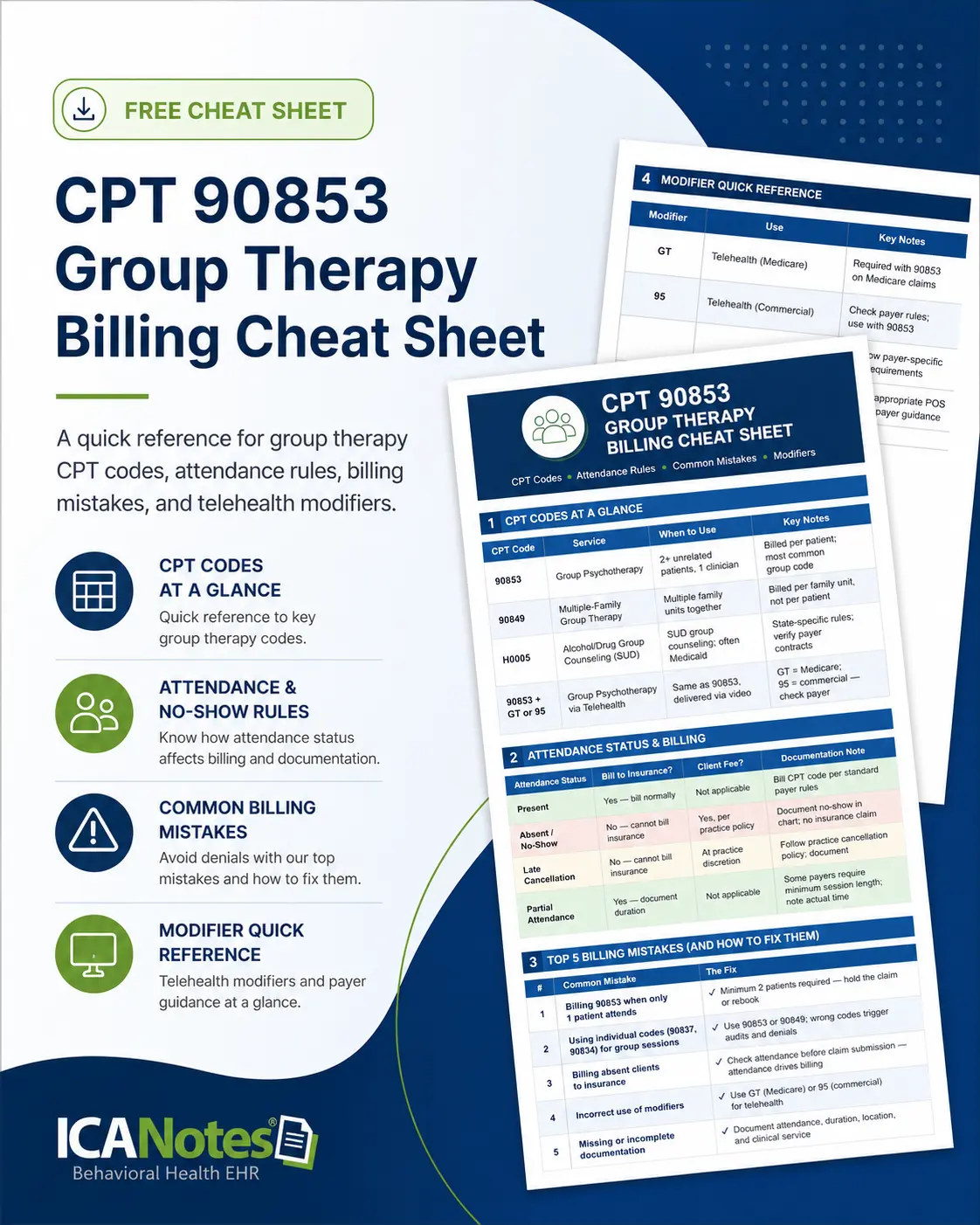
Get the Free CPT 90853 Group Therapy Billing Cheat Sheet
Keep the most important group therapy billing rules within easy reach. This quick-reference guide covers CPT codes, attendance and no-show rules, common billing mistakes, and modifier guidance for group psychotherapy.
05 / DenialsCommon Reasons Claims for 90853 Get Denied
Most 90853 denials trace back to a small, repeatable set of errors, and several of them show up in federal audit findings, not just anecdotal billing-service complaints.
- Missing or generic per-participant documentation. A note that could describe any client in the group, rather than this client specifically, fails medical necessity review.
- Billing more than one unit per date of service. This trips the CMS Medically Unlikely Edit for 90853 and denies automatically in many payer systems.
- Miscoding a family or multi-family session as 90853, or the reverse, billing 90853 when the actual encounter was family therapy.
- No clear diagnosis-to-treatment-plan link for a given participant, particularly in psychoeducational groups that drift away from an individualized therapeutic focus.
- Billing individual therapy and group therapy for the same client on the same day without modifier -59 (or the more specific X-modifiers some payers now prefer) to show the two encounters were clinically distinct and separately documented, per CMS's coding guidance.
- Group size or clinical focus that does not match payer policy, including groups that fall outside a payer's stated minimum or maximum participant count.
The HHS Office of Inspector General's audit of Medicare psychotherapy payments made via telehealth found that Medicare paid an estimated $580 million improperly out of roughly $1 billion in psychotherapy claims examined for the period from March 2020 through February 2021, including $348 million tied specifically to telehealth-delivered sessions. The OIG traced the leading causes to missing time documentation and incomplete treatment plans, exactly the two failure points described above. A separate OIG audit of a Florida mental health provider (report A-04-21-06251) illustrates that these are not abstract findings; individual practices get audited on group and individual psychotherapy billing, and documentation gaps are what auditors find.
If your practice bills a meaningful volume of 90853 claims every week across several clinicians, treat the OIG's findings as a preview of what a payer audit would look for in your own charts, not just a Medicare-specific concern.
The Compliance & Audit-Readiness Checklist walks through every denial trigger above, plus a payer-verification checklist to run before you launch a new group program. Get the free checklist →
06 / ReimbursementReimbursement, Units, and Modifiers
Reimbursement. Group psychotherapy is typically reimbursed per participant at a contracted or Medicare-allowed rate, meaning a ten-person group generates ten separate claims (one per client), each reimbursed individually rather than the practice billing once for the whole room. Because Medicare's national payment rates update annually and third-party summaries of "the 90853 reimbursement rate" go stale quickly, look up the current allowed amount directly through the CMS Physician Fee Schedule Look-Up Tool rather than relying on a static figure; search the tool by CPT code 90853 for your locality.
Units. The one-unit-per-date-of-service rule described earlier comes from the CMS Medically Unlikely Edit for 90853, as explained in CMS's NCCI MUE overview. If a clinician genuinely runs two clinically distinct groups on the same day (a morning group and an unrelated afternoon group, each with different membership and treatment focus), separately documented, some payers will allow a second unit with modifier -59 attached and clear documentation showing the sessions were not duplicative. Confirm this specifically with each payer rather than assuming it is standard.
Modifiers. Modifier -59 (distinct procedural service) is the modifier most associated with 90853, used when billing it alongside another same-day service for the same client that is not normally billed together, per CMS's billing and coding article. For telehealth-delivered group sessions, expect to append the modifier your specific payer requires, commonly 95 or GT for commercial payers and FQ in some Medicare telehealth contexts, alongside the correct place-of-service code (more on this in the telehealth section below).
Add-on codes. Interactive complexity (90785) can be billed alongside 90853 when specific complicating communication factors are present and documented, per APA Services' code reference; it is not billed routinely.
07 / PayersMedicare and Major-Payer-Specific Rules
CMS's billing and coding article A57480, built on the underlying Local Coverage Determination L34616, sets the baseline federal rules most Medicare Administrative Contractors follow for psychiatry and psychology services, including 90853: covered ICD-10 diagnoses, the one-unit MUE limit, and interactive complexity eligibility. The Medicare Benefit Policy Manual, Chapter 15, lays out which provider types (clinical social workers, psychologists, marriage and family therapists, mental health counselors, and others) Medicare recognizes as eligible to bill outpatient mental health services in the first place, which matters before you even get to coding.
Commercial payers, state Medicaid programs, and Medicare Advantage plans frequently diverge from traditional Medicare on group size caps, prior authorization requirements, and telehealth coverage for group psychotherapy. Some Medicaid programs publish their own bypass or state-specific billing codes for group services (Kentucky Medicaid is one documented example), so treat any single state's Medicaid rule as informative for that state only, not as general guidance.
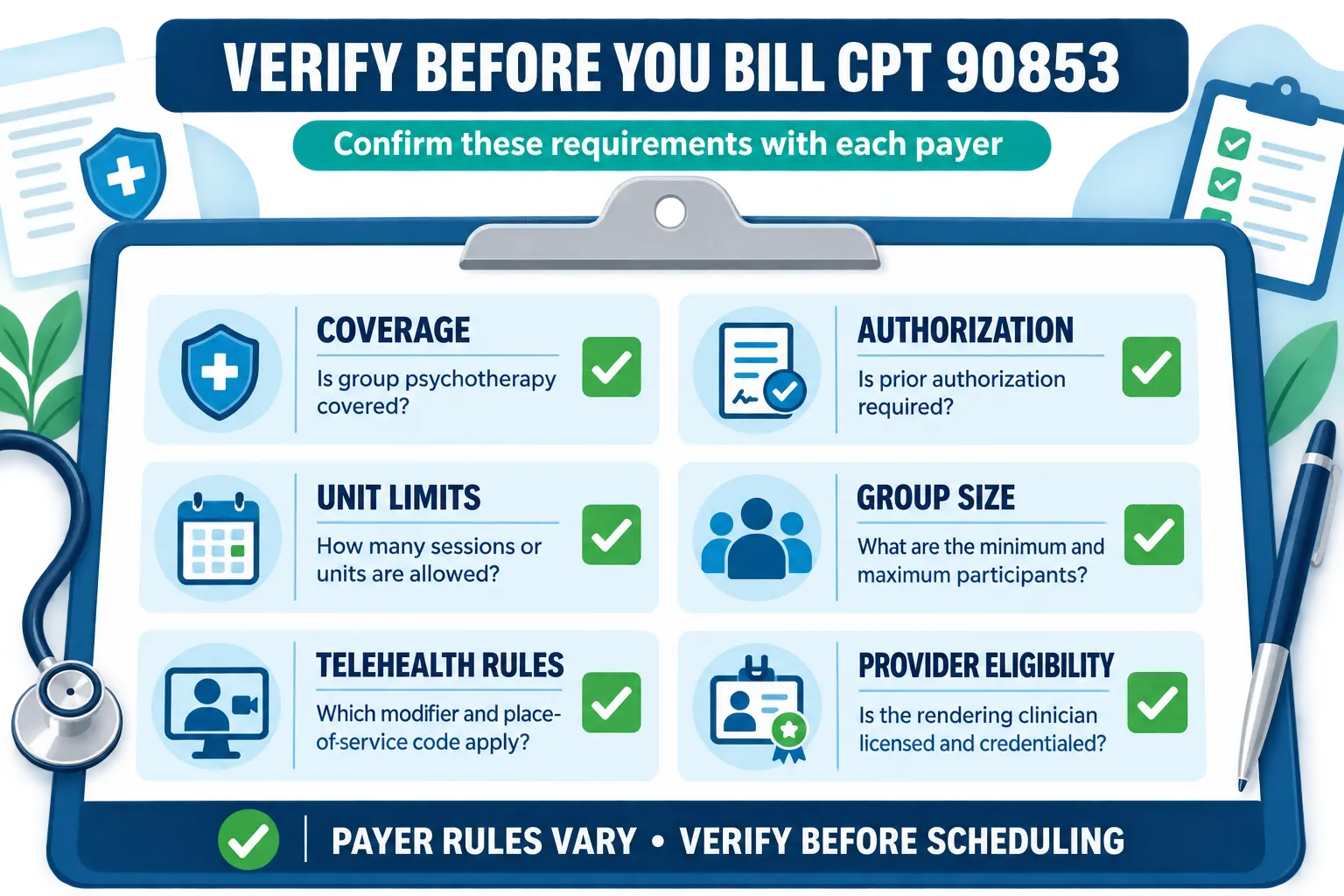
Before enrolling clients in a new group program, confirm the following with each payer:
- Does this payer cover CPT 90853 at all, and under which behavioral health benefit?
- Is there a unit limit beyond the standard one-per-day MUE, or a separate authorization requirement?
- What is the minimum and maximum group size this payer recognizes?
- Does this payer require prior authorization for group psychotherapy, and if so, how many sessions does an authorization typically cover?
- Which telehealth modifier and place-of-service code does this payer require for group sessions delivered virtually?
- Does this payer require the rendering provider to hold a specific license type to bill 90853?
08 / TelehealthTelehealth Group Therapy Billing for 90853
Group psychotherapy delivered via telehealth expanded substantially during the COVID-19 public health emergency, and the HHS OIG's audit of Medicare psychotherapy payments specifically flagged telehealth-delivered sessions ($348 million of the $580 million in improper payments identified) as a distinct area of oversight risk. That does not mean telehealth group therapy is disfavored; it means the documentation and modifier requirements matter more, not less, when sessions happen virtually.
Practically, telehealth group billing for 90853 typically requires:
- The place-of-service code your payer expects for telehealth (commonly POS 02 for telehealth not in the client's home, or POS 10 for telehealth delivered to the client's home).
- A modifier indicating telehealth delivery, which varies by payer (95 and GT are common for commercial plans; Medicare's requirements have shifted across recent rule cycles, so confirm current guidance before billing).
- Documentation that each participant consented to telehealth-delivered group therapy, along with the platform or modality used.
- The same per-participant clinical documentation standard described above; a virtual format does not lower the medical necessity bar.
Confirm current Medicare and commercial telehealth policy for group psychotherapy before scheduling an ongoing virtual group program, since these rules have changed more than once in recent years and a policy that applied last year may not still apply.
09 / WorkflowBilling Workflow Tips for Multi-Clinician Group Practices
Everything above gets harder to manage once you have more than one clinician running groups, and this is where most of the actual revenue leakage in group practices happens. A solo practitioner running one group has one set of credentials, one caseload, and one documentation habit to maintain. A group practice running five concurrent therapy groups across four clinicians has to get all of the following right, simultaneously, every week:
Credentialing each facilitator with each payer.
A clinician can be fully licensed and still not be credentialed with a given payer to bill 90853 under their own NPI. Track credentialing status per clinician, per payer, and confirm before assigning a clinician to lead a group whose participants are covered by a payer that clinician is not yet credentialed with.
Tracking authorization and unit limits per client across a caseload.
When a payer requires prior authorization for group sessions, that authorization typically attaches to the client, not the group. A practice running multiple groups needs a way to see, at a glance, which clients are approaching an authorization limit, regardless of which clinician is facilitating their group that week.
Co-facilitated groups.
When two clinicians lead one group together, confirm with each payer how they want the session billed: some payers expect a single rendering provider of record even for co-led sessions, while others have specific rules for split or shared billing. Document both facilitators' involvement in the clinical note even when only one is the billing provider.
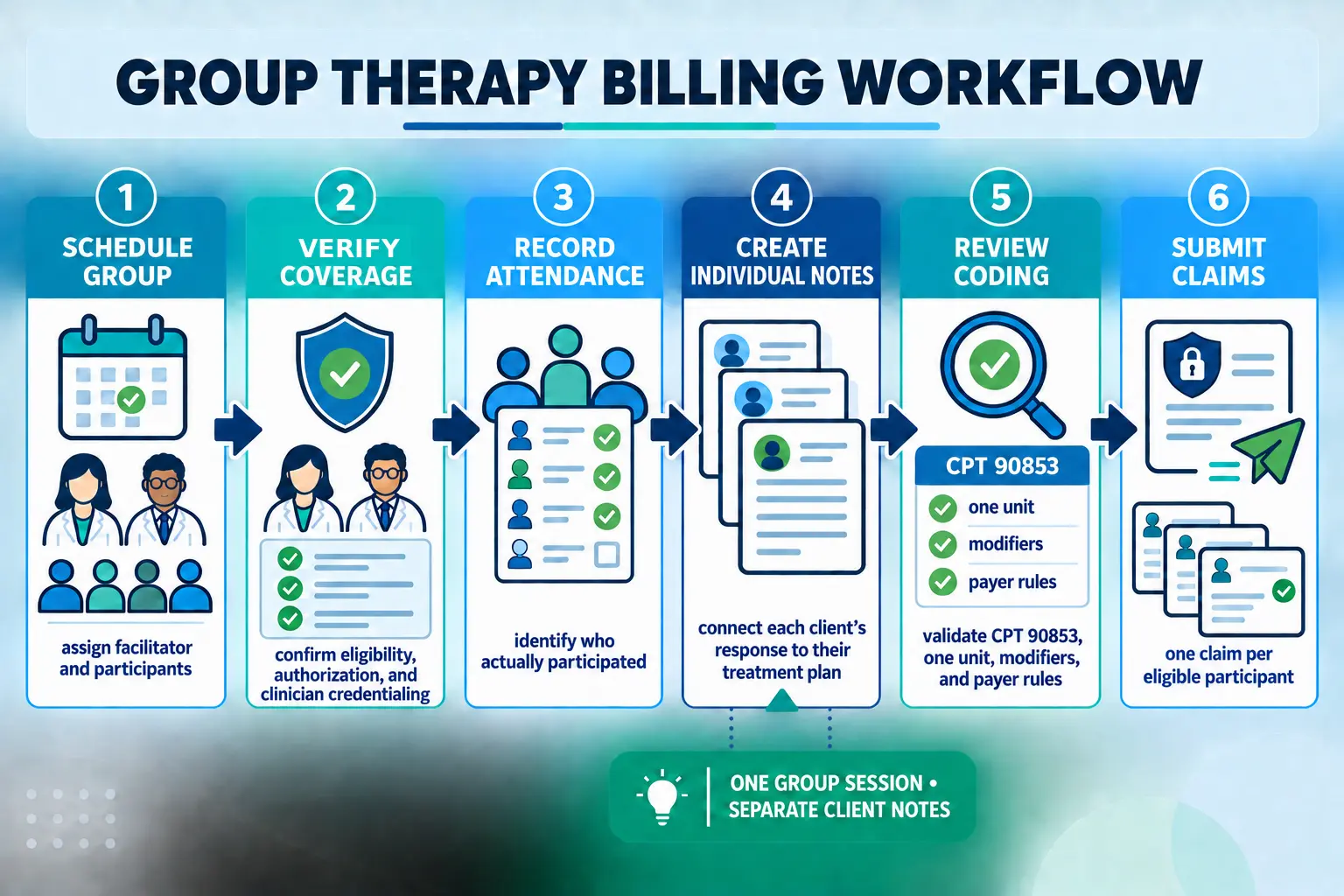
Where EHR tooling actually reduces denial risk at scale. The recurring theme in this guide, per-participant documentation, one-unit-per-day tracking, modifier accuracy, and payer-specific authorization limits, is a lot to hold in a spreadsheet once you are running multiple concurrent groups. This is the specific problem ICANotes' group therapy documentation tools are built around: a single group session template that generates a separate, individualized progress note for each participant automatically, tied to that client's own treatment plan and diagnosis, rather than requiring a clinician to write (or copy and adjust) a separate note by hand for every person in the room. Attendance tracking that flows directly into billing eligibility for 90853 means a client who no-shows does not accidentally get billed as a group participant. Role-based access lets a second clinician see a shared client's full history without re-entering data, which matters for co-facilitated groups and for consistency as new clinicians join the practice. None of this replaces clinical judgment about medical necessity, but it does remove a meaningful share of the manual, error-prone steps where multi-clinician practices tend to generate the denials described earlier in this guide.
Generate an individualized note for every group participant — automatically with ICANotes
ICANotes turns one group session into separate, defensible progress notes tied to each client's own treatment plan and diagnosis, with attendance that flows into 90853 billing eligibility. Start your free trial and see how much manual documentation your group program can retire.
- Notes completed in under 3 minutes
- 30-day free trial, no credit card required
- HIPAA compliant and ONC Cures certified
- Live support from behavioral health specialists
FAQFrequently Asked Questions About CPT Code 90853
Can I bill 90853 and individual therapy for the same client on the same day?
What happens if only one client shows up for a scheduled group?
What is the minimum number of participants for a CPT 90853 group?
Does a client need a 90791 diagnostic evaluation before their first 90853 session?
Is CPT 90853 time-based?
Can I bill 90853 for telehealth-delivered groups?
What's the difference between 90853 and 90849?
What's the difference between 90853 and 90847?
Key Takeaways: A Compliance Checklist for 90853 Billing
- Confirm medical necessity before scheduling. Each participant needs an active diagnosis and treatment plan the group work is meant to serve.
- Bill one unit per date of service, per client, per provider, consistent with the CMS Medically Unlikely Edit for 90853.
- Write a separate, specific note for every participant, every session. No copy-pasted group notes.
- Use modifier -59 correctly when billing 90853 alongside another same-day service for the same client, and only when the encounters are genuinely distinct.
- Verify payer-specific rules before launching a group program: group size limits, authorization requirements, and telehealth modifiers all vary.
- Treat the OIG's psychotherapy audit findings as a guide to your own risk, not just a Medicare statistic; missing time documentation and incomplete treatment plans are the two most common, most preventable errors.
- In multi-clinician practices, track credentialing and authorization status per clinician and per client, not just at the practice level, and standardize documentation across every facilitator so a co-facilitated or covered group does not create a compliance gap.
References
- CMS Medicare Coverage Database, "Billing and Coding: Psychiatry and Psychology Services" (A57480): https://www.cms.gov/medicare-coverage-database/view/article.aspx?articleId=57480
- CMS LCD L34616, Psychiatry and Psychology Services: https://www.cms.gov/medicare-coverage-database/view/lcd.aspx?lcdId=34616&ver=44
- CMS, Medicare NCCI Medically Unlikely Edits (MUEs) overview: https://www.cms.gov/medicare/coding-billing/national-correct-coding-initiative-ncci-edits/medicare-ncci-medically-unlikely-edits-mues
- Premera Blue Cross, Payment Policy "Group Psychotherapy Services (90853)" (CP.PP.367.v2.4): https://www.premera.com/paymentpolicies/cmi_058004.pdf
- APA Services, "Psychotherapy codes for psychologists": https://www.apaservices.org/practice/reimbursement/health-codes/psychotherapy
- AAPC/Codify, CPT 90853 code page: https://www.aapc.com/codes/cpt-codes/90853
- HHS Office of Inspector General, "Medicare Could Have Saved Millions by Improving Its Oversight of Psychotherapy Services Provided Via Telehealth" (A-09-21-03021): https://oig.hhs.gov/oas/reports/region9/92103021.pdf
- HHS OIG, "Mental Health Center of Florida Generally Met Medicare Requirements..." (A-04-21-06251): https://oig.hhs.gov/documents/audit/10200/A-04-21-06251.pdf
- CMS Physician Fee Schedule Look-Up Tool: https://www.cms.gov/apps/physician-fee-schedule/search/search-results.aspx
- Medicare Benefit Policy Manual, Chapter 15: https://www.cms.gov/Regulations-and-Guidance/Guidance/Manuals/Downloads/bp102c15.pdf
- American Medical Association, CPT product page (for the official 90853 descriptor, paywalled): https://www.ama-assn.org/practice-management/cpt
Dr. October Boyles
Dr. October Boyles is a behavioral health expert and clinical leader with extensive expertise in nursing, compliance, and healthcare operations. With a Doctor of Nursing Practice (DNP) and advanced degrees in nursing, she specializes in evidence-based practices, EHR optimization, and improving outcomes in behavioral health settings. Dr. Boyles is passionate about empowering clinicians with the tools and strategies needed to deliver high-quality, patient-centered care.