Blog > Practice Management > Behavioral Health EHR vs General Medical EHR
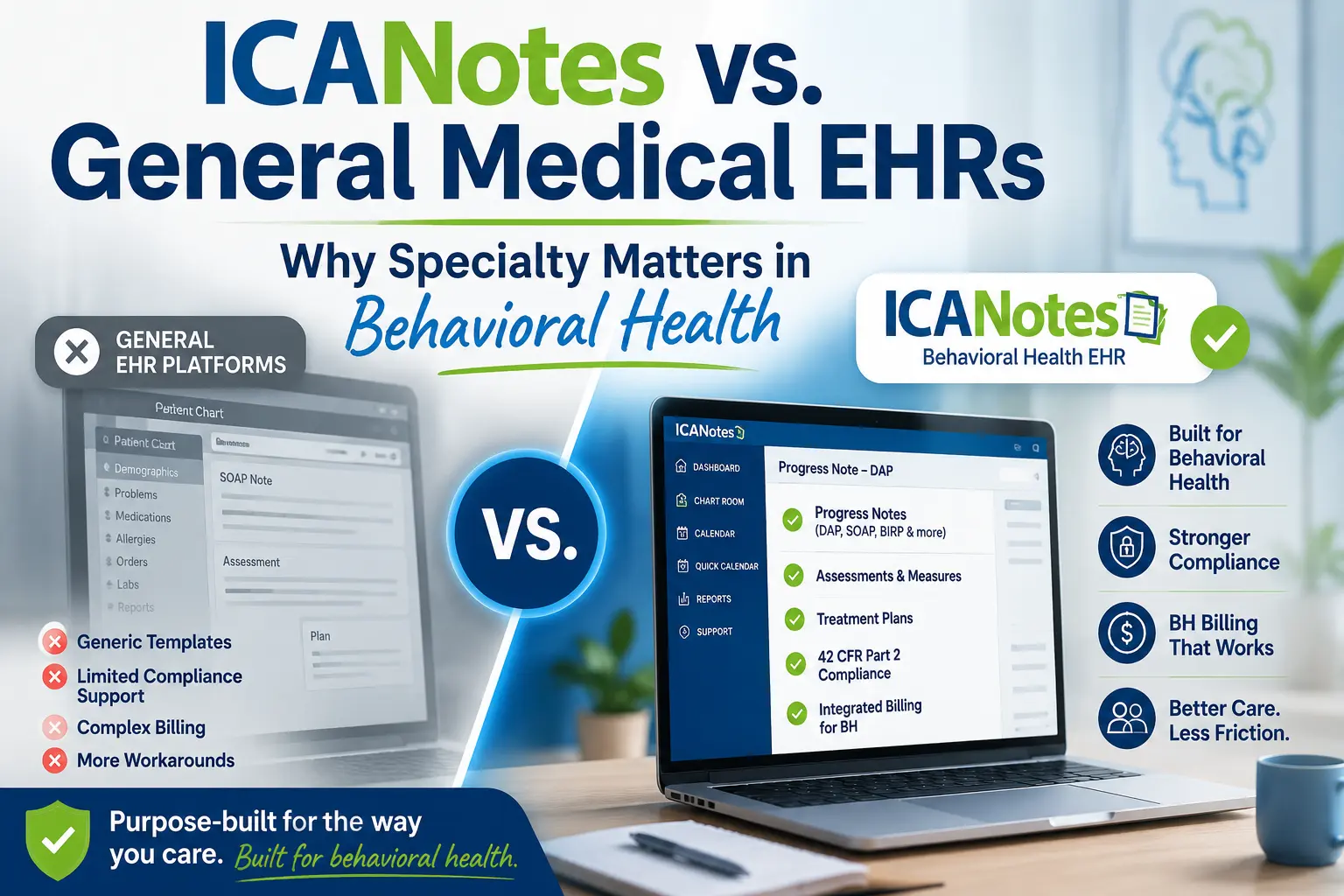
ICANotes vs. General Medical EHR Platforms: Why Specialty Matters in Behavioral Health
When comparing a behavioral health EHR vs general medical EHR, the differences extend far beyond simple software features. Behavioral health practices have unique documentation, billing, compliance, and treatment workflow requirements that general medical EHR platforms were not designed to support. This guide explores the structural gaps that often create inefficiencies, compliance risks, and billing challenges for mental health providers using general healthcare systems. Learn why a specialty EHR for mental health, such as ICANotes, can improve clinical documentation, streamline behavioral health billing, support regulatory compliance, and help practices operate more efficiently while delivering high-quality patient care.


Last Updated: July 2, 2026

What You'll Learn
- Why behavioral health documentation differs fundamentally from general medical documentation
- The most common ways general medical EHRs create workflow, billing, and compliance challenges for mental health practices
- How behavioral health-specific requirements such as 42 CFR Part 2, psychiatric prescribing, and group therapy impact EHR selection
- What "built for behavioral health" actually means in practice
- How to evaluate the true total cost of ownership of a general EHR versus a specialty behavioral health EHR
- Which organizations may still benefit from a general medical EHR — and which are better served by a purpose-built solution like ICANotes
Let's start with something worth acknowledging: general medical EHR platforms are capable and widely deployed. Epic, Athenahealth, Kareo, and similar platforms power millions of clinical encounters every year. They are not bad software. The question isn't whether they work — it's whether they work for behavioral health. And that's a meaningfully different question.
This piece makes the case that behavioral health documentation, billing, and compliance represent a distinct discipline — not a variation of general medicine — and that the platform a practice chooses has real consequences for clinical efficiency, revenue integrity, and regulatory standing. It uses ICANotes as a concrete example of what a purpose-built behavioral health EHR actually looks like in practice.
What “General Medical EHR” Actually Means
General medical EHR platforms are designed around the workflows of primary care and general medicine: scheduled office visits, ICD-10-coded diagnoses, lab orders, medication lists, and referrals. They are optimized for high-volume, episodic care — a patient comes in, is assessed, receives a treatment or referral, and the encounter is documented and billed.
These platforms are excellent at what they were built for. The challenge is that behavioral health practices were never the design target. Session-based therapy, longitudinal mental health documentation, 42 CFR Part 2 substance use records, and the billing patterns of mental health claims are not edge cases that can be accommodated with workarounds. They are fundamentally different workflows.
When a behavioral health practice runs on a general medical EHR, clinicians are typically working against the grain of the software — customizing templates, building workarounds, and managing compliance requirements that the platform wasn't designed to support.
How Behavioral Health Documentation Differs
The structural difference between behavioral health documentation and general medical documentation is not one of complexity or volume alone — it's one of kind.
Session Note Frequency and Legal Significance
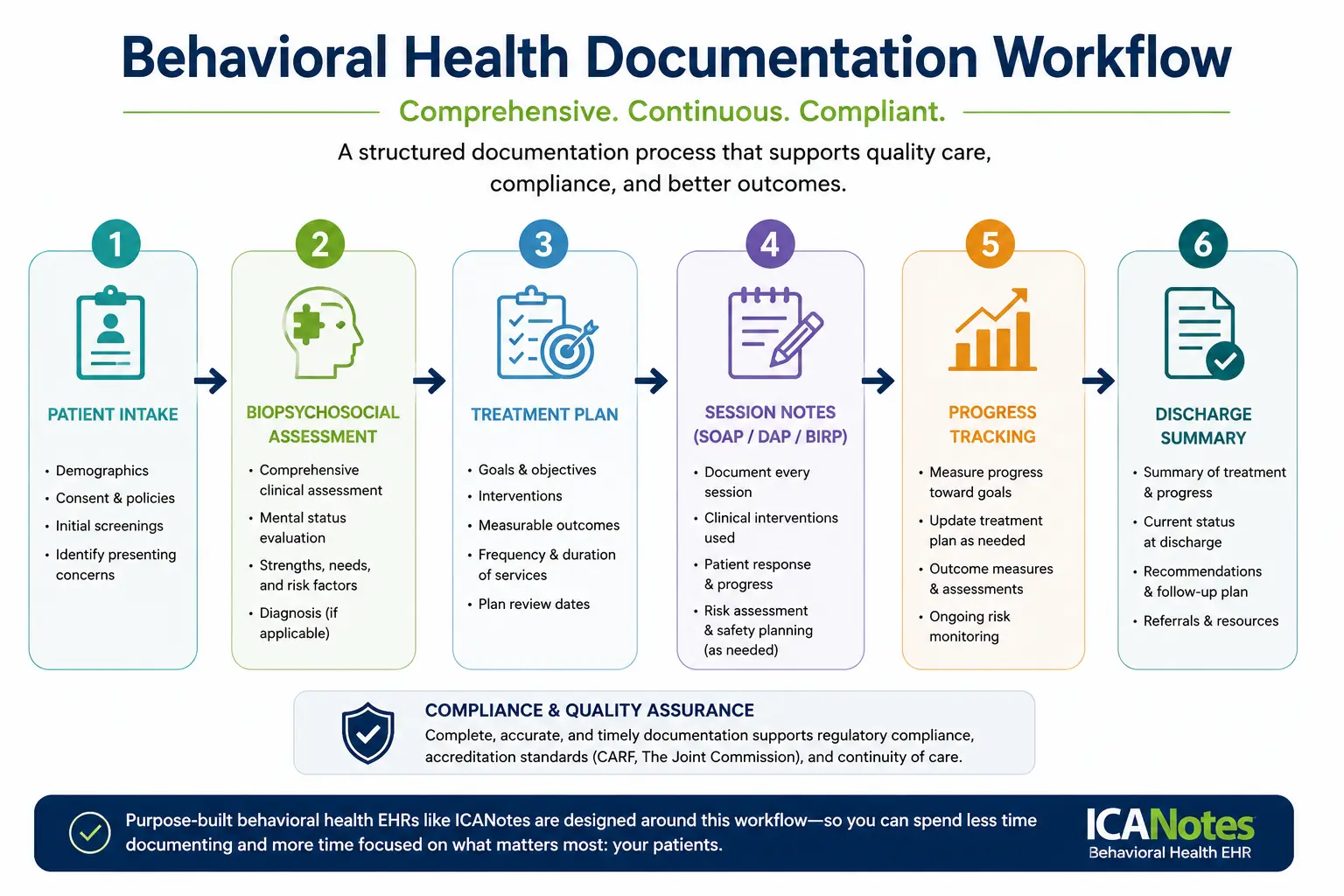
In primary care, a physician may document a handful of visits per patient per year. A behavioral health clinician documents every session — weekly, sometimes more frequently — and each note carries legal and clinical weight. Progress notes are not summaries of an encounter; they are the primary record of the therapeutic relationship and a clinician's ongoing assessment of a patient's mental status, risk level, and treatment progress.
Note Type Diversity
Behavioral health documentation requires support for a range of note formats that simply don't exist in general medicine: SOAP, DAP, BIRP, biopsychosocial assessments, treatment plans, crisis plans, discharge summaries, and session-specific formats tied to therapeutic modality. A platform built for general medicine has no native concept of most of these.
The Compliance Layer
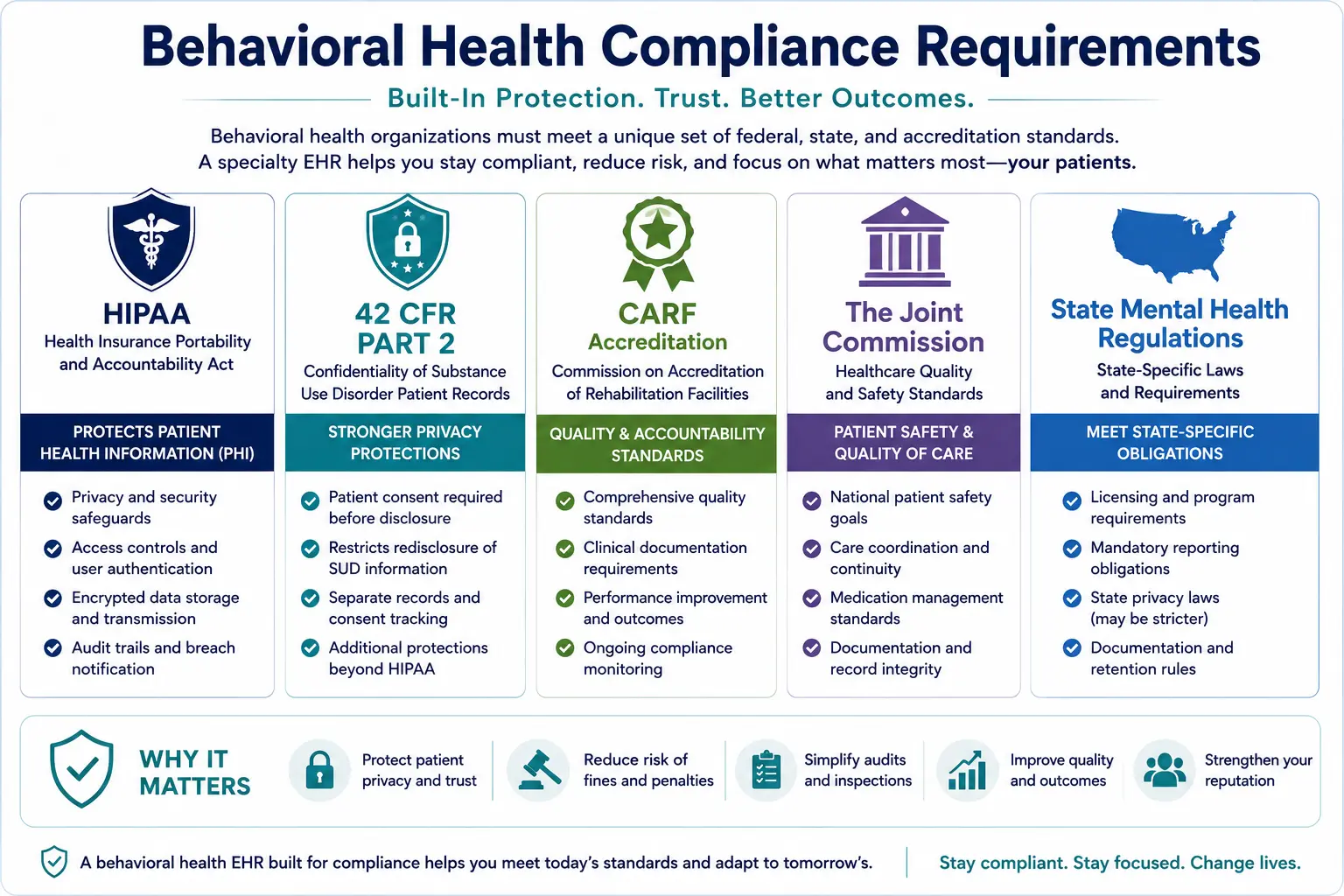
Behavioral health operates under a compliance framework that general EHRs are not designed to address:
- 42 CFR Part 2 governs the confidentiality of substance use disorder records and imposes consent and disclosure requirements that go well beyond HIPAA. General medical EHRs typically have no native support for this regulatory framework.
- State mental health documentation laws vary significantly and impose requirements around progress note content, treatment plan timelines, and patient rights that differ from state to state.
- CARF and Joint Commission accreditation standards require specific documentation practices — treatment plan reviews, outcome measurement integration, and audit trail fidelity — that general medical EHRs don't accommodate natively.
Psychiatric vs. Therapy Documentation
Psychiatric practice introduces additional documentation requirements: medication management, prescribing decisions, PDMP queries, psychiatric evaluations, and the documentation of risk-benefit conversations. These are not add-ons to a general medical EHR; they require purpose-built workflows to document accurately and efficiently.
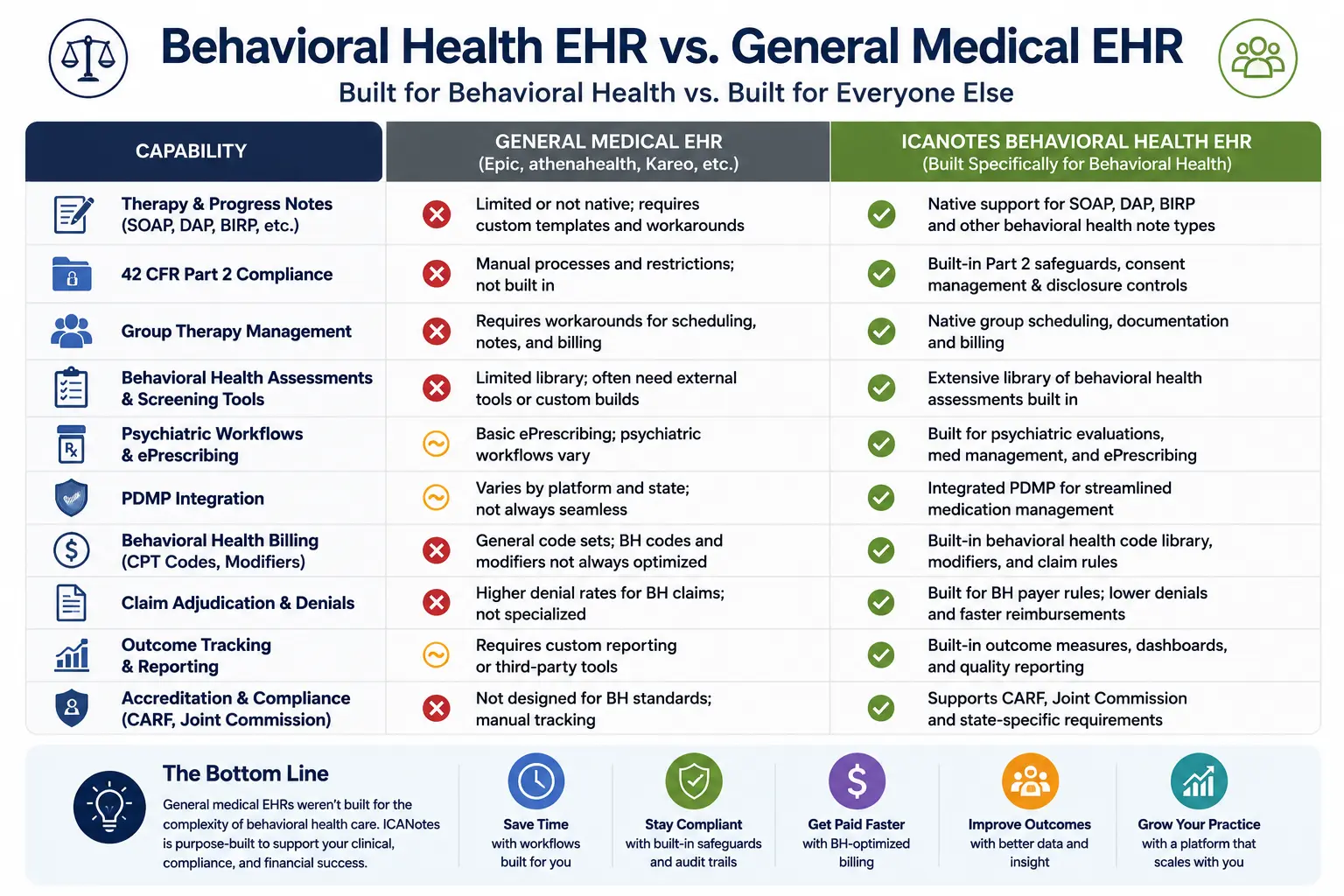
Where General Medical EHRs Fall Short: A Practical Breakdown
Documentation
General medical EHR note templates are built around the SOAP note as used in primary care — chief complaint, objective findings, assessment, plan. This maps poorly onto the session documentation needs of behavioral health, where note content reflects therapeutic technique, mental status, risk assessment, and treatment plan progress rather than a clinical problem list.
The practical result: clinicians spend significant time customizing templates that were never designed for their workflows, and the customizations introduce inconsistency and potential compliance gaps. A progress note written around a general SOAP template is not the same as a progress note written in a template built for behavioral health documentation — and the difference matters in audits and legal proceedings.
Billing
Behavioral health billing uses CPT codes — 90834, 90837, 90847, 90853 for therapy; 99213–99215 with modifier 25 for psychiatric evaluation and management — that are structurally different from the E&M billing that general medical EHRs are optimized for. Mental health claims also carry parity law considerations, prior authorization complexity, and Medicaid behavioral health carve-out rules that general medical platforms don't accommodate natively.
The downstream effect is higher claim denial rates and increased administrative burden for billing staff who must manage workarounds that shouldn't be necessary. For a practice processing hundreds of claims monthly, even a modest increase in denial rates represents a meaningful revenue impact.
Psychiatry and Prescribing
Psychiatric ePrescribing involves controlled substance workflows, DEA compliance requirements, and PDMP integration that general medical EHR ePrescribing modules are not configured for. A prescriber working in a general medical EHR without native PDMP integration must manage prescription drug monitoring queries outside the platform — adding steps, creating documentation gaps, and increasing compliance risk.
Compliance
General medical EHRs are built to meet HIPAA requirements for general medical records. They are not built to enforce 42 CFR Part 2 consent requirements, which require affirmative patient consent for each disclosure of substance use disorder information — including disclosures to treating providers. Without native support for this framework, a practice either manages it manually (error-prone) or ignores it (a serious compliance exposure).
Group Therapy
Group therapy is a core clinical modality in behavioral health — and a revenue-significant one. It requires the ability to document group sessions efficiently, bill each participant on a single claim where appropriate, and manage group enrollment and attendance tracking. In most general medical EHRs, group therapy either doesn't exist as a workflow or has been bolted on as an afterthought. The practical result is a multi-step manual process that clinicians work around rather than through.
What “Built for Behavioral Health” Actually Means
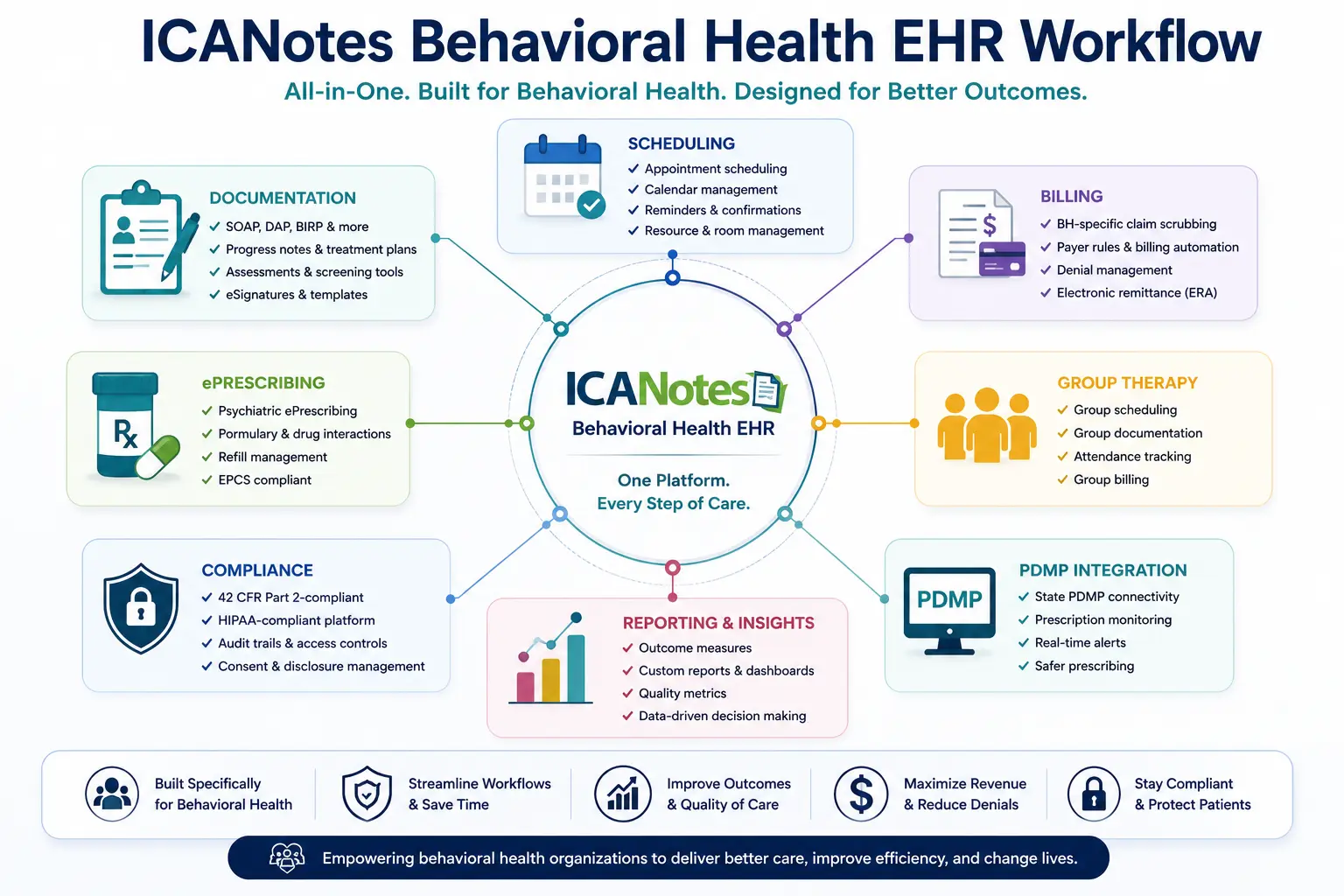
The phrase “built for behavioral health” gets used broadly in EHR marketing. It's worth translating it into concrete product reality. ICANotes was designed exclusively for behavioral health from the outset — it has never served a general medical practice — and the difference shows up in specifics.
Documentation Built Around Behavioral Health Workflows
ICANotes provides note templates designed specifically for behavioral health documentation from day one — not adapted from primary care formats. This includes SOAP, DAP, and BIRP note structures, biopsychosocial assessment templates, treatment plan frameworks, and session note formats that align with how behavioral health clinicians actually document care. Clinicians can document faster because the template reflects the clinical task, not a workaround to fit it.
Billing Configured for Behavioral Health
The ICANotes billing workflow is configured for behavioral health CPT codes, including therapy codes, psychiatric E&M codes, and the modifier combinations used in mental health billing. This extends to Medicaid behavioral health billing, Medicare mental health parity requirements, and ERA/EOB processing for the claim patterns specific to behavioral health. The goal is a billing workflow where common behavioral health billing scenarios work as expected — not as exceptions.
Compliance Architecture
ICANotes is ONC-certified and supports the compliance requirements specific to behavioral health practices, including CARF and Joint Commission documentation standards. The platform's audit trail and record-keeping architecture is designed to meet the documentation fidelity requirements of behavioral health regulatory frameworks, not just general HIPAA requirements.
Psychiatric Workflow as a Native Feature
ePrescribing in ICANotes includes PDMP integration as a native feature of the prescribing workflow — not a separate step outside the platform. Medication management, controlled substance prescribing, and the documentation of prescribing decisions are built into the psychiatric workflow, not added on.
Group Therapy as a First-Class Workflow
Group therapy in ICANotes is a native feature, not a workaround. Clinicians can document group sessions, manage group enrollment and attendance, and process billing for group participants without leaving the platform or constructing manual processes. For practices that rely on group therapy as a significant part of their clinical model, this difference is material.
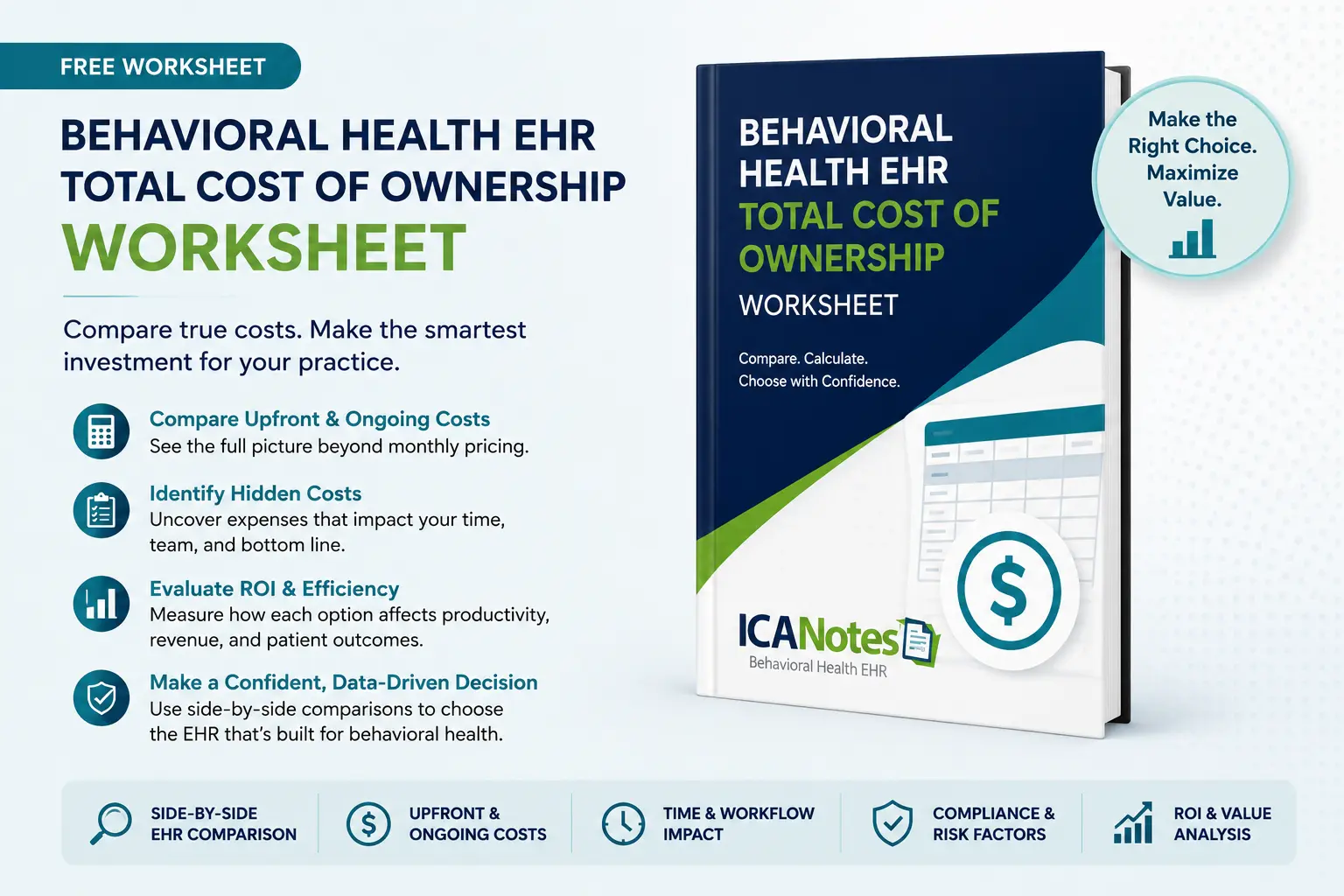
Free Worksheet
Compare the True Cost of Your EHR Options
Monthly subscription fees are only part of the picture. Use this worksheet to compare upfront costs, hidden expenses, workflow impact, compliance risk, and long-term value when evaluating a behavioral health EHR.
- ✓ Compare upfront and ongoing EHR costs
- ✓ Identify hidden costs from workarounds and inefficiencies
- ✓ Evaluate ROI, compliance risk, and workflow impact
The Real Cost Comparison
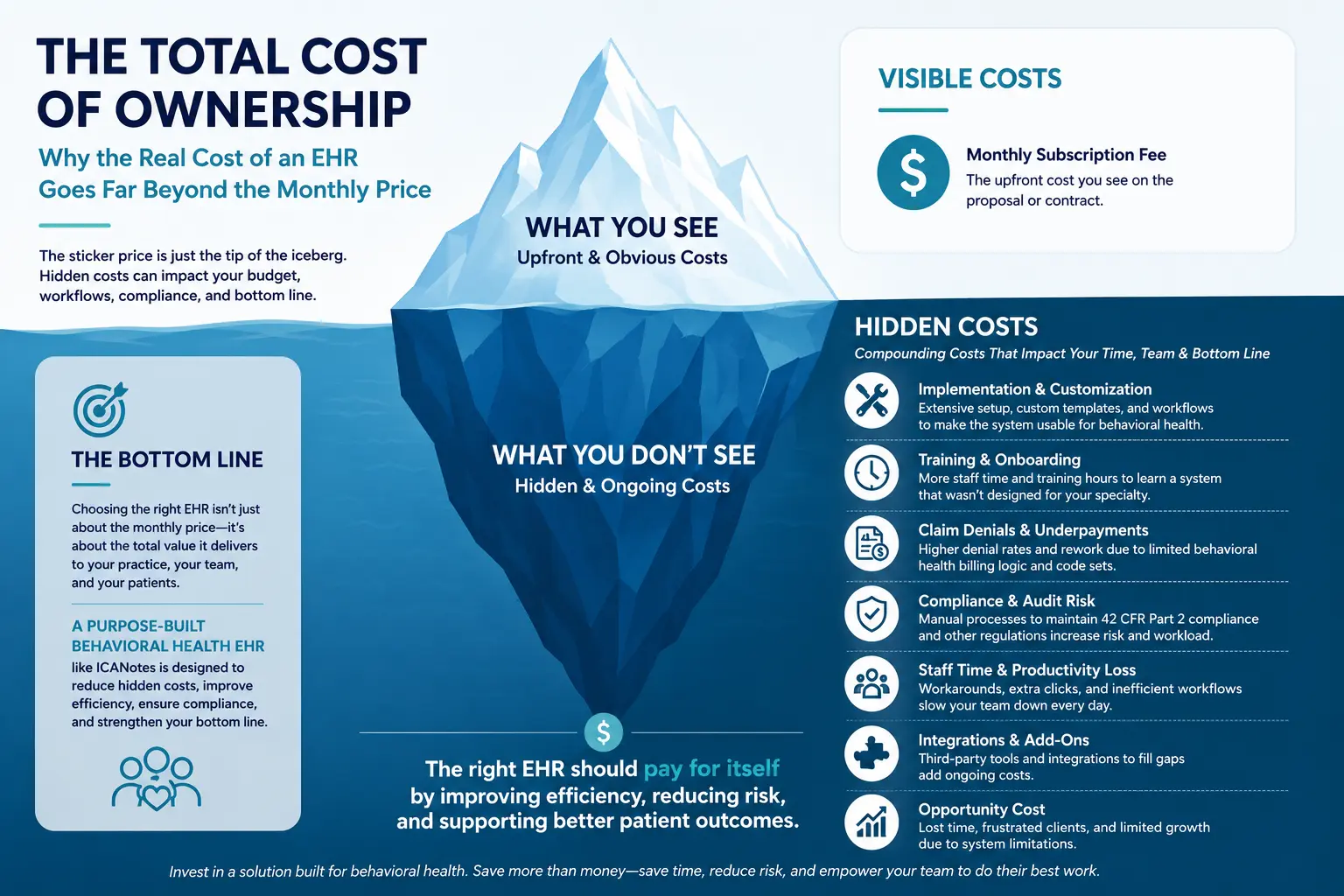
General medical EHR platforms can carry lower subscription costs than specialty alternatives. This is real, and it's the objection that practice administrators most frequently raise. What the subscription price comparison omits is the total cost of ownership — the full picture of what a platform actually costs to run in a behavioral health context.
Consider what “cheaper” often means in practice:
- Staff time spent customizing and maintaining templates that weren't built for behavioral health workflows — a cost that's invisible in a subscription comparison but very visible in a clinician's schedule
- Billing workarounds and the denial rate impact of claims processed on a platform not configured for behavioral health CPT and modifier patterns — practices routinely underestimate the revenue impact of even small increases in denial rates
- Compliance management outside the platform — manual processes to handle 42 CFR Part 2 consent, PDMP queries, and documentation requirements the EHR doesn't natively support
- Implementation and ongoing customization resource — general medical EHRs typically require more implementation effort to approximate behavioral health functionality, and that effort has a cost whether it's paid to a vendor or borne internally
A subscription that appears 20–30% cheaper at the platform level can carry a significantly higher total cost of ownership once these factors are accounted for. The comparison that matters for a behavioral health practice is not platform price — it's the cost of operating the platform in a behavioral health context.
Who Should Still Consider a General Medical EHR
Not every behavioral health practice should rule out a general medical EHR. There are scenarios where the trade-offs point a different direction:
- Large integrated health systems with existing Epic or Athenahealth infrastructure, where the cost and disruption of a separate platform outweighs the workflow benefits of a specialty solution
- Practices that are genuinely split between behavioral and physical health services at roughly equal volume, where a unified platform reduces coordination overhead
- Organizations with dedicated IT and implementation resources who can absorb the customization cost of adapting a general medical platform to behavioral health workflows
The honest recommendation: if behavioral health is your primary or exclusive clinical model, a purpose-built platform will almost always produce a better outcome on workflow efficiency, billing performance, and compliance standing than a general medical EHR adapted to fit. If behavioral health is one component of a larger, integrated care model, the answer depends on the specifics of your organization.
Free 30-Day Trial
See What a Behavioral Health-Specific EHR Can Do
General medical EHRs often require workarounds for behavioral health documentation, billing, compliance, and group therapy workflows. ICANotes is built specifically for mental health and substance use treatment providers, so you can document faster, stay organized, and support compliance from one purpose-built platform.
- ✓ Behavioral health note templates, treatment plans, and assessments
- ✓ Billing workflows designed for mental health CPT codes and claim patterns
- ✓ Support for compliance, psychiatric workflows, and group therapy documentation
Start Your Free Trial
Try ICANotes free for 30 days. No credit card required.
Frequently Asked Questions About General Medical EHR vs Behavioral Health EHR
Recent Posts






Dr. October Boyles
DNP, MSN, BSN, RN
About the Author
Dr. October Boyles is a behavioral health expert and clinical leader with extensive expertise in nursing, compliance, and healthcare operations. With a Doctor of Nursing Practice (DNP) and advanced degrees in nursing, she specializes in evidence-based practices, EHR optimization, and improving outcomes in behavioral health settings. Dr. Boyles is passionate about empowering clinicians with the tools and strategies needed to deliver high-quality, patient-centered care.