Blog > Documentation > Mental Health Discharge Summary Sample & Template | Free Examples
Mental Health Discharge Summary Sample and Template: What "Good" Looks Like
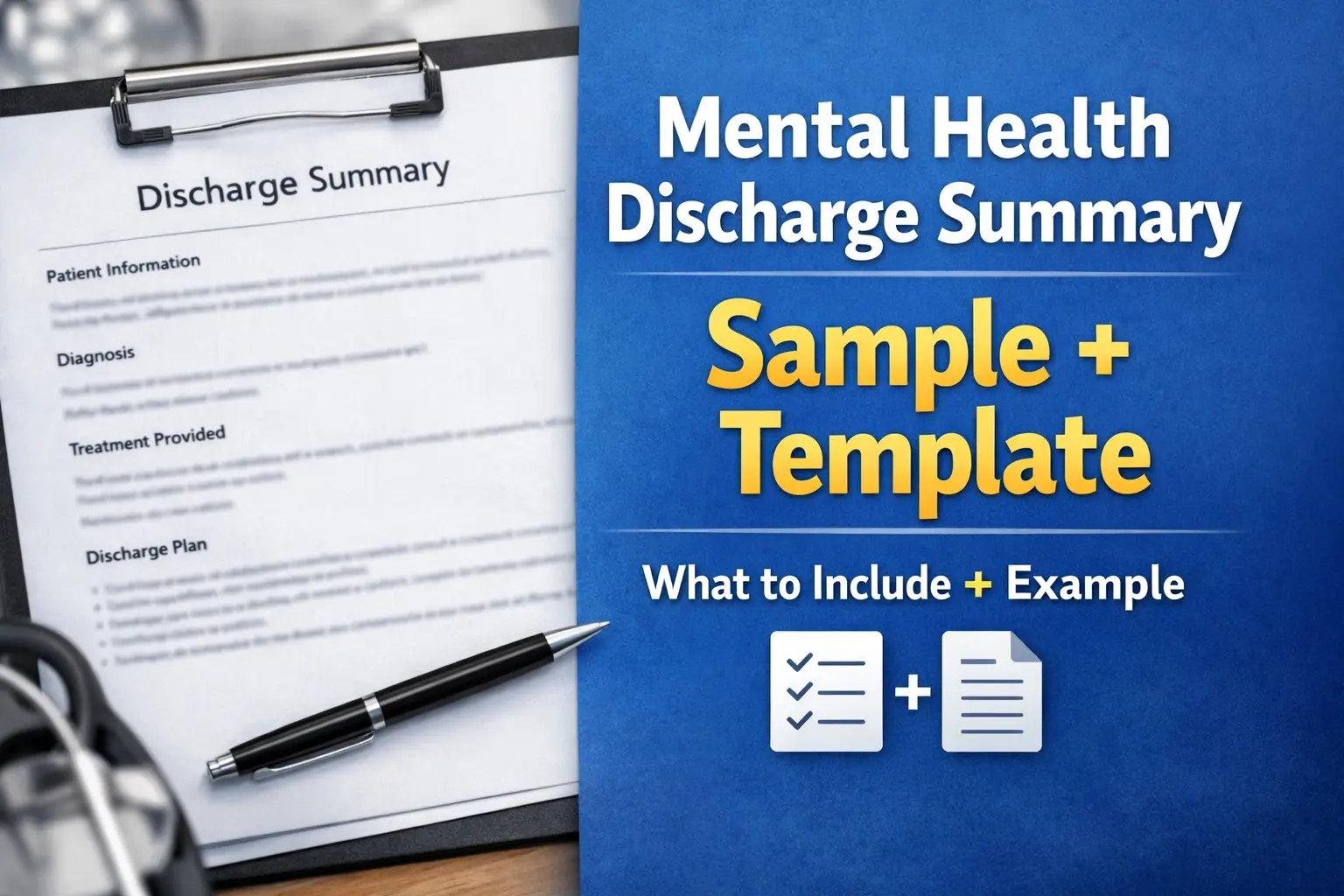
A mental health discharge summary is a critical clinical document that outlines a client’s treatment progress, current status, and plan for ongoing care. In this guide, you’ll find a complete mental health discharge summary sample, along with a customizable discharge summary template and real-world examples of mental health discharge documentation. We also break down what a discharge summary must include, how to approach mental health discharge planning, and step-by-step guidance on how to write a discharge summary that meets clinical, legal, and reimbursement standards.

Kaylee Kron, LMSW, GC-C
Last Updated: April 8, 2026
What You'll Learn
- What a mental health discharge summary must include to meet clinical, legal, and payer expectations
- How to use a mental health discharge summary template to create consistent, audit-ready documentation
- Step-by-step guidance on how to write a discharge summary for therapy and psychiatric care
- The difference between a discharge summary, discharge note, and discharge progress note
- How to document treatment outcomes, functional status, and validated measures clearly
- Best practices for mental health discharge planning, including aftercare and follow-up
- How to incorporate safety planning and crisis instructions into discharge documentation
- Examples of mental health discharge summaries and discharge progress notes you can adapt for your own practice
Contents
- What a Discharge Summary Must Include
- Mental Health Discharge Summary Example
- Mental Health Discharge Summary Template
- Therapy Discharge Letter Template
- Discharge Progress Note vs Discharge Summary: What's the Difference?
- How to Write a Mental Health Discharge Summary
- What Makes a Good Mental Health Discharge Summary?
- How ICANotes Simplifies Mental Health Discharge Planning
- FAQ: Mental Health Discharge Summary
A well-structured discharge plan is essential for ensuring continuity of care and promoting positive long-term outcomes for clients transitioning out of mental health treatment. Whether you're a therapist, social worker, or psychiatric provider, crafting a comprehensive, clear, and collaborative mental health discharge summary is a key part of behavioral health documentation best practices and can make the difference between ongoing recovery and relapse or crisis.
In this post, we'll walk through a realistic mental health discharge summary sample, provide a fillable mental health discharge summary template, break down what every discharge summary must include, and show you how ICANotes can help clinicians streamline the discharge planning process without sacrificing quality or compliance.
Why Discharge Planning Matters in Mental Health Care
Mental health discharge planning is more than just an administrative task. It’s a therapeutic process that:
- Prepares the client for discharge from the beginning of care and provides a clear understanding of what treatment is working toward
- Reduces risk of relapse, readmission, or disengagement from care
- Provides clients with clear next steps for continued support
- Ensures that vital clinical information is shared with future providers
- Fulfills legal, ethical, and billing documentation requirements
For psychiatric discharges, this process is especially important when managing medications, follow-up care, or residual safety concerns.
What a Discharge Summary Must Include
Whether you're writing a mental health discharge summary for a psychiatric hospital discharge, outpatient therapy termination, or a social work case closure, here's what your discharge summary must include:
✅ Client Information
Name, date of birth, diagnosis, dates of service, and type of care provided.
✅ Reason for Discharge
Include whether discharge was planned, voluntary, administrative, or due to goal completion. Clear discharge criteria should be established early in treatment so that the client understands what milestones indicate readiness for discharge.
✅ Summary of Treatment
A brief overview of treatment duration, type (e.g., CBT, DBT, medication management), and major clinical themes addressed during care.
✅ Functional Status and Condition at Discharge
Describe symptom changes, functional improvements, or persistent challenges. Document the client's condition at discharge using measurable outcomes such as validated assessment scores, behavioral observations, and the client's own self-report.
✅ Discharge Goals and Outcomes
Summarize which treatment goals were met, partially met, or unmet. Specific discharge goals examples include: "Client will demonstrate at least a 50% reduction in PHQ-9 score," "Client will identify and use three coping strategies independently," or "Client will attend three consecutive sessions without crisis contact."
✅ Medications and Medical Follow-Up
Include current medications, prescriber information, and instructions for follow-up appointments or lab work.
✅ Crisis or Safety Plan
Outline steps for managing future crises, including emergency contacts and crisis hotlines.
✅ Aftercare and Referrals
List specific next steps — such as ongoing therapy, psychiatry follow-up, case management, housing support, or substance use treatment.
✅ Client Participation
Document client input, agreement with the plan, and understanding of recommendations.
✅ Provider Contact Information
Include provider name, credentials, and a way for new clinicians to follow up if needed.
Want to make sure you never miss a step when discharging a client?
Download our Comprehensive Discharge Checklist for Mental Health Clinicians—a practical, printable tool designed to help therapists, counselors, and psychiatric providers ensure every discharge is ethical, complete, and clinically sound.
Mental Health Discharge Summary Example
Here's a realistic discharge summary example for a mental health outpatient case:
Mental Health Discharge Summary Template
Download the Mental Health Discharge Summary Template
Get a free, fillable template designed to help therapists, psychiatric providers, and social workers document discharge clearly, efficiently, and compliantly.
This free PDF includes:
- A fillable mental health discharge summary template
- Built-in sections for treatment summary, outcomes, and aftercare
- Space for medications, follow-up care, and crisis planning
- A structured format that supports continuity of care
Get the Free Template
Enter your information below to access the download.
We’ll also send helpful behavioral health documentation resources from ICANotes. You can unsubscribe at any time.
Looking for a faster way? ICANotes includes built-in discharge summary templates that auto-populate client data, diagnoses, medications, and progress metrics — so you're not starting from scratch every time.
Book a DemoTherapy Discharge Letter Template
A therapy discharge letter is different from a discharge summary. While the summary is a clinical document for the medical record, a discharge letter is a client-facing communication that summarizes the conclusion of treatment in accessible, non-clinical language. Here's a brief template:
Discharge Progress Note vs. Discharge Summary: What's the Difference?
A discharge progress note and a discharge summary serve different purposes, and many clinicians use the terms interchangeably — but they aren't the same.
A discharge progress note documents the final session itself — what was discussed, the client's presentation that day, interventions used, and the clinical rationale for ending treatment. It functions like any other progress note but marks the final encounter.
A discharge summary is a standalone document that provides a comprehensive overview of the entire episode of care — from intake through termination — including treatment provided, outcomes achieved, medications, aftercare plans, and referrals.
In many outpatient settings, clinicians combine both into a single final note. In inpatient or residential settings, they are typically separate documents.
How to Write a Mental Health Discharge Summary
If you're writing a mental health discharge summary for the first time — or looking to improve your current process — here's a step-by-step approach:
1. Start Discharge Planning at Intake
Identify preliminary discharge criteria and goals during the first session so the entire treatment arc points toward a planned, purposeful ending.
2. Gather Your Documentation
Pull together the intake assessment, treatment plan, progress notes, and validated measures (PHQ-9, GAD-7, PCL-5) to inform your summary.
3. Write the Treatment Summary
Describe the treatment approach, duration, modalities used, and key themes. Focus on the clinical narrative rather than every session detail.
4. Document Outcomes & Condition at Discharge
Use measurable data when possible. Compare intake and discharge scores, describe functional changes, and note any unresolved issues.
5. Build the Aftercare Plan Collaboratively
Identify referrals, follow-ups, medication needs, support systems, and crisis planning. Document the client’s input and agreement.
6. Finalize and Share
Ensure the summary is complete and compliant, and provide the client with a discharge summary or letter outlining next steps in plain language.
What Makes a Good Mental Health Discharge Summary?
The mental health discharge summary example above reflects best practices in mental health discharge planning because it:
- Clearly summarizes treatment outcomes in measurable, observable terms
- Includes follow-up and referral details, reducing gaps in care and providing a clear roadmap for next steps
- Documents medication and prescriber information, supporting continuity of care
- Addresses client safety, including crisis plan instructions
- Engages the client in the planning process and documents their agreement
- Establishes discharge criteria tied to specific, measurable treatment goals
This is the kind of discharge plan that supports client autonomy, demonstrates clinical diligence, and protects both the client and the provider.
How ICANotes Simplifies Mental Health Discharge Planning
Creating a detailed, personalized mental health discharge summary doesn't need to be a manual process. With ICANotes, clinicians can:
- Use built-in mental health discharge summary templates tailored to psychiatric and therapeutic workflows
- Auto-populate relevant data from prior documentation, reducing time spent copying notes
- Track medications, diagnoses, and progress metrics all in one place
- Document risk assessments and follow-up plans directly into the clinical record
- Export or print easy-to-understand discharge instructions for clients
Whether you're managing discharge planning for psychiatric patients, outpatient therapy clients, or social work case closures, ICANotes helps ensure that every transition is safe, efficient, and compliant.
Spend Less Time Writing Mental Health Discharge Summaries
Discharge summaries should support continuity of care without slowing down your workflow. ICANotes helps behavioral health clinicians create detailed, compliant discharge documentation faster with built-in templates, structured note-writing tools, and key clinical information all in one place.
- Use built-in discharge summary templates designed for behavioral health
- Auto-populate client data, diagnoses, medications, and progress details
- Document outcomes, follow-up plans, and crisis instructions more efficiently
- Keep discharge documentation consistent, complete, and audit-ready
Start Your Free Trial
No credit card required. See how ICANotes simplifies discharge summaries, progress notes, treatment plans, and more.
Final Thoughts on Mental Health Discharge Summaries
Discharge isn't the end — it's a bridge between what your client has accomplished in treatment and the support they'll need moving forward. A thoughtful, well-documented discharge plan lays the foundation for continued care and stability. With the right structure, collaborative communication, and smart tools like ICANotes, you can make the process faster, more consistent, and clinically sound.
Related Resources

Frequently Asked Questions: Mental Health Discharge Summary
What is a mental health discharge summary?
What must a discharge summary include?
What is the difference between a discharge summary and a discharge note?
How do I write a discharge summary for therapy?
When should discharge planning begin?
Does a mental health discharge plan need to include safety planning?
Why is mental health discharge documentation so important?
Related Posts




Kaylee Kron
LMSW, GC-C
Kaylee Kron, LMSW, GC-C, is a certified grief counselor with over a decade of experience. She has worked extensively in nonprofit hospice care, helping individuals navigate their grief journeys. As an author, speaker, and advocate, Kaylee brings a wealth of knowledge and compassion to her work, creating spaces for acknowledgment and healing.