50 Positive Coping Strategies Therapists Can Teach Clients for Better Mental Health
A practical, evidence-informed guide to expanding your clients' coping repertoire and building the coping flexibility that predicts lasting resilience.

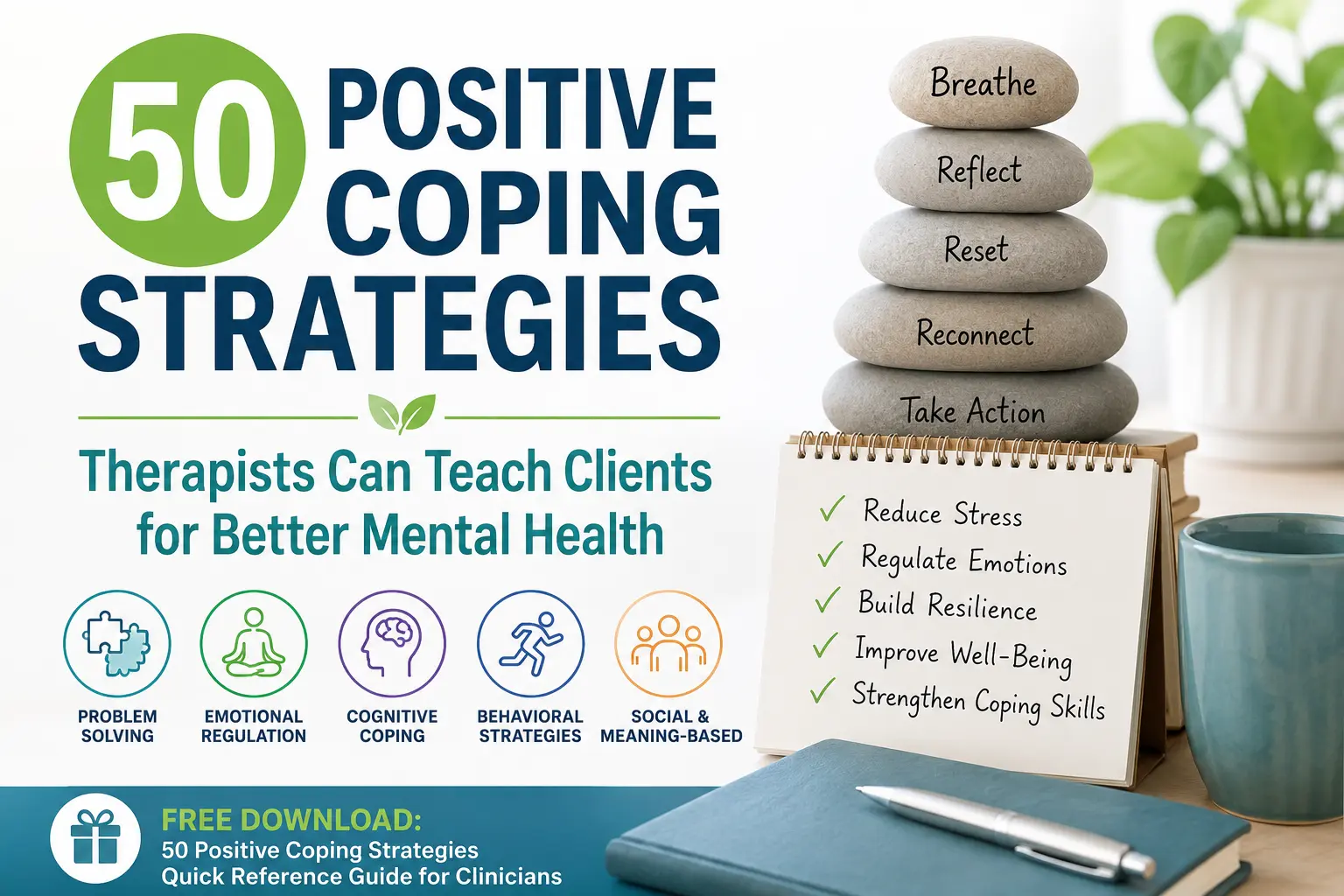
Positive coping strategies are healthy thoughts and behaviors that help clients manage stress, regulate emotions, solve problems, and build resilience without causing long-term harm. In this guide, you'll discover 50 evidence-informed coping strategies therapists can teach clients, organized into five practical categories—problem-solving, emotional regulation, cognitive, behavioral, and social or meaning-based coping. You'll also learn how to match coping skills to common mental health concerns, avoid common teaching mistakes, and help clients develop the coping flexibility needed for lasting psychological well-being.
What You'll Learn
- What positive coping strategies are and how they differ from maladaptive coping.
- Why coping flexibility is one of the strongest predictors of resilience and long-term mental health.
- 50 evidence-informed coping strategies organized into five practical categories therapists can teach clients.
- How to match coping strategies to common mental health concerns such as anxiety, depression, trauma, grief, burnout, and ADHD.
- Common mistakes clinicians make when teaching coping skills — and how to help clients apply new strategies successfully.
Every therapist teaches coping skills, but effective treatment is about more than handing clients a list of techniques. The real goal is helping clients build coping flexibility — the ability to choose the right strategy for the situation rather than relying on the same response every time stress arises.
Many clients arrive in therapy with only a few familiar coping habits, often developed through trial and error. Some are effective, while others may provide short-term relief but create longer-term problems. By expanding a client's coping repertoire and matching strategies to their presenting concerns, clinicians can improve emotional regulation, strengthen resilience, and support lasting behavior change.
This guide organizes 50 positive coping strategies into five evidence-informed categories, explains when each type of coping skill is most effective, and offers practical guidance for teaching these interventions in clinical practice.
Positive coping strategies are healthy thoughts and behaviors that help people manage stress, regulate emotions, solve problems, and adapt to life's challenges without causing long-term harm. They improve resilience, support mental well-being, and help individuals respond more effectively to both everyday stress and significant life events. Unlike maladaptive coping strategies — which may offer short-term relief but ultimately increase distress or impair functioning — positive coping strategies promote long-term psychological health. Therapists teach these evidence-based coping skills to help clients manage anxiety, depression, trauma, grief, burnout, and other common mental health concerns.
01 / FoundationsWhat Are Positive Coping Strategies?
Positive (or adaptive) coping strategies are thoughts and behaviors used to manage stress, regulate emotion, or solve a problem in a way that doesn't create long-term harm. They sit in contrast to maladaptive coping — strategies like avoidance, substance use, or rumination that may offer short-term relief but tend to make things worse over time.
Not every coping strategy promotes long-term mental health. While positive coping strategies help people adapt to stress in healthy, sustainable ways, maladaptive coping strategies often provide temporary relief while increasing distress or impairing functioning over time. Understanding this distinction helps clinicians identify behaviors that should be strengthened versus replaced during treatment.
Positive Coping Strategies vs. Maladaptive Coping
| Positive Coping Strategies | Maladaptive Coping Strategies |
|---|---|
| Address stress constructively | Avoid or escape stress |
| Promote long-term well-being | Provide only temporary relief |
| Improve emotional regulation | Increase emotional reactivity |
| Strengthen resilience | Reinforce unhealthy patterns |
| Support healthy relationships | Damage relationships or increase isolation |
| Improve daily functioning | Impair work, school, or family functioning |
| Encourage problem-solving or acceptance | Maintain avoidance or denial |
| Examples: mindfulness, exercise, journaling, boundary setting, behavioral activation | Examples: substance use, rumination, emotional suppression, self-isolation, procrastination |
Keep in mind that coping strategies are not inherently "good" or "bad." A behavior that is adaptive in one situation may become maladaptive in another. The goal of therapy is to help clients build coping flexibility so they can choose the most effective strategy for the situation at hand.
Coping Flexibility, Not Just Coping Skill
A large meta-analytic review covering nearly 60,000 participants found that coping flexibility — the ability to adjust a strategy to fit a situation, rather than reaching for the same one regardless of context — was consistently linked to better psychological adjustment. In practice, this means the value of teaching 50 strategies isn't that a client will use all of them; it's that having a wider menu makes it easier to find the right fit in the moment.
Problem-Focused vs. Emotion-Focused Coping
Many of the strategies below fall along a classic distinction from Lazarus and Folkman's transactional model of stress and coping: problem-focused coping (changing or managing the stressor itself) and emotion-focused coping (managing the emotional response when the stressor can't be changed). For a deeper look at this distinction, see ICANotes' related post, Problem-Focused vs. Emotion-Focused Coping.
02 / RationaleWhy Positive Coping Strategies Matter
Positive coping strategies do more than provide temporary relief from stress — they help clients develop the skills needed to navigate future challenges with greater confidence and resilience. By teaching adaptive ways to regulate emotions, solve problems, and respond to difficult situations, therapists can help clients reduce psychological distress while improving long-term functioning and overall well-being. Over time, a diverse repertoire of positive coping strategies becomes a protective factor against relapse, supports treatment progress, and enables clients to respond more flexibly as life circumstances change. Positive coping strategies contribute to mental health in several important ways:
- Reduces the toll of stress — lowering the intensity and duration of the stress response protects both mental and physical health over time.
- Builds resilience for future stressors — practicing strategies in lower-stakes moments makes them more accessible during a crisis.
- Supports relapse prevention — clients recovering from depression, anxiety, or substance use are less likely to default to maladaptive coping when they have a ready alternative.
- Improves emotional regulation — a broader coping repertoire reduces reliance on any single strategy, which research links to better psychological adjustment.
- Strengthens day-to-day functioning — clients who can self-regulate are better able to maintain work, relationships, and daily responsibilities under stress.
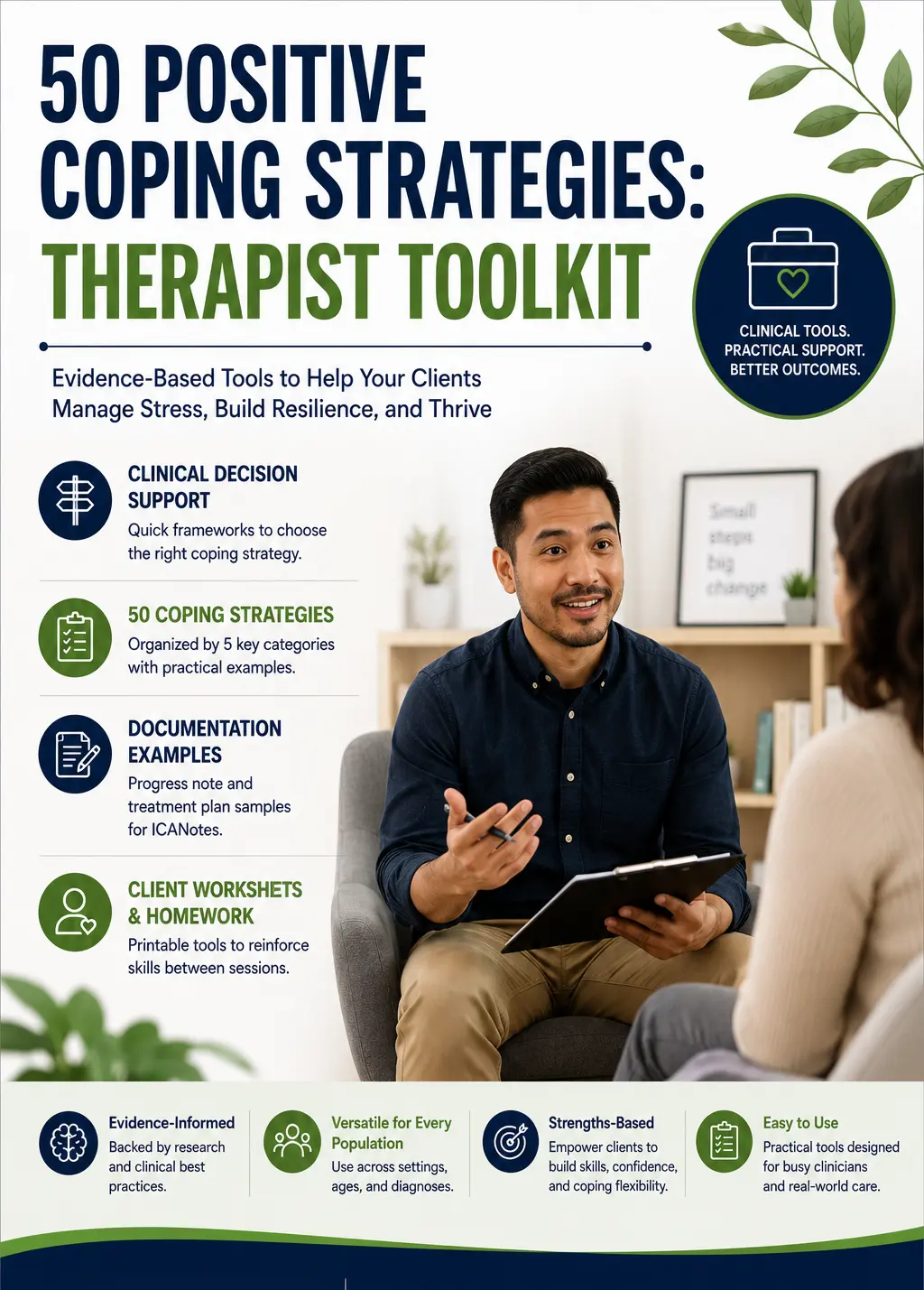
Free Therapist Toolkit: 50 Positive Coping Strategies You Can Use in Session Today
Download this free evidence-informed toolkit to help you choose the right coping interventions, strengthen treatment planning, document clinical care, and reinforce skill-building between sessions.
- Clinical Decision Flow to help you choose the most appropriate coping strategy for each client.
- Therapist Cheat Sheets for matching interventions to common presenting problems.
- Printable Client Worksheet to reinforce coping skills between sessions
03 / Clinical Decision-MakingHow Therapists Choose Coping Strategies
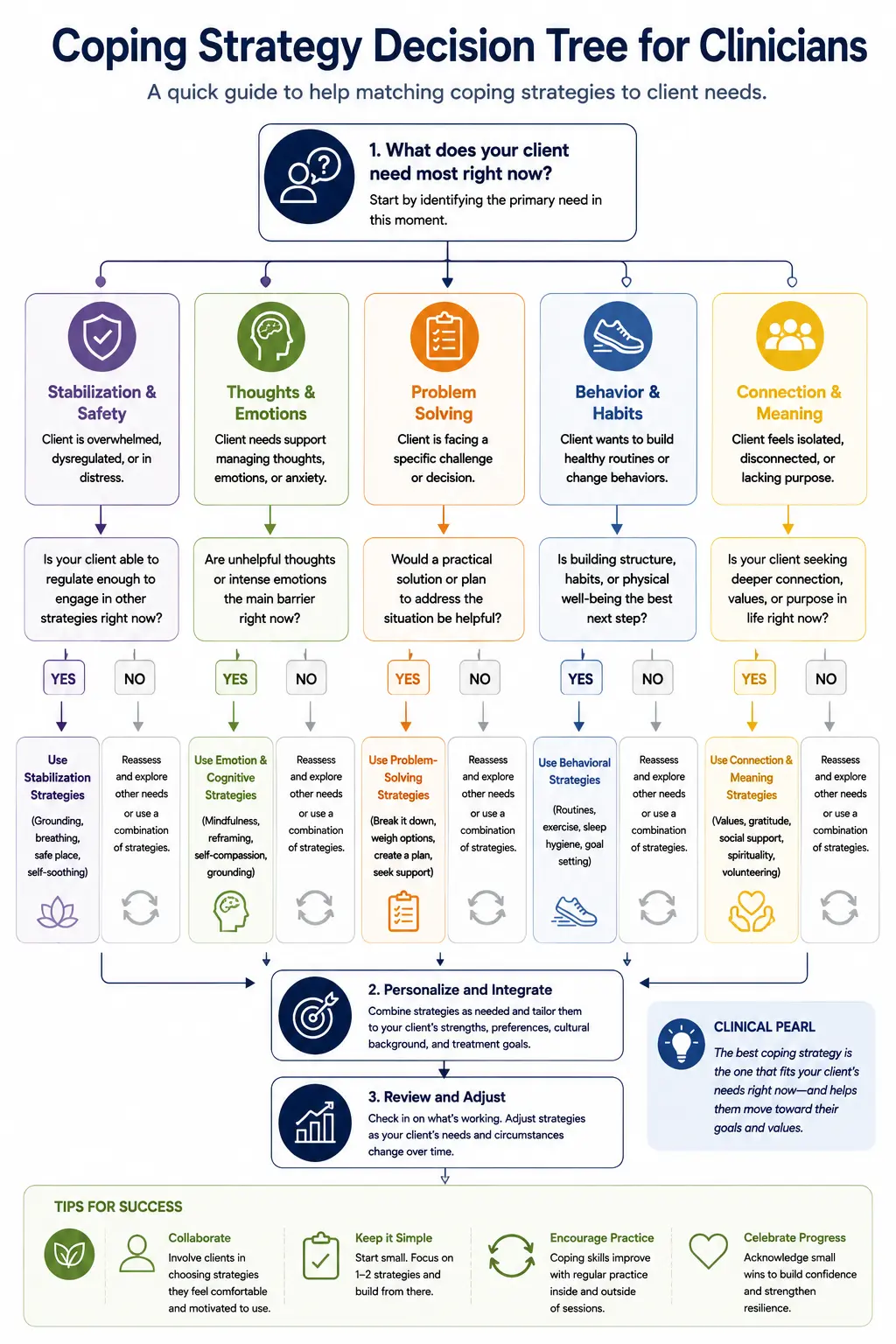
Not every coping strategy fits every client or moment. Clinicians typically work through a few clinical questions — rooted in the same appraisal process Lazarus and Folkman described — before deciding where to start.
- Is the stressor controllable or uncontrollable? If a client can realistically change or influence the situation, problem-solving strategies are usually the better starting point. If the stressor can't be changed — a past event, a loss, a diagnosis — emotion-focused strategies tend to fit better.
- Does the client need emotional regulation before problem-solving? When distress is too high for clear thinking, strategies like grounding or breathing often need to come first to lower arousal enough for cognitive or problem-solving work to land.
- Does the client need behavioral activation? Clients who are withdrawing, isolating, or showing low motivation often benefit more from strategies that prompt action first, rather than strategies that require already feeling motivated.
- Is the client avoiding or over-functioning? Some clients cope by avoiding difficult emotions or situations; others cope by staying constantly busy. Identifying which pattern is present helps determine whether the goal is gentle approach (reducing avoidance) or intentional rest (reducing over-functioning).
04 / The List50 Positive Coping Strategies Therapists Can Teach Clients
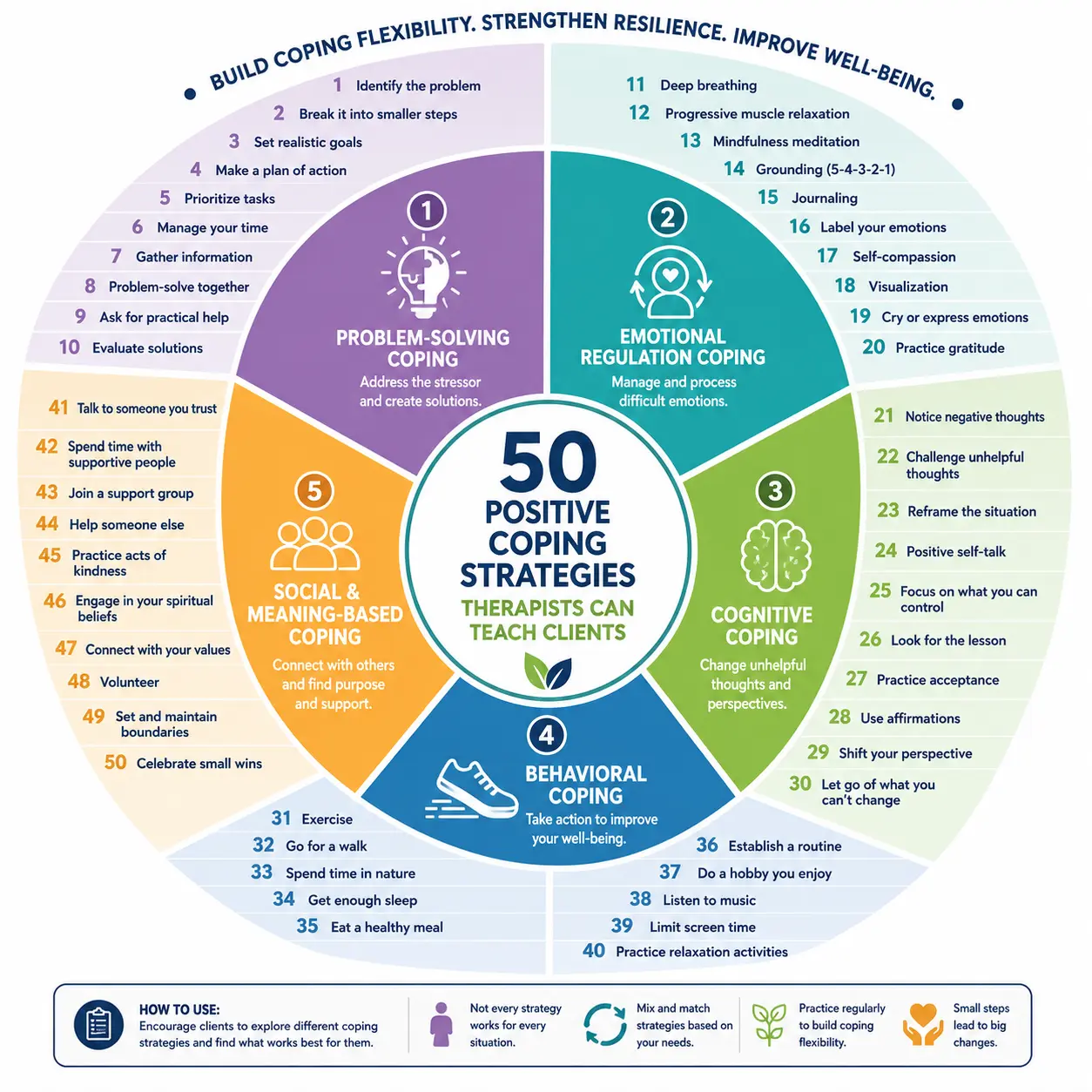
Rather than one long list, these 50 strategies are organized into five clinical categories — problem-solving, emotional regulation, cognitive, behavioral, and social or meaning-based — with a clinical note on when each category tends to be most useful.
Problem-Solving Coping Strategies
- Action Planning — breaking a stressor into a concrete series of steps with a clear first action.
- SMART Goal-Setting — turning a vague intention into a goal that is specific, measurable, achievable, relevant, and time-bound.
- Time Blocking — assigning fixed blocks of time to tasks or worries to reduce overwhelm and procrastination.
- Budgeting — creating a written spending plan to reduce financial stress and increase a sense of control.
- Decision Matrix — weighing the pros, cons, and relative importance of each option before choosing a course of action.
- Boundary Setting — clearly communicating limits to protect time, energy, and emotional well-being.
- Seeking Professional Help — recognizing when a problem requires outside expertise (legal, medical, financial) and reaching out for it.
- Communication Skills Training — practicing clear, assertive language to resolve conflict and express needs directly.
- Organization Systems — using calendars, checklists, or apps to reduce the cognitive load of tracking responsibilities.
- Task Chunking — breaking large, intimidating tasks into smaller, manageable steps to build momentum.
Problem-solving strategies work best when a stressor is at least partially controllable. Lazarus and Folkman's transactional model of stress and coping supports matching problem-focused strategies to changeable stressors, while reserving emotion-focused strategies for situations that cannot be altered. A meta-analysis of problem-solving therapy found effects on depressive symptoms comparable to other established psychotherapies, particularly when delivered in a structured, stepwise format.
Emotional Regulation Coping Strategies
- Diaphragmatic (Deep) Breathing — slow, controlled breathing that activates the parasympathetic nervous system to lower physiological arousal.
- Mindfulness Practice — observing thoughts, feelings, and sensations without judgment to reduce reactivity.
- Progressive Muscle Relaxation (PMR) — systematically tensing and releasing muscle groups to reduce physical tension.
- Grounding Techniques — using the five senses (such as a 5-4-3-2-1 exercise) to anchor attention in the present moment.
- Emotional Labeling — naming a feeling specifically (“I feel disappointed” rather than “I feel bad”) to reduce its intensity.
- Self-Soothing — using calming sensory input, such as warm tea or music, to regulate distress.
- Acceptance — acknowledging a difficult emotion or situation without fighting it, reducing the suffering added by resistance.
- Visualization — mentally rehearsing a calm place or a successful outcome to reduce anticipatory anxiety.
- Journaling — writing about thoughts and feelings to process emotion and gain perspective.
- Self-Compassion Practice — responding to one's own struggles with the same kindness typically offered to a friend.
Emotional regulation strategies are often the right starting point when a client's distress is too high to engage in problem-solving or behavior change. Mindfulness-based approaches have a substantial evidence base: a meta-analytic review found moderate-to-large effects on both anxiety and mood symptoms across a range of clinical populations. Several of these techniques also form the foundation of dialectical behavior therapy's distress tolerance and emotion regulation modules.
Cognitive Coping Strategies
- Cognitive Restructuring — identifying and challenging distorted or unhelpful thought patterns.
- Reframing — intentionally viewing a situation from a different, more workable perspective.
- Gratitude Practice — regularly noting specific things one is thankful for to shift attention away from threat-focused thinking.
- Positive Self-Talk — replacing harsh internal criticism with encouraging, realistic internal dialogue.
- Thought Records — writing down automatic thoughts alongside the evidence for and against them.
- Evidence Testing — asking “What's the evidence for and against this thought?” to evaluate its accuracy.
- Perspective-Taking — considering how someone else might view the same situation to widen a narrow viewpoint.
- Growth Mindset Framing — viewing setbacks as opportunities to learn rather than evidence of failure.
- Decatastrophizing — asking “What's the worst that could realistically happen, and could I cope with it?” to reduce catastrophic thinking.
- Values Clarification — connecting a difficult task or decision back to what matters most, to increase motivation and meaning.
Cognitive strategies target the thoughts that drive distress rather than the distress itself. Cognitive-behavioral therapy, which relies heavily on techniques like restructuring and reframing, remains one of the most extensively researched forms of psychotherapy, with reviews of meta-analyses showing meaningful effects across depression, anxiety, and a range of other conditions. One nuance worth flagging for clients: gratitude practices reliably boost general well-being, but research suggests their direct effect on clinical depression and anxiety symptoms is more modest than popular wellness content often implies — a useful talking point when setting expectations.
Behavioral Coping Strategies
- Physical Exercise — engaging in regular movement to help reduce stress hormones and improve mood.
- Behavioral Activation — deliberately scheduling and engaging in activities, even when motivation is low.
- Sleep Hygiene — following consistent sleep and wake habits to support emotional regulation and resilience.
- Healthy Nutrition — eating regular, balanced meals to help stabilize energy and mood.
- Daily Routine Building — creating predictable structure to reduce decision fatigue and anxiety.
- Pleasant Activity Scheduling — intentionally planning enjoyable activities rather than waiting for motivation to appear.
- Nature Exposure — spending time outdoors to help reduce rumination and lower physiological stress.
- Reducing Avoidance — gradually approaching feared or uncomfortable situations rather than escaping them.
- Digital Boundaries — setting limits on screen time or notifications to protect attention and reduce overstimulation.
- Volunteer Work — engaging in service to others to build a sense of purpose and connection.
Behavioral strategies work by changing actions first and letting mood follow, rather than waiting to feel motivated before acting. Behavioral activation has one of the strongest evidence bases of any depression intervention, with meta-analyses showing effects comparable to other established treatments. Physical activity carries a similarly strong evidence base, with research syntheses linking regular exercise to meaningful reductions in depression and anxiety symptoms, even in non-clinical populations.
Social and Meaning-Based Coping Strategies
- Seeking Social Support — reaching out to trusted friends, family, or peers when under stress.
- Joining Support Groups — connecting with others facing similar challenges to reduce isolation.
- Assertiveness Training — practicing direct, respectful communication of needs and limits.
- Asking for Help — actively requesting support rather than struggling alone.
- Acts of Kindness — engaging in small, deliberate acts of generosity to boost mood and connection.
- Spiritual or Religious Practice — drawing on faith, prayer, or spiritual community as a source of meaning and comfort.
- Meaning-Making — finding personal significance or purpose within a difficult experience.
- Humor — using appropriate humor to lighten emotional intensity and build connection.
- Mentorship — giving or receiving guidance through a mentoring relationship to build perspective and support.
- Family Connection — strengthening relationships with family members as a source of stability and support.
Social and meaning-based strategies draw on one of the most consistent findings in stress research: supportive relationships buffer the impact of stress on mental health. This stress-buffering effect, first articulated in the early 1980s, remains a cornerstone of how clinicians think about social support as a coping resource. Compassion-focused strategies — including self-compassion and acts of kindness — also have a growing evidence base, with meta-analyses linking them to reduced psychological distress.
05 / MatchingPositive Coping Strategies by Clinical Population
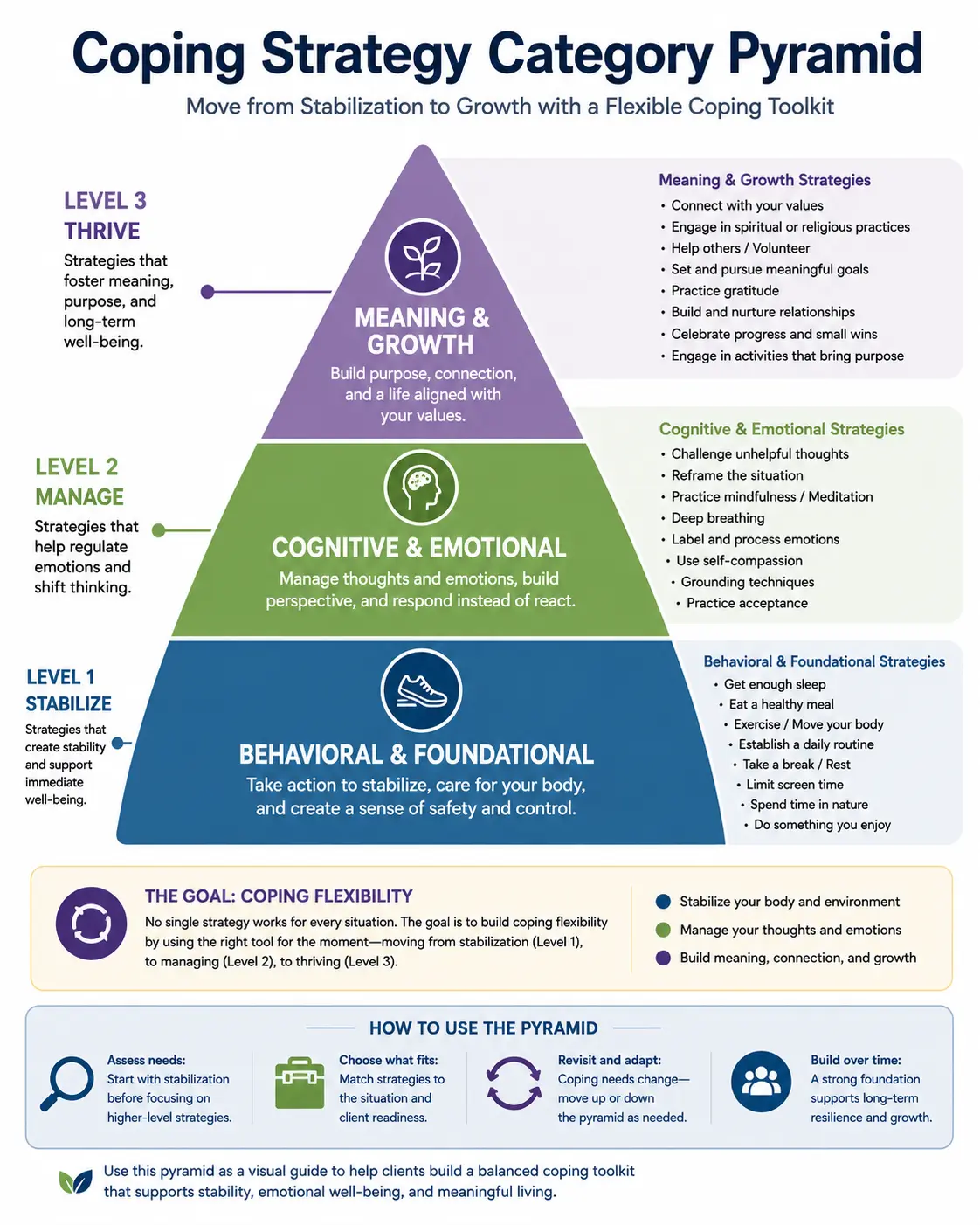
While many coping strategies can be adapted across diagnoses, the most effective interventions depend on a client's presenting concerns, symptom profile, and stage of treatment. Matching coping skills to the client's primary challenges helps increase engagement, improve outcomes, and build coping flexibility over time.
Anxiety Disorders
Clients experiencing anxiety often benefit from coping strategies that reduce physiological arousal before attempting cognitive or behavioral change. Diaphragmatic breathing, grounding exercises, progressive muscle relaxation, mindfulness, and cognitive restructuring can help lower distress enough for problem-solving and exposure-based work to become more effective. As symptoms improve, therapists may introduce behavioral experiments and gradual exposure to reduce avoidance.
Depression
When depression is characterized by withdrawal, low motivation, and reduced activity, behavioral coping strategies are often the most effective starting point. Behavioral activation, pleasant activity scheduling, daily routine building, physical exercise, and small achievable goals help clients regain momentum and reconnect with rewarding experiences. Cognitive strategies such as reframing and gratitude practices may become more effective after behavioral engagement increases.
Trauma and PTSD
Clients recovering from trauma frequently require stabilization before engaging in trauma processing. Grounding techniques, mindfulness, emotional labeling, self-compassion, and carefully paced breathing exercises help improve emotional regulation and reduce dissociation. As treatment progresses, therapists can gradually integrate cognitive and meaning-making strategies while maintaining a focus on safety and window of tolerance.
Grief and Loss
Because grief often involves circumstances that cannot be changed, emotion-focused coping strategies are particularly valuable. Journaling, acceptance, mindfulness, self-compassion, spiritual practices, and seeking social support help clients process difficult emotions while gradually adapting to life after loss. Practical problem-solving strategies may also be appropriate when clients begin addressing new responsibilities created by the loss.
Burnout and Chronic Stress
Clients experiencing occupational burnout often benefit from a combination of problem-focused and behavioral coping strategies. Boundary setting, time management, workload prioritization, self-care routines, physical activity, and scheduled recovery time can reduce ongoing stress while restoring a sense of control. Therapists should also explore perfectionism, over-functioning, and workplace expectations that may be maintaining burnout.
ADHD and Executive Functioning Challenges
For clients with ADHD or executive functioning difficulties, coping strategies should reduce cognitive load rather than rely solely on willpower. Organization systems, calendars, reminders, task chunking, time blocking, environmental modifications, and consistent routines help compensate for executive functioning deficits while reducing overwhelm. External supports are often more effective than simply encouraging greater motivation or self-discipline.
Chronic Illness and Medical Conditions
Chronic illness frequently requires both problem-focused and emotion-focused coping. Practical strategies such as medication adherence, appointment planning, and lifestyle modifications address aspects of the condition within the client's control, while acceptance, mindfulness, self-compassion, and social support help clients cope with uncertainty, grief, and changes in identity that often accompany long-term health conditions.
Rather than asking, "What is the best coping strategy?" experienced clinicians ask, "Which coping strategy best fits this client's current needs?" The most effective treatment plans help clients develop a flexible repertoire of coping skills that can be adapted as symptoms, stressors, and life circumstances evolve.
06 / Quick ReferenceMatching Coping Strategies to Common Clinical Presentations
This quick-reference table maps common presenting problems to coping strategy categories covered above. It's also included as a standalone tool in the accompanying quick reference guide.
| Presenting Problem | Helpful Coping Strategies |
|---|---|
| Anxiety | Breathing, grounding, cognitive restructuring |
| Depression | Behavioral activation, exercise, routine |
| Trauma | Grounding, mindfulness, self-compassion |
| Grief | Acceptance, social support, journaling |
| Burnout | Boundary setting, time management, self-care |
| ADHD | Organization systems, reminders, routines |
| Chronic Illness | Acceptance combined with problem-solving |
Introduce a strategy
Introduce one or two new coping skills at a time, matched to the client's presenting problem and current emotional state.
Practice it together
Rehearse techniques during the therapy session to increase confidence and improve the likelihood that clients will use them outside of therapy.
Assign it as homework
Assign between-session practice so coping skills training doesn't stay theoretical.
Revisit how it's working
Review homework before introducing new interventions, tailoring coping strategies to each client's needs as treatment continues.
07 / PitfallsCommon Mistakes Therapists Make When Teaching Coping Skills
Teaching positive coping strategies is not simply a matter of introducing new techniques. Even evidence-based coping skills may be ineffective if they are presented at the wrong time, mismatched to the client's needs, or assigned without sufficient practice and follow-up. Successful coping skills training requires thoughtful assessment, collaboration, and reinforcement throughout the treatment process. Avoiding the following common mistakes can help clinicians improve client engagement, increase between-session practice, and support more durable therapeutic outcomes. Some of the most common mistakes therapists make when teaching coping skills include:
- Teaching too many strategies at once — clients rarely retain or use skills introduced in a single rapid-fire list.
- Not practicing the skill in session — a strategy that's only described, not rehearsed, is less likely to be used outside the room.
- Ignoring client preferences and capacity — a strategy that conflicts with a client's culture, beliefs, or physical ability is unlikely to stick.
- Teaching only emotion-focused skills — clients also need tools for changing what can actually be changed.
- Teaching only problem-solving skills — without emotional regulation first, some clients can't engage with problem-solving at all.
- Failing to assign homework — without between-session practice, coping skills training stays theoretical.
08 / For TherapistsClinical Pearls for Therapists
- There is no single "best" coping strategy. The most effective intervention depends on the client's presenting problem, emotional state, and the degree of control they have over the stressor.
- Teach coping flexibility — not coping perfection. Clients who can adapt their coping strategies to different situations tend to be more resilient than those who rely on a single preferred technique.
- Introduce one or two new coping skills at a time. Too many strategies can overwhelm clients and reduce follow-through between sessions.
- Practice coping skills during the therapy session. Rehearsing techniques together increases confidence and improves the likelihood that clients will use them outside of therapy.
- Review homework before introducing new interventions. Discussing successes and barriers helps clinicians tailor coping strategies to each client's needs.
- Focus on function, not just symptoms. Effective coping should improve daily functioning, relationships, and quality of life — not simply reduce emotional distress in the moment.
09 / Case ExampleA Clinical Example: Teaching Coping Skills for Generalized Anxiety
The following is an illustrative, composite example for training purposes and does not represent an actual client.
Teaching Coping Skills for Generalized Anxiety
A client presents with generalized anxiety disorder, reporting chronic worry, muscle tension, and difficulty completing work tasks due to racing thoughts.
In the first few sessions, the clinician introduces diaphragmatic breathing and a grounding technique to lower physiological arousal before attempting cognitive work. Once the client can reliably use these in session, the clinician adds cognitive restructuring to address catastrophic predictions about work performance.
The client practices the grounding technique twice daily and completes one thought record per day, bringing it to the next session for review.
Over several sessions, the client reports lower baseline tension and more confidence identifying and challenging anxious thoughts before they escalate. The clinician continues to track the client's use of these strategies and adjusts the toolbox as new stressors arise.
10 / DocumentationHow ICANotes Helps Clinicians Document Coping Skills
Teaching positive coping strategies doesn't end when the session does. Effective documentation captures which coping skills were introduced, why they were selected, how the client responded, what homework was assigned, and how the intervention supports the client's treatment goals. Thorough documentation also makes it easier to evaluate progress over time and demonstrate medical necessity.
ICANotes is designed specifically for behavioral health clinicians, making it easier to document coping interventions without relying on lengthy narrative notes. Clinicians can efficiently record the therapeutic interventions provided, the client's participation and response, homework assignments, progress toward treatment goals, and plans for reinforcing coping skills during future sessions.
Whether you're documenting behavioral activation for depression, grounding techniques for trauma, cognitive restructuring for anxiety, boundary-setting for burnout, or mindfulness exercises for emotional regulation, ICANotes helps keep interventions connected to diagnoses, treatment plans, and measurable client outcomes. Structured charting templates and behavioral health-specific workflows reduce documentation time while helping clinicians create consistent, comprehensive progress notes.
See How ICANotes Can Simplify Your Documentation
Start a free 30-day trial and experience how ICANotes helps behavioral health professionals document coping interventions, treatment plans, progress notes, and client outcomes more efficiently — so you can spend less time on paperwork and more time with clients. Start your free trial.
- Notes completed in under 3 minutes
- 30-day free trial, no credit card required
- Integrated billing and practice management
- 24x7 live support from behavioral health specialists
FAQFrequently Asked Questions About Coping Strategies
What are positive coping strategies?
What coping strategies work best for anxiety?
What are examples of healthy coping skills?
How many coping skills should therapists teach at one time?
Are coping strategies evidence based?
How do coping strategies improve mental health?
Katie Cox
Katie Cox, MA, LPCC is a Licensed Professional Clinical Counselor with over 10 years of clinical experience working with adolescents and adults. Her areas of expertise include anxiety, depression, OCD, life transitions, self-esteem, career concerns, and women's mental health. Katie utilizes evidence-based, client-centered approaches to help individuals develop practical coping skills, increase emotional awareness, and achieve their personal goals. Through her clinical work and writing, she is committed to making mental health information accessible, practical, and empowering.
Sources
- Cheng, C., Lau, H.-P. B., & Chan, M. S. (2014). Coping flexibility and psychological adjustment to stressful life changes: A meta-analytic review. Psychological Bulletin, 140(6), 1582–1607. https://doi.org/10.1037/a0037913
- Cohen, S., & Wills, T. A. (1985). Stress, social support, and the buffering hypothesis. Psychological Bulletin, 98(2), 310–357
- Cregg, D. R., & Cheavens, J. S. (2021). Gratitude interventions: Effective self-help? A meta-analysis of the impact on symptoms of depression and anxiety. Journal of Happiness Studies, 22, 413–445. https://doi.org/10.1007/s10902-020-00236-6
- Cuijpers, P., van Straten, A., & Warmerdam, L. (2007). Behavioral activation treatments of depression: A meta-analysis. Clinical Psychology Review, 27(3), 318–326. https://doi.org/10.1016/j.cpr.2006.11.001
- Cuijpers, P., van Straten, A., & Warmerdam, L. (2007). Problem solving therapies for depression: A meta-analysis. European Psychiatry, 22(1), 9–15. https://doi.org/10.1016/j.eurpsy.2006.11.001
- Frattaroli, J. (2006). Experimental disclosure and its moderators: A meta-analysis. Psychological Bulletin, 132(6), 823–865. https://doi.org/10.1037/0033-2909.132.6.823
- Hofmann, S. G., Asnaani, A., Vonk, I. J. J., Sawyer, A. T., & Fang, A. (2012). The efficacy of cognitive behavioral therapy: A review of meta-analyses. Cognitive Therapy and Research, 36(5), 427–440. https://doi.org/10.1007/s10608-012-9476-1
- Hofmann, S. G., Sawyer, A. T., Witt, A. A., & Oh, D. (2010). The effect of mindfulness-based therapy on anxiety and depression: A meta-analytic review. Journal of Consulting and Clinical Psychology, 78(2), 169–183. https://doi.org/10.1037/a0018555
- Kirby, J. N., Tellegen, C. L., & Steindl, S. R. (2017). A meta-analysis of compassion-based interventions: Current state of knowledge and future directions. Behavior Therapy, 48(6), 778–792. https://doi.org/10.1016/j.beth.2017.06.003
- Lazarus, R. S., & Folkman, S. (1984). Stress, appraisal, and coping. Springer Publishing Company.
- Rebar, A. L., Stanton, R., Geard, D., Short, C., Duncan, M. J., & Vandelanotte, C. (2015). A meta-meta-analysis of the effect of physical activity on depression and anxiety in non-clinical adult populations. Health Psychology Review, 9(3), 366–378. https://doi.org/10.1080/17437199.2015.1022901.