
Blog > Treatment Strategies > Conduct Disorder vs ODD vs ASPD: Diagnostic Differences
Conduct Disorder vs Oppositional Defiant Disorder vs ASPD: Diagnostic Differences
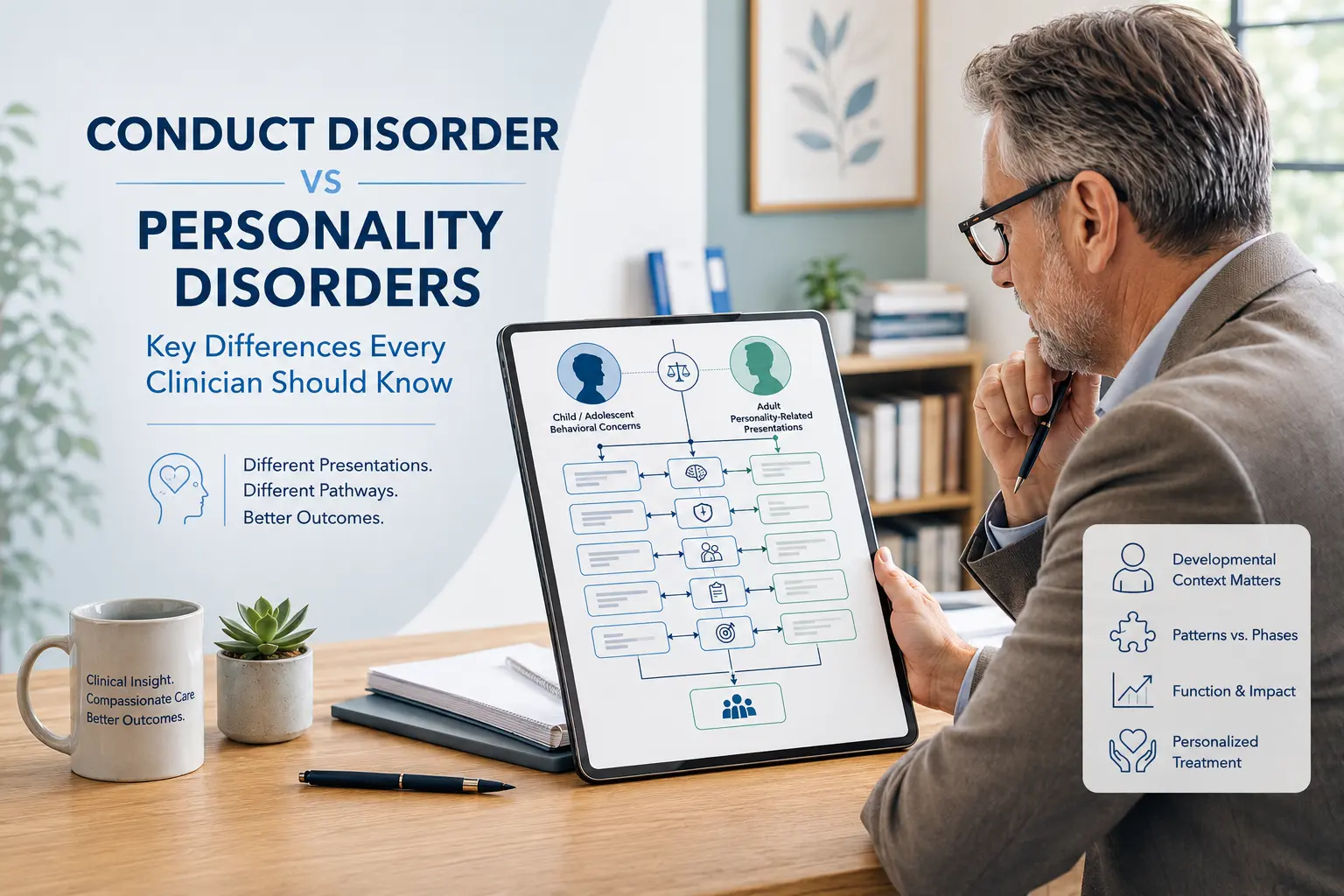
Conduct disorder, oppositional defiant disorder, and antisocial personality disorder can look similar in clinical practice, but they differ in age of onset, symptom severity, developmental course, and treatment implications. This guide explains the key differences between conduct disorder and personality disorders, including conduct disorder vs. oppositional defiant disorder, conduct disorder vs. antisocial personality disorder, whether conduct disorder can be diagnosed in adults, and the causes and risk factors clinicians should consider during assessment and documentation.


Last Updated: August 3, 2026

Key Takeways:
-
ODD, conduct disorder, and ASPD can look similar, but they are not interchangeable diagnoses. ODD centers on angry, irritable, argumentative, or defiant behavior, while conduct disorder involves more serious violations of others’ rights or major social norms.
-
Conduct disorder is a childhood- or adolescent-onset diagnosis. Adults are not newly diagnosed with conduct disorder, but they may present with a history of conduct disorder, antisocial personality disorder, adult antisocial behavior, or another condition that explains ongoing rule-violating behavior.
-
Antisocial personality disorder requires evidence of conduct disorder symptoms before age 15. Without that childhood history, an adult’s antisocial behavior may require a different diagnostic formulation.
-
Conduct disorder has multiple causes and risk factors. Biological, temperamental, family, peer, school, trauma-related, and environmental factors can all contribute, so clinicians should avoid oversimplifying or assigning blame.
-
Accurate differential diagnosis depends on context. Clinicians should assess symptom onset, severity, function, setting, collateral information, safety concerns, co-occurring conditions, and look-alikes such as trauma, ADHD, substance use, mood disorders, and systemic bias.
-
Clear documentation supports better care. Behaviorally specific notes help explain the clinical reasoning behind the diagnosis, guide treatment planning, and reduce the risk of stigmatizing or unsupported conclusions.
Contents
- What Is Conduct Disorder?
- Conduct Disorder vs. Oppositional Defiant Disorder
- Conduct Disorder vs. Antisocial Personality Disorder
- Can Adults Have Conduct Disorder?
- Conduct Disorder vs. Personality Disorders: Broader Clinical Differences
- Conduct Disorder Causes and Risk Factors
- Assessment Considerations for Clinicians
- Treatment Planning: How the Diagnosis Changes the Intervention
- Common Diagnostic Pitfalls
- Quick Comparison: ODD, Conduct Disorder, ASPD, and Adult Antisocial Behavior
- How ICANotes Supports Documentation Across These Presentations
- Frequently Asked Questions: Conduct Disorder, ODD, and Antisocial Personality Disorder
Conduct disorder is a childhood- or adolescent-onset condition marked by a persistent pattern of behavior that violates others’ rights or major age-appropriate social norms. It differs from oppositional defiant disorder (less severe, defiance-focused) and from antisocial personality disorder, an adult diagnosis that requires documented conduct disorder symptoms before age 15.
A 14-year-old presents with escalating aggression, rule-breaking, defiance toward parents, and little evident remorse after hurting a classmate. Across town, an adult client describes a long history of unstable jobs, legal trouble, exploiting people close to him, and indifference to the fallout. Is this oppositional defiant disorder? Conduct disorder? Antisocial personality disorder? A different personality disorder entirely? Trauma-related behavior? Substance use? The diagnostic question matters — and answering it well shapes everything downstream: treatment planning, risk assessment, family intervention, school or court coordination, and documentation.
Conduct disorder, oppositional defiant disorder (ODD), and antisocial personality disorder (ASPD) can look similar on the surface — all three involve conflict, rule-breaking, interpersonal friction, or disregard for others’ expectations. But they differ meaningfully in age of onset, severity, developmental course, and what they call for in treatment. Clinicians should be cautious about reaching for stigmatizing shorthand — “bad kid,” “sociopath,” “manipulative personality” — before completing a careful, behaviorally specific assessment.
This guide covers: how conduct disorder differs from oppositional defiant disorder (the comparison clinicians and clients search for most), how it differs from antisocial personality disorder and what the DSM-5-TR’s age-15 criterion actually requires, whether conduct disorder occurs in adults, the known causes and risk factors, and how to document and conceptualize these presentations without overreaching or under-assessing.
What Is Conduct Disorder?
The American Academy of Child and Adolescent Psychiatry (AACAP) describes conduct disorder as a group of behavioral and emotional problems in children and teens marked by serious difficulty following rules and behaving in a way that respects the rights of others. Yale Medicine similarly characterizes it as a condition diagnosed when children or teens display serious aggressive and antisocial behaviors that violate rules or others’ rights, with little guilt or concern about the impact. Conduct disorder is one of the most frequently diagnosed conditions in child and adolescent behavioral health settings, with lifetime prevalence estimates commonly cited in the range of roughly 2% to 10% of the general population, and it is diagnosed more often in boys than girls.
Conduct disorder involves four behavioral domains:
- Aggression toward people or animals
- Destruction of property
- Deceitfulness or theft
- Serious rule violations
Conduct disorder is not simply “acting out” or typical adolescent rebellion. To meet criteria, symptoms must be persistent (generally at least 12 months, with at least one criterion present in the past 6), clinically impairing, and inconsistent with the child’s developmental stage. Behaviors may show up at home, school, with peers, in the community, or in legal settings — clinicians should assess across all of them rather than relying on a single setting’s report. Severity, frequency, age of onset, and whether the child shows limited prosocial emotions (see below) all shape both diagnosis and treatment planning.
Common Conduct Disorder Symptoms Clinicians May See
- Bullying, intimidation, or initiating physical fights
- Cruelty to people or animals
- Fire-setting or deliberate property destruction
- Breaking into homes, cars, or buildings
- Lying, stealing, or conning others
- Running away, truancy, or staying out overnight against rules
- Limited remorse or apparent indifference to harm caused
Childhood-Onset vs. Adolescent-Onset Conduct Disorder
DSM-5-TR specifies onset subtypes because they carry different prognostic weight. Childhood-onset conduct disorder, with symptoms appearing before age 10, is associated with more physical aggression, greater neuropsychological involvement, and a higher likelihood of persisting into adulthood. Adolescent-onset conduct disorder, with symptoms emerging at or after age 10, is more often shaped by peer context, identity development, or situational stressors, and tends to carry a better prognosis — particularly when it appears alongside an identifiable stressor and remits once structure and support are restored. A third “unspecified onset” category applies when the age of onset can’t be determined.
Conduct Disorder vs. Oppositional Defiant Disorder
Of all the comparisons in this guide, “conduct disorder vs. oppositional defiant disorder” is the one clinicians, clients, and families search for most — and for good reason. Both are disruptive behavior disorders, both frequently co-occur with ADHD, and both can present in a chart as “kid won’t listen to authority.” But ODD and conduct disorder are distinct diagnoses with different thresholds, different risk profiles, and different treatment emphases.
How ODD and Conduct Disorder Overlap
Both conditions can involve:
- Defiance toward parents, teachers, or other authority figures
- Anger or irritability
- Conflict at home and school
- Rule-breaking
- Functional impairment across settings
- Comorbidity with ADHD, learning disorders, trauma-related symptoms, mood disorders, anxiety, or substance use
Because of this overlap, a child who initially meets criteria for ODD may later be reassessed for conduct disorder — but that doesn’t mean the two sit on a single continuum of severity. ODD is its own diagnosis with its own course, not just “mild conduct disorder.”
Key Difference: Defiance vs. Rights Violations
The clearest distinguishing line is that ODD centers on angry or irritable mood, argumentative or defiant behavior, and vindictiveness, often within relationships involving authority. Conduct disorder involves more serious behavior that violates the basic rights of others or major age-appropriate social norms, including aggression, property destruction, deceit, theft, or serious rule violations.
Expert Insight
“ODD defines the pattern in the relationship, while conduct disorder defines patterns in the world,” explains Sheldon Cohen, LMFT, a therapist with experience treating disruptive behavior, trauma, and substance use. “Same child, different contexts.”
| Feature | Oppositional Defiant Disorder | Conduct Disorder |
|---|---|---|
| Core pattern | Angry/irritable mood, argumentative or defiant behavior, vindictiveness | Persistent violation of others’ rights or major social norms |
| Typical target | Authority figures (parents, teachers) | People, animals, property, or societal rules generally |
| Severity | Generally less severe; relational friction | More severe; can include aggression, theft, and destruction |
| Rights violations | Not a core feature | Core diagnostic feature |
| Risk concerns | Lower baseline risk; can co-occur with or precede CD | Higher risk for legal involvement, injury, and (if childhood-onset) adult antisocial outcomes |
| Clinical question | “Is this defiance and irritability impairing functioning?” | “Is this behavior violating others’ rights or major norms?” |
How to Explain the Difference to Families
ODD is more about a persistent pattern of anger, arguing, and defiance toward authority figures. Conduct disorder involves more serious behaviors that may harm others, violate others’ rights, or break major rules. The purpose of diagnosis is not to label your child as ‘bad,’ but to understand the pattern clearly enough to choose the right supports.
Can ODD Progress to Conduct Disorder?
Some children diagnosed with ODD later meet criteria for conduct disorder, but progression is far from inevitable — most children with ODD do not go on to develop conduct disorder, and a meaningful proportion outgrow ODD symptoms within a few years of diagnosis. Risk of progression appears higher when ODD symptoms are severe, persistent across settings, and accompanied by aggression, trauma exposure, inconsistent supervision, delinquent peer involvement, or untreated ADHD or substance use. Early intervention for ODD specifically is one of the more actionable levers clinicians have for reducing that risk.
Documentation Tip for Clinicians
Whichever diagnosis applies, documentation should describe behavior, not just assign a label. Useful notes specify:
- The specific behaviors observed or reported
- The settings where they occur (home, school, peer, community, legal)
- Frequency, duration, and severity
- Functional impact
- Safety concerns
- Family, school, peer, and legal context
- Protective factors and strengths
Sample chart language
“Client demonstrates a persistent pattern of rule-violating behavior across home and school settings, including repeated truancy, theft from peers, and physical aggression, resulting in school suspension and family conflict.”
This sentence supports a conduct disorder impression without ever using a character-based label like “bad” or “manipulative” — it’s behaviorally specific and defensible if the chart is reviewed later.

Free Clinical Quick-Reference Guide
Distinguish ODD, Conduct Disorder, and ASPD More Clearly
Download this practical guide for help differentiating oppositional defiant disorder, conduct disorder, antisocial personality disorder, and adult antisocial behavior during assessment and treatment planning.
The guide includes:
- A side-by-side diagnostic comparison
- A step-by-step decision pathway
- Clinical interview questions and differential checks
- Sample documentation language
- Risk-factor and safety red-flag checklists
Get Your Free Guide
Conduct Disorder vs. Antisocial Personality Disorder
Once conduct disorder is established as a youth diagnosis, the next common clinical question is how it relates to antisocial personality disorder (ASPD) — and whether a teenager’s conduct disorder predicts an adult ASPD diagnosis.
The Developmental Relationship Between Conduct Disorder and ASPD
Conduct disorder is diagnosed in children and adolescents. ASPD is an adult personality disorder, diagnosable only at age 18 or older, involving a pervasive pattern of disregard for and violation of others’ rights — deceitfulness, impulsivity, irritability and aggression, reckless disregard for safety, consistent irresponsibility, and lack of remorse. Critically, DSM-5-TR requires evidence of conduct disorder with onset before age 15 as a diagnostic prerequisite for ASPD. Without that documented childhood history, ASPD cannot be diagnosed — regardless of how antisocial the adult’s current presentation looks.
This is a one-directional requirement, not a prediction: every ASPD diagnosis requires a conduct disorder history, but most people with a conduct disorder history do not go on to develop ASPD.
Key Difference: Age and Diagnostic Category
| Feature | Conduct Disorder | Antisocial Personality Disorder |
|---|---|---|
| Usual diagnostic period | Childhood or adolescence (before 18) | Adulthood (18 and older) |
| Minimum age issue | No minimum age; onset subtypes apply | Requires documented conduct disorder onset before age 15 |
| Main pattern | Violating others’ rights or major social norms | Pervasive disregard for and violation of others’ rights as an enduring personality pattern |
| Developmental link | May or may not persist into adulthood | Cannot be diagnosed without a childhood conduct disorder history |
| Treatment focus | Family- and systems-based intervention | Adult-focused: accountability, harm reduction, functioning |
| Clinical caution | Avoid assuming inevitable progression to ASPD | Avoid diagnosing without confirming childhood history |
Does Conduct Disorder Always Become ASPD?
No. Estimates of progression vary by study and follow-up length, but generally fall in the range of roughly 25% to 40% of youths with conduct disorder going on to meet ASPD criteria in adulthood — with some longitudinal cohorts reporting figures as low as 20% or as high as 50%. Childhood-onset conduct disorder carries meaningfully higher risk than adolescent-onset conduct disorder. Outcome varies based on age of onset, symptom severity, presence of callous-unemotional traits, trauma exposure, family support, peer environment, substance use, educational stability, and access to treatment. Protective factors and early, sustained treatment can and do change developmental trajectories — this is not a deterministic pathway.
Adult Antisocial Behavior vs. ASPD
This distinction is the key to the “conduct disorder in adults” search intent (more below). Adults can display antisocial behavior — such as repeated law-breaking, exploitation, or aggression — without meeting full ASPD criteria. One key reason is the absence of evidence that conduct disorder symptoms were present before age 15. DSM-5-TR includes a separate category, adult antisocial behavior (coded V71.01/Z72.811), for exactly this situation: it’s listed among conditions that may be a focus of clinical attention, not a mental disorder in its own right. Clinicians should be cautious about diagnosing ASPD in an adult without confirming — through history, records, or collateral report — that conduct disorder symptoms were present before age 15.
“A very common mistake when assessing for ASPD is to assume that because an individual has engaged in criminal behavior, they meet criteria for ASPD,” says Lauren Grawert, MD, FASAM, a double board-certified addiction psychiatrist. “It is entirely possible that individuals who commit crimes do so for reasons unrelated to having a personality disorder.”
Clinicians should consider substance use, trauma, bipolar disorder, ADHD, traumatic brain injury, and other potential explanations before concluding that the behavior reflects an enduring personality pattern.
Can Adults Have Conduct Disorder?
The Short Clinical Answer
No — not as a new diagnosis. Conduct disorder is, by definition, a disorder of childhood and adolescence; DSM-5-TR requires onset before age 18. Adults presenting with conduct-disorder-like behavior are more accurately understood through one of several other lenses:
- A documented past history of conduct disorder (relevant to an ASPD workup)
- Antisocial personality disorder
- Adult antisocial behavior (without an ASPD-qualifying childhood history)
- Substance-related behavioral problems
- Trauma-related aggression or survival behavior
- Impulse-control difficulties
- Traits associated with a personality disorder
- The downstream legal, occupational, or interpersonal consequences of a longstanding behavioral pattern
Why the Search Term “Conduct Disorder in Adults” Is So Common
Clinicians, clients, students, and family members commonly type this phrase when really asking, “What happens when conduct disorder persists?” A more clinically precise framing usually points to one of:
- A history of conduct disorder in an adult
- Conduct disorder symptoms documented before age 15
- Antisocial personality disorder
- Adult antisocial behavior
- Persistent antisocial behavior carried from adolescence into adulthood
Recognizing the search intent — and redirecting it to the right diagnostic question — is part of good differential work, not just SEO housekeeping.

Clinical Assessment Questions for Adults
When an adult’s presentation raises this question, useful intake and assessment questions include:
- “Before age 15, were there repeated concerns about aggression, theft, truancy, fire-setting, cruelty to animals, or other serious rule violations?”
- “Were there school suspensions, expulsions, arrests, or juvenile justice involvement?”
- “Did caregivers, teachers, or courts identify ongoing behavioral concerns at the time?”
- “Were these behaviors isolated, situational, trauma-related, substance-related, or part of a persistent pattern?”
- “What is the client’s current level of remorse, accountability, empathy, and motivation for change?”
Differential Diagnosis in Adults
Conditions that can mimic or co-occur with antisocial presentations in adults include:
- Antisocial personality disorder
- Borderline personality disorder
- Narcissistic personality disorder
- Substance use disorders
- Bipolar disorder or manic episodes
- PTSD and complex trauma
- Intermittent explosive disorder
- ADHD-related impulsivity
- Psychotic disorders
- Neurocognitive or neurological conditions
- Autism spectrum disorder, when social disregard is misread as defiance
- Cultural, contextual, or systemic factors, including bias in how “defiance” gets interpreted
Conduct Disorder vs. Personality Disorders: Broader Clinical Differences
Conduct Disorder Is Developmental; Personality Disorders Are Enduring Adult Patterns
Conduct disorder describes a pattern of rights-violating behavior in youth. Personality disorders describe enduring patterns of inner experience and behavior that are inflexible, pervasive across contexts, stable over time, and impairing — and DSM-5-TR generally requires that pattern be traceable to adolescence or early adulthood, with the diagnosis itself typically reserved for adulthood. Diagnosing a personality disorder requires careful developmental, cultural, and longitudinal assessment — not a single crisis presentation.
Why Conduct Disorder Is Most Closely Linked to ASPD
Of the ten DSM-5-TR personality disorders, conduct disorder has a specific, codified developmental relationship with exactly one: antisocial personality disorder. It is not a required or expected precursor to borderline, narcissistic, histrionic, avoidant, obsessive-compulsive, dependent, schizoid, schizotypal, or paranoid personality disorder. That said, youth with conduct problems often also carry emotional dysregulation, trauma histories, or attachment disruptions that can resemble — or later co-occur with — other personality pathology. Resemblance is not the same as a developmental pathway, and clinicians should be careful not to conflate the two.
Avoiding Overdiagnosis and Stigma
- Don’t diagnose a personality disorder based on one crisis presentation
- Don’t interpret all defiance, anger, or rule-breaking as pathology
- Weigh developmental stage, trauma history, neurodivergence, family context, and environmental stressors — including racism, poverty, and disparities in school discipline — before settling on a diagnostic impression
- Use behaviorally specific language rather than character-based labels
- Diagnose based on documented patterns, functional impairment, and full criteria — not on a single setting’s report or a clinician’s gut read
Conduct Disorder Causes and Risk Factors
There Is No Single Cause of Conduct Disorder
Conduct disorder is best understood as multifactorial — the product of interacting biological, psychological, family, and environmental influences rather than any one cause. Contributing domains include biological and temperamental factors, genetics and family history, neurodevelopmental factors, trauma and adverse childhood experiences, parenting and caregiving patterns, peer influences, school environment, neighborhood and community stressors, substance exposure, and co-occurring ADHD, learning disorders, mood disorders, or anxiety.

Biological and Temperamental Factors
Heritability estimates for conduct disorder are substantial — commonly cited in the range of 40% to 50%. Research has also linked conduct disorder to:
- Impulsivity and low frustration tolerance
- Difficulty with emotional regulation
- Sensation-seeking
- A reduced fear response in some youth
- Callous-unemotional traits in a meaningful subset of cases
- Family history of behavioral, mood, substance use, or personality-related concerns
Clinical note: Callous-unemotional traits
DSM-5-TR added a “with limited prosocial emotions” specifier for conduct disorder, applied when a child shows two or more of the following across at least 12 months and multiple relationships: lack of remorse or guilt, callousness or lack of empathy, lack of concern about performance, and shallow or deficient affect. Youth who meet this specifier tend to show more aggressive behavior, a more treatment-resistant course, and higher risk of persistent antisocial behavior — making it a clinically meaningful subtype to flag, not just a symptom checklist.
Family and Environmental Factors
- Harsh, inconsistent, or neglectful discipline
- Abuse or other trauma exposure
- Domestic violence in the home
- Parental substance use
- Low supervision
- Family instability
- Lack of a consistent attachment figure
- Chronic stressors, including poverty
Social and School Factors
- Peer rejection
- Association with delinquent peers
- Academic failure or learning difficulties
- Bullying (as either target or perpetrator)
- Suspensions and expulsions
- Exposure to community violence
- Lack of access to prosocial activities or supports
Clinical Caveat: Risk Factors Are Not Blame
Risk factors help guide assessment and intervention — they are not meant to assign blame to parents, clients, schools, or communities. A trauma-informed, systems-informed approach holds both truths at once: behavior has a function and a history, and accountability still matters. Clinicians should also weigh the documented role of bias in how disruptive behavior gets perceived and disciplined — research on school discipline has found that Black and multiracial students face significantly higher rates of suspension and disciplinary referral than white peers even after accounting for the behaviors being disciplined, a pattern that can both mask underlying needs and inflate apparent symptom counts.
Assessment Considerations for Clinicians
A thorough assessment of conduct disorder requires more than identifying isolated behaviors. Clinicians should evaluate when the pattern began, where and how often it occurs, what function the behavior may serve, and how developmental, family, school, peer, trauma, and safety factors shape the presentation. A multi-informant, context-sensitive approach helps distinguish conduct disorder from overlapping conditions while supporting a more accurate diagnosis and individualized treatment plan.
Start With a Multi-Informant Assessment
- Client interview
- Caregiver interview
- School reports
- Prior treatment records
- Legal or juvenile justice history, when relevant
- Collateral contacts, with consent
- Screening for trauma, ADHD, mood disorders, substance use, learning disorders, and safety concerns
Assess Context, Not Just Behavior
- What happened before, during, and after the behavior?
- Is the behavior reactive, instrumental, impulsive, planned, peer-driven, trauma-triggered, or survival-based?
- Does the client show remorse?
- Does the behavior occur across settings, or just one?
- Are there identifiable triggers?
- What function does the behavior serve?
- What strengths and supports are present?
Consider Safety and Mandated Reporting
- Harm to self or others
- Cruelty to animals
- Fire-setting
- Access to weapons
- Abuse, neglect, exploitation, or domestic violence exposure
- Legal involvement
- Duty-to-warn or duty-to-protect obligations, as applicable in your jurisdiction
- Documentation of the risk assessment and any safety plan
When to Refer, Coordinate, or Escalate Care
- Imminent risk of harm to self or others
- Repeated aggression, weapon access, fire-setting, or cruelty to animals
- Severe family safety concerns
- Juvenile justice, school expulsion, or court involvement
- Need for a higher level of care, wraparound services, psychiatric evaluation, or coordinated school or legal planning
- Significant caregiver burnout or inability to maintain safety at home
Treatment Planning: How the Diagnosis Changes the Intervention
Conduct Disorder Treatment Is Usually Systems-Based
Evidence-based approaches for conduct disorder tend to work across systems rather than targeting the child in isolation. Family-based models — including parent management training, multisystemic therapy, and functional family therapy — have the strongest evidence base, generally outperforming treatment-as-usual on measures like delinquency, out-of-home placement, and substance use, though the strength of evidence varies by model and outcome measured. Components commonly include:
- Parent management training
- Family therapy
- Multisystemic therapy
- Functional family therapy
- CBT skills for anger, problem-solving, and impulse control
- School collaboration
- Prosocial peer and community involvement
- Treatment for co-occurring ADHD, depression, anxiety, trauma, or substance use
- Case management and wraparound supports when needed
ODD Treatment Often Focuses on Defiance, Family Patterns, and Emotion Regulation
- Parent-child interaction therapy or other parent training models
- Collaborative problem-solving
- Emotion regulation skills
- Reinforcement strategies
- Consistent routines and expectations
- Reducing coercive family cycles
- School-based behavior plans
ASPD Treatment Requires Adult-Focused Goals
Engagement and motivation are often the central challenge in treating ASPD. Treatment tends to focus on harm reduction, accountability, legal and occupational functioning, relationship patterns, substance use, anger management, and co-occurring symptoms. Clear boundaries and structured treatment plans matter more than they might in other adult presentations. Clinicians should avoid punitive framing while still maintaining safety and holding the client accountable — the goal is a workable therapeutic alliance, not absolution.
Common Diagnostic Pitfalls
Mistaking Trauma Responses for Conduct Disorder
Trauma can present as aggression, defiance, distrust, emotional numbing, or survival-oriented behavior that looks remarkably similar to conduct disorder on the surface.
“One of the most common errors in diagnosis is mislabeling behaviors related to survival after trauma, impulsivity secondary to ADHD, or substance use as ‘antisocial,’ without assessing the underlying purpose of the person’s actions or examining long-term patterns,” says Allen Masry, MD, a board-certified adult and addiction psychiatrist.
Clinicians should assess whether the behavior is reactive, survival-based, impulsive, substance-related, or part of a persistent rights-violating pattern before finalizing the diagnosis.
Mistaking ADHD Impulsivity for Intentional Rule Violation
Impulsivity, forgetfulness, emotional dysregulation, and poor planning associated with ADHD can look oppositional or rule-breaking without reflecting the same intent or pattern as conduct disorder — and the two conditions call for different treatment emphases even when they co-occur.
Diagnosing ASPD Without Confirming Childhood History
It’s worth repeating: clinicians should verify documented evidence of conduct disorder symptoms before age 15 before considering an ASPD diagnosis. Antisocial-looking behavior in an adult without that history points toward adult antisocial behavior or another differential, not ASPD.
Overlooking Cultural and Systemic Context
- Differential discipline patterns across racial and ethnic groups
- School-to-justice system involvement
- Cultural expectations around authority and respect
- Bias in how “defiance” gets interpreted
- Socioeconomic stressors
- Unequal access to care
Treating the Label Instead of the Function of Behavior
A diagnosis should sharpen the clinical picture, not replace it. Functional questions stay relevant regardless of which label applies:
- What does the behavior achieve or help the client avoid?
- What skill deficit might be present?
- What environmental contingencies reinforce the behavior?
- What unmet need might be driving it?
Quick Comparison: ODD, Conduct Disorder, ASPD, and Adult Antisocial Behavior
Use this quick comparison to distinguish ODD, conduct disorder, and antisocial personality disorder by age of diagnosis, core symptom pattern, and clinical focus.

| Diagnosis | Typical Age / Context | Core Pattern | Key Clinical Distinction |
|---|---|---|---|
| Oppositional Defiant Disorder | Childhood / adolescence | Angry, argumentative, defiant, vindictive toward authority figures | No core rights violations; relational/oppositional focus |
| Conduct Disorder | Childhood or adolescence (before 18) | Persistent violation of others’ rights or major social norms | Onset subtype (childhood vs. adolescent) shapes prognosis |
| Antisocial Personality Disorder | Adulthood (18+) | Pervasive disregard for and violation of others’ rights | Requires documented conduct disorder onset before age 15 |
| Adult Antisocial Behavior | Adulthood | Antisocial behavior without a qualifying childhood history | A V-code/Z-code, not a mental disorder |
How ICANotes Supports Documentation Across These Presentations
Whichever diagnosis fits — ODD, conduct disorder, ASPD, or a presentation that doesn’t fit neatly into any of them yet — the chart needs to show your reasoning, not just your conclusion. ICANotes’ menu-driven note builder generates audit-ready narrative notes for intakes, progress notes, and treatment plans that stay aligned with DSM-5 and ICD-10 coding, so the specific behavioral findings behind a diagnosis — not just the diagnosis code — are easy to find later.
Because treatment plans in ICANotes are diagnosis-driven, selecting a working diagnosis surfaces relevant goals, objectives, and interventions — including content built for both child/adolescent and adult behavioral health — which clinicians can individualize rather than build from scratch. That’s especially useful when a single client’s chart needs to evolve over time, such as moving from an ODD or conduct disorder treatment plan in adolescence to a different plan in adulthood. Customizable templates make it straightforward to document the behavioral specifics — frequency, setting, severity, functional impact — that differential diagnosis among ODD, conduct disorder, and ASPD depends on.
Ready to see it in action? Schedule a demo or start a free trial of ICANotes to see how diagnosis-driven treatment planning and menu-driven documentation work for behavioral health practices like yours.
Frequently Asked Questions About Conduct Disorder, ODD, and Antisocial Personality Disorder
+What is the main difference between conduct disorder and oppositional defiant disorder?
+Can someone be diagnosed with conduct disorder as an adult?
+What's the difference between conduct disorder and antisocial personality disorder?
+Does everyone with conduct disorder develop antisocial personality disorder?
+What causes conduct disorder?
+What does “callous-unemotional traits” or “limited prosocial emotions” mean in a conduct disorder diagnosis?
+How is childhood-onset conduct disorder different from adolescent-onset?
+Is conduct disorder the same thing as a personality disorder?
Recent Posts






Dr. October Boyles
DNP, MSN, BSN, RN
About the Author
Dr. October Boyles is a behavioral health expert and clinical leader with extensive expertise in nursing, compliance, and healthcare operations. With a Doctor of Nursing Practice (DNP) and advanced degrees in nursing, she specializes in evidence-based practices, EHR optimization, and improving outcomes in behavioral health settings. Dr. Boyles is passionate about empowering clinicians with the tools and strategies needed to deliver high-quality, patient-centered care.