
DBT Skills for Family Gatherings: Helping Clients Manage Stress and Conflict
How clinicians can use Cope Ahead, Wise Mind, radical acceptance, and DEAR MAN to help clients navigate family conflict and holiday stress.


A client has spent weeks feeling more confident about setting boundaries. Then a holiday invitation arrives, and a familiar worry takes over: What happens when everyone starts asking questions?
Family gatherings can bring connection and discomfort into the same room. A comment about work, an argument over politics, or an expectation to stay longer than planned can leave clients caught between protecting their needs and keeping the peace. Even an enjoyable visit can become exhausting when it includes travel, noise, disrupted routines, or little time alone.
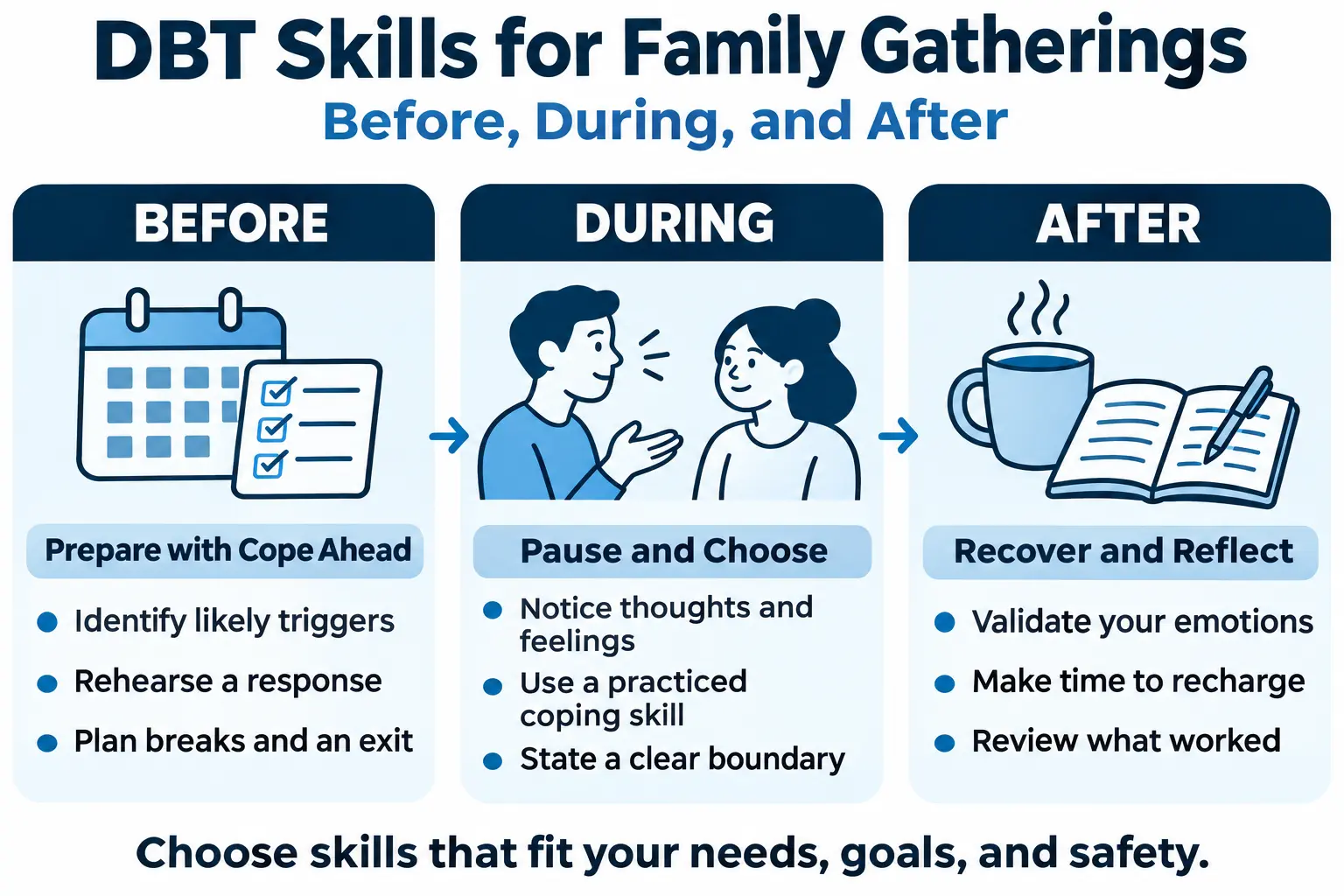
DBT skills for family gatherings give clinicians practical ways to help clients prepare for those moments. Mindfulness, emotion regulation, distress tolerance, and interpersonal effectiveness can support more intentional responses before, during, and after a stressful interaction. The same skills apply beyond the holidays, including birthdays, weddings, and reunions.
For clients, progress may look like a shorter conversation, a clearly stated boundary, or a break taken before frustration builds. A gathering does not have to go perfectly for skill practice to matter.
For therapists helping clients navigate family conflict, DBT skills offer practical strategies for managing emotional triggers, setting boundaries, and preparing for difficult conversations without escalating tension.
What You'll Learn
- How to help clients identify family-related emotional triggers and prepare for stressful gatherings.
- Ways to use Cope Ahead and Wise Mind to anticipate difficult interactions and respond more intentionally.
- How to teach DEAR MAN skills for setting boundaries, communicating needs, and managing family conflict.
- Strategies for applying radical acceptance and dialectical thinking to challenging family dynamics.
- How to use emotion regulation and distress tolerance skills to manage holiday stress and emotional overwhelm.
- Practical techniques for helping clients reflect on difficult interactions, reinforce progress, and strengthen coping skills.
Why Family Gatherings Trigger Stress and Conflict
Family relationships often come with expectations that outlast the circumstances that created them. An adult who manages a demanding job may still be treated as the irresponsible sibling. Someone who has always kept everyone happy may feel guilty declining a request, even when they are exhausted.
These familiar roles can make ordinary decisions feel emotionally loaded. Saying “We’re leaving at seven” may bring up fears of disappointing a parent. Choosing not to discuss a relationship may feel like inviting criticism. For some clients, grief, estrangement, discrimination, or a history of mistreatment adds another layer.
Understanding the specific source of stress helps clinicians choose useful interventions. A client overwhelmed by a crowded room needs a different plan from one who expects repeated personal criticism. Both may benefit from DBT, but the skill should fit the situation.
The four DBT skills modules offer several ways to respond. Mindfulness helps clients notice what is happening. Emotion regulation helps them understand emotions and reduce vulnerability. Distress tolerance supports getting through intense moments. Interpersonal effectiveness provides tools for communicating needs and limits. These skills come from Marsha Linehan’s DBT framework; using selected skills in therapy is distinct from providing a comprehensive DBT program.
Help Clients Set Goals Before Family Gatherings
Before discussing coping strategies, it helps to ask what would make the visit worthwhile. The answer may be spending time with a supportive relative, participating in a tradition, or staying connected without sharing private information.
Meet Macy
Macy, a fictional client whose sibling often comments on her career.
She wants to attend a holiday dinner to see her cousin, but she expects questions about her job to turn into criticism. In the past, she has defended her choices at length and left feeling hurt and frustrated.
Macy’s goal is to enjoy time with her cousin while keeping work out of the conversation. That gives her and her therapist something concrete to plan around.
It also makes room for options: she can attend briefly, arrange her own ride, or leave if the questioning continues.
For other clients, the right decision may be to decline the invitation. Cultural expectations, caregiving responsibilities, financial dependence, and safety can all affect the choices available. A useful plan respects those realities rather than assuming that everyone should attend or respond in the same way.
Which DBT Skills Help With Common Family Conflicts?
Family conflicts can trigger a range of emotional and behavioral responses, from anticipatory anxiety and frustration to difficulty asserting boundaries. For clinicians, the key is helping clients identify the specific challenges they anticipate and select DBT skills that address those situations. Whether a client is preparing for criticism, managing overwhelming emotions, or navigating longstanding family dynamics, matching the right skill to the situation can make interventions more practical and effective. The following examples illustrate how clinicians can apply DBT skills to common family conflicts and help clients respond with greater awareness, confidence, and emotional control.
| Family Conflict or Challenge | Recommended DBT Skill | Clinical Application |
|---|---|---|
| Anticipating criticism or uncomfortable questions | Cope Ahead | Help clients identify likely triggers, rehearse responses to difficult questions, and develop a plan for managing challenging interactions before a family gathering. |
| Feeling overwhelmed by anger, anxiety, or frustration | STOP and Wise Mind | Teach clients to pause, observe emotional reactions, and consider both their feelings and goals before responding to a family member. |
| Struggling to communicate needs or establish boundaries | DEAR MAN | Use role-playing exercises to help clients express needs clearly, make specific requests, and practice maintaining boundaries when family members push back. |
| Feeling hurt by recurring family dynamics | Radical Acceptance | Help clients acknowledge longstanding patterns they cannot directly control while identifying choices that protect emotional well-being. Acceptance does not mean tolerating mistreatment. |
| Feeling torn between family obligations and personal needs | Dialectical Thinking | Help clients recognize that seemingly conflicting feelings can coexist. For example: “I love my family, and I can choose to limit how much time I spend with them.” |
| Experiencing intense distress during a family interaction | Distress Tolerance (TIP/TIPP, ACCEPTS, Self-Soothing) | Help clients practice appropriate distraction, relaxation, or self-soothing strategies they can use when emotions become difficult to manage. Select techniques based on individual needs and circumstances. |
| Becoming emotionally vulnerable due to travel, fatigue, or disrupted routines | PLEASE | Work with clients to identify how sleep, nutrition, illness, and other physical factors influence emotional vulnerability. Develop realistic self-care plans before and after gatherings. |
| Interpreting ambiguous comments as criticism or rejection | Check the Facts | Help clients distinguish observable events from assumptions about a family member’s intentions, while recognizing situations in which criticism or mistreatment is genuine. |
| Feeling guilty or second-guessing boundaries after a gathering | Mindfulness and Radical Acceptance | Encourage clients to acknowledge emotional responses without judgment, evaluate how effectively they used skills, and identify opportunities for continued practice. |
For a broader overview of the treatment model, explore our guide to DBT skills, stages, and techniques, including how these approaches support emotion regulation, distress tolerance, and interpersonal effectiveness.
Help Clients Navigate Family Conflict With Confidence
Equip your clients with practical DBT strategies for managing emotional triggers, setting boundaries, and navigating stressful family gatherings. Download this free clinical resource featuring:
- 8 core DBT skills with practical applications before, during, and after gatherings.
- 10 common family conflict scenarios paired with recommended DBT interventions.
- 25 dialectical statements to help clients manage emotions and maintain boundaries.
- Ready-to-use therapist scripts and a customizable Cope Ahead planning worksheet.
DBT Cope Ahead Examples for Stressful Family Gatherings
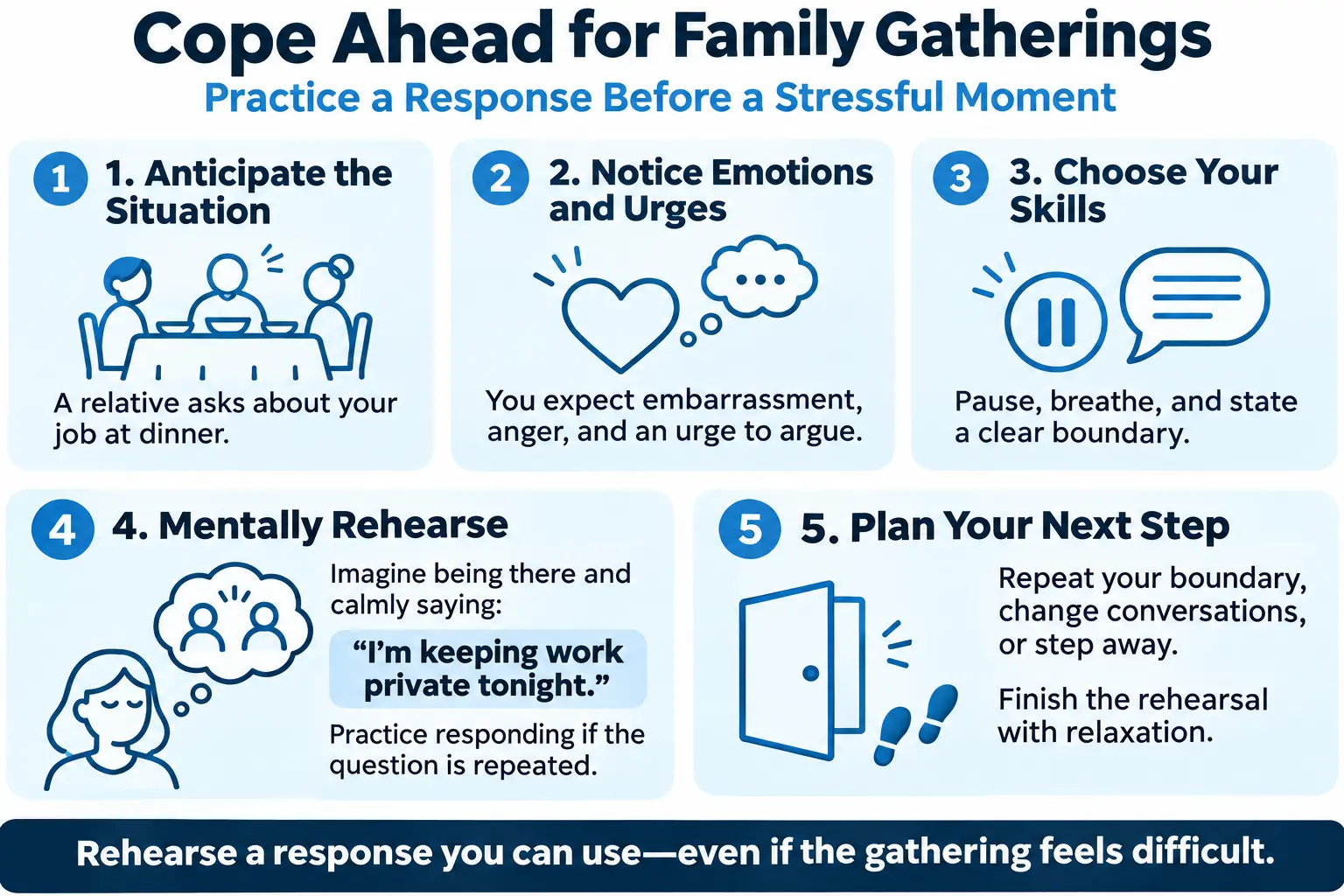
Anticipatory anxiety can fill the days before a gathering with imagined arguments. DBT’s Cope Ahead skill gives that mental rehearsal a more useful direction by helping clients imagine themselves responding effectively to a likely challenge.
For Macy, the difficult moment is specific: her sibling asks about work while everyone is seated at dinner. She expects to feel embarrassed and angry, followed by an urge to explain herself. In session, she imagines the scene and practices pausing before saying, “I’m keeping work private tonight.”
The rehearsal includes what happens if her sibling persists. Macy imagines repeating the boundary, moving to another conversation, or stepping away. Her therapist can role-play different responses so the plan accounts for realistic obstacles. Afterward, Macy practices relaxing and considers whether the wording feels natural enough to remember.
A Cope Ahead plan is easier to use when it includes practical details. How will the client get home? Where can they take a break? Is there someone who has agreed to help change the conversation? A boundary is more actionable when the client has a way to follow through.
Clients do not need an elaborate script for every possibility. One likely trigger, a few practiced responses, and a workable exit plan may be enough to start. The aim is to build familiarity with a skillful response while accepting that the interaction itself remains uncertain.
Wise Mind Examples for Managing Family Conflict
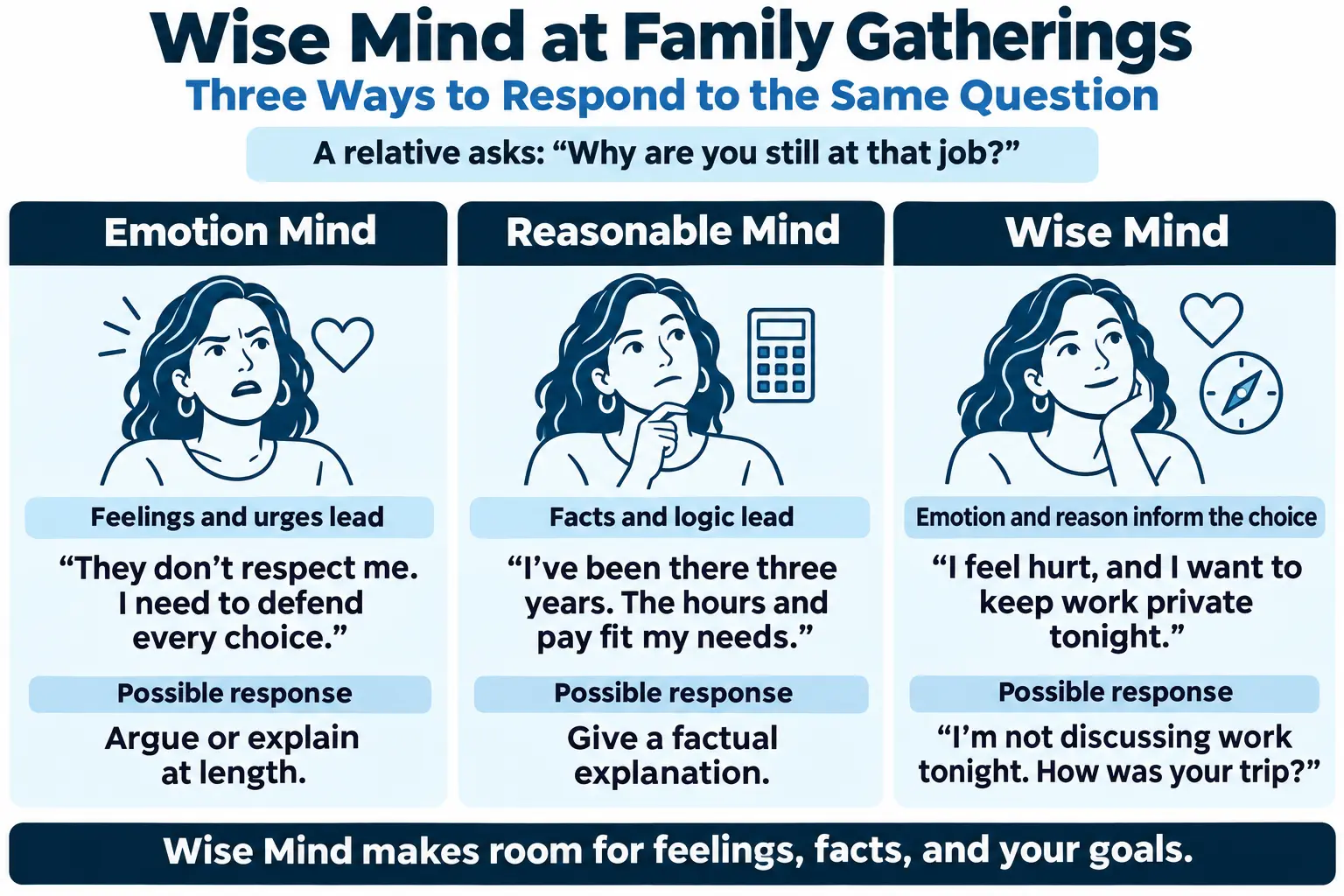
Preparation helps, but clients still need a way to respond when emotions rise. Wise Mind brings emotional experience and reason together so a person can consider both how they feel and what action fits the moment.
Macy’s anger tells her that the career questions matter to her. If she acts only on the urge to defend herself, she may spend the evening in a conversation she never wanted. If she focuses only on appearing unaffected, she may overlook how much the comments hurt.
A Wise Mind response makes room for both: “I’m hurt, and I want to spend my time with my cousin.” Macy can acknowledge the feeling, state her boundary, and decide where to put her attention next.
Other Wise Mind examples might sound like:
- “I want to be here, and I need a quiet break.”
- “This question upset me. I can decide how much I want to share.”
- “I can care about my family and leave at the time I planned.”
A client does not have to feel calm before making an intentional decision. For many, the first step is simply noticing the urge to react and allowing a brief pause before answering.
Mindfulness creates room for that pause
DBT mindfulness involves observing, describing, and participating, with attention to practicing nonjudgmentally, one-mindfully, and effectively. In a busy room, that can begin with noticing a tight jaw, a racing thought, or difficulty following the conversation.
Describing the experience as “I’m feeling pressure to answer” gives Macy more information than immediately deciding she must defend herself. She can then choose a response. Another client might notice sensory overload and move to a quieter seat or take a break.
The practice is personal. Focusing on a conversation may help one client stay engaged; reducing stimulation may help another. Mindfulness supports noticing what is happening and responding effectively, including recognizing when continued participation is becoming unmanageable.
Radical Acceptance and Dialectical Thinking for Family Conflict
Some of the hardest moments at family gatherings come from wishing that familiar dynamics were different. A client may know a relative tends to criticize and still feel blindsided when it happens again.
Radical acceptance means acknowledging the situation as it is, without requiring approval. It allows clients to direct their effort toward choices they can make. For Macy, that might mean recognizing, “My sibling has criticized my work before. I cannot guarantee that tonight will be different, and I can prepare my response.”
If a comment occurs, acceptance may sound like, “That was painful. It happened, and I can decide what to do next.” The response could be a request, a limit, a break, or leaving. Accepting reality does not require accepting continued mistreatment.
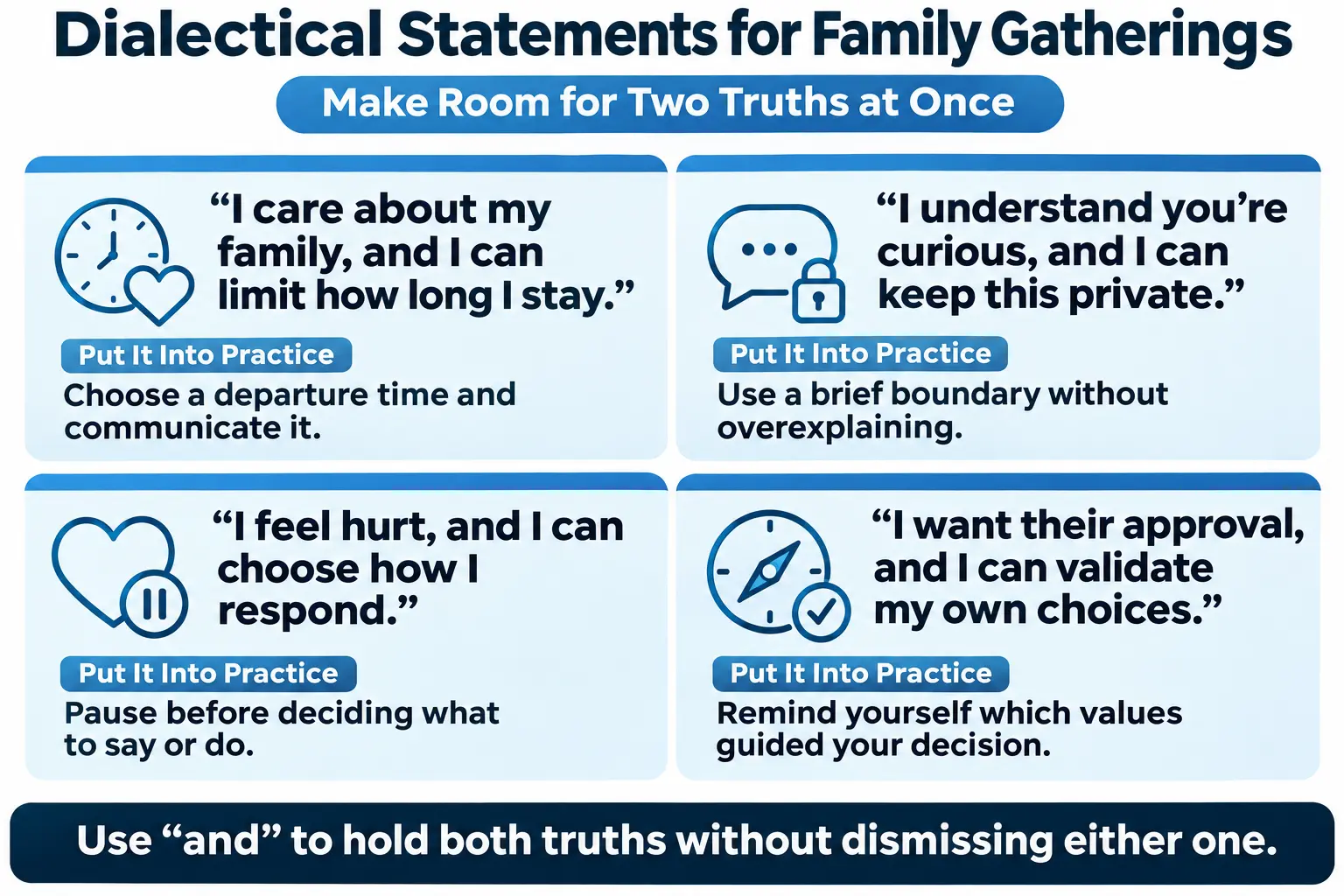
Dialectical thinking complements this approach by helping clients hold more than one truth at a time. Someone who feels torn between connection and self-protection may find a statement such as “I love my family, and I can limit how long I stay” more workable than believing they must choose one or the other.
Useful dialectical statements for family conflict include:
- “I understand that you are curious, and I am keeping this private.”
- “I want their approval, and I can validate my own decisions.”
- “My family may see me in an old role, and I can act according to who I am now.”
These statements work best when they lead to a concrete choice. A client who recognizes that they can care about family and still limit a visit can decide on a departure time and rehearse communicating it.
DBT Emotion Regulation Skills for Holiday Stress
The conversation at the dinner table is only part of the picture. A rushed journey, missed meal, or poor night’s sleep can leave a client with fewer resources for handling an already difficult interaction.
DBT emotion regulation includes attending to factors that increase emotional vulnerability. PLEASE offers a reminder to address physical illness, maintain balanced eating and sleep, avoid mood-altering substances, and include appropriate exercise. Plans should fit the client’s health needs, circumstances, and existing treatment recommendations.
For Macy, preparation might include eating before she leaves work and allowing enough time to avoid arriving rushed. Another client may need to protect sleep while traveling or leave recovery time between social commitments.
Emotion regulation also includes checking the facts. A relative asking “Are you still at the same job?” could be making conversation or signaling criticism; the words and context matter. Helping a client separate the observable event from their interpretation can clarify what response fits.
This is not an exercise in assuming good intentions. An explicit insult gives different information from an ambiguous question. When hurt or anger fits the situation, therapy can focus on how the client wants to act on that emotion.
DBT Distress Tolerance Skills for Family Conflict
Even with preparation, a client may feel overwhelmed. Distress tolerance skills offer ways to get through a difficult moment while preserving the ability to choose what comes next.
STOP provides a simple sequence: Stop, Take a step back, Observe, and Proceed mindfully. At dinner, that might look like putting down a fork, pausing before answering, and noticing the urge to argue. The pause gives Macy a chance to use the sentence she rehearsed.
Temporary distraction can also help when a problem cannot be resolved in the moment. ACCEPTS describes several options: activities, contributing, comparisons, emotions, pushing away, thoughts, and sensations. A client might help with a task, do a short puzzle, or set an issue aside until they can address it more effectively.
Self-soothing draws on sensory experiences that the individual finds comforting, such as familiar music, a warm drink, or a soft fabric. Trying options beforehand matters because a sound or sensation that helps one person may overwhelm another.
TIP skills, also called TIPP, include temperature, intense exercise, paced breathing, and paired muscle relaxation. Clinicians should teach appropriate options with attention to health conditions and physical restrictions. A previously practiced breathing or relaxation exercise may be more feasible at a gathering than a strategy requiring privacy or a different setting.
The useful question afterward is whether the skill helped the client make their next decision. Feeling some distress while choosing an effective response can still represent progress.
DEAR MAN Examples for Setting Boundaries With Family
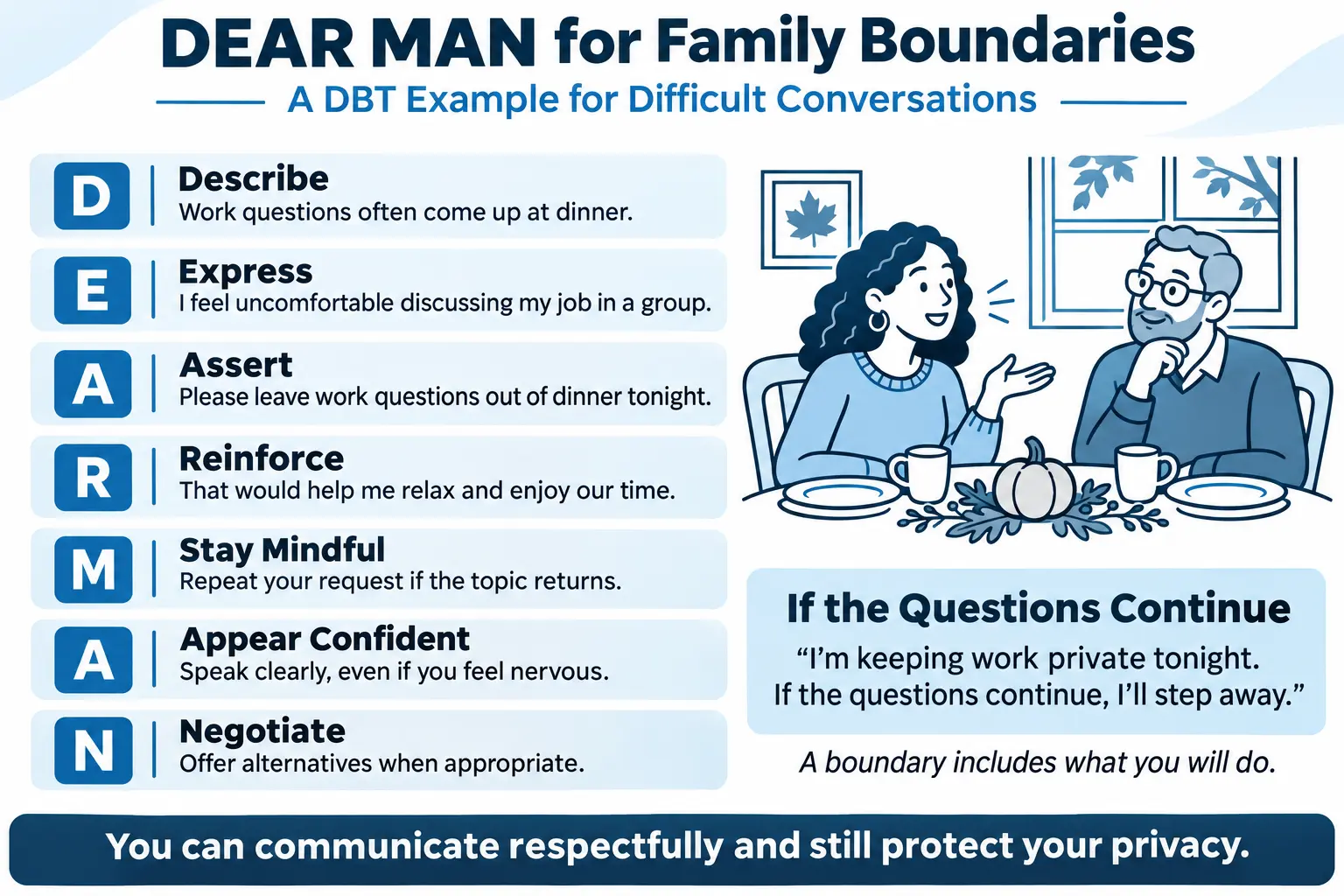
A client may know exactly what they need and still struggle to say it. DEAR MAN provides a structure for making a request or saying no while staying focused on an objective: Describe, Express, Assert, Reinforce, stay Mindful, Appear confident, and Negotiate.
Describe
Describe the situation.
Express
Express the impact.
Assert
Assert what you want.
Reinforce
Reinforce by describing a benefit.
stay Mindful
Stay focused on the objective.
Appear confident
Speak steadily, even while feeling anxious.
Negotiate
Negotiate flexible details when appropriate.
Before the gathering, Macy could tell her sibling:
“When my job comes up at dinner, people sometimes comment on my choices. I feel uncomfortable discussing it in front of everyone. Please leave career questions out of dinner tonight. That would help me relax and enjoy our time together.”
The request identifies the situation, explains the impact, states what Macy wants, and describes a benefit. In rehearsal, she can practice keeping her message clear if the conversation drifts or the request is challenged. Appearing confident can mean speaking steadily while still feeling anxious.
If the questions continue, a shorter boundary may be more useful: “I’m not discussing work tonight. If the questions continue, I’m going to step away.” The request asks for cooperation; the follow-through describes what Macy will do.
Negotiation may help with flexible details, such as choosing another time to talk. Privacy and safety limits do not require compromise. GIVE skills can support relationship goals, while FAST skills can support self-respect; the emphasis depends on the interaction and the client’s priorities.
Combine validation with a clear limit
Validation acknowledges an understandable feeling or perspective without requiring agreement. Paired with a boundary, it can make the client’s message both respectful and direct:
- “I understand you’re worried about me. I’m keeping the details private.”
- “I hear that this matters to you. I’m not discussing politics tonight.”
- “I appreciate the invitation. I can stay for an hour.”
A redirect such as “How was your trip?” can help when the client wants to continue the conversation. It is optional. If the relative repeatedly ignores the limit, ending the interaction may be more effective than finding a different way to explain it.
Make room for recovery after the gathering
Clients often devote so much effort to getting through a visit that they overlook what comes afterward. Once the event ends, they may replay conversations, question their boundaries, or feel guilty about leaving.
Recovery can be part of the plan from the beginning. A quiet evening, a familiar routine, or time with someone supportive may give the client space to settle. Radical acceptance can help here too: “That evening was difficult, and I can take care of myself now.”
In the next session, the gathering offers useful information. What triggered the strongest reaction? Which response was available in the moment? What made a skill easier or harder to use?
Macy might still feel hurt by her sibling’s questions while recognizing that she set her boundary and spent time with her cousin. That is a specific behavior to reinforce. If she found it difficult to leave the conversation, the next session can focus on practicing that step.
Helping clients use DBT skills for family gatherings is an ongoing process of preparation, practice, and adjustment. Small changes can give clients more choice in relationships that have often felt automatic.
Support DBT treatment with clear documentation
As clients practice these skills, progress notes can show how the intervention connects to their treatment goals. “Practiced DEAR MAN through role-play to address difficulty expressing needs during family interactions” communicates more than a list of skills alone. The client’s response and agreed next step help make the clinical work visible.
ICANotes offers treatment planning tools that connect goals, interventions, and progress notes. Schedule a demo to explore how ICANotes can support your practice’s documentation workflow.
Document DBT interventions with clarity and confidence
ICANotes helps you connect DBT skills like Cope Ahead and DEAR MAN to measurable treatment goals. Start your free trial today.
- Link DBT skills to goals in progress notes
- Document role-play and boundary interventions fast
- Connect treatment plans to session notes
- Capture client response and next steps easily
See how ICANotes can support your clinical workflow. Start your free 30-day trial, no credit card required.
Start Your Free 30-Day Trial
Frequently Asked Questions
What DBT skills help with holiday family stress?
Does radical acceptance mean tolerating mistreatment?
How can therapists help clients who choose not to attend?
How can therapists teach DBT skills for family conflict?
What is an example of using DEAR MAN to set boundaries with family members?
How does the DBT Cope Ahead skill help with holiday anxiety?
How can clients use DBT skills when family members repeatedly violate their boundaries?
References
- Linehan, M. M. (2025). DBT Skills Training Handouts and Worksheets, Revised Edition. Guilford Press.
- Linehan, M. M. (2015). DBT Skills Training Manual, Second Edition. Guilford Press. Publisher-provided teaching materials.
Diane Bigler
Diane Bigler, LCSW, LSCSW, is a Licensed Clinical Social Worker in Missouri and Kansas with over 25 years of experience in the mental health field. She has held clinical positions as an outpatient and in-home therapist and clinical supervisor in diverse settings. Diane was an Adjunct Professor of Social Work for 10 years at The University of Kansas, School of Social Welfare and a Field Liaison and Field Instructor. She has also held administrative positions as a Program Director and Coordinator. Diane is a popular local and national trainer on a wide variety of mental health and workplace development topics for clinicians and corporations and has facilitated over 500 training courses in the last few years.