
Blog > Treatment Strategies > First-Episode Psychosis vs. Schizophrenia: Key Differences
First-Episode Psychosis vs. Schizophrenia: Assessment, Treatment, and the Role of Substance Use
First-episode psychosis (FEP) is a clinical emergency that can alter the course of a person's life, yet it is frequently misunderstood and misdiagnosed. While many people assume a first psychotic episode automatically means schizophrenia, the reality is far more complex. Understanding first-episode psychosis vs. schizophrenia, recognizing the role of substance use, and implementing evidence-based first-episode psychosis treatment can help clinicians improve outcomes and reduce the long-term impact of untreated psychosis.



Last Updated: June 29, 2026

What You'll Learn
- The difference between first-episode psychosis and schizophrenia and why the distinction matters clinically.
- How cannabis, synthetic cannabinoids, stimulants, and other substances can trigger or complicate psychotic symptoms.
- Key elements of a comprehensive first-episode psychosis assessment, including differential diagnosis and collateral gathering.
- Why duration of untreated psychosis (DUP) has a significant impact on long-term outcomes.
- Evidence-based first-episode psychosis treatment approaches, including Coordinated Specialty Care (CSC).
- Documentation strategies that support clinical decision-making, medical necessity, and risk management.
How to engage families and connect patients to appropriate specialty services early in the course of illness.
Contents
-
First-Episode Psychosis vs. Schizophrenia: What's the Difference?
- Why Substance Use is the Central Issue in First-Episode Psychosis
- When Substance-Induced Psychosis Isn't the Whole Story
- Building a Disciplined Differential Diagnosis
- The Cost of Delay: Duration of Untreated Psychosis
- First-Episode Psychosis Treatment: Coordinated Specialty Care
- Documenting First-Episode Psychosis: What Clinicians Should Include
- Why Family Education Matters in First-Episode Psychosis
- Improving Access to First-Episode Psychosis Treatment
- How ICANotes Supports First-Episode Psychosis Documentation
- FAQ: First-Episode Psychosis
What is first-episode psychosis? First-episode psychosis (FEP) is the first time a person experiences psychotic symptoms — such as hallucinations, delusions, or disorganized thinking — severe enough to require clinical attention. FEP is a clinical presentation, not a diagnosis: it can stem from schizophrenia, a mood disorder, substance use, or several other conditions, and how quickly clinicians intervene shapes long-term outcomes.
First-episode psychosis is not a minor detour. It is a clinical turning point, a life-course event, and in many cases a race against time. When psychosis first appears, the question isn't whether the moment matters — it's whether the people in front of the patient move fast enough, think broadly enough, and act decisively enough to change the trajectory before the damage deepens.
Many patients don't walk into a specialty early-psychosis clinic with a clean, textbook presentation. They show up in emergency departments, primary care offices, schools, homes, mobile crisis encounters, and correctional settings — often frightened, disorganized, sleep-deprived, or behaviorally escalating, and often with substance use somewhere in the picture. That combination is exactly why first-episode psychosis demands urgency rather than hesitation (ICANotes, 2026).

First-Episode Psychosis vs. Schizophrenia: What's the Difference?
Clinicians often hear “first episode of psychosis” and “schizophrenia” used as if they were interchangeable. They aren't, and the distinction shapes diagnosis, treatment planning, and how you talk to patients and families.
Psychosis itself isn't a diagnosis. It's a clinical state — a constellation of symptoms such as hallucinations, delusions, and disorganized thinking — that can arise from many different underlying conditions. First-episode psychosis simply describes the first time those symptoms appear and become severe enough to need clinical attention. It's an entry point into care, not an endpoint diagnosis.
Schizophrenia, by contrast, is one specific diagnosis that a person presenting with FEP may or may not eventually receive. Per DSM-5-TR criteria, schizophrenia requires at least two characteristic symptoms (delusions, hallucinations, disorganized speech, grossly disorganized or catatonic behavior, or negative symptoms) present for a significant portion of at least one month, along with continuous signs of disturbance — including prodromal or residual periods — persisting for at least six months, plus a marked decline in functioning. A single psychotic episode can't meet that bar on day one.
| First-Episode Psychosis (FEP) | Schizophrenia | |
|---|---|---|
| What it describes | The first occurrence of psychotic symptoms severe enough to need clinical care | A chronic schizophrenia-spectrum disorder diagnosed after longitudinal assessment and DSM-5-TR criteria are met |
| Diagnostic status | A clinical presentation and entry point into care, not a diagnosis itself | A defined diagnosis with specific DSM-5-TR criteria |
| Minimum duration | None — can and should be recognized and treated immediately | Continuous signs of disturbance for at least 6 months, with active symptoms present for a significant portion of at least 1 month |
| Possible underlying causes | Schizophrenia, schizophreniform disorder, brief psychotic disorder, schizoaffective disorder, bipolar disorder or major depression with psychotic features, substance- or medication-induced psychosis, a medical condition, or a single self-limited episode | One outcome among several possible explanations for a psychotic episode |
| Diagnostic stability | Often provisional in the early weeks; may shift as more history, collateral, and follow-up data accumulate | Tends to be highly stable once the diagnosis is established |
| Treatment starting point | Coordinated specialty care, regardless of which diagnosis eventually emerges | Coordinated specialty care during the early phase; longer-term illness management thereafter |
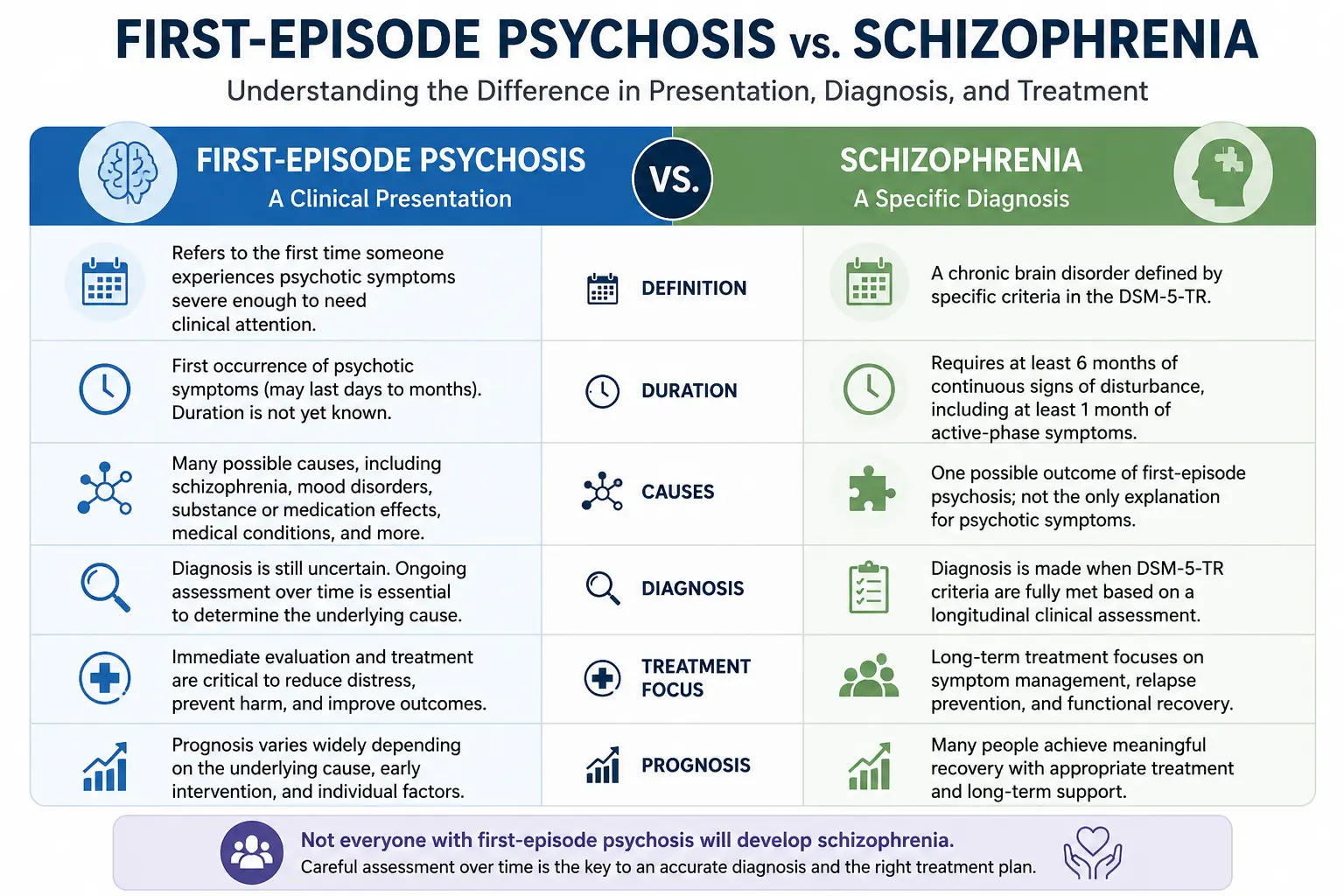
Why this matters clinically: research tracking people after a first psychotic episode finds that diagnoses within the schizophrenia spectrum tend to be highly stable once established (about 93% in one meta-analysis), but that stability describes what happens after a category is confirmed — it doesn't mean every FEP case is schizophrenia from day one. Many people who present with FEP are ultimately diagnosed with a mood disorder with psychotic features, a brief or substance-induced psychotic disorder, or another condition entirely. Telling a frightened patient or family “this is schizophrenia” at the first encounter, before a longitudinal picture exists, risks being inaccurate — and it can shape how the family copes, how the patient understands their own prognosis, and how the case is documented going forward.
Can First-Episode Psychosis Go Away?
Some people who experience first-episode psychosis never develop schizophrenia. Depending on the underlying cause, symptoms may resolve completely, recur intermittently, or evolve into a chronic psychotic disorder. This is one reason clinicians should avoid making premature assumptions during the initial assessment.
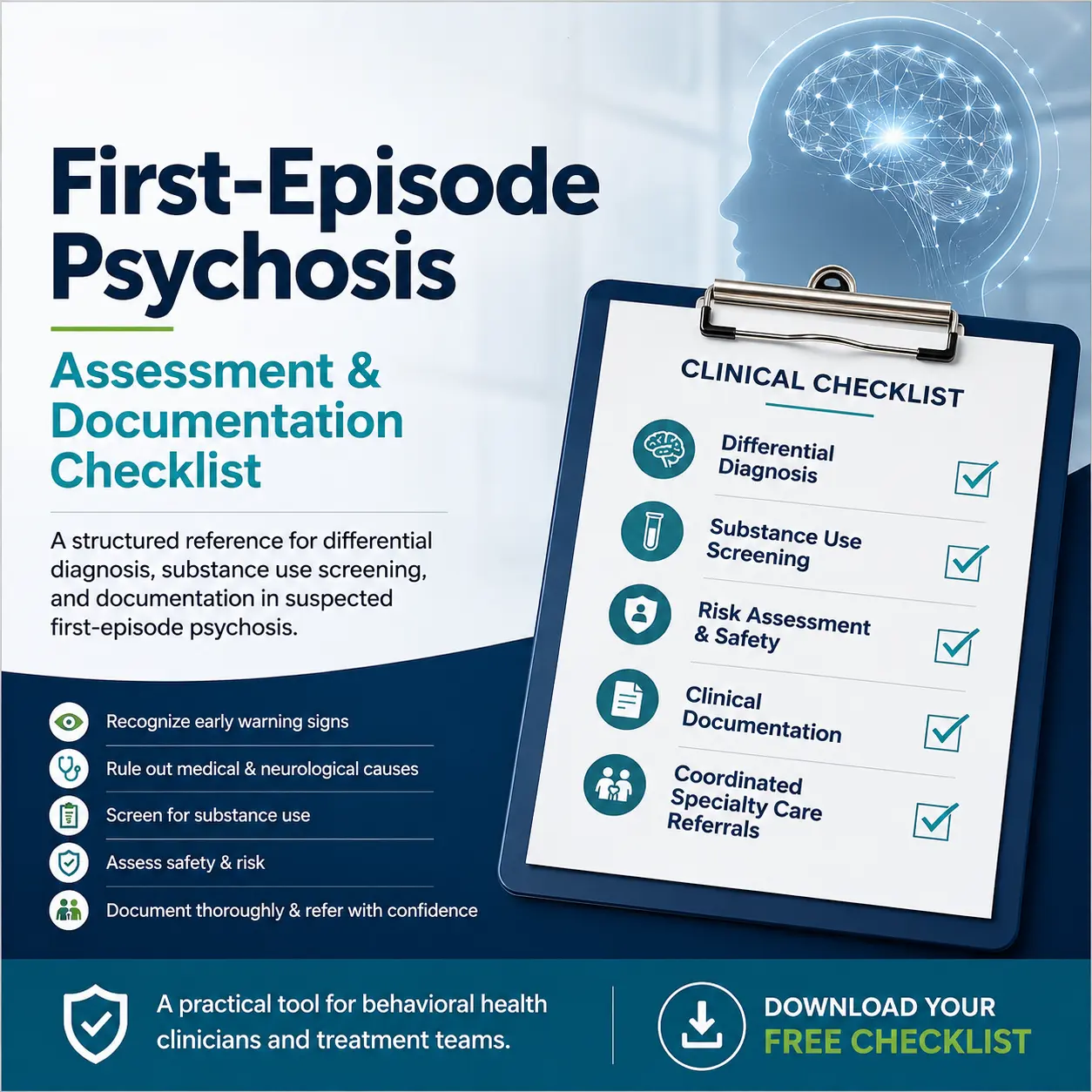
First-Episode Psychosis Assessment & Documentation Checklist
First-episode psychosis assessments often involve significant diagnostic uncertainty. Clinicians must evaluate psychotic symptoms, substance use, risk factors, collateral information, and medical rule-outs while documenting their clinical reasoning clearly and thoroughly.
This free checklist provides a structured framework to help behavioral health professionals conduct comprehensive assessments, strengthen documentation, and support appropriate treatment and referral decisions.
Inside You'll Get:
- Recognition criteria for suspected first-episode psychosis
- Differential diagnosis and medical rule-out reminders
- Substance use screening guidance
- Collateral information collection checklist
- Safety and risk assessment essentials
- Documentation best practices
- Coordinated Specialty Care referral recommendations
Get Your Free Checklist
Complete the form below to access your downloadable PDF.
Why Substance Use is the Central Issue in First-Episode Psychosis
One of the most dangerous mistakes in real-world practice is treating substance use as a side note instead of a central diagnostic and safety issue. Substance use can cloud the clinical picture, delay recognition, complicate engagement, and in some cases directly induce psychotic symptoms that look alarmingly similar to a primary psychotic disorder. The literature is clear that psychosis can occur in association with cannabis, stimulants such as amphetamines and methamphetamine, cocaine, hallucinogens, and synthetic cannabinoids, among other substances. This is not a fringe issue, and it isn't rare enough to dismiss — it's a frontline problem hiding in plain sight, and clinicians who fail to confront it head-on will miss opportunities to intervene before the situation becomes far more dangerous.
Cannabis and Synthetic Cannabinoids
Cannabis deserves special attention because too many people still speak about it as if it were harmless by default. That assumption is reckless. Evidence reviewed in the literature shows that cannabis exposure—particularly products with higher THC concentrations—is associated with paranoia, hallucinations, perceptual disturbance, and psychotic presentations that may outlast intoxication itself.
For some individuals, especially younger people who may already carry biological or psychosocial vulnerability, cannabis can push a fragile system into a full psychiatric emergency. Synthetic cannabinoids raise the stakes further: they can produce severe, unpredictable psychiatric reactions and may not appear on standard toxicology screens, meaning a clinician who relies on a negative routine screen may be falsely reassured at exactly the wrong time.
Stimulants and Psychosis
Stimulants are no safer in this conversation. Methamphetamine, amphetamine, and cocaine can all produce psychotic symptoms, often with intense paranoia, agitation, suspiciousness, auditory or visual disturbances, and violent or highly impulsive behavior.
In acute settings, this can be misread as simple intoxication, malingering, oppositional behavior, or personality pathology when what is actually unfolding is a severe psychiatric syndrome with immediate safety implications. When that misread happens, the patient doesn't just lose diagnostic clarity—they lose time, trust, and sometimes any realistic chance at early stabilization without further trauma, incarceration, or recurrent crisis utilization.
When Substance-Induced Psychosis Isn't the Whole Story
The clinical challenge is that not every substance-related psychotic presentation stays neatly contained inside the category of substance-induced psychosis — which is where the FEP-vs-schizophrenia distinction above becomes more than academic. Review data suggest that some individuals initially diagnosed with substance-induced psychosis later transition to schizophrenia-spectrum or bipolar disorders, meaning a clinician can't safely assume symptoms will simply disappear once the drug effect wears off. Younger age and certain clinical risk factors appear to increase concern for later conversion. In plain terms: the first psychotic break linked to substance use may not be the end of the story — it may be the opening chapter. That's why a rushed encounter, a vague note, or a casual discharge plan can become a serious clinical and legal problem later.
First-Episode Psychosis Assessment Workflow
Use this workflow to guide a structured assessment when first-episode psychosis is suspected.
1. Recognize Suspected First-Episode Psychosis
Identify new-onset hallucinations, delusions, disorganized thinking, functional decline, unusual behavior, or collateral reports of recent change.
2. Consider Medical and Neurological Rule-Outs
Assess whether infectious, metabolic, toxic, neurologic, medication-related, or other medical causes could be contributing to the presentation.
3. Screen for Substance Use
Ask about cannabis, synthetic cannabinoids, stimulants, hallucinogens, alcohol, medications, timing of use, withdrawal, potency, route, and whether symptoms began before or after substance exposure.
4. Gather Collateral Information
Collect observations from family, caregivers, schools, workplaces, EMS, prior records, or other sources to clarify onset, symptom progression, and functional decline.
5. Assess Safety, Risk, and Capacity
Evaluate suicide risk, risk of harm to others, grave disability, ability to consent to or refuse treatment, and the clinically appropriate level of care.
6. Build the Differential Diagnosis
Document whether the presentation may reflect schizophrenia-spectrum illness, mood disorder with psychotic features, substance-induced psychosis, trauma-related symptoms, delirium, or another medical condition.
7. Refer to Coordinated Specialty Care
When first-episode psychosis is suspected, initiate a warm handoff to Coordinated Specialty Care or another appropriate specialty mental health service, while integrating substance use treatment and family education into the care plan.
Building a Disciplined Differential Diagnosis
First-episode psychosis has to be evaluated with a disciplined differential diagnosis: medical rule-outs, trauma assessment, collateral gathering, and a deliberate review of substance exposure rather than quick assumptions. That approach isn't bureaucratic busywork — it's the backbone of safe care. A patient with paranoia, bizarre behavior, poor sleep, and social withdrawal may be presenting with a primary psychotic disorder, a substance-induced psychosis, a mood disorder with psychotic features, delirium, neurologic illness, or some combination of these factors. The point isn't to delay action until certainty arrives. The point is to act urgently while documenting the reasoning, the evidence considered, and the steps taken to rule in or rule out the most dangerous possibilities.
Why Collateral Information is Not Optional
People with emerging psychosis often don't have the insight or language to explain what's happening to them, which is why collateral information matters. Family members may report abrupt withdrawal, unusual fearfulness, academic collapse, bizarre beliefs, loss of sleep, or sudden changes in hygiene and functioning. Teachers may notice perplexity, declining performance, or social isolation. EMS personnel may describe disorganized behavior that predated arrival at the hospital. Prior records may reveal repeated vague complaints that, in hindsight, marked a deteriorating prodrome. Clinicians who gather this information early are assembling the timeline that may determine whether the patient receives timely specialty care or becomes one more delayed diagnosis with worsening outcomes.
What to Ask About Substance Use
Every encounter with suspected FEP should include sharp questions about substance use: timing, potency, route, patterns, withdrawal, prior episodes, and whether symptoms predated use or persisted after use stopped. Be careful about false reassurance — a patient who says, “it's just the weed,” may be minimizing, and a family member who says, “he only acts this way when he's high,” may be describing the very pattern that signals escalating vulnerability. Correctional and emergency settings can further distort the picture, since psychosis is often misread as defiance, intoxication, or manipulation. In those settings, it isn't enough to control behavior — the job is to recognize the syndrome before the system punishes what it should be treating.
The Cost of Delay: Duration of Untreated Psychosis
Delay is expensive. Longer duration of untreated psychosis (DUP) is associated with worse clinical and functional outcomes, which is one reason early identification matters so much. First-episode psychosis frequently emerges during adolescence and young adulthood, when people are building education, employment, relationships, and identity. Every untreated month can fracture those foundations. This isn't only about symptom reduction — it's about preserving a person's developmental trajectory before psychosis and substance use together derail school, work, housing stability, family trust, and long-term independence.
First-Episode Psychosis Treatment: Coordinated Specialty Care
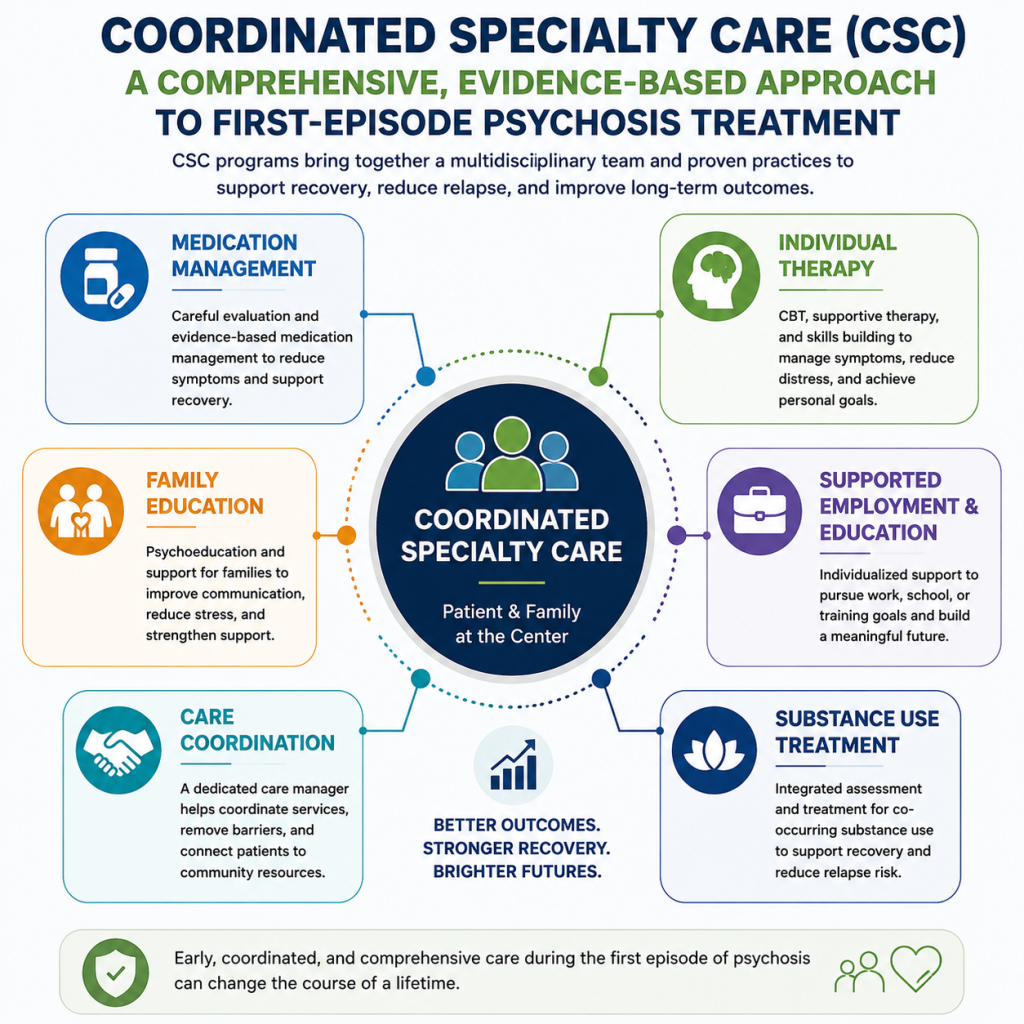
The evidence-based response to that urgency is coordinated specialty care (CSC). CSC combines medication management, psychotherapy, family education, care coordination, and support for work or school functioning in a team-based structure designed for rapid, youth-friendly engagement. It grew out of the NIMH-funded RAISE (Recovery After an Initial Schizophrenia Episode) initiative and has since become the standard of care: the American Psychiatric Association's Practice Guideline for the Treatment of Patients With Schizophrenia recommends that people experiencing a first episode of psychosis be treated in a coordinated specialty care program. In the NAVIGATE model studied under RAISE, participants in CSC showed improved quality of life, reduced symptom severity, and greater educational and vocational engagement over two years compared with typical community care.
A warm handoff into a CSC program is far more powerful than a generic discharge instruction telling a frightened patient to find outpatient treatment somewhere, somehow, at some point in the future.
What Does First-Episode Psychosis Treatment Typically Include?
Effective first-episode psychosis treatment extends beyond symptom management. Because FEP often occurs during adolescence or young adulthood, treatment should address both clinical symptoms and the person's ability to function at school, work, and home. Coordinated Specialty Care (CSC) programs bring these services together in a single team-based model.
Evidence-based first-episode psychosis treatment often includes:
Medication Management
Antipsychotic medications are commonly used to reduce hallucinations, delusions, disorganized thinking, and other psychotic symptoms. Current best practices emphasize using the lowest effective dose, particularly during a first episode, while closely monitoring side effects, treatment adherence, and patient preferences. Shared decision-making is critical, especially when patients are uncertain about treatment or have limited insight into their symptoms.
Individual Psychotherapy
Psychotherapy helps patients understand their symptoms, build coping skills, and manage the emotional impact of experiencing psychosis. Cognitive Behavioral Therapy for Psychosis (CBTp), supportive therapy, and other evidence-based approaches can help patients reduce distress, improve functioning, and remain engaged in treatment.
Family Education and Support
Families are often the first to notice changes in behavior and are frequently responsible for helping patients access care. Psychoeducation helps family members understand psychosis, recognize warning signs, respond effectively during crises, and support treatment adherence. Research consistently shows that family involvement improves engagement and long-term outcomes.
Supported Education and Employment Services
Psychosis often emerges during critical developmental years when individuals are pursuing education, careers, and independent living. Supported education and employment services help patients remain connected to school and work, reducing the long-term functional consequences of untreated illness.
Care Coordination
Navigating behavioral health systems can be overwhelming for patients and families, particularly following a first psychotic episode. Care coordinators help connect individuals with psychiatric services, therapy, substance use treatment, community resources, and follow-up appointments to reduce gaps in care.
Integrated Substance Use Treatment
Because substance use can trigger, worsen, or complicate psychotic symptoms, it should be addressed as part of the treatment plan rather than as a separate issue. Integrated treatment models allow clinicians to address psychosis and substance use simultaneously, improving engagement and reducing the risk of relapse.
The goal of first-episode psychosis treatment is not simply symptom reduction. Early intervention aims to preserve functioning, support recovery, and help patients maintain their educational, occupational, and social development before psychosis creates long-term disruption.
Documenting First-Episode Psychosis: What Clinicians Should Include
Documentation is where clinical judgment becomes defensible. A strong note in a first-episode psychosis case should clearly describe when symptoms began, how functioning changed, what the patient reported, what collateral sources observed, what substances were involved or suspected, what medical causes were considered, how risk was assessed, whether decision-making capacity was impaired, and why the chosen level of care was medically necessary. This level of specificity does more than satisfy payers or auditors — it protects the patient by making the clinical reasoning visible and protects the clinician by demonstrating that dangerous possibilities were carefully evaluated rather than overlooked.
Because first-episode psychosis often presents with significant diagnostic uncertainty, clinicians should document not only their conclusions but also their differential diagnosis and the reasoning behind it. A patient presenting with hallucinations, paranoia, and disorganized thinking may ultimately be diagnosed with schizophrenia, a mood disorder with psychotic features, substance-induced psychosis, or a medical condition. Clear documentation of the assessment process helps ensure continuity of care and provides critical context for future providers.
Key documentation elements include:
- Symptom onset, duration, and progression
- Changes in school, work, relationships, or daily functioning
- Collateral information from family, caregivers, schools, or emergency responders
- Substance us history, including timing relative to symptom onset
- Medical and neurological rule-outs considered
- Suicide, violence, and capacity assessments
- Differential diagnosis considerations
- Rationale for treatment recommendations and level-of-care decisions
Vague documentation in a first-episode psychosis case is not simply incomplete — it can create clinical, legal, and reimbursement challenges later. Thorough documentation helps ensure patients receive appropriate care while creating a clear record of the clinician's assessment and decision-making process.
Why Family Education Matters in First-Episode Psychosis
Families need plain-language education early, not after the crisis has already escalated. First-episode psychosis often emerges gradually, and family members are frequently the first people to notice subtle changes in behavior, sleep, social functioning, academic performance, or thinking patterns. When families understand that psychosis can worsen quickly and may be intensified by substance use, they are better positioned to respond with urgency rather than denial, frustration, or blame.
Family education is also a core component of evidence-based first-episode psychosis treatment. Coordinated Specialty Care programs routinely incorporate family psychoeducation because research has shown that informed family involvement improves treatment engagement, supports recovery, and reduces the likelihood of future crises. Family members can help reinforce treatment recommendations, encourage follow-through with appointments, recognize warning signs of relapse, and provide valuable collateral information throughout the course of care.
Importantly, education can help families separate the person from the illness. Psychotic symptoms may lead to behaviors that are confusing, frightening, or difficult to understand. Providing families with accurate information about psychosis, substance use, treatment expectations, and recovery can reduce stigma within the home and strengthen the support system surrounding the patient.
For many individuals experiencing first-episode psychosis, family members are not simply observers — they are an essential part of the treatment team. The earlier they are engaged, the greater the opportunity to support recovery and long-term stability.
Improving Access to First-Episode Psychosis Treatment
Even the most effective treatment plan cannot succeed if patients are unable to access care. Unfortunately, many individuals experiencing first-episode psychosis encounter significant barriers before they ever reach a Coordinated Specialty Care program or specialty mental health provider. Transportation challenges, insurance limitations, provider shortages, long waitlists, fragmented referral systems, and stigma can all delay treatment during a period when rapid intervention is critical.
These barriers are especially concerning because longer durations of untreated psychosis are consistently associated with worse clinical and functional outcomes. A patient discharged from an emergency department with a referral list may never successfully navigate the behavioral health system without additional support. Families may struggle to identify appropriate resources, coordinate appointments, understand insurance requirements, or convince a reluctant patient to engage in care.
This is why warm handoffs are so important. Whenever possible, clinicians should move beyond simply providing referral information and instead help facilitate a direct connection to treatment. Scheduling appointments before discharge, communicating with receiving providers, engaging family members in follow-up planning, and addressing logistical barriers can significantly improve treatment engagement. The goal is not merely to recommend care — it is to increase the likelihood that the patient actually receives it.
For patients and families facing both psychosis and substance use concerns, SAMHSA's National Helpline provides a free, confidential, 24/7 resource for treatment referrals and information. Sometimes a practical resource delivered at the right moment can be the difference between entering treatment and falling through the cracks of an already complicated system.
The Bottom Line
Substance use is not a side conversation in first-episode psychosis. It can be the spark, the accelerant, the camouflage, or all three at once. Cannabis can destabilize. Stimulants can intensify paranoia and disorganization. Synthetic drugs can produce unpredictable psychiatric states. And first-episode psychosis itself is not synonymous with schizophrenia — it's a clinical turning point that may lead to several different diagnoses, which is exactly why a disciplined, urgent, well-documented response matters more than a fast label. When clinicians or systems wave any of this away as “just intoxication” or jump straight to “it's schizophrenia,” they invite delayed diagnosis, avoidable harm, and preventable deterioration. The answer is disciplined assessment, rapid intervention, integrated substance use treatment, family engagement, precise documentation, and urgent referral to coordinated specialty care.
How ICANotes Supports First-Episode Psychosis Documentation
None of the assessment, family education, or care coordination above means much if it isn't captured clearly in the chart. ICANotes' behavioral health EHR includes menu-driven clinical templates and treatment planning content built for psychiatric and substance use presentations, helping clinicians document the differential reasoning, risk assessment, and collateral information that an FEP case demands — without slowing down an already time-pressured encounter.
For a deeper walkthrough of early-intervention strategies, watch ICANotes' on-demand webinar, First-Episode Psychosis: Early Intervention Strategies That Improve Long-Term Outcomes, featuring psychiatrist Dr. Jacqueline Norman and psychiatric NP Monique Ornelas.
To see how ICANotes can support documentation for first-episode psychosis and other complex behavioral health presentations, schedule a demo or start a free trial today.
Document First-Episode Psychosis Assessments Faster—and More Thoroughly
First-episode psychosis cases demand careful assessment, collateral gathering, differential diagnosis, substance use screening, risk evaluation, and detailed documentation. ICANotes helps behavioral health clinicians capture the clinical details that matter while reducing documentation burden.
Create comprehensive psychiatric evaluations, treatment plans, progress notes, and risk assessments in minutes using templates designed specifically for behavioral health.
- Behavioral health-specific documentation templates
- Psychiatric evaluations and treatment planning tools
- Integrated scheduling, billing, and patient portal
- Designed exclusively for mental health professionals
Start Your Free Trial
See how ICANotes can help you document complex behavioral health cases more efficiently.
Frequently Asked Questions About First-Episode Psychosis
Recent Posts






About the Authors
Jacqueline Norman, DO
Dr. Jacqueline Norman is a board-certified psychiatrist with expertise in diagnosing and treating complex psychiatric conditions. She completed her residency at the University of Virginia and has worked with diverse populations across disorders including schizophrenia, bipolar disorder, and trauma-related conditions. Her approach is evidence-based and patient-centered, with a focus on accurate diagnosis and individualized care. Dr. Norman is especially passionate about women’s mental health and improving access to psychiatric services in underserved communities.
Monique Ornelas, PMHNP
Monique Ornelas is a Psychiatric Mental Health Nurse Practitioner with extensive experience in acute and emergency psychiatric care. She earned her MSN from Vanderbilt University and currently practices in a psychiatric emergency department. Her background spans crisis stabilization, inpatient, and observational settings, giving her a comprehensive perspective across levels of care. Monique also serves as a clinical preceptor and brings practical, frontline insight into risk assessment and evidence-based interventions.
October Boyles, DNP, MSN, BSN, RN
Dr. October Boyles is a behavioral health expert and clinical leader with extensive expertise in nursing, compliance, and healthcare operations. With a Doctor of Nursing Practice (DNP) and advanced degrees in nursing, she specializes in evidence-based practices, EHR optimization, and improving outcomes in behavioral health settings. Dr. Boyles is passionate about empowering clinicians with the tools and strategies needed to deliver high-quality, patient-centered care.