Blog > Documentation > How to Document Medical Necessity in Mental Health
How to Document Medical Necessity in Mental Health Treatment
Documenting medical necessity in mental health is essential for securing insurance reimbursement and avoiding costly claim denials. This guide explains how to effectively document medical necessity for therapy by connecting symptoms, diagnosis, and functional impairment to the interventions you provide. Learn how medical necessity criteria for mental health are applied by payers, including key insights from CMS medical necessity guidelines. You’ll also find practical medical necessity documentation examples and step-by-step strategies for documenting medical necessity in progress notes, treatment plans, and clinical records. Whether you’re refining your documentation of medical necessity or building stronger audit-ready notes, this resource will help you align your clinical documentation with payer expectations and improve reimbursement outcomes.


Last Updated: April 1, 2026
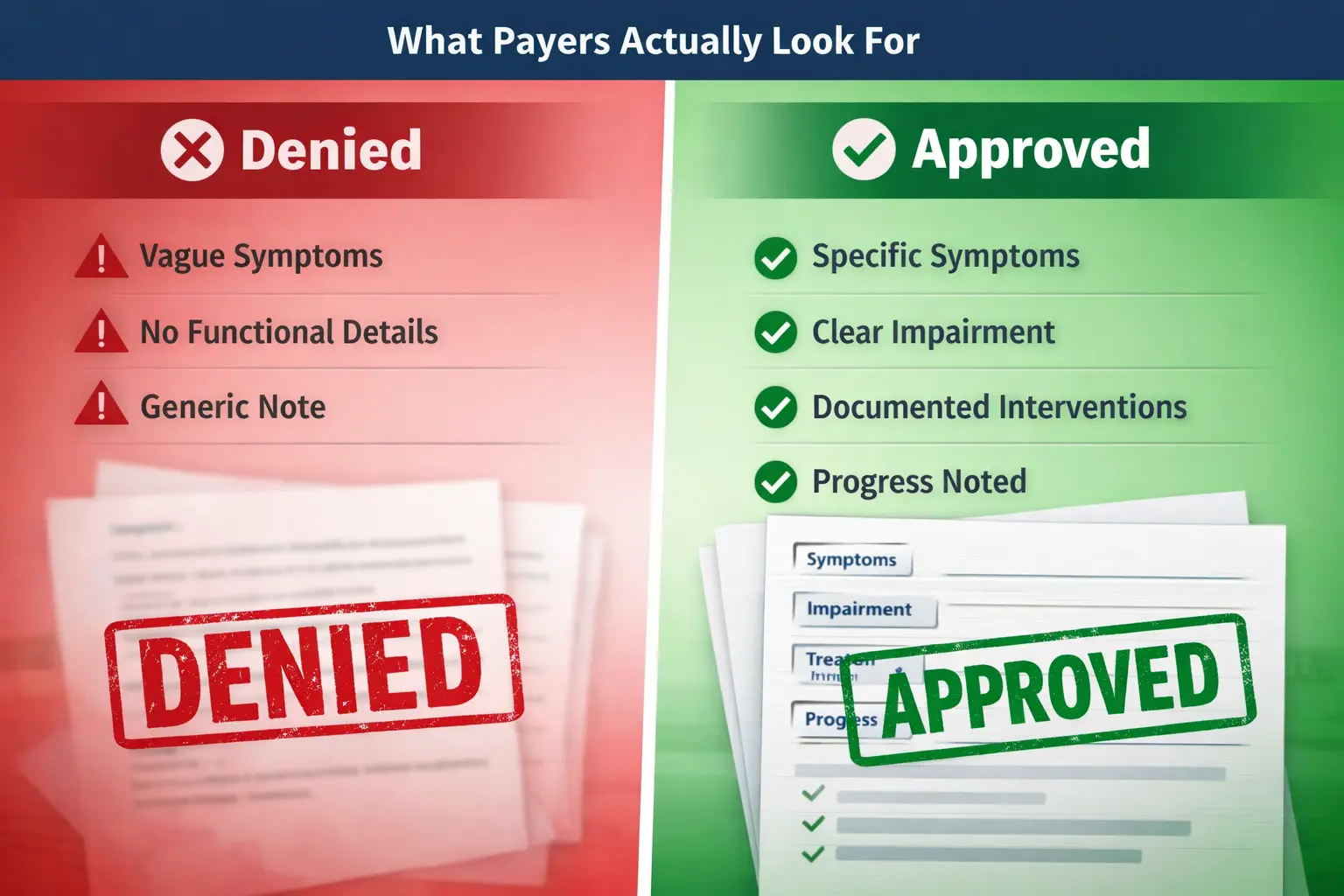
Few things derail a mental health practice faster than denied claims — and the most common reason claims get denied is inadequate documentation of medical necessity. If you've ever had a payer push back on a session that you know your client needed, the problem likely wasn't the care you provided. It was how the record told the story.
Documenting medical necessity for mental health services requires more than checking a diagnostic code and writing a brief note. It demands a clear, evidence-based narrative that connects a client's symptoms, functional impairments, and diagnosis to the specific treatment you're delivering. When that narrative is airtight, reimbursement follows. When it's not, even the most clinically sound treatment plan can be rejected at the utilization review stage.
This guide walks through exactly what medical necessity means in a behavioral health context, what payers and auditors are looking for, and how to build documentation habits that protect your practice — and your clients' access to care.
What Medical Necessity Means in Mental Health
What Is Medical Necessity in Mental Health?
Medical necessity in mental health refers to services that are clinically appropriate and required to diagnose, treat, or manage a mental health condition. To meet medical necessity criteria for mental health, documentation must clearly show a connection between the client’s diagnosis, symptoms, and functional impairment, along with the specific interventions provided and the expected or observed clinical outcomes. Payers use this information to determine whether services are eligible for reimbursement.
At its core, medical necessity in mental health refers to services that are clinically appropriate and required to diagnose or treat a mental health condition. The service must be consistent with the diagnosis, delivered at the appropriate level of care, and expected to produce measurable improvement — or, in chronic cases, to prevent deterioration and maintain functioning.
CMS medical necessity guidelines define covered services as those that are "reasonable and necessary for the diagnosis or treatment of illness or injury." For outpatient psychiatric care specifically, CMS requires that treatment be designed to reduce or control symptoms, prevent relapse or hospitalization, and improve or maintain the patient's functional level. Importantly, CMS does not require that treatment restore a patient to their pre-illness baseline — an acknowledgment that many clients live with long-term conditions where stabilization and maintenance are legitimate clinical goals.
Private payers generally align with this framework but often layer on their own medical necessity criteria for mental health, including session-frequency limits, prior authorization requirements, and level-of-care guidelines based on tools like InterQual or ASAM criteria. The specifics vary by plan and state, which is why understanding the criteria your client's insurer uses is essential before treatment begins.
Why Documentation of Medical Necessity Gets Rejected
Before diving into best practices, it helps to understand why documentation fails. Most denials related to documentation of medical necessity fall into a few predictable patterns.
Vague Symptom Descriptions
Writing that a client “feels anxious” or “reports depression” tells a reviewer almost nothing. Without specifics about severity, frequency, duration, and functional impact, there’s no basis for a reviewer to agree the service was necessary.
Disconnect Between Diagnosis and Treatment
If your note describes generalized anxiety but your intervention was grief-focused narrative therapy, a reviewer may question whether the treatment matched the presenting condition. Every session note needs to make the clinical rationale visible.
Missing Functional Impairment
Payers don't just want to know that a client has a diagnosis — they want to know how that diagnosis is affecting the client's daily life, relationships, work, or safety. Functional impairment is the bridge between a clinical label and a justified service.
Stale Treatment Plans
A treatment plan written six months ago that hasn't been updated to reflect the client's current status signals to a reviewer that treatment may be on autopilot rather than actively managed.

The Core Elements of Documenting Medical Necessity
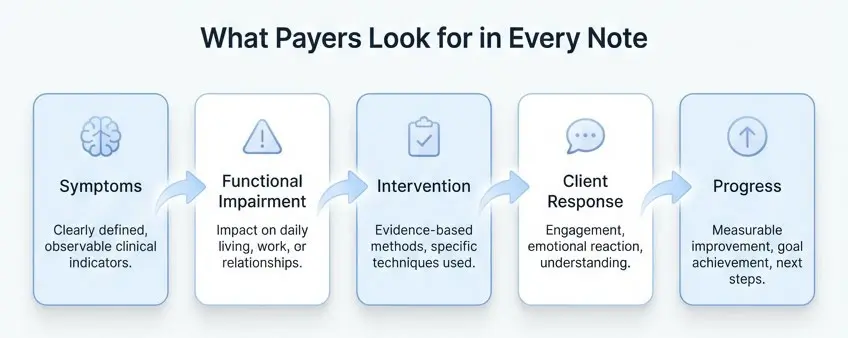
Effectively documenting medical necessity in behavioral health requires a consistent structure across every note you write. While formats differ — SOAP, DAP, BIRP — the underlying elements remain the same. The framework below shows the five elements payers expect to see clearly documented in every session note.
Presenting Problem and Current Symptoms
Each note should describe the client's current clinical presentation in specific, observable terms. Rather than "client is depressed," document the behavioral and functional markers: sleep disruption, appetite changes, psychomotor retardation, tearfulness in session, reported difficulty completing daily responsibilities. Quantify when possible. If you're using a validated measure like the PHQ-9 or GAD-7, include the score and note any change from the previous administration.
Diagnosis Linked to Impairment
Your diagnostic impression should clearly connect to the functional impairments driving treatment. Medical necessity for therapy hinges on this connection. A diagnosis alone doesn't justify services — what justifies services is the way that diagnosis impairs the client's ability to function in their daily roles. Document how symptoms interfere with occupational, social, academic, or self-care functioning.
Interventions and Clinical Rationale
Name the specific therapeutic interventions used during the session — cognitive restructuring, exposure planning, motivational interviewing, behavioral activation — and explain briefly why that intervention was appropriate given the client's current presentation. This is where many clinicians fall short: they document what they did but not why they did it.
Client Response to Treatment
Document how the client responded during the session. Did they demonstrate insight? Were they resistant? Did they practice a new skill successfully? Noting the client's in-session response gives reviewers evidence that active treatment is occurring.
Progress Toward Treatment Goals
Every session note should reference the treatment plan and speak to whether the client is progressing, plateauing, or regressing relative to their stated goals. If progress has stalled, note the clinical rationale for continuing treatment at the current frequency and level of care — this is especially important when documenting medical necessity criteria for outpatient mental health services, where payers scrutinize ongoing treatment closely.
Updated Plan
End each note with a clear plan: what happens next, when the next session is scheduled, any homework or between-session tasks, and whether the treatment plan needs modification.
Strong documentation of medical necessity in mental health requires more than listing symptoms. Payers evaluate whether your notes clearly connect clinical presentation, functional impairment, and interventions to measurable progress. Using a consistent framework like this helps ensure your documentation aligns with medical necessity criteria for outpatient mental health and supports reimbursement.
Medical Necessity Documentation Examples
To make these principles concrete, consider the difference between weak and strong documentation.
Weak vs Strong Medical Necessity Documentation Example
The comparison below shows why vague notes are difficult to defend in utilization review, while specific, structured documentation makes the clinical rationale visible.
“Client discussed anxiety. Provided supportive counseling. Will continue weekly sessions.”
This note gives a reviewer no basis for determining necessity.
- No symptom specificity
- No functional impairment
- No named intervention
- No treatment-plan reference
- No rationale for weekly sessions
“Client presented with increased generalized anxiety (GAD-7 score: 16, up from 12 at last administration). Reports difficulty falling asleep four or more nights per week, missing two days of work in the past two weeks due to panic symptoms, and avoiding social situations including a family event last weekend. Intervention: Introduced diaphragmatic breathing and began cognitive restructuring targeting catastrophic thinking patterns related to work performance. Client was engaged and able to identify two automatic thoughts during session. She practiced the breathing technique and reported a subjective decrease in tension. Progress toward Goal 1 (reduce frequency of panic episodes from daily to two or fewer per week) remains partial — panic episodes have decreased from daily to approximately four per week since treatment began. Plan: Continue weekly CBT sessions to build on cognitive restructuring skills. Client will practice thought records between sessions. Will reassess GAD-7 at next visit.”
This version clearly documents symptom severity, functional impairment, evidence-based intervention, client response, progress toward goals, and the rationale for continued weekly treatment.
The strong documentation example leaves no ambiguity. The symptoms are specific and measurable, the impairment is clear, the intervention is named and justified, progress is tracked against a concrete goal, and the plan is forward-looking.
Here's a second example illustrating medical necessity documentation examples for a maintenance-focused case:
Strong Medical Necessity Example (Maintenance Case)
This example demonstrates how to justify continued treatment when the goal is stabilization and prevention of deterioration rather than symptom reduction.
“Client with chronic PTSD (stable on current medication regimen) presented with baseline hypervigilance and sleep disruption (approximately five hours per night, consistent with recent sessions). No increase in flashback frequency this week. Intervention: Continued grounding techniques and reviewed use of coping strategies during a triggering workplace interaction. Client demonstrated effective use of 5-4-3-2-1 grounding without clinician prompting — a notable improvement from three months ago when she required step-by-step guidance. Progress toward Goal 2 (independent use of coping skills in triggering environments) is advancing. Clinical rationale for continued biweekly sessions: Client's symptom profile remains stable but deteriorates rapidly when session frequency is reduced, as documented during the four-week gap in October when she reported a return to daily flashbacks and contacted the crisis line. Plan: Maintain biweekly sessions. Reassess step-down to monthly in 60 days if stability continues.”
✔ This note clearly supports medical necessity by documenting baseline symptoms, functional impact, skill progression, and a strong clinical rationale for continued care — even in a maintenance phase.
This example demonstrates how to justify ongoing treatment for chronic conditions — a frequent sticking point for medical necessity criteria for mental health reviews.
How CMS Medical Necessity Guidelines Apply to Outpatient Mental Health
For clinicians treating Medicare beneficiaries, CMS medical necessity guidelines set the floor for documentation standards. CMS requires that outpatient psychiatric services be reasonable and necessary, meaning they must serve a diagnostic purpose or be reasonably expected to improve the client's condition. For clients with chronic mental illness, CMS acknowledges that improvement may mean symptom control and functional maintenance rather than full resolution.
CMS expects each psychotherapy session to be supported by a progress note documenting the presenting condition, the interventions used, the client's response, progress toward treatment goals, and any updates to the treatment plan. Documentation should also include accurate diagnostic coding consistent with the client's actual condition — upcoding or using unsupported diagnoses is a compliance risk that can trigger audits and recoupments.
Medical necessity criteria for outpatient mental health under CMS also require that treatment be delivered at the least restrictive appropriate level of care. If a client can be effectively treated with biweekly outpatient sessions, documenting a rationale for more intensive services requires clear clinical justification — such as acute symptom escalation, safety concerns, or recent hospitalization.
Private payers frequently adopt CMS standards as a baseline and then apply additional requirements. Many commercial plans use InterQual behavioral health criteria for utilization review, while substance use treatment is often evaluated against ASAM criteria. Knowing which framework your client's payer uses helps you write documentation that speaks directly to their review process.
Building Documentation Habits That Stick
Good documentation is ultimately a clinical habit, and the best way to build it is to reduce the friction involved in producing thorough notes. A few practical strategies can help.
Write Notes the Same Day
The longer you wait, the less specific your recall becomes, and vague documentation is the single biggest threat to demonstrating medical necessity.
Use Structured Templates
Templates that prompt you for each required element — symptoms, impairment, intervention, response, progress, plan — ensure you don't skip critical components under time pressure. A good template doesn't constrain your clinical voice; it scaffolds it.
Integrate Measurement-Based Care
Validated rating scales like the PHQ-9, GAD-7, PCL-5, or Columbia Suicide Severity Rating Scale provide objective, quantifiable data points that strengthen documentation significantly. Including scale scores in your notes gives reviewers concrete evidence of symptom severity and change over time.
Review Your Notes with an Auditor's Eye
Periodically re-read your notes and ask: if I were a utilization reviewer with no other context, would I approve this session based solely on what's written here? If the answer is uncertain, tighten the documentation.
How Strong Are Your Progress Notes?
Take our free 5-minute Progress Note Self-Assessment Tool to see how your documentation stacks up. Identify gaps, reduce compliance risk, and get practical insight into whether your notes are audit-ready.
It’s a quick way to spot documentation weaknesses before they become billing or compliance problems.
Take the 5-Minute Self-Assessment
How ICANotes Supports Documenting Medical Necessity
One of the most effective ways to consistently produce thorough, audit-ready documentation is to use an EHR system designed specifically for behavioral health. This is where ICANotes makes a measurable difference for clinicians.
ICANotes was built by a practicing psychiatrist who understood that behavioral health documentation has fundamentally different demands than general medical charting. The platform's menu-driven, click-to-chart templates are designed around the specific elements that establish medical necessity mental health services require — presenting symptoms, functional impairment, DSM-5-aligned diagnoses, named interventions, client response, and goal-referenced progress tracking.
Rather than starting from a blank screen, clinicians using ICANotes select from pre-configured clinical content that generates detailed narrative notes in minutes. The templates are structured to prompt for every element a utilization reviewer looks for, which means the documentation of medical necessity is built into the workflow rather than added as an afterthought. Notes are automatically coded for accurate billing, reducing the risk of mismatches between clinical content and submitted claims.
For practices focused on measurement-based care, ICANotes includes access to over 100 clinical rating scales — from the PHQ-9 and GAD-7 to the YMRS and AUDIT — directly within the charting workflow. Scores can be tracked over time and referenced in progress notes, giving payers the quantifiable evidence they need to approve ongoing treatment.
Treatment planning tools in ICANotes link goals, objectives, and interventions directly to progress notes, ensuring continuity across the clinical record. When a reviewer pulls a chart, they can trace a clear line from the initial assessment through each session to the current treatment plan — exactly the kind of coherent narrative that satisfies medical necessity criteria for mental health at any level of review.
For group practices and multidisciplinary teams, ICANotes supports role-based access and shared treatment plan tools so that every provider documenting on a case is working from the same clinical framework. This consistency strengthens the overall record and reduces the risk of contradictory or incomplete documentation across providers.
Build Medical Necessity Into Every Note—Automatically
ICANotes helps you document medical necessity consistently with structured templates, built-in clinical logic, and integrated rating scales — so your notes support reimbursement without extra effort.
- Prompted documentation for symptoms, impairment, interventions, and progress
- 100+ built-in rating scales (PHQ-9, GAD-7, PCL-5, and more)
- Automatically structured, audit-ready progress notes
- Designed specifically for behavioral health clinicians
Start your 30-day free trial and see how easy compliant documentation can be (no credit card required!)
Protecting Your Practice and Your Clients
Documenting medical necessity isn't just an administrative task — it's a clinical responsibility. Thorough documentation protects your clients' access to the care they need by giving payers the evidence required to authorize and reimburse services. It protects your practice from audit risk and claim recoupments. And it sharpens your clinical thinking by requiring you to articulate, in every session, why this client needs this treatment at this intensity right now.
The clinicians who rarely face denials aren't necessarily treating different populations or using different interventions. They're documenting differently — with specificity, structure, and a clear line from diagnosis to impairment to intervention to progress.
Whether you're refining your current documentation practices or looking for a system that builds compliance into the workflow, the goal is the same: notes that tell a complete clinical story every time. ICANotes gives behavioral health clinicians the tools to do exactly that — so you can spend less time on paperwork and more time on the work that matters.
Ready to see how ICANotes can streamline your documentation and strengthen medical necessity in every note? Book a demo or start your free trial today.

Frequently Asked Questions: Medical Necessity in Mental Health
Related Posts



Dr. October Boyles
DNP, MSN, BSN, RN
About the Author
Dr. October Boyles is a behavioral health expert and clinical leader with extensive expertise in nursing, compliance, and healthcare operations. With a Doctor of Nursing Practice (DNP) and advanced degrees in nursing, she specializes in evidence-based practices, EHR optimization, and improving outcomes in behavioral health settings. Dr. Boyles is passionate about empowering clinicians with the tools and strategies needed to deliver high-quality, patient-centered care.