ACT Therapy for Anxiety: Interventions & Treatment Plans
A clinician's guide to what the evidence says, twelve session-ready interventions, and a worked ACT treatment plan for anxiety.


Clients rarely come to therapy asking to feel everything more fully. They want the anxiety to stop. That single fact is what makes ACT therapy for anxiety both counterintuitive and useful: the treatment starts by questioning the goal the client walked in with.
This guide covers what the evidence actually says about acceptance and commitment therapy for anxiety disorders, twelve interventions you can use inside a standard session, a worked ACT treatment plan with measurable objectives, and how the approach shifts across generalized anxiety, panic, social anxiety, and health anxiety. A running vignette shows how each move sounds in the room.
What you'll learn
- What it targets: not anxiety itself, but the control agenda — the avoiding, analyzing, reassuring and checking that shrinks a client's life in exchange for short-term relief.
- Evidence: meta-analyses report a medium-to-large effect on anxiety symptoms and no reliable difference from CBT. NICE CG113 does not name ACT as a specific recommended intervention.
- Mechanism: psychological flexibility, built across six processes — present-moment contact, acceptance, defusion, self-as-context, values, and committed action.
- Course length: typically 8 to 16 sessions, with willingness and defusion usually shifting before symptom scores do.
- How progress is measured: participation in valued activity, tracked alongside symptom measures rather than replaced by them.
Is ACT Effective for Anxiety? What the Evidence Shows
ACT has accumulated a substantial randomized trial literature over the past two decades, and the anxiety findings are consistent enough to summarize plainly.
Pooled analyses of randomized controlled trials report a medium-to-large effect of ACT on anxiety symptoms, with a reported effect size around g = 0.52. Broader meta-analyses of ACT across mental and physical health conditions find it superior to waitlist (g = 0.82), to psychological placebo (g = 0.51), and to treatment as usual (g = 0.64).
The comparison clinicians ask about most is ACT versus CBT. Here the honest answer is that head-to-head trials have not found a statistically significant difference between ACT and established cognitive behavioral treatments for anxiety. That is a meaningful finding rather than a disappointing one: it means ACT is a defensible first-line psychological option, not that it outperforms what you may already be doing well.
What the Evidence Does Not Yet Settle
Three limitations are worth holding onto when you describe ACT to a client or a payer:
- Disorder-specific trials are uneven. Much of the anxiety evidence comes from mixed-anxiety samples rather than from diagnosis-specific trials. Panic disorder and health anxiety have thinner literatures than GAD or social anxiety.
- Process claims outrun process evidence. Psychological flexibility is the proposed mechanism, and mediation findings are broadly supportive, but the causal chain is not fully established.
- Protocol heterogeneity is high. Trials vary widely in dose, format, and therapist training, which makes pooled effect sizes less precise than the numbers suggest.
ACT in NICE and Clinical Guidelines
This question comes up often enough to answer directly: NICE does not specifically recommend ACT for anxiety.
NICE guideline CG113, which covers the management of generalized anxiety disorder and panic disorder in adults, recommends psychological therapy, medication and guided self-help as treatment options, but names CBT-based interventions rather than ACT. NICE surveillance review has acknowledged evidence from mixed-anxiety populations indicating that ACT, described as an adaptation of CBT, is as effective as CBT for GAD — but concluded that there was not sufficient new evidence to add a standalone ACT recommendation.
The practical reading for clinicians: ACT sits inside the recommended category of psychological therapy without having its own line in the guideline. If you practice in a setting that requires guideline-aligned treatment selection, document ACT as an evidence-supported cognitive behavioral intervention and cite the trial literature directly rather than relying on a NICE endorsement that does not exist.
Clinicians outside the UK: the equivalent question is usually about payer medical-necessity criteria rather than national guidelines. There, what matters is that your documentation links a recognized intervention to a measurable functional goal — covered in the treatment plan section below.
How ACT Works for Anxiety: The Six Core Processes
The Clinical Problem, Reframed
Anxiety thrives on a control agenda: avoid, analyze, reassure, check. Each of those strategies works — briefly. Over months they become away moves that quietly shrink a life until the client is managing anxiety full-time and living part-time.
ACT normalizes this pattern without judgment and offers a different move: notice what shows up inside, make room for it, and choose a toward move guided by values. The capacity that makes this possible is psychological flexibility.
Psychological Flexibility as the North Star
Psychological flexibility is the ability to stay in contact with difficult thoughts and feelings while continuing to act on what matters. It increases when a session helps a client do six things:
- Contact the present moment — attention on now rather than on rehearsal or review.
- Acceptance — making room for discomfort instead of suppressing it.
- Cognitive defusion — seeing thoughts as thoughts rather than as mandates.
- Self-as-context — standing in the observing self rather than inside the story.
- Values — clarifying what the client wants their life to be about.
- Committed action — taking steps in that direction with anxiety along for the ride.
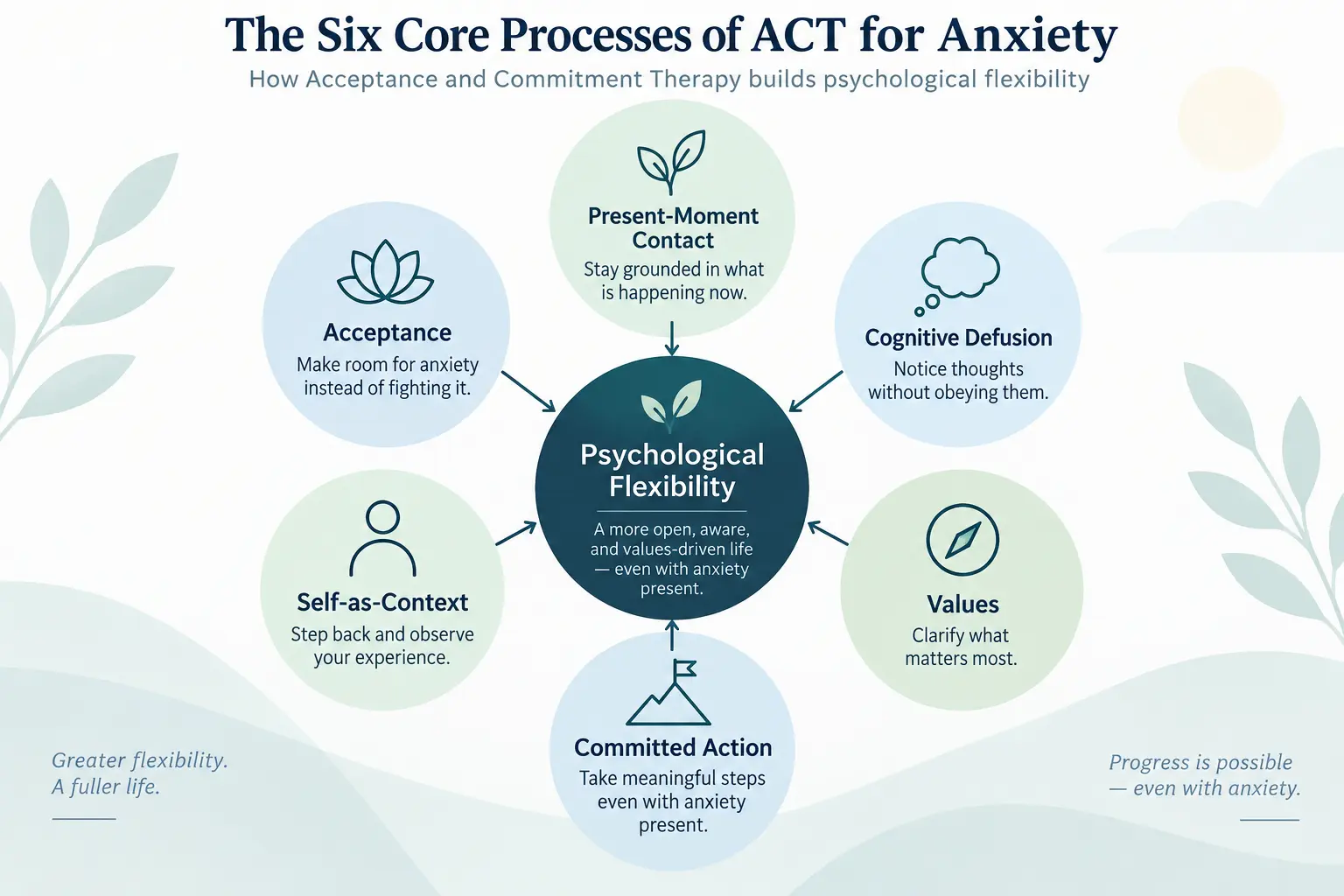
These are not stages to complete in order. They are six handles on the same problem, and in a good session you will reach for two or three of them.
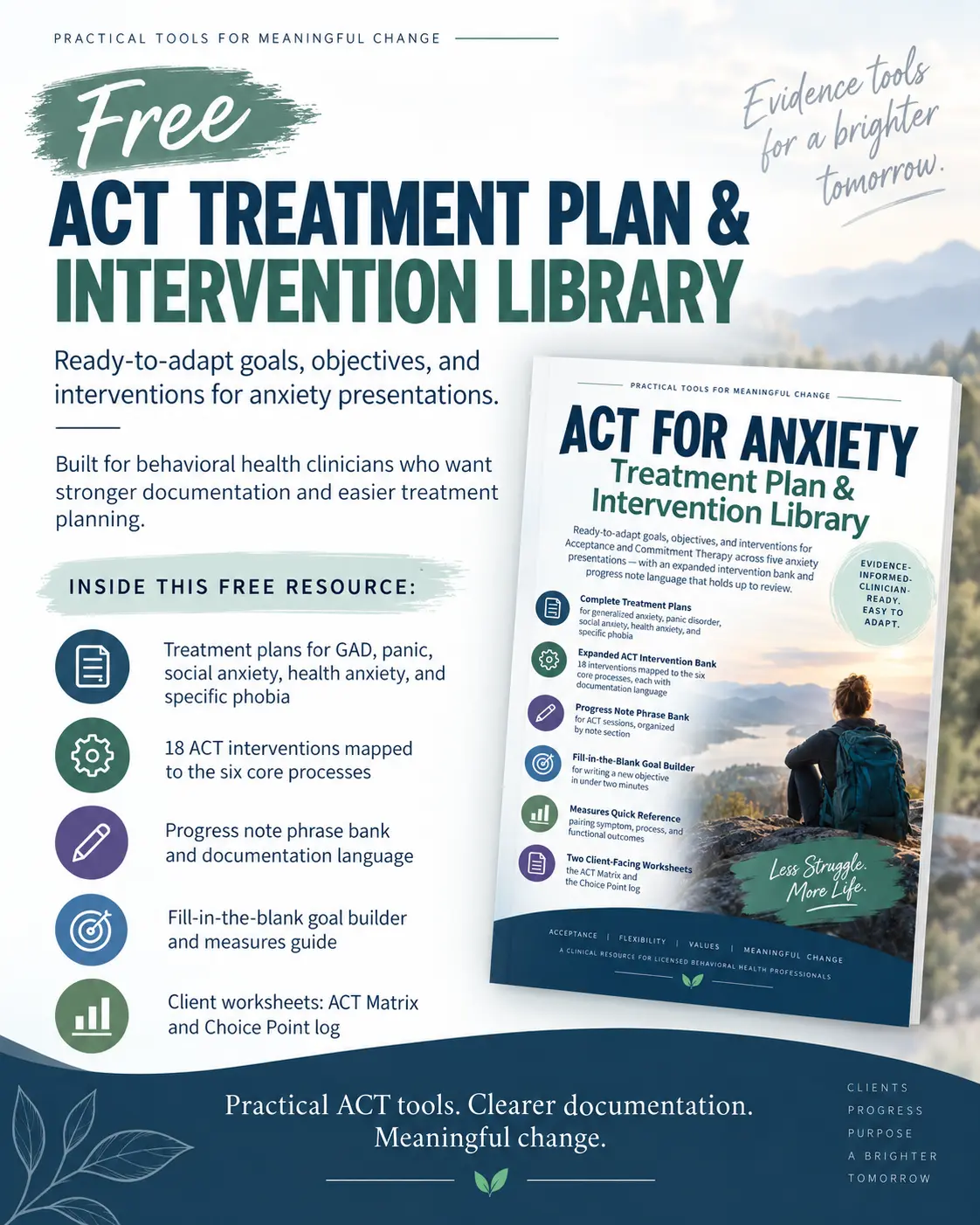
Free ACT Treatment Planning Resource for Anxiety
Inside the ACT for Anxiety Treatment Plan & Intervention Library, you’ll get complete treatment plan examples for generalized anxiety, panic disorder, social anxiety, health anxiety, and specific phobia, plus practical tools you can use to strengthen documentation across the episode of care.
- 18 ACT interventions mapped to the six core processes
- Progress note language organized by note section
- A fill-in-the-blank ACT goal builder
- A quick reference for symptom, process, and functional measures
- Client-facing ACT Matrix and Choice Point worksheets
12 ACT Interventions for Anxiety
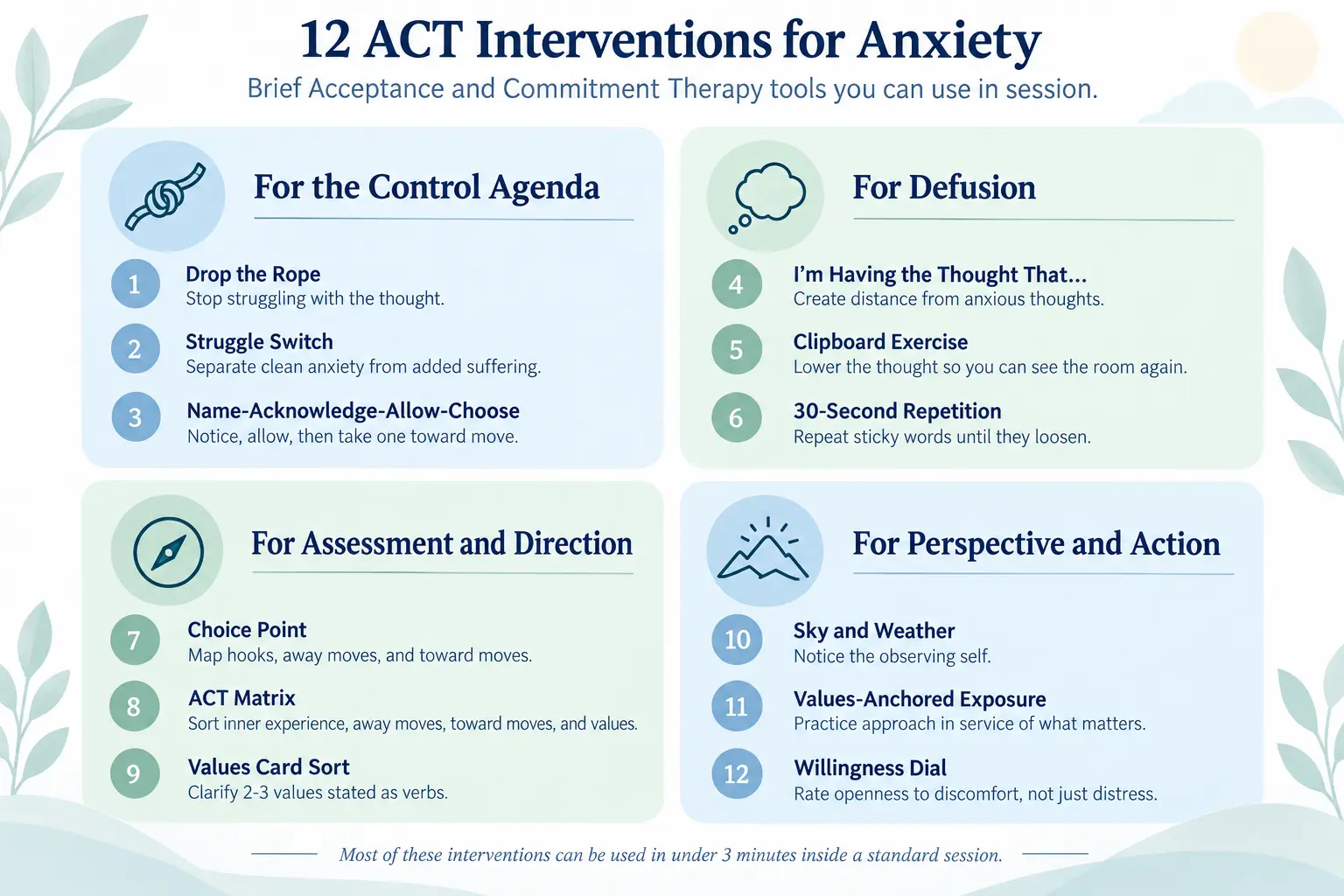
The interventions below are organized by the process they target. Most take under three minutes, which is the constraint that matters in a real session.
For the Control Agenda
- Drop the rope. When a client is wrestling with a thought like "I'll say something stupid," enact a tug-of-war with an actual object and then invite them to let go. The thought does not disappear; the struggle eases and their hands come free. Debrief with: what became possible when you stopped pulling?
- The struggle switch. Distinguish clean anxiety — the sensations themselves — from the added layer generated by fighting them. Ask the client to picture a switch. Switch on, every wave of anxiety recruits more anxiety. Switch off, the wave still comes and then passes. This is usually the fastest way to introduce willingness without it sounding like resignation.
- Name — Acknowledge — Allow — Choose. A four-beat sequence you can run in ninety seconds: name what is here ("tight chest"), acknowledge the urge to avoid, allow two or three breaths of space, choose one small toward move.
For Defusion
- "I'm having the thought that..." Have the client restate an anxious thought with that prefix, then with "I notice my mind is predicting...". The content is untouched; the grip loosens. Practice it on a low-stakes thought first so it is available when a hot one arrives.
- The clipboard exercise. Ask the client to hold a pad or notebook directly in front of their face — that is fusion, and notice how little else they can see. Then have them lower it to their lap. The pad is still there. The room comes back. Few metaphors land as reliably as this one.
- Thirty-second repetition. For a phrase that has become sticky, repeat it aloud, quickly, for half a minute, or in an odd voice. Its sound-like quality surfaces and its literal authority drops. Use it playfully and only with rapport established; it can read as mocking if introduced cold.
For Assessment and Direction
- The choice point. Sketch a simple fork: the situation at the bottom, the hooks that show up, then away moves on one branch and toward moves on the other. Clients grasp it in about a minute, and it becomes shared shorthand for the rest of treatment.
- The ACT Matrix. Four quadrants sorting inner experience, away moves, toward moves, and what matters. Excellent at intake — see the assessment section for a worked example.
- Values card sort. Narrow a broad list to two or three values, then insist on stating them as verbs: be present, be curious, be reliable. Verbs can be done on a Tuesday afternoon. Nouns cannot.
For Perspective and Action
- Sky and weather. When anxiety surges, invite the client to notice the part of them that is noticing. Short and concrete: "Close your eyes. Notice the noticer." Weather moves through; sky does not leave.
- Values-anchored exposure. Graded real-world practice, with the ladder built from values rather than from a fear hierarchy. The step is chosen because it serves connection or contribution, not because it will lower anxiety — and that reframe is what keeps exposure from becoming another control strategy.
- Willingness dial. Rather than asking for a distress rating, ask the client to rate how open they were to feeling what showed up, 0 to 10. This tracks the thing you are actually building and gives you a process measure that moves earlier than symptom scores.
The 12 interventions above can be grouped into four practical clinical functions, making it easier to choose an ACT technique based on what is happening in the session.
Assessment: The ACT Matrix and Process Measures
Case Vignette
Jamie — Social Anxiety Presentation
Jamie, 28, reports intense anxiety in social settings — racing heart, catastrophic self-talk ("I'm boring," "They're judging me"), and escalating avoidance.
Jamie wants friends and professional growth but is "waiting until I'm less anxious" to try. We will return to Jamie throughout.
Map Function, Not Just Form
Early sessions ask three questions: What does anxiety stop you from doing? What do you do instead? What does that cost you? The ACT Matrix organizes the answers. Jamie's, at intake:
| Quadrant | Jamie's content |
|---|---|
| What matters | Connection, learning, reliability |
| Inner experience | Tight chest, heat, "I'm awkward," images of blushing |
| Away moves | Cancel plans, drink to cope, overprepare, scroll at home |
| Toward moves | Text a coworker, attend a meetup for 20 minutes, ask one curious question |
Measures Worth Collecting
Pair a symptom measure with a process measure so you can see flexibility change before symptoms do:
- Symptom: GAD-7, or a disorder-specific scale where one fits the presentation.
- Process: a psychological flexibility or acceptance-and-action measure.
- Function: a brief count of valued activities completed per week — often the most clinically meaningful of the three, and the easiest to explain to a payer.
Document the matrix and baseline scores, then revisit both at set intervals rather than ad hoc.
A Phase-Based ACT Treatment Arc
Phase 1: Orient and Steady
Normalize the control trap and introduce allowing as the workable alternative.
Phase 2: Unhook from Language
Help the client see thoughts as events rather than instructions, using the defusion moves.
Phase 3: Make Meaning Explicit
Clarify values — anxiety is loud because something matters.
Phase 4: Let Values Drive Behavior
Build a ladder of steps sized to succeed with anxiety in the client's pocket.
Phase 5: Stabilize Perspective
Invite the client into the observing position when anxiety surges.
Phase 1: Orient and Steady
Normalize the control trap and introduce allowing as the workable alternative.
Therapist: "Where is the anxiety in your body right now?"
Jamie: "Tight chest."Therapist: "Let's make room around that tightness — no fight, no fix — so you can keep choosing what matters."
Keep it brief and experiential: 60 to 90 seconds of breath and sensation labeling, sprinkled through the hour. The goal is not serenity. It is willingness while engaged.
Phase 2: Unhook from Language
Help Jamie see thoughts as events rather than instructions, using the defusion moves above. Defusion is not debate. If Jamie insists a thought is true, explore how it might be — then ask whether treating it as truth is advancing what Jamie cares about right now.
Phase 3: Make Meaning Explicit
Anxiety is loud because something matters.
Therapist: "If your social life were easier, what kind of person would you be?"
Jamie: "Present and supportive."Therapist: "Let's let that steer our experiments."
Phase 4: Let Values Drive Behavior
Build a ladder of steps sized to succeed with anxiety in the client's pocket:
- This week: send one text invite by Thursday noon; attend a coffee for 10 minutes minimum.
- Willingness cue: "Tight chest can ride along while I ask one curious question."
- After-action review: What moved you toward or away? What did you learn about what helps?
Phase 5: Stabilize Perspective
When anxiety surges, invite Jamie into the observing position. Short sky-and-weather exercises reduce over-identification with strong thoughts and urges.
Phase 6: Consolidate and Prevent Relapse
Map typical choice points — thirty minutes before an event, for instance — and rehearse a three-step plan: name it, make room, move toward. Refresh the matrix, re-score measures, and review gains in life participation alongside symptom change.
ACT Treatment Plan for Anxiety: A Worked Example
This is where ACT most often runs into trouble on paper. The work is process-focused and experiential; treatment plans and payers want countable objectives. The two are reconcilable, but the objectives have to be written in behavior rather than in insight.
Jamie's Plan (Social Anxiety Presentation)
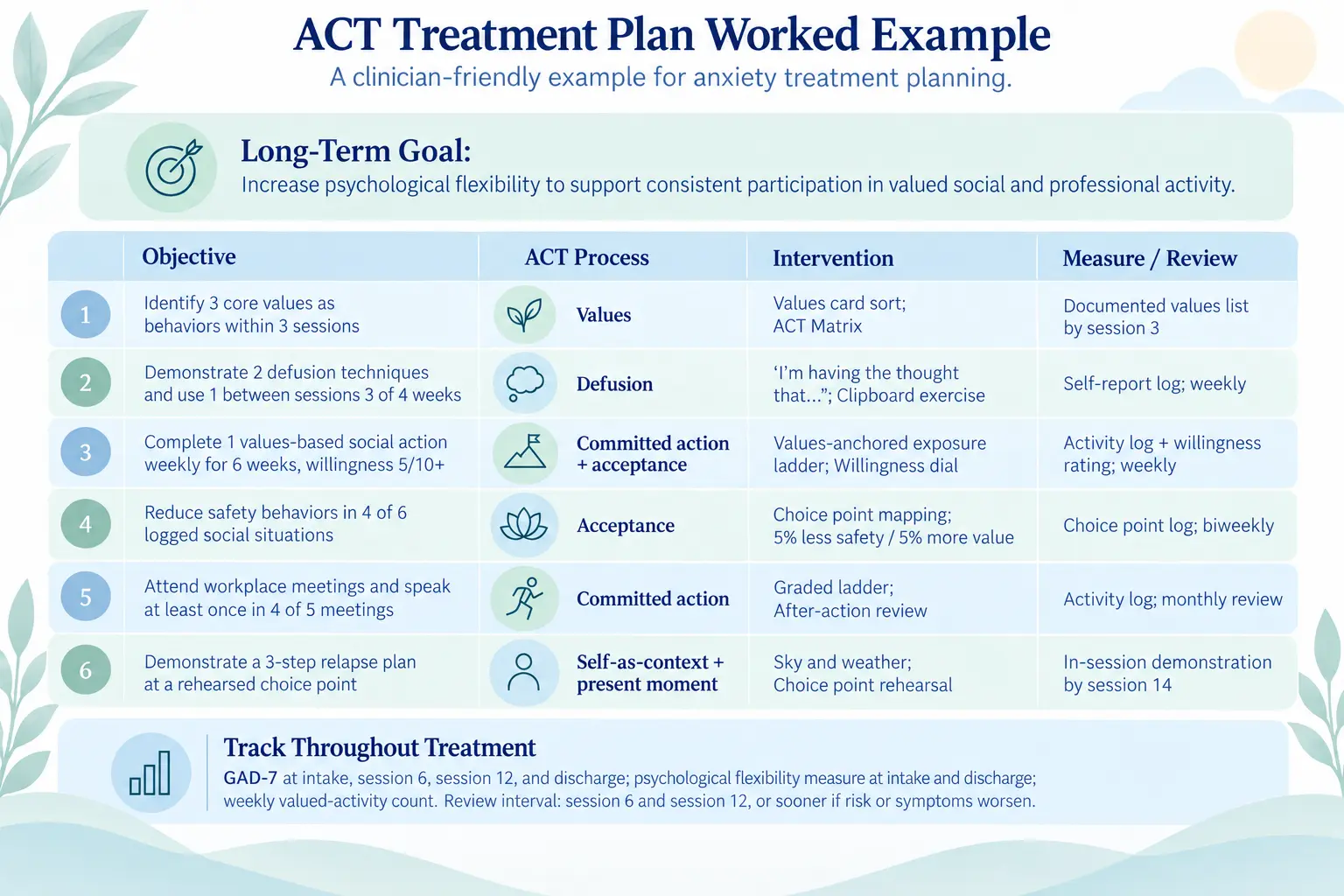
Problem statement: Client reports persistent anxiety in social and performance situations with associated physiological arousal and self-critical cognition, resulting in avoidance of workplace meetings and social invitations. Avoidance has reduced professional participation and social contact over approximately 18 months.
Long-term goal: Increase psychological flexibility to support consistent participation in valued social and professional activity.
| Short-term objective | ACT process targeted | Interventions | Measure / interval |
|---|---|---|---|
| Client will identify and state three core values as behaviors within 3 sessions. | Values | Values card sort; matrix bottom-right quadrant | Documented values list / session 3 |
| Client will demonstrate two defusion techniques in session and report using one between sessions, 3 of 4 weeks. | Defusion | "I'm having the thought that—" clipboard exercise | Self-report log / weekly |
| Client will complete one values-based social action per week for 6 consecutive weeks, with willingness rated at or above 5/10. | Committed action; acceptance | Values-anchored exposure ladder; willingness dial | Activity log + willingness rating / weekly |
| Client will reduce identified safety behaviors (rehearsing, early exit, alcohol to cope) in at least 4 of 6 logged social situations. | Acceptance | Choice point mapping; 5% less safety / 5% more value | Choice point log / biweekly |
| Client will attend scheduled workplace meetings and contribute verbally at least once per meeting, 4 of 5 consecutive meetings. | Committed action | Graded ladder; after-action review | Activity log / monthly review |
| Client will demonstrate a 3-step relapse plan (name it, make room, move toward) at a rehearsed choice point. | Self-as-context; present moment | Sky and weather; choice point rehearsal | In-session demonstration / session 14 |
Measures: GAD-7 at intake, session 6, session 12, discharge. Psychological flexibility measure at intake and discharge. Weekly valued-activity count throughout.
Review interval: Plan reviewed at session 6 and session 12, or sooner if measures worsen or risk emerges.
The example below shows how those objectives, ACT processes, interventions, and progress measures fit together in a single treatment plan.
The Same Plan Adjusted for GAD
For a generalized presentation, the structure holds but the targets shift. Worry is the away move, so objectives track worry behavior rather than situational avoidance:
- Client will identify daily worry episodes and label them as mental behavior using a choice point log, 5 of 7 days per week.
- Client will practice a defusion technique at worry onset and redirect to a present-moment task, 4 of 7 days per week.
- Client will reduce reassurance-seeking and checking behaviors to no more than two identified instances per week.
- Client will complete one values-based activity per day that was previously postponed pending reduced worry.
Three Writing Rules That Keep ACT Plans Defensible
- Count behavior, not insight. "Client will accept anxious feelings" is not auditable. "Client will complete one values-based social action weekly with willingness rated 5/10 or above" is.
- Name the functional impairment explicitly. Medical necessity rests on impairment and the rationale for continued care, so the problem statement should state what the client cannot currently do.
- Track both symptom and function. ACT expects function to improve before symptoms do. If the chart only holds GAD-7 scores, a real early gain looks like no progress at all.
For a broader walkthrough of goal and objective structure, see our guide to creating mental health treatment plans.
Adapting ACT by Anxiety Presentation
The six processes stay constant. What changes is which away move you are working against.
ACT for Generalized Anxiety Disorder (GAD)
In GAD the away move is mental. Worry promises preparation and delivers avoidance — of uncertainty, of feeling unprepared, of the present moment itself. The ACT move is not to test whether the worries are realistic but to help the client notice worrying as something they are doing, then unhook and redirect.
"Your mind is doing its job. It's trying to solve a problem that isn't happening yet. What would you be doing right now if this problem weren't yours to solve today?"
Watch for intolerance of uncertainty presenting as a values question — clients often cannot name what matters because they have deferred every valued activity pending certainty that never arrives.
ACT for Panic Disorder and Panic Attacks
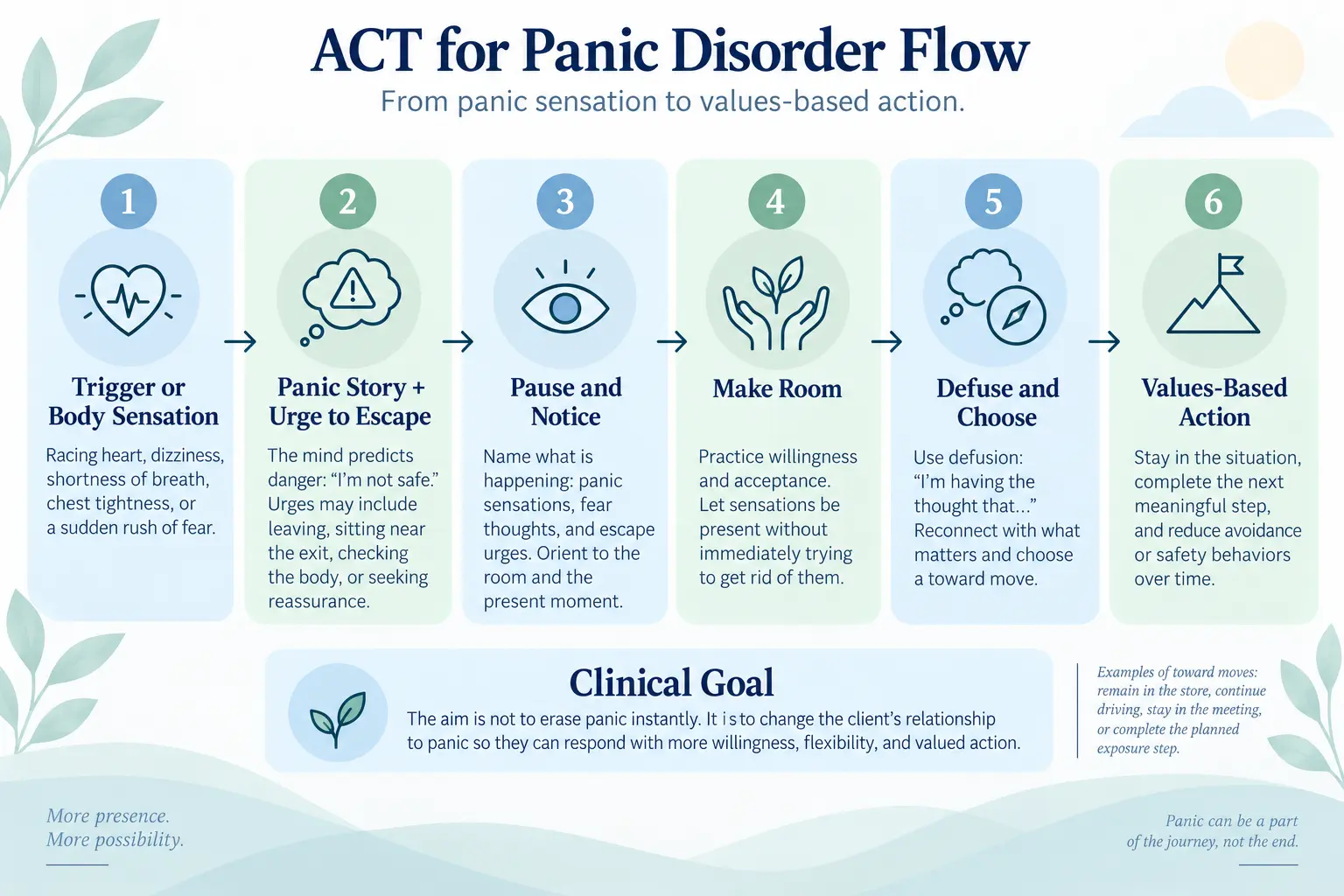
Panic is where ACT diverges most visibly from a symptom-reduction model, because ACT explicitly drops the goal of preventing attacks. Interoceptive practice still happens, but the frame is different: you are building willingness to feel the sensations, not demonstrating that they are harmless.
This distinction matters clinically. Reassurance that sensations are safe can function as a safety behavior, one the client must keep renewing. Willingness does not require renewal.
Success looks like re-entering avoided settings — the highway, the grocery store, the crowded room — with values intact, whether or not panic shows up. Note that the panic-specific ACT literature is smaller than the CBT literature, so be measured when discussing evidence with clients.
The flow below shows how ACT helps clients move from panic sensations and escape urges toward willingness, defusion, and values-based action.
ACT for Social Anxiety
Two away moves dominate: pre-event rehearsal and post-event review. Both feel like preparation and function as avoidance of the actual encounter. Jamie's plan above is built on this presentation.
The reliable lever is shifting attention outward. Self-focused attention is doing much of the work in social anxiety, and a values-framed instruction — "be curious about them" — accomplishes more than an instruction to stop monitoring oneself.
ACT for Health Anxiety
Here the away moves are checking, researching, and reassurance-seeking, and they are unusually well-reinforced because each one produces genuine relief within minutes.
Bodily sensations are the hooks, which makes acceptance work both central and delicate: you are asking a client to allow sensations they have interpreted as evidence of danger. Move slowly, work with the observing self early, and be explicit that the goal is not certainty about health. It is a life that does not require certainty in order to proceed.
A common snag: clients bargain for "one more test, then I'll do the ACT work." Name that as an away move in the moment and map it on the choice point.
How Many Sessions? Structuring an ACT Course
Published anxiety protocols generally run 8 to 16 sessions. A workable default structure:
| Sessions | Focus | Primary processes |
|---|---|---|
| 1-2 | Assessment, matrix, baseline measures, informed consent about willingness work | Present moment |
| 3-4 | Control agenda, creative hopelessness, introducing willingness | Acceptance |
| 5-6 | Defusion skills; first plan review | Defusion |
| 7-8 | Values clarification and translation into behavior | Values |
| 9-12 | Values-anchored exposure and committed action; safety behavior reduction | Committed action |
| 13-14 | Self-as-context; choice point rehearsal | Self-as-context |
| 15-16 | Consolidation, relapse plan, re-measurement, discharge | All six |
Treat this as a scaffold, not a manual. Clients with significant avoidance often need longer in sessions 9 through 12, and trauma histories usually warrant a slower approach to acceptance work.
Troubleshooting Common Snags
"Acceptance means giving up."
Reframe acceptance as the cost of admission to a valued life, not resignation. A 60-second push-the-beach-ball-underwater experiment makes the energy cost of suppression obvious, then ask which approach leaves more energy for action.
"Prove this will work."
Offer a behavioral bet: one small experiment, tracked in writing, judged against the client's values rather than your persuasiveness.
Safety behaviors creeping into exposures.
Treat them as away moves, without judgment. Then test 5% less safety alongside 5% more value — one question asked without rehearsing it first.
Values sound borrowed.
If stated values read like a performance review, they probably belong to someone else. Ask what the client would do with a free Saturday that nobody would ever hear about.
Willingness work destabilizes a trauma survivor.
Slow down and return to present-moment and self-as-context work before resuming acceptance exercises. Consent and collaboration are non-negotiable.
Cultural Humility and Accessibility
Values are client-defined, not clinician-prescribed. Honor culturally bound views of courage, family, spirituality, and help-seeking. Keep metaphors flexible — some clients prefer concrete demonstrations, others resonate with narrative. And recognize that some away moves are adaptive responses to real conditions; avoidance of a genuinely hostile workplace is not the same clinical target as avoidance of a friendly meetup.
Documenting ACT for Anxiety
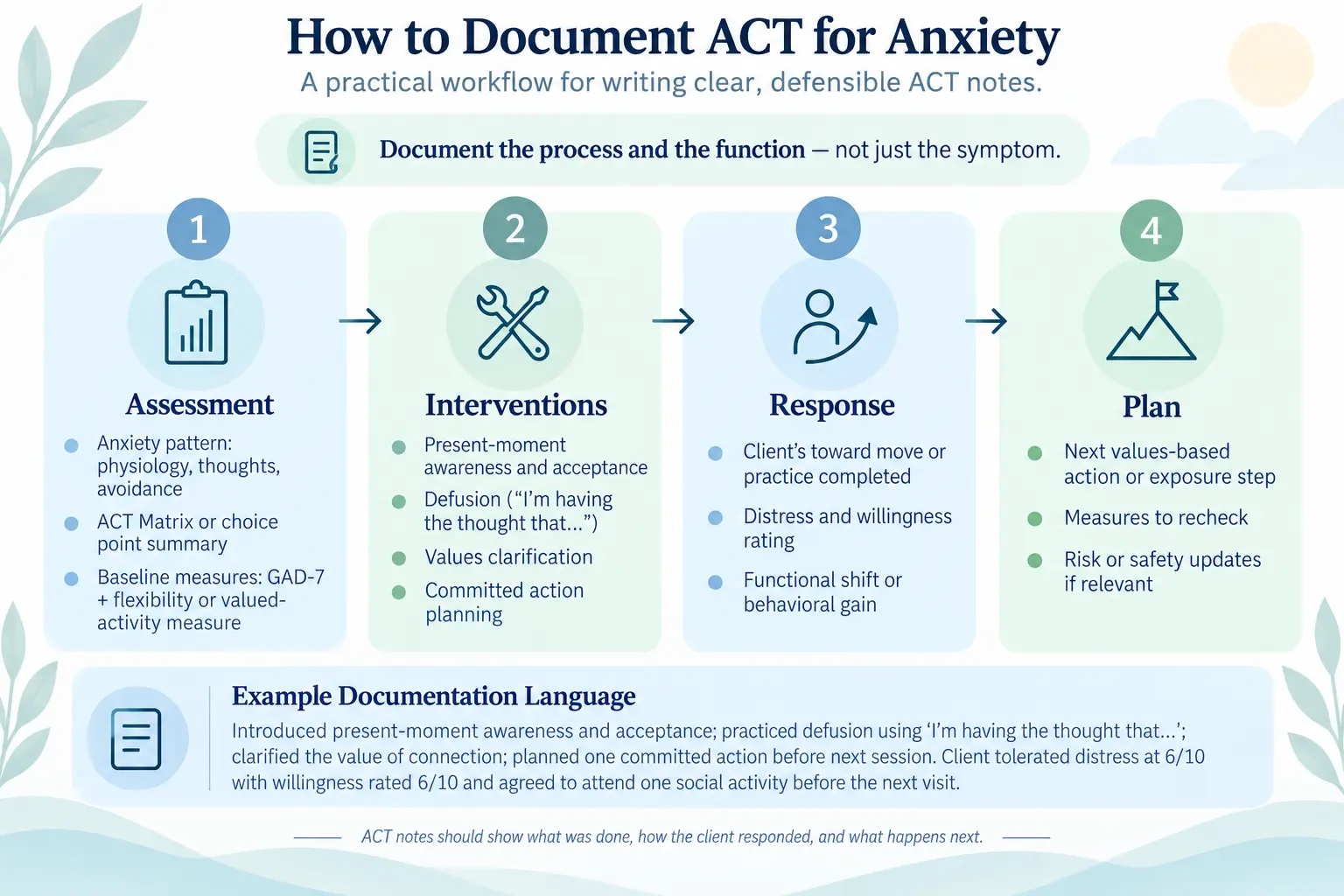
ACT's language does not map neatly onto symptom-focused note templates, which is why ACT notes often end up vaguer than the session actually was. Write notes that name the process and the function:
- Assessment: anxiety pattern (physiology, cognition, avoidance), matrix summary, baseline measures.
- Interventions: "Introduced present-moment awareness and acceptance; practiced defusion ('I'm having the thought—'); clarified values (connection); planned one committed action."
- Response: "Client enacted toward move; tolerated distress at 6/10 with willingness rated 6/10; reported pride and energy afterward."
- Plan: next step on ladder; measures to recheck; risk updates if relevant.
A strong ACT note should make the clinical sequence easy to follow: what was assessed, what intervention was used, how the client responded, and what happens next.
How ICANotes Supports ACT Documentation
If you use ICANotes, this language maps to the structured charting workflow rather than requiring free-text narration:
- ACT-aligned note content. Use or create custom buttons and phrases for acceptance practice, defusion, self-as-context, values clarification, and committed action, so notes reflect ACT language without typing from scratch.
- Treatment plans that map to values. Tie a goal like "increase psychological flexibility for social participation" to specific interventions and measurable objectives, then link each session note to those goals.
- Outcome and process tracking. Enter scales such as GAD-7 and PHQ-9 and track trends alongside process targets like toward and away moves and exposure steps completed.
- Client portal for ACT homework. Send matrix worksheets, values sorts and assessments through the portal and collect them before session, so therapy time goes to practice rather than paperwork.
- Audit-ready detail. Document MSE, risk checks, time spent, CPT code, and medical-necessity statements with structured clicks rather than prose.
If you want your ACT work to be faster to document and simpler to defend, see plans and pricing or book a demo.
Make ACT documentation faster to write and simpler to defend
See how ICANotes maps acceptance, defusion, values, and committed action to structured notes and value-linked treatment plans. Start your free trial and chart your next ACT session in a fraction of the time.
- Notes completed in under 3 minutes
- 30-day free trial, no credit card required
- Fully integrated billing, scheduling, and practice management
- 24x7 live support from behavioral health specialists
See how ICANotes can support your clinical workflow. Start your free 30-day trial, no credit card required.
Start Your Free 30-Day Trial
Explore ICANotes and see how it can simplify your clinical workflow. No credit card required.
Frequently Asked Questions
Is ACT effective for anxiety disorders?
Does NICE recommend ACT for anxiety?
What are the best ACT interventions for anxiety?
How do you write an ACT treatment plan for anxiety?
Can ACT be used for generalized anxiety disorder (GAD)?
Is ACT effective for panic attacks and panic disorder?
What's the difference between ACT and CBT for anxiety treatment?
How long does ACT therapy take to work for anxiety?
Can ACT make anxiety worse initially?
What does homework look like in ACT therapy for anxiety?
Making ACT Workable in the Real World
ACT widens a life even when anxiety stays noisy. Jamie still notices a quickened pulse at crowded events, but now texts a peer, asks one curious question, and leaves by choice rather than by panic.
The day-to-day challenge for clinicians is rarely knowing what to do in the room. It is documenting how you did it, linking it to goals a payer will recognize, and showing change over time — which is exactly the work a behavioral health EHR should be absorbing rather than adding to.
References
- A-Tjak, J. G. L., Davis, M. L., Morina, N., Powers, M. B., Smits, J. A. J., & Emmelkamp, P. M. G. (2015). A meta-analysis of the efficacy of acceptance and commitment therapy for clinically relevant mental and physical health problems. Psychotherapy and Psychosomatics, 84(1), 30–36. PubMed
- Powers, M. B., Zum Vörde Sive Vörding, M. B., & Emmelkamp, P. M. G. (2009). Acceptance and commitment therapy: A meta-analytic review. Psychotherapy and Psychosomatics, 78(2), 73–80. PubMed
- Gloster, A. T., Walder, N., Levin, M. E., Twohig, M. P., & Karekla, M. (2020). The empirical status of acceptance and commitment therapy: A review of meta-analyses. Journal of Contextual Behavioral Science, 18, 181–192. ScienceDirect
- Twohig, M. P., & Levin, M. E. (2017). Acceptance and commitment therapy as a treatment for anxiety and depression: A review. Psychiatric Clinics of North America, 40(4), 751–770. PubMed
- Ferreira, M. G., Mariano, L. I., de Rezende, J. V., Caramelli, P., & Kishita, N. (2022). Effects of group Acceptance and Commitment Therapy (ACT) on anxiety and depressive symptoms in adults: A meta-analysis. Journal of Affective Disorders, 309, 297–308. ScienceDirect
- National Institute for Health and Care Excellence. (2011, updated 2020). Generalised anxiety disorder and panic disorder in adults: management (Clinical guideline CG113). NICE
- National Institute for Health and Care Excellence. (2019). Surveillance review proposal: Generalised anxiety disorder and panic disorder in adults (CG113). NICE
Diane Bigler
Diane Bigler, LCSW, LSCSW, is a Licensed Clinical Social Worker in Missouri and Kansas with over 25 years of experience in the mental health field. She has held clinical positions as an outpatient and in-home therapist and clinical supervisor in diverse settings. Diane was an Adjunct Professor of Social Work for 10 years at The University of Kansas, School of Social Welfare and a Field Liaison and Field Instructor. She has also held administrative positions as a Program Director and Coordinator. Diane is a popular local and national trainer on a wide variety of mental health and workplace development topics for clinicians and corporations and has facilitated over 500 training courses in the last few years.