Blog > Documentation > Functional Impairment: Definition, Examples & How It’s Measured
What Is Functional Impairment in Mental Health? Definition, Examples, Documentation & Medical Necessity
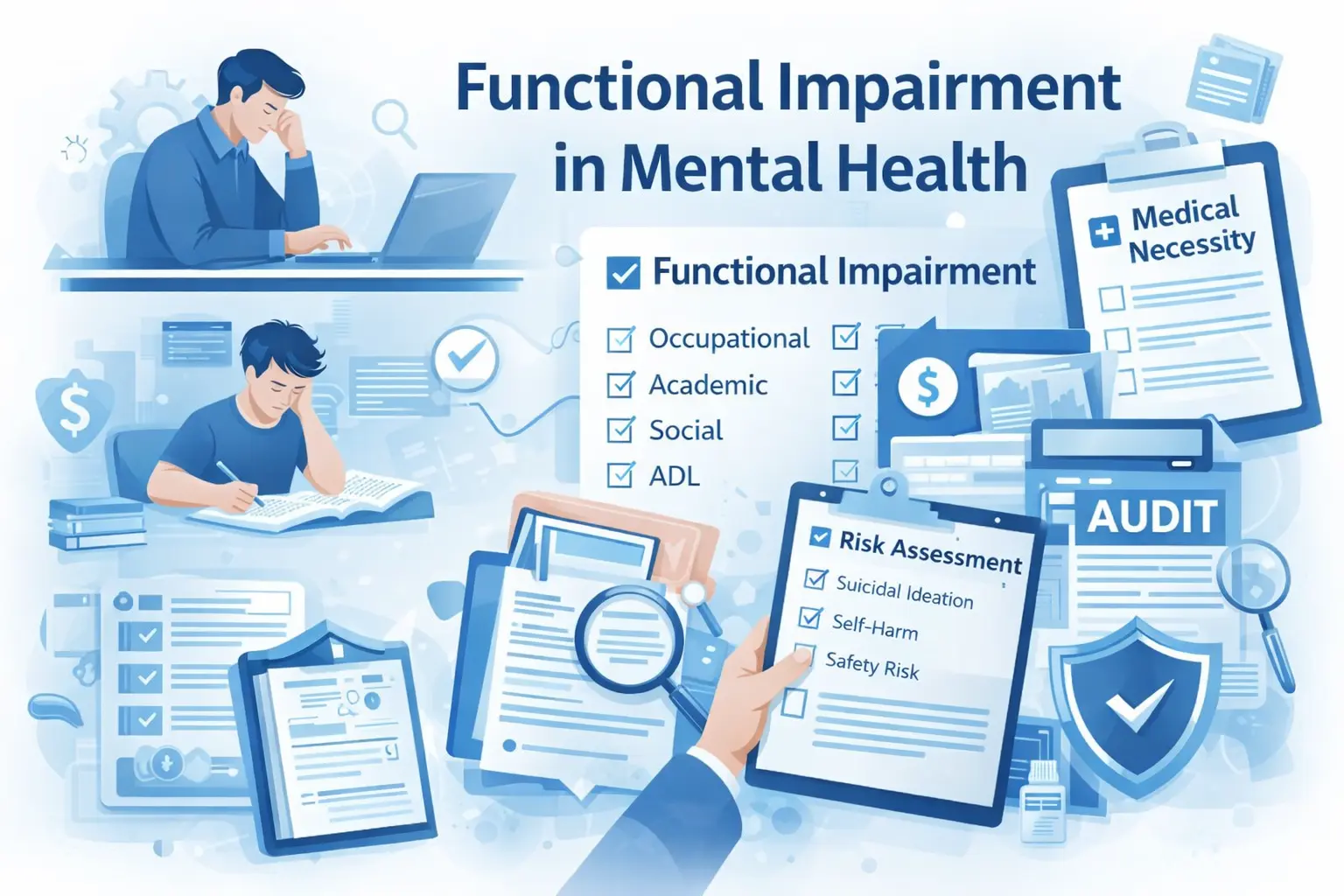
Functional impairment in mental health refers to the real-world disruption caused by psychiatric symptoms. In this comprehensive guide, you’ll learn the definition of functional impairment, review clear examples across life domains, understand the different levels of impairment severity, explore tools used to measure impairment, understand how medical necessity is determined, and see how to document impairment in a way that supports insurance reimbursement and audit defensibility.

Last Updated: April 8, 2026

What You'll Learn
-
The clinical definition of functional impairment in mental health
-
The difference between symptoms and impaired functioning
- How functional impairment differs from functional limitations
-
Clear examples of functional impairment across work, school, relationships, and daily living
- Levels of functional impairment severity — from mild to severe
-
How to identify impairment in clinical practice
-
Which standardized tools help measure functional impairment
-
How functional impairment connects to medical necessity
-
How to document impairment for insurance reimbursement and audits
-
Common documentation mistakes that increase audit risk
Contents
- What is Functional Impairment in Mental Health?
- Functional Impairment Definition
- Functional Limitations vs. Functional Impairment
- Symptoms vs. Functional Impairment
- Examples of Functional Impairment in Mental Health
- Levels of Functional Impairment: From Mild to Severe
- How to Identify Functional Impairment in Clinical Practice
- Assessing and Documenting Risk When Safety Concerns Are Present
- Functional Impairment Assessment Tools
-
How to Document Functional Impairment for Insurance and Audits
- What is Medical Necessity in Mental Health?
- Functional Impairment in Mental Health: FAQs for Clinicians
-
How ICANotes Supports Documentation of Functional Impairment and Risk
If you’ve ever asked yourself “What is functional impairment?” or wondered how to clearly document impairment for insurance and audits, you’re not alone.
In mental health care, symptoms alone are not enough to justify diagnosis or treatment. Clinicians must demonstrate functional impairment — how symptoms interfere with a client’s ability to live, work, learn, and relate to others.
In this guide, we’ll define functional impairment in mental health, explain how it differs from functional limitations, provide real examples of impaired functioning at each severity level, explore assessment tools that measure impairment, and show how to document it clearly to support medical necessity.
What is Functional Impairment in Mental Health?
Functional impairment in mental health refers to the measurable disruption a mental health condition causes in a person’s daily functioning.
It answers one central question:
How are this client’s symptoms interfering with their real-world responsibilities?
To meet DSM criteria and medical necessity standards, symptoms must cause clinically significant distress or impairment in social, occupational, academic, or other important areas of functioning.
Without documented impairment, treatment may not be considered medically necessary.
Functional Impairment Definition: What Clinicians Must Demonstrate
The functional impairment definition in behavioral health is:
A loss or reduction in the ability to perform expected life roles due to psychiatric symptoms.
This includes interference with work performance, academic achievement, household management, financial responsibilities, parenting or caregiving, interpersonal relationships, and health maintenance.
The key is connecting symptoms directly to observable life disruption.
Functional Limitations vs. Functional Impairment: What's the Difference?
The terms functional impairment and functional limitations are sometimes used interchangeably, but they carry different connotations depending on context.
Functional Impairment
Functional impairment is the term most commonly used in mental health and behavioral health settings. It refers specifically to the disruption psychiatric symptoms cause in a person’s ability to carry out life roles — and it is the standard language used in DSM-5 diagnostic criteria, insurance medical necessity determinations, and clinical documentation.
Functional Limitations
Functional limitations is more commonly used in disability law, occupational therapy, vocational rehabilitation, and ADA (Americans with Disabilities Act) contexts. It often describes the specific activities or tasks a person cannot perform or has difficulty performing, regardless of the underlying cause.
In practice, the distinction matters for documentation. When writing clinical notes for insurance reimbursement, the term functional impairment aligns with the language reviewers expect and the criteria they apply. When preparing disability evaluations, accommodation requests, or vocational assessments, functional limitations may be the more precise and expected term.
Both concepts describe how a condition affects real-world functioning. The difference is largely one of clinical setting and audience.
Symptoms vs. Functional Impairment: What’s the Difference?
A common documentation mistake is describing symptoms without describing impact.
Symptoms
What it is: Internal experiences a client reports or you observe, such as sadness, anxiety, intrusive thoughts, irritability, or mood instability.
What it tells you: How the client feels and what they are experiencing clinically.
Functional Impairment
What it is: The real-world impact of symptoms on daily responsibilities, such as missed workdays, declining grades, social withdrawal, or difficulty managing self-care.
What it tells you: What the client cannot do — or struggles to do — because of their symptoms.
❌ “Client reports severe depression.”
✅ “Client reports severe depressive symptoms resulting in missed workdays, decreased productivity, and withdrawal from family interactions.”
Symptoms describe what the client feels.
Functional impairment explains what the client cannot do — or struggles to do — because of those symptoms.
Examples of Functional Impairment in Mental Health
Functional impairment in mental health can appear in many forms depending on the diagnosis, severity of symptoms, and the client’s life context. Below are common examples clinicians document when establishing medical necessity.
Occupational Impairment
- Repeated absences due to panic attacks
- Inability to meet productivity expectations
- Conflict with supervisors or coworkers related to irritability
- Job loss due to poor concentration or emotional instability
Academic Impairment
- Declining grades
- Missed assignments
- Chronic lateness or absenteeism
- Difficulty concentrating during lectures
Social and Relationship Impairment
- Withdrawal from friends and family
- Increased marital conflict
- Loss of previously meaningful relationships
- Avoidance of social situations due to anxiety
Activities of Daily Living (ADLs)
- Poor hygiene
- Failure to manage finances
- Missed medical appointments
- Inability to maintain household responsibilities
Health and Safety Impairment
- Sleep disturbance impacting daily performance
- Non-adherence to medication
- Risky behaviors related to impulsivity or substance use
When documenting examples of functional impairment, specificity is critical. Broad statements like “client struggling” rarely support medical necessity or withstand audit scrutiny.
Levels of Functional Impairment: From Mild to Severe
Functional impairment is not all-or-nothing. Impairment exists on a spectrum, and clinicians must assess and document the severity level to support appropriate treatment intensity and medical necessity.
Insurance reviewers, utilization review teams, and auditors evaluate impairment severity when determining whether the level of care matches the clinical picture. Documenting impairment level — not just its presence — strengthens authorization requests and supports step-up or step-down decisions.
Below is a reference for how functional impairment severity levels are generally understood in clinical practice.
| Severity Level | What It Looks Like | Clinical Significance |
|---|---|---|
| Mild | Minor difficulty in one or two life domains. Client can still perform most responsibilities but with increased effort or reduced quality. May report frustration or early signs of avoidance. | May support outpatient treatment. Monitor for progression. Document specific domains affected and frequency of difficulty. |
| Moderate | Noticeable disruption across multiple life domains. Missed workdays, declining academic performance, interpersonal conflict, or reduced self-care becoming consistent patterns. | Typically supports outpatient or intensive outpatient treatment. Document measurable disruption (frequency, duration, impact on specific responsibilities). |
| Severe | Significant inability to function in major life roles. May include job loss, academic failure, inability to maintain basic self-care, social isolation, or safety concerns. | May support intensive outpatient, partial hospitalization, or inpatient level of care. Document specific functional losses and safety risks. |
| Variably Impaired | Impairment fluctuates over time or across settings. Client may function well in some areas while significantly impaired in others, or may cycle between periods of higher and lower functioning. | Document the pattern of variability, triggers for functional decline, and highest/lowest functioning observed. Variable impairment often supports ongoing treatment to maintain stability. |
Mildly impaired functional status does not mean treatment is unnecessary. Even mild impairment may meet medical necessity criteria when symptoms are persistent, worsening, or likely to escalate without intervention.
Variably impaired functional status is common in conditions such as bipolar disorder, PTSD, ADHD, and borderline personality disorder, where functioning may shift significantly based on stressors, triggers, or treatment adherence. Documenting the range and pattern of variability — rather than capturing only a single point in time — gives reviewers a more accurate and defensible clinical picture.
When documenting impairment severity, quantify whenever possible: specify the number of missed workdays, the frequency of symptom interference, or the degree of decline from baseline functioning.
Download the Functional Impairment Documentation Quick-Reference Card
Need a faster way to document functional impairment with more specificity? This printable quick-reference card gives you a practical framework for connecting symptoms to real-world disruption across work, school, relationships, self-care, and safety.
Use it to quickly assess severity, strengthen documentation language, and support medical necessity with more audit-ready notes.
Get the Free PDF
Enter your information below to download the Functional Impairment Documentation Quick-Reference Card.
How to Identify Functional Impairment in Clinical Practice
Identifying impairment requires looking beyond diagnosis and symptom severity. Impairment can present in obvious or subtle ways, and some clients may minimize or overlook its impact.
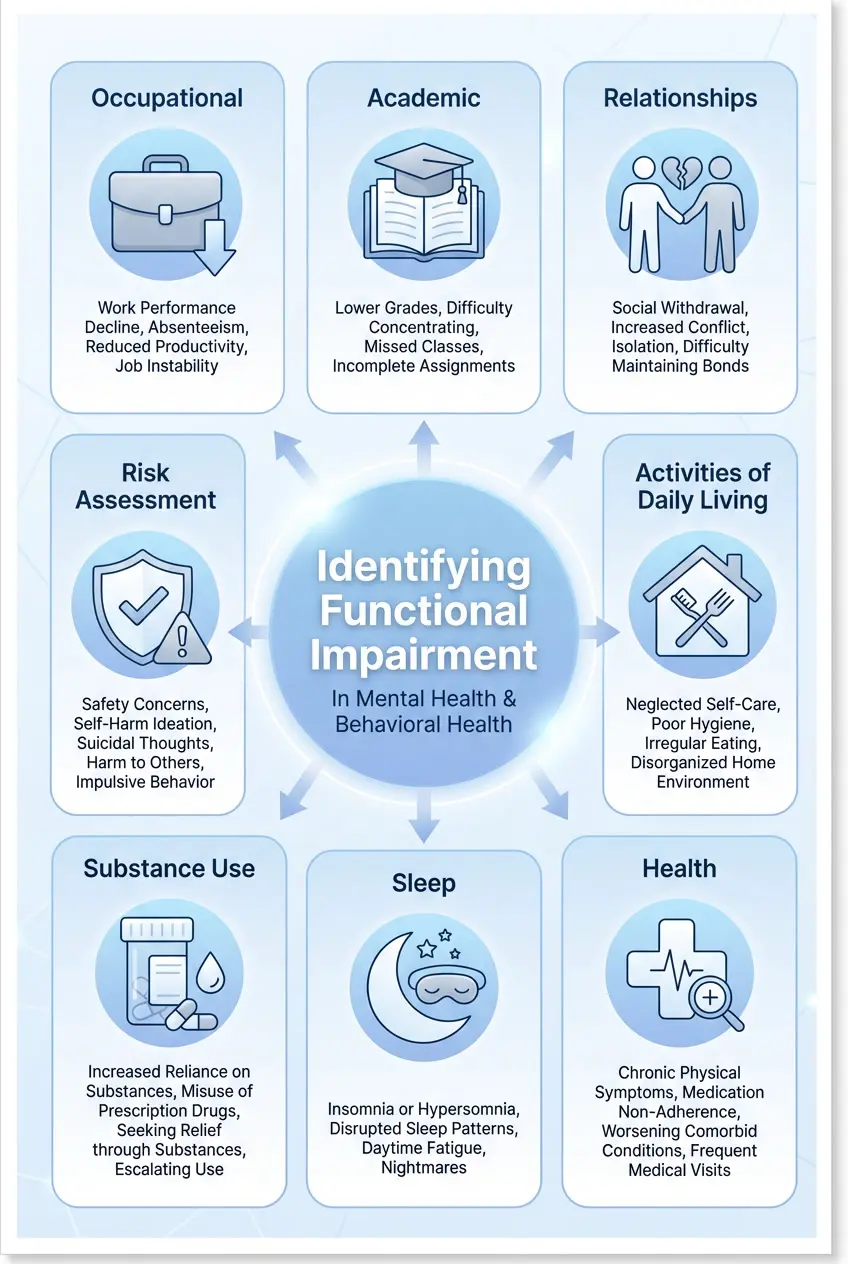
Below are key domains to evaluate when assessing functional impairment in mental health.
1. Work Habits and Occupational Functioning
Depression, anxiety, ADHD, trauma-related disorders, and other conditions frequently impact work functioning.
Look for:
-
Increased absenteeism
-
Chronic lateness
-
Decreased productivity
-
Work-related errors or poor decision-making
-
Emotional outbursts at work
-
Conflict with coworkers or clients
-
Risk of job loss
-
Difficulty finding or maintaining employment
Some clients may maintain attendance but struggle to disengage from work due to anxiety or compulsive tendencies, negatively affecting other life areas.
Any disruption in occupational performance may represent functional impairment and should be documented clearly in progress notes.
2. Academic Performance
For student clients, mental health symptoms may impair academic success.
Consider:
- Declining attendance
-
Missed classes
-
Late or incomplete assignments
-
Falling grades
-
Emotional dysregulation in the classroom
-
Loss of motivation
Academic impairment can have long-term consequences for financial stability and career development, making early documentation and intervention critical.
3. Life Tasks and Daily Responsibilities
Mental disorders often impair a client’s ability to manage everyday responsibilities.
Assess for difficulty with:
-
Paying bills or managing finances
-
Keeping a home clean or safe
-
Preparing meals
-
Responding to emails or phone calls
-
Managing appointments
-
Taking medication as prescribed
When clients fall behind on essential tasks, their living environment, safety, and health may deteriorate — clear evidence of impaired functioning.
4. Relationships and Social Functioning
Mental health conditions frequently disrupt interpersonal functioning.
Look for:
-
Increased marital or family conflict
-
Irritability or anger toward loved ones
-
Social withdrawal
-
Avoidance of previously enjoyed activities
-
Reliance on others to assume responsibilities
-
Difficulty forming or maintaining friendships
Since supportive relationships are protective factors, impairment in this domain is clinically significant.
5. Sleep Patterns
Sleep disturbance is both a symptom and a marker of impairment.
Assess:
-
Insomnia or hypersomnia
-
Nightmares
-
Daytime fatigue affecting performance
-
Falling asleep at work or school
-
Difficulty getting out of bed
Sleep disruption can impair every other life domain and should be linked clearly to daily functioning in documentation.
6. Physical Health
Mental health conditions often affect physical well-being.
Look for:
-
Unexplained headaches, stomach pain, or body aches
-
Missed medical appointments
-
Poor diet or lack of exercise
-
Non-adherence to medical advice
Impairment in health maintenance can escalate into more serious medical issues.
7. Self-Care Practices
Impaired self-care is a common sign of functional decline.
Consider:
-
Noticeable weight gain or loss
-
Skipping meals or binge eating
-
Poor hygiene
-
Wearing the same clothes repeatedly
-
Stopping grooming or exercise routines
Even seemingly small changes in self-care may reflect significant impairment and should be documented.
8. Substance Use
Clients may increase substance use to cope with symptoms.
Evaluate:
-
Increased alcohol or drug consumption
-
Concern expressed by client or family
-
Substance use interfering with work, school, or home responsibilities
Substance use often compounds impairment and should be documented as part of functional impact.
Structured tools strengthen documentation by providing objective data to support clinical findings.
Assessing and Documenting Risk When Safety Concerns Are Present
In some cases, a client’s symptoms don’t just impair functioning — they may create safety risks that require immediate intervention. When risk is present, clinicians should document assessment findings, clinical rationale, and the actions taken to protect the client or others.
While laws and ethical requirements vary by state and licensure type, common situations that may override confidentiality or require additional action include:
-
Imminent risk of self-harm or suicide
-
Imminent risk of harm to others
-
Suspected abuse or neglect of a child, dependent adult, or vulnerable person (mandated reporting)
-
Grave disability or inability to care for basic needs (in some settings)
When suicidal ideation or safety concerns are present, clinicians should follow a structured approach such as the six-step crisis intervention process to ensure both client safety and defensible documentation.
Documentation should focus on objective details and clinical decision-making, such as:
-
What the client reported (with relevant quotes when appropriate)
-
Observed warning signs or changes from baseline
-
Risk/protective factors identified
-
Tools used (e.g., standardized suicide risk screening)
-
Safety planning steps, referrals, consultation, or emergency actions
-
Follow-up plan and timeframe
Clear risk documentation protects client safety and supports medical necessity by demonstrating severity, urgency, and clinical reasoning.
Note: This content is general information and not legal advice; clinicians should follow their state laws, professional ethics code, and organizational policies.
Functional Impairment Assessment Tools: Which Tool Helps the Clinician Determine Impairment From Mental Illness?
Several standardized tools help quantify functional impairment in mental health. Using validated instruments adds objective, measurable data to clinical documentation and strengthens medical necessity arguments.
Structured tools strengthen documentation by providing objective data to support clinical findings. Standardized instruments such as the PHQ-9 and other validated depression assessment tools can help clinicians quantify symptom severity and demonstrate measurable impairment over time.
When selecting an assessment tool, consider the client’s presenting concerns, the domains most relevant to their impairment, and whether the tool captures functional impact (not just symptom severity). Many instruments include specific questions about how symptoms affect daily life — these responses provide direct, documentable evidence of impairment.
How to Document Functional Impairment for Insurance and Audits
Clear documentation of functional impairment is essential for establishing medical necessity and defending reimbursement decisions. For a deeper breakdown of defensible note structure, see our guide on how to write progress notes.
Insurance reviewers are not simply evaluating symptom severity. They are assessing whether symptoms cause clinically significant disruption that justifies treatment.
Effective documentation should:
-
Identify the diagnosis.
-
Describe specific symptoms.
-
Link symptoms directly to life role disruption.
-
Clarify frequency, duration, and severity.
-
Explain why treatment is needed now.
-
Demonstrate how treatment is expected to reduce impairment.
Weak vs. Audit-Ready Documentation Examples
Below are multiple examples illustrating the difference between vague and defensible documentation.
Depression
“Client reports severe depression.”
“Client reports persistent depressive symptoms including low energy, impaired concentration, and anhedonia occurring daily for six weeks. Symptoms have resulted in three missed workdays this month, reduced productivity, and withdrawal from family interactions.”
Anxiety
“Client anxious about work.”
“Client reports excessive anxiety related to workplace interactions, resulting in avoidance of team meetings, difficulty completing assigned tasks, and increased absenteeism (two days missed this week). Symptoms occurring most days and interfering with job performance.”
ADHD
“Client struggles with focus.”
“Client reports difficulty sustaining attention during tasks, leading to missed academic deadlines, declining grades in two courses, and incomplete assignments despite adequate effort. Impairment present across school and home settings.”
Trauma-related symptoms
“Client triggered by reminders of trauma.”
“Client experiences intrusive memories and hypervigilance when exposed to trauma reminders, resulting in avoidance of grocery stores and crowded environments, limiting ability to complete routine errands and social activities.”
Substance use
“Client drinks too much.”
“Client reports increased alcohol consumption (5–6 drinks nightly), resulting in missed work twice this month, conflict with spouse, and impaired morning functioning due to hangover symptoms.”
The Pattern Reviewers Look For
Strong documentation consistently answers:
-
What is the symptom?
-
How often does it occur?
-
What life domain is affected?
-
How significant is the disruption?
-
Why does this require treatment?
Quantify When Possible
Adding measurable language strengthens documentation:
-
“Three missed workdays this month”
-
“Daily symptoms for six weeks”
-
“Avoids 4 out of 5 social invitations”
-
“Grades declined from B average to D average”
Quantification signals clinical specificity.
Avoid These Common Documentation Pitfalls
-
Vague descriptors (e.g., “struggling,” “having a hard time”)
-
No clear link between symptom and impairment
-
No time frame
-
No severity indicators
-
No explanation of treatment necessity
Tie Impairment to Treatment Goals
Documentation should also connect impairment to your treatment plan:
Treatment will focus on reducing panic-related avoidance behaviors to improve consistent work attendance and restore occupational functioning.
This closes the medical necessity loop. Treatment goals should clearly target restoration of functioning, as outlined in this guide to creating a mental health treatment plan.
Behavioral health claims are frequently audited for medical necessity. The most common documentation weaknesses include:
- Listing symptoms without describing functional impairment
- Failing to link symptoms to specific life disruptions
- Vague language such as “client struggling” or “client doing better”
- No measurable time frame or severity indicators
- Treatment goals that do not clearly target functional improvement
Documentation that clearly connects diagnosis, symptoms, functional impairment, and measurable treatment goals is significantly more defensible during utilization review and post-payment audits.
Struggling to find the right words?
Download our free cheat sheet of sample progress note language that clearly supports medical necessity and strengthens your case with payers. Perfect for outpatient, IOP, or higher levels of care.
Get your copy now — keep it nearby when writing or preparing for reviews.
What Is Medical Necessity in Mental Health?
The term medical necessity does not have a single universal definition. Each insurance plan defines medical necessity according to its own policies, provided those policies comply with applicable state and federal laws.
However, most definitions share common themes: the service must be clinically appropriate, supported by diagnosis, and necessary to reduce symptoms or improve functioning.
Government programs provide clearer public standards.
The Centers for Medicare and Medicaid Services, which administers Medicare, describes medically necessary services as those that are needed for the diagnosis or treatment of a medical condition, meet accepted standards of good medical practice, and are not primarily for the convenience of the client or provider
Medicaid programs, which are jointly funded by federal and state governments, may define medical necessity more specifically at the state level.
For example, according to California's Medicaid program, a mental health service may be reimbursed when the treatment is directed towards the functional impairment related to the diagnosis, he client has significant impairment in an important area of life functioning, and the treatment will significantly diminish the impairment.
In practical terms, this means clinicians must identify and document the specific life domains affected by a mental disorder.
Understanding medical necessity standards is critical during the credentialing process, particularly when avoiding common insurance credentialing pitfalls that can impact reimbursement.
Medical necessity generally requires that mental health treatment:
- Addresses a diagnosable condition recognized in the DSM-5
- Targets clinically significant symptoms
- Documents functional impairment or meaningful safety risk
- Meets accepted standards of clinical practice
- Is expected to reduce symptoms or improve functioning
Across public programs like Medicare and Medicaid and most private insurance plans, functional impairment is often the determining factor in whether care qualifies as medically necessary.
How the DSM-5 Connects to Medical Necessity
Most insurance plans require treatment to address symptoms of a condition recognized in the Diagnostic and Statistical Manual of Mental Disorders (DSM-5).
Importantly, DSM-5 diagnostic criteria for most disorders include:
Clinically significant distress or impairment in social, occupational, or other important areas of functioning.
This language directly ties diagnosis to functional impairment. A diagnosis alone is not enough. Symptoms must cause meaningful disruption, and treatment must target that disruption.
Insurance companies are unlikely to reimburse therapy that focuses solely on personal growth, life coaching, or self-improvement unless there is a documented mental disorder with associated impairment or risk.
Why Functional Impairment Is Central to Medical Necessity
Across both private and public insurance systems, functional impairment often becomes the deciding factor in determining whether care qualifies as medically necessary.
Clear documentation should show the DSM-5 diagnosis, specific symptoms, how those symptoms impair life functioning, and why treatment is expected to reduce that impairment.
When impairment is clearly articulated, documentation is more defensible during prior authorization, utilization review, continued stay reviews, and post-payment audits.
Why Functional Impairment is Required for Reimbursement
Functional impairment is often the deciding factor in whether behavioral health services qualify for reimbursement.
Insurance companies do not reimburse therapy simply because a client reports symptoms. They reimburse treatment that is medically necessary — meaning the symptoms are causing clinically significant disruption in important areas of life functioning.
Across both public programs (such as Medicare and Medicaid) and private insurance plans, reviewers are evaluating documentation for evidence that a DSM-5 diagnosis is supported by clinical assessment; symptoms are persistent, measurable, and clinically significant; those symptoms interfere with occupational, academic, social, or daily functioning; and treatment is expected to reduce the impairment.
Without documented impairment, a diagnosis may be considered insufficient to justify ongoing care.
What Reviewers Are Actually Looking For
During prior authorization, utilization review, or post-payment audits, reviewers commonly ask:
-
How are the symptoms affecting the client’s ability to function?
-
What specific life domains are impaired?
-
How severe and frequent is the impairment?
-
Why is treatment required at this level of care?
-
Is there measurable progress toward improved functioning?
If documentation only lists symptoms (e.g., “client anxious” or “client depressed”) without linking them to functional consequences, claims may be denied or recouped. Clear documentation of impairment is especially important when preparing for mental health utilization review, where reviewers evaluate medical necessity and continued stay criteria.
Functional Impairment Demonstrates Clinical Necessity
Functional impairment establishes the severity of the condition, the urgency of treatment, and the clinical rationale for continued services.
For example, a client experiencing sadness may not meet medical necessity criteria. A client experiencing depressive symptoms that result in job loss, social withdrawal, and inability to manage daily responsibilities likely does.
That distinction is what determines reimbursement.
Why This Matters for Documentation
Clear articulation of functional impairment protects clinicians during prior authorization reviews, continued stay reviews, insurance audits, and payment recoupment investigations.
When impairment is consistently and specifically documented, treatment decisions are easier to defend.
Because impairment connects symptoms to real-world consequences, it becomes the backbone of medical necessity.
Insurance reimbursement in behavioral health generally requires more than a documented diagnosis. Reviewers look for evidence that:
- A DSM-5 diagnosis is supported by clinical assessment
- Symptoms are persistent and clinically significant
- Functional impairment or meaningful safety risk is present
- Treatment is expected to reduce the impairment
- Progress is monitored and documented over time
Without clearly documented impairment, services may be denied during prior authorization, utilization review, or post-payment audit.
Related Resources
Deepen your understanding of medical necessity, audit readiness, and documentation standards that support compliant, high-quality care.
Learn what payers look for during reviews and how to ensure your documentation supports continued treatment authorization.
Understand how progress notes tie directly to reimbursement, compliance, and demonstrating medical necessity.
Practical strategies for documenting symptom severity, functional impairment, and treatment progress in a way reviewers expect.
A step-by-step guide to connecting symptoms, functional impairment, and treatment plans to justify ongoing care.
Improve clarity, compliance, and efficiency with documentation strategies tailored to behavioral health workflows.
Discover how routine chart audits can identify documentation gaps and reduce risk during payer reviews.

Functional Impairment in Mental Health: FAQs for Clinicians
These frequently asked questions explain how functional impairment is defined, documented, and used to support diagnosis, treatment planning, and medical necessity in behavioral health.
How ICANotes Supports Documentation of Functional Impairment and Risk
Clear documentation of functional impairment requires more than narrative description. It requires structured prompts that guide clinicians to connect symptoms, life domains, risk factors, and treatment goals in a defensible format.
ICANotes is designed specifically for behavioral health documentation and includes:
-
Structured fields that prompt clinicians to document occupational, social, academic, and ADL impairment
-
Built-in DSM-aligned diagnostic workflows
-
More than 100 integrated rating scales (such as PHQ-9 and GAD-7) that support measurable symptom severity
-
Risk assessment prompts for suicide, self-harm, and safety concerns
-
Treatment planning tools that link symptoms and impairment to measurable goals
By guiding clinicians through structured documentation rather than relying solely on free text, ICANotes helps ensure that functional impairment is clearly articulated, risk assessments are documented consistently, medical necessity is supported, and progress toward restored functioning is measurable.
This structured approach strengthens compliance, improves audit defensibility, and supports reimbursement integrity.
You can explore how ICANotes' structured prompts within its behavioral health EHR software guide clinicians to document functional impairment and risk clearly and consistently with a free 30-day trial.
Make Functional Impairment Documentation Faster — and Audit-Ready
Payers don’t just look for symptoms — they look for how those symptoms impact real life. ICANotes helps you clearly connect symptoms to functional impairment so your documentation supports diagnosis, treatment planning, and medical necessity.
See how structured behavioral health documentation can help you create clearer, more defensible notes in less time.
Recent Posts

Dr. October Boyles
DNP, MSN, BSN, RN
Dr. October Boyles is a distinguished healthcare professional with extensive expertise in behavioral health, clinical leadership, and evidence-based care delivery. With a Doctor of Nursing Practice (DNP) and advanced degrees in nursing, she brings a depth of clinical knowledge and a passion for improving mental health care services.