CPT Code 90791: Billing and Documentation Guide for Psychiatric Diagnostic Evaluations
A practical guide to coding, documenting, and defending the most-billed intake code in outpatient behavioral health.


CPT code 90791 reports a psychiatric diagnostic evaluation without medical services. It commonly includes a clinical interview, relevant biopsychosocial history, mental status examination, risk assessment, diagnostic formulation, and initial treatment recommendations. The code is generally used at the beginning of care, although payer rules and documented clinical circumstances may permit a repeat evaluation.
Every new client begins with an important coding decision: choose the evaluation code that matches the service, and document the encounter clearly enough to support the claim.
Key takeaways
- CPT code 90791 covers the psychiatric diagnostic evaluation, an intake-level biopsychosocial assessment with no medical services included, and it can be billed by LCSWs, LPCs, LMHCs, LMFTs, psychologists, and psychiatrists alike, according to CMS's Local Coverage Article A57480.
- 90791 is not a timed code the way 90832, 90834, or 90837 are. The AMA's own descriptor contains no minute requirement, though documenting the time you actually spent still matters for medical necessity and some payer policies.
- According to Pabau's billing guide for 90791, a missing mental status exam, an absent treatment plan, or a missing DSM-5/ICD-10 diagnosis are the most common reasons these claims get denied.
- Medicare reimbursement for 90791 changes annually and varies by locality, place of service, and clinician type. Use the current CMS Physician Fee Schedule Search and the applicable payer fee schedule rather than relying on a static national dollar estimate.
- Qualifying marriage and family therapists and mental health counselors have been able to enroll and bill Medicare independently since January 1, 2024. CMS pays these practitioners at 75% of the clinical psychologist rate under the Medicare Physician Fee Schedule.
- 90791 and 90792 cannot both be billed for the same client on the same day, and the two codes serve different roles: 90791 excludes medical services, 90792 includes them.
Introduction
If you've ever stared down a claim rejection three weeks after an intake session, you already know the stakes of getting a CPT code wrong. CPT code 90791, the code for a psychiatric diagnostic evaluation, is the single most-billed intake code in outpatient behavioral health. It is also frequently misunderstood because payer policies differ on repeat evaluations, telehealth requirements, and reimbursement.
This guide walks through what CPT code 90791 actually covers, who is eligible to bill it, how to document it so the claim survives an audit, and where the industry's guidance genuinely disagrees. You'll also find a side-by-side comparison with 90792, notes on telehealth billing, and the denial reasons that show up most often in claims data. If you run a solo practice or a small group, the goal here isn't just compliance. It's protecting the revenue that a single missed documentation element can quietly cost you.
What Is CPT Code 90791?
The 90791 CPT code description, per the CPT manual, is “psychiatric diagnostic evaluation.” It's the code used for a comprehensive, integrated biopsychosocial assessment, one that includes a clinical history, a mental status exam, and a set of initial recommendations for treatment. That's the 90791 CPT code definition in practice: an intake evaluation without a medical component, distinct from 90792, which covers the same evaluation when it includes medical services like a physical exam or a prescribing decision.
The evaluation typically covers:
- A clinical interview exploring the presenting problem, its history, and its course
- Psychosocial, developmental, and family history relevant to the diagnosis
- A structured mental status exam across all standard domains
- A risk assessment addressing suicidality, homicidality, and safety concerns
- A diagnostic impression, usually expressed as a DSM-5-aligned ICD-10 code
- An initial treatment plan outlining modality, frequency, and goals
Is 90791 the same thing as a “psychiatric diagnostic interview”? Functionally, yes. Older billing language sometimes uses “diagnostic interview examination” to describe what CPT now codes as 90791, and the two terms point at the same clinical encounter. The current CPT manual uses “psychiatric diagnostic evaluation” as the official language, so that's the term to use on your claims and in your documentation headers.
One historical note worth flagging: the American Psychiatric Association's “CPT Primer for Psychiatrists” describes the 2013 CPT overhaul that first split this evaluation into the 90791 (non-physician) and 90792 (physician, with medical services) codes. That primer is a useful explainer for understanding where the split came from, but it's dated 2013 and shouldn't be treated as a source for current billing rates or rules. Pair it with more current guidance, like CMS's Local Coverage Article A57480, for anything you're relying on today.
Who Can Bill CPT 90791?
A range of behavioral health professionals may report 90791 when the service is within their licensed scope of practice. Eligibility is not determined by credential alone: the clinician must also meet state requirements, be enrolled with the payer, and comply with the plan’s policy. Depending on those requirements, eligible professionals may include:
- Licensed Clinical Social Workers (LCSWs)
- Licensed Professional Counselors (LPCs)
- Licensed Mental Health Counselors (LMHCs)
- Licensed Marriage and Family Therapists (LMFTs)
- Clinical psychologists
- Psychiatrists
- Psychiatric-mental health nurse practitioners, when the evaluation doesn't include a billed medical service (in which case 90792 applies instead)
Qualifying marriage and family therapists and mental health counselors gained the ability to enroll and bill Medicare independently effective January 1, 2024. CMS states that Medicare Part B pays enrolled MFTs and MHCs at 75% of the amount paid to a clinical psychologist under the Medicare Physician Fee Schedule.
Across license types, confirm that the service is within your scope of practice, your enrollment and NPI information are current, and the payer recognizes your credential for the billed service. A credential or enrollment mismatch can cause a denial even when the clinical documentation is complete.
When to Use 90791 (and When Not To)
90791 is built for the beginning of a treatment episode, not the middle of one. Use it for:
- A brand-new client's first evaluation
- A returning client whose case has been formally closed and is now reopening after a genuine gap in care
CMS's Local Coverage Article A57480 notes that the evaluation “can be conducted once, at the onset of an illness or suspected illness,” language that supports using 90791 at the start of a treatment episode rather than as a recurring check-in code.
There are a few situations where 90791 doesn't apply, and billing it anyway is a fast route to a denial or, worse, a post-payment audit finding:
- The encounter consists only of collateral or family participation. CPT guidance permits communication with family members or other sources as part of a diagnostic evaluation, but payer rules may differ when the client is not present. Verify the payer’s policy and determine whether another service more accurately describes the encounter before submitting 90791.
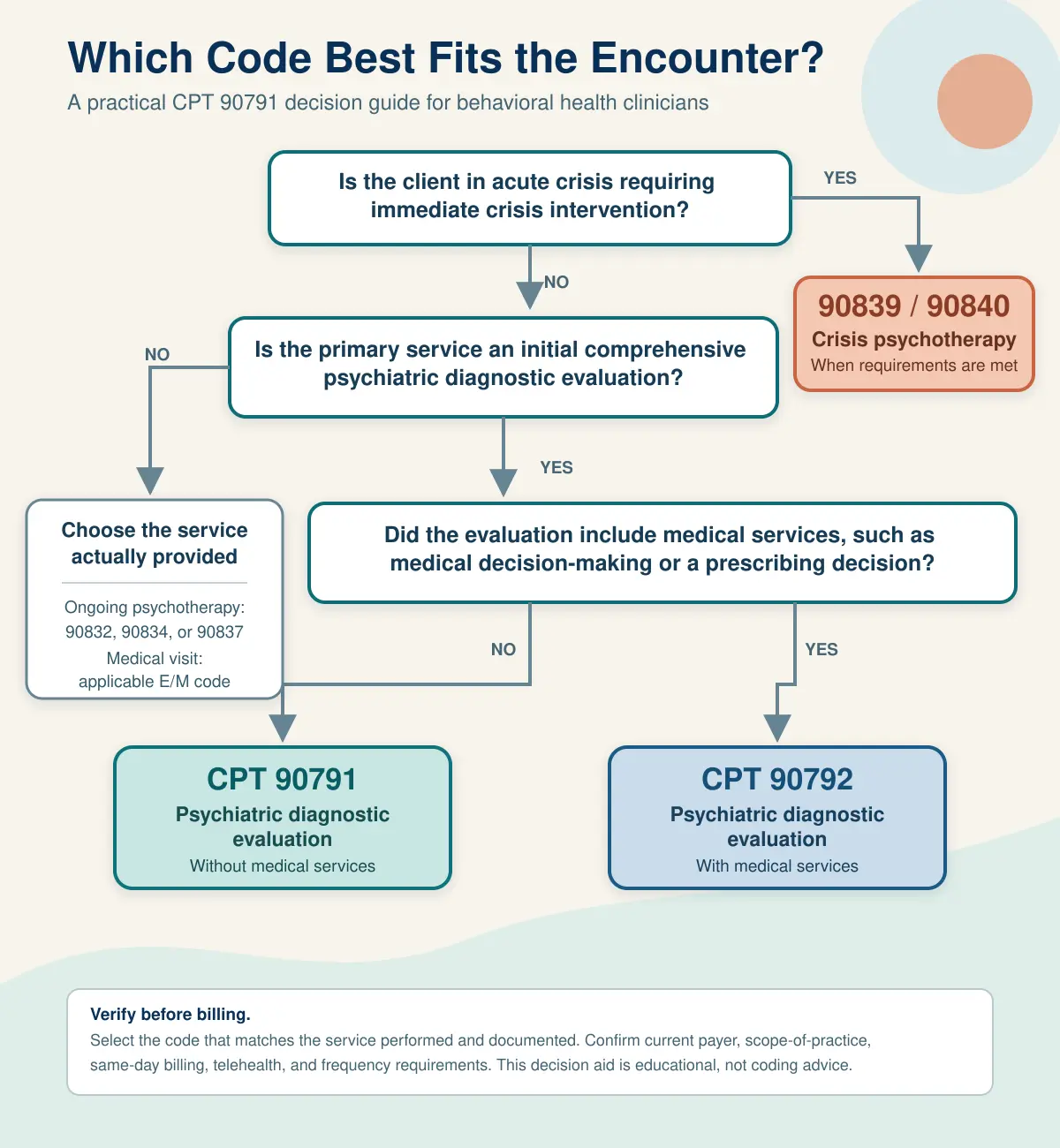
- The client is in acute crisis. Rula's guidance also flags that when a client presents in acute crisis, CPT 90839 (psychotherapy for crisis) is often the more accurate code, not 90791.
- The evaluation extends across multiple sessions. Complex evaluations sometimes require more than one visit. Document what was completed during each encounter, identify that the evaluation remains in progress, and confirm the payer’s rules for reporting the completed diagnostic evaluation rather than assuming each session can be billed separately as 90791
- Same-day duplicate billing. You can't bill 90791 and 90792 for the same provider on the same date, and CMS's Local Coverage Article A57480 also restricts billing an E/M service alongside 90791 or 90792 on the same day for the same client.
New or reopening intake
A brand-new client's first evaluation, or a returning client whose case was formally closed after a genuine gap in care.
Evaluation includes medical services
A prescriber's first visit that includes a medication discussion or prescribing decision.
Client is in acute crisis
When a client presents in acute crisis, a crisis code is often the more accurate choice.
90791 CPT Code Requirements: What Your Documentation Must Include
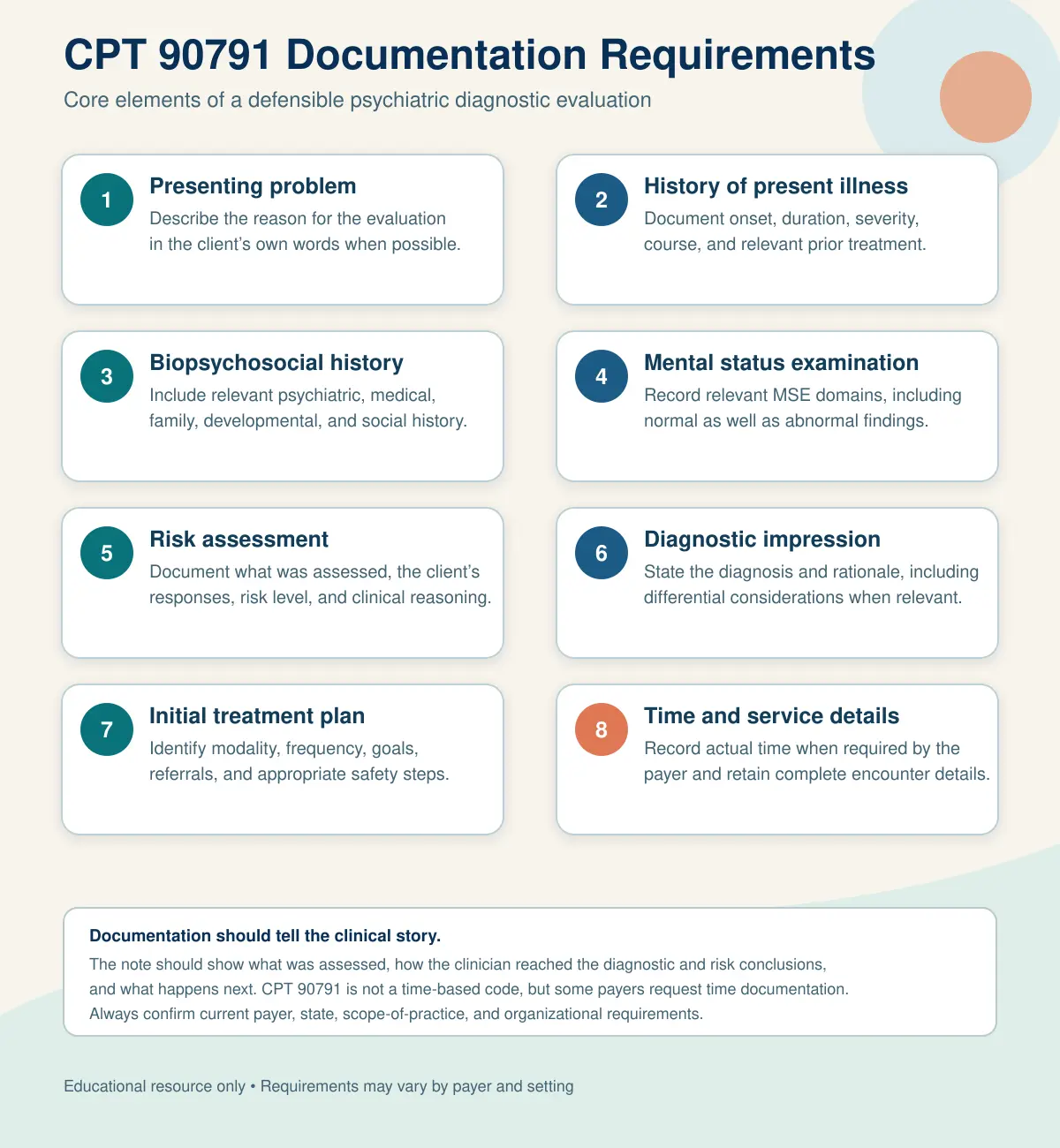
This is the section that actually determines whether your claim survives scrutiny, and it's worth slowing down here. A defensible 90791 note, drawing on the structure outlined in MedCare MSO's 90791 vs. 90837 guide, generally needs:
- The presenting problem, described in the client's own words where possible
- A history of present illness: onset, duration, severity, and any prior treatment
- Relevant psychosocial, developmental, and family history
- A complete mental status exam across all domains, not just the abnormal findings
- A risk assessment that includes actual clinical reasoning, not just a checked box
- A diagnostic impression with a stated rationale, including differential considerations
- An initial treatment plan: modality, frequency, measurable goals, and any referrals or safety steps
Two of those items deserve extra attention because they're where claims most often fall apart. First, the mental status exam needs every domain documented, even the normal ones. An auditor reading a note that only lists abnormal findings can't tell whether you assessed orientation, or simply didn't ask. Second, risk assessment needs a sentence or two of actual reasoning behind the conclusion. “Denies SI” on its own tells a reviewer nothing about how you arrived at that judgment; a note that states what you asked, what the client reported, and why you assessed the risk level you did is the version that holds up.
If you're charting in a system that wasn't built specifically for behavioral health, this is usually where the gaps show up. A general medical SOAP template doesn't prompt you through all ten MSE domains or walk you through a structured risk-assessment narrative; it just gives you a blank text box and trusts you to remember everything under time pressure. Menu-driven behavioral health templates, the kind built specifically for psychiatric intake documentation, prompt you through each MSE domain individually and include structured risk-assessment fields that push you to record your reasoning rather than a single checkbox. ICANotes' intake and evaluation templates are built around exactly this structure, which is less about convenience and more about making sure the note itself does the work of proving medical necessity, whether or not that claim ever gets reviewed.
A note on time. 90791 isn't a timed code (more on that below), but it's still worth recording your start and stop time in every intake note. Several payers request it even though CPT itself doesn't mandate it, and it gives you a documented answer if a reviewer ever asks how long the evaluation took.

Reduce Preventable CPT 90791 Denials
A strong 90791 claim starts with complete documentation. Use this free printable checklist to:
- Verify payer and billing requirements before the visit
- Capture the required elements of a complete 90791 note
- Avoid common documentation gaps that can trigger denials
- Quickly compare CPT 90791 and 90792
Time Requirements: Is 90791 Time-Based?
Here's where a lot of billing guides genuinely disagree, so it's worth being precise. CPT code 90791 is not a timed code the way 90832, 90834, and 90837 are. Those psychotherapy codes are explicitly tiered by minutes in the CPT manual. The 90791 descriptor itself, “psychiatric diagnostic evaluation,” contains no time component at all. You bill it once for the full evaluation, whether that evaluation runs 50 minutes or 90.
You'll see a “16 to 90 minutes” figure repeated across several billing sites, and it's not wrong exactly, but it's often presented in a misleading way. That range traces back to a general CMS outpatient psychiatric services fact sheet, not to a 90791-specific time requirement written into the CPT descriptor. Treat it as a helpful reference point for how long these evaluations typically run in practice, not as a hard CPT rule you need to hit.
That said, documenting actual time spent is still smart practice, for two reasons. First, some commercial payers do ask for it in their own reimbursement policies, even though CMS's CPT-level guidance doesn't require it. Second, and more practically, a note showing that you spent 55 or 75 minutes on a first evaluation supports medical necessity if a claim is ever reviewed. Most clinicians report evaluations landing somewhere between 45 and 90 minutes depending on case complexity, which is a reasonable range to plan your schedule around even though it isn't a codified requirement.
How Often Can You Bill 90791? (Frequency Limits)
Frequency rules for 90791 come from payer and Medicare contractor policy rather than a universal annual limit in the CPT descriptor. CMS Local Coverage Article A57480 states that a psychiatric diagnostic evaluation may generally be conducted at the onset of an illness or suspected illness.
The same CMS contractor article allows a repeat evaluation in specified circumstances, including an extended break in treatment, an inpatient admission for psychiatric illness, a significant change in mental status, or a need for a second opinion or diagnostic clarification. The article describes an extended break as approximately six months, but that contractor-specific guidance should not be treated as a universal Medicare, Medicaid, or commercial-payer rule.
Before rebilling 90791, check the applicable payer or Medicare contractor policy. When a repeat evaluation is clinically appropriate, document the circumstance that required a new comprehensive assessment rather than a routine progress note.
Billing Guidelines: Modifiers, Telehealth, and Place of Service
CPT 90791 is included on Medicare’s permanent telehealth services list. For Medicare fee-for-service claims, current federal guidance uses modifier 95 for qualifying real-time audio-video services. Place-of-service code 10 applies when the patient is at home, while POS 02 applies when telehealth is provided somewhere other than the patient’s home. Confirm commercial, Medicaid, and Medicare Advantage requirements separately.
For qualifying Medicare audio-only telehealth services, current HHS guidance recognizes modifier 93. Audio-only coverage depends on the service, patient location, technology circumstances, provider type, and current Medicare requirements. Federally qualified health centers and rural health clinics may have additional billing instructions, including use of modifier FQ. Verify the payer’s current policy before submitting any audio-only claim.
A few other billing rules to keep in your back pocket:
- You cannot bill 90791 and 90792 for the same client, same provider, same date.
- You cannot bill 90791 alongside an E/M service for the same client, same provider, same date, per CMS's Local Coverage Article A57480.
- Family therapy codes (90846, 90847) have their own separate billing restrictions relative to 90791 worth checking if your evaluation involves family members.
90791 Reimbursement Rates
Reimbursement for 90791 changes over time and varies by payer, locality, place of service, and clinician type. For that reason, a national dollar figure quoted in a blog post can become inaccurate quickly and may not reflect what a particular practice will be paid.
For Medicare, use the current CMS Physician Fee Schedule Search and select the applicable year, locality, and facility or non-facility setting. For Medicaid, Medicare Advantage, and commercial plans, consult the payer’s current fee schedule or provider portal before setting fees or estimating client responsibility.
Credential level can also affect your rate. LCSWs, LPCs, LMFTs, and LMHCs are generally reimbursed at 75% of the psychologist or physician rate for the same code, while PMHNPs and physician assistants are typically reimbursed at 85% of the physician rate, according to medsolercm.com's coding guide. Commercial payers set their own rates independently and often pay more than Medicare, though the spread between payers can be significant. As a general pattern, 90791 tends to reimburse higher than a standard 45-minute psychotherapy session (90834), reflecting the additional clinical work an initial comprehensive evaluation requires.
90791 vs. 90792: What's the Difference?
The confusion between these two codes usually comes down to one thing: whether the evaluation includes medical services. 90791 is the version without them, generally billed by non-prescribing clinicians. 90792 is the same evaluation, but performed by (or under the medical direction of) a prescriber and inclusive of medical decision-making, like a mental status exam paired with medication evaluation.
If you're searching for “CPT code for initial psychiatric evaluation with medication management,” 90792 is almost always the code you actually want, not 90791. A psychiatrist or PMHNP doing a first visit that includes a medication discussion and prescribing decision should generally reach for 90792, reserving 90791 for evaluations where no medical service is involved.
| CPT 90791 | CPT 90792 | |
|---|---|---|
| Official descriptor | Psychiatric diagnostic evaluation | Psychiatric diagnostic evaluation with medical services |
| Includes medical services (e.g., physical exam elements, prescribing decisions) | No | Yes |
| Typical billing clinicians | Eligible LCSWs, LPCs, LMHCs, LMFTs, psychologists, psychiatrists (non-medical portion) when within scope of practice and enrolled with the payer | Psychiatrists, PMHNPs, physician assistants |
| Same-day billing with the other code | Not permitted alongside 90792 for the same client/provider/date | Not permitted alongside 90791 for the same client/provider/date |
| Typical reimbursement relative to the other | Generally lower | Generally higher, reflecting the added medical component |
| Telehealth eligibility | Yes, on Medicare's permanent telehealth list | Yes, on Medicare's permanent telehealth list |
90791 vs. Psychotherapy and E/M Codes (90837, 99204, etc.)
Where 90791 gets compared most often outside of 90792 is against the standard psychotherapy codes, 90832, 90834, and 90837, and against Evaluation and Management (E/M) codes like 99202 through 99205.
The key distinction is structural. 90791 and 90792 are flat, one-time evaluation codes, not tiered by time. 90832, 90834, and 90837 are psychotherapy codes explicitly tiered by session length (roughly 30, 45, and 60 minutes respectively), reflecting ongoing treatment rather than an initial diagnostic workup. You'd never bill 90791 for a routine, established-client therapy session; that's what the psychotherapy codes are for.
E/M codes enter the picture for prescribers. A psychiatrist or PMHNP has a choice on a new patient's first visit: bill 90792 if the visit is structured as a psychiatric diagnostic evaluation with a medical component, or bill an E/M code (99202-99205 for new patients) if the visit is structured more like a standard medical evaluation with psychiatric focus, sometimes paired with an add-on psychotherapy code if therapy was also furnished. Which one fits better usually comes down to how the visit was actually structured and documented, not a fixed rule, so this is a good conversation to have with your billing team or a coding consultant if you're a prescriber choosing between the two on a regular basis.
| Code | What It Is | Tiered by Time? | Typical Use |
|---|---|---|---|
| 90791 | Psychiatric diagnostic evaluation — no medical services | No | Initial psychiatric diagnostic evaluation without medical services, non-prescribing clinician |
| 90792 | Psychiatric diagnostic evaluation — with medical services | No | Initial evaluation, prescriber |
| 90832 / 90834 / 90837 | Individual psychotherapy | Yes — roughly 30 / 45 / 60 minutes | Ongoing therapy for an established client, not an initial evaluation |
| 99202–99205 | E/M new-patient visit | Level-based on complexity/time, not CPT-tiered like psychotherapy codes | Prescriber's alternative to 90792 for a visit structured as a standard medical evaluation, sometimes paired with an add-on psychotherapy code |
Common Reasons 90791 Claims Get Denied (and How to Prevent Them)
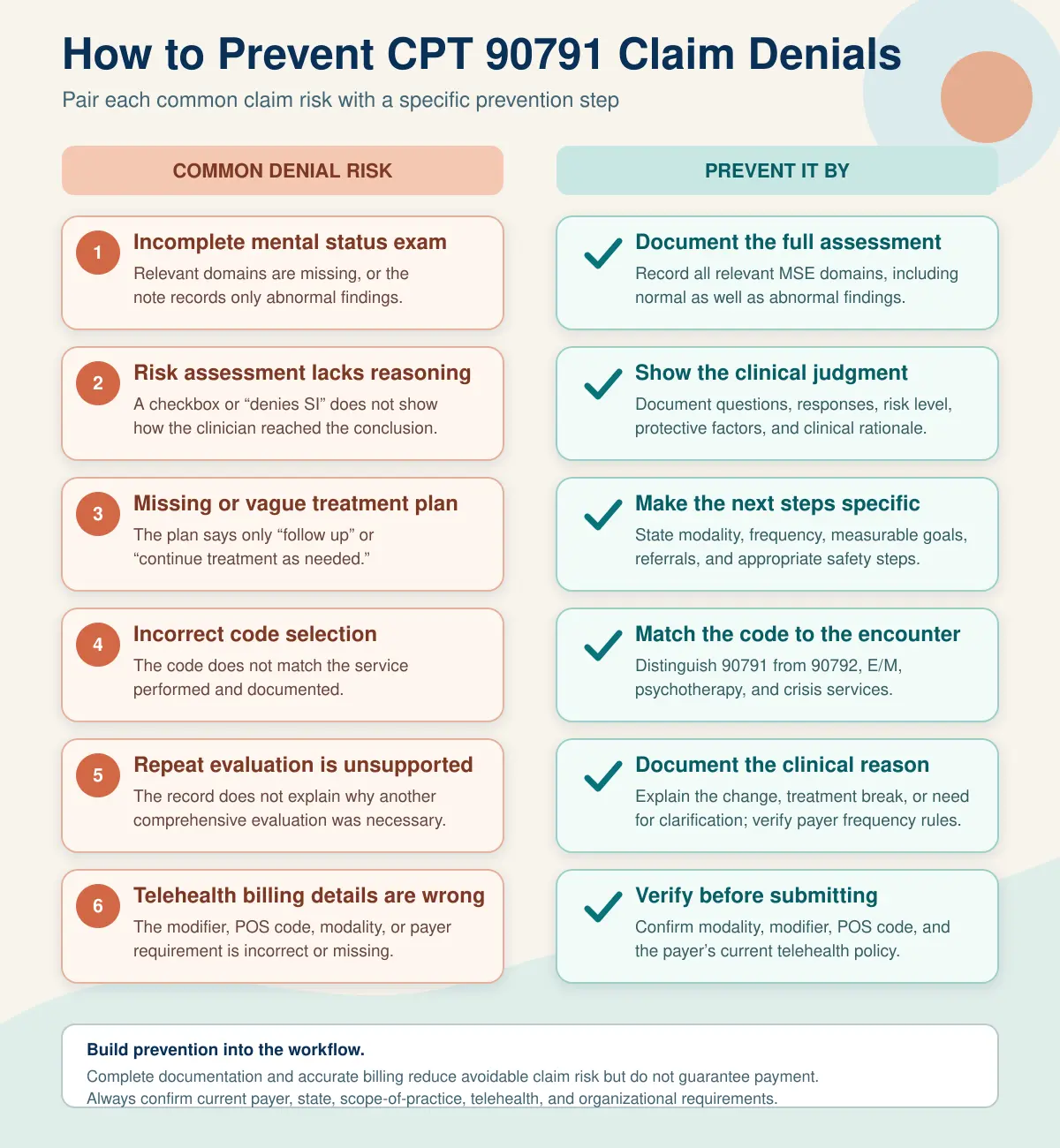
According to Pabau's billing guide for 90791, “missing a mental status exam, treatment plan, or DSM-5/ICD-10 diagnosis in the clinical note is the most common reason claims for 90791 are denied.” medsolercm.com's coding guide expands that list further, and mapping each reason to its underlying documentation gap makes prevention a lot more concrete:
- Incomplete mental status exam. A note that skips domains, or only lists abnormal findings, gives a reviewer nothing to confirm the assessment actually happened. A structured note format that prompts for every MSE domain, not a blank narrative box, closes this gap by design.
- Risk assessment without clinical reasoning. A checked box saying “denies SI” doesn't show your reasoning. Templates with dedicated risk-assessment fields that prompt for the actual clinical judgment behind the conclusion, not just a yes/no field, make this omission much harder to make by accident.
- Missing or vague treatment plan. A plan needs modality, frequency, and measurable goals, not a one-line note that treatment will “continue as needed.”
- Incorrect code selection. Billing 90791 when 90792 or an E/M code was the better fit (or vice versa) is a frequent, avoidable error. Understanding the distinctions covered above is the fix here.
- Exceeding payer frequency limits without documented justification. If you're rebilling 90791 for an existing client, the note needs to explicitly state why a new comprehensive evaluation was clinically warranted.
- Telehealth modifier or place-of-service errors. Using the wrong modifier or POS code for a telehealth encounter is a technical error that has nothing to do with clinical quality, but it denies the claim just the same.
The common thread across nearly every one of these denial reasons is the same: they're documentation gaps, not clinical failures. The assessment itself was probably done correctly; the note just didn't capture it in a way a reviewer could verify. That's precisely the gap that structured, menu-driven behavioral health note templates are designed to close, not by cutting corners on clinical depth, but by making sure the required elements (a full MSE, a reasoned risk assessment, a specific treatment plan) are built into the note's structure instead of left to memory during a packed intake day. ICANotes' evaluation templates include exactly this kind of scaffolding, which is worth a look if denials tied to incomplete documentation have been eating into your practice's revenue.
The common thread across nearly every one of these denial reasons is the same: they're documentation gaps, not clinical failures.
Download the free CPT 90791 Documentation & Denial-Prevention Checklist to keep every intake evaluation audit-ready — payer verification, required note elements, and the denial-trigger table from this article in one printable page. Download the checklist
Make every 90791 intake note audit-ready with ICANotes
Getting 90791 right isn't about memorizing every payer's fine print. It's about building a documentation habit, and ideally a documentation system, that captures the full evaluation every time, so the note itself does the defending if a claim ever gets a second look. That's the kind of infrastructure ICANotes was built around from the start. Start your 30-day free trial of the behavioral health EHR built for clinicians — faster notes, simpler billing, less admin.
- Notes completed in under 3 minutes
- 30-day free trial, no credit card required
- Fully integrated billing, scheduling, and practice management
- 24x7 live support from behavioral health specialists
Frequently Asked Questions About CPT Code 90791
Is 90791 the same as a psychiatric diagnostic interview?
How long does a 90791 evaluation need to be?
What is the difference between CPT codes 90791 and 90792?
Can 90791 be billed for telehealth?
How often can you bill CPT 90791?
Does CPT 90791 require prior authorization?
Is there an age limit for CPT 90791?
Can a mental health counselor (LPC/LMHC) bill CPT 90791?
References
- Centers for Medicare & Medicaid Services. “Billing and Coding: Psychiatry and Psychology Services” (Local Coverage Article A57480). cms.gov/medicare-coverage-database/view/article.aspx?articleId=57480
- Centers for Medicare & Medicaid Services. Physician Fee Schedule Search tool. cms.gov/medicare/physician-fee-schedule/search
- American Medical Association. Behavioral Health Coding Guide. ama-assn.org/practice-management/cpt/behavioral-health-coding-guide
- American Psychiatric Association. “CPT Primer for Psychiatrists” (2013; historical/background reference only). psychiatry.org
- AAPC. “CPT® Code 90791 – Psychiatric Diagnostic Evaluation Services.” aapc.com/codes/cpt-codes/90791
- Pabau. “CPT Code 90791: Psychiatric Diagnostic Evaluation Billing Guide.” pabau.com/procedure-codes/cpt-code-90791/
- Rula. “Best Practices for Billing CPT Code 90791 (Initial Diagnostic Evaluation).” therapistsupport.rula.com
- MedCare MSO. “CPT 90791 vs 90837: A Comprehensive Guide for Mental Health Billing.” medcaremso.com
- MedSole RCM. CPT Code 90791 coding guide. medsolercm.com/blog/cpt-code-90791
Dr. October Boyles
Dr. October Boyles is a behavioral health expert and clinical leader with extensive expertise in nursing, compliance, and healthcare operations. With a Doctor of Nursing Practice (DNP) and advanced degrees in nursing, she specializes in evidence-based practices, EHR optimization, and improving outcomes in behavioral health settings. Dr. Boyles is passionate about empowering clinicians with the tools and strategies needed to deliver high-quality, patient-centered care.