Blog > Treatment Strategies > 25 Essential Counseling Skills & Therapeutic Skills Guide
25 Essential Counseling Skills and Therapeutic Skills Every Therapist Should Master
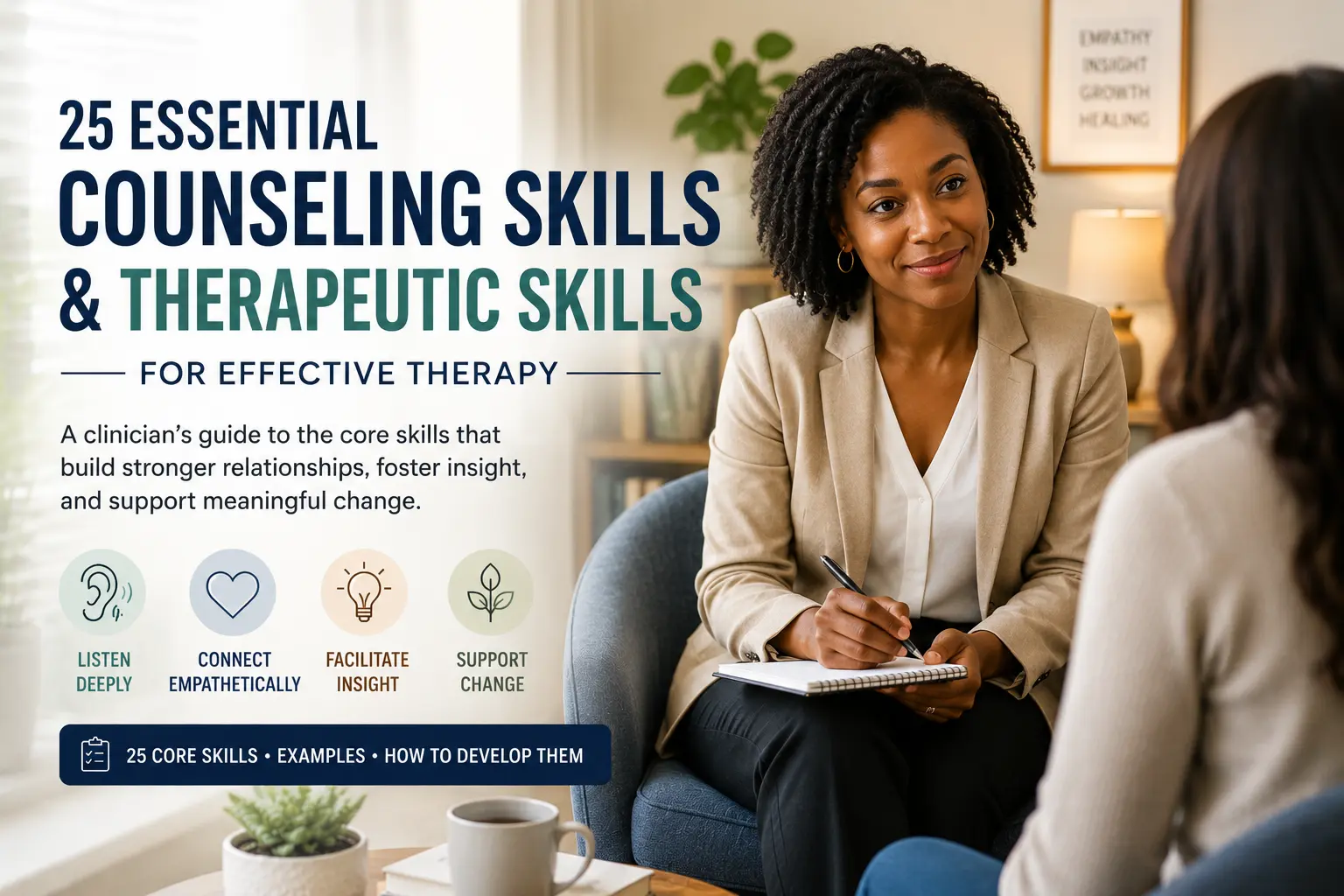
Strong counseling skills are the foundation of effective therapy, regardless of clinical modality or treatment setting. In this guide, you'll learn the most important counseling skills and therapeutic skills used in behavioral health practice, including active listening, empathy, reflection, rapport building, cognitive restructuring, motivational interviewing, alliance repair, and other essential skills in therapy. Whether you're looking for a counseling skills list, practical counseling skills examples, or a deeper understanding of advanced counseling techniques and skills, this article breaks down 25 core competencies every therapist should develop.


Last Updated: May 14, 2026

What You'll Learn
-
The difference between basic counseling skills, therapeutic skills, and advanced clinical competencies
-
How counseling skills support stronger therapeutic relationships and better treatment outcomes
-
The most important counseling skills examples therapists use in everyday sessions
-
Core microskills such as active listening, empathy, reflection, validation, and summarizing
-
Intermediate therapy skills including psychoeducation, cognitive restructuring, emotion regulation coaching, and motivational interviewing
-
Advanced counseling techniques and skills like alliance repair, case conceptualization, and managing transference
-
Practical ways to improve your counseling skills through supervision, role-play, consultation, and continuing education
-
How strong therapeutic skills support more accurate clinical documentation and treatment planning
Contents
- Counseling Skills at a Glance
- Counseling Skills Quick Reference Table
- What Are Counseling Skills in Therapy?
- Core Counseling Skills: The Foundational Microskills Every Therapist Needs
- Intermediate Therapeutic Skills and Counseling Techniques
- How Counseling Skills Support the Therapy Process
- Advanced Counseling Skills and Techniques for Therapists
- Counseling Skills Examples Therapists Use in Real Sessions
- How Therapists Develop Strong Counseling and Therapeutic Skills
- Why Counseling Skills Matter in Effective Therapy
- Frequently Asked Questions: Counseling Skills
Effective therapy depends less on any single technique and more on the therapist's underlying counseling skills. The way a clinician listens, reflects, and stays present often shapes the work more than the modality on the treatment plan. Therapeutic skills are what turn a structured intervention into a meaningful conversation — they help clients feel understood, build trust over time, and create the conditions where insight and change become possible.
Whether you are a graduate student building your first toolkit, an early-career clinician refining your style, or an experienced therapist returning to the fundamentals, the same core skills in therapy show up across every modality, from CBT and DBT to psychodynamic and integrative practice.
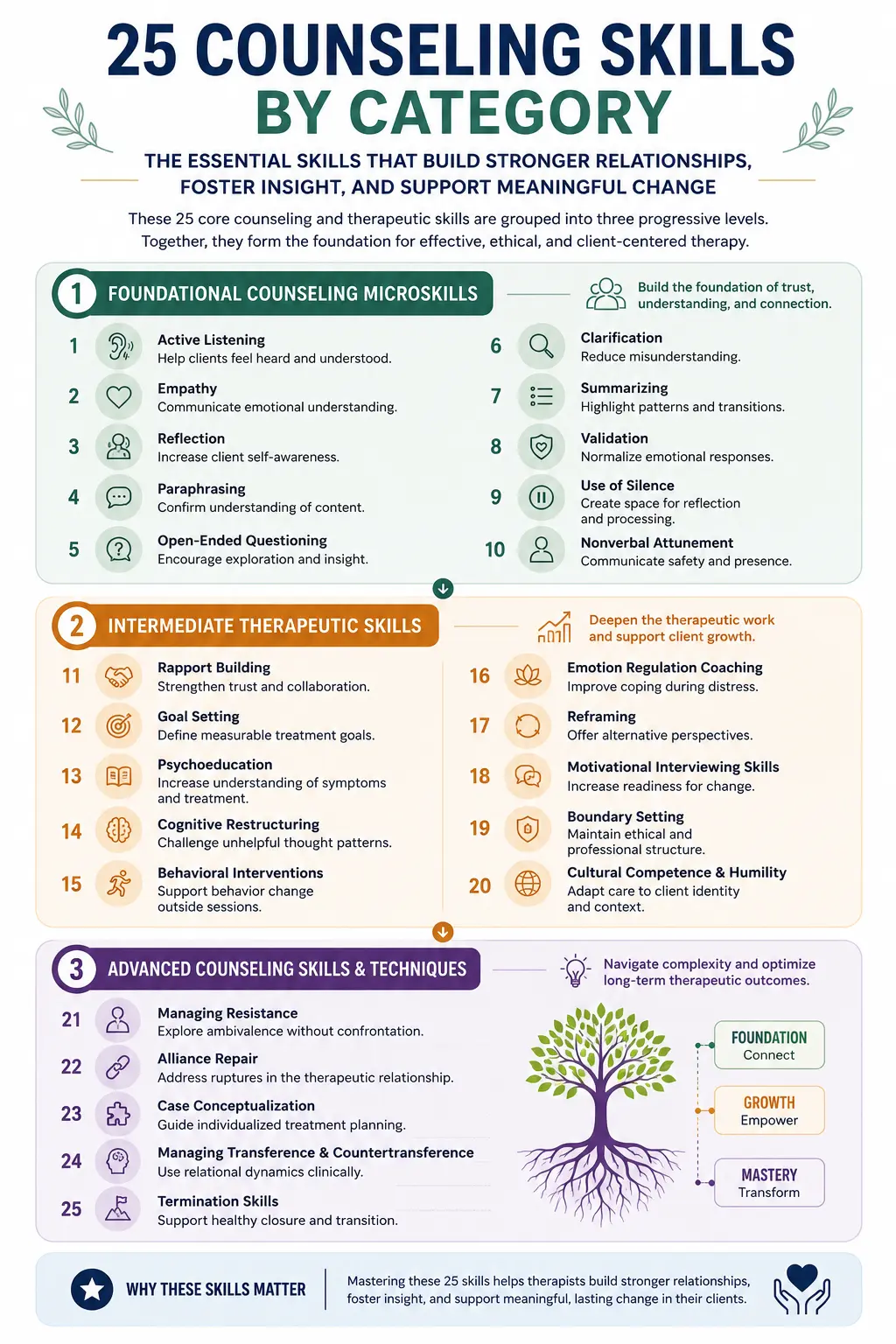
This guide outlines 25 essential counseling skills and therapeutic skills, organized from foundational microskills to advanced clinical competencies. Each skill includes its purpose and a practical example so you can recognize it in your own sessions and continue developing it across your career.
Counseling Skills at a Glance
The 25 counseling skills below are grouped into foundational, intermediate, and advanced therapeutic competencies. Together, these skills help therapists build trust, deepen insight, support behavior change, and strengthen the therapeutic relationship over time.
Counseling Skills Quick Reference Table
Foundational Counseling Microskills
Intermediate Therapeutic Skills
Advanced Counseling Skills and Techniques
Free Printable Workbook
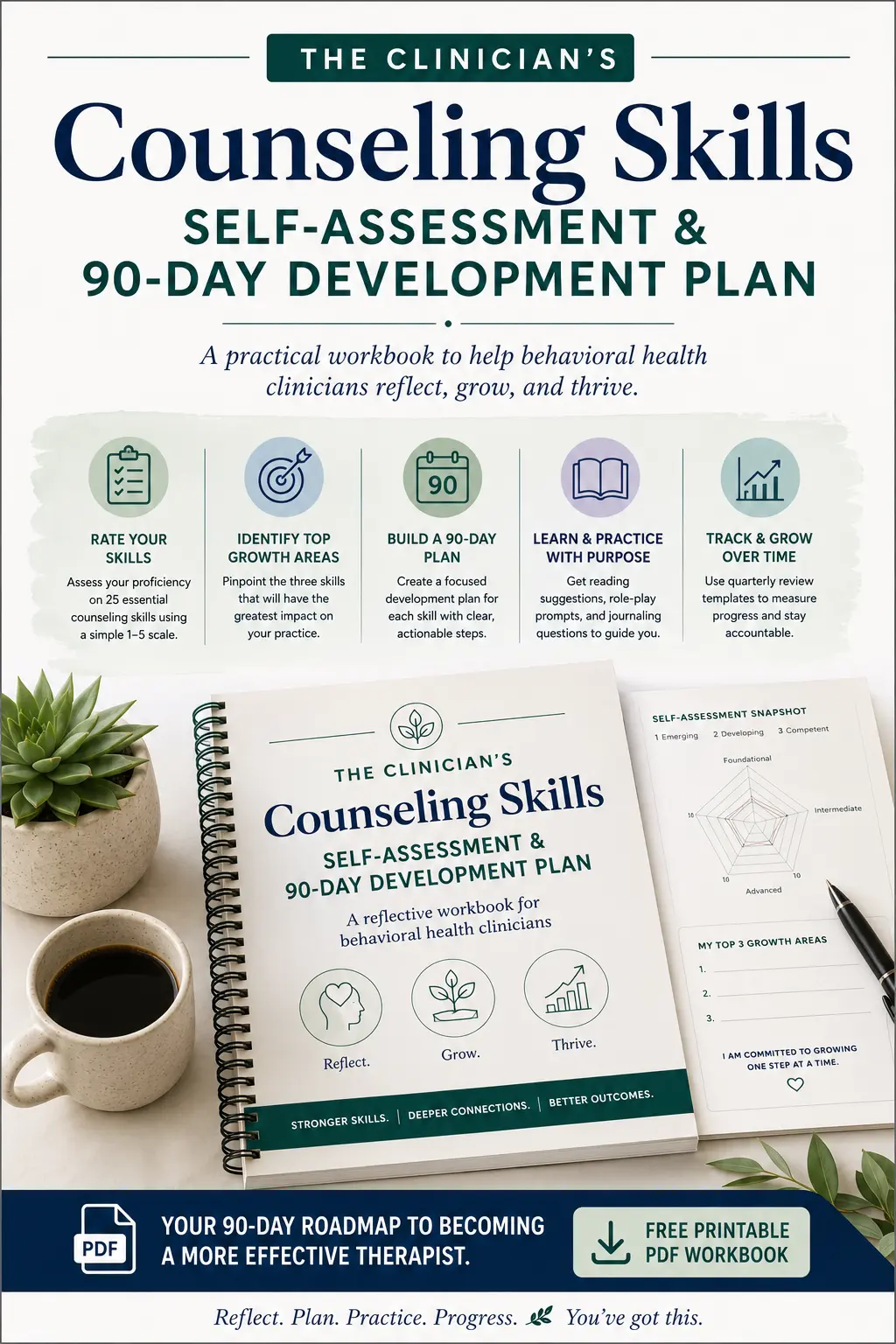
Download the Counseling Skills Self-Assessment & 90-Day Development Plan
Want a structured way to strengthen your counseling skills over the next 90 days? This free workbook helps behavioral health clinicians assess their therapeutic strengths, identify growth areas, and create a focused professional development plan.
- Rate yourself on 25 essential counseling and therapeutic skills
- Identify your top three growth areas
- Map each skill to a 90-day development plan
- Track progress with a quarterly review template
What Are Counseling Skills in Therapy?
Counseling skills are the interpersonal and clinical abilities therapists use throughout the therapeutic relationship. They form the foundation of every modality and every theoretical orientation, regardless of whether a clinician primarily uses cognitive behavioral therapy, person-centered therapy, ACT, EMDR, or psychodynamic approaches.
At their core, counseling skills allow clinicians to:
- Build rapport and create a safe, collaborative therapeutic relationship
- Understand the client's experience from the inside out
- Facilitate emotional processing and self-reflection
- Support behavior change in a way that respects client autonomy
- Maintain ethical boundaries and a clear professional frame
You can think of counseling skills as the connective tissue between assessment, intervention, and outcome. A well-designed treatment plan delivered without these skills tends to fall flat, while strong therapeutic skills can make even simple interventions land with depth and care.
The list below moves from basic counseling skills (often called microskills) to intermediate therapeutic skills and finally to advanced skills in therapy that develop over years of supervised practice.
Core Counseling Skills: The Foundational Microskills Every Therapist Needs
These ten basic counseling skills are typically introduced in graduate training and refined throughout a clinician's career. They form the bedrock of any list of counseling skills.
1. Active Listening
Purpose: Fully attending to a client's verbal and nonverbal communication so they feel heard before any intervention happens.
Active listening is more than staying quiet while the client speaks. It involves tracking content, tone, body language, pacing, and what is left unsaid, then communicating that attention back to the client.
Example: “It sounds like that situation left you feeling dismissed — like your concerns didn't really land for him.”
2. Empathy
Purpose: Communicating an accurate understanding of the client's emotional experience.
Empathy is not agreement, sympathy, or rescuing. It is the ability to enter the client's frame of reference, sense what they may be feeling, and reflect that back without imposing your own interpretation.
Example: “There's a heaviness in how you're describing this week. I hear how exhausting it's been to keep pushing through.”
3. Reflection
Purpose: Mirroring thoughts or feelings to deepen the client's awareness of their own experience.
Reflections are short, focused statements that invite the client to slow down and notice what they just said. Effective reflections often surface a feeling that was implied but not explicitly named.
Example: Client: “I just kept smiling and saying it was fine.” Therapist: “On the outside, fine. Underneath, something else.”
4. Paraphrasing
Purpose: Restating the content of what the client said in your own words to confirm understanding.
Paraphrasing focuses on the cognitive content rather than the emotional layer. It helps the client hear their narrative reflected back and gives them a chance to correct or expand.
Example: “So the conversation started about scheduling, then shifted into the same disagreement you've had a dozen times before.”
5. Open-Ended Questioning
Purpose: Encouraging exploration and elaboration rather than yes-or-no responses.
Open-ended questions invite the client to think out loud. They typically begin with what, how, or could, and they avoid leading the client toward a specific answer.
Example: “What was going through your mind right before you decided to leave?”
6. Clarification
Purpose: Preventing misunderstanding and ensuring you and the client are working from the same picture.
Clarification can be a question, a tentative restatement, or a request for more detail. It is especially important when a client uses ambiguous language or when context might shift meaning.
Example: “When you say ‘shut down,’ I want to make sure I'm picturing it accurately. What does that look like for you in the moment?”
7. Summarizing
Purpose: Pulling together themes within or across sessions.
Summaries are longer than reflections and help the client see patterns. They are particularly useful at transitions, such as moving into a new topic, ending a session, or revisiting progress.
Example: “Over the last few weeks, I've heard a thread about feeling responsible for everyone else's emotions, going back to your role at home growing up.”
8. Validation
Purpose: Affirming that the client's emotional response makes sense given their context.
Validation does not require agreement with the client's interpretation or behavior. It communicates that, given what they've experienced, their feelings are understandable.
Example: “Of course you felt anxious — you walked into a room where you didn't know who to trust.”
9. Use of Silence
Purpose: Allowing space for the client to process emotion, formulate thought, or sit with something difficult.
Strategic silence can feel uncomfortable for new clinicians. Resist the urge to fill the pause. Often, the most important moments happen in the few seconds after the client stops talking.
Example: A client describes a loss, then trails off. The therapist holds eye contact, leans in slightly, and waits.
10. Nonverbal Attunement
Purpose: Communicating presence and safety through posture, tone, facial expression, eye contact, and pacing.
Clients track your nonverbals constantly, often without realizing it. In telehealth, this extends to camera framing, lighting, and matching the client's energy.
Example: When a client begins to cry, the therapist softens their expression, slows their breathing, and lowers their voice slightly.
Intermediate Therapeutic Skills and Counseling Techniques
These ten skills build on the microskills and bring more structure into the room. They are the everyday counselling skills techniques clinicians use to translate the relationship into measurable progress.
11. Rapport Building
Purpose: Establishing safety, trust, and collaboration early in treatment so deeper work becomes possible.
Rapport is built through consistency, warmth, accurate empathy, and follow-through. The first three to five sessions are often disproportionately important.
Example: Beginning each session with a brief, genuine check-in and remembering details from the previous week without needing to be reminded.
12. Goal Setting
Purpose: Collaboratively defining treatment objectives that are specific, meaningful to the client, and clinically appropriate.
Strong goal setting balances the client's stated priorities with the clinician's case formulation. Goals should be revisited regularly, not set once and forgotten.
Example: “You said you want to feel ‘less reactive at home.’ Let’s break that down — what would ‘less reactive’ look like in a Tuesday-night moment with your partner?”
13. Psychoeducation
Purpose: Providing structured information about diagnosis, symptoms, or skills in a way that informs without overwhelming.
Effective psychoeducation is bite-sized, contextualized, and tied to the client's lived experience. It is also a two-way conversation, not a lecture.
Example: “What you're describing — racing thoughts at 2 a.m. — is a common feature of anxiety. Your nervous system is essentially still scanning for threats. Want me to walk through how that mechanism works?”
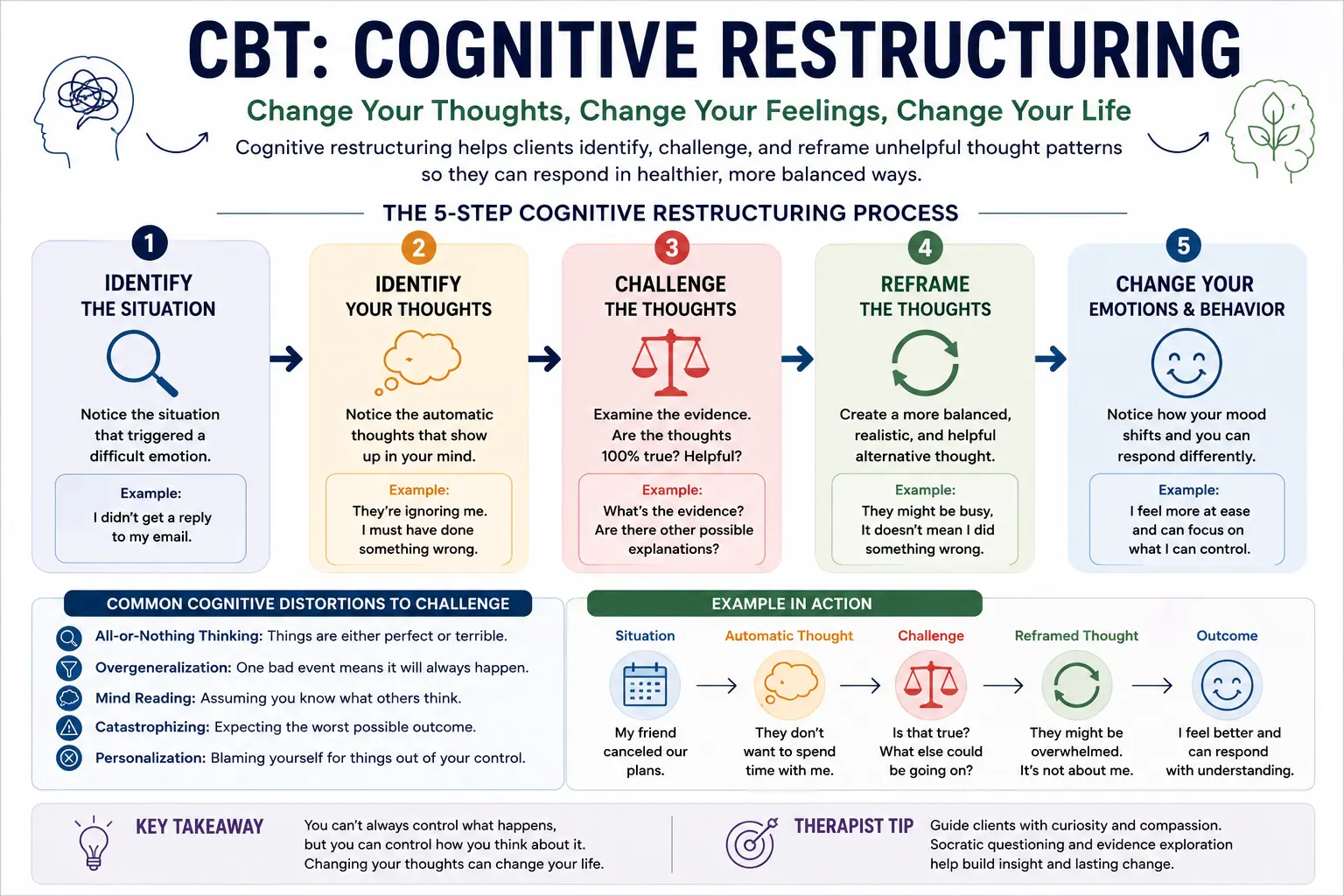
14. Cognitive Restructuring
Purpose: Helping clients identify, examine, and shift thought patterns that contribute to distress.
Drawn from CBT, cognitive restructuring works best when it is collaborative rather than corrective. The goal is not to convince the client their thought is wrong, but to invite curiosity about whether it is the most accurate or useful thought available.
Example: “You said, ‘I always mess this up.’ If we set that down on the table and looked at it together, what evidence supports it, and what might complicate it?”
15. Behavioral Interventions
Purpose: Assigning concrete, actionable strategies — exposures, behavioral activation tasks, or skills practice — that move the work outside the therapy room.
Behavioral interventions are most effective when they are co-designed with the client, calibrated to their current capacity, and reviewed in the next session.
Example: Building a graded exposure hierarchy with a client experiencing social anxiety, beginning with low-stakes interactions before progressing toward more activating situations.
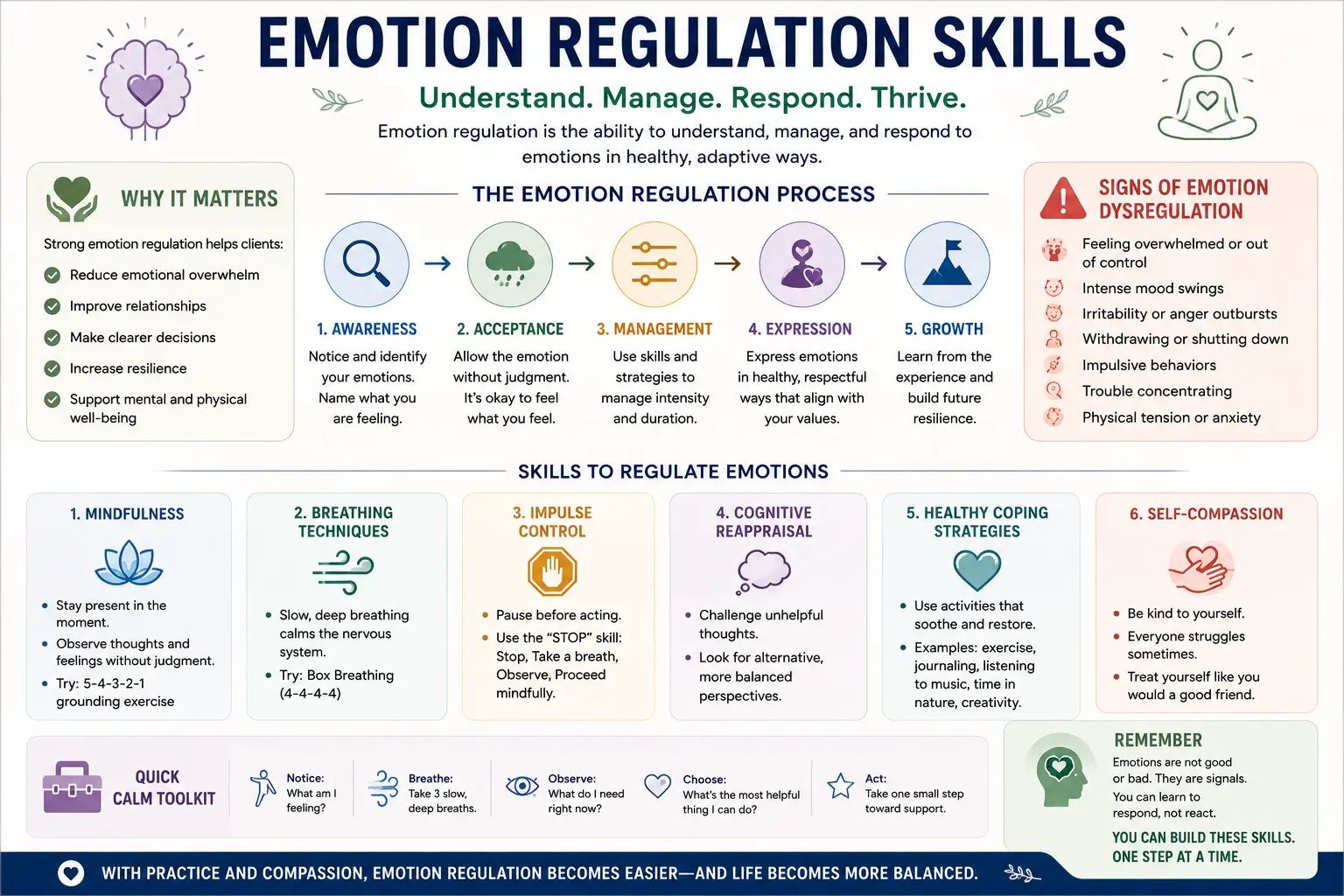
16. Emotion Regulation Coaching
Purpose: Teaching grounding, distress tolerance, and coping tools so clients can navigate intense emotional states between sessions.
This includes skills from DBT (TIPP, paced breathing, opposite action), somatic approaches, and mindfulness. The skill of the clinician lies in matching the right tool to the right moment for the right client.
Example: Walking a client through a 5-4-3-2-1 grounding exercise during a session when they begin to dissociate, then debriefing what helped.
17. Reframing
Purpose: Offering an alternative perspective on a situation, behavior, or self-judgment without invalidating the client's feelings.
Reframing is not “looking on the bright side.” It is a precise clinical move that holds both the difficulty of the experience and a wider view at the same time.
Example: Client: “I'm such a pushover. I let her walk all over me.” Therapist: “I hear self-criticism. I also hear someone who's been working hard to keep the peace in a relationship that matters to you. Those can both be true.”
18. Motivational Interviewing Skills
Purpose: Eliciting change talk, exploring ambivalence, and respecting client autonomy in the change process.
The core MI skills — open questions, affirmations, reflections, summaries (OARS) — overlap with the microskills above but are deployed strategically to draw out the client's own reasons for change.
Example: “On one hand, drinking helps you wind down at the end of a hard day. On the other, it's getting in the way of being the dad you want to be. Where does that leave you?”
19. Boundary Setting
Purpose: Maintaining a professional frame that protects the therapeutic relationship and the client's care.
Boundaries cover scheduling, communication between sessions, scope of practice, and the therapist's own limits. Clear boundaries are not rigid — they are stable enough to feel safe and flexible enough to feel human.
Example: “I'm glad you reached out. Email is fine for scheduling, but for clinical content, let's hold it for our session so we can give it the time it deserves.”
20. Cultural Competence and Humility
Purpose: Adapting therapy to the client's cultural background, identity, and lived context — and acknowledging the limits of your own perspective.
Cultural humility is an ongoing practice rather than a checklist. It includes asking respectful questions, examining your own assumptions, and being willing to be corrected.
Example: “I want to make sure I understand the role your faith plays here. Can you tell me more about how your community would think about what you're going through?”
How Counseling Skills Support the Therapy Process
Therapy is not a single intervention or conversation — it is a process that unfolds over time through trust, collaboration, emotional exploration, skill-building, and growth. Throughout each stage of treatment, therapists rely on different counseling skills and therapeutic techniques to help clients feel safe, gain insight, navigate challenges, and create meaningful change.
The timeline below illustrates how foundational counseling microskills, intermediate therapeutic skills, and advanced clinical competencies support the therapy process from the first session through termination and long-term maintenance.
Counseling skills are used throughout every stage of therapy, from building rapport to supporting long-term growth. This process illustrates how foundational, intermediate, and advanced therapeutic skills build on one another throughout treatment. Each phase supports the next, helping clinicians guide clients from safety and trust toward insight, behavioral change, repair, and long-term resilience.
1. Rapport & Trust
Active listening, empathy, validation, and nonverbal attunement help clients feel safe, respected, and understood.
2. Assessment & Goals
Clarification, summarizing, goal setting, and case conceptualization help define what the client wants to change.
3. Exploration & Insight
Reflection, open-ended questioning, silence, and reframing help clients examine emotions, patterns, and meaning.
4. Skill Building
Psychoeducation, cognitive restructuring, emotion regulation coaching, and behavioral interventions support change.
5. Adjustment & Repair
Alliance repair, motivational interviewing, cultural humility, and managing resistance help therapy stay collaborative.
6. Growth & Maintenance
Termination skills, relapse-prevention planning, and progress review help clients consolidate gains and continue growing.
Although every therapeutic relationship unfolds differently, most counseling approaches move through these core stages of connection, assessment, intervention, adjustment, and growth.
Advanced Counseling Skills and Techniques for Therapists
These five competencies typically develop over years of supervised practice and reflective work. They show up in case conceptualization, in the room when things get complicated, and at the natural end of treatment.
21. Managing Resistance
Purpose: Exploring ambivalence with curiosity rather than confronting or pushing through it.
Resistance is often a signal that something important is happening — a fear, a competing value, or a misalignment between the client's stated goal and the pace of the work.
Example: “I notice every time we get close to talking about your dad, the conversation pivots.”
22. Alliance Repair
Purpose: Naming and addressing ruptures or moments of disconnection in the therapeutic relationship.
The ability to notice a rupture and repair it is among the most important advanced therapeutic skills a clinician can develop.
Example: “Did that suggestion land the way I intended, or did it feel off?”
23. Case Conceptualization
Purpose: Synthesizing themes, history, strengths, and patterns into a coherent treatment framework.
Strong conceptualization helps clinicians tailor interventions to the individual rather than relying on rigid protocols.
Example: Connecting perfectionism, burnout, and family roles to guide treatment planning.
24. Managing Transference & Countertransference
Purpose: Recognizing relational dynamics and using them clinically rather than reactively.
Therapists often explore these reactions in supervision to maintain clarity and strengthen the therapeutic frame.
Example: Reflecting on unusually strong emotional reactions to a client in consultation.
25. Termination Skills
Purpose: Supporting healthy closure while consolidating therapeutic gains and preparing for the future.
The ending phase of therapy can be one of the most meaningful parts of treatment when handled intentionally.
Example: Reviewing growth, relapse-prevention strategies, and next steps during final sessions.
Counseling Skills Examples Therapists Use in Real Sessions
Below are three short therapist-client exchanges that illustrate how multiple skills layer together in real time.
Example 1: Empathic Reflection
Client: “I just don't know why I'm still upset about it. It was months ago. I should be over it by now.”
Therapist: “‘Should be over it’ — that's a heavy expectation to put on yourself. It sounds like part of you is hurting, and another part is judging you for still hurting. Both of those are in the room right now.”
This response uses reflection, validation, and reframing without rushing the client toward resolution.
Example 2: Gentle Challenge
Client: “My boss is impossible. Every single thing I do is wrong.”
Therapist: “I hear how worn down you are. I also want to slow down on ‘every single thing.’ Can we look at this past week together — was there a moment, even a small one, where the feedback was different?”
The therapist validates the emotion first, then invites the client into cognitive restructuring without dismissing the underlying experience.
Example 3: Alliance Repair
Client: “[arms folded, shorter answers than usual]”
Therapist: “I want to pause for a second. Something feels different in the room today, and I'm wondering if something I said last week didn't sit right. I'd rather check in than guess.”
Client: “Honestly? When you said the avoidance was ‘keeping me stuck,’ it felt kind of judgmental.”
Therapist: “Thank you for telling me. That's not how I meant it, and I can see how it landed that way. I'd like to understand more about what that word felt like for you.”
This brief exchange demonstrates noticing the rupture, naming it, taking responsibility without becoming defensive, and inviting repair.
How Therapists Develop Strong Counseling and Therapeutic Skills
Therapy skills are not finished after graduate school. The clinicians who continue to grow tend to build a few sustainable habits into their practice.
- Supervision and consultation. Regular consultation — whether in formal supervision, peer groups, or case conferences — is one of the highest-leverage ways to develop skills in therapy. Other clinicians notice patterns you can't see on your own.
- Session recordings, ethically obtained. With informed consent and appropriate safeguards under HIPAA, recording occasional sessions for self-review or supervision is one of the most direct ways to refine micro-skills. Many clinicians are surprised by how often they interrupt, fill silence too quickly, or miss nonverbal cues until they watch themselves.
- Skills drills and role-play. Role-playing specific moments — a difficult disclosure, a moment of resistance, a termination conversation — with a colleague or in supervision builds muscle memory before you need it in the room.
- Reflective journaling. A brief end-of-day note on what felt clinically alive, what felt stuck, and what you noticed in yourself can surface patterns over months that no single session would reveal.
- Continuing education. Workshops, certification programs, and reading focused on specific modalities (MI, DBT, EFT, IFS, trauma-informed care) deepen the toolkit. Aim for depth in one or two areas rather than scattered exposure to many.
- Reviewing session documentation. Strong progress notes are not just a compliance task. The act of writing a focused note — clinical observations, interventions used, client response, plan — reinforces case conceptualization and surfaces themes across sessions. Clinicians using a behavioral health EHR designed around therapist workflows can spend less time fighting the form and more time using documentation as a reflective tool.
Why Counseling Skills Matter in Effective Therapy
Counseling skills are what make therapy feel safe, collaborative, and effective for clients. While treatment modalities and evidence-based interventions matter, research consistently shows that the quality of the therapeutic relationship is one of the strongest predictors of client engagement and positive outcomes. The counseling skills a therapist brings into the room — listening carefully, responding with empathy, asking thoughtful questions, and repairing moments of disconnection — are what help that relationship develop over time.
Strong therapeutic skills also help clients feel understood rather than analyzed. A well-timed reflection, validating response, or moment of attuned silence can reduce defensiveness, deepen emotional processing, and encourage clients to explore experiences they may never have spoken aloud before. Without these foundational counseling skills, even highly structured interventions can feel mechanical or disconnected.
These skills matter across every therapeutic modality. Whether a clinician practices CBT, DBT, psychodynamic therapy, ACT, EMDR, or solution-focused therapy, the ability to build rapport, communicate empathy, and maintain emotional attunement remains essential. Counseling techniques and skills are not separate from treatment — they are the vehicle through which treatment happens.
Effective counseling skills also support better clinical judgment and documentation. Therapists who can recognize patterns, summarize themes, and track emotional shifts during sessions are often better equipped to create accurate treatment plans, write meaningful progress notes, and adapt interventions to the client's evolving needs. In this way, therapeutic skills strengthen both the relational and administrative sides of clinical care.

Over time, counseling skills become more than techniques. They develop into a therapist's clinical presence — the combination of communication, emotional steadiness, curiosity, and professionalism that helps clients feel supported during difficult and vulnerable moments. For many clients, the experience of being deeply heard and understood is not just part of therapy; it is part of the healing itself.
Strong counseling skills help therapists build a therapeutic alliance grounded in trust, empathy, collaboration, and emotional safety — all of which contribute to stronger treatment outcomes.
Research consistently shows that the therapeutic alliance is one of the strongest predictors of client engagement, retention, and meaningful progress in therapy.
Related Resources
Explore more resources on counseling boundaries, transference, treatment planning, and clinical documentation.
How ICANotes Supports Stronger Counseling and Therapeutic Skills
Developing strong counseling skills does not happen only during graduate training or supervision — it also depends on having workflows and tools that allow clinicians to stay present, reflective, and engaged during the therapy process. Administrative burden, fragmented documentation, and time spent navigating complicated systems can pull attention away from the therapeutic relationship and reduce the mental space clinicians need for thoughtful clinical work.
ICANotes was designed specifically for behavioral health clinicians, with documentation and practice management tools built around the realities of therapy sessions and clinical workflows. Rather than forcing therapists to spend excessive time typing or navigating generic medical templates, ICANotes helps streamline note-writing so clinicians can focus more fully on listening, observing patterns, and responding intentionally during sessions.
Strong therapeutic skills rely on accurate case conceptualization, consistent treatment planning, and the ability to track themes over time. ICANotes supports this process with structured behavioral health documentation tools that make it easier to review previous sessions, monitor progress toward goals, and maintain continuity of care across treatment. Clinicians can spend less time reconstructing what happened in prior sessions and more time deepening insight, strengthening rapport, and tailoring interventions to the client’s evolving needs.
The platform also supports many of the counseling techniques and skills discussed throughout this guide, including goal setting, treatment planning, emotion regulation interventions, motivational interviewing, and progress monitoring. Organized documentation can help therapists identify recurring themes, notice shifts in client presentation, and reflect more intentionally on therapeutic dynamics over time.
For many clinicians, professional growth depends on having enough cognitive and emotional bandwidth left after documentation and administrative tasks are complete. By reducing charting burden and supporting efficient clinical workflows, ICANotes helps therapists protect more time and energy for supervision, consultation, continuing education, and reflective practice — all essential components of developing advanced counseling and therapeutic skills throughout a clinical career.
Spend Less Time Charting and More Time Strengthening Therapeutic Skills
Strong counseling skills depend on presence, reflection, and meaningful client connection — not hours of administrative work after sessions end. ICANotes helps behavioral health clinicians streamline documentation, organize treatment planning, and reduce charting burden so they can focus more fully on the therapeutic relationship.
Designed specifically for behavioral health, ICANotes supports therapists with faster note-writing workflows, structured clinical documentation, and tools that make it easier to track progress, review themes, and stay engaged in the work that matters most.
- Reduce behavioral health documentation time
- Support cleaner treatment planning and progress tracking
- Spend more time focused on clients — not paperwork
- Built specifically for therapists and behavioral health clinicians
Start Your Free Trial
Explore how ICANotes helps therapists simplify documentation and support more effective clinical workflows.
Frequently Asked Questions About Counseling Skills
+What are the most important counseling skills?
+What are therapeutic skills in therapy?
+Can counseling skills be learned?
+How do therapists improve their skills?
+What skills do therapy students need to develop first?
+What is the difference between basic and advanced counseling skills?
+What are some counseling skills examples used in everyday sessions?
+Are counseling skills and counselling skills the same thing?
+How do counseling skills support better documentation?
Recent Posts





Dr. October Boyles
DNP, MSN, BSN, RN
About the Author
Dr. October Boyles is a behavioral health expert and clinical leader with extensive expertise in nursing, compliance, and healthcare operations. With a Doctor of Nursing Practice (DNP) and advanced degrees in nursing, she specializes in evidence-based practices, EHR optimization, and improving outcomes in behavioral health settings. Dr. Boyles is passionate about empowering clinicians with the tools and strategies needed to deliver high-quality, patient-centered care.