Blog > Practice Management > ICANotes vs Practice Fusion: Best EHR for Mental Health?
ICANotes vs Practice Fusion: Which EHR Is Right for Your Mental Health Practice?
Comparing ICANotes vs Practice Fusion? While both platforms offer electronic health record (EHR) functionality, they are built for very different clinical needs. Practice Fusion is a general medical EHR designed primarily for primary care and outpatient medical practices, whereas ICANotes is purpose-built for behavioral health. This comparison breaks down how the two systems differ across documentation workflows, billing and revenue cycle management, treatment planning, rating scales, group therapy support, and overall suitability for mental health clinicians — so you can choose the EHR that best fits your practice.


Last Updated: January 16, 2026
Quick Answer
If you're a behavioral health provider, ICANotes is almost certainly the better choice. It's purpose-built for therapy, psychiatry, and mental health services with specialized templates, DSM-5 integration, and behavioral health billing tools.
If you run a primary care or general medical practice that occasionally addresses mental health, Practice Fusion's general medical workflows may be sufficient.
Still deciding? Here's everything you need to know.
Why Clinicians Compare ICANotes vs Practice Fusion
At first glance, ICANotes and Practice Fusion seem similar: both are cloud-based EHRs designed for outpatient practices. But they serve fundamentally different specialties.
Many behavioral health clinicians consider Practice Fusion because:
- It has name recognition as an affordable, user-friendly EHR
- It's marketed to small practices
- Some hospital systems or medical groups already use it
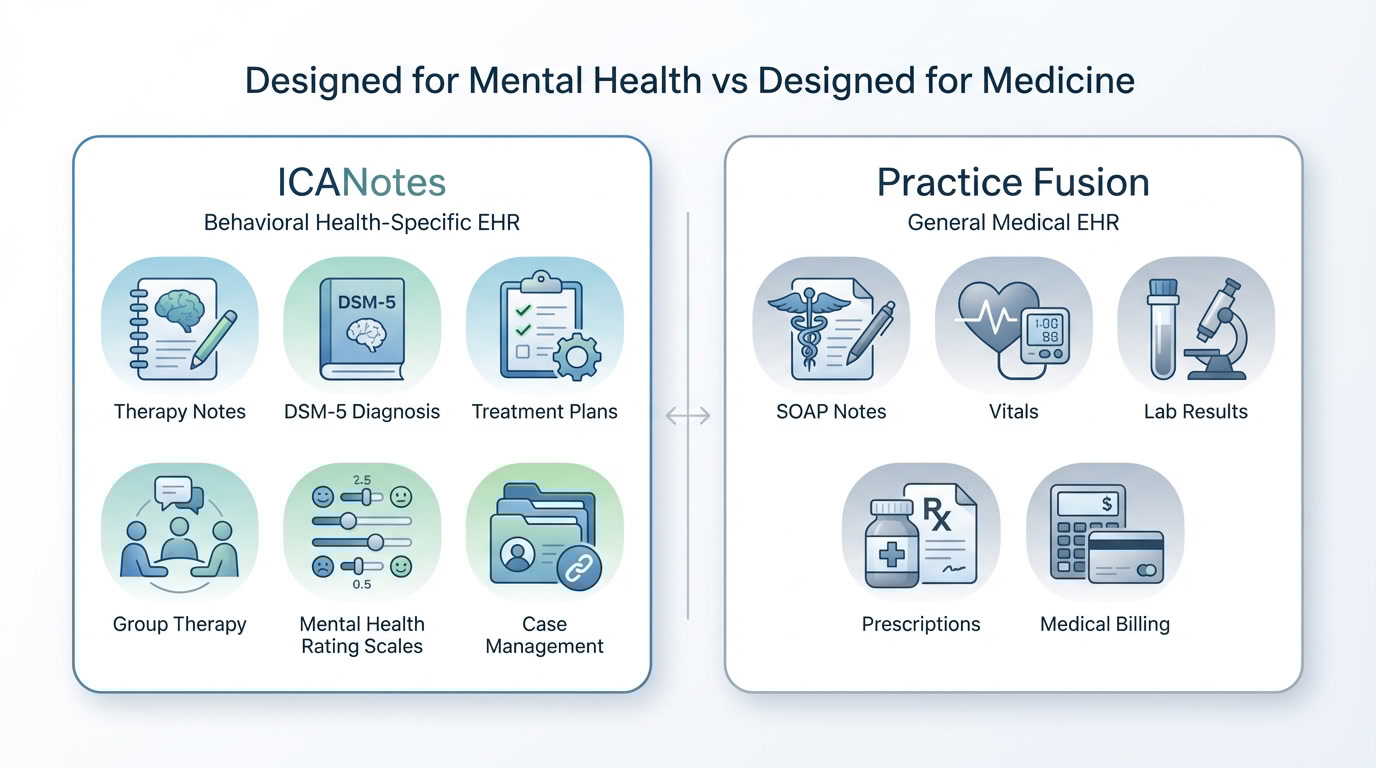
However, Practice Fusion was designed for family medicine, internal medicine, and general outpatient clinics. Its workflows center on physical exams, lab orders, vital signs, and medical prescribing — not psychotherapy notes, treatment plans, or mental health outcomes.
ICANotes, by contrast, was built exclusively for mental health providers. If your practice focuses on therapy, psychiatry, case management, or community behavioral health services, the specialized features make a significant difference in both documentation quality and time savings.
Who Should Use Each System?
Choose ICANotes if you:
- Provide therapy, psychiatry, counseling, or psychological services
- Need DSM-5-aligned documentation and treatment planning
- Need psychiatric lab ordering, vitals tracking, and electronic prescribing
- Bill for group therapy, case management, or PRP services
- Want integrated mental health rating scales (PHQ-9, GAD-7, etc.)
- Need audit-ready behavioral health documentation
- Require specialized support from mental health EHR experts
Choose Practice Fusion if you:
- Run a primary care or general medical practice
- Focus on physical health with occasional mental health screening
- Need strong lab ordering, vitals tracking, and medical prescribing
- Document primarily using medical SOAP notes
- Rarely create formal mental health treatment plans
| Feature | ICANotes | Practice Fusion | Verdict |
|---|---|---|---|
| Clinical Documentation | Menu-driven, DSM-5-aligned templates built specifically for behavioral health. | General medical SOAP documentation designed for primary care. | ICANotes for mental health depth |
| Treatment Planning | Structured goals, objectives, and interventions tied directly to progress notes. | No behavioral-health-specific treatment plan engine. | ICANotes |
| Evidence-Based Rating Scales | 100+ built-in scales (PHQ-9, GAD-7, C-SSRS, etc.) integrated into documentation. | No native mental-health assessment library. | ICANotes |
| Group Therapy | Chart once and distribute compliant notes to all participants. | Not supported. | ICANotes |
| Billing & Claims | Behavioral-health-optimized billing and optional RCM services. | Medical billing workflows focused on primary care. | ICANotes for BH billing |
| Best Fit | Behavioral health practices, therapy, psychiatry, agencies, and programs. | Primary care and general medical practices. | Depends on specialty |
Download this EHR Evaluation Checklist
Choosing a new EHR is one of the most important decisions your practice will make. To help you evaluate vendors confidently and avoid costly surprises, download our free guide: Questions to Ask Mental Health EHRs.
This expert-designed checklist covers the essential questions to ask about documentation, compliance, telehealth, billing, integrations, scalability, pricing, analytics, and more — so you can compare systems side by side and choose the right fit for your practice.
Deep Dive: Key Differences Between ICANotes and Practice Fusion
1. Clinical Documentation
ICANotes provides structured, menu-driven documentation that generates fully narrative notes in minutes:
- Individual therapy notes
- Psychiatric evaluations and medication management
- Group therapy (chart once, apply to all participants)
- Couples and family therapy
- Case management and PRP documentation
- Crisis assessments and discharge summaries
All templates align with DSM-5 and meet payer documentation requirements.

Example Scenario
A therapist sees 6 clients in group therapy. With ICANotes, they document the session once and distribute individualized notes to each client's chart. With Practice Fusion, they'd need to create separate notes manually or use workarounds.
Practice Fusion supports general medical documentation:
- History of Present Illness (HPI)
- Review of Systems (ROS)
- Physical exam findings
- Lab orders and results
- Medical SOAP notes
It lacks pre-built templates for therapy sessions, mental status exams, or psychosocial assessments. Clinicians must create custom templates, which takes time and may not meet behavioral health standards.
For mental health work, ICANotes saves significant time and produces more compliant, audit-ready documentation.
2. Treatment Planning & Medical Necessity
ICANotes includes a comprehensive treatment plan engine:
- Problem list linked to DSM-5 diagnoses
- Measurable goals and objectives
- Evidence-based interventions
- Automatic connection to progress notes
- Revision tracking for audits
Treatment plans link with progress notes to facilitate the documentation of progress, creating a clear thread of medical necessity.
Practice Fusion has no behavioral health treatment plan module. Clinicians would need to create treatment plans as standalone documents without integration into clinical notes.
If you need to demonstrate medical necessity for insurance authorization or audits, ICANotes is substantially stronger.
3. Evidence-Based Rating Scales & Outcomes
ICANotes includes over 100 integrated rating scales:
- Depression: PHQ-9, HAM-D, MDI, QIDS-C, CES, MDQ, SDS, GDS, DASS
- Anxiety: GAD-7, HAM-A, PSWQ, SCARED, SAS
- PTSD: PCL-5, ITQ, CATS, CPSS, TESI-C
- ADHD: ASRS, NVA
- Substance use: CAGE-AID, AUDIT, DAST, MAST, CRAFFT, BAM, CIWA, COWS, URICA
- Suicide Risk: Columbia Screener (C-SSRS)
Results flow directly into clinical notes and can be tracked over time for outcomes reporting.
Practice Fusion has no built-in library of mental health assessments. Clinicians would need to administer scales separately and manually record results.
For outcomes tracking and measurement-based care, ICANotes is far superior.
4. Billing & Revenue Cycle Management
ICANotes is designed for behavioral health billing:
- Automated charge capture from documentation
- Integrated EHR and billing in one system
- Support for behavioral health-specific modifiers
- PRP and case management billing workflows
- Optional full RCM service
Practice Fusion provides solid general medical billing but lacks:
- Treatment plan integration with claims
- Specialized PRP or community service billing
- Behavioral health modifier automation (some must be added manually)

Example
If you bill Medicaid for Psychiatric Rehabilitation Program services, ICANotes handles the complex documentation and billing requirements. Practice Fusion would require significant customization.
For mental health billing — especially Medicaid or complex behavioral health services — ICANotes is the clear winner.
5. Telehealth & Client Engagement
Both systems offer telehealth capabilities, but with different focuses:
ICANotes:
- Telehealth add-on available on all plans
- Client portal designed for mental health intake forms
- Integrated outcome measures and e-signatures
- Secure messaging tailored to therapeutic relationships
Practice Fusion:
- Telehealth built-in for medical visits
- Portal optimized for lab results, prescriptions, and vital signs
- Less suited for therapy intake or mental health questionnaires
For therapeutic work, ICANotes offers better workflow alignment.
6. Support & Training
Support and training can significantly impact how quickly clinicians adopt an EHR and how effectively they use it over time.
While both platforms provide assistance, their approaches differ in terms of hands-on onboarding, behavioral health expertise, and long-term support.
| Category | ICANotes | Practice Fusion | Verdict |
|---|---|---|---|
| Support Availability | 24/7 live support via phone, email, and chat with behavioral-health-trained staff. | Support available primarily during business hours with general technical teams. | ICANotes for availability and specialization |
| Training & Onboarding | Includes personalized 1-on-1 onboarding and live training at no additional cost. | Self-guided setup with documentation and optional support. | ICANotes for hands-on onboarding |
| Behavioral Health Expertise | Support staff understand therapy, psychiatry, billing, and compliance workflows. | Support focused on general medical workflows. | ICANotes for mental health expertise |
| Implementation Support | Guided implementation ensures templates, billing, and workflows are configured before go-live. | Primarily self-directed implementation. | ICANotes for proactive setup |
| Ongoing Education | Webinars, workflow guidance, and behavioral-health-specific resources. | Help center and general EHR resources. | ICANotes for specialty-focused education |
If you value hands-on support from people who understand mental health workflows, ICANotes provides more comprehensive assistance.
Pricing Considerations
Note: Pricing varies based on practice size, features, and contract terms. Contact vendors directly for current quotes.
ICANotes typically offers:
- Per-provider monthly pricing based on discipline with part-time and full-time pricing
- All core behavioral health features included
- Optional add-ons for telehealth, RCM, and advanced features
Practice Fusion offers:
- Starts at $199 per provider per month
- Paid tiers with enhanced features
- May charge per-claim fees for billing services
For practices focused on mental health, the specialized features in ICANotes often justify any price difference through time savings and reduced claim denials.
What About Drawbacks?
ICANotes limitations:
- Steeper learning curve initially due to comprehensive features
- Higher cost than basic medical EHRs
- May be overkill for practices that do minimal mental health work
Practice Fusion limitations:
- Lacks depth for behavioral health documentation
- No specialized mental health treatment planning
- Limited support for therapy-specific workflows
- May require extensive customization for mental health use
Migration & Integration
Can you switch between systems? Both platforms can export data, but migrating historical notes requires planning. Work with vendors to understand data transfer options.
Third-party integrations:
- ICANotes integrates with behavioral health-specific tools
- Practice Fusion connects with general medical practice management systems
Check with each vendor about integration with your existing labs, billing, or insurance verification tools.
Compliance & Security
Both systems are HIPAA-compliant and offer:
- Encrypted data storage
- Secure messaging
- Audit logs
- Regular security updates
ICANotes additionally provides behavioral health-specific compliance support for:
- State licensing board requirements
- Behavioral health accreditation standards
- Medicaid behavioral health documentation rules
Final Recommendation
For behavioral health practices — whether you're a solo therapist, a psychiatry group, or a community mental health center — ICANotes is the better choice. Its specialized templates, DSM-5 integration, treatment planning tools, and behavioral health billing support will save you time and reduce documentation headaches.
For primary care or general medical practices that occasionally screen for depression or anxiety, Practice Fusion's medical workflows may be sufficient, especially if you're already comfortable with general medical documentation.
Next Steps
- Request demos from both platforms using realistic scenarios from your practice
- Ask specific questions about your most complex documentation needs
- Involve your billing team to understand the revenue cycle implications
- Start a free trial to evaluate the EHR in real-world clinical workflows before committing.
The right EHR should feel like it was built for the way you work — not something you have to work around.
Ready to See the Difference a Behavioral Health–Specific EHR Makes?
Choosing the right EHR isn’t just about features—it’s about how well the system supports your clinical workflow, documentation requirements, and reimbursement needs. ICANotes was built specifically for behavioral health, with structured therapy notes, DSM-5–aligned diagnosis support, treatment planning tools, and workflows designed for mental health and addiction treatment settings.
See how ICANotes works in real practice.
Start a free trial or schedule a personalized demo to explore how ICANotes can help you document more efficiently, stay compliant, and focus more time on client care.
Start Your 30-Day Free Trial
Experience the most intuitive, clinically robust EHR designed for behavioral health professionals, built to streamline documentation, improve compliance, and enhance patient care.
- Complete Notes in Minutes - Purpose-built for behavioral health charting
- Always Audit-Ready – Structured documentation that meets payer requirements
- Keep Your Schedule Full – Automated reminders reduce costly no-shows
- Engage Clients Seamlessly – Secure portal for forms, messages, and payments
- HIPAA-Compliant Telehealth built into your workflow

Related Posts






Sandy Crowley
Chief Marketing Officer
About the Author
Sandy Crowley is the Chief Marketing Officer at ICANotes, a leading EHR platform purpose-built for behavioral health. Sandy has over two decades of experience bridging healthcare, marketing, and software innovation. Formerly the company’s CEO, she guided ICANotes through a period of rapid growth and product expansion. With a background in communications from Stanford University and a passion for helping clinicians streamline documentation and improve outcomes, Sandy continues to drive ICANotes’ mission to make behavioral health software smarter, more efficient, and clinician-focused.