Blog > Treatment Strategies > Therapy Termination Activities: 13 Ideas for Meaningful Closure
Therapy Termination Activities: 13 Structured Ideas for a Meaningful Closing Session
Therapy termination activities help clinicians create meaningful closure while reinforcing client growth, resilience, and independence. In this guide, you'll discover 13 structured therapy termination activities for adults, teens, children, couples, families, and groups, along with practical strategies for conducting an effective therapy termination session. You'll also learn how to navigate difficult or premature endings, address ethical considerations in termination counseling, develop relapse prevention plans, and document treatment appropriately. Whether you're looking for counseling termination activities, group therapy termination exercises, or guidance on writing termination notes and discharge summaries, these evidence-informed approaches can help clients leave therapy feeling prepared, empowered, and supported.

Last Updated: May 31, 2026

What You'll Learn
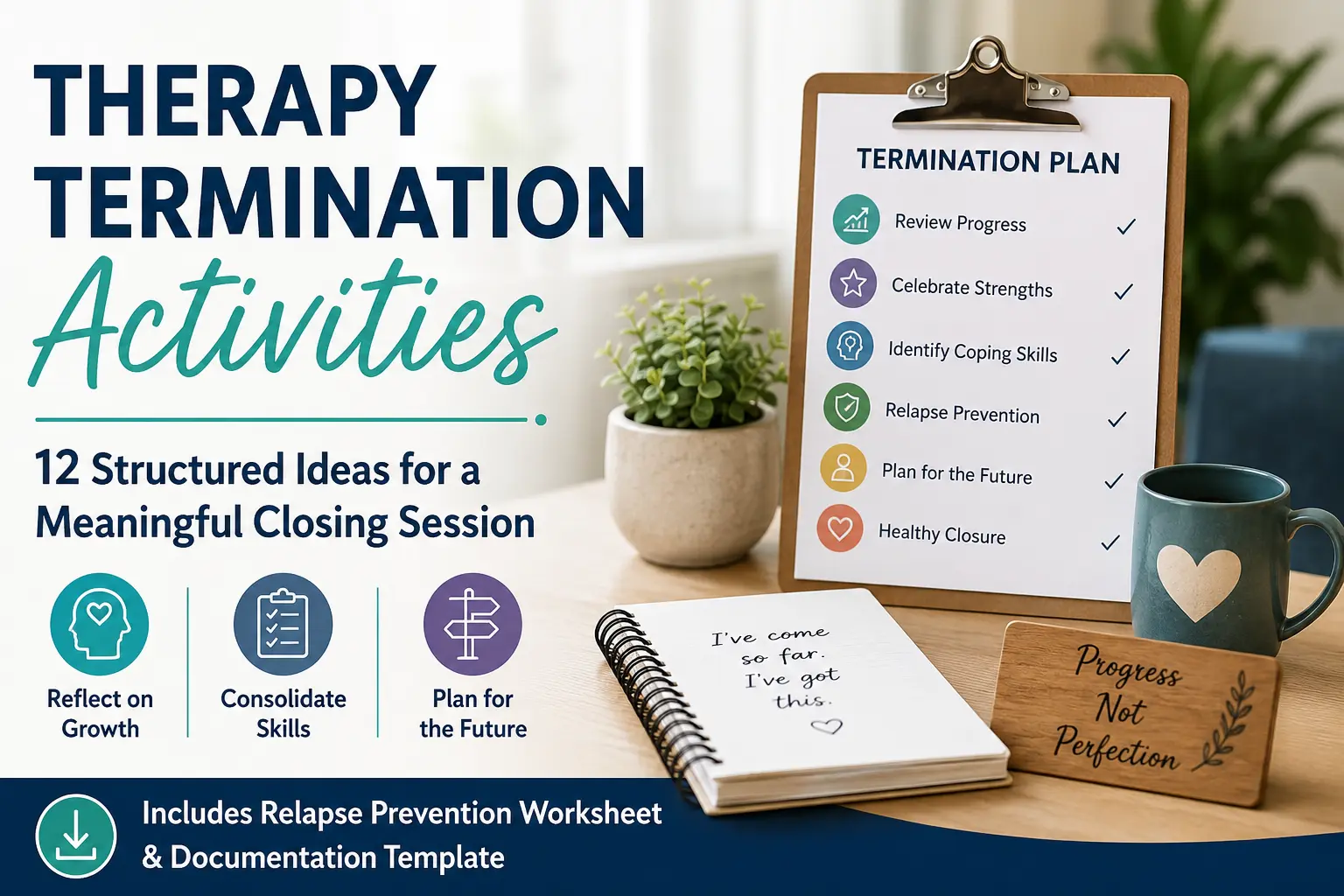
- Why therapy termination is an essential clinical intervention that supports client autonomy, relapse prevention, and long-term treatment outcomes
- How to structure a therapy termination session that promotes reflection, emotional processing, and meaningful closure
- Thirteen evidence-informed therapy termination activities for adults, teens, children, families, couples, and group therapy settings
- Best practices for managing difficult or premature termination, addressing ethical considerations, and avoiding client abandonment
- How to document termination counseling effectively, including termination notes, discharge summaries, referrals, and follow-up recommendations
Contents
Why Termination Matters in Therapy
How to Structure a Therapy Termination Session
13 Therapy Termination Activities for Adults, Teens, Children, and Groups
Adapting Counseling Termination Activities by Age
Managing Difficult or Premature Termination
Ethical Considerations in Therapy Termination
How to Document a Therapy Termination Session
The final therapy session is one of the most clinically significant moments in the therapeutic relationship. Done well, it reinforces the progress a client has made, honors the work you’ve done together, and sends the client forward with a clear sense of their own capabilities. Done poorly — or skipped altogether — it can leave clients feeling abandoned, uncertain, or underprepared for what comes next.
Structured therapy termination activities help clinicians facilitate this transition intentionally. Rather than simply reviewing goals and saying goodbye, these exercises create space for reflection, integration, and genuine closure — no matter how many sessions the client completed or why they’re leaving treatment.
This guide covers 13 evidence-informed counseling termination activities suited to adults, teens, and children, along with guidance on adapting your approach by developmental stage and managing difficult or premature endings.
Why Termination Matters in Therapy
Termination is not a formality — it’s a clinical intervention in its own right. Research consistently shows that the way therapy ends influences outcomes, including whether clients maintain gains and whether they’re willing to seek help again in the future. Ending therapy is more than scheduling a final appointment. Just as clinicians create thoughtful treatment plans at the start of care, they should approach termination with the same level of intention and structure.
A well-structured therapy termination session serves several clinical functions:
- Reinforces treatment goals achieved
- Supports client autonomy and self-efficacy
- Addresses attachment dynamics that may surface during endings
- Reduces the risk of abrupt or avoidant endings
- Creates space for meaningful reflection and emotional integration
For many clients, especially those with histories of loss, abandonment, or trauma, termination can trigger strong reactions. Thoughtful closure — supported by structured activities — allows these dynamics to be processed rather than avoided.
How to Structure a Therapy Termination Session
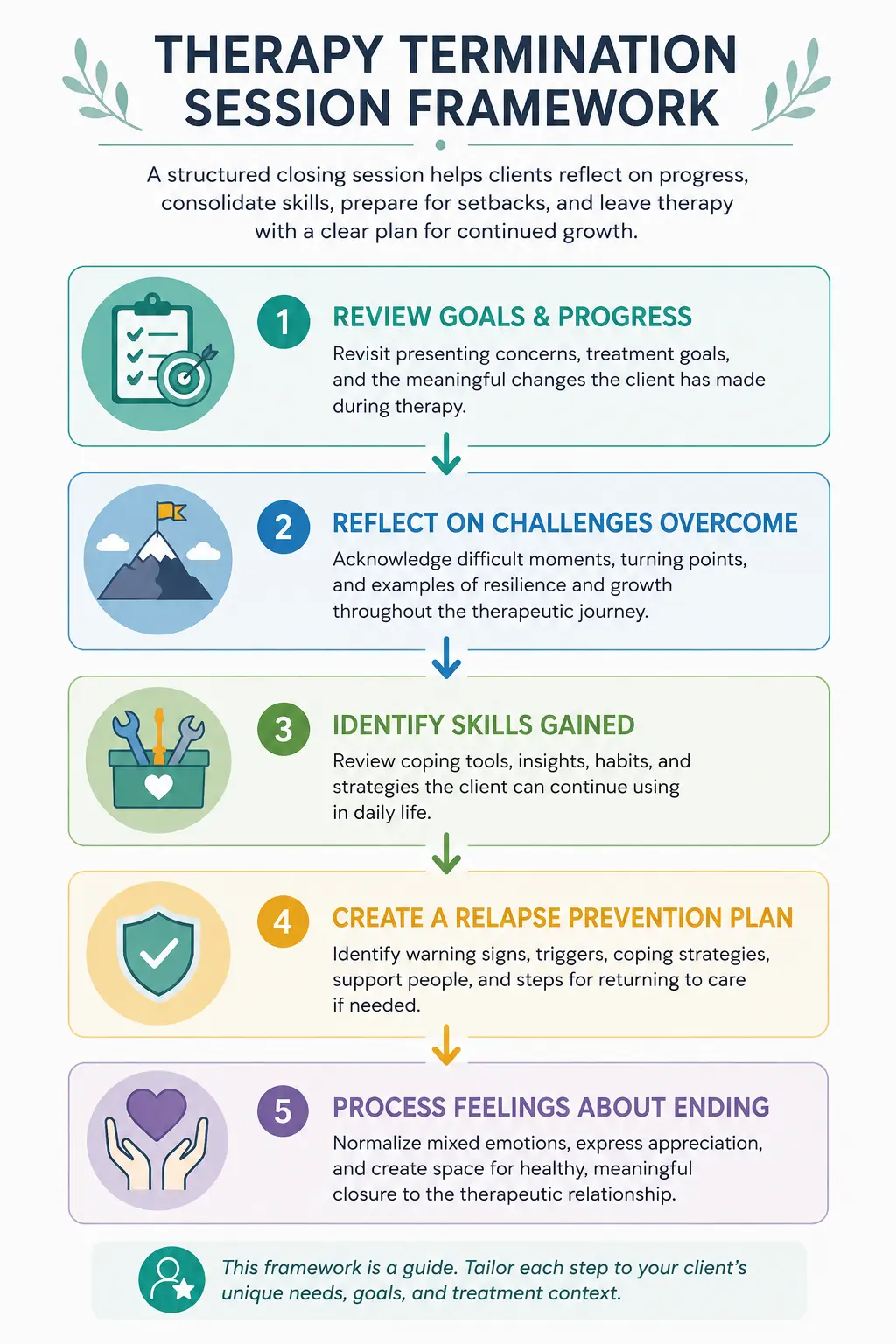
While every client's needs are different, most effective therapy termination sessions follow a similar structure. Creating a clear framework helps ensure that important clinical tasks aren't overlooked and gives clients an opportunity to reflect on their progress, prepare for future challenges, and process the end of the therapeutic relationship.
Effective therapy termination sessions do more than review progress — they help clients consolidate therapeutic gains and prepare for life after treatment. By intentionally addressing both accomplishments and future challenges, clinicians can create a meaningful closing experience that supports long-term resilience and continued growth.
Whether you’re planning a single closing session or spreading termination across several appointments, a thoughtful structure keeps the session focused and clinically grounded. A typical framework includes:
- Review goals and progress: Revisit the client’s presenting concerns and what they set out to accomplish. If you're looking for strategies to connect goals, interventions, and outcomes more effectively, our guide to writing progress notes provides practical documentation examples.
- Reflect on challenges overcome: Acknowledge difficult moments and how the client navigated them.
- Identify skills gained: Inventory coping tools, insights, and behavioral changes the client can carry forward.
- Create a relapse prevention or maintenance plan: Identify triggers, warning signs, and strategies for getting back on track if needed.
- Process feelings about ending: Normalize ambivalence, grief, pride, and relief — all common responses to termination.
The activities below can be woven into this structure or used as standalone exercises depending on your client’s needs and the time available.
Therapy Termination Session Toolkit
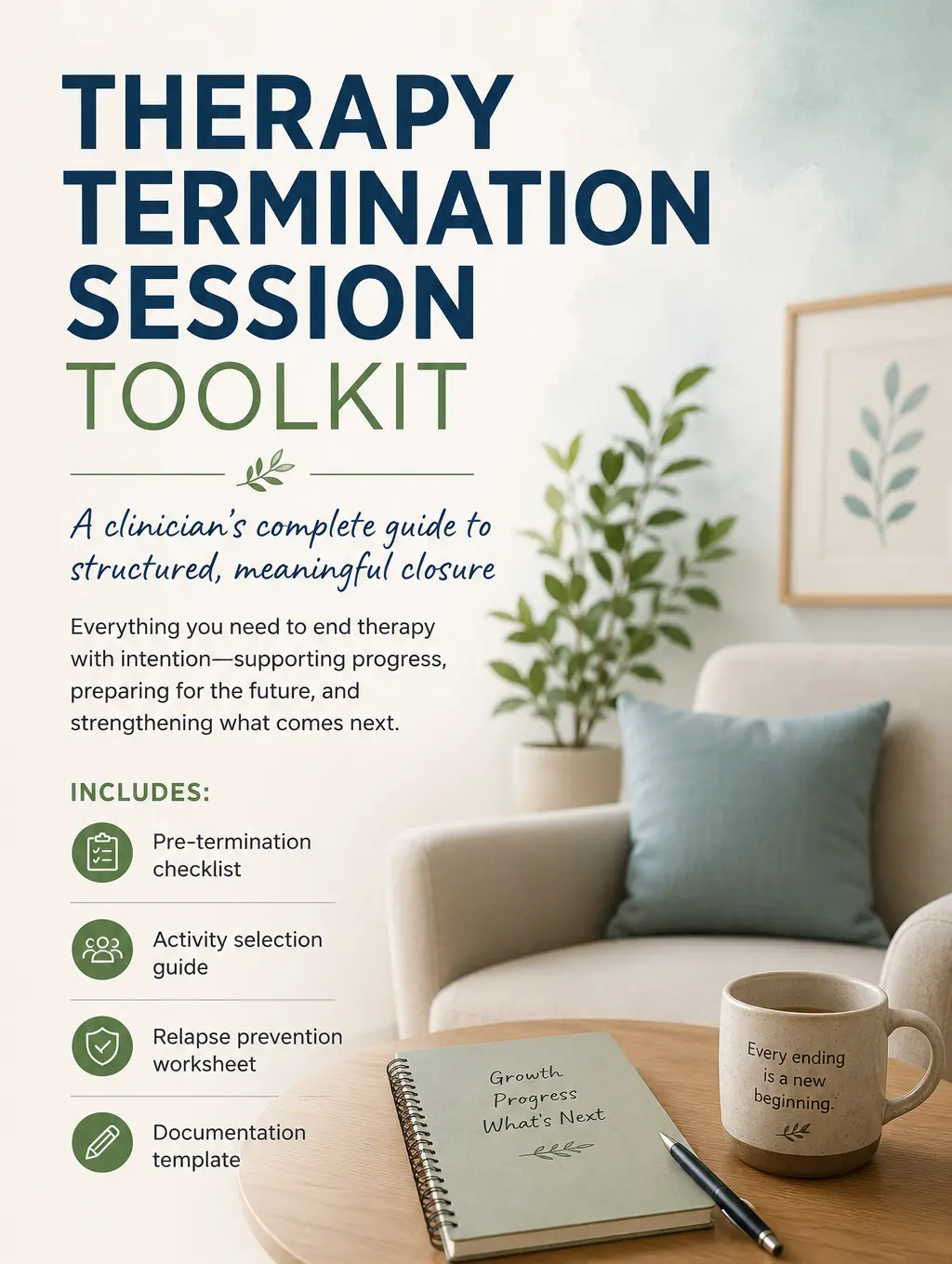
End treatment with confidence and intention. This free clinician toolkit helps you create meaningful therapy endings while maintaining strong clinical documentation and continuity of care.
- Pre-Termination Planning Checklist
- Termination Activity Selection Guide
- Relapse Prevention & Maintenance Worksheet
- Therapy Termination Documentation Template
Get Your Free Copy
Join thousands of behavioral health professionals who rely on ICANotes for clinical documentation, treatment planning, billing, and practice management.
13 Therapy Termination Activities for a Meaningful Closing Session
Each activity below includes a clinical goal, structured steps, sample processing questions, and considerations for special populations or situations.
1. Progress Timeline Review
- Draw or print a horizontal timeline representing the length of treatment.
- Ask the client to mark key moments: when they first noticed change, difficult periods, and breakthroughs.
- Review the arc together, noting patterns and resilience.
2. Letter to Your Future Self
- Ask the client to write a letter to themselves to be read in six to twelve months.
- Prompt them to include what they’ve learned, what they want to remember, and encouragement for hard times ahead.
- The client seals and keeps the letter or uses a service like futureme.org for delivery.
3. Therapist-to-Client Strengths Reflection
- The therapist prepares a written or verbal reflection identifying three to five specific strengths they observed.
- Share the reflection directly with the client, referencing concrete examples from sessions.
- Invite the client to respond—what resonates, what surprises them.
4. Relapse Prevention Plan
- Collaboratively identify the client’s personal triggers and early warning signs.
- List the coping skills and supports that have been most effective.
- Identify who the client will contact and what steps they will take if they notice warning signs.
- Document when and how the client would seek professional support again.
5. “What I’m Taking With Me” Exercise
- Ask the client to list or draw the things they’re “taking with them” from therapy—skills, phrases, perspectives, and habits.
- Explore which of these came most naturally versus which required the most effort to develop.
- Ask them to identify one thing they want to continue working on independently.
6. Before-and-After Comparison
- Use a two-column worksheet or whiteboard: “Before therapy” / “After therapy.”
- Ask the client to describe how they thought, felt, or behaved in a specific area before treatment.
- Compare with how they approach the same area now.
7. Coping Skills Inventory
- Generate a full list of coping strategies the client has tried or learned in treatment.
- Rate each skill based on effectiveness and how likely the client is to use it going forward.
- Narrow the list to a “top five” the client commits to maintaining.
8. Values and Next Chapter Planning
- Ask the client to name two or three core values that feel central to who they want to be.
- Identify one or two meaningful goals in relationships, work, or daily life that reflect those values.
- Discuss what a “next chapter” looks like and how treatment has equipped them to write it.
9. Empty Chair Closure Dialogue
- Use Gestalt-informed empty chair work to invite the client to address an unresolved relationship, part of self, or emotion.
- Guide the client through speaking what they need to say, then shifting chairs to respond.
- Debrief fully before ending the session.
10. Gratitude and Acknowledgment Exchange
- Invite the client to share what they’ve appreciated about the therapeutic relationship or what was most helpful.
- The therapist reciprocates with authentic, boundaried appreciation for what the client brought to the work.
- Allow space for silence, emotion, or humor—whatever arises naturally.
11. Memory or Milestone Symbol
- Invite the child or teen to create or choose an object that symbolizes something meaningful about their therapy experience.
- Use examples such as a decorated stone, small drawing, certificate of completion, or memory jar filled over several sessions.
- Discuss what the object represents and how they can use it as a reminder of their growth.
12. Open Door Conversation
- Explicitly discuss whether and how the client could return to therapy in the future.
- Clarify your practice’s policies around re-engagement, waitlists, or referrals.
- Reinforce that seeking help again is a sign of strength, not failure.
Adapting Counseling Termination Activities by Age and Treatment Setting
While many therapy termination activities can be adapted across populations, the way closure is approached should reflect the client's developmental stage, treatment goals, and relational context. The following comparison highlights key considerations for children, adolescents, adults, and couples or families.
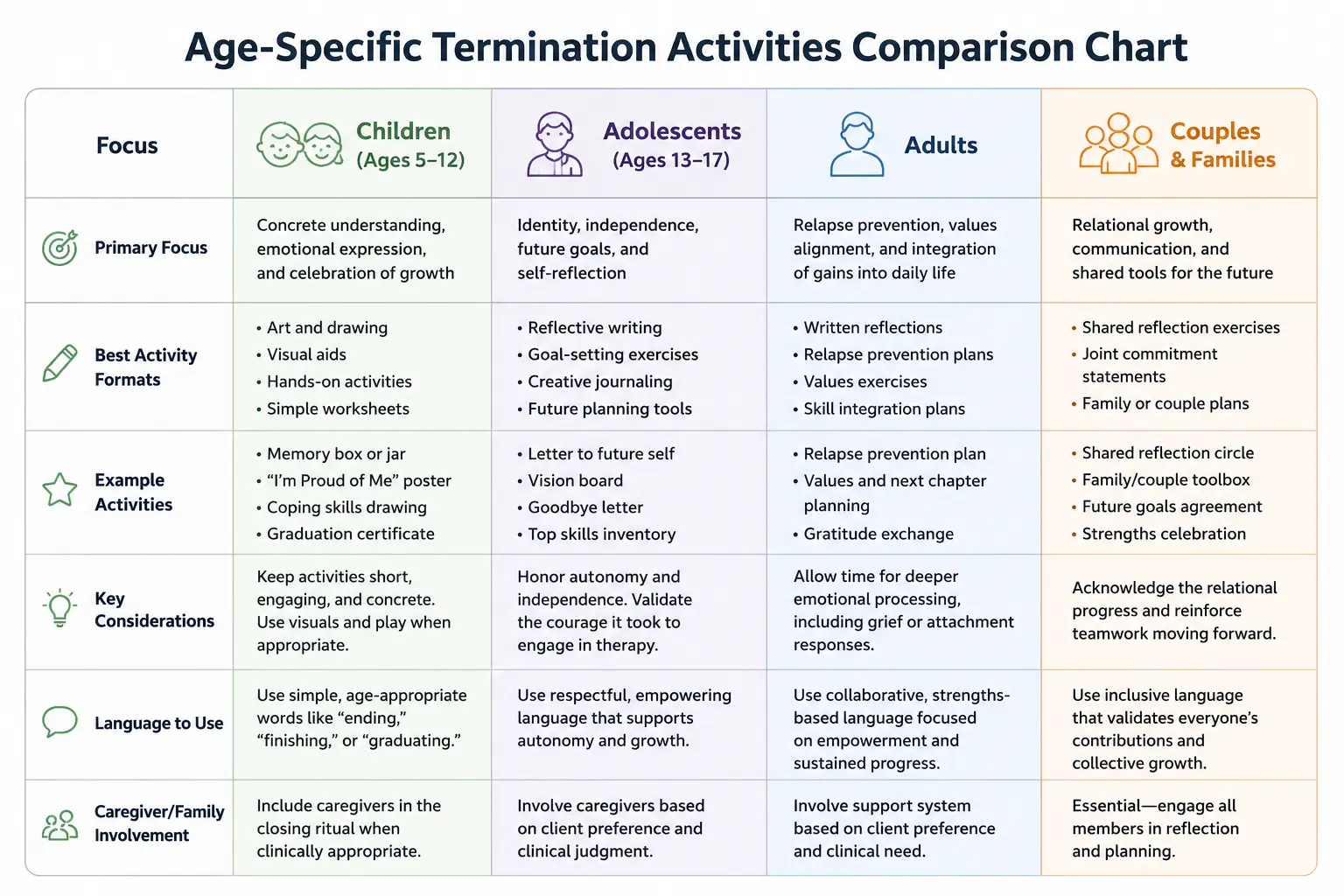
The chart provides a high-level overview, while the sections below offer additional guidance for tailoring termination activities to each population.
Children (Ages 5–12)
Lean on visual and art-based formats. Concrete objects, drawings, and simple worksheets help make abstract ideas more tangible and developmentally appropriate. Include caregivers in the closing ritual when clinically appropriate, and use age-appropriate language for concepts such as “ending therapy” or “graduating from counseling.”
Adolescents (Ages 13–17)
Focus on identity development, independence, and future goals. Teens often respond well to reflective writing activities, values exploration, and forward-planning exercises. Acknowledge the courage it took to engage in therapy and validate the autonomy involved in completing treatment.
Adults
Emphasize relapse prevention, values alignment, and integration of therapeutic gains into everyday life. Clients who have participated in longer-term therapy may experience more complex grief, loss, or attachment responses, making it important to allow adequate time for emotional processing during the closing phase of treatment.
Couples & Families
Use shared reflection exercises, collaborative goal reviews, and joint commitment statements. Acknowledge the relational growth that occurred throughout treatment and identify the communication skills, coping strategies, and problem-solving tools the couple or family can continue using independently.
Beyond age-specific considerations, clinicians should also adapt termination activities to the treatment setting. In group therapy, effective closure involves helping members reflect on both their individual growth and their shared experience within the group.
Group Therapy
Group termination requires attention to both individual progress and the group's shared experience. Activities such as reflection circles, group appreciations, shared milestone reviews, and future commitment statements help members process the ending while reinforcing skills and connections developed during treatment. Therapists should allow time for members to discuss feelings about separation, acknowledge one another's growth, and identify supports they will use after the group concludes.
13. Shared Reflections Circle (Group Therapy)
- What has been the most meaningful part of your experience in this group?
- What have you learned about yourself through interactions with other members?
- What is one strength you want to remember after leaving this group?
- What support or skill will help you maintain your progress moving forward?
- Invite each group member to reflect on their experience and identify one meaningful lesson, insight, or change they are taking with them.
- Arrange members in a circle and provide each participant an opportunity to share their reflection.
- Encourage members to offer positive feedback or observations to one another, focusing on strengths, growth, and contributions they witnessed throughout the group process.
- Ask each member to identify one goal, coping skill, or commitment they plan to carry forward after the group ends.
- Close with a brief summary of the group’s collective accomplishments and encourage members to recognize the courage required to engage in the therapeutic process.
Managing Difficult or Premature Termination
Not every therapy ending is planned or mutually agreed upon. Clients sometimes disengage abruptly, exhaust their insurance coverage, or request to stop before treatment goals are reached. These situations require a different approach.
- Explore avoidance or resistance: Gently name the pattern if the client seems to be avoiding the ending rather than truly ready to terminate.
- Validate mixed emotions: Ambivalence, relief, and grief can coexist. Normalizing this range reduces shame and makes space for honest closure.
- Address unresolved goals: Acknowledge what remains and discuss options — continued care with another provider, a step-down level of service, or a follow-up plan.
- Document clearly: Record the reason for termination, the client’s response, and any referrals or recommendations made. This protects both the client and the clinician. Thorough documentation becomes particularly important when clients disengage unexpectedly or treatment ends before goals are fully achieved. Following established clinical documentation guidelines can help reduce compliance and liability concerns.
Ethical Considerations in Therapy Termination
Termination is both a clinical process and an ethical responsibility. While the goal of counseling termination is often to celebrate progress and prepare clients for greater independence, therapists must also ensure that services are ended in a way that protects client welfare and supports continuity of care.
Professional ethics codes generally emphasize that clinicians should avoid client abandonment and make reasonable efforts to ensure that termination occurs appropriately. This becomes especially important when treatment ends unexpectedly, when a therapist is leaving a practice, or when a client continues to require services beyond the therapist's scope of practice.
Provide Adequate Notice When Possible
Whenever feasible, termination should be planned rather than abrupt. Giving clients advance notice allows time to process the ending, review progress, address unresolved concerns, and develop a plan for maintaining gains after treatment.
The amount of notice may vary depending on the circumstances, but allowing at least one or more sessions dedicated to closure can help clients transition more successfully than a sudden ending.
Assess Ongoing Clinical Needs
Before terminating services, consider whether the client can safely and appropriately function without ongoing treatment. If significant symptoms, safety concerns, or unmet treatment needs remain, discuss available options and recommendations openly.
Termination does not always mean treatment is no longer needed. In some cases, it means that a different level of care, specialty provider, or treatment approach would be more beneficial.
Provide Referrals When Appropriate
When continued care is recommended, provide referrals that are relevant to the client's needs, location, insurance coverage, and treatment goals whenever possible.
Examples may include:
- Another therapist or counselor
- A psychiatrist or medication provider
- A higher or lower level of care
- Support groups or community resources
- Specialized treatment programs
Document any referrals provided and the client's response to those recommendations.
Be Mindful of Attachment and Loss Reactions
For some clients, the end of therapy may activate feelings related to grief, abandonment, rejection, or previous relationship losses. These reactions are especially common among clients with trauma histories, attachment difficulties, or long-term therapeutic relationships.
Creating space to discuss these feelings openly can transform termination into a meaningful therapeutic experience rather than an avoided ending. Exploring what the client learned from the therapeutic relationship and how they can carry those experiences forward often helps foster a healthier sense of closure.
Avoid Abandonment Through Clear Communication
Ethical termination requires clear communication about why treatment is ending, what support remains available, and how the client can access help in the future.
Whether the ending is planned, client-initiated, or driven by external circumstances, clinicians should communicate expectations clearly, provide appropriate resources, and discuss options for returning to care if needed. An "open door" conversation can reduce barriers to future help-seeking while reinforcing the client's autonomy and strengths.
When handled thoughtfully, ethical termination does more than satisfy professional obligations—it models healthy endings, reinforces therapeutic gains, and helps clients leave treatment with confidence in their ability to navigate future challenges.
How to Document a Therapy Termination Session
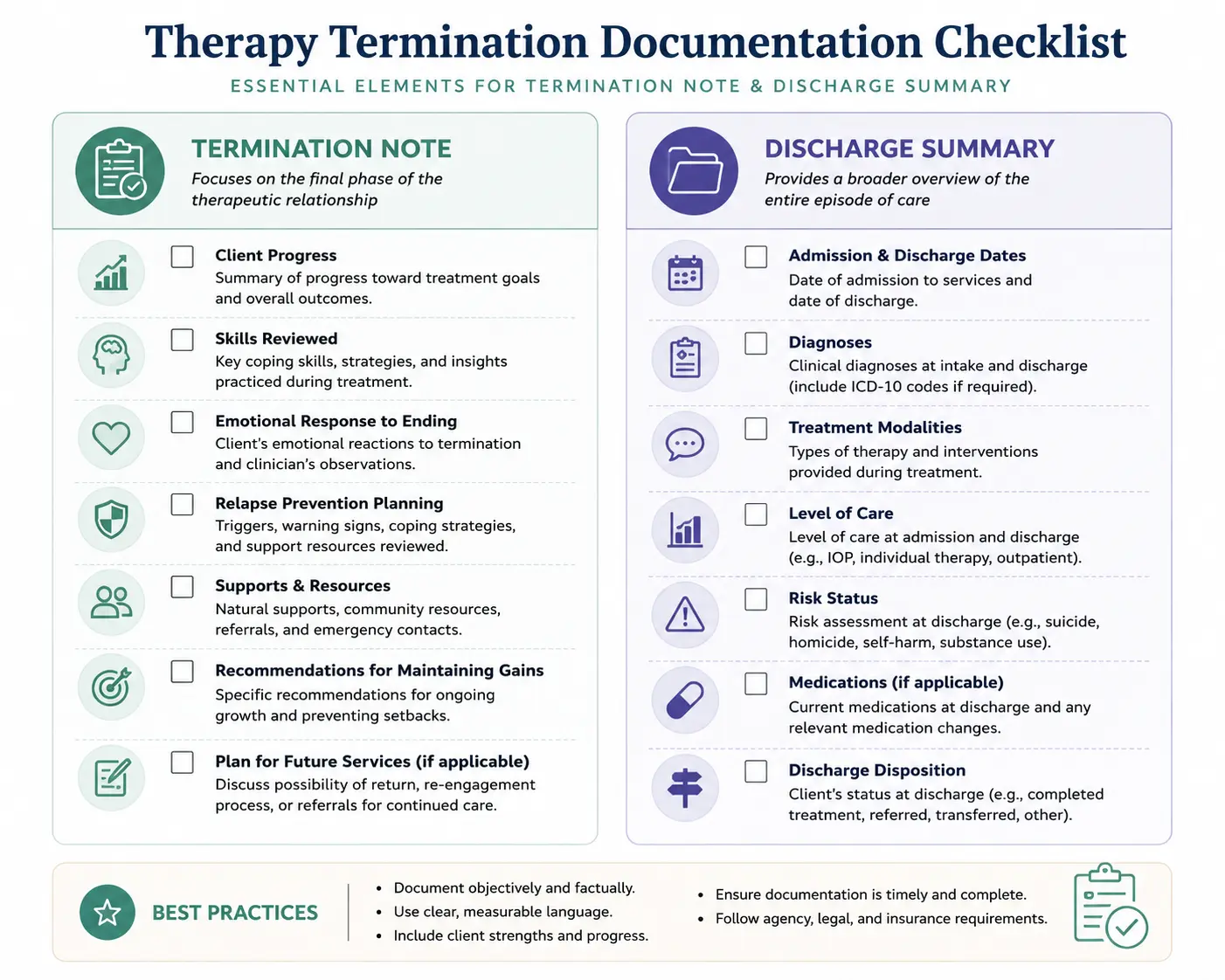
The termination session may be the final clinical encounter, but the documentation often carries lasting significance. Thorough therapy termination documentation creates a clear record of treatment outcomes, supports continuity of care, demonstrates clinical decision-making, and helps protect against potential ethical or legal concerns. Whether treatment ends because goals have been achieved, the client chooses to discontinue services, or a referral to another provider is needed, the closing note should clearly tell the story of the client's treatment journey and next steps. In many cases, clinicians also prepare a formal counseling discharge summary to document treatment outcomes, recommendations, referrals, and continuity-of-care considerations.
What Should Be Included in a Therapy Termination Note?
A well-written termination note should document both the clinical work completed and the rationale for ending treatment. At a minimum, consider including:
- Reason for termination: Document why services are ending, such as successful completion of treatment goals, client choice, referral to another provider, relocation, insurance limitations, non-attendance, or administrative discharge.
- Progress toward treatment goals: Summarize the client's progress and note which goals were fully achieved, partially achieved, or remain ongoing.
- Interventions and skills reviewed: Include key therapeutic approaches, coping skills, behavioral strategies, or insights reinforced during the final sessions.
- Relapse prevention or maintenance planning: Document warning signs, coping strategies, support systems, and plans for seeking help if symptoms return or worsen.
- Current functioning and risk status: Include relevant observations about symptom severity, functioning, and any risk assessment completed at discharge.
- Referrals and follow-up recommendations: Record referrals provided, recommendations for future care, and whether the client accepted or declined those recommendations.
- Client's response to termination: Document the client's emotional reaction to ending treatment, including expressions of confidence, sadness, ambivalence, relief, or other clinically relevant responses.
- Instructions for returning to care: Note any discussion regarding future treatment options and how the client may re-engage with services if needed.
Termination Notes vs. Discharge Summaries: What's the Difference?
A well-written termination note should document both the clinical work completed and the rationale for ending treatment. Therapists often use the terms termination note and discharge summary interchangeably, but they are not always the same document.
Termination Note
A termination note focuses on the final phase of the therapeutic relationship. It documents the client's progress, skills reviewed, emotional response to ending treatment, relapse prevention planning, and recommendations for maintaining gains after therapy.
Discharge Summary
A discharge summary provides a broader overview of the entire episode of care. Depending on the practice setting, it may include admission and discharge dates, diagnoses, treatment modalities, level of care, risk status, medications, and discharge disposition.
In many outpatient psychotherapy practices, a single termination note may effectively serve as both the termination record and discharge summary. In community mental health settings, substance use treatment programs, intensive outpatient programs (IOPs), partial hospitalization programs (PHPs), residential treatment centers, and other structured care environments, separate discharge documentation is often required.
Regardless of format, clinicians should ensure that documentation clearly explains why treatment ended, what progress was made, the client's status at discharge, and any recommendations for future care.
Common Documentation Mistakes to Avoid
Even experienced clinicians can overlook important details when documenting termination. Avoiding these common mistakes helps create a more complete clinical record.
- Failing to document the reason for termination. Simply stating that a client was discharged provides little context. Clearly explain whether treatment goals were achieved, the client elected to discontinue services, a referral was made, or another factor influenced the decision.
- Omitting current risk status. If risk was assessed during the final session, document the findings. This is particularly important for clients with histories of suicidality, self-harm, substance use disorders, or severe mood symptoms.
- Forgetting to document referrals. If referrals or recommendations were provided, record them and note whether the client accepted, declined, or planned to follow up independently.
- Neglecting the client's emotional response. Termination is a clinically significant event. The client's reaction may provide valuable information about treatment outcomes, attachment patterns, and readiness for discharge.
- Leaving out relapse prevention planning. If coping strategies, warning signs, support systems, or maintenance plans were discussed, include the key elements in the record.
Example Termination Documentation Elements
The exact format will vary by practice setting and EHR, but a complete termination note often includes information such as:
- Reason for termination: Client successfully completed treatment goals related to generalized anxiety disorder.
- Progress summary: Client demonstrated significant improvement in anxiety management, reporting reduced symptom frequency, improved sleep, and increased confidence in social and occupational settings.
- Skills reviewed: Cognitive restructuring, grounding techniques, behavioral activation, and self-monitoring strategies.
- Relapse prevention plan: Client identified early warning signs of increased anxiety and reviewed coping skills, support contacts, and criteria for seeking additional professional support.
- Follow-up recommendations: Continue independent use of coping skills and return to treatment if symptoms significantly increase or interfere with daily functioning.
- Client response: Client expressed pride in progress made and confidence in maintaining gains independently while acknowledging some normal anxiety about ending therapy.
EHR platforms designed for behavioral health make this process faster and more consistent. Features such as customizable templates and structured workflows found in modern behavioral health EHR software can help ensure termination notes remain complete and compliant. ICANotes, for example, includes specialty-specific templates designed to support complete, efficient termination notes and discharge documentation while reducing administrative burden on clinicians.
Related Resources
Explore more ICANotes resources on counseling skills, clinical documentation, treatment planning, and discharge summaries.
Frequently Asked Questions About Therapy Termination Activities
Simplify Termination Documentation with ICANotes
Termination documentation should be thorough, but it should not pull clinicians away from the clinical work of helping clients close treatment well. ICANotes is designed specifically for behavioral health documentation, giving clinicians structured tools to capture the essential elements of a termination note or discharge summary without starting from a blank page.
With ICANotes, clinicians can document key details such as the reason for termination, progress toward treatment goals, interventions used, skills reviewed, relapse prevention planning, referrals, risk status, and recommendations for future care. Specialty-specific templates help ensure that important information is captured consistently across providers, programs, and levels of care.
This structure is especially helpful when termination involves more than a simple planned ending. Whether a client has completed treatment goals, requested to discontinue therapy, transferred to another provider, or requires a higher level of care, ICANotes helps clinicians create a clear record of what happened, what was recommended, and how continuity of care was addressed.
ICANotes also supports a more complete clinical story by connecting termination documentation to the broader treatment record. Rather than treating the final note as an isolated task, clinicians can document the closing session in the context of the client’s presenting concerns, treatment goals, progress, ongoing needs, and follow-up recommendations.
For busy behavioral health practices, this means less time wrestling with documentation and more confidence that each termination note or discharge summary reflects the care provided. From intake through treatment planning, progress notes, and discharge, ICANotes helps clinicians close the loop on care with documentation that is efficient, organized, and clinically meaningful.
Ready to see how ICANotes can support your full clinical workflow from intake to termination? Schedule a demo today.
Support every stage of care
Make therapy termination easier to document and manage
From treatment planning to discharge summaries, ICANotes helps behavioral health clinicians document the full client journey with confidence. Use customizable templates, clinical prompts, and streamlined workflows to support thoughtful endings, continuity of care, and compliant documentation.
Start your free 30-day trial today and see how ICANotes can simplify your clinical documentation.
Recent Posts






Dr. October Boyles
DNP, MSN, BSN, RN
About the Author
Dr. October Boyles is a behavioral health expert and clinical leader with extensive expertise in nursing, compliance, and healthcare operations. With a Doctor of Nursing Practice (DNP) and advanced degrees in nursing, she specializes in evidence-based practices, EHR optimization, and improving outcomes in behavioral health settings. Dr. Boyles is passionate about empowering clinicians with the tools and strategies needed to deliver high-quality, patient-centered care.