Blog > Treatment Strategies > Motivational Interviewing in Therapy: A Clinician's Guide
Motivational Interviewing in Therapy: Principles, Interventions, Steps, and a Clinician Cheat Sheet
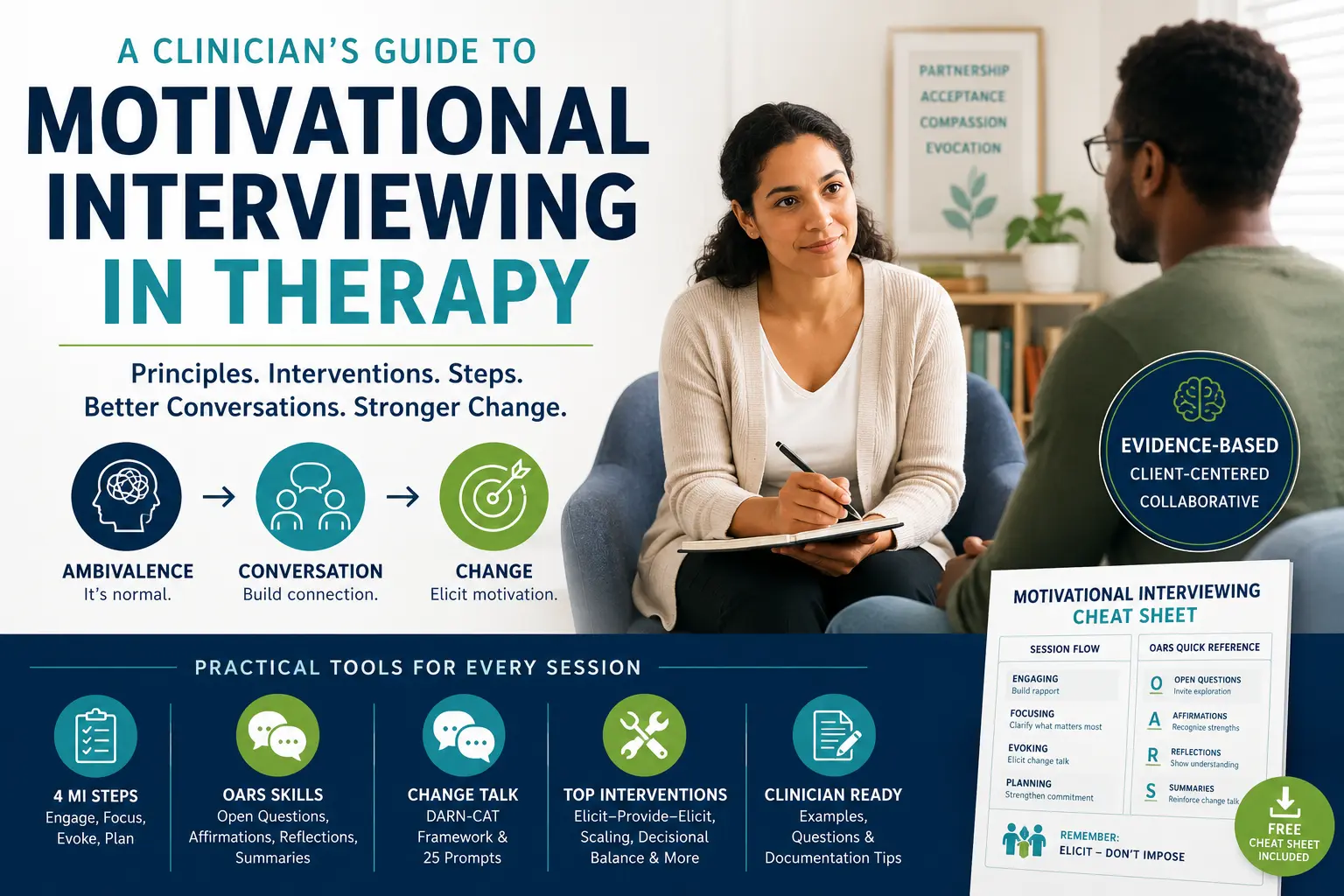
Looking for a practical guide to motivational interviewing therapy? This comprehensive resource covers the principles of motivational interviewing, the four motivational interviewing steps, OARS skills, change talk, and evidence-based motivational interviewing interventions used in mental health counseling, substance use treatment, trauma therapy, and medication adherence work. Learn the primary goal of motivational interviewing, review real-world motivational interviewing examples and questions, and download a free motivational interviewing cheat sheet designed specifically for behavioral health clinicians.


Last Updated: July 8, 2026

What You'll Learn
- Learn what motivational interviewing therapy is, how it works, and the primary goal of motivational interviewing in behavioral health practice.
- Understand the principles of motivational interviewing, the four motivational interviewing steps, and the OARS skills used to build client motivation for change.
- Explore evidence-based motivational interviewing techniques, interventions, and change talk strategies that help clients resolve ambivalence.
- Review practical motivational interviewing examples and clinician-ready questions for substance use, depression, anxiety, trauma, medication adherence, and treatment engagement.
- Discover common motivational interviewing mistakes to avoid and download a free motivational interviewing cheat sheet with OARS, DARN-CAT, and session prompts for clinical practice.
Contents
- What Is Motivational Interviewing?
- The Spirit of Motivational Interviewing
- What Is the Primary Goal of Motivational Interviewing?
- The Four Core Principles of Motivational Interviewing
- The Four Motivational Interviewing Steps
- OARS: The Core Skills of Motivational Interviewing
- Motivational Interviewing Techniques and Interventions
- Why Motivational Interviewing Works
- Motivational Interviewing in Therapy: Clinical Applications
- Motivational Interviewing Examples in Clinical Practice
- Common Motivational Interviewing Mistakes Clinicians Should Avoid
- Motivational Interviewing Cheat Sheet for Clinicians
- Documenting Motivational Interviewing Sessions in ICANotes
- Frequently Asked Questions About Motivational Interviewing
- Putting Motivational Interviewing Into Practice
Motivational interviewing (MI) is a collaborative, person-centered counseling style that helps clients work through ambivalence and strengthen their own motivation to change. Developed by psychologists William Miller and Stephen Rollnick, MI guides clinicians to elicit a client’s reasons for change rather than impose them, making it one of behavioral health’s most widely used evidence-based approaches.
Few counseling approaches have held up as well over the past four decades as motivational interviewing. First described in the early 1980s and refined across four editions of Miller and Rollnick’s foundational text, MI remains one of the most widely used evidence-based approaches in behavioral health — not because it’s a passing trend, but because it works with the psychology of ambivalence rather than against it.
Clinicians now apply motivational interviewing therapy across a wide range of presentations: substance use disorders, treatment adherence, depression, anxiety, general health behavior change, and medication compliance. What ties these applications together is a single insight — people are more likely to change when they hear themselves argue for it, not when a clinician argues for them. That insight shapes both the spirit of motivational interviewing and the motivational interviewing techniques, examples, and interventions clinicians use session to session, covered in detail below.
What Is Motivational Interviewing?
What Is Motivational Interviewing?
Motivational interviewing (MI) is a collaborative, person-centered counseling approach that helps clients resolve ambivalence and strengthen their own motivation for change. Rather than persuading clients to change, motivational interviewing uses empathy, reflective listening, and strategic questions to help people identify and verbalize their own reasons for making meaningful behavioral changes.
Definition of Motivational Interviewing
Motivational interviewing was developed by clinical psychologists William Miller and Stephen Rollnick, who first described the approach in 1983 and have refined it across four editions of their core text, most recently in 2023 (Miller & Rollnick, 2023). At its core, MI is a collaborative, person-centered counseling style — not a fixed set of scripts, but a way of being with clients that places their autonomy and expertise about their own lives at the center of the conversation.
The goal isn’t to convince clients to change. It’s to strengthen their own motivation and commitment to change by helping them voice their own reasons for it. This distinction — eliciting versus persuading — separates MI from more directive counseling styles and explains why it travels so well across diagnoses and settings.
Motivational Interviewing vs. CBT
Because MI and cognitive behavioral therapy (CBT) are often used in the same course of treatment, clinicians new to MI sometimes ask how the two approaches actually differ. The table below summarizes the core distinctions.
In practice, the two are often complementary rather than competing: many clinicians use MI to build a client’s motivation and engagement, then transition into CBT once that motivation is established.
The Spirit of Motivational Interviewing
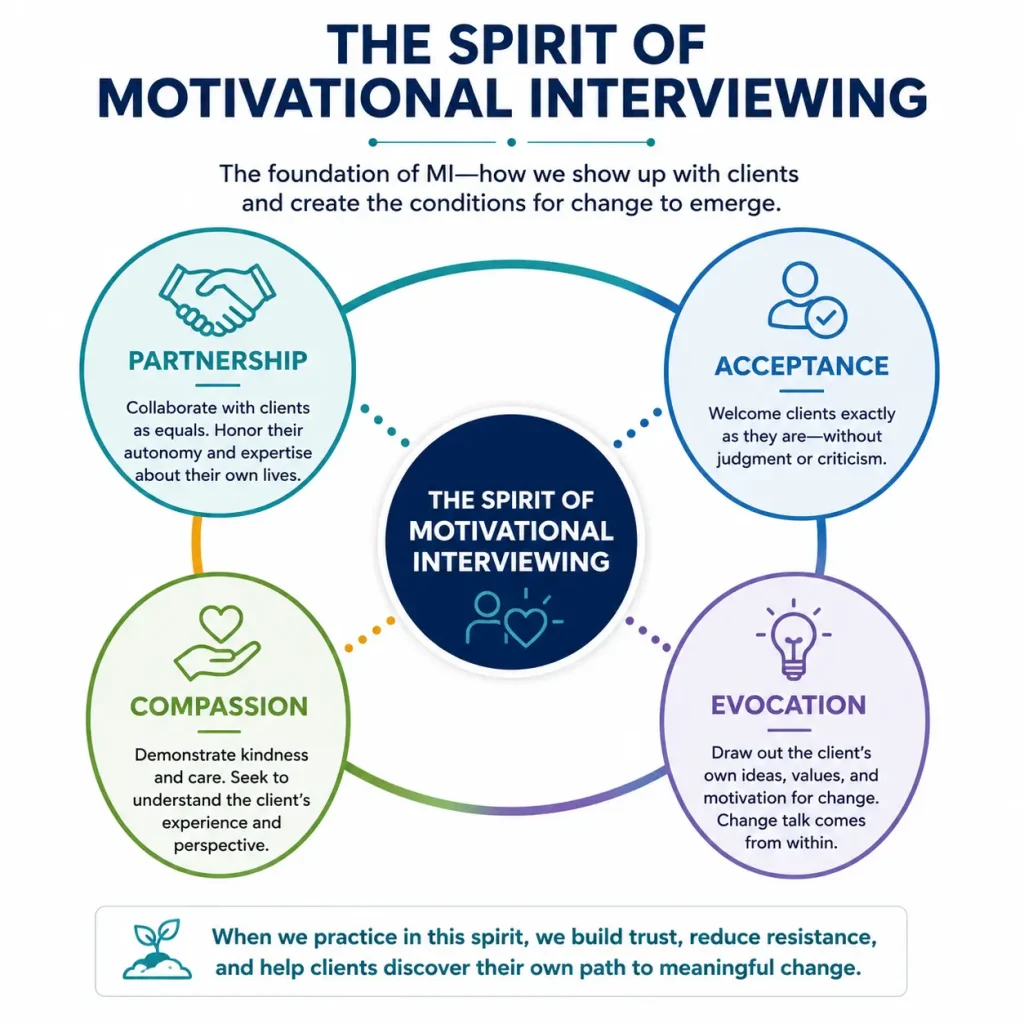
Miller and Rollnick are careful to distinguish MI’s specific techniques from what they call its underlying spirit, and they’re emphatic that the spirit matters more than any individual technique. A clinician can deliver a textbook reflection or a well-timed open-ended question and still miss the mark if the underlying stance isn’t there. The spirit of motivational interviewing rests on four elements: partnership, acceptance, compassion, and evocation.
Partnership
MI treats the clinician-client relationship as a collaboration between two experts, not a hierarchy where the clinician directs and the client complies. The clinician brings expertise in behavior change; the client brings expertise in their own life, values, and circumstances. Neither side can do the work alone.
Acceptance
Acceptance in MI has four components: respecting a client’s absolute worth, expressing accurate empathy, supporting their autonomy, and affirming their strengths. None of this requires agreeing with every choice a client makes. It means engaging with the client as they actually are, not as the clinician wishes they were.
Compassion
MI asks clinicians to actively prioritize a client’s welfare and needs, not simply complete the session efficiently or satisfy a treatment plan checklist. Compassion keeps the other three elements oriented toward the client’s genuine interests rather than the clinician’s convenience.
Evocation
Rather than depositing motivation, knowledge, or insight into a client who supposedly lacks it, MI assumes clients already hold what they need to change, and the clinician’s job is to draw it out. This is the spirit element most directly responsible for the eliciting-rather-than-persuading stance that runs through every other part of MI.

Download the Motivational Interviewing Cheat Sheet
Keep practical MI tools close at hand with this quick-reference guide for mental health clinicians. Use it to structure MI-informed sessions, elicit change talk, strengthen client motivation, and document clinical progress more clearly.
- Session flow template
- OARS and DARN-CAT frameworks
- 25 change-talk prompts
- Common MI mistakes to avoid
- Documentation examples for behavioral health clinicians
What Is the Primary Goal of Motivational Interviewing?
The primary goal of motivational interviewing is to help clients resolve ambivalence and strengthen their intrinsic motivation for change. Rather than persuading clients to change, motivational interviewing helps them identify and verbalize their own reasons for change.
Most clients who feel stuck aren’t unaware that change would help them — they’re caught between competing desires: wanting to feel better, and wanting to keep behaviors that currently serve a purpose, however maladaptive. MI treats that ambivalence as the central clinical target, not as a barrier to talk around.
Why resistance often reflects ambivalence
In MI’s framework, what looks like “resistance” is usually a signal that the clinician has moved faster than the client’s own readiness — pushing one side of an ambivalence the client hasn’t resolved. Rather than meeting resistance with more persuasion, MI-trained clinicians treat it as clinically useful information about where the client actually stands.
Persuading versus eliciting
Traditional advice-giving asks, “How do I convince this person to change?” MI asks, “How do I help this person hear their own reasons for changing?” The shift matters because change talk that comes from the client predicts behavior change far more reliably than change talk that comes from the clinician.
The importance of autonomy
MI assumes that clients, not clinicians, are the experts on their own lives and the ones who must ultimately decide whether and how to change. Explicitly supporting that autonomy — rather than quietly undermining it with pressure — is part of what keeps clients engaged rather than defensive.
A client in outpatient treatment for alcohol use says, “I know I should cut back, but it’s the only thing that helps me relax after work.” A directive response might counter with reasons to quit. An MI-consistent response reflects the ambivalence directly: “Part of you sees a problem with how much you’re drinking, and part of you relies on it. Tell me more about what relaxing actually does for you.” That reflection keeps the client talking — and moving toward their own resolution — rather than putting them in the position of defending their drinking.
The Four Core Principles of Motivational Interviewing
Miller and Rollnick organized the spirit of MI into four core principles. These describe the stance a clinician brings to every MI conversation — the “how” behind the specific interventions covered later in this guide.
1. Express Empathy
Empathy in MI isn’t a soft skill bolted onto the “real” clinical work — it’s the foundation the rest of the approach is built on. Clinicians communicate empathy primarily through reflective listening: restating what a client has said in a way that shows genuine understanding of their perspective, including the parts that feel contradictory.
Reflective listening also builds rapport and validates the client’s experience without necessarily agreeing with every belief behind it. A clinician can validate the difficulty of a client’s situation while still gently exploring the behaviors connected to it.
Example clinician statement: “It sounds exhausting to feel like you have to choose between managing your anxiety and showing up for your kids the way you want to.”
2. Develop Discrepancy
Lasting motivation tends to come from clients recognizing — in their own words — a gap between where they are and where they want to be. MI clinicians help surface that discrepancy by exploring the client’s own values and goals, then gently holding up current behavior against them, rather than pointing out the gap directly.
Example questions: “You mentioned that being a present, patient parent matters a lot to you. How does your drinking fit with that?” or “What would need to be true for your day-to-day life to match the kind of recovery you’re describing?”
3. Roll With Resistance
Confrontation tends to entrench resistance rather than resolve it. When a client pushes back, argues, or minimizes, MI-consistent clinicians avoid the instinct to correct or argue the point. Instead, they reframe the resistance as useful clinical information — often a sign that the conversation moved into territory the client isn’t ready for, or that the client felt unheard.
Example intervention: If a client says, “I don’t think this is as big a deal as everyone’s making it,” rather than arguing the point, a clinician might respond, “It sounds like other people have been pushing harder on this than feels right to you. Tell me how you see it.”
4. Support Self-Efficacy
Clients who don’t believe they can change rarely sustain the attempt, regardless of how motivated they feel in the moment. MI clinicians actively reinforce a client’s belief in their own capacity for change — pointing to existing strengths and highlighting past successes, including small or partial ones.
Example statement: “You stopped smoking for three months on your own two years ago. What helped you do that, and what would it take to get back to that?”
The Four Motivational Interviewing Steps
While the four principles above describe the spirit clinicians bring to MI, the four processes — often called the four motivational interviewing steps — describe how an actual MI conversation tends to unfold. Miller and Rollnick describe these as overlapping and recursive rather than strictly linear; clinicians often cycle back to an earlier process within a single session.
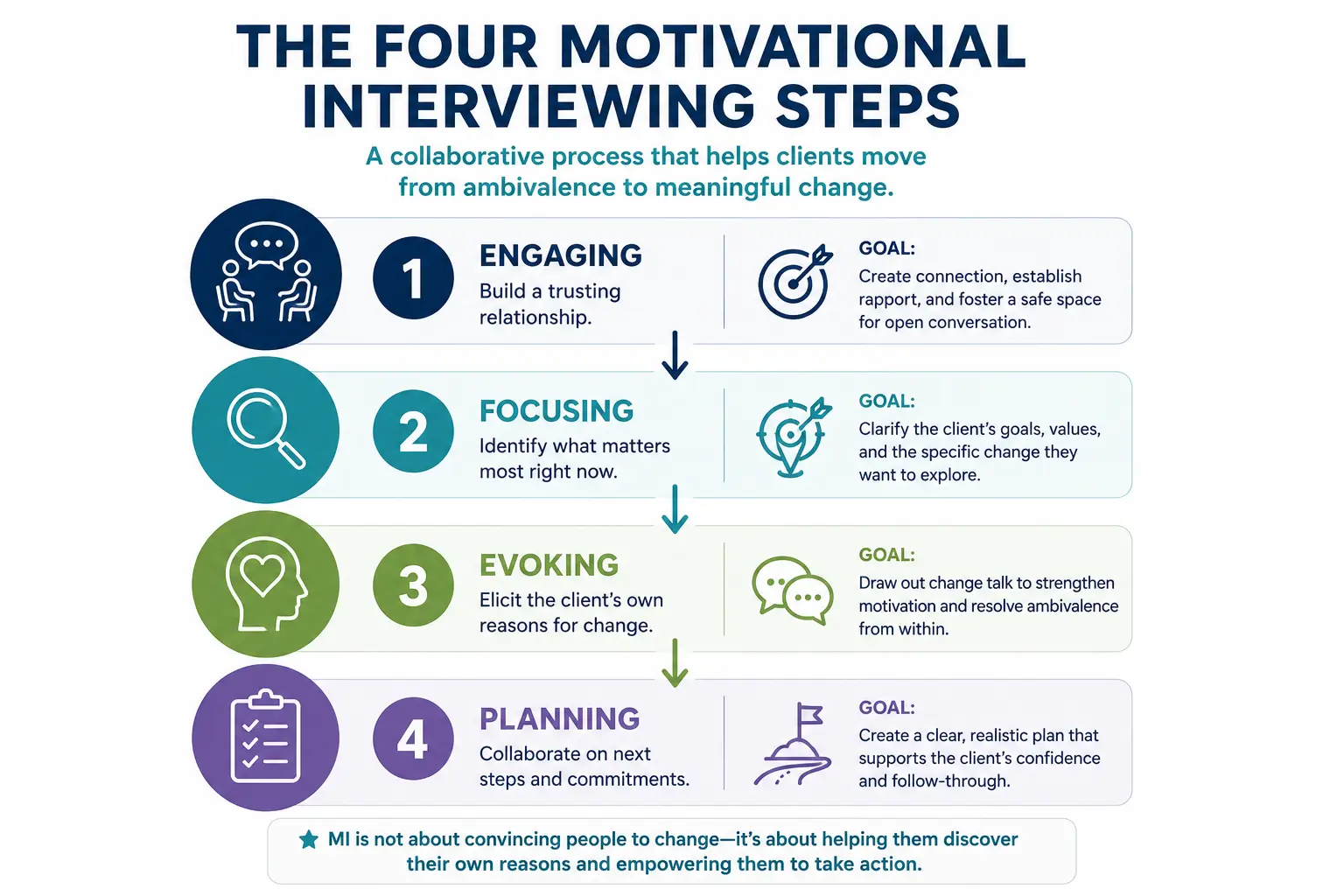
Skipping ahead — for example, jumping to planning before a client has voiced genuine change talk during evoking — is one of the most common ways MI conversations stall. Each process builds the foundation the next one needs.
OARS: The Core Skills of Motivational Interviewing
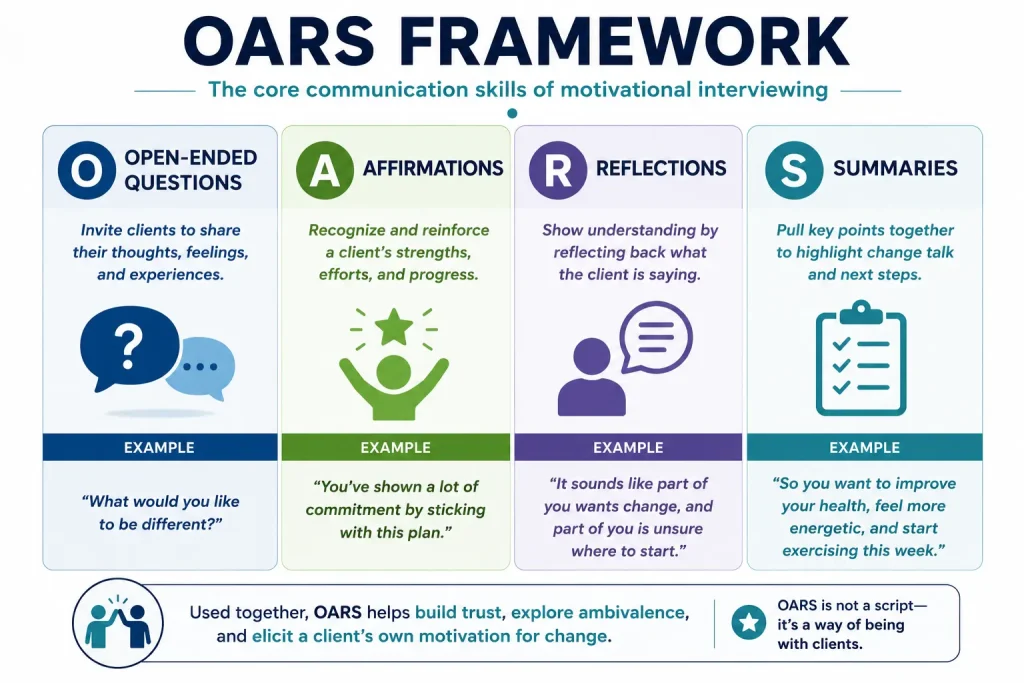
OARS is the acronym clinicians use for the four core motivational interviewing skills that show up throughout every stage of an MI conversation: open questions, affirmations, reflections, and summaries. Where the four principles describe the spirit behind MI and the four processes describe its structure, OARS describes the moment-to-moment skills that carry both into the room.
Open Questions
Open-ended motivational interviewing questions invite clients to elaborate rather than answer in a word or two, giving them room to talk themselves toward their own insights.
- “What concerns you most about continuing this behavior?”
- “What would be different if things improved?”
Affirmations
Affirmations recognize a client’s strengths and effort, genuinely and specifically — generic praise tends to land as hollow.
- “You’ve worked hard to stay engaged in treatment.”
- “It sounds like persistence is one of your strengths.”
Reflections
Reflections do more clinical work than simple acknowledgment — they test the clinician’s understanding while subtly steering the conversation toward change talk.
- Simple reflections restate what the client said with minor rephrasing.
- Complex reflections add meaning or emotion the client implied but didn’t say outright.
- Double-sided reflections hold both sides of a client’s ambivalence in the same statement (“You’re worried about losing the relationship, and you’re not ready to stop drinking yet either”).
Summaries
Periodic summaries pull together what a client has said — especially their own change talk — and reflect it back as a coherent narrative. Because summaries selectively highlight the change-oriented parts of what a client said, they reinforce that material without the clinician ever stating an opinion directly.
Motivational Interviewing Techniques and Interventions
OARS describes the foundational skills behind MI; the techniques below build on them to address ambivalence and elicit change talk more directly. Together, they make up the broader toolkit of motivational interviewing techniques and interventions clinicians draw on session to session.
Decisional Balance Exercises
Structured pros-and-cons exploration helps clients examine the costs and benefits of both changing and staying the same, often surfacing values-based reasons for change that didn’t come up in less structured conversation.
Importance and Confidence Rulers
Importance and confidence rulers are a focused application of scaling questions that ask clients to rate two different things separately: how important a change feels to them, and how confident they feel in their ability to make it. Separating the two often reveals that a client values a change highly but doubts their ability to pull it off, or the reverse — information that should shape whether a clinician spends more time evoking reasons (importance) or building self-efficacy (confidence).
- “On a scale of 1 to 10, how important is this change to you?”
- “On a scale of 1 to 10, how confident are you that you could make this change if you decided to?”
- “Why are you at a [X] and not a [lower number]?”
- “What would move you up one point?”
Exploring Values and Goals
Values clarification exercises connect a target behavior to what a client says actually matters to them, which is often a more durable motivator than external pressure from a provider, employer, or family member.
Eliciting Change Talk
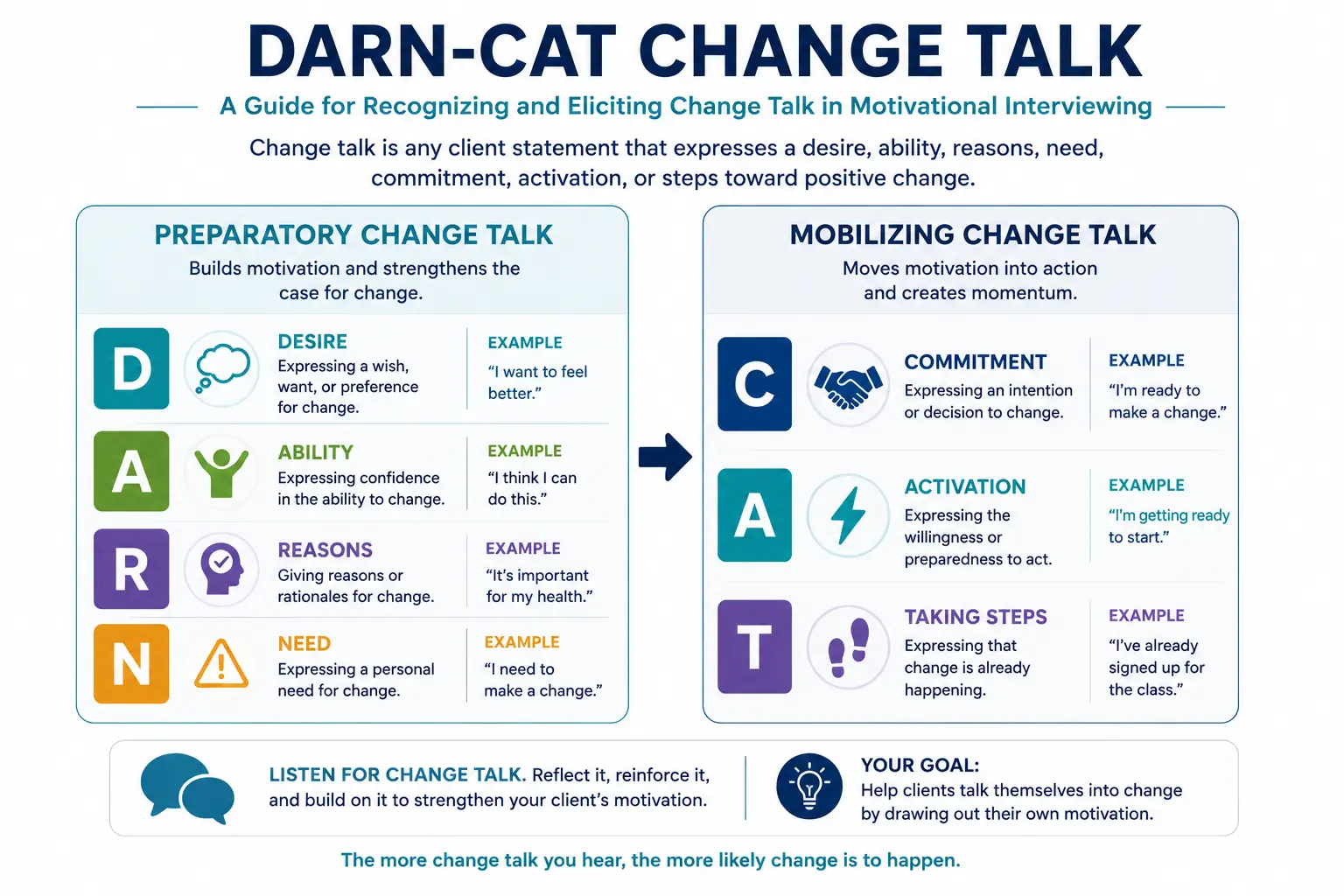
Change talk — anything a client says in favor of change — is the clearest predictor MI research has identified for whether a session translates to behavior change afterward. Miller and Rollnick organize change talk using the DARN-CAT framework:
DARN typically reflects preparatory change talk — a client thinking out loud about change — while CAT reflects mobilizing change talk, where a client is actually moving toward action. Recognizing the difference helps clinicians calibrate whether a client is ready for planning or still needs more evoking.
Elicit-Provide-Elicit
Elicit-provide-elicit gives clinicians a respectful structure for sharing information or professional opinion without slipping into persuasion. The clinician first elicits what the client already knows or wants to know, then provides neutral information only with permission, then elicits the client’s own reaction to it.
“What do you already know about how this medication works?” (elicit) → “Would it be helpful if I shared what we typically see?” (provide, with permission) → “What do you make of that?” (elicit). The structure keeps the client, not the clinician’s information, at the center of the conversation.
Agenda Mapping
When a client is managing several concerns at once, agenda mapping helps the two of you collaboratively choose what to focus on in a given session rather than the clinician deciding unilaterally. A clinician might lay out several possible topics — sleep, medication side effects, a strained relationship, return to work — and ask which feels most pressing today. This is especially useful with complex or multi-diagnosis clients, where sessions can otherwise drift without a shared sense of priority.
Looking Forward / Looking Back
These are classic discrepancy-building exercises. Looking forward asks a client to imagine their life in five or ten years if nothing changes, or if the change they’re considering actually happens. Looking back asks a client to recall what life was like before a problem developed, often surfacing values or a sense of self that current behavior has moved away from. Both techniques generate change talk indirectly, by letting a client arrive at the discrepancy themselves rather than having a clinician point it out.
Querying Extremes
Querying extremes asks a client to describe the best- and worst-case outcomes of changing, or of not changing.
“What concerns you most about continuing this pattern?” or “What would be the best thing that could happen if you made this change?” Because the question asks about extremes rather than the immediate future, it can surface motivation that more measured questions miss, particularly with ambivalent or contemplative clients.
Why Motivational Interviewing Works
MI’s staying power in behavioral health isn’t a matter of popularity alone. It’s backed by several decades of clinical research, summarized below.
- Effective for substance use disorders — MI remains among the most studied brief interventions for substance use, with a widely cited meta-analysis of 72 clinical trials finding a meaningful average effect across studies (Hettema et al., 2005).
- Improves treatment engagement — By addressing ambivalence directly, MI helps clients stay engaged with treatment they might otherwise avoid or drop out of, particularly early in care.
- Improves medication adherence — A systematic review and meta-analysis found that MI-based interventions improved medication adherence across a range of chronic conditions (Palacio et al., 2016).
- Effective across healthcare settings — MI has moved well beyond specialty addiction treatment into primary care, psychiatry, and general medical practice, where it’s recognized as an evidence-based approach to clinical communication (Bischof et al., 2021).
That evidence base is part of why motivational interviewing counseling has become a near-standard expectation in behavioral health graduate programs and continuing education, rather than a niche specialty skill.
Motivational Interviewing in Therapy: Clinical Applications
Motivational interviewing therapy began in substance use treatment, but its application has expanded substantially. Below are five of the most common clinical contexts.
Substance Use Disorders
MI remains best documented in substance use treatment, where it’s used both as a standalone brief intervention and as a precursor to more intensive treatment. A typical MI conversation in this setting might explore a client’s ambivalence about reducing use without requiring them to commit to abstinence before they’re ready to.
Depression
In depression treatment, MI is frequently used to increase engagement — addressing the ambivalence that depression itself creates around showing up for sessions, completing homework, or following through on activation strategies, rather than treating low motivation as simply a symptom to wait out.
Anxiety Disorders
With anxiety, MI techniques help reduce avoidance by exploring a client’s own reasons for approaching feared situations, which tends to generate more durable engagement with exposure-based work than encouragement alone.
Trauma Treatment
Before beginning trauma-focused modalities, clinicians often use MI to build readiness — helping clients explore their own ambivalence about engaging with difficult material before asking them to do so.
Medication Adherence
MI is also widely used to address ambivalence toward psychiatric medication, exploring a client’s specific concerns — side effects, stigma, loss of identity — rather than simply repeating the case for adherence.
Motivational Interviewing Examples in Clinical Practice
One of the best ways to understand motivational interviewing is to hear what it sounds like in session. The examples below illustrate how clinicians use motivational interviewing questions, reflections, and change-talk strategies to help clients explore ambivalence and strengthen their own motivation for change.
Example 1: Substance Use
Client: “I know I drink more than I should, but it's the only thing that helps me relax after work.”
Clinician: “So on one hand, drinking helps you manage stress, and on the other hand, you're concerned about how much you're relying on it.”
Client: “Yeah. I don't like how much I've started needing it.”
Clinician: “What worries you most about continuing things the way they are?”
Why it works: Rather than arguing against drinking, the clinician uses a double-sided reflection and an open-ended question to explore ambivalence and elicit change talk.
Example 2: Depression and Behavioral Activation
Client: “Everyone keeps telling me to exercise, but I can't even get myself off the couch most days.”
Clinician: “It sounds frustrating to know what might help and still feel stuck.”
Client: “Exactly. I know I'd probably feel better if I got moving.”
Clinician: “What makes you think it could help?”
Client: “I've noticed I feel less depressed when I actually get outside.”
Why it works: The clinician reflects the client's experience and then invites the client to voice their own reasons for change rather than providing advice.
Example 3: Medication Adherence
Client: “I stopped taking my medication last week.”
Clinician: “Tell me more about what led to that decision.”
Client: “I hate the side effects, but I'm also worried my symptoms will come back.”
Clinician: “Part of you wants relief from the side effects, and part of you is concerned about what could happen without the medication.”
Client: “That's exactly it.”
Why it works: The clinician explores both sides of the ambivalence without taking a position, helping the client feel understood rather than judged.
Example 4: Anxiety and Avoidance
Client: “I know I should go to the networking event, but the thought of walking into that room makes me anxious.”
Clinician: “What are some of the reasons you think attending might be worth it?”
Client: “It could help my career. And I'd probably feel proud of myself afterward.”
Clinician: “Those sound like important reasons. On a scale of 1 to 10, how willing do you feel to give it a try?”
Why it works: The clinician draws out the client's own motivation and then uses a scaling question to assess readiness for change.
Example 5: Treatment Engagement
Client: “I'm not sure therapy is helping.”
Clinician: “What have you noticed so far that feels useful, even if it's small?”
Client: “I guess I'm more aware of my patterns than I used to be.”
Clinician: “That's an important observation. How might that awareness help you moving forward?”
Why it works: The clinician uses affirmations and open-ended questions to explore the client's experience rather than becoming defensive about therapy itself.
What These Motivational Interviewing Examples Have in Common
Although the situations differ, each example demonstrates the same core motivational interviewing skills:
- Open-ended questions that invite exploration
- Reflective listening that communicates empathy
- A focus on eliciting change talk
- Respect for client autonomy
- Collaboration rather than persuasion
The goal of motivational interviewing is not to convince clients to change. It's to help them discover and strengthen their own reasons for changing, making motivation more likely to endure long after the session ends.
Common Motivational Interviewing Mistakes Clinicians Should Avoid
MI looks deceptively simple on paper, which makes a handful of common mistakes easy to fall into, even for clinicians who know the model well.
- Giving advice too quickly — Jumping to solutions before a client has had room to voice their own reasoning shortcuts the process that makes MI effective in the first place.
- Arguing with clients — Even gentle argument tends to push clients toward defending the status quo, the opposite of the intended effect.
- Focusing on clinician goals rather than client goals — MI only works when the target behavior is one the client has actually identified as a priority, not one imposed by the treatment plan.
- Missing opportunities for change talk — Change talk is easy to let pass unnoticed in a session; clinicians need to actively listen for it and reflect it back.
- Overusing questions — A conversation made up mostly of questions can start to feel like an interrogation; MI relies on a balance of questions, reflections, and affirmations — the OARS skills covered earlier in this guide.
Motivational Interviewing Cheat Sheet for Clinicians
The OARS framework — covered in detail earlier in this guide — is summarized again here for quick reference.
Quick Change Talk Prompts
- “What worries you about staying the same?”
- “What would improve if this changed?”
- “What makes you think you can do this?”
Scaling Questions
- “Why are you at a 5 and not a 2?”
- “What would move you to a 6?”
Reflective Listening Starters
- “It sounds like...”
- “You’re feeling...”
- “On one hand... on the other hand...”
- “What I’m hearing is...”
Want the full version of this resource? Download the complete Motivational Interviewing Cheat Sheet for Mental Health Clinicians below — it includes the DARN-CAT framework, 25 ready-to-use change-talk prompts, and a session flow guide you can keep at your desk.
Documenting Motivational Interviewing Sessions in ICANotes
MI-informed sessions generate exactly the kind of clinical content that’s easy to capture poorly: ambivalence, change talk, partial commitments, and next steps that don’t fit neatly into a checkbox. ICANotes’ customizable behavioral health note templates are built for that kind of narrative detail, letting clinicians document a client’s own words around readiness and change alongside structured treatment plan goals, without slowing down the conversation itself to take notes.
If you’re looking for an EHR built specifically around behavioral health documentation, schedule a demo or start a free trial of ICANotes to see how it fits into your workflow.
Frequently Asked Questions About Motivational Interviewing
+What is the primary goal of motivational interviewing?
+What are the four principles of motivational interviewing?
+What are the four processes or steps of motivational interviewing?
+Is motivational interviewing the same as cognitive behavioral therapy?
+Can motivational interviewing be used with other therapeutic approaches?
+What is the DARN-CAT framework?
+How long does it take to learn motivational interviewing well?
+What’s the difference between motivational interviewing and giving advice?
Putting Motivational Interviewing Into Practice
At its heart, motivational interviewing is less about persuasion and more about creating the conditions for clients to hear, and trust, their own reasons for change. That requires consistent empathy, genuine respect for client autonomy, and a collaborative stance that resists the urge to push, even when pushing feels faster.
None of this requires a complete overhaul of how you practice. Most clinicians start by integrating one or two MI techniques, a well-placed double-sided reflection, a scaling question, a more deliberate ear for change talk, into sessions they’re already running. Small, consistent use tends to compound faster than waiting for a dedicated “MI session” that never quite materializes.
That spirit — partnership, acceptance, compassion, and evocation — and the OARS skills that carry it into the room matter more than mastering every technique in this guide. Clinicians who internalize the spirit first tend to pick up the rest naturally.
Recent Posts






Katie Cox
MA, LPCC
About the Author
Katie Cox, MA, LPCC is a Licensed Professional Clinical Counselor with over 10 years of clinical experience working with adolescents and adults. Her areas of expertise include anxiety, depression, OCD, life transitions, self-esteem, career concerns, and women's mental health. Katie utilizes evidence-based, client-centered approaches to help individuals develop practical coping skills, increase emotional awareness, and achieve their personal goals. Through her clinical work and writing, she is committed to making mental health information accessible, practical, and empowering.