7 Ways AI Is Transforming Behavioral Health EHRs
From clinical documentation to risk assessment, here is where AI genuinely helps behavioral health clinicians and where it needs guardrails.


Key takeaways
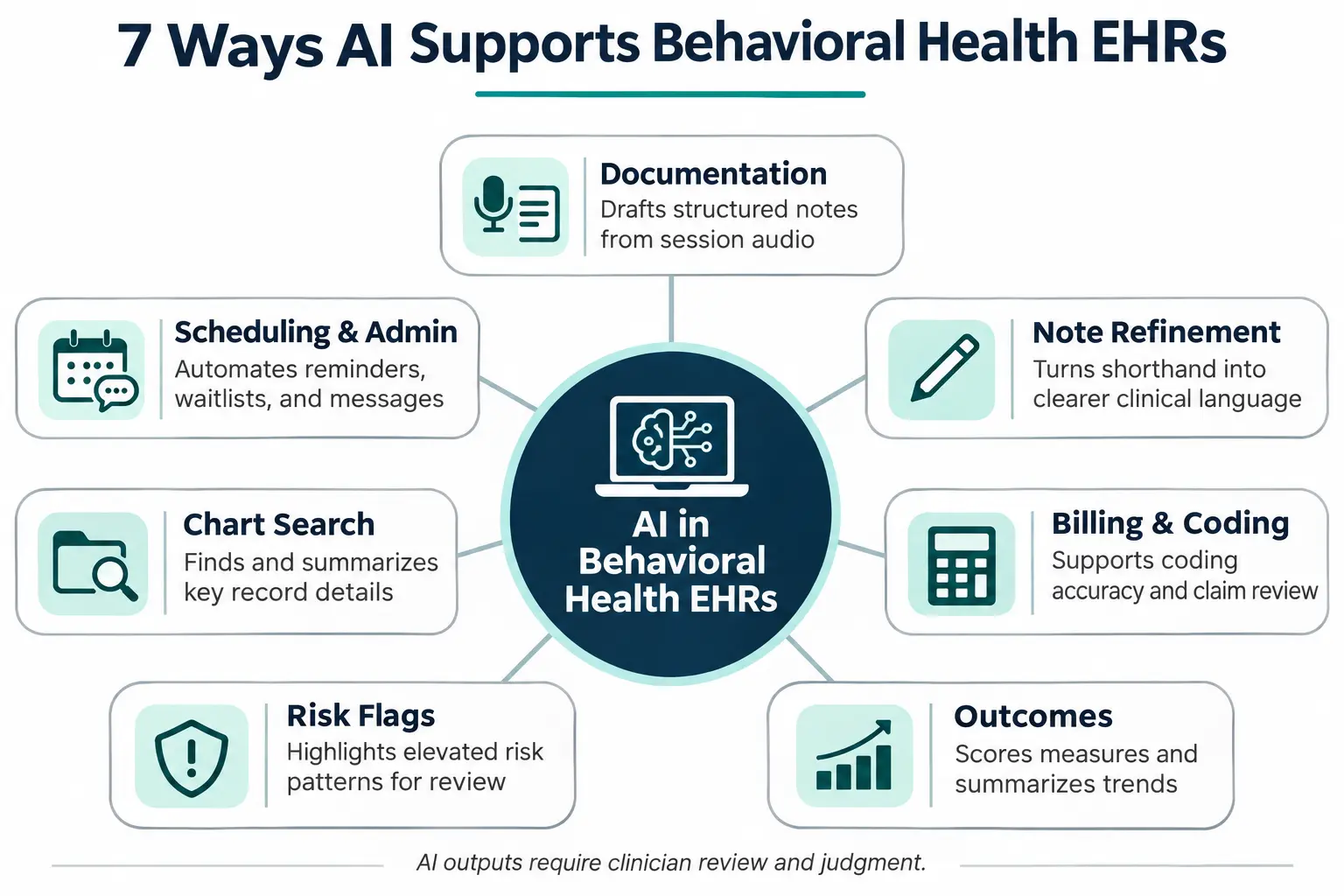
- AI in behavioral health EHRs now drafts session notes, refines note language, supports coding, summarizes outcome scores, flags risk, searches the chart, and streamlines scheduling.
- Ambient AI scribes have the strongest evidence so far: randomized trials show modest time savings and lower burnout, alongside occasional clinically significant errors that clinicians must catch.
- Mental health carries risks general healthcare AI articles skip: session recordings, psychotherapy note boundaries, 42 CFR Part 2 records, and suicide-risk models that miss most people who go on to die by suicide.
- A growing number of states regulate AI in therapy. Illinois and Colorado require written client consent before AI records or transcribes a session.
- AI drafts are drafts. The clinician who signs the note owns it.
- Not every EHR automation feature uses AI. Rules-based tools for coding, assessment scoring, and other workflows can be just as valuable—and may offer greater transparency and predictability.
- Choosing the right AI-powered EHR requires more than comparing features. Behavioral health practices should evaluate data privacy, clinical accuracy, workflow integration, informed consent, vendor transparency, and ongoing support.
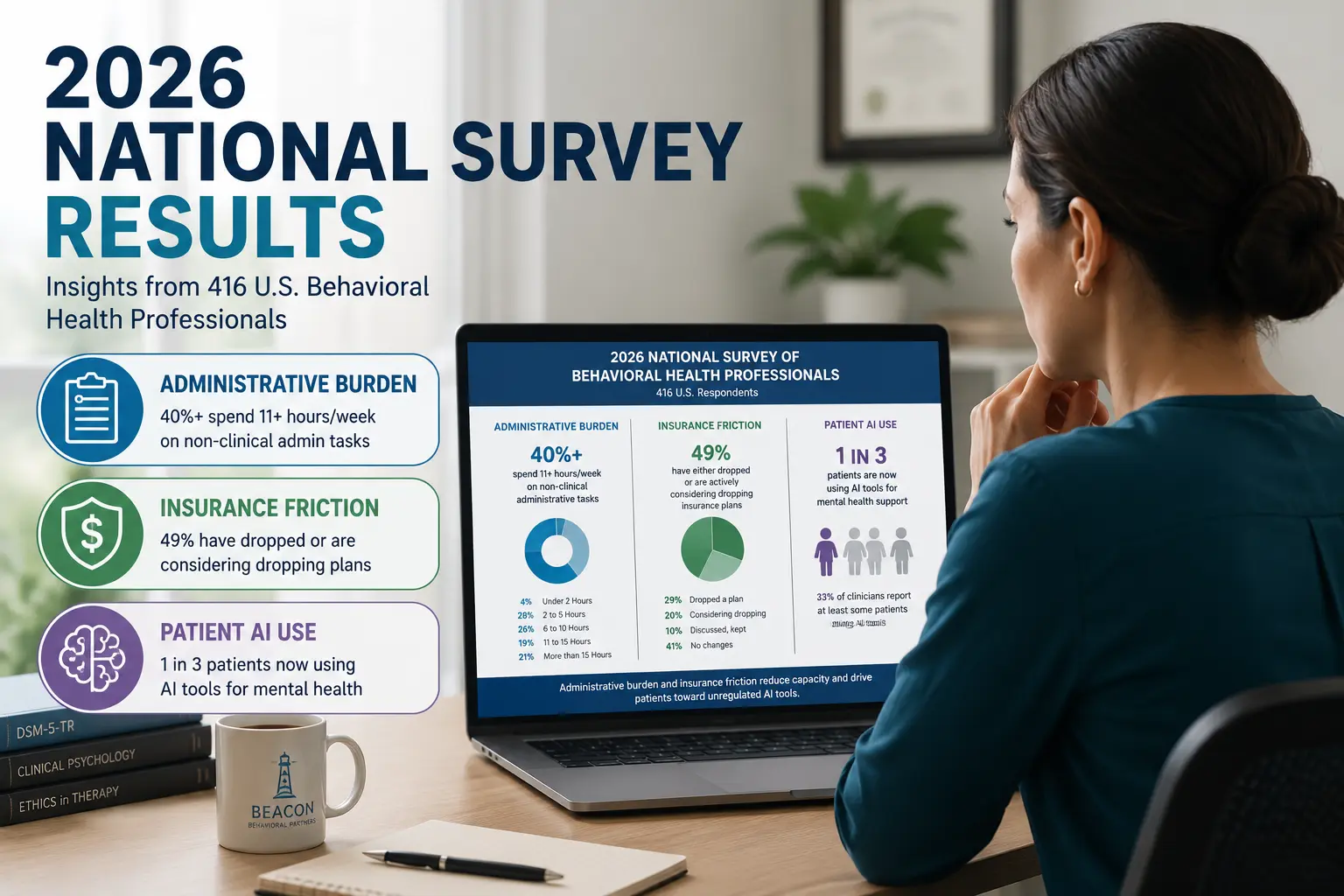
Behavioral health clinicians did not enter the field to type. Yet a widely cited time-and-motion study found that physicians spend nearly two hours on EHR and desk work for every hour of direct patient care, and the pattern looks familiar in mental health. In ICANotes' 2026 national survey of 416 behavioral health clinicians, 40% reported spending 11 to 15 or more hours each week on non-clinical administrative work such as documentation and billing.
Administrative Work Takes a Toll on Behavioral Health Clinicians
Approximately 40% of behavioral health clinicians surveyed spend 11 or more hours per week on nonclinical administrative tasks such as documentation and billing.
Source: ICANotes 2026 National Clinician Survey (416 respondents).
That burden explains why AI in EHR systems has moved from novelty to daily tool so quickly. Using AI to improve electronic health records is no longer a question of if, but of which features genuinely help and which need guardrails.
What is AI in a Behavioral Health EHR?
AI in a behavioral health electronic health record (EHR) refers to technology that helps clinicians draft documentation, organize records, analyze clinical information, and automate administrative tasks. Examples include ambient AI scribes, clinical note refinement, predictive analytics, and AI-assisted chart summaries. Clinicians remain responsible for reviewing AI outputs and making clinical decisions..
This guide walks through seven ways AI in mental health care is transforming the EHR. For each, you will find what the technology does, why it matters in behavioral health specifically, and what to watch for. Some of these uses are mature and well studied. Others are still emerging, and a few deserve real caution.
AI in Behavioral Health EHRs at a Glance
| Application | What AI does | Current State of Adoption | Primary Consideration |
|---|---|---|---|
| 1. Documentation | Drafts notes from session audio | Widely available; RCT evidence | Recordings, consent, errors |
| 2. Note refinement | Turns shorthand into clear narrative | Widely available | Changes to clinical meaning |
| 3. Billing | Suggests and checks codes | Mixed (many tools are rules-based) | Over-coding, traceability |
| 4. Outcomes | Scores scales, summarizes trends | Scoring mature; AI summaries emerging | Summaries vs. raw scores |
| 5. Risk flags | Predicts elevated risk from EHR data | Emerging; limited accuracy | Flags replacing assessment |
| 6. Chart search | Summarizes histories, extracts records | Emerging | Omissions, access controls |
| 7. Operations | Predicts no-shows, drafts admin messages | Available | Equity in scheduling |
AI Scribes Automate Behavioral Health Documentation
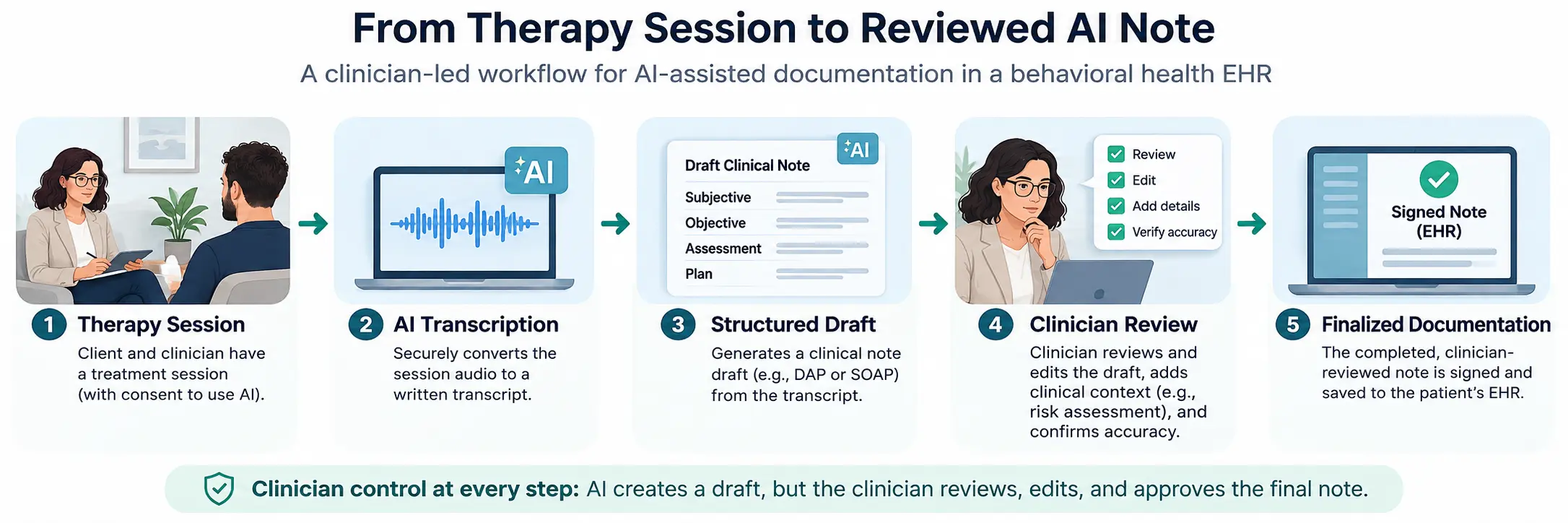
Ambient AI scribes use speech recognition and generative AI to turn therapy session audio into structured clinical note drafts. Clinicians review and edit the drafts before signing, potentially reducing documentation time while retaining control over clinical accuracy. Of all the ways AI is changing the EHR, this is the one most clinicians notice first, because it targets the task that follows them home: writing the note.
What does the research show?
Ambient scribes now have randomized trial data behind them, which is rare for healthcare software. In a UCLA trial published in NEJM AI in late 2025, 238 outpatient physicians across 14 specialties were randomized to one of two commercial scribes or to usual care for two months. One scribe reduced time spent writing each note by about 9.5% compared with control; the other did not produce a statistically significant change. Users of both tools reported modest improvements in burnout, cognitive load, and work exhaustion. A 2026 randomized crossover trial of 160 clinicians at an academic medical center, published in JAMIA, found that both scribes it tested reduced personal and work burnout scores, with no meaningful difference between the two.
The same research is clear about limits. In the UCLA trial, physicians reported that drafts "occasionally" contained clinically significant inaccuracies, most often omissions and pronoun errors, and one mild patient safety event was reported. The authors' conclusion was simple: the technology needs active oversight, not passive acceptance.
Why it matters in behavioral health
Most scribe studies come from primary care and specialty medicine, where a visit is a history, an exam, and a plan. A therapy session is different. Much of its clinical value sits in nuance: the client's own words, affect, what was avoided, and how risk was explored. A tool tuned for medical visits may summarize a 53-minute session competently and still miss what matters most. Ask any vendor whether its model has been tested on behavioral health sessions specifically. Our guide on what to look for in an ambient AI scribe for mental health covers this in more depth.
What should clinicians watch for?
A session recording in mental health is not a neutral by-product. If audio or a full transcript is retained, it can become a second, unreviewed record of everything a client said, with potential exposure to subpoena or breach. Before you use any scribe, find out whether audio and transcripts are stored, for how long, where, and who can access them. Obtain and document client consent every time the tool is used for a client.
State law increasingly makes consent mandatory rather than merely good practice. Illinois' Wellness and Oversight for Psychological Resources Act requires licensed professionals to provide written notice explaining that AI will be used and for what purpose, and to obtain the client's explicit, informed, revocable written consent before using AI for supplementary support in recorded or transcribed therapy sessions. Colorado's HB26-1195, effective August 12, 2026, also requires written, revocable informed consent before AI records or transcribes a therapy session. Professional ethics codes for social workers and marriage and family therapists also establish informed consent requirements for recording sessions.
In ICANotes: The Ambient AI Scribe is built into the EHR rather than bolted on. It captures audio from in-person sessions through the device microphone and directly from telehealth sessions, then drafts a structured note that the clinician reviews, edits, and finalizes before it enters the chart. Per ICANotes' support documentation, audio is sent to ICANotes' servers for processing and is not retained there afterward. Practices remain responsible for obtaining client consent.
How AI Improves Clinical Note Clarity and Structure
AI note refinement takes what a clinician has already written, such as shorthand, dictation, or menu-built text, and turns it into a clear, professional narrative in the required note structure. Some tools also align note content with treatment plan goals, so a progress note visibly connects interventions to the objectives on the plan. This is a different job from scribing: the input is the clinician's own documentation, not session audio. Related reading: AI-powered documentation and AI progress notes.
Why it matters in behavioral health
Clients increasingly read their own notes. Since the 21st Century Cures Act information-blocking rules took effect, clinical notes are generally available to patients through portals, with psychotherapy notes as a key exception. A note that reads as cold, cryptic, or stigmatizing can damage the therapeutic relationship. Clear, person-first language protects that relationship and still meets payer and audit expectations. We cover the clinical case for transparency in why you should share therapy notes with patients.
Readability also matters to reviewers. Auditors and payers need to follow the clinical reasoning quickly, and clean structure (for example, a consistent SOAP, DAP, or BIRP layout) makes medical necessity easier to see.
What should clinicians watch for?
"Polishing" is not always neutral. A language model asked to make text clearer can soften a risk statement, turn "client denied suicidal ideation when asked" into "client is not suicidal," or add a detail that sounds plausible but was never said. In clinical documentation, those small shifts matter. Treat every refined version as a proposed edit: read it against what happened in the session, and reject changes that alter clinical meaning, hedge a risk finding, or introduce new facts. Watch, too, for notes that start to sound identical from session to session, which auditors may read as cloned documentation.
In ICANotes: The AI Readability Enhancer works on Progress Notes and Complete Evaluations. It shows the original text and the enhanced version side by side, and the clinician chooses which version to keep, whole note or section by section. Processing runs through AWS Bedrock under a Business Associate Agreement. See AI clinical notes and AI therapy notes for examples.
How AI Supports Behavioral Health Coding and Billing
AI billing tools suggest CPT and ICD-10 codes from documentation, check notes against payer rules, and flag claims likely to be denied before they go out. In behavioral health, that can mean catching a session-length mismatch between 90834 and 90837, a missing add-on code, or a diagnosis that does not support the service billed. For a refresher on the time thresholds, see our CPT 90834 vs. 90837 billing guide.
The appeal is easy to see. Denials in behavioral health often come down to small, fixable gaps: a missing start and stop time, an authorization that lapsed, a diagnosis code that does not match the service. Catching those before submission is far cheaper than reworking a denied claim weeks later, and it keeps cash flow predictable for small practices.
Not every coding automation is AI. Many dependable tools use rules-based logic, applying published guidelines to structured documentation, rather than a predictive or generative model. That is not a weakness. Rules-based coding is transparent and predictable, and you can trace every suggested code back to the documentation that supports it. When a vendor describes a coding feature as "AI," ask which kind it is.
What should clinicians watch for?
The clinician or biller remains accountable for every code submitted. Richer, auto-generated notes can make higher-level codes easier to justify on paper, and payers have noticed. A March 2026 Trilliant Health analysis found that outpatient E/M coding shifted toward higher-intensity levels at six health systems that publicly adopted AI scribing, though the authors did not establish that AI caused the shift. A December 2025 policy brief in npj Digital Medicine reported that one major commercial payer began automatically reducing many level 4 and 5 E/M claims by one level in October 2025 unless documentation clearly supported the higher complexity.
The safeguard is traceability. Each code should map to specific documented elements: medical decision making or time for E/M services, and session time and medical necessity for psychotherapy codes. Note length should never carry the level. Run periodic audits on AI-influenced claims using a tool such as our documentation audit checklist, and review how to document medical necessity with your team.
In ICANotes: Automatic E/M coding is rules-based rather than AI. As a prescribing clinician documents problems, data reviewed, and risk, ICANotes tracks those elements, calculates the E/M code the note supports, and writes the coding rationale into the note so auditors can see why the level was chosen.
How AI Supports Measurement-Based Behavioral Health Care
Measurement-based care tools automatically score rating scales such as the PHQ-9 and GAD-7, graph results over time, and increasingly use AI to summarize whether a client is improving, plateauing, or getting worse. The scoring itself is arithmetic. The AI layer is the narrative summary and the pattern detection across many scales and sessions.
Why it matters in behavioral health
Measurement-based care is an accreditation expectation, not just a best practice. Since January 1, 2018, Joint Commission standard CTS.03.01.09 has required accredited behavioral health care organizations to monitor outcomes of care using a standardized tool or instrument and to use that data to inform care. Outcome scores also support medical necessity: a documented trend shows a payer why treatment should continue, change, or step down. And they support clinical judgment directly, since research on measurement feedback suggests clinicians are not always accurate at detecting deterioration without data.
Built-in assessment tools that score automatically and feed results into treatment plans remove most of the friction that makes measurement-based care hard to sustain in busy practices.
Where AI adds value
Once scores are collected consistently, the volume of data becomes the problem. A client seen weekly for six months may have dozens of PHQ-9, GAD-7, and functional measures on file. AI can turn that into a short, readable picture before the session: depression scores down from 18 to 11 over eight weeks, anxiety flat, sleep item worsening since a medication change. It can also highlight clients across a caseload whose scores have stalled, which supports supervision and treatment-plan reviews. Used this way, the summary does not replace the graph. It points you to the part of the graph worth looking at.
What should clinicians watch for?
Scores summarize; they do not diagnose. An AI-generated statement such as "symptoms improving" may be technically true of a total score while missing something critical in a single item. The clearest example is PHQ-9 item 9, which asks about thoughts of death or self-harm: a falling total score can coexist with a new positive response on that item. Always check AI trend summaries against the raw item-level responses, and make sure any summary you rely on links back to the underlying data. Remember, too, that a client's score reflects how they chose to answer that day. Context from the session still matters.
How AI Identifies Clinical Risk Patterns
Predictive models analyze EHR data, such as diagnoses, prior attempts, recent hospitalizations, and service use, to flag patients at elevated risk of outcomes like suicide or disengagement from care, so clinicians can review and strengthen their care. This is the most sensitive use of AI in mental health care, and it deserves a balanced look.
What a mature program looks like
The best-studied example is the Veterans Health Administration's REACH VET program, rolled out nationally in 2017. A statistical model identifies the top 0.1% of patients at each facility by predicted suicide risk. Local coordinators then notify the patient's clinicians, who re-evaluate care, review safety planning, and reach out. The model is a prompt for human attention, not a decision.
The results are encouraging but mixed. A 2021 evaluation in JAMA Network Open found that entering the program was associated with more outpatient visits, more documented safety plans, and fewer documented suicide attempts. A 2025 follow-up in the same journal, however, did not find an association with suicide or all-cause mortality.
Accuracy is the harder issue. A 2025 study in npj Mental Health Research evaluated the REACH VET model's ability to predict death by suicide and found a positive predictive value of just 0.05% and a false negative rate of 98.1%. In plain terms: almost everyone flagged did not die by suicide, and almost everyone who died by suicide was never flagged. That is partly a property of predicting a rare event across a huge population, and it is why the VA is improving the model. A 2026 study in BMJ Mental Health reported that a retrained version discriminated risk better than the original.
What should clinicians watch for?
A risk flag is a prompt for clinical review, never a replacement for a structured suicide risk assessment. The absence of a flag does not mean a client is low risk.
Several practical questions follow. Who sees the flag, and what is the expected response? If an alert fires and nobody documents a response, the record now shows a known risk that went unaddressed. How was the model validated, and on what population? Models trained on one health system or demographic may perform differently elsewhere. Can the vendor explain which factors drive a flag?
On that last point, federal transparency rules have recently loosened. ONC's HTI-1 rule had required certified health IT to support "model card" style source attributes for predictive decision support. The HTI-5 final rule, published in October 2026, removes those source-attribute and risk-management requirements, with the decision support changes effective December 28, 2026. Transparency about how a predictive tool works is now largely a question you must put to your vendor yourself.
Following the HTI-5 changes, practices should be especially careful to ask AI vendors for information about intended use, clinical validation, known limitations, and risk-management practices rather than assuming those details are provided through federal EHR certification requirements.
How AI Summarizes and Searches Patient Records
Chart-level AI summarizes long histories before a session, extracts key details from referral letters and prior records, and answers search questions across the chart, for example, "When was lithium last adjusted, and why?" or "Has this client ever reported a suicide attempt?"
Why it matters in behavioral health
Behavioral health charts grow long and dense. Clients may be seen for years, move between levels of care, and arrive with stacks of outside records. A reliable summary saves real time before a session with a complex, long-term client, at intake, and at handoffs between a therapist, a prescriber, and a care manager. Integrated settings, where behavioral health and primary care share a record, benefit most.
What should clinicians watch for?
The main risk is omission. Research on large language model summaries of clinical records has repeatedly found that summaries can read fluently while leaving out clinically important details, such as history, prior events, and context, and omissions are harder to spot than outright errors because you cannot see what is missing. For high-stakes questions, use the summary to orient yourself, then verify in the source documents.
Access controls matter just as much. Under HIPAA, psychotherapy notes, meaning a therapist's separate process notes, receive extra protection only when they are kept apart from the rest of the medical record, and most disclosures require a specific authorization. If an AI search tool can read everything in the system, it could surface process notes in a summary that a colleague, a biller, or a client portal can see. Substance use disorder records covered by 42 CFR Part 2 raise similar questions: the updated Part 2 rule, with a compliance date of February 16, 2026, aligned many provisions with HIPAA but kept added protections around use and redisclosure. Ask any vendor exactly which record types its AI can and cannot read. Our guide on how to create a psychotherapy note explains where that boundary sits.
How AI Improves Scheduling and Practice Operations
Operational AI predicts which appointments are likely to be missed, automates reminders, manages waitlists, optimizes calendars, and drafts routine administrative messages such as appointment confirmations, intake instructions, and portal replies for staff to review.
Why it matters in behavioral health
Missed appointments hit behavioral health harder than most specialties. A no-show is a lost hour of revenue that cannot be backfilled from a waiting room, and, more importantly, a gap in care for someone who may be struggling. Demand is high: in the ICANotes 2026 clinician survey, 23% of providers reported waitlists of four weeks or more, or were not accepting new clients at all. Smarter reminders and waitlist management can fill cancelled slots with clients who need them. Even without AI, well-designed scheduling and automated reminders remove much of the front-desk burden, and telehealth options reduce barriers for clients who struggle to attend in person.
What should clinicians watch for?
Prediction should lead to support, not deprioritization. The clients most likely to miss appointments often face transportation, childcare, work, or symptom-related barriers, and they are often the clients with the greatest need. Research on machine-learning scheduling in a large specialty clinic found that optimizing for efficiency placed Black patients, who had higher predicted no-show risk, into overbooked slots disproportionately, leaving them waiting roughly 30% longer. The authors showed the disparity could be removed at little cost by changing the scheduling objective. In behavioral health, a high no-show score is better used to trigger outreach, a telehealth option, or a reminder call than a double-booked slot.
AI-drafted messages need a similar safeguard. A client's portal message about rescheduling may also mention that they are not doing well. Any tool that drafts replies or sorts the inbox must route possible risk disclosures to a clinician immediately rather than answer them with a cheerful template. Before turning on message drafting, test how it handles a message that mixes an admin request with a clinical concern, and make sure staff review every draft before it is sent.
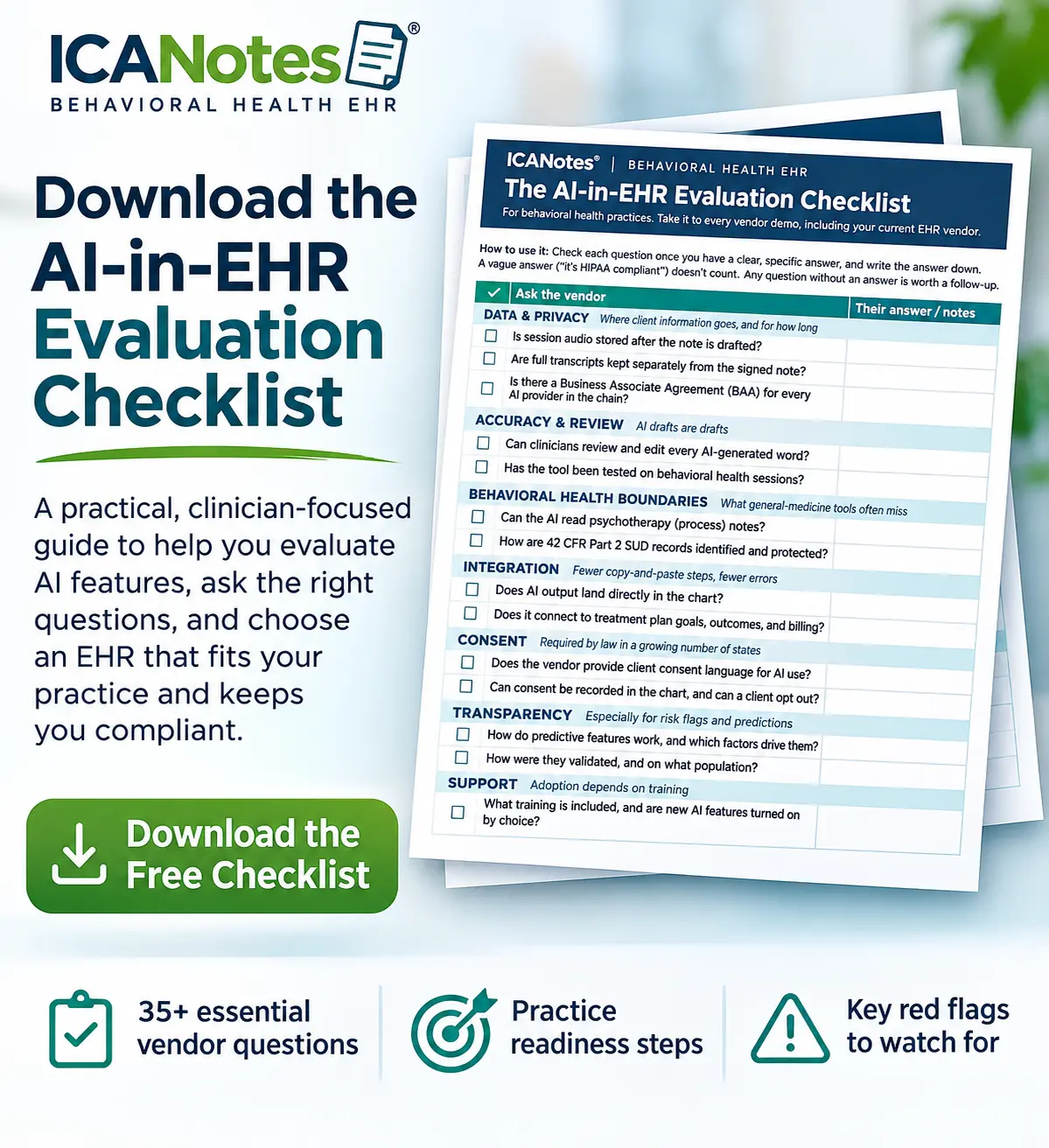
Is Your EHR's AI Safe, Accurate, and Right for Your Practice?
Before adopting AI-powered EHR features, make sure you're asking the right questions. Get our free evaluation checklist designed specifically for behavioral health practices.
- Evaluate AI with confidence using essential questions about privacy, accuracy, and clinical oversight.
- Protect sensitive patient information with guidance on informed consent, psychotherapy notes, and 42 CFR Part 2 safeguards.
- Spot potential red flags in vendor claims, data handling, and AI-generated documentation.
- Prepare your practice for AI adoption with practical readiness steps and compliance considerations.
Which AI Features are Most Useful in Behavioral Health EHRs Today?
For most behavioral health practices, AI-assisted documentation is the most practical starting point because it addresses a common administrative burden and has randomized trial evidence supporting some benefits. Note refinement can also offer value, provided clinicians verify that the final documentation preserves clinical meaning.
Coding assistance and automated outcome scoring are useful, but practices should distinguish established rules-based automation from genuinely AI-powered capabilities. AI-generated outcome summaries and chart searches may help clinicians navigate complex information, although their accuracy requires verification.
Predictive suicide-risk models and other high-stakes clinical decision-support tools require the greatest caution. Their performance varies by population and setting, and they should supplement — not replace — established clinical assessment procedures.
Using AI Responsibly in Behavioral Health
The seven uses above share a common set of obligations. None of them is new in principle; AI simply raises the stakes.
Consent and transparency
Tell clients when AI listening or transcription tools are used, explain in plain language how their data is handled, and document consent. Make consent specific: several states now require a dedicated, written consent that cannot be buried in general intake paperwork. Give clients a real choice to opt out without affecting their care. Our article on informed consent and AI in healthcare includes practical language you can adapt.
Privacy and security
Any vendor that processes protected health information for an AI feature needs a Business Associate Agreement, and that includes the AI model provider behind your EHR vendor. Confirm encryption in transit and at rest, retention periods for audio and transcripts, and whether your data is used to train models. Keep psychotherapy notes and Part 2 records inside their proper boundaries. See ICANotes' approach to HIPAA compliance.
Federal rules: where things stand
As of November 2026, there is no comprehensive federal law governing AI in clinical documentation. HIPAA, 42 CFR Part 2, and FDA rules for certain clinical decision software still apply. ONC's HTI-5 final rule removes the HTI-1 model-card requirements for predictive decision support in certified EHRs, effective December 28, 2026. Separately, Executive Order 14365, signed in December 2025, directs federal agencies to challenge state AI laws the administration views as burdensome. Legal analysts note that an executive order cannot by itself preempt state law without supporting federal legislation, so state AI laws remain in force unless a court rules otherwise. Expect continued change and check with counsel.
State laws
State law is where most of the action is. Key examples include:
- Illinois (Wellness and Oversight for Psychological Resources Act, 2025): prohibits AI from providing therapy, limits licensed professionals to administrative and supplementary AI support, and requires written informed consent before AI is used in recorded or transcribed sessions. Penalties reach $10,000 per violation.
- Nevada (AB 406, effective July 1, 2025): prohibits AI systems that provide or claim to provide professional mental or behavioral health care, and bars providers from using AI to deliver care directly to patients, while allowing AI for administrative support such as scheduling and billing.
- Utah (HB 452, 2025): regulates mental health chatbots, requiring disclosures and restricting the sale or sharing of user data and certain advertising.
- Colorado (HB26-1195, effective August 12, 2026): bars AI from engaging in therapeutic communication, requires clinician review of AI recommendations, and requires written, revocable consent before AI records or transcribes sessions.
- 2026 wave: Maine, Tennessee, Rhode Island, and Vermont have enacted further restrictions on AI therapy services or AI chatbots presented as mental health professionals, and bills are pending in several other states.
If you practice across state lines or by telehealth, the law of the state where your client is located generally matters.
Clinician accountability
AI drafts are drafts. The signing clinician owns the note, the code, and the clinical decision.
The signing clinician owns the note, the code, and the clinical decision. AI drafts are drafts. Build review into the workflow, not as an afterthought: read every AI-generated note before signing, verify summaries against source data for high-stakes decisions, and document your own clinical reasoning.
How to Evaluate AI Features in Your EHR
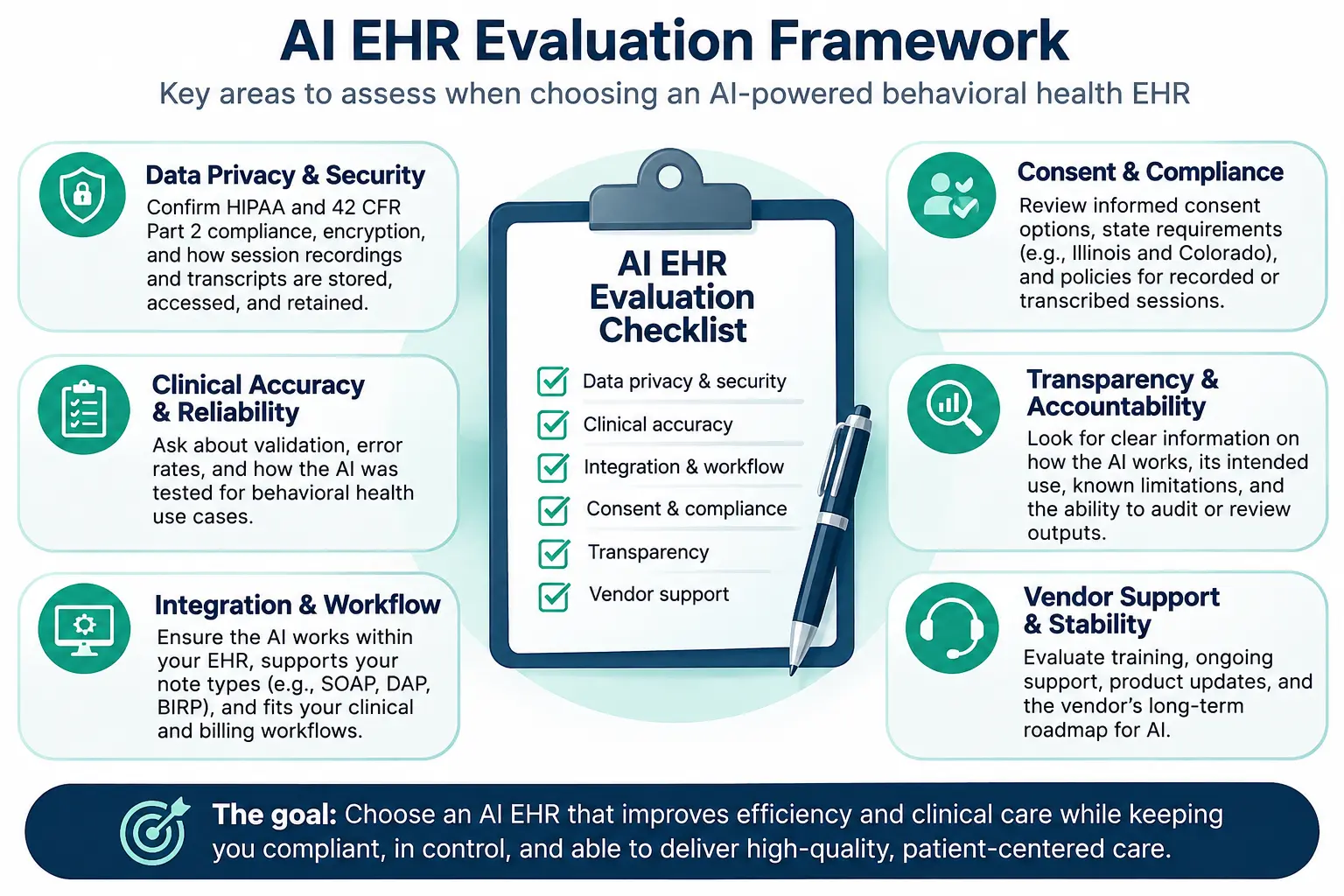
Use these questions with any vendor, including your current one. For a broader comparison framework, see our behavioral health EHR buyer's guide.
Data
- Is session audio stored? If so, where, for how long, and who can access it?
- Is there a BAA covering every AI provider in the processing chain?
- Where is data processed, and is it used to train models?
Accuracy
- Can I review and edit everything before it is signed or submitted?
- Has the tool been tested on behavioral health sessions, including group, family, and telehealth sessions?
- How does the vendor monitor and respond to reported errors?
Integration
- Does AI output go straight into the chart, or does it require copy and paste between systems?
- Does it link to treatment plans, outcome measures, and billing?
- Does it respect psychotherapy note and Part 2 access boundaries?
Consent
- Does the vendor provide client consent language and a way to record consent in the chart?
- Can clients opt out easily, and can I pause recording mid-session?
Transparency
- Will the vendor explain how predictive features work and how they were validated, and on what population?
- Will it tell me when a feature is AI and when it is rules-based?
Support
- What training is included, and is help available when I need it?
- How are new AI features announced, and can I control which ones are turned on?
How ICANotes Approaches AI in the EHR
ICANotes was designed by a psychiatrist for behavioral health, and its approach to AI follows the same principle as everything else in the platform: the clinician stays in control. AI features sit inside the EHR, so drafts land directly in the chart where you review, edit, and sign them, with no copy and paste between systems.
The Ambient AI Scribe drafts notes from in-person and telehealth sessions, and the AI Readability Enhancer refines note language with side-by-side comparison so you decide what changes. Both run alongside ICANotes' menu-driven templates, so you can mix AI drafting with the structured documentation your practice already relies on. Coding support is rules-based and writes its reasoning into the note. Rating scales and treatment plans are built in for measurement-based care.
Just as important is what ICANotes does not do: AI does not sign notes, choose diagnoses, or send anything to a client without a clinician's review. Explore the full AI EHR platform to see how the pieces fit together.
Put clinician-controlled AI to work in your charts
Start a free trial and see how ICANotes drafts notes, refines language, and codes rules-based claims while you stay in control of every signature.
- Ambient AI Scribe drafts notes you review and sign
- AI Readability Enhancer with side-by-side review
- Rules-based E/M coding with documented rationale
- Built-in rating scales linked to treatment plans
See how ICANotes can support your clinical workflow. Start your free 30-day trial, no credit card required.
Start Your Free 30-Day Trial
Frequently Asked Questions
How is AI used in behavioral health EHRs?
Are AI scribes accurate enough for therapy notes?
Do AI scribes record therapy sessions?
Do I need client consent to use an AI scribe?
Is AI in an EHR HIPAA compliant?
Can AI make clinical decisions or diagnoses?
Which states restrict the use of AI in mental health care?
What should I ask an EHR vendor about its AI features?
References
- Sinsky C, Colligan L, Li L, et al. Allocation of physician time in ambulatory practice: a time and motion study in 4 specialties. Annals of Internal Medicine. 2016;165(11):753-760.
- ICANotes. AI in Behavioral Health 2026: National Clinician Survey Report. June 26, 2026. https://www.icanotes.com/2026/06/26/ai-in-behavioral-health/
- Lukac PJ, Turner W, Vangala S, et al. Ambient AI scribes in clinical practice: a randomized trial. NEJM AI. 2025;2(12). doi:10.1056/AIoa2501000. https://pubmed.ncbi.nlm.nih.gov/41497288/
- Chowdhury A, Casey M, Wilson J, et al. Comparing ambient scribes: a randomized crossover clinical trial addressing ambient scribe technologies' impact on physician burnout. JAMIA. 2026;33(5):990-999. https://pubmed.ncbi.nlm.nih.gov/41729180/
- Illinois General Assembly. Wellness and Oversight for Psychological Resources Act, HB 1806, Public Act 104-0054 (2025). https://www.ilga.gov/ftp/legislation/104/BillStatus/HTML/10400HB1806.html
- Colorado General Assembly. HB26-1195, Psychotherapy Artificial Intelligence Restrictions (2026). https://leg.colorado.gov/bills/HB26-1195
- Nevada Legislature. AB 406 (2025). https://archive.leg.state.nv.us/Session/83rd2025/Bills/AB/AB406_EN.pdf
- Utah Legislature. HB 452, Artificial Intelligence Amendments (2025). https://le.utah.gov/~2025/bills/static/HB0452.html
- Trilliant Health. Increased outpatient coding intensity following hospital adoption of AI-enabled scribing. March 2026. https://www.trillianthealth.com/increased-outpatient-coding-intensity-following-hospital-adoption-of-ai-enabled-scribing
- The Joint Commission. Measurement-Based Care: Standardized Tools and Instruments (CTS.03.01.09). https://www.jointcommission.org/standards/standard-faqs/behavioral-health/care-treatment-and-services-cts/000002332
- McCarthy JF, Cooper SA, Dent KR, et al. Evaluation of the REACH VET suicide risk modeling clinical program in the Veterans Health Administration. JAMA Network Open. 2021. https://pmc.ncbi.nlm.nih.gov/articles/PMC8524305/
- The Veterans Health Administration REACH VET program: suicide predictive modeling in practice. Psychiatric Services. https://psychiatryonline.org/doi/full/10.1176/appi.ps.202100629
- Dent KR, et al. REACH VET program and mortality outcomes. JAMA Network Open. 2025. doi:10.1001/jamanetworkopen.2025.19513
- Evaluating the accuracy of the Veterans Health Administration's REACH VET suicide prediction model for legal-involved veterans. npj Mental Health Research. 2025. https://www.nature.com/articles/s44184-025-00167-1
- Peluso A, et al. Predictive analytics to direct clinical attention to complex patients with elevated suicide risk: enhancement of the VHA REACH VET model. BMJ Mental Health. 2026;29. doi:10.1136/bmjment-2025-302338
- ONC. HTI-1 Decision Support Interventions fact sheet. https://www.healthit.gov/wp-content/uploads/2023/12/HTI-1_DSI_fact-sheet_508.pdf
- ONC. HTI-5 Final Rule: Removals or Revisions of Certification Criteria. October 2026. https://healthit.gov/resources/hti-5-final-rule-removals-or-revisions-of-certification-criteria/
- HHS. Does HIPAA provide extra protections for mental health information? (psychotherapy notes, 45 CFR 164.501). https://www.hhs.gov/hipaa/for-professionals/faq/2088/does-hipaa-provide-extra-protections-mental-health-information-compared-other-health.html
- HHS. Fact Sheet: 42 CFR Part 2 Final Rule. https://www.hhs.gov/hipaa/for-professionals/regulatory-initiatives/fact-sheet-42-cfr-part-2-final-rule/index.html
- Samorani M, Harris SL, Blount LG, Lu H, Santoro MA. Overbooked and overlooked: machine learning and racial bias in medical appointment scheduling. Manufacturing & Service Operations Management. 2022;24(6):2825-2842.
- Schumacher E, et al. MED-OMIT: extrinsically-focused evaluation metric for omissions in medical summarization. Proceedings of Machine Learning Research. 2025;259:897-922.
- Executive Order 14365, Ensuring a National Policy Framework for Artificial Intelligence. December 11, 2025.
Dr. October Boyles
Dr. October Boyles is a behavioral health expert and clinical leader with extensive expertise in nursing, compliance, and healthcare operations. With a Doctor of Nursing Practice (DNP) and advanced degrees in nursing, she specializes in evidence-based practices, EHR optimization, and improving outcomes in behavioral health settings. Dr. Boyles is passionate about empowering clinicians with the tools and strategies needed to deliver high-quality, patient-centered care.