Blog > Digital Innovations > ChatGPT for Therapy Notes: Benefits, Risks & HIPAA Guidance
ChatGPT for Therapy Notes: Benefits, Risks, and HIPAA Considerations for Clinicians
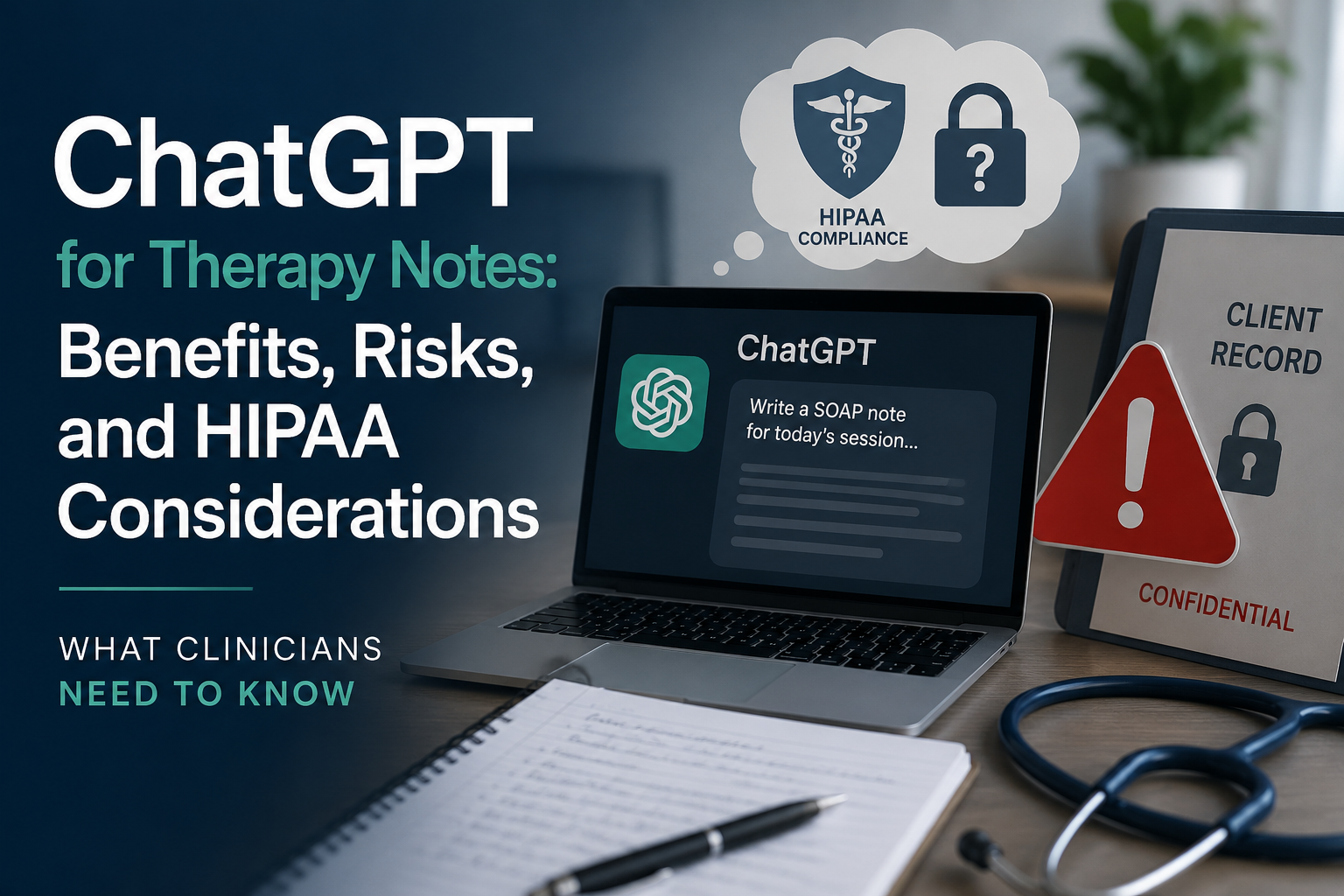
ChatGPT for therapy notes has become an increasingly popular solution for clinicians looking to reduce documentation time and administrative burden. While AI tools can help generate note templates, improve note structure, and streamline workflows, therapists must carefully consider HIPAA therapy notes requirements, data privacy concerns, and the limitations of using a general-purpose AI tool in clinical settings. This guide explores the benefits and risks of using ChatGPT for therapy notes, provides examples of a safe ChatGPT therapist prompt, explains HIPAA compliance considerations, and compares ChatGPT with purpose-built AI therapy documentation tools designed specifically for behavioral health practices.


Last Updated: June 11, 2026
What You'll Learn
- Learn the benefits and limitations of using ChatGPT for therapy notes in behavioral health practice.
- Understand the biggest HIPAA therapy notes risks when using consumer AI tools.
- Discover safe ways therapists can use AI therapy documentation without exposing protected health information.
- See how a well-crafted ChatGPT therapist prompt can improve note structure and efficiency.
- Compare ChatGPT for therapy notes with purpose-built behavioral health EHR documentation tools.
- Explore ethical, legal, and compliance considerations surrounding AI therapy documentation for clinicians.
AI tools like ChatGPT have made their way into nearly every professional workflow — and behavioral health is no exception. For therapists drowning in end-of-day documentation, the appeal is easy to understand: type a few details, get a structured SOAP note back in seconds. Faster charting, less burnout, more time for clients.
But before you paste your session notes into ChatGPT, there are some important things to understand — particularly around HIPAA compliance, data privacy, and the limitations of general-purpose AI in a clinical setting.
This guide breaks down exactly what ChatGPT can and cannot do for therapy documentation, how to use it safely if you choose to, and when a purpose-built behavioral health EHR offers a more compliant and clinically appropriate path.
What Is ChatGPT — and What Was It Built For?
ChatGPT is a large language model (LLM) developed by OpenAI. It generates human-like text by predicting what words or sentences should follow a given prompt. It’s trained on an enormous corpus of general text — not clinical records, mental health literature, or behavioral health documentation standards.
That distinction matters. ChatGPT is a general-purpose writing tool. It can produce well-structured, grammatically sound notes — but it has no clinical training, no awareness of DSM criteria nuances, and no understanding of your therapeutic approach. Think of it as a very capable writing assistant, not a clinical AI scribe.
Can ChatGPT Write Therapy Notes?
Technically, yes. With the right prompt, ChatGPT can generate a recognizable structure for:
- SOAP notes (Subjective, Objective, Assessment, Plan)
- DAP notes (Data, Assessment, Plan)
- BIRP notes (Behavior, Intervention, Response, Plan)
- Treatment plan drafts
- Progress note summaries
However, “can generate” is not the same as “should be used for.” Every output requires careful clinician review. ChatGPT does not know your client. It does not know what actually happened in the session. It produces plausible-sounding text — which is exactly what makes uncritical use risky.
Benefits of Using ChatGPT for Therapy Notes
When used appropriately — meaning without real client data — ChatGPT can offer genuine advantages for clinicians:
Faster First Drafts
Starting from a blank page is often the hardest part of documentation. A ChatGPT-generated template or structure gives clinicians something to edit rather than create from scratch, which can meaningfully reduce documentation time.
Improved Note Structure
New clinicians or those transitioning to a different note format can use ChatGPT to internalize what a well-organized SOAP or DAP note looks like — a useful training scaffold.
Clinical Language Assistance
For clinicians who are non-native English speakers or who struggle to translate their session impressions into documentation language, ChatGPT can help bridge that gap — particularly for generating neutral, professional phrasing.
Template and Workflow Development
ChatGPT is useful for building reusable templates, drafting intake forms, or creating psychoeducation handouts — tasks that don’t involve protected health information.

Limitations and Risks Clinicians Must Understand
The limitations of ChatGPT for therapy documentation are significant — and not always obvious.
It Can Confidently Generate Inaccurate Content
LLMs are optimized to produce fluent, coherent text — not factually accurate clinical records. ChatGPT may generate clinically plausible but entirely fabricated content if your prompt is vague. In a legal or audit context, this is a serious liability.
It Lacks Clinical Nuance
ChatGPT cannot assess risk, recognize diagnostic patterns, or account for the subtleties of a therapeutic relationship. It processes text — it cannot interpret what happened in the room.
Clinical Responsibility Remains Entirely with the Clinician
Whatever ChatGPT produces, the clinician who signs the note owns it. If an AI-assisted note contains errors, omissions, or mischaracterizations of a client’s presentation, the clinician bears the professional and legal consequences.

Free Download
The Therapist’s Safe AI Documentation Toolkit
Get HIPAA-safe ChatGPT prompt templates and an AI documentation tool evaluation checklist designed for behavioral health clinicians.
- SOAP, DAP, and BIRP prompt templates
- AI tool compliance and workflow checklist
- Guidance for safer, more ethical AI use
HIPAA and Privacy Concerns: What Every Therapist Needs to Know
This is where many therapists underestimate the risk. ChatGPT is not HIPAA compliant — at least not in the form most clinicians use it.
Here’s why that matters:
- OpenAI does not sign Business Associate Agreements (BAAs) for the standard ChatGPT consumer product. A BAA is required under HIPAA before a vendor can handle Protected Health Information (PHI) on your behalf.
- Data entered into ChatGPT’s standard interface may be used to train OpenAI’s models, stored on OpenAI’s servers, or otherwise processed externally — outside your control.
- If you enter any information that could identify a client — names, dates of birth, specific diagnoses tied to a person, session content — you may be creating a HIPAA violation.
- Even general descriptions of a session can constitute PHI if they contain details that could reasonably identify a specific individual.
Note: OpenAI does offer an enterprise API with different data handling terms. Vendors building on that API may be able to sign BAAs. But if you are using ChatGPT.com directly as a clinician, you are using the consumer product — and it is not HIPAA compliant.
Safe Ways Therapists Can Use ChatGPT
There are legitimate, lower-risk use cases for ChatGPT in a therapy practice — as long as you never enter PHI:
- Generate blank note templates (SOAP, DAP, BIRP) you can fill in manually
- Draft de-identified sample notes for training or supervision purposes
- Create psychoeducation summaries or client handouts
- Brainstorm clinical language or phrasing for common presentations
- Develop intake questionnaire language or informed consent template language
- Practice and improve documentation skills through hypothetical case examples
The rule of thumb: if a real client’s information — however indirectly described — is in the prompt, it should not go into ChatGPT.

ChatGPT vs. Purpose-Built AI Documentation Tools
The landscape of AI-assisted documentation has expanded significantly. There’s an important distinction between general AI tools like ChatGPT and purpose-built clinical documentation solutions.
General AI Tools Like ChatGPT
- Flexible, capable of many writing tasks
- Not designed for healthcare or behavioral health specifically
- Not HIPAA compliant in their standard form
- Require significant clinician effort to produce usable notes
- No integration with EHR workflows or billing systems
Purpose-Built Behavioral Health AI Documentation Tools
- Designed specifically for clinical language and mental health documentation
- Built within HIPAA-compliant environments with appropriate data safeguards
- Often integrated directly into EHR platforms for seamless workflows
- Support insurance-ready documentation formats
- Reduce liability by keeping PHI within a controlled, compliant system
For behavioral health clinicians who want to use AI to reduce documentation burden, an EHR with built-in AI tools — like ICANotes — is typically the safer, more efficient choice — because it keeps clinical data where it belongs.
Ethical Considerations for AI-Assisted Therapy Documentation
Beyond legal compliance, there are professional and ethical dimensions to consider:
Informed Consent
Many licensing boards and professional organizations recommend — and some require — that clinicians disclose AI use in documentation to clients. Review your state licensing board’s guidance and update your informed consent accordingly.
Accuracy and Integrity
A therapy note is a legal record of care. Every entry must reflect what actually occurred. AI-generated text that is accepted without rigorous review could result in a note that does not accurately represent the session — which is both an ethical and a legal problem.
Avoiding Over-Reliance
AI tools should support — not replace — clinical judgment. Over time, habitual use of AI-generated documentation may dull a clinician’s attention to the detail and nuance that makes therapy notes clinically meaningful.
The Bottom Line
ChatGPT can be a genuinely useful tool for behavioral health clinicians — when used with clear boundaries. It can help you build templates, improve your documentation skills, and draft de-identified examples. What it cannot do is serve as a compliant, reliable alternative to a clinical documentation system.
For clinicians looking to reduce documentation time without compromising compliance or clinical integrity, a behavioral health EHR with built-in AI tools is worth a serious look. The right platform can offer the efficiency of AI-assisted drafting within a system designed specifically for the realities of behavioral health practice — HIPAA compliance, billing integration, and all.
Want to see how purpose-built AI documentation works in a behavioral health EHR? Download our free guide: The Therapist’s Safe AI Documentation Toolkit — including HIPAA-safe ChatGPT prompt templates and a checklist for evaluating AI documentation tools.
Frequently Asked Questions About ChatGPT for Therapy Notes
Recent Posts



Dr. October Boyles
DNP, MSN, BSN, RN
About the Author
Dr. October Boyles is a behavioral health expert and clinical leader with extensive expertise in nursing, compliance, and healthcare operations. With a Doctor of Nursing Practice (DNP) and advanced degrees in nursing, she specializes in evidence-based practices, EHR optimization, and improving outcomes in behavioral health settings. Dr. Boyles is passionate about empowering clinicians with the tools and strategies needed to deliver high-quality, patient-centered care.