Blog > Treatment Strategies > 17 Therapy Communication Techniques for Clinicians
17 Therapy Communication Techniques Every Clinician Should Know
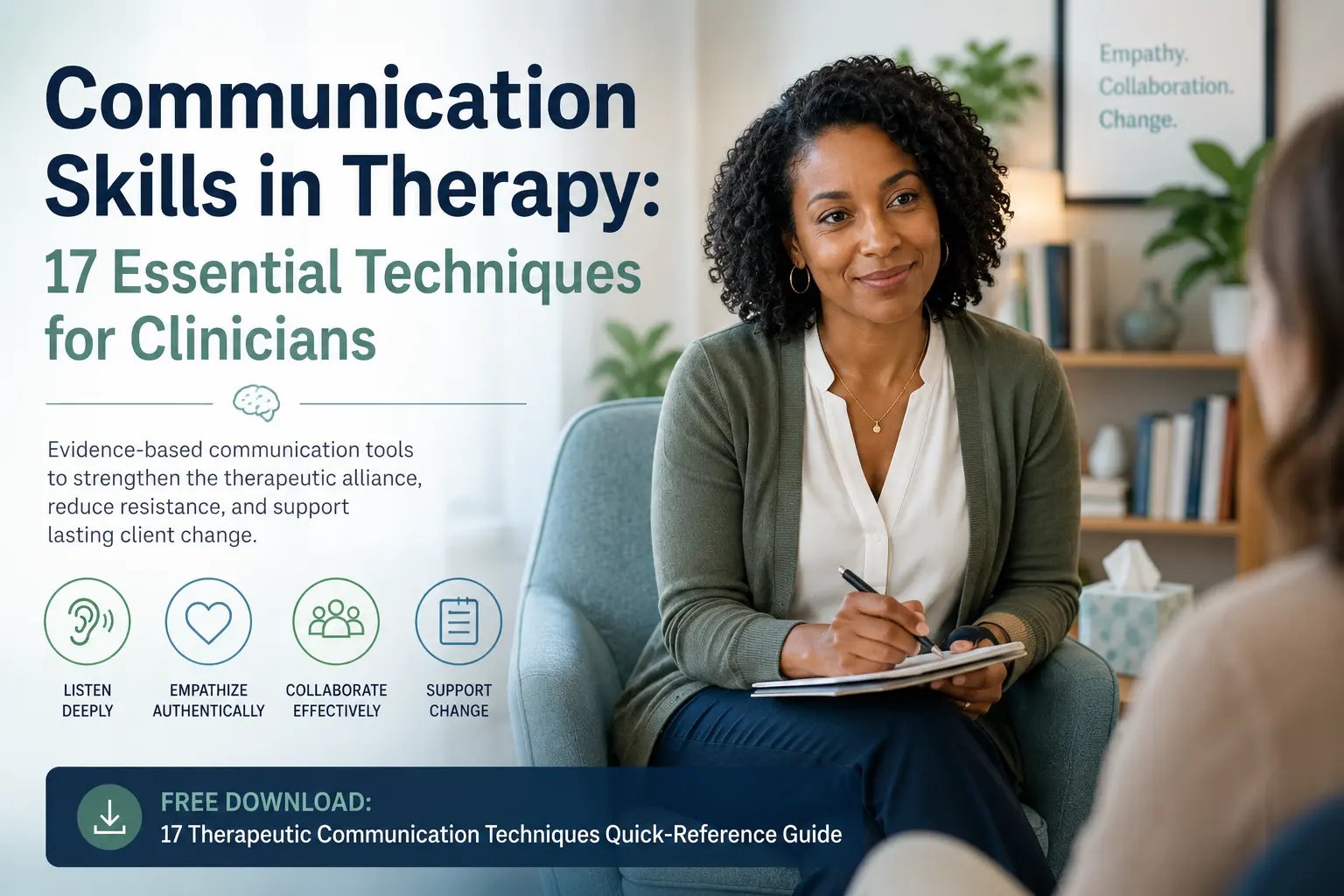
Therapy communication techniques are foundational to effective counseling, psychotherapy, and behavioral health treatment. This guide explores 17 essential therapeutic communication techniques clinicians can use to strengthen the therapeutic alliance, improve client engagement, reduce resistance, and support better clinical outcomes across CBT, DBT, EFT, psychodynamic, solution-focused, couples, and family therapy settings. You’ll learn practical examples of active listening, validation, reflective listening, rupture repair, de-escalation, nonverbal communication, and boundary-setting techniques, along with strategies for documenting communication-based interventions in behavioral health progress notes. Whether you’re looking for therapy communication techniques, communication therapeutic techniques, or a therapeutic communication techniques PDF for clinical reference, this clinician-focused resource provides practical tools you can apply immediately in session.


Last Updated: May 27, 2026
What You'll Learn
- The 17 essential therapy communication techniques used across counseling and psychotherapy
- How active listening, validation, reflection, and empathy strengthen the therapeutic alliance
- Practical examples of therapeutic communication you can apply immediately in session
- How nonverbal communication affects client safety, trust, and engagement
- Communication strategies for couples therapy and family therapy settings
- Techniques for rupture repair, de-escalation, and reducing client resistance
- Ways to improve communication skills through deliberate clinical practice
- How to document communication-based interventions clearly in behavioral health progress notes
- Differences between validation, empathy, reframing, confrontation, and feedback invitation
- How structured behavioral health EHR templates can support faster, more defensible documentation
Contents
What Are Therapy Communication Techniques?
Communication in Therapy and Counseling
Why Communication Matters in Therapy
5 Core Communication Skills for Therapists
17 Essential Therapy Communication Techniques
Nonverbal Communication in Therapy
Activities for Improving Communication
Couples Therapy Communication Techniques
Family Therapy Communication Strategies
How Communication Techniques Differ Across Therapy Modalities
What Are Therapy Communication Techniques?
Therapeutic communication techniques are structured verbal, nonverbal, and relational strategies clinicians use to build trust, improve emotional safety, strengthen the therapeutic alliance, and support client engagement during therapy sessions.
Behavioral health clinicians know that the words we choose — and the way we deliver them — carry as much therapeutic weight as the modality we practice. Decades of process research point to the therapeutic alliance as one of the most consistent factors associated with client engagement and progress in psychotherapy, regardless of theoretical orientation. And the alliance, in turn, is built almost entirely through communication: what we say, how we say it, what we leave unsaid, and how we respond when something goes sideways in the room.
The good news is that therapeutic communication isn’t a fixed trait. It’s a clinical skill — one that sharpens with intention, structure, and ongoing reflection. This guide walks through 17 essential therapy communication techniques you can apply across CBT, DBT, EFT, psychodynamic, solution-focused, and integrative practices, alongside the verbal, vocal, nonverbal, and boundary skills that anchor them. Each technique includes its purpose, example phrasing, and clinical considerations you can take into your next session. We’ll also cover communication strategies specific to couples and family work, plus practical guidance on how to document what you’re doing in the chart.
Communication in Therapy and Counseling
The therapeutic relationship is one of the most extensively studied variables in psychotherapy research. Meta-analyses have repeatedly found that the quality of the alliance — the bond between clinician and client, plus shared agreement on goals and tasks — is associated with client engagement and treatment continuation across modalities, often as strongly as any specific technique within a given approach.
Communication is the medium of that alliance. It shapes whether a client feels safe enough to disclose, willing to challenge a long-held belief, or motivated to come back next week after a difficult session. Subtle phrasing shifts — a closed question reworked as an open one, a “yes, but” replaced with “and” — can determine whether a client opens up or shuts down.
Communication also affects therapist sustainability. Clinicians who develop a deliberate communication framework tend to make more efficient use of session time, document more clearly, and feel less depleted by emotionally complex cases. In other words, refining your therapy communication techniques is good for your clients and good for you.
How Communication Strengthens the Therapeutic Alliance
Strong therapy communication techniques help transform individual interactions into a stronger clinical relationship.
Verbal, vocal, nonverbal, and boundary-setting techniques
Shared trust, collaboration, and agreement on goals
Clients feel heard, respected, and emotionally safer
More openness, feedback, participation, and follow-through
Clearer insight, stronger collaboration, and measurable change
Why Communication is Important in Therapy
Strong therapeutic communication does several things at once:
- Builds empathy and shared understanding so clients feel known, not just heard.
- Reduces shame during moments of insight, when a client risks vulnerability.
- Sharpens case conceptualization and supports clearer mental status exams (MSEs) by surfacing the affect, cognition, and behavior data you need to plan treatment.
- Repairs alliance ruptures before they become attrition.
- Invites feedback and collaboration, transforming therapy into a shared project rather than something done to the client.
In short, communication is what turns a session from an exchange of information into a clinical intervention.
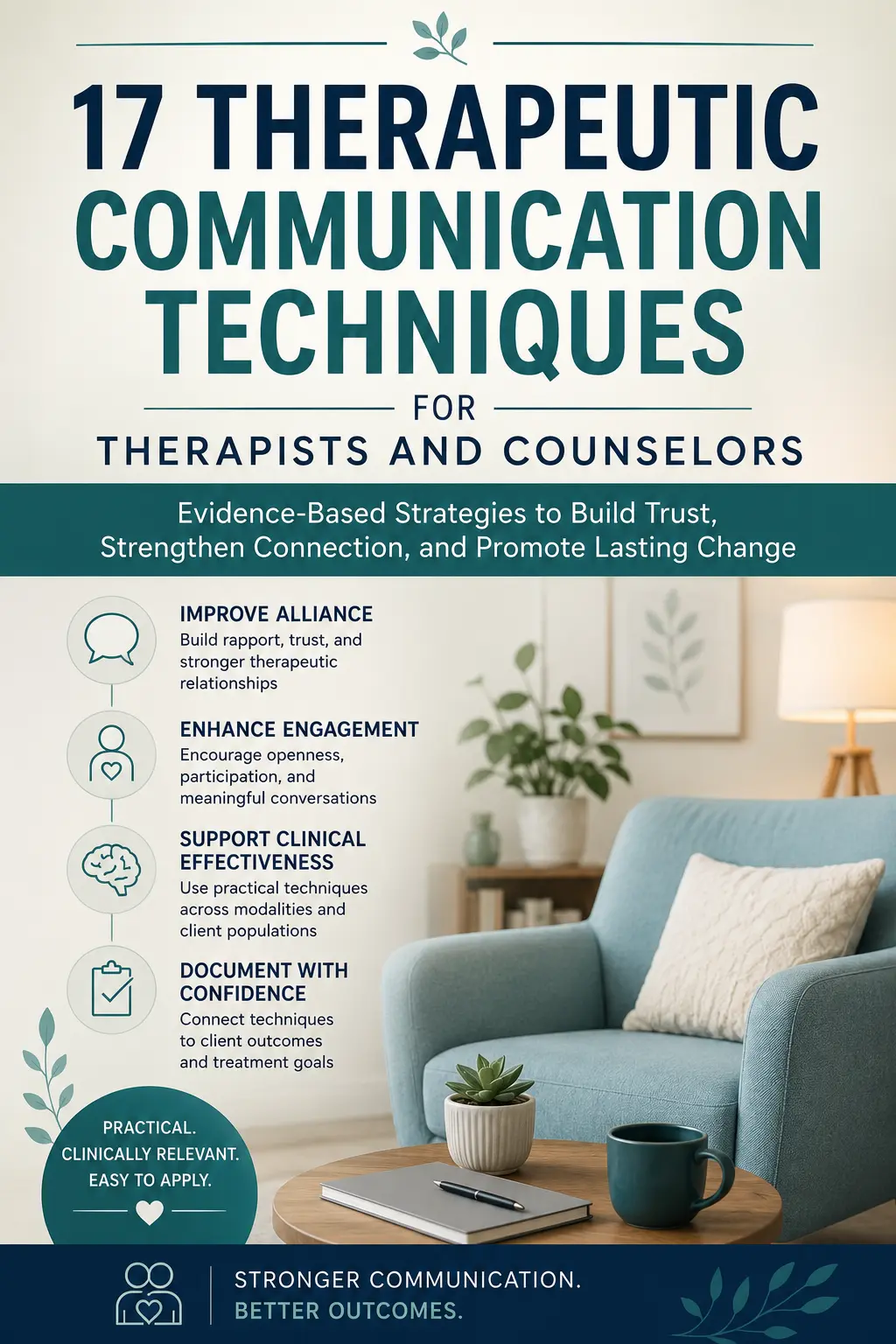
Download the 17 Therapeutic Communication Techniques Quick-Reference Guide
Keep this printable guide nearby for session planning, supervision, documentation support, and solo skill review.
- A one-glance reference card covering all 17 techniques
- Example therapist phrasing and clinical notes
- A nonverbal communication checklist
- Documentation prompts for progress notes
- A reflection worksheet for supervision or solo review
5 Core Communication Skills for Therapists
Before we get to specific techniques, it’s worth grounding in the five skill domains that every therapeutic interaction draws on.
Verbal Communication Skills
Word choice, tone, and pronoun use all signal stance. Inclusive pronouns (“we,” “let’s”), present-tense framing, and naming what’s happening in the room without judgment form the foundation of clear verbal communication.
Vocal Communication Skills
Pace, pitch, volume, and emphasis carry emotional information separate from content. Slowing down before a difficult question, softening volume during disclosure, or using emphasis to underscore a key insight all shape how a message lands.
Nonverbal Communication Skills
Eye contact (or culturally appropriate gaze), facial expression, posture, and gesture often communicate more than words. Clients track your nonverbals continuously — particularly during disclosures of shame, grief, or trauma.
Boundary Communication Skills
Clear, consistent communication around the professional frame — session length, scope of practice, limits of confidentiality, and between-session contact — is a form of care, not a barrier to it.
Action-Based Communication
Follow-ups, homework explanations, scheduling, and referral language are all communication. Ambiguity here can erode trust even when in-session communication is strong.
17 Therapy Communication Techniques for Your Sessions
Each technique below includes its goal, example phrasing, and clinical considerations. These are designed to layer — most sessions weave several together. Here’s a quick visual overview of the 17 therapy communication techniques covered below. Use this as a high-level reference, then review each technique in more detail in the tiles that follow.
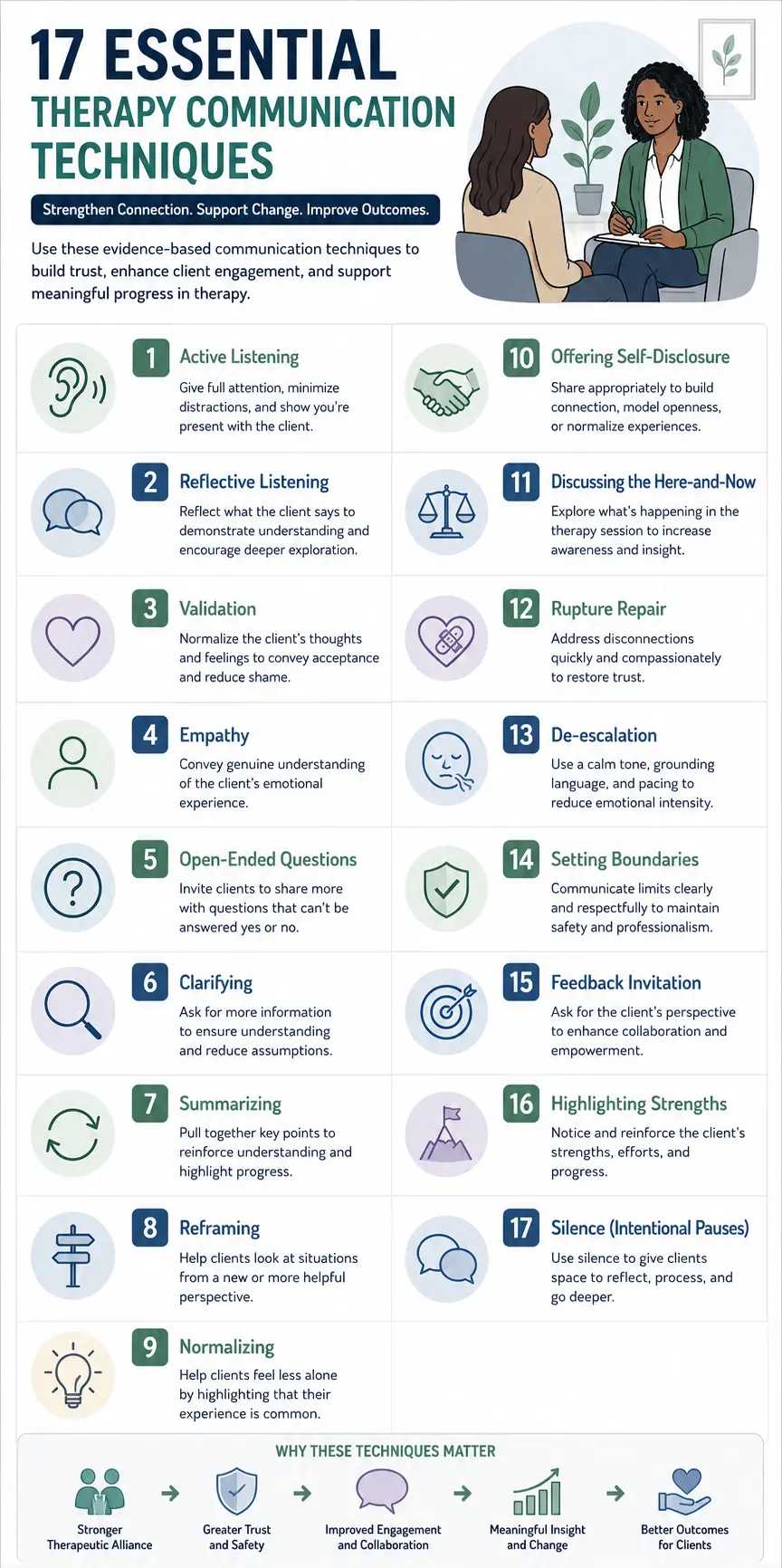
Active Listening
Goal: Convey full presence and attunement.
Example phrasing: “I want to make sure I’m tracking with you. You’re saying that when your sister called, the old anger came back almost instantly.”
Clinical notes: Active listening is more than silence — it’s reflected attention. Watch for the urge to formulate your next response while the client is still speaking; that’s the moment to redirect attention to their words and affect.
Reflective Listening
Goal: Mirror content and feeling back to the client to confirm understanding and slow the process.
Example phrasing: “It sounds like the silence at home has started to feel heavier than the arguments did.”
Clinical notes: Reflect both content and feeling. Avoid parroting; rephrase in your own words at roughly the same emotional intensity as the client.
Validation
Goal: Acknowledge that the client’s experience makes sense given their context.
Example phrasing: “Given what you grew up with, of course you’d read his tone that way — that response served you for a long time.”
Clinical notes: Validation is not agreement or endorsement. You can validate the understandability of a feeling or behavior without endorsing the client’s interpretation.
Empathic Affirmation
Goal: Communicate care for the client’s emotional reality, especially during pain.
Example phrasing: “I’m really glad you brought this here. It took something to say it out loud.”
Clinical notes: Use sparingly and authentically. Repeated, generic affirmation can read as performative.
Open-Ended Questions
Goal: Invite exploration rather than yes/no answers.
Example phrasing: “What was it like in your body when you saw the email?”
Clinical notes: Open-ended questions usually start with “what,” “how,” or “tell me about.” “Why” questions can sound interrogative and trigger defensiveness — reframe to “what got in the way” or “what made that hard.”
Clarification
Goal: Make sure you and the client share the same meaning of a word, image, or event.
Example phrasing: “When you say ‘shut down,’ I want to picture that more clearly. What does that look like for you in those moments?”
Clinical notes: Don’t assume jargon — even common words like “anxious,” “trauma,” or “boundary” carry different meanings for different clients.
Summarizing
Goal: Consolidate themes, mark transitions, or close a session.
Example phrasing: “Before we shift gears, let me pull together what I’ve heard so far…”
Clinical notes: Summaries also serve documentation. A clean mid-session summary often becomes the spine of your progress note.
Strategic Use of Silence
Goal: Create space for affect, reflection, or insight.
Example phrasing: Pausing for several seconds after a client says something difficult, holding eye contact gently.
Clinical notes: Silence is most powerful when paired with attuned presence. Long silences without nonverbal warmth can feel withholding. Cultural and trauma considerations matter — for some clients, prolonged silence raises threat.
Normalization
Goal: Reduce shame by situating the client’s experience within human or clinical norms.
Example phrasing: “Many people who’ve been through something similar describe exactly that pattern — it’s a recognizable response, not a personal failing.”
Clinical notes: Don’t normalize past the client’s experience. Pair normalization with curiosity about their unique version.
Reframing
Goal: Offer an alternative meaning or perspective on an experience or behavior.
Example phrasing: “I wonder if what you’re calling ‘overreacting’ might be your system finally letting you feel something it wasn’t safe to feel before.”
Clinical notes: Reframes should be tentative, not declarative. A reframe imposed too quickly can feel dismissive.
Scaling Questions
Goal: Surface change, motivation, or progress in measurable terms (rooted in solution-focused therapy).
Example phrasing: “On a scale of zero to ten, where zero is the worst this anxiety has been and ten is fully resolved, where would you put this week?”
Clinical notes: Follow up the number with movement: “What would a half-point higher look like?” Scaling supports both the alliance and outcome tracking.
Gentle Confrontation
Goal: Surface a discrepancy between what a client says, feels, and does — without shaming.
Example phrasing: “I notice you’re smiling as you tell me about the layoff. I’m curious about that.”
Clinical notes: Confrontation is best deployed only after the alliance can hold it. Tone matters more than wording.
Rupture Repair Dialogue
Goal: Address misattunements, ruptures, or therapy-interfering moments directly.
Example phrasing: “I want to come back to last session. I’m not sure my response to what you shared landed the way I meant it. How did it sit with you?”
Clinical notes: Repair attempts that the clinician initiates explicitly — including taking responsibility for their part — are often associated with deepening of the alliance.
Feedback Invitation
Goal: Build collaboration by routinely asking how therapy is going.
Example phrasing: “What’s been useful in our work lately? What’s missing or off?”
Clinical notes: Feedback-informed treatment is supported by a meaningful evidence base. Build it into the structure of sessions rather than waiting for problems to surface.
Emotion Labeling
Goal: Help clients put precise language to internal experience.
Example phrasing: “That sounds less like anger to me and more like grief — does that resonate?”
Clinical notes: Specific emotion words (“ashamed,” “abandoned,” “bereft”) often unlock more than generic ones (“upset,” “bad”). Tentative phrasing keeps the client as the expert on their own experience.
Boundary-Setting Language
Goal: Communicate the professional frame clearly, calmly, and without apology.
Example phrasing: “I won’t be able to text between sessions, but I want to make sure we have time to plan for hard moments. Let’s build that out together.”
Clinical notes: Boundaries are most effective when they include the rationale and an alternative path forward.
De-escalation Techniques
Goal: Reduce arousal in moments of high distress, agitation, or risk.
Example phrasing: Lowering voice, slowing pace, naming what you’re observing (“your hands are shaking — let’s slow down for a moment”), and offering a grounding option.
Clinical notes: De-escalation is regulation work. Your nervous system is the intervention before any specific technique. Pair with safety planning when indicated.
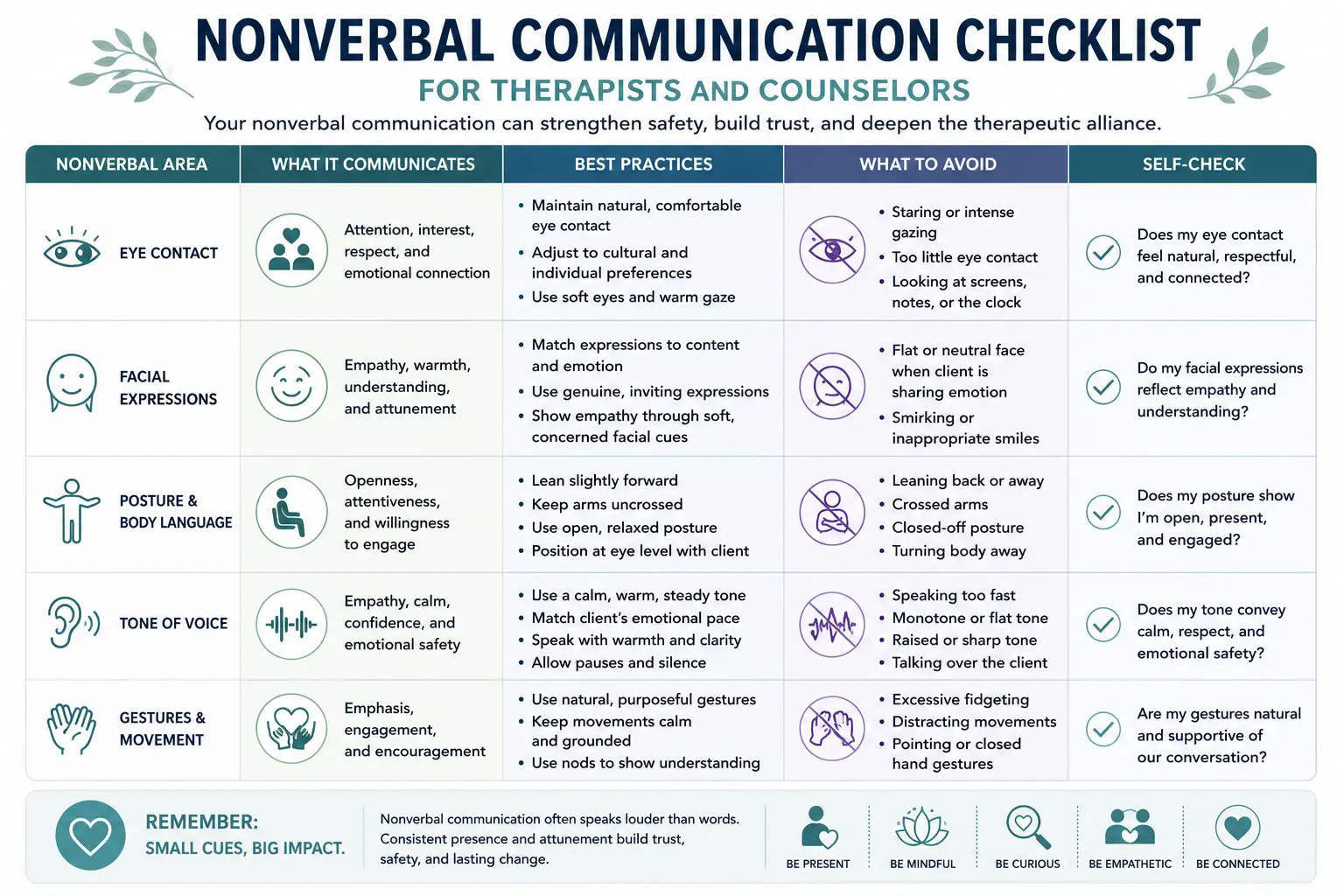
A Look at Nonverbal Communication in Therapy
Nonverbal communication often carries the meta-message of a session — the implicit answer to questions like “Am I safe here?” and “Does this person actually care about what I’m saying?” Even when clinicians choose their words carefully, nonverbal incongruence can quietly undercut every technique above.
Key channels to attend to:
- Gaze and eye contact. Steady but soft, with cultural sensitivity. Some clients experience direct eye contact as confronting; others need it to feel met.
- Facial expression. Micro-expressions of surprise, disgust, or impatience are visible. A neutral, warmly engaged face is the goal.
- Posture and physical orientation. A slight lean in during disclosures, an open torso, and uncrossed arms communicate availability.
- Distance communicates respect and safety. Always check the client’s preference, especially in trauma work.
- Vocal pacing. Match and gently slow the client’s pace when they’re escalated; bring some energy when they’re flat.
- Regulated breathing. Your breath is contagious. Slow, audible exhales co-regulate the client without a single word.
Telehealth introduces its own nonverbal considerations — camera angle, lighting, eye-line, and screen size all shape how presence is read. Many of the same principles apply; the channels just shift.
Activities for Improving Communication
Communication skill grows with deliberate practice. Useful activities for both new and seasoned clinicians include:
- Recording and reviewing sessions (with informed consent), focusing on a single dimension at a time — pacing, open vs. closed questions, validation density, etc.
- Verbal communication drills in peer consultation, practicing reframes or rupture repair language out loud before using them with clients.
- Vocal pattern self-assessment — listening to the first two minutes of a session and noting pace, volume, and emphasis without judgment.
- Active listening reflection journals where clinicians log moments of strong attunement and moments of drift, mining the latter for skill targets.
- Presence practice between sessions — brief grounding rituals that reset attention before the next client.
- Over- and under-involvement check-ins in supervision, examining cases where a clinician might be working harder than the client — or harder than is helpful.
- Client speech pattern awareness — noticing each client’s idioms, metaphors, and emotional vocabulary, and using their language back to them.
Couples Therapy Communication Techniques
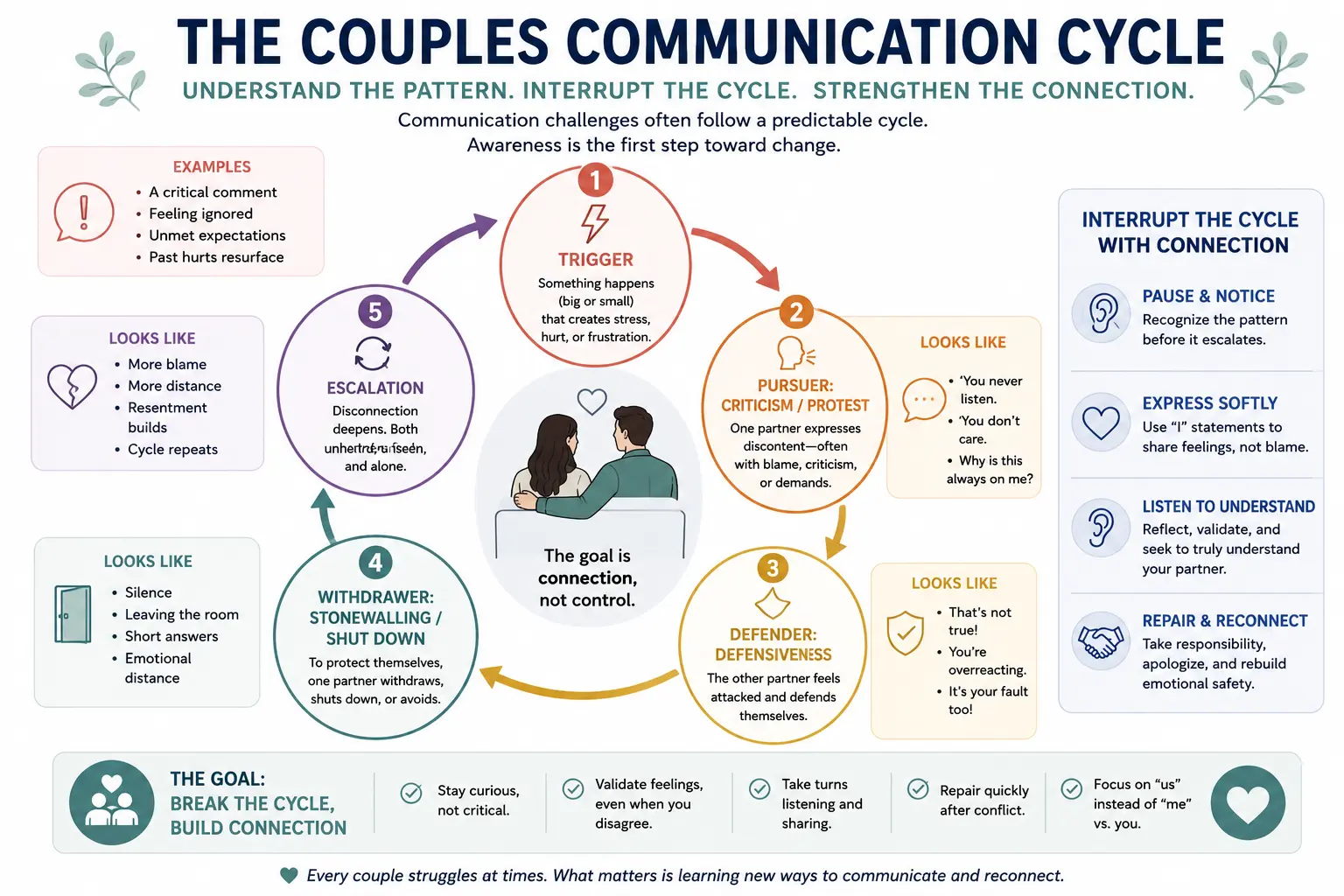
In couples therapy, communication isn’t only between clinician and client — it’s the territory the work is about. The clinician’s role is often to be a translator and pacer, slowing communication enough that partners can hear each other for the first time in a long time. Common couples therapy communication techniques include:
- Speaker–listener turn-taking. Structuring conversations so one partner speaks while the other listens and reflects, then switches roles. Helpful for de-escalating loops where both partners are talking past each other.
- “I” statements. Coaching partners to share experience from their own perspective (“I felt invisible when…”) rather than starting with “you” accusations.
- Soft start-ups. Replacing harsh openings with statements that lead with feeling and a positive need (“I feel overwhelmed and I need help with bedtime”).
- Reflective summaries between partners. Each partner paraphrases what they heard before responding. This slows reactive cycles and builds attunement.
- Naming and reinforcing repair attempts. Pointing out the small bids each partner makes to de-escalate or reconnect during conflict, and inviting the other to receive them.
- Withdrawal interruption. Gently surfacing stonewalling or shutdown patterns — often associated with physiological flooding — and pausing to regulate before continuing.
When couples present with entrenched negative cycles, structured communication tools work best alongside an emotion-focused or systemic frame that names the cycle itself, not just the words exchanged inside it.
Family Therapy Techniques to Improve Communication
Family communication patterns are typically multi-generational, role-bound, and reinforced by long-standing rules about who can say what, to whom, and when. Family therapy techniques to improve communication often combine direct skill-building with interventions that surface the system:
- Circular questioning. Asking each member how they think another member sees a problem (“Mom, what do you imagine your son is most worried about?”). Surfaces hidden assumptions and breaks linear blame patterns.
- Genograms with communication overlays. Mapping who talks to whom, who avoids whom, and what topics are off-limits across generations.
- Family rules dialogue. Naming spoken and unspoken rules (“we don’t talk about Dad’s drinking”) and exploring their function and cost.
- Structured parent–child listening. Teaching parents to reflect a child’s emotional experience before redirecting behavior.
- Sibling subsystem work. Carving out time for sibling communication separate from parental presence to surface alliances and protectiveness.
- De-triangulation language. Coaching members to speak directly to one another rather than through a third member — including the therapist.
Across both couples and family work, communication-based interventions are most effective when paired with an explicit relational frame that helps members understand why old patterns persist, not just how to talk differently.
Related: Family Therapy Activities: 12 Practice Exercises to Improve Communication and Connection
How Communication Techniques Differ Across Therapy Modalities
While core therapeutic communication techniques like active listening, validation, empathy, and open-ended questioning appear across nearly every form of psychotherapy, different modalities emphasize different communication styles, pacing, and intervention strategies. Skilled clinicians often adapt their communication approach based on both the treatment model and the client’s needs in the moment. The chart below offers a quick comparison before we explore each modality in more detail.
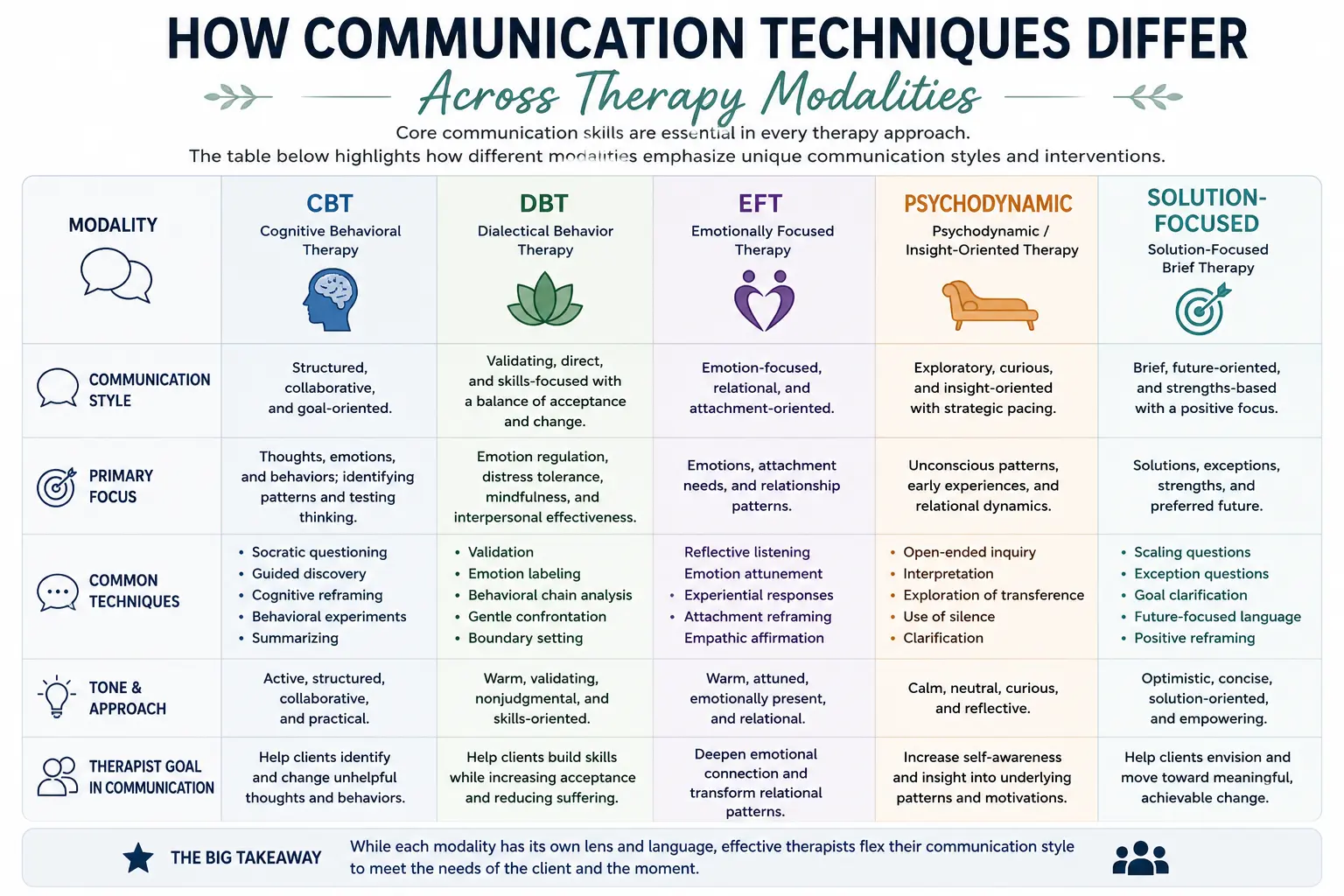
CBT Communication Techniques
Cognitive behavioral therapy (CBT) communication tends to be structured, collaborative, and goal-oriented. Clinicians frequently use:
- Socratic questioning
- Guided discovery
- Clarification
- Reframing
- Summarizing
The communication style in CBT is typically direct but collaborative, helping clients identify patterns in thoughts, emotions, and behaviors without feeling judged. Questions are often designed to help clients examine evidence, test assumptions, and develop alternative perspectives.
“What evidence supports that belief, and what evidence might point in another direction?”
DBT Communication Techniques
Dialectical behavioral therapy (DBT) places heavy emphasis on validation, emotional regulation, and balancing acceptance with change. Communication in DBT often includes:
- High levels of validation
- Emotion labeling
- Behavioral chain analysis
- Gentle confrontation
- Clear boundary-setting language
DBT clinicians frequently communicate warmth and acceptance while also encouraging accountability and behavioral change. Tone and pacing are especially important when working with emotionally dysregulated clients.
“It makes sense that you wanted relief in that moment — and we also need to look at what the behavior cost you afterward.”
EFT Communication Techniques
Emotionally focused therapy (EFT) centers emotional experience, attachment needs, and relational patterns. Communication techniques in EFT often involve:
- Reflective listening
- Slowing emotional moments
- Attachment-focused reframing
- Heightening emotional experience
- Empathic affirmation
EFT clinicians often use softer pacing, emotionally attuned reflections, and experiential language designed to deepen emotional processing and increase relational safety.
“Under the anger, I wonder if there’s also fear that you won’t matter to them.”
Psychodynamic Communication Techniques
Psychodynamic and insight-oriented therapies often emphasize curiosity, interpretation, and exploration of unconscious relational patterns. Communication tends to include:
- Strategic use of silence
- Clarification
- Interpretation
- Exploration of transference
- Open-ended inquiry
Rather than moving quickly toward problem-solving, psychodynamic communication often creates space for reflection, ambiguity, and deeper meaning-making.
“I notice this feeling seems familiar in several important relationships — including here with me.”
Solution-Focused Communication Techniques
Solution-focused brief therapy (SFBT) emphasizes strengths, exceptions, future orientation, and measurable change. Communication techniques frequently include:
- Scaling questions
- Exception questions
- Goal clarification
- Future-focused language
- Positive reframing
The clinician’s communication style is typically concise, hopeful, and oriented toward identifying what is already working.
“Tell me about a recent moment when the problem felt even slightly less intense. What was different?”
Integrative and Eclectic Approaches
Many modern clinicians work from integrative or eclectic frameworks, blending communication techniques across modalities depending on the client, diagnosis, therapeutic stage, and treatment goals. A therapist might use CBT-style reframing in one moment, EFT-style emotional reflection in another, and DBT validation during a high-distress interaction.
Ultimately, effective therapeutic communication is less about rigidly following one style and more about developing the flexibility to respond intentionally, relationally, and clinically to the person in front of you.
How to Document Therapeutic Communication Techniques
Documentation is where clinical communication meets the medical record. Notes that clearly capture communication-based interventions support continuity of care, defensible records, billing accuracy, and supervision conversations.
When documenting communication techniques, aim to capture:
- Technique used — for example, reflective listening, validation, gentle confrontation, or rupture repair.
- Client response to the intervention — verbal content, observable affect, and body posture changes.
- Emotional shifts during the session, with concrete language (“affect moved from constricted to tearful while discussing the loss”).
- Alliance observations — engagement, collaboration on the agenda, willingness to provide feedback.
- Progress toward treatment plan goals with specific reference to the goal addressed.
Process for Documenting Therapeutic Communication Techniques
A simple documentation structure can help clinicians connect the communication technique used in session to the client’s response, emotional shift, alliance observation, and treatment plan progress.
Technique Used
Name the intervention, such as reflective listening, validation, reframing, rupture repair, or de-escalation.
Client Response
Document verbal content, observable affect, body language, engagement, or change in participation.
Emotional Shift
Note concrete changes in affect, intensity, regulation, insight, or willingness to explore the topic.
Alliance Observation
Capture collaboration, feedback, repair, trust, agenda agreement, or increased therapeutic engagement.
Progress Toward Goal
Connect the intervention to the treatment plan goal addressed and quantify progress when appropriate.
A structured EHR built specifically for behavioral health can streamline this kind of documentation. ICANotes’ content-rich templates include behavioral health–specific terminology for communication interventions, mental status exam, and treatment plan progress, which can shorten note-writing time and support more consistent records across a practice.
Related Resources for Behavioral Health Clinicians
Explore additional ICANotes resources on therapeutic communication, counseling skills, CBT techniques, family therapy, couples therapy, and psychodynamic approaches.
Active Listening in Therapy
Learn how active listening techniques strengthen the therapeutic alliance, improve attunement, and deepen client engagement.
Cognitive Behavioral Therapy (CBT) Techniques
Explore CBT interventions, Socratic questioning strategies, cognitive restructuring tools, and behavioral techniques for therapy sessions.
Counseling Skills and Therapeutic Skills
Review foundational counseling skills for therapists, including empathy, reflection, questioning, and relationship-building techniques.
Family Therapy Activities
Discover structured family therapy activities that support communication, emotional regulation, and healthier family dynamics.
Couples Therapy Activities
Explore couples therapy exercises designed to improve communication, attachment security, conflict repair, and emotional connection.
Brief Psychodynamic Therapy
Learn how psychodynamic therapy techniques use insight, interpretation, reflection, and relational exploration to support change.
Frequently Asked Questions About Therapy Communication Techniques
+What are the most important therapy communication techniques?
Most clinicians point to active listening, reflective listening, validation, open-ended questions, and rupture repair as the foundational techniques. They show up across virtually every modality and form the base layer of the therapeutic alliance. More specialized techniques — like scaling questions in solution-focused work or reframing in cognitive therapy — sit on top of that base.
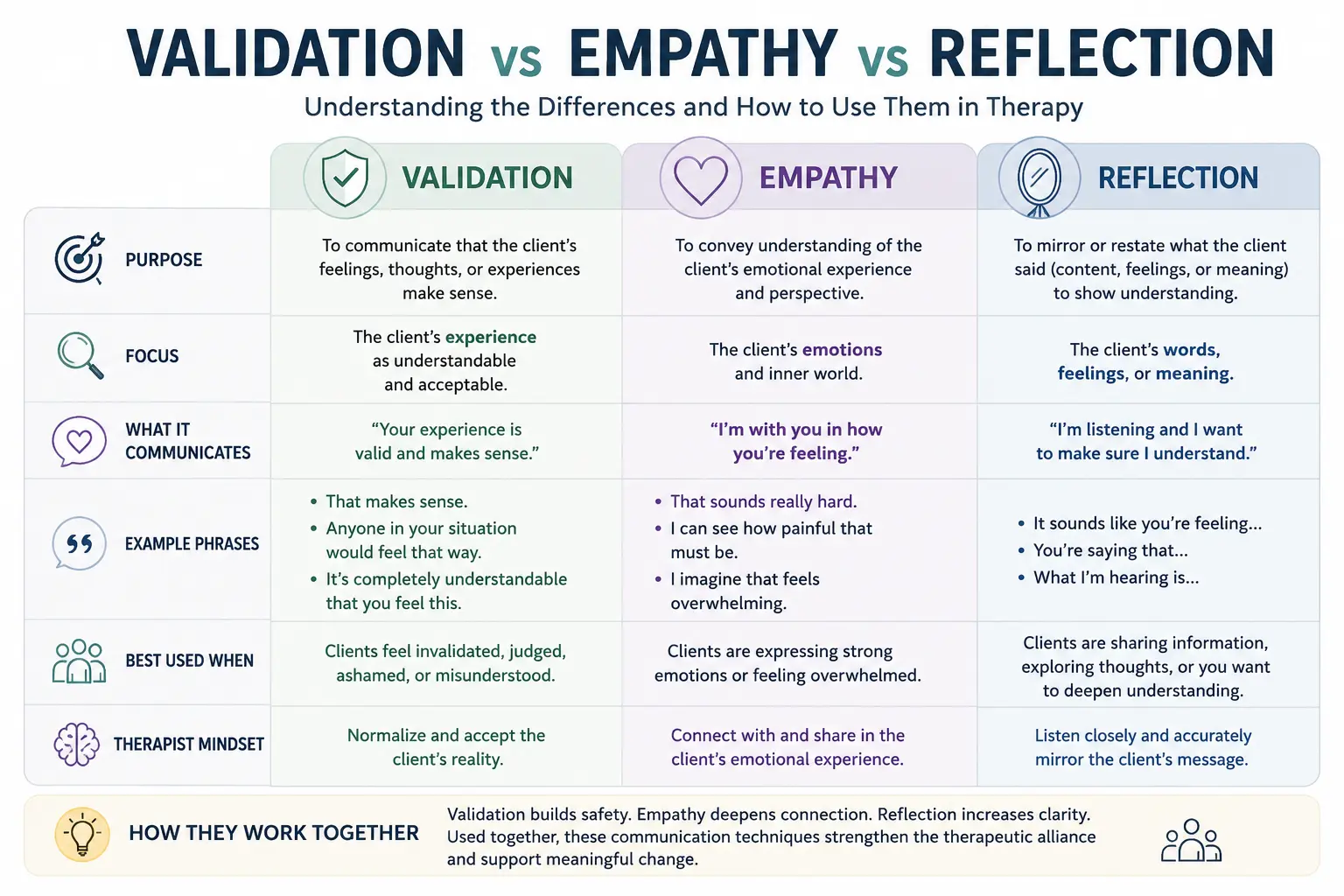
+What is the difference between empathy and validation?
Empathy is the experience of understanding and feeling alongside the client’s emotional reality. Validation is the verbal communication of that understanding in a way that conveys “your response makes sense given your context.” Empathy is the internal stance; validation is one of the external techniques that expresses it. You can validate without feeling much empathy in a given moment (a useful skill on hard days), and you can experience deep empathy without yet verbalizing it through validation.
+How do therapists repair alliance ruptures?
Rupture repair generally involves four steps: noticing the rupture, naming it explicitly, taking responsibility for the clinician’s part, and inviting the client to share how the moment landed for them. Research suggests that successful repair is often associated with deepening of the alliance — the willingness to address the rupture itself can be therapeutic.
+Why is nonverbal communication important in therapy?
Nonverbal communication — facial expression, posture, vocal pacing, breath — often carries more emotional information than the words themselves. Clients track nonverbals constantly, especially during shame, trauma, or crisis moments. Incongruence between verbal warmth and nonverbal flatness can quietly undermine an entire intervention.
+How can communication skills reduce client resistance?
Much of what looks like resistance is a response to phrasing, pacing, or stance. Reframing a “why” question to “what got in the way,” validating before challenging, and inviting the client’s perspective on the goal can substantially reduce defensive responses. The motivational interviewing spirit of partnership, acceptance, compassion, and evocation is built almost entirely on communication skill.
+What are some couples therapy communication techniques?
Common couples therapy communication techniques include speaker–listener turn-taking, “I” statements, soft start-ups, reflective summaries between partners, naming and reinforcing repair attempts, and gently interrupting withdrawal patterns. These tools work best when paired with a frame that names the couple’s negative cycle, not just the words exchanged within it.
+What family therapy techniques can improve communication?
Family therapy techniques to improve communication include circular questioning, genograms with communication overlays, naming family rules, structured parent–child listening, sibling subsystem work, and de-triangulation language. These techniques surface multi-generational patterns alongside direct skill-building.
+Where can I find a therapeutic communication techniques PDF for clinical reference?
Many clinicians prefer a printable PDF reference they can keep at their desk or share in supervision. ICANotes offers a free downloadable Therapeutic Communication Techniques Quick-Reference Guide that summarizes all 17 techniques, example phrasing, and documentation prompts in a clinician-friendly format. (Link to lead magnet below.)
+How do communication techniques differ across modalities like CBT, DBT, and EFT?
The core skills — active listening, validation, open-ended questions — are shared across modalities. The differences usually live in the structure and emphasis. CBT pairs Socratic questioning with collaborative empiricism. DBT layers in dialectical balancing of acceptance and change. EFT centers emotional experience and attachment language. Solution-focused work emphasizes scaling and exception questions. Strong clinicians adapt their communication to match both the modality and the client in front of them.
Recent Posts




Dr. October Boyles
DNP, MSN, BSN, RN
About the Author
Dr. October Boyles is a behavioral health expert and clinical leader with extensive expertise in nursing, compliance, and healthcare operations. With a Doctor of Nursing Practice (DNP) and advanced degrees in nursing, she specializes in evidence-based practices, EHR optimization, and improving outcomes in behavioral health settings. Dr. Boyles is passionate about empowering clinicians with the tools and strategies needed to deliver high-quality, patient-centered care.