Social Determinants of Health and Substance Abuse: Screening, Documentation, and Treatment
How to screen for, document, code, and treat the social conditions that shape substance use risk and recovery.


A substance use disorder (SUD) is never only an individual problem. Where a client lives, works, and finds support shapes their risk of developing an SUD, their ability to reach treatment, and their chances of staying in recovery.
This guide is for clinicians who need to act on that reality in their next session. It covers how to screen for social determinants of health (SDOH), how to document and code them, how to build them into SUD treatment plans, and what changed in Medicare coding for 2026.
Key takeaways
- Social determinants of health are the non-medical conditions where people are born, live, learn, work, play, worship, and age. In substance use treatment, they shape who develops a substance use disorder, who can reach care, and who stays in recovery.
- Clinicians can address SDOH by screening with a validated tool, recording findings with ICD-10-CM Z codes, and turning each need into a treatment plan goal or referral.
- Turn social needs into treatment goals by translating identified barriers, such as housing instability or unemployment, into measurable objectives, targeted interventions, and community referrals.
- Reassess as circumstances change. Review social needs during treatment plan updates and after major life events to ensure interventions remain relevant and support long-term recovery.
Need a quick way to start screening? Download our free SDOH Risk Assessment and use it at your next intake.
What Are Social Determinants of Health in Substance Use?
What They Are
Healthy People 2030 defines social determinants of health as the conditions in the environments where people are born, live, learn, work, play, worship, and age that affect health, functioning, and quality of life. When those conditions influence whether someone starts, escalates, or recovers from substance use, they are often called social determinants of substance use.
SDOH sit alongside genetic, psychological, and developmental risk factors. They should never be used to explain away addiction. Instead, they help explain why two clients with similar clinical histories can follow very different paths. For a broader introduction, see our guide to what social determinants of health are.
What are the Five Domains of Social Determinants of Health?
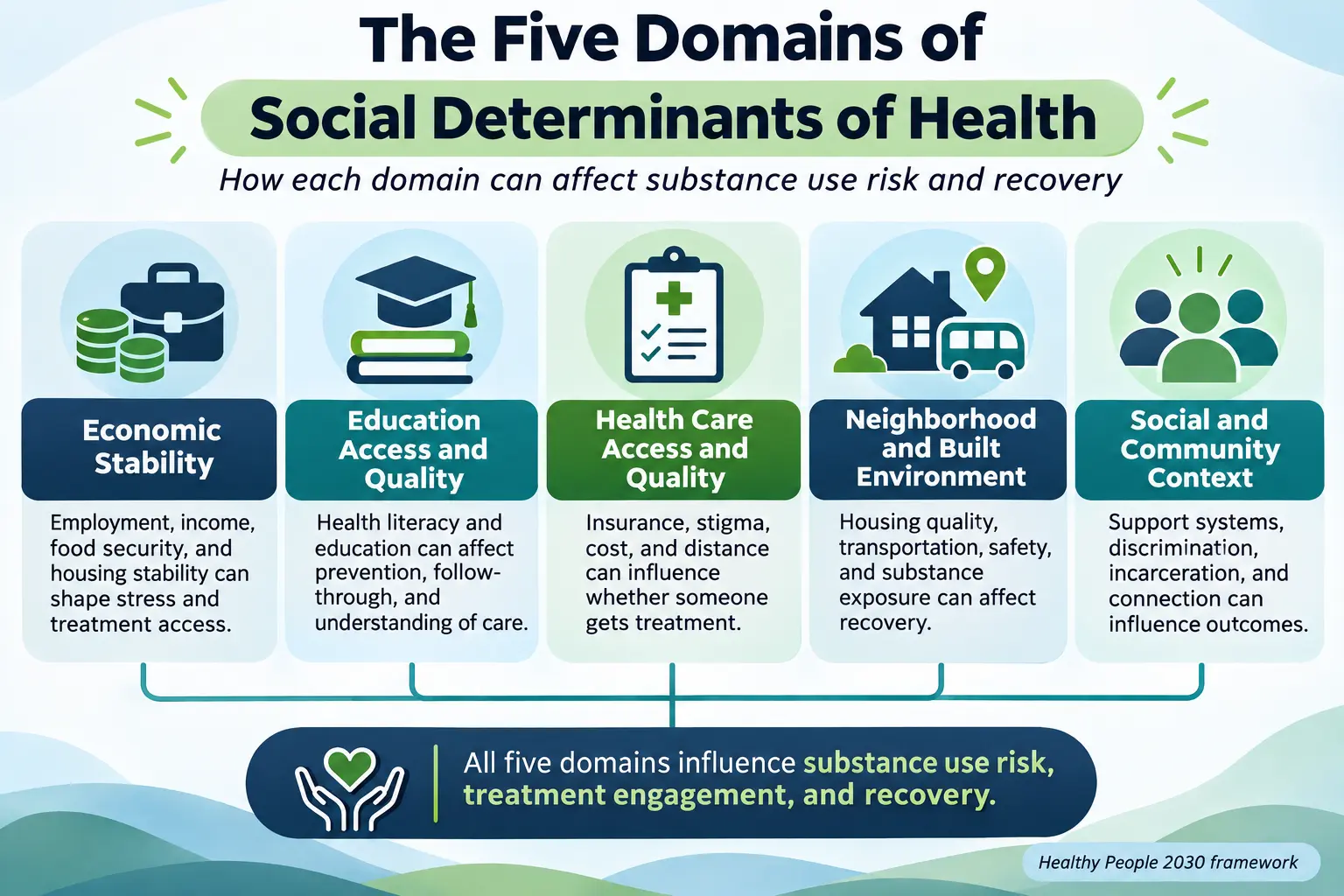
The five domains of social determinants of health (SDOH), as defined by Healthy People 2030, are economic stability, education access and quality, health care access and quality, neighborhood and built environment, and social and community context. These factors influence substance use risk, access to treatment, and long-term recovery by shaping a person's financial security, living conditions, healthcare access, and support systems.
- Economic stability: employment, income, food security, and housing stability
- Education access and quality: early childhood education, high school completion, and health literacy
- Health care access and quality: insurance coverage and access to primary and behavioral health care
- Neighborhood and built environment: housing quality, transportation, safety, and exposure to violence
- Social and community context: social support, discrimination, incarceration, and community connection
Why SDOH Matter in SUD Treatment
The National Institute on Drug Abuse (NIDA) has stated plainly that social determinants of health can't be extricated from addiction science. Chronic stress from financial hardship, trauma, and unsafe housing can push people toward substances as a way to cope. Living where substance use is normalized makes it harder to resist.
A 2024 scoping review of 50 longitudinal studies in the Journal of Substance Use and Addiction Treatment found that unemployment, neighborhood vulnerability, negative peer influence, violence and trauma, and criminal justice involvement were linked to escalating use. Employment and social support helped people enter treatment and progress in recovery. Unstable housing and criminal justice involvement worked against recovery and were associated, along with unemployment and isolation, with overdose and death.
SDOH Domain Reference Table for Intake
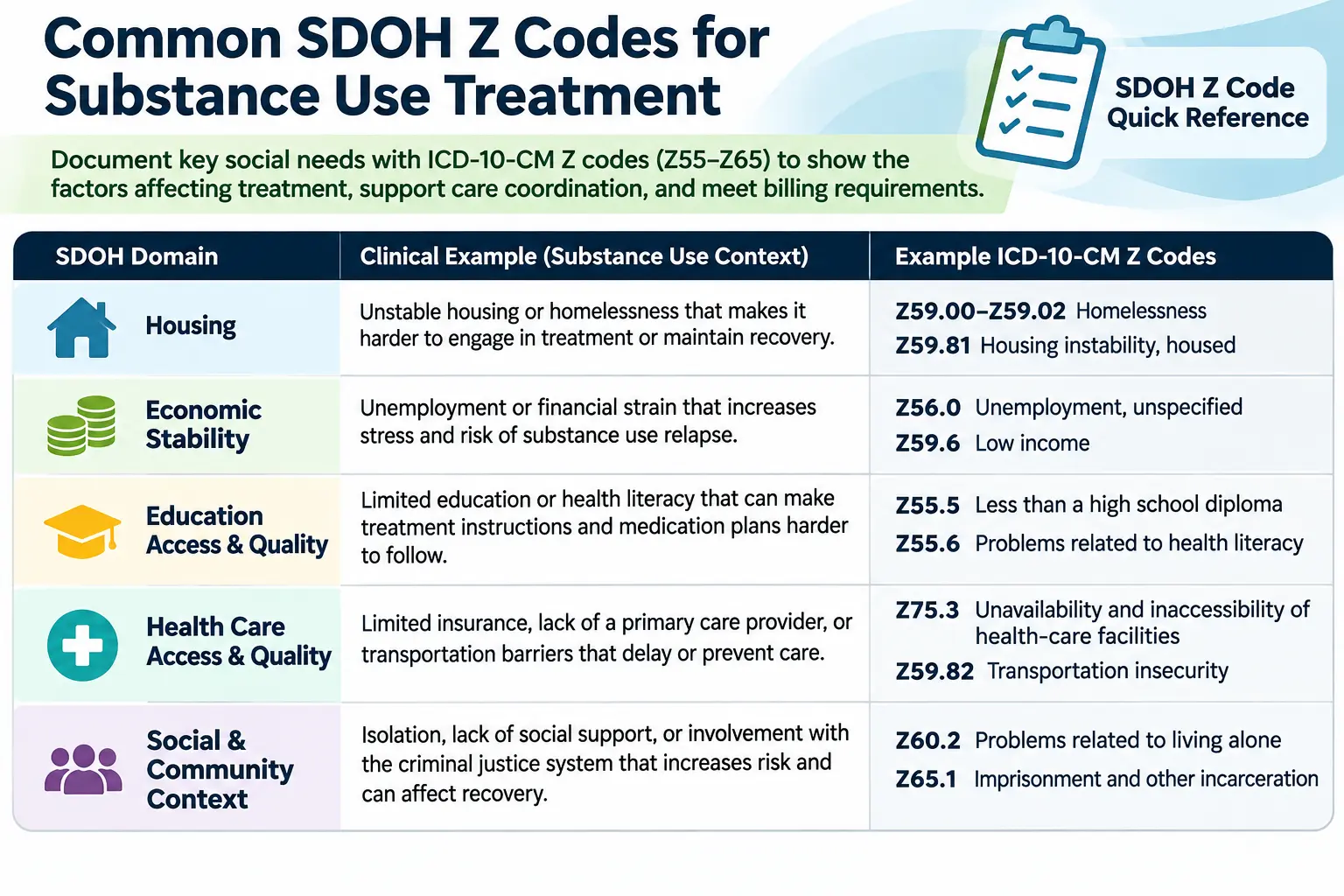
Use this table at intake to connect each SDOH domain to its clinical impact, a practical next step, and an example ICD-10-CM Z code.
| SDOH domain | How it affects SUD risk and recovery | Clinical action | Example ICD-10-CM Z codes |
|---|---|---|---|
| Economic stability | Unemployment and financial stress are linked to escalating use; employment supports treatment entry and recovery | Refer to job training, vocational rehabilitation, and benefits navigation | Z56.0 Unemployment, unspecified; Z59.6 Low income; Z59.41 Food insecurity |
| Housing | Unstable housing deters recovery and is associated with overdose risk | Connect to recovery, transitional, or supportive housing | Z59.00–Z59.02 Homelessness; Z59.81- Housing instability, housed |
| Health care access | Cost, stigma, and distance block treatment entry | Coordinate care; refer to low-barrier medications for substance use disorder; offer telehealth | Z75.3 Unavailability and inaccessibility of health-care facilities; Z59.82 Transportation insecurity |
| Social and community context | Isolation and negative peer networks raise risk; social support aids recovery | Mutual-help groups, peer recovery support, family involvement | Z60.2 Problems related to living alone; Z60.4 Social exclusion and rejection |
| Criminal justice involvement | Linked to escalation, treatment dropout, and overdose | Reentry planning and legal aid referrals | Z65.1 Imprisonment and other incarceration; Z65.2 Problems related to release from prison; Z65.3 Problems related to other legal circumstances |
| Education and health literacy | Limited health literacy makes treatment instructions and medication plans harder to follow | Use plain language, teach-back, and adult education referrals | Z55.5 Less than a high school diploma; Z55.6 Problems related to health literacy |
ICD-10-CM codes are updated every October 1. Confirm codes against the current code set before submitting claims.
Social Determinants of Health Screening in Substance Use Treatment
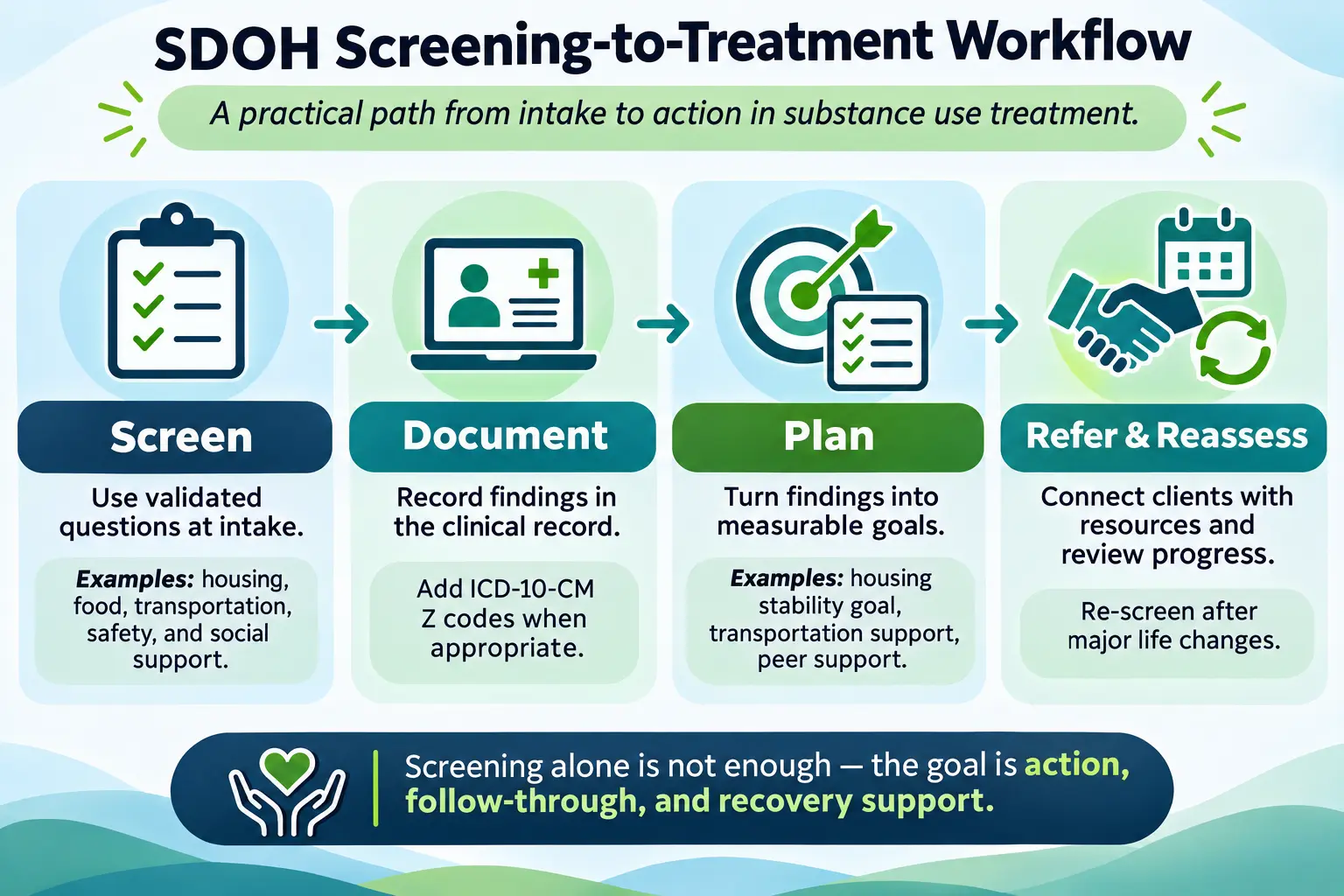
Screening for social determinants of health at intake helps you understand each client's risk context and tailor interventions. Re-screen at treatment plan reviews and after major life changes, such as a job loss, eviction, or release from incarceration.
Build screening into your biopsychosocial assessment so social needs are captured in the same workflow as substance use history, mental health, and medical status.
Validated SDOH Screening Tools
A validated social determinants of health questionnaire gives you consistent, comparable data. These are widely used options:
| Tool | What it covers | Length | Best use |
|---|---|---|---|
| PRAPARE (National Association of Community Health Centers) | Personal characteristics, family and home, money and resources, social and emotional health, plus optional questions | About 20 questions | Comprehensive intake in community behavioral health settings |
| CMS AHC Health-Related Social Needs Screening Tool | Housing instability, food insecurity, transportation, utilities, and interpersonal safety, with optional supplemental domains | 10 core questions | Fast, standardized screening that clients can self-administer |
| Hunger Vital Sign | Food insecurity | 2 questions | Quick add-on to any intake |
| The ASAM Criteria | Recovery environment, including housing, relationships, and supports (Dimension 5 in the fourth edition) | Part of a full ASAM assessment | Level-of-care and placement decisions |
SDOH Screening Questions for Substance Use Treatment
If you are building your own intake form, these plain-language SDOH screening questions cover the domains most relevant to substance use treatment:
- Housing: What is your living situation today? Are you worried about losing your housing?
- Food: In the past year, have you worried about running out of food before you had money to buy more?
- Finances and work: Are you currently working? How hard is it to pay for basics like rent, food, and utilities?
- Transportation: Has a lack of reliable transportation kept you from appointments, meetings, or work?
- Safety: Do you feel physically and emotionally safe where you live?
- Social support: Who can you count on when you need help? Does anyone you live or spend time with use alcohol or drugs?
- Legal: Are you currently involved with the courts, probation, or parole?
- Health literacy: How confident are you filling out medical forms on your own?
Explain why you are asking before you start. Clients disclose more when they know the answers lead to practical help rather than judgment.
](https://www.icanotes.com/wp-content/uploads/2024/10/Social-Determinants-Risk-Assessment.png)
Identify Social Factors That May Affect Recovery
Download our free SDOH Risk Assessment to identify social and environmental barriers that may affect your clients' substance use treatment and recovery.
- Screen for key risk factors including housing instability, financial challenges, and limited social support.
- Identify barriers to treatment that may affect engagement, stability, and recovery.
- Guide individualized care planning by prioritizing needs and appropriate community referrals.
How to Document and Code SDOH (2026 Update)
Social determinants of health (SDOH) codes are ICD-10-CM Z codes used to document social, economic, and environmental circumstances that may affect a client's health, access to treatment, and recovery. Categories Z55–Z65 cover factors such as unemployment, housing instability, limited social support, and legal challenges. Clinicians identify these needs through SDOH screening, biopsychosocial assessments, and client interviews, then document relevant findings in the health record. Appropriate Z codes can be reported as secondary diagnoses alongside the primary substance use disorder diagnosis to support care coordination, individualized treatment planning, and population health reporting.
SDOH Codes: Common ICD-10-CM Z Codes and Documentation
ICD-10-CM categories Z55–Z65 cover persons with potential health hazards related to socioeconomic and psychosocial circumstances. They include education and literacy (Z55), employment (Z56), housing and economic circumstances (Z59), social environment (Z60), and legal and other psychosocial circumstances (Z65).
SDOH codes are reported as secondary codes alongside the primary SUD diagnosis. Under the ICD-10-CM Official Guidelines, they can be assigned from documentation by any clinician involved in the client's care, including social workers and case managers. Client self-reported information can also be used once a clinician or provider incorporates it into the health record.
Coding SDOH consistently supports:
- Care coordination: Referral partners and future providers can see the client's social needs at a glance.
- Treatment planning: Each coded need maps to a goal, objective, or referral.
- Population reporting: Practices can track social needs across caseloads and support quality reporting. CMS offers Z code resources to help.
The 2026 Medicare Change to HCPCS G0136
CMS introduced G0136 in 2024 as an add-on code for an SDOH risk assessment. In the CY 2026 Physician Fee Schedule final rule, CMS kept the code but revised its descriptor to cover a standardized, evidence-based assessment of physical activity and nutrition. As of January 1, 2026, G0136 can no longer be billed for an SDOH risk assessment.
That doesn't make SDOH screening less valuable. You can still:
- Screen for social needs and record findings with Z codes.
- Count SDOH that significantly limit diagnosis or treatment toward the risk element of E/M medical decision making, when billing E/M services.
- Use screening results to guide referrals and treatment plan goals.
"Upstream Drivers": New CMS Terminology
CMS now uses "upstream drivers" in place of "social determinants of health" in some code descriptors, including G0019 for Community Health Integration services. When you see either term in CMS guidance, it refers to the same family of social and environmental factors.
This section reflects the CY 2026 Physician Fee Schedule final rule. Billing rules change often, so confirm current requirements with your Medicare Administrative Contractor and commercial payers.
How to Address Social Determinants of Health in SUD Treatment Plans
Identifying social determinants of health (SDOH) is only the first step. For clinicians treating substance use disorders (SUDs), the next challenge is translating social and environmental needs into individualized treatment goals, practical interventions, and coordinated support services.
Factors such as unstable housing, unemployment, transportation barriers, and limited social support can interfere with treatment engagement and long-term recovery. Incorporating these factors into a substance use disorder treatment plan helps clinicians address barriers that may otherwise undermine clinical progress.
Incorporating SDOH Into Individualized Treatment Plans
An effective SDOH-informed treatment plan connects each identified social need to a measurable goal, specific objectives, and appropriate interventions or referrals.
Clinicians can use the following approach:
Identify and document social needs
Use findings from the biopsychosocial assessment or an SDOH screening tool to identify barriers affecting treatment participation, stability, or recovery.
Prioritize needs based on clinical impact
Determine which factors present the greatest immediate obstacles to treatment. For example, housing instability may require more urgent attention than longer-term employment goals.
Develop measurable treatment goals
Translate identified needs into specific, realistic, time-bound goals that reflect the client's priorities and circumstances.
Establish actionable objectives and interventions
Identify steps the client and treatment team can take, such as completing housing applications, enrolling in vocational services, or developing transportation arrangements.
Coordinate community referrals
Connect clients with housing assistance, employment services, benefits navigation, peer recovery support, or other resources. Document referrals and follow-up activities to support continuity of care.
Monitor progress and reassess needs
Review SDOH-related goals during treatment plan updates and after significant life changes. Adjust interventions when circumstances, available resources, or recovery priorities change.
These steps help ensure that SDOH screening results contribute to clinical decision-making rather than remaining isolated information in the health record.
SDOH Treatment Plan Example: Housing Instability and Unemployment
Consider a 34-year-old man receiving treatment for moderate alcohol use disorder. He recently lost his warehouse job, and his lease expires in 30 days. He has no alternative housing arrangements and identifies financial stress as a significant trigger for drinking.
During his biopsychosocial assessment, the clinician identifies two social determinants affecting his recovery:
- Housing instability: At risk of homelessness (ICD-10-CM Z59.811).
- Unemployment: Currently unemployed (ICD-10-CM Z56.0).
Rather than documenting these findings without further action, the clinician incorporates them into the client's substance use treatment plan.
Problem 1: Housing Instability
Secure stable, substance-free housing within 60 days.
Complete an application for a recovery residence within two weeks. Attend an appointment with a housing navigator to explore available housing options.
The treatment team provides information about recovery residences, transitional housing, and supportive housing programs. The clinician or case manager coordinates a housing navigation referral and follows up on application progress.
Problem 2: Unemployment and Financial Instability
Obtain part-time employment within 90 days.
Enroll in a vocational rehabilitation program. Identify two recovery-friendly employers. Practice employment-related conversations and interview skills during therapy sessions.
The clinician connects the client with vocational rehabilitation and employment assistance services while addressing financial stress as part of treatment.
Connecting SDOH Goals to Substance Use Recovery
Because the client identifies job-loss stress as a drinking trigger, the clinician also incorporates coping skills for financial stress into his substance use treatment goals. Sessions may focus on recognizing stress-related triggers, developing alternative coping strategies, and strengthening recovery-supportive routines.
Housing and employment objectives are reviewed during treatment plan updates, allowing the clinician to monitor progress, identify new barriers, and coordinate additional services when needed.
SDOH-informed treatment planning goes beyond identifying social risks.
SDOH-informed treatment planning goes beyond identifying social risks. By translating screening findings into measurable goals, targeted interventions, and coordinated referrals, clinicians can address practical barriers to treatment participation and help clients build a more stable foundation for recovery.
Addressing Addiction Stigma
Stigma around substance use and related circumstances, such as poverty and homelessness, is a major barrier to effective treatment. It can keep clients from seeking help or fully engaging once they do.
Clinicians can counter stigma by creating a nonjudgmental, supportive environment where clients can talk openly about their struggles. Using person-first language, such as "a person with a substance use disorder" rather than "an addict," reinforces that message.
How Specific Social Determinants Affect Substance Use and Recovery
Identifying and Addressing Changeable and Unchangeable Factors
Effective treatment addresses both changeable and unchangeable social determinants. Changeable factors, such as housing and employment, can be improved through targeted interventions. Unchangeable factors, such as trauma history or parental substance use, are managed through acceptance and support strategies.
Clinicians should identify these determinants, support change where possible, and build coping strategies for what cannot change. For example, connecting clients with community housing and food services can reduce the impact of economic instability.
Likewise, helping clients process trauma or understand the long-term effects of their family history can empower them to take meaningful steps toward recovery. The result is a more balanced and realistic treatment plan.
Poverty and Economic Inequality
Financial stress and unemployment are among the most consistent predictors of escalating substance use. Poverty also limits access to treatment, transportation, and safe housing.
Clinicians can help by referring clients to benefits navigation, job training, and vocational rehabilitation. Treating employment as a recovery goal, not a side issue, reflects the evidence that work supports long-term recovery.
Housing Insecurity
Unstable housing deters recovery and is associated with overdose and death. It is hard to maintain a recovery routine without a safe, stable place to live.
Recovery residences, transitional housing, and supportive housing programs can bridge the gap. Document housing status at every plan review, since it can change quickly.
Health Care Access
Cost, insurance gaps, distance, and stigma all delay treatment entry. Low-barrier access to medications for substance use disorders is one of the factors that facilitates treatment participation.
Telehealth, sliding-scale fees, and warm handoffs between primary care and behavioral health can reduce these barriers.
Criminal Justice Involvement
Involvement with the criminal justice system is linked to escalating use, treatment dropout, and overdose. The weeks after release from incarceration carry especially high overdose risk because tolerance has dropped.
Reentry planning, legal aid referrals, and coordination with probation or parole (with the client's consent) help keep treatment on track.
Social Support and Isolation
Isolation and negative peer networks raise the risk of substance use. Strong social support is one of the most reliable facilitators of recovery.
Mutual-help groups, peer recovery specialists, and family involvement in treatment can help clients build recovery-supportive relationships.
Education and Health Literacy
Early childhood education is protective against substance use initiation. Later in life, limited health literacy can make treatment instructions, medication schedules, and paperwork harder to follow.
Plain-language materials, teach-back, and referrals to adult education programs support engagement.
Neighborhood and Transportation
Neighborhood vulnerability, including exposure to violence and easy availability of substances, is linked to both initiation and escalation. Transportation barriers can make it hard to attend appointments, groups, and work.
Clinicians can offer telehealth sessions, help clients access transit assistance, and identify recovery supports close to home.
How Can Clinicians Focus on the Prevention of Substance Use?
Leaders hope to reduce substance use through prevention, but prevention is often seen as too challenging. It is difficult to identify at-risk individuals, offer sound interventions, and track outcomes.
Offering the same strategies to everyone also wastes resources. SDOH can guide prevention by helping clinicians tailor their offerings to different groups, since people respond differently to interventions. This adds efficiency.
For example, a therapist treating a teenager for anxiety or depression can include information about alcohol and other drugs, their use as a form of self-medication, and their risks. This works toward prevention within existing care.
Similarly, a clinician can ask school and community leaders to host substance use information sessions for students and parents. Addressing that group's specific SDOH, rather than taking a universal approach, can make the presentation more impactful.
Community-Based Interventions
Collaboration with Community Partners
No single clinician can address every social need. Partnerships with housing agencies, food banks, employment services, schools, and legal aid organizations turn screening results into real help.
Social workers and case managers often lead these connections. Learn more about the role of a social worker in behavioral health.
Harm Reduction Strategies
Harm reduction strategies, such as syringe services programs and safe consumption sites, focus on safety and health rather than immediate abstinence. Clinicians can use these community resources to support clients at any stage, whether or not they are ready to stop using.
Policy Implications and Advocacy
Advocacy for Policy Change
Clinicians see firsthand how housing, health care access, and education shape recovery. That experience gives them a credible voice in supporting policies that expand affordable housing, health care coverage, and educational opportunity.
Capture SDOH at intake with ICANotes
ICANotes' menu-driven biopsychosocial assessment and 75+ built-in assessment tools help you document housing, employment, legal, and social support needs at intake. Then carry those findings straight into your SUD treatment plan.
- Document SDOH in the biopsychosocial assessment
- 75+ built-in assessment and screening tools
- Map Z codes to treatment plan goals
- Carry social needs into your SUD plan
See how ICANotes can support your clinical SUD treatment workflows. Start your free 30-day trial, no credit card required.
Start Your Free 30-Day Trial
Frequently Asked Questions
What are the social determinants of substance use?
How do social determinants of health affect addiction?
What are the five domains of social determinants of health?
How do you screen for SDOH in substance use treatment?
What are Z codes for social determinants of health?
Can you bill for an SDOH assessment in 2026?
How does housing instability affect recovery from addiction?
How can clinicians address SDOH in a treatment plan?
Final Thoughts
Substance use is as much a social problem as an individual one. Screening for social determinants of health, documenting them with Z codes, and building them into treatment plans helps clinicians address the conditions that drive substance use, not just the symptoms.
Start small: add a validated screening tool to your intake, code what you find, and link every social need to a goal or referral. Those steps make treatment plans more realistic and recovery more durable.
Streamline SDOH-informed care with ICANotes — ICANotes is a behavioral health EHR built for clinicians who treat substance use disorders. Document SDOH in your biopsychosocial assessment, use 75+ built-in assessment tools, and build treatment plans that carry your findings forward. Explore our addiction specialists EHR and substance abuse sample notes. Start Your 30-Day Free Trial
References
- Centers for Medicare & Medicaid Services. (2025). Medicare and Medicaid Programs; CY 2026 Payment Policies Under the Physician Fee Schedule (final rule). Federal Register.
- Centers for Medicare & Medicaid Services. Using Z Codes: The Social Determinants of Health (SDOH) Data Journey to Better Outcomes.
- Galea, S., & Vlahov, D. (2002). Social determinants and the health of drug users: Socioeconomic status, homelessness, and incarceration. Public Health Reports.
- Harvard Health Publishing. (2021). Poverty, homelessness, and social stigma make addiction more deadly.
- Lin, C., Cousins, S. J., Zhu, Y., Clingan, S. E., Mooney, L. J., Kan, E., Wu, F., & Hser, Y. (2024). A scoping review of social determinants of health's impact on substance use disorders over the life course. Journal of Substance Use and Addiction Treatment, 166, 209484.
- Minnesota Department of Health. (2024). Social determinants of health: Substance use.
- National Institute on Drug Abuse. (2023). Social determinants of health can't be extricated from addiction science.
- Office of Disease Prevention and Health Promotion. Healthy People 2030: Social Determinants of Health.
- First Coast Service Options. (2026). Revision to social determinants of health risk assessment (HCPCS code G0136).
Eric Patterson
Eric Patterson is a professional counselor who has been working for over a decade to help children, adolescents, and adults in western Pennsylvania reach their goals and improve their well-being. Along the way, Eric worked as a collaborating investigator for the field trials of the DSM-5 and completed an agreement to provide mental health treatment to underserved communities with the National Health Service Corp.