Blog > Documentation > BIRP Notes: What They Are, How to Write Them + Free Template
BIRP Notes: What They Are, How to Write Them, and Examples
BIRP notes are a structured documentation format used by behavioral health clinicians to record therapy sessions. BIRP stands for Behavior, Intervention, Response, and Plan — the four sections that make up every note. If you're looking for a clear explanation of the BIRP note format, real examples, and a free downloadable template, you're in the right place. This guide covers everything you need to write accurate, audit-ready BIRP notes faster.


Last Updated: May 14, 2026

What You'll Learn
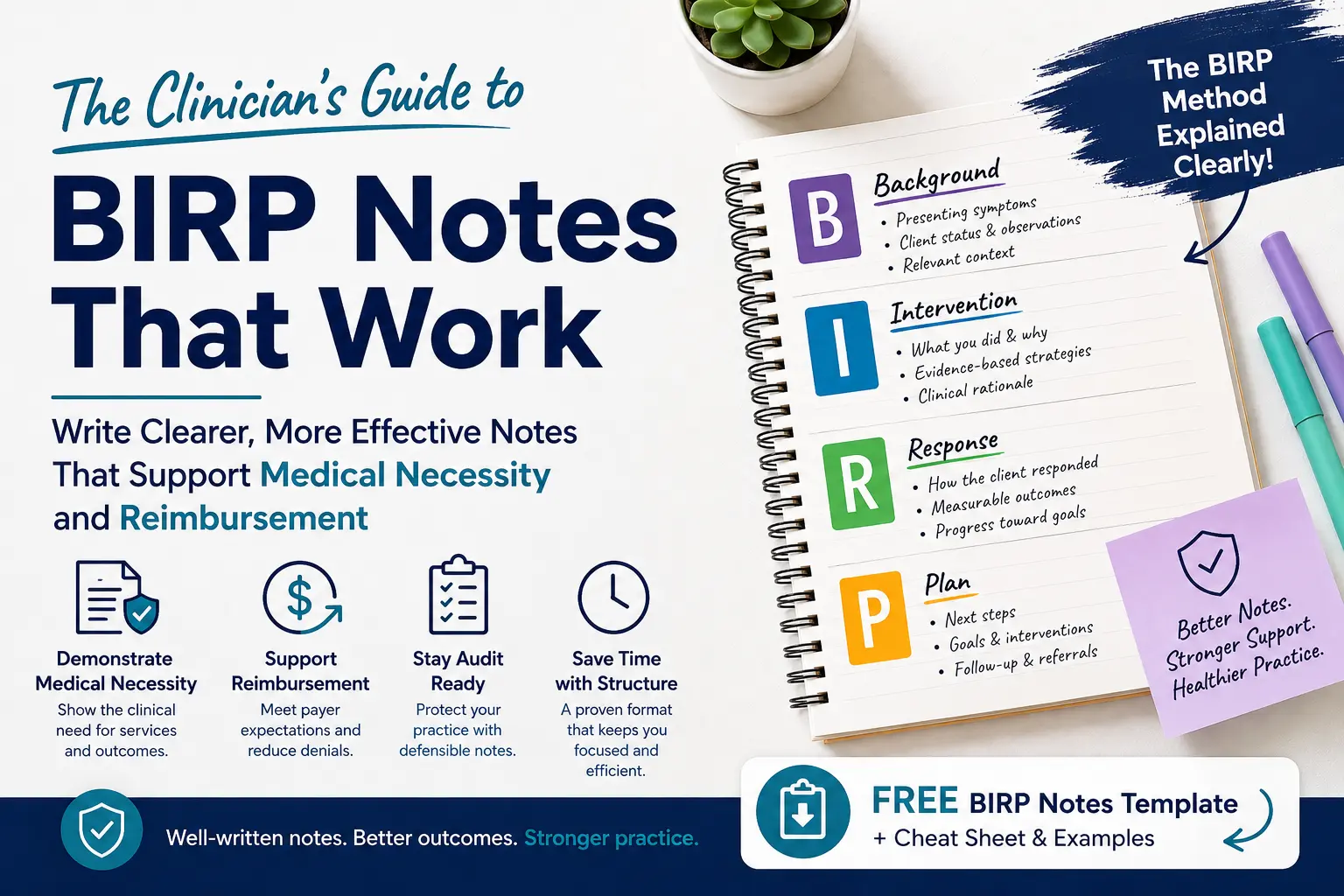
- How to structure BIRP notes that clearly support clinical accuracy, medical necessity, and legal compliance
- The exact language and power verbs that make documentation stronger and more audit-ready
- Common BIRP documentation mistakes that can trigger claim denials or compliance concerns
- A printable BIRP template and annotated example note you can immediately use in practice
- Multiple real-world BIRP note examples for counseling, psychiatry, and group therapy settings
- Practical note-writing tips to help you document more efficiently while improving clarity, compliance, and reimbursement support
Contents
- Why Are BIRP Notes Important?
- BIRP vs SOAP vs DAP Notes: What's the Difference?
- How Are BIRP Notes Used?
- Writing BIRP Notes
- BIRP Notes Quick Reference
- Common BIRP Note Mistakes That Can Trigger Claim Denials
- Sample BIRP Notes
- FAQ: BIRP Notes
- How to Write BIRP Notes Faster
- How ICANotes Helps Clinicians Write BIRP Notes Efficiently
Whether you're a psychiatrist, therapist, counselor, or social worker, mastering BIRP notes can help you save time, enhance communication with other providers, and ensure compliance. As a clinician you understand how much work goes into writing good notes and how challenging it is to consistently write comprehensive notes in addition to seeing clients.
The BIRP note format can make this process much more efficient for busy mental health professionals. Find out what BIRP notes are and how to write them so you can start creating your mental health progress notes more efficiently. Review our sample BIRP notes and download our BIRP Notes Cheat Sheet & Template.
What Does BIRP Stand For?
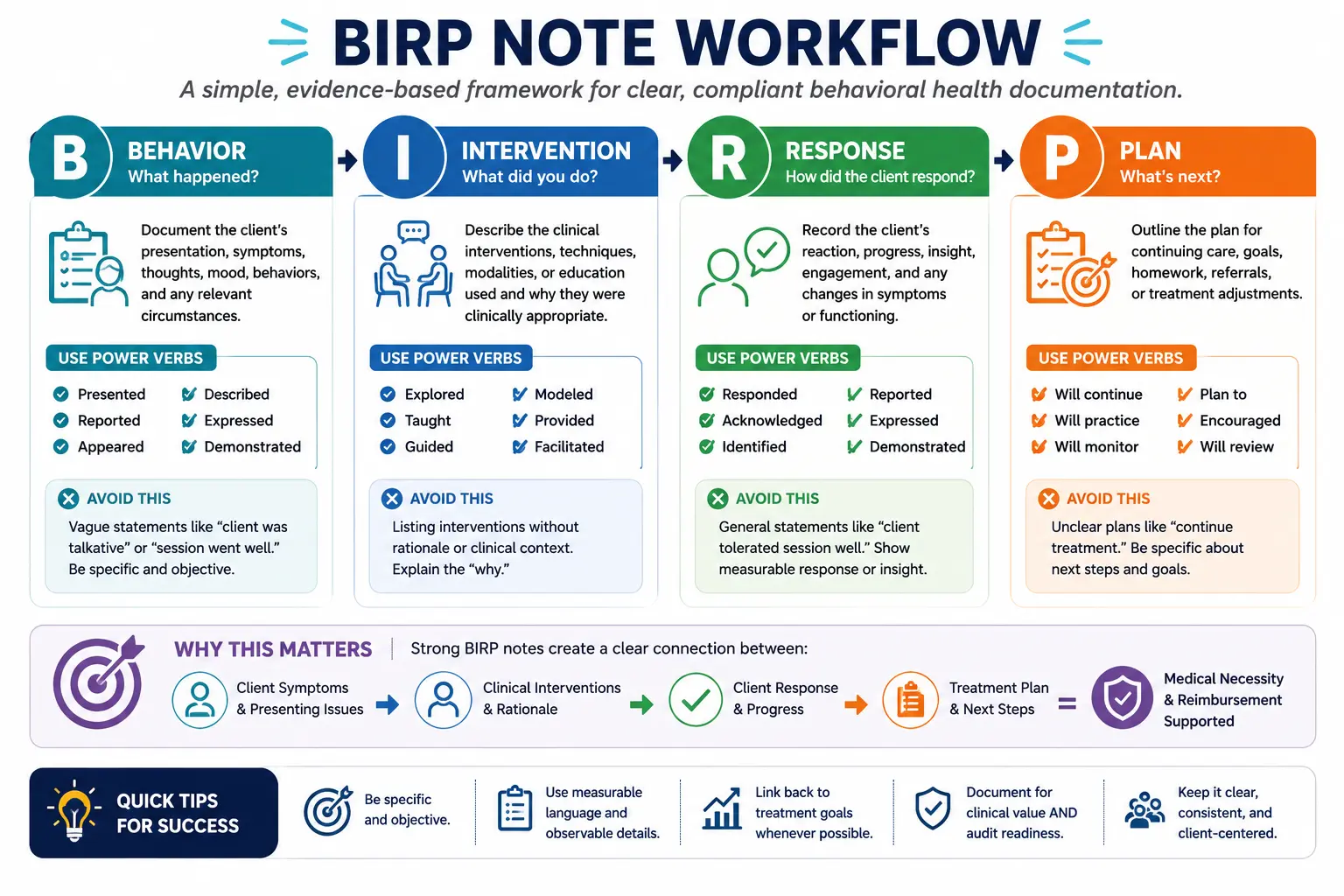
BIRP is a structured clinical documentation format used by behavioral health professionals to create organized, audit-ready progress notes. The acronym stands for Behavior, Intervention, Response, and Plan — the four sections included in every BIRP note.
Each section serves a specific purpose in documenting medical necessity, treatment progress, and continuity of care.
- Behavior — Documents the client’s presenting symptoms, mood, affect, appearance, risk factors, and both subjective and objective observations from the session.
- Intervention — Records the specific therapeutic techniques, clinical interventions, psychoeducation, or treatment strategies used by the clinician during the session.
- Response — Captures how the client reacted to the interventions, including engagement level, progress toward goals, symptom changes, and direct client feedback or quotes.
- Plan — Outlines next steps in treatment, including homework assignments, referrals, follow-up care, treatment plan updates, risk management, and the focus of future sessions.
Because BIRP notes clearly connect symptoms, interventions, client responses, and treatment planning, they are widely used in behavioral health settings to support medical necessity, insurance reimbursement, and audit readiness.
What is a BIRP Note?
BIRP notes are a format mental health professionals use to document their clients' progress and treatment plans. BIRP is an acronym used to help clinicians organize their notes into four specific sections — Behavior, Intervention, Response, and Plan.
This consistent method of writing notes is widely accepted for its standard format. This consistency makes the BIRP notes template an important resource for communicating client information with other healthcare providers.
How the BIRP Note Format Works
A strong BIRP note creates a clear clinical thread from what happened in session to what comes next in treatment.
Behavior
Document symptoms, presentation, mood, affect, observations, and relevant risk factors.
Shows: Why care is needed
Intervention
Record the specific therapeutic techniques, education, skills, or clinical actions provided.
Shows: What the clinician did
Response
Capture how the client responded, including engagement, progress, feedback, or barriers.
Shows: Whether treatment is working
Plan
Outline next steps, homework, referrals, risk management, and treatment plan updates.
Shows: How care continues
Why this matters: When each section connects clearly to the next, the note is easier to read, supports medical necessity, and helps justify ongoing care for reimbursement and audit purposes.
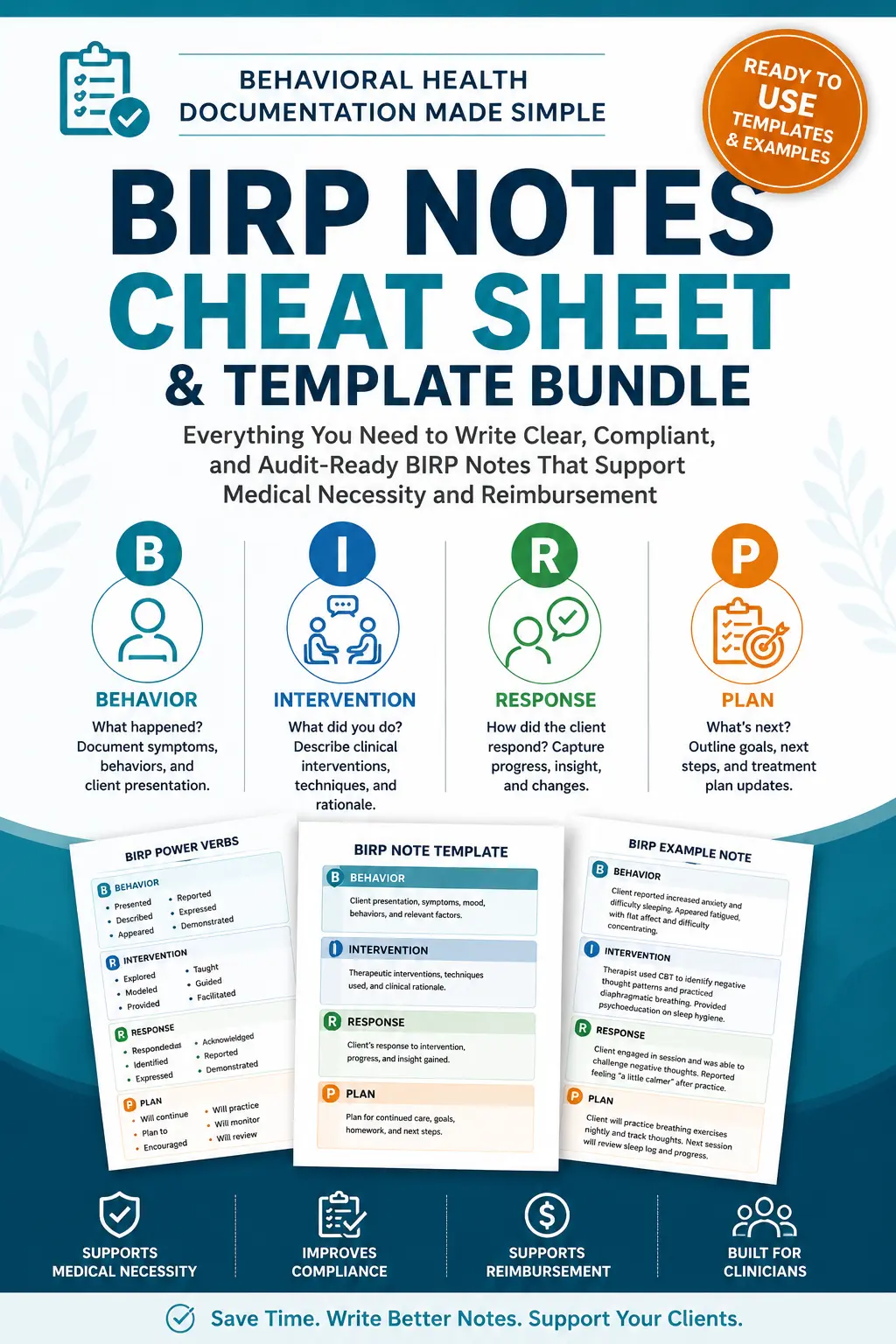
Get the Free BIRP Notes Cheat Sheet & Template Bundle
Download this practical BIRP documentation bundle to help you write clearer, more compliant progress notes that support medical necessity, reimbursement, and audit readiness.
- Quick-reference BIRP cheat sheet
- Printable BIRP note template
- Annotated example note
- Power verbs and documentation tips
Why Are BIRP Notes Important?
BIRP notes are a type of clinical record that helps ensure clients receive continuous care, especially if they change providers or see multiple specialists.
Timely updates to records provide everyone involved with the most accurate information to make their care decisions. This updated information makes reviewing notes more convenient for providers, as well as ensures the safety of the client.
Imagine a psychiatrist prescribes their client medication and forgets to make a note of the prescription in the BIRP note. If the client sees another specialist, the new provider will have no knowledge of the medication.
This miscommunication can lead to providers over-medicating clients or prescribing medications that can potentially react with each other and cause negative side effects for the client.
Proper documentation is also critical in case you get audited or your notes need to be used in a court proceeding. Documentation of appointments with clients is required in most states, and BIRP notes are an effective way to help you comply with requirements.
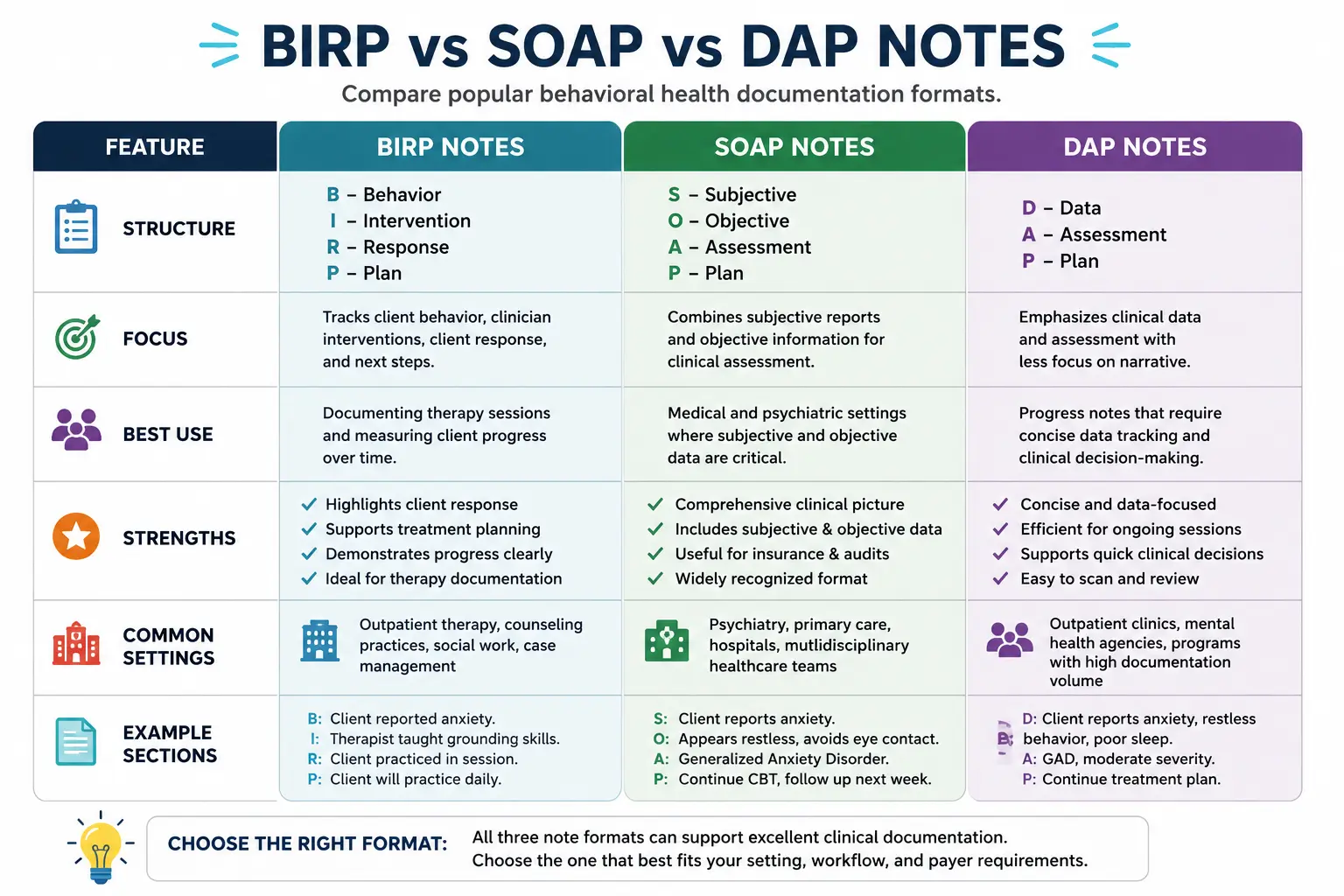
BIRP vs. SOAP vs. DAP Notes: What's the Difference?
BIRP notes are one of several standard progress note formats used in behavioral health. Here's how they compare to the two most common alternatives:
- SOAP Notes (Subjective, Objective, Assessment, Plan) — SOAP is widely used across all healthcare settings. The Subjective and Objective sections are similar to BIRP's Behavior section, but SOAP includes a clinical Assessment — a diagnostic interpretation — that BIRP does not require. SOAP is often preferred in medical and psychiatric settings.
- DAP Notes (Data, Assessment, Plan) — DAP is a streamlined format that combines subjective and objective observations into a single Data section. Like BIRP, DAP omits a formal diagnostic assessment, making it efficient for therapy settings.
- BIRP Notes — BIRP's defining feature is the explicit Intervention and Response sections, which keep the clinician's methods and the client's reaction to treatment clearly separated. This makes BIRP especially useful for demonstrating medical necessity and documenting evidence-based practice for insurance and audit purposes.
The right format depends on your setting, payer requirements, and workflow. ICANotes supports BIRP, SOAP, DAP, and other formats within a single EHR — so your team can document the way they were trained.
How Are BIRP Notes Used?
Most forms of progress notes are used to streamline the note-writing process, and BIRP notes are no different. Standardized forms of documenting clinical records like BIRP, DAP, or SOAP makes note writing fast so providers can spend more time with clients.
BIRP notes also make reading notes simple so providers can communicate a client's progress and plan with other clinicians. While one of the most important uses for BIRP notes is to track a client's progress, they can also be used for insurance reimbursement, billing and planning.
Writing BIRP Notes
BIRP notes consist of four main elements — Behavior, Intervention, Response, and Plan. The standard format for BIRP notes allows mental health professionals to write high-quality notes at an efficient rate.
This way of organizing clinical data helps ensure client care is consistent and all important information is documented properly. To better understand what to include in each category, let's dive into the individual elements of BIRP notes.
Tips for the Behavior Section
The behavior section of a BIRP note is where you record the problem being presented, how the client appears and behaves and your impressions of the client during the appointment. Record both subjective and objective observations in this section:
- Subjective observations are anything the client reports feeling, their thoughts and opinions, as well as symptoms they may experience. Subjective notes are often recorded as direct quotes from the client.
- Objective observations come from the provider's point of view. Note the client's appearance, how they acted and what kinds of signs they presented.
Does the client seem frustrated or unwilling to participate? Did they do their homework or make an effort toward progress? Make a note of actions like hesitation to respond to prompts or enthusiasm toward activities. While it can be tempting to record everything the client says, limit yourself to relevant observations so your notes are concise and focused.
Power Verbs That Make BIRP Notes Stronger
The language you use in BIRP notes matters. Strong clinical verbs help clarify what happened during the session, demonstrate medical necessity, and create more precise documentation for reimbursement and audit purposes.
The examples below can help behavioral health clinicians write clearer, more defensible BIRP notes while avoiding vague or repetitive phrasing.
Strong Verbs for the Behavior Section
Use objective, clinically descriptive language to document symptoms, presentation, mood, affect, and client-reported experiences.
Tips for the Intervention Section
The first section of a BIRP note is dedicated to the client and the intervention section shifts to a strong focus on the counselor's methods for intervention.
This section of your note is where you should outline and record the methods you use to help the client reach their objectives and goals of treatment. The intervention section should be a detailed account of what you did as the mental health professional during the session.
Include documentation of questions you asked and your reasoning for asking them, intervention techniques you used, and your decisions to adjust the treatment plan if necessary. Use verbs to show what you actively did to work with the client. Consider using these verbs in your BIRP notes:
Strong Verbs for the Intervention Section
Intervention language should clearly explain the therapeutic techniques, education, and clinical actions used during the session.
Noting which general category of intervention techniques the methods you applied in an appointment fall under can also be helpful. For example, you may list cognitive behavioral therapy, art therapy, or other relevant methods.
Tips for the Response Section
Next, you'll want to record your client's response to the interventions you chose during the specific session and to the therapy as a whole. Document what they said and the way they reacted.
How do they feel about the techniques used? Here, you can note their responses to your questions and questions they may have asked regarding the intervention.
Try to be as detailed as possible in the response section of your BIRP notes.
Be specific about what bothered or excited the client and what their immediate reactions were. You can use direct quotes here to ensure the description is accurate.
If the client changes their mind about a therapy, document the change in your notes.
Strong Verbs for the Response Section
The Response section should document how the client reacted to interventions and whether progress, resistance, or symptom changes occurred.
Tips for the Plan Section
In the final section of BIRP notes, plan for your next session with the client. Provide the date and time the appointment is scheduled for as well as what you will focus on. The plan section allows you to base your future appointments on the progress you make during each session.
Your plan for the next session and the treatment plan as a whole will depend on:
- What you uncover during sessions
- The level of determination the client demonstrates
- Whether or not their goals have changed
Document what will happen next for both you and the client. Did you assign any homework for your client to complete before the next session? Plan to review it next time. What techniques will you use in the next appointment?
If you make any changes to the overall treatment plan, make a note of the changes and the reasoning for the decision.
Strong Verbs for the Plan Section
The Plan section should outline measurable next steps, treatment goals, follow-up care, and continuity planning.
BIRP Notes Quick Reference
Use this quick guide to document each section clearly and avoid common mistakes.
| Section | What to Document | Power Verbs | What to Avoid |
|---|---|---|---|
| B — Behavior | Client appearance, affect, mood, speech, subjective symptoms, objective observations, and risk indicators. | Reported, presented, appeared, described, demonstrated, endorsed, denied | Vague phrases like “seemed fine,” unsupported opinions, or long narratives without clinical focus. |
| I — Intervention | Specific clinical techniques used, questions asked, psychoeducation provided, and treatment plan adjustments. | Introduced, explored, facilitated, guided, reinforced, taught, prompted | Generic phrases like “provided therapy,” passive wording, or omitting the clinical rationale. |
| R — Response | How the client responded to interventions, direct quotes, affect changes, engagement, and progress toward goals. | Engaged, verbalized, demonstrated, expressed, reported, acknowledged | Copying prior notes, skipping the section, or only documenting positive responses. |
| P — Plan | Next session date or focus, homework, treatment plan updates, referrals, and risk management steps. | Will practice, will continue, will monitor, referred, scheduled, assigned | Writing “continue therapy” without specifics or omitting follow-up for at-risk clients. |
Audit-readiness tip: Every BIRP note should create a clear thread from presenting symptoms to clinical intervention, client response, and next steps tied to the treatment plan.
Common BIRP Note Mistakes That Can Trigger Claim Denials
Even experienced behavioral health clinicians can make documentation mistakes that weaken medical necessity, create compliance concerns, or increase the risk of insurance claim denials. Strong BIRP notes should clearly connect the client’s symptoms, the interventions provided, the client’s response, and the clinical rationale for continued treatment.
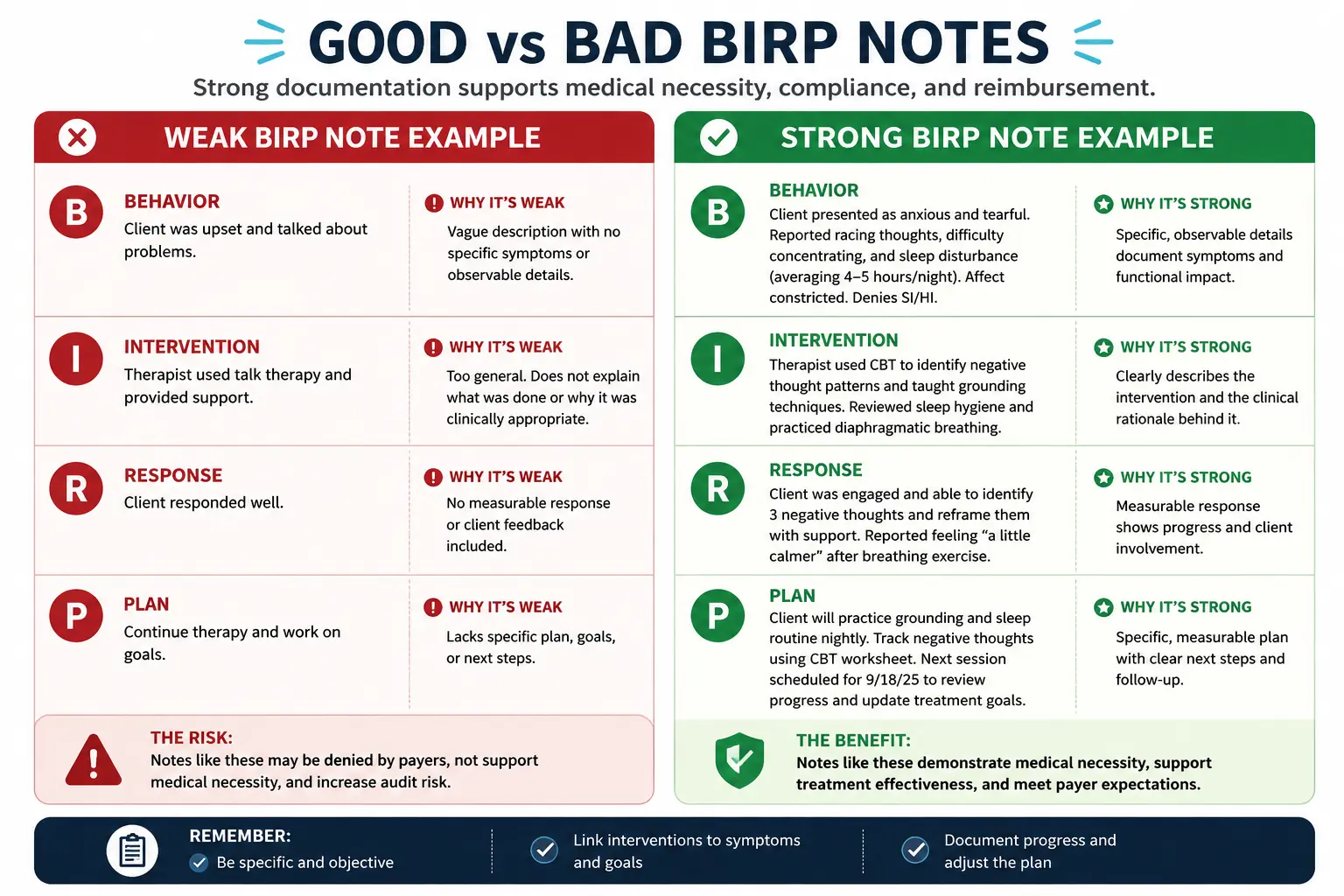
Here are some of the most common BIRP documentation mistakes — and how to avoid them.
Writing Vague or Generic Behavior Descriptions
The Behavior section should include clinically meaningful observations, not broad statements like “client doing okay” or “mood improved.” Auditors and payers look for specific symptoms, functional impairments, and observable behaviors that justify treatment.
Instead of:
“Client seemed better today.”
Write:
“Client reported reduced anxiety symptoms over the past week but continued difficulty sleeping and concentrating at work.”
Specific documentation strengthens medical necessity and demonstrates measurable clinical concerns.
Writing Vague or Generic Behavior Descriptions
One of the most common documentation issues is writing vague interventions such as:
- “Provided therapy”
- “Processed emotions”
- “Discussed stress”
These phrases do not explain what clinical skill or evidence-based intervention was actually used.
Instead, document:
- CBT cognitive restructuring
- Motivational interviewing techniques
- Psychoeducation provided
- DBT distress tolerance skills
- Grounding exercises
- Behavioral activation strategies
Strong Intervention sections demonstrate clinical decision-making and support reimbursement.
Failing to Document the Client’s Response
Many clinicians thoroughly document what they did in session but provide little detail about how the client responded.
The Response section is critical because it demonstrates whether treatment is effective and medically necessary to continue.
Weak example:
“Client responded well.”
Stronger example:
“Client initially struggled to identify cognitive distortions but was able to successfully reframe several negative thoughts with prompting and verbalized increased confidence using the exercise independently.”
Detailed responses help demonstrate progress, barriers, and treatment effectiveness.
Copying and Pasting Previous Notes
Repeated or duplicated documentation is one of the biggest red flags in behavioral health audits. Notes that appear cloned from prior sessions may raise concerns about:
- accuracy
- medical necessity
- session individuality
- billing integrity
Each BIRP note should reflect:
- the client’s current presentation
- interventions used during that specific session
- individualized treatment planning
- measurable progress or setbacks
Even when symptoms are ongoing, the documentation should remain session-specific.
Omitting Measurable Goals or Next Steps
The Plan section should clearly explain what happens next in treatment. Generic statements like:
“Continue therapy.”
do not demonstrate ongoing clinical direction.
Instead, include:
- homework assignments
- coping skills practice
- referrals
- treatment plan updates
- risk management steps
- next session focus
For example:
“Client will practice diaphragmatic breathing nightly and complete thought-record exercises before next session.”
Specific plans strengthen continuity of care and support payer expectations.
Forgetting to Link Symptoms to Interventions
A strong BIRP note creates a logical clinical thread:
Presenting symptoms → Clinical intervention → Client response → Treatment plan
If that connection is unclear, auditors may question whether the session met medical necessity requirements.
Your documentation should explain:
- why treatment was needed,
- what intervention was clinically appropriate,
- how the client responded,
- and why continued care remains necessary.
Why These BIRP Documentation Mistakes Matter
Incomplete or vague BIRP notes can create problems far beyond simple charting issues. Weak documentation may contribute to:
- denied claims,
- failed audits,
- reimbursement delays,
- compliance concerns,
- and difficulty demonstrating treatment progress.
Well-written BIRP notes help behavioral health clinicians create clearer, more defensible documentation while improving continuity of care and supporting reimbursement.
Why Auditors Reject Behavioral Health Notes
Weak documentation can create compliance risks, reimbursement delays, and denied claims.
Insurance payers and auditors look for clear evidence that behavioral health treatment is medically necessary, clinically appropriate, and tied to measurable treatment goals. Even when excellent care is being provided, vague or incomplete documentation can create problems during audits and utilization reviews.
Vague Symptoms
Notes that fail to clearly describe symptoms, impairments, or functional limitations may not justify ongoing treatment.
Missing Clinical Rationale
Auditors expect documentation explaining why specific interventions were selected and how they support treatment goals.
No Measurable Progress
Notes should demonstrate whether symptoms are improving, worsening, or remaining unchanged over time.
Copy-Paste Documentation
Repetitive notes that appear duplicated from previous sessions are a major red flag during behavioral health audits.
Strong BIRP notes reduce these risks by creating a clear connection between:
Sample BIRP Notes
When written correctly, BIRP notes are an effective tool to use in the behavioral health field. Of course, good note writing comes with practice. Referencing relevant BIRP notes samples can also be helpful. Let's take a look at a few sample BIRP notes on depression and other mental health cases.
Counseling BIRP Note Example (Individual Therapy, Depression & Sleep Difficulties)
Imagine you're treating a client diagnosed with depression. Your notes for a regularly scheduled individual therapy appointment might look like the following example. This note provides a clear account of the techniques the provider offered to the client and how they plan to use them between sessions. There is also a clear focus set in place for the next appointment.
B — Behavior
The client reported persistent negative thoughts and ongoing sleep disturbance since the last session, averaging 4–5 hours of sleep per night. Client described feeling “exhausted and hopeless” and endorsed increased difficulty concentrating at work. In session, client appeared fatigued, with slowed speech, downcast affect, and limited eye contact. Mood was described as “depressed.” Client verbalized, “I’m desperate for some relief.” No suicidal ideation was reported, though client acknowledged feeling overwhelmed at times.
I — Intervention
Therapist introduced and practiced progressive muscle relaxation combined with diaphragmatic breathing as a bedtime routine. Explored cognitive distortions contributing to negative self-talk. Therapist guided the client in reframing the thought “I can’t do anything right” into more balanced alternatives such as “It’s okay to make mistakes” and “I am capable and have succeeded in many areas.” Therapist provided psychoeducation on sleep hygiene, including consistent bedtime, limiting screen use before sleep, and creating a calming pre-sleep environment. Encouraged the client to pair relaxation techniques with journaling to track mood and thought patterns before bed.
R — Response
The client engaged actively in relaxation and breathing exercises and was able to visualize peaceful imagery, including a beach setting. Reported feeling “a little calmer” after the exercise. Client initially struggled to identify examples of negative thoughts but, with support, generated several and was able to replace them with more constructive phrases. Client expressed willingness to attempt the relaxation routine at home and verbalized understanding of the sleep hygiene recommendations. Affect remained flat but slightly more hopeful at session’s end.
P — Plan
Client will practice relaxation and breathing exercises nightly before bed and maintain a sleep log documenting hours slept and perceived restfulness. Client will track negative thoughts during the week, noting attempts to reframe them. At the next session, therapist and client will review sleep patterns and cognitive restructuring progress, with a focus on building a personalized list of positive self-statements. Longer-term goals include reducing depressive symptoms, improving sleep quality to 7+ hours per night, and strengthening coping skills for negative thought patterns.
BIRP Notes for Nurses and Psychiatric Nurse Practitioners
BIRP notes are increasingly used by nurses and psychiatric nurse practitioners (PMHNPs) in behavioral health settings.
In nursing contexts, the Behavior section typically mirrors mental status exam elements such as mood, affect, thought process, insight, and judgment.
The Intervention section documents psychoeducation, medication administration, and patient education provided, while the Response section captures the patient’s reaction to nursing interventions and self-reported symptom changes.
The Plan section aligns with care plan updates, physician orders, and discharge planning. The core BIRP structure remains the same — only the clinical lens differs.
Psychiatry BIRP Note Example (Medication Management, Bipolar Disorder with Mood Stabilizer)
Two months ago, you diagnosed a young patient at a psychiatric treatment center with bipolar disorder. At that appointment, you prescribed her medication to help with her mood swings. Today, the patient has returned for a follow-up appointment. This BIRP note might look like the following example. In this case, the patient must give the medication more time to see results. In the meantime, you'd want to help the patient find a support system so she feels less isolated and to help her come to terms with her condition.
B — Behavior
Patient reported, “I’m taking both medicines like you said, but I’m still feeling down most days.” Endorses continued low mood, fatigue, and poor concentration, though denies hopelessness or suicidal ideation. Reports improved sleep since adding mood stabilizer but persistent lack of motivation. Patient appeared tired, affect constricted but reactive at times, and maintained adequate eye contact. No signs of mania or hypomania observed.
I — Intervention
Reviewed adherence to current regimen: sertraline 100 mg daily and lamotrigine 100 mg daily. Patient confirmed consistent compliance and denied adverse effects, including rash, GI upset, and headaches. Psychoeducation provided on expected timeline for lamotrigine titration and full therapeutic benefit. Discussed adjunctive options, including psychotherapy, structured daily routines, and support groups, to augment pharmacological treatment. Explored barriers to group participation; provided reassurance regarding confidentiality and online alternatives. Reinforced importance of regular mood charting to identify fluctuations.
R — Response
Patient expressed mild frustration with ongoing depressive symptoms but acknowledged slight improvement in sleep and irritability since starting lamotrigine. Remains apprehensive about support groups, stating, “I’m not sure I’m ready for that.” However, patient verbalized openness to individual therapy referral. Patient agreed to continue current regimen and to track daily mood, sleep, and energy. Receptive to ongoing psychoeducation and displayed cautious optimism about longer-term improvement.
P — Plan
- Continue sertraline 100 mg daily.
- Continue lamotrigine 100 mg daily; monitor for adverse effects and titrate as clinically indicated.
- Patient to maintain daily mood and sleep log; review at next visit.
- Provide referral for individual psychotherapy.
- Reassess in 4 weeks; if minimal improvement, consider augmentation, such as quetiapine or lurasidone for bipolar depression.
- Patient instructed to contact clinic for emergent mood changes, rash, or suicidal ideation.
Anxiety Treatment BIRP Note Example
Three weeks ago, a client began therapy to address escalating anxiety related to work stress and chronic overthinking. During the initial sessions, the client described persistent worry, sleep disruption, irritability, and difficulty concentrating throughout the workday. Today, the client returns reporting continued anxiety symptoms, particularly before meetings and interactions with a supervisor. This BIRP note example demonstrates how a behavioral health clinician might document CBT interventions, grounding techniques, the client’s response to treatment, and the ongoing plan for reducing anxiety symptoms and improving emotional regulation.
B — Behavior
Client reported increased anxiety symptoms related to workload demands and ongoing conflict with a supervisor. Described persistent worry, muscle tension, irritability, and difficulty falling asleep over the past two weeks. Client stated, “I feel like my brain never shuts off.” Observed fidgeting throughout the session, rapid speech, and difficulty maintaining focus during discussion. Client denied suicidal ideation or panic attacks but endorsed frequent rumination and anticipatory anxiety before work meetings.
I — Intervention
Therapist introduced CBT-based cognitive restructuring techniques to identify catastrophic thinking patterns related to work performance. Explored common cognitive distortions including mind-reading and worst-case scenario thinking. Guided client through grounding exercises focused on diaphragmatic breathing and present-moment awareness. Provided psychoeducation regarding the physiological effects of chronic anxiety and the role of avoidance behaviors in maintaining symptoms. Encouraged the client to develop a structured evening routine to improve sleep hygiene and reduce nighttime rumination.
R — Response
Client engaged actively in identifying anxious thought patterns and demonstrated increased insight into how avoidance behaviors contribute to stress escalation. Initially struggled to challenge automatic negative thoughts but successfully generated alternative interpretations with prompting. Reported feeling “more in control” after practicing grounding exercises during session. Client verbalized willingness to practice breathing exercises before work meetings and acknowledged the connection between poor sleep and anxiety severity.
P — Plan
Client will practice diaphragmatic breathing exercises twice daily and complete a thought-record worksheet when experiencing heightened anxiety. Will implement a consistent bedtime routine and reduce screen exposure one hour before sleep. Next session scheduled for 10/03/2025. Future sessions will focus on cognitive restructuring, stress management strategies, and reducing workplace avoidance behaviors. Treatment goals include decreasing generalized anxiety symptoms, improving sleep quality, and increasing emotional regulation during work-related stressors.
Substance Use Counseling BIRP Note Example
A client in early recovery recently began substance use counseling after experiencing increased alcohol cravings during periods of stress and interpersonal conflict. At previous appointments, the client identified emotional triggers, discussed relapse history, and began developing healthier coping strategies to support sobriety. Today, the client reports heightened cravings following a difficult family interaction but states they have remained sober since the last session. This BIRP note example illustrates how a clinician might document motivational interviewing techniques, relapse prevention planning, the client’s response to interventions, and the ongoing treatment plan to support long-term recovery.
B — Behavior
Client attended session reporting increased cravings for alcohol following a recent argument with a family member. Stated, “I almost stopped at the liquor store on the way home.” Client described elevated stress, poor sleep, and feelings of shame related to past relapse history. Affect appeared anxious and guarded initially but became more engaged as the session progressed. Client denied current substance use since the previous session and denied suicidal ideation. Reported attending one peer support meeting during the past week.
I — Intervention
Counselor utilized motivational interviewing techniques to explore triggers associated with cravings and reinforce the client’s commitment to sobriety goals. Facilitated discussion regarding high-risk situations and relapse warning signs. Guided the client through development of a coping plan for managing emotional distress without substance use. Reinforced use of peer support systems and encouraged increased meeting attendance. Provided psychoeducation on the relationship between emotional dysregulation, stress, and relapse vulnerability.
R — Response
Client participated actively in identifying emotional triggers and acknowledged that interpersonal conflict significantly increases urges to drink. Demonstrated improved insight into the connection between isolation and relapse risk. Reported feeling “less overwhelmed” after reviewing coping strategies and verbalized confidence in contacting a sponsor when cravings intensify. Client was receptive to increasing accountability measures and agreed to attend additional peer support meetings during the upcoming week.
P — Plan
Client will attend at least three peer support meetings before the next appointment and contact sponsor during periods of elevated cravings. Will complete a written relapse prevention worksheet and continue practicing grounding and emotional regulation skills discussed in session. Next session scheduled for 10/05/2025. Ongoing treatment will focus on relapse prevention, emotional coping strategies, interpersonal stress management, and strengthening recovery supports. Treatment goals include maintaining sobriety, improving emotional regulation, and reducing relapse risk factors.
Group Therapy BIRP Note Example (Substance Use Recovery)
Although a bit more time-consuming than in an individual therapy session, BIRP notes can also be used in group therapy settings. Group therapy sessions include multiple clients with different conditions, and they all need their own notes for each session. BIRP notes can make the note writing process simpler to quickly jot down notes for each client. Just be sure to collect:
- Subjective and objective observations, signs and symptoms
- Methods you used and how you prompted the clients
- Their responses and behaviors toward your methods and questions
- Time and place of the next session as well as topics for discussion
Despite being a lot to juggle in group therapy sessions, BIRP notes are still essential for tracking client progress in group therapy settings.
Here is a sample BIRP group therapy note for substance use recovery that documents both the overall group process and one participant’s individual engagement and progress toward treatment goals:
Sample BIRP Note for Group Therapy
B — Behavior
The group discussed recent challenges with relapse triggers, including stress at work and social pressure. John reported feeling “restless and irritable” when around coworkers who drink after shifts. He appeared engaged, maintaining eye contact and contributing multiple times, though occasionally displayed anxious body language, including tapping his foot and shifting posture.
I — Intervention
Facilitator guided discussion on identifying high-risk situations and taught “urge surfing” as a craving management technique. Group members role-played declining invitations to use substances. John was encouraged to practice refusal skills relevant to his workplace environment. Facilitator provided positive reinforcement for his openness and linked coping strategies to John’s treatment plan goal of sustaining sobriety in social settings.
R — Response
John actively participated in role-play, successfully modeling assertive refusal statements, including, “No thanks, I’m working on my recovery.” He acknowledged lingering anxiety about being judged by peers but stated, “It felt good to practice saying it out loud.” John expressed motivation to try urge surfing this week when cravings arise. Group peers offered support and normalized his concerns.
P — Plan
John will document cravings and practice urge surfing daily, noting situations that trigger the urge to drink. He will also implement refusal strategies during social interactions at work. Progress toward the treatment goal of managing cravings in high-risk environments will be reviewed in next week’s group session on September 17, 2025. Facilitator will continue monitoring anxiety management and reinforce use of coping skills.
Continue Learning About Behavioral Health Documentation
Explore additional ICANotes resources on medical necessity, behavioral health compliance, progress notes, chart audits, and documentation best practices.
Documenting Medical Necessity in Mental Health
Learn how stronger documentation supports reimbursement, compliance, and audit readiness.
Behavioral Health Documentation Best Practices
Improve note quality, reduce compliance risks, and strengthen clinical documentation workflows.
Why Regular Chart Audits Matter in Behavioral Health
Discover how chart audits help identify documentation gaps before they become reimbursement issues.
How to Write Better Progress Notes
Practical strategies for writing clearer, more clinically effective behavioral health notes.
Types of Therapy Notes Explained
Compare SOAP, DAP, BIRP, and other documentation formats used in behavioral health care.
Understanding Golden Thread Documentation
Learn how treatment plans, assessments, and progress notes work together to support compliance.

BIRP Notes FAQs
What is the purpose of a BIRP note?
The purpose of a BIRP note is to document a behavioral health session in a clear, organized format. BIRP notes help clinicians record the client’s behavior, the intervention provided, the client’s response, and the treatment plan so the note supports continuity of care, medical necessity, and reimbursement.
Are BIRP notes required for insurance reimbursement?
BIRP notes are not universally required by insurance payers, but progress notes must generally support medical necessity, treatment goals, interventions, and client progress. BIRP is one format clinicians can use to organize that information clearly for insurance reimbursement, audits, and utilization reviews.
How long should a BIRP note be?
A BIRP note should be long enough to document the session accurately, but concise enough to remain clinically focused. Most BIRP notes are a few brief paragraphs or structured sections. The goal is not length — it is clarity, specificity, and a clear connection between symptoms, interventions, response, and plan.
What’s the difference between BIRP and SOAP notes?
BIRP notes focus on Behavior, Intervention, Response, and Plan. SOAP notes focus on Subjective, Objective, Assessment, and Plan. The biggest difference is that BIRP separates the clinician’s intervention from the client’s response, while SOAP includes a formal assessment section often used across broader medical settings.
Can nurses use BIRP notes?
Yes. Nurses and psychiatric nurse practitioners can use BIRP notes in behavioral health settings. In nursing contexts, the Behavior section may include mental status observations, the Intervention section may document medication education or care coordination, and the Plan section may address follow-up care, monitoring, or provider orders.
Are BIRP notes HIPAA compliant?
BIRP notes can be HIPAA compliant when they are created, stored, accessed, and shared according to HIPAA requirements. The BIRP format itself does not determine compliance. Clinicians should use secure documentation systems, limit unnecessary details, follow privacy policies, and protect all client health information.
What should not be included in a BIRP note?
BIRP notes should not include vague statements, unsupported opinions, irrelevant personal details, copied text from previous sessions, or excessive narrative that does not support treatment. Avoid phrases like “client seemed fine” or “provided therapy” without documenting specific symptoms, interventions, client responses, and next steps.
What makes a BIRP note audit-ready?
An audit-ready BIRP note clearly links the client’s symptoms, the intervention provided, the client’s response, and the treatment plan. It should be timely, objective, individualized, and specific enough to show why treatment was medically necessary and how the session supported the client’s goals.
Can BIRP notes be integrated into an EHR system?
Yes. Behavioral health EHR systems like ICANotes can support BIRP notes with structured templates, drop-down menus, pre-written clinical phrases, treatment plan integration, and group documentation tools. These features help clinicians save time while keeping notes individualized, compliant, and reimbursement-supporting.
How do you document group therapy sessions using BIRP notes?
For group therapy, clinicians should document the group topic, interventions used, and overall session focus while also recording individualized details for each participant. Each client’s note should describe participation, response to interventions, progress toward treatment goals, and any risk factors or follow-up needs.
How does ICANotes streamline BIRP note documentation?
ICANotes helps behavioral health clinicians write BIRP notes faster with built-in templates, menu-driven clinical content, customizable phrase libraries, group note tools, treatment plan integration, and electronic signatures. These tools help clinicians complete thorough notes efficiently while supporting compliance, medical necessity, and reimbursement documentation.
How to Write BIRP Notes Faster

Aim for 2 to 3 Sentences

Set a Timer

Use ICANotes
Even though writing detailed notes is an essential part of the behavioral health profession, it's often one of the most time-consuming processes. This can take valuable time away from treating clients or patients. So, how can you streamline the BIRP note writing process? Consider these tips for writing faster BIRP notes:
- Aim for two to three sentences per section: The BIRP template is already ideal for concision, and limiting yourself to a few sentences in each section can help speed up the process. Unless something significant happens during your client's session, a few sentences will be sufficient.
- Set a timer: Try giving yourself a time limit. Set a timer to your goal note-writing time and see if you can complete a single session note within the time frame. If you find yourself needing more time, determine what you spend a significant amount of time on and try to reduce the time spent there. For example, if you consistently find you're spending the most time writing the behavior section, you might try writing quick notes during the session to jog your memory later.
- Use ICANotes EHR software: Electronic health records (EHR) like ICANotes can significantly reduce the time you spend writing your mental health notes. ICANotes software features time-saving buttons and templates like BIRP to make note writing more efficient.
How ICANotes Helps Clinicians Write BIRP Notes Efficiently
Writing BIRP notes is a critical part of delivering effective, accountable behavioral health care — but it can also be one of the most time-consuming tasks in your day. That’s where ICANotes can help. As an EHR built specifically for behavioral health professionals, ICANotes offers a structured, intuitive BIRP note template that guides you through each section: Behavior, Intervention, Response, and Plan.
Instead of writing everything from scratch, clinicians can use pre-written, clinically accurate content designed to fit a variety of client issues and treatment styles.
With ICANotes, you can generate a complete, professional BIRP note in just a few minutes. Drop-down menus, editable templates, and time-saving shortcuts reduce typing, minimize errors, and ensure that your notes are both thorough and compliant. Because all documentation is automatically linked to the client’s treatment plan, you’ll also have a seamless way to demonstrate progress and medical necessity for insurance or audits.
Whether you're documenting individual sessions, group therapy, or psychiatric follow-ups, ICANotes helps you spend less time writing and more time focusing on what matters most — your clients. Book a demo to find out more, or sign up for a free 30 day trial below (no credit card required!).
Recent Posts



Dr. October Boyles
DNP, MSN, BSN, RN
About the Author
Dr. October Boyles is a behavioral health expert and clinical leader with extensive expertise in nursing, compliance, and healthcare operations. With a Doctor of Nursing Practice (DNP) and advanced degrees in nursing, she specializes in evidence-based practices, EHR optimization, and improving outcomes in behavioral health settings. Dr. Boyles is passionate about empowering clinicians with the tools and strategies needed to deliver high-quality, patient-centered care.