Blog > Treatment Strategies > Strength-Based Therapy & Assessment Techniques
Strength-Based Therapy & Assessment: A Clinician’s Guide to Techniques and Examples
Strength-based therapy is a clinical approach that focuses on identifying and leveraging a client’s existing strengths to support growth, resilience, and long-term outcomes. Through structured strength-based assessment techniques, clinicians can uncover key assets such as coping skills, support systems, and past successes. This guide explores practical strength-based therapy techniques, example assessment questions, and real-world applications to help clinicians integrate a strengths-focused approach into everyday practice.


Last Updated: May 1, 2026
What You'll Learn
- What strength-based therapy is and how it differs from deficit-focused approaches
- How to conduct a strength-based assessment in clinical practice
- Practical strength-based therapy techniques you can use in sessions
- Example strength-based assessment questions to help clients identify their strengths
- Common examples of client strengths in therapy, including resilience, coping skills, and support systems
- How to apply strength-based approaches to improve treatment planning and client outcomes
Contents
- What is a Strength-Based Assessment?
- Core Principles of Strength-Based Therapy
- Benefits and Limitations of Strength-Based Therapy
- Strength-Based Therapy Techniques and Assessment Methods
- Examples of Client Strengths in Therapy
- FAQ: Strength-Based Therapy
- Document Strength-Based Therapy More Efficiently
What Is Strength-Based Therapy?
Strength-Based Therapy
Strength-based therapy is a clinical approach that focuses on identifying and building on a client’s existing strengths — such as coping skills, resilience, and support systems — rather than focusing only on problems or symptoms.
Strength-based therapy is a clinical approach that focuses on identifying and building on a client’s existing strengths rather than concentrating solely on symptoms or deficits. Instead of asking “What’s wrong?”, clinicians using this approach ask, “What’s working?” and “What strengths can we build on?”
This approach is grounded in positive psychology and emphasizes resilience, resourcefulness, and the client’s capacity for growth. By helping clients recognize their strengths — such as coping skills, supportive relationships, past successes, and personal values — clinicians can foster greater self-efficacy and more sustainable progress.
Strength-based therapy is often used alongside other evidence-based approaches and plays a key role in treatment planning, goal setting, and ongoing assessment.
What Is a Strength-Based Assessment?
Strength-Based Assessment
A strength-based assessment is a structured clinical process used to identify a client’s strengths, resources, and capabilities to inform treatment planning and support positive outcomes.
A strength-based assessment is a structured process used by clinicians to identify a client’s existing strengths, resources, and capabilities. Rather than focusing only on problems or diagnoses, this type of assessment highlights what the client already does well and how those strengths can support treatment.
A strength-based assessment typically explores areas such as coping skills, social supports, cultural and spiritual resources, personal values, and past experiences of resilience or success. Clinicians use open-ended questions, collaborative discussion, and sometimes standardized tools to build a comprehensive picture of the client’s strengths.
This assessment forms the foundation of strength-based therapy by guiding treatment planning, improving client engagement, and supporting more personalized care.
Strength-Based Assessment Process
A strength-based assessment helps clinicians move from identifying client strengths to applying them in treatment planning and progress monitoring.
Identify Strengths
Explore coping skills, values, support systems, resilience, and past successes.
Assess Domains
Evaluate key strength areas such as self-efficacy, social support, insight, and goal orientation.
Apply in Treatment
Use identified strengths to shape goals, interventions, and treatment planning.
Track Progress
Revisit strengths over time to document growth, adjust goals, and reinforce progress.
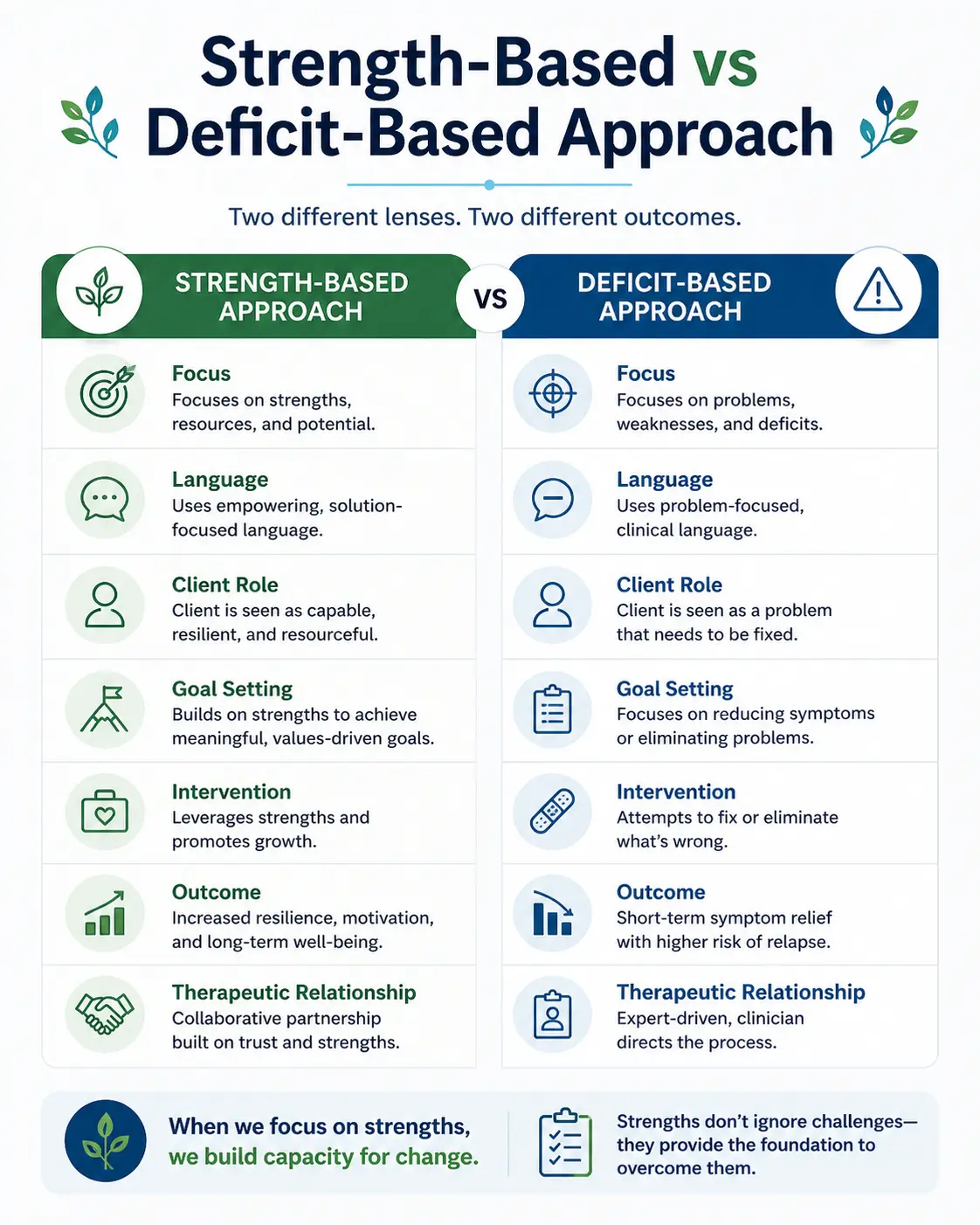
Strength-Based vs. Deficit-Focused Approaches
In traditional deficit-focused models, assessment centers on symptoms, diagnoses, and problems that need to be fixed. In contrast, strength-based therapy and assessment focus on identifying and leveraging what is already working for the client.
Both approaches can be valuable, but strength-based methods help balance the clinical picture by highlighting resilience, capability, and potential — factors that are essential for long-term progress.
Download the Strength-Based Assessment Toolkit
Get three ready-to-use tools for conducting strength-based assessments, identifying client strengths, and documenting progress in therapy.
- Client Strengths Inventory
- Strength-Based Assessment Question Bank
- Strength-Based Progress Note Template
Core Principles of Strength-Based Therapy
Strength-based therapy is guided by a set of core principles that shape how clinicians assess, engage, and support clients. These principles emphasize resilience, collaboration, and a client-centered approach that recognizes each individual’s capacity for growth.
There are six core principles of the strength-based approach:
1. Focus on Strengths, Not Deficits
Strength-based therapy emphasizes what clients already do well, including their skills, values, coping strategies, and sources of resilience. Rather than focusing exclusively on symptoms or problems, clinicians intentionally identify and reinforce strengths that can support progress. This shift helps create a more balanced clinical perspective and encourages clients to see themselves as capable and resourceful.
2. Collaboration Between Clinician and Client
Strength-based therapy is inherently collaborative. Rather than taking a directive role, clinicians work alongside clients to identify strengths, set goals, and explore solutions. This partnership reflects a client-centered approach, where the client’s perspective, preferences, and lived experience guide the therapeutic process.
3. Emphasis on Resilience and Resourcefulness
This approach recognizes the client’s ability to recover from challenges and adapt over time. By highlighting past successes and effective coping strategies, clinicians help clients build confidence in their capacity to navigate current and future difficulties. This focus on resilience supports long-term growth and reinforces the idea that change is both possible and sustainable.
4. Client-Centered and Individualized Care
Strength-based therapy is closely aligned with client-centered therapy principles, emphasizing empathy, respect, and unconditional positive regard. Treatment is tailored to each client’s unique strengths, cultural background, relationships, and personal goals, ensuring that care is both meaningful and relevant.
5. Empowerment and Self-Efficacy
By creating a supportive, client-centered environment, clinicians help clients recognize their own capabilities and take an active role in change. This emphasis on empowerment strengthens self-efficacy and encourages long-term growth beyond the therapy setting.
6. Hope and Future Orientation
Strength-based therapy encourages a forward-looking perspective by helping clients envision a future shaped by their strengths rather than their limitations. By identifying possibilities and setting achievable goals, clinicians foster hope and motivation. This future orientation helps clients move beyond immediate challenges and stay engaged in the therapeutic process.
These core principles form the foundation of both strength-based therapy and strength-based assessment, guiding clinicians in identifying and applying client strengths throughout treatment.
Benefits and Limitations of Strength-Based Therapy
Strength-based therapy offers several advantages in clinical practice, but like any approach, it also has limitations. Understanding both can help clinicians apply it more effectively and integrate it with other treatment models when needed.
Benefits of Strength-Based Therapy
- Improves client engagement and motivation:
By focusing on what clients are already doing well, strength-based therapy helps shift the tone of sessions from problem-focused to possibility-focused. This can increase engagement, especially for clients who feel discouraged or stuck. - Builds resilience and self-efficacy:
Identifying past successes and existing coping skills reinforces a client’s belief in their ability to manage challenges. Over time, this strengthens resilience and supports more sustainable progress between sessions. - Supports collaborative, client-centered care:
Strength-based assessment techniques emphasize partnership. Clients are actively involved in identifying their strengths and setting goals, which can improve therapeutic alliance and treatment adherence. - Enhances treatment planning:
Understanding a client’s strengths—such as social supports, values, and problem-solving abilities—allows clinicians to develop more personalized and effective treatment plans. - Encourages a more balanced clinical perspective:
While diagnosis and symptom tracking remain important, incorporating a strengths-focused lens ensures that clients are not defined solely by their challenges.
Limitations of Strength-Based Therapy
- May overlook acute symptoms if used in isolation:
A purely strengths-focused approach can risk minimizing serious symptoms or clinical risks. It is most effective when combined with thorough diagnostic assessment and evidence-based interventions. - Can be difficult for some clients to engage with initially:
Clients experiencing severe depression, trauma, or low self-esteem may struggle to identify their strengths early in treatment. Clinicians may need to scaffold this process with guided questions and examples. - Requires clinical skill and intentional application:
Effectively conducting a strength-based assessment and integrating strengths into treatment planning requires training, practice, and thoughtful questioning. - May need integration with other therapeutic approaches:
Strength-based therapy is often most effective when used alongside modalities such as CBT, trauma-informed care, or psychodynamic approaches to ensure a comprehensive treatment strategy. - Risk of appearing overly optimistic if not balanced:
If not applied carefully, focusing too heavily on strengths can feel invalidating to clients who need space to process pain, loss, or distress.
In practice, most clinicians integrate strength-based therapy with other approaches to create a balanced, flexible, and client-centered treatment plan.
Strength-Based Therapy Techniques and Assessment Methods
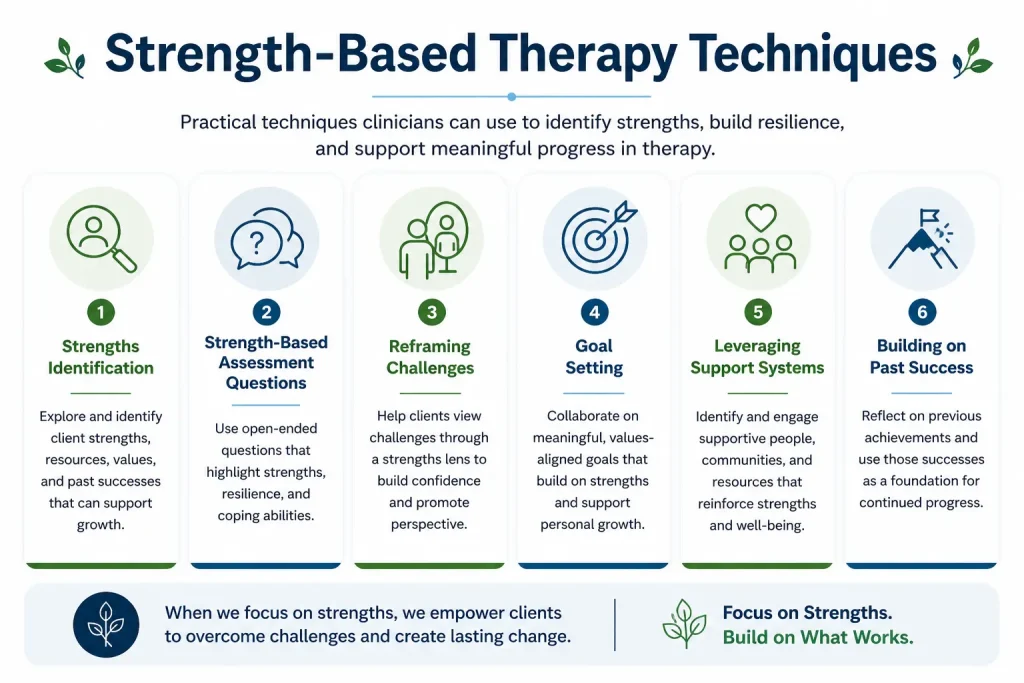
Strength-based therapy techniques are designed to help clients identify, apply, and build on their existing strengths. These methods are often integrated into the assessment process and ongoing sessions to support resilience, improve engagement, and guide treatment planning.
Conducting a comprehensive strength-based assessment involves more than asking a few reflective questions — it requires a set of intentional techniques that help clients move from surface-level self-description to genuine recognition of their own capabilities.
Many of these techniques overlap with approaches used in solution-focused therapy, particularly the emphasis on identifying what is already working and building toward achievable, future-oriented goals.
These strength-based therapy techniques can be used across intake, treatment planning, and ongoing sessions to consistently identify and reinforce client strengths.
Strengths Identification and Exploration
Before clients can build on their strengths, they need help seeing them clearly. Many people entering treatment are so focused on what isn't working that their existing capabilities are genuinely invisible to them. Strengths identification begins by guiding clients through an exploration of their history — past successes, moments of resilience, coping strategies that have worked before, and the values that have shaped their decisions.
This process typically starts during the strength-based assessment and continues throughout treatment as new strengths emerge. A client who initially describes herself as someone who "can't handle stress" may, through careful exploration, recognize that she has been managing a demanding caregiving role for years — evidence of considerable endurance, organization, and compassion. The clinician's role is to slow that recognition down and make it explicit. Once identified, thse strengths can then be incorporated into progress notes and treatment plans.
Strength-Based Assessment Questions
Open-ended questions are the primary tool for surfacing client strengths, and the quality of those questions directly shapes what clients are able to articulate. Rather than asking closed or deficit-oriented questions, strength-based assessment questions invite clients to look inward and make connections between their experiences and their capabilities.
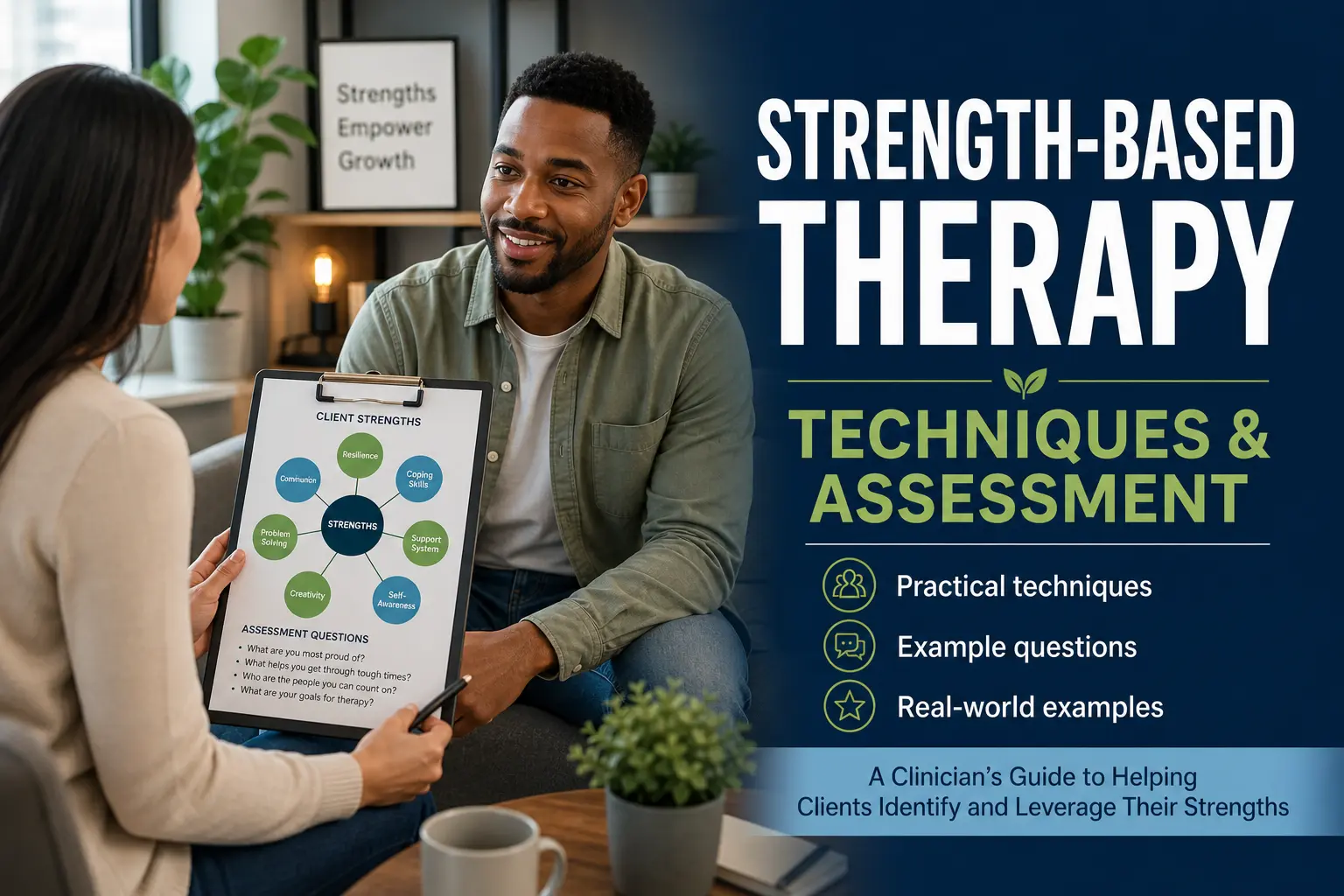
Strength-based assessment questions help clients identify the skills, relationships, values, and coping strategies they already use to navigate challenges. These open-ended prompts can be used during intake, treatment planning, or ongoing therapy sessions to help clients recognize strengths they may overlook.
Effective examples include:
General Strengths
- What are you most proud of overcoming?
- What personal qualities have helped you get through difficult situations?
- What do people who know you well appreciate about you?
- When have you felt most capable or confident?
Coping Skills and Resilience
- What has helped you manage stress or setbacks in the past?
- Can you describe a time when you handled a difficult situation better than expected?
- What do you usually do when things feel overwhelming?
- What strengths helped you survive previous challenges?
Support Systems
- Who do you turn to when you need support?
- What relationships help you feel grounded, encouraged, or understood?
- Are there community, cultural, spiritual, or family resources that support you?
- How have others helped you recognize your strengths?
Goals and Growth
- What would progress look like for you?
- What strengths can help you move toward that goal?
- What is one small step you feel capable of taking this week?
- How will you know you are using your strengths more effectively?
Values and Meaning
- What matters most to you right now?
- What values have guided you through difficult decisions?
- When do you feel most connected to your purpose?
- What gives you hope for the future?
These questions work best when you allow space for reflection rather than rushing toward an answer. Some clients will need time — or several sessions — before they can respond with genuine depth. Building in that patience is itself part of strength-based practice. Clinicians can use these question to move from identifying strengths to applying them in treatment planning, goal setting, and ongoing progress monitoring.
Reframing Challenges as Strengths
One of the most powerful techniques in strength-based therapy is reframing: helping clients reinterpret experiences or traits they view as weaknesses through a more accurate, strength-informed lens. The goal isn't to minimize real difficulties or offer false positivity — it's to help clients see that many of the characteristics they've been taught to regard as problems often contain real adaptive value.
A client who describes himself as "a control freak" may be showing you someone with a strong need for safety and a high capacity for structure. A client who says she "worries too much" may be demonstrating sophisticated anticipatory thinking that, redirected, supports careful planning and goal achievement. Reframing isn't about relabeling — it's about expanding the client's understanding of themselves so they can use what they already have more intentionally.
This technique requires a strong therapeutic alliance. Reframes land when clients trust that you're reflecting something genuine, not managing them. Introduce them tentatively, check in, and let the client refine or reject the framing as needed.
Goal Setting Based on Strengths
In conventional treatment approaches, goals are often organized around symptom reduction. In strength-based therapy, goals are organized around what clients want to move toward — and specifically around the capacities they already possess that can carry them there.
Collaborating with clients to set goals rooted in their identified strengths increases intrinsic motivation and makes treatment plans feel achievable rather than prescriptive. A client who has identified creativity as a strength might set a goal around developing a new expressive outlet for emotional processing. A client whose strength lies in strong family relationships might set a goal around improving communication with a specific family member. When goals feel like a natural extension of who someone already is, follow-through tends to improve.
From a documentation standpoint, linking treatment goals explicitly to identified client strengths creates a coherent clinical record that reflects the strength-based model — something worth capturing systematically in your progress notes.
Leveraging Support Systems
A client's support network is often one of their most underrecognized strengths. Friends, family members, faith communities, peer support groups, and community organizations can all represent significant resources that reinforce progress made in session and provide continuity between appointments.
Part of strength-based assessment involves mapping these relationships — not just noting that they exist, but understanding their quality, accessibility, and how the client actually experiences them. Some clients have robust networks they haven't thought to draw on. Others have networks that look supportive on the surface but function inconsistently. Still others have experienced significant relational loss and need help identifying where new connections might be built.
Helping clients see their relationships as active resources — rather than passive background — expands the scope of treatment beyond the therapy room. This might involve encouraging clients to reach out to a trusted person between sessions, connecting them to a community resource, or simply naming an existing relationship as a genuine strength.
Building on Past Successes
Clients rarely arrive in treatment having never navigated anything difficult. Even in the most challenging presentations, there is almost always a history of problems faced and survived — often without the benefit of professional support. Exploring those experiences is not about minimizing current struggles; it's about locating evidence of capability that the client may have forgotten or discounted.
When you ask a client to describe a time they successfully worked through a hard situation, you're doing several things at once: building a case file of their resilience, identifying what specific strategies actually worked for them, and providing a reference point they can return to when current challenges feel insurmountable. "You've done something like this before" is a more powerful therapeutic statement than almost anything else — when it's true, and when it's supported by the client's own recollection.
These explorations also inform goal-setting and treatment planning. If a client once managed a major life transition through structure and routine, that's a blueprint worth building on. If they leaned on humor or spirituality during a loss, those resources are worth naming explicitly and keeping accessible.
These strength-based therapy techniques are most effective when combined with thoughtful, open-ended questioning. The following section outlines specific strength-based assessment questions you can use in sessions.
Examples of Client Strengths in Therapy
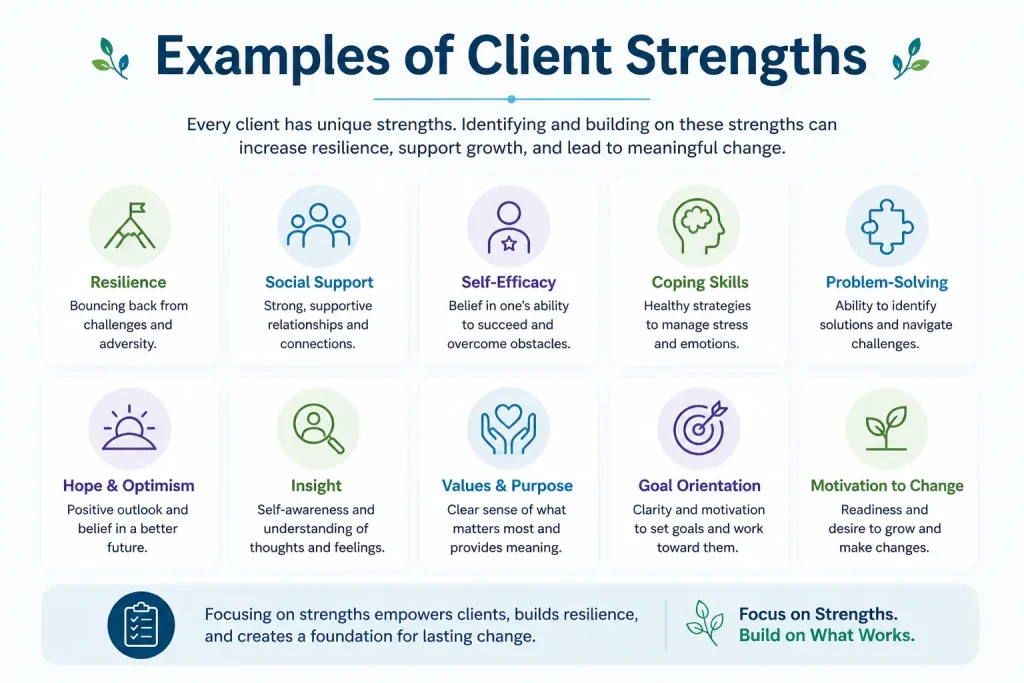
Every client brings a unique set of strengths to treatment, even if they have difficulty recognizing those strengths at first. In strength-based therapy, clinicians help clients identify personal qualities, coping strategies, relationships, values, and past successes that can support healing and growth.
Examples of client strengths in therapy may include:
- Resilience: The ability to recover from setbacks or continue moving forward despite adversity.
- Self-awareness: The capacity to recognize emotions, patterns, triggers, and personal needs.
- Coping skills: Healthy strategies the client already uses to manage stress, distress, or difficult situations.
- Social support: Relationships with family, friends, peers, faith communities, or other support networks.
- Problem-solving ability: The ability to think through challenges, consider options, and take practical steps toward change.
- Perseverance: Continued effort toward goals, even when progress feels slow or motivation is low.
- Empathy: The ability to understand and care about the feelings and experiences of others.
- Creativity: The ability to express emotions, adapt to challenges, or find new ways to approach problems.
- Cultural, spiritual, or personal values: Sources of meaning, identity, connection, and guidance during difficult times.
- Past success: Previous examples of overcoming challenges, making positive changes, or using strengths effectively.
Identifying these client strengths gives clinicians a stronger foundation for treatment planning, goal setting, and progress monitoring throughout strength-based therapy.
Frequently Asked Questions About Strength-Based Therapy
What is a strength-based assessment?
A strength-based assessment is a clinical process that identifies a client’s existing strengths, resources, coping skills, support systems, and capabilities. Instead of focusing only on symptoms or deficits, this type of assessment helps clinicians understand what the client already does well and how those strengths can support treatment planning.
What is strength-based therapy?
Strength-based therapy is a clinical approach that focuses on helping clients identify, use, and build on their existing strengths. It emphasizes resilience, self-efficacy, support systems, and past successes to help clients make meaningful progress.
What are examples of client strengths in therapy?
Examples of client strengths in therapy include resilience, self-awareness, coping skills, perseverance, empathy, creativity, problem-solving ability, social support, cultural or spiritual resources, and past experiences of overcoming challenges.
What questions are used in a strength-based assessment?
Strength-based assessment questions often ask clients to reflect on past successes, coping strategies, support systems, values, and goals. Examples include: “What has helped you get through difficult situations before?” and “What strengths can help you move toward your goals?”
How does strength-based therapy support treatment planning?
Strength-based therapy supports treatment planning by helping clinicians connect client goals to existing strengths, resources, and coping strategies. This can make treatment plans more personalized, collaborative, and realistic for the client.
Document Strength-Based Therapy More Efficiently with ICANotes
Strength-based therapy relies on consistently identifying, documenting, and building on client strengths over time. But without the right tools, capturing these insights in a structured, efficient way can be challenging — especially across intake, progress notes, and treatment planning.
ICANotes is designed specifically for behavioral health clinicians, making it easier to document strength-based assessments, track client progress, and develop treatment plans that reflect each client’s unique strengths and goals. With customizable templates, guided workflows, and clinically relevant prompts, clinicians can quickly capture key information without sacrificing quality or detail.
Instead of starting from scratch each session, ICANotes helps streamline documentation so you can focus on what matters most — engaging with your clients and supporting their growth.
Document Strength-Based Therapy Faster with ICANotes
Strength-based therapy depends on consistently identifying, documenting, and building on client strengths over time.
ICANotes helps behavioral health clinicians streamline strength-based assessments, progress notes, and treatment plans—so you can spend less time on paperwork and more time with your clients.
Book a demo to see how ICANotes supports your clinical workflow.
Recent Posts






Dr. October Boyles
DNP, MSN, BSN, RN
About the Author
Dr. October Boyles is a behavioral health expert and clinical leader with extensive expertise in nursing, compliance, and healthcare operations. With a Doctor of Nursing Practice (DNP) and advanced degrees in nursing, she specializes in evidence-based practices, EHR optimization, and improving outcomes in behavioral health settings. Dr. Boyles is passionate about empowering clinicians with the tools and strategies needed to deliver high-quality, patient-centered care.