Blog > Emerging Trends > Money Dysmorphia: What It Is, Symptoms, Causes, and Treatment
Money Dysmorphia: What It Is, Symptoms, Causes, and Treatment
Money dysmorphia is a distorted perception of one’s financial situation that can cause people to feel financially inadequate, insecure, or behind — even when their circumstances are stable. Often shaped by financial trauma, social comparison, family money messages, and pressure to tie self-worth to net worth, money dysmorphia can contribute to anxiety, shame, avoidance, and compulsive financial behaviors. Learn how to recognize the signs, understand the root causes, and explore evidence-based treatment strategies clinicians can use to support healthier financial self-perception.

Last Updated: June 25, 2026


What You'll Learn
- What money dysmorphia means and how it differs from everyday financial stress
- Common signs and symptoms, including avoidance, shame, comparison, and compulsive checking
- Why money dysmorphia is not a formal DSM diagnosis, but can still cause real distress
- How childhood financial trauma, family beliefs, and social pressure can shape money-related anxiety
- How money dysmorphia can affect self-worth, relationships, mood, and decision-making
- CBT and other therapeutic approaches clinicians can use to address distorted money beliefs
- How to document money-related anxiety, shame, and avoidance in clinical treatment plans
Contents
- Is Money Dysmorphia a Real Diagnosis?
- Signs and Symptoms of Money Dysmorphia
- What Causes Money Dysmorphia?
- How Money Dysmorphia Affects Mental Health
- Money Dysmorphia vs Money Anxiety vs Financial Trauma and Obsession with Money
- How is Money Dysmorphia Treated?
- CBT Approaches for Money Dysmorphia
- How Clinicians Document Money Dsymorphia
- FAQ: Money Dysmorphia
Money dysmorphia describes a distorted perception of your financial situation. A person may feel financially inadequate, behind, unsafe, or like a failure even when objective evidence does not support those beliefs. For some people, this can look like constant worry about money, compulsive account checking, avoidance of financial tasks, shame about spending, or tying personal worth to income, savings, debt, or lifestyle.
Although the term is often used in consumer finance and mental health conversations, money dysmorphia is especially relevant for behavioral health clinicians. Clients may not present by saying they have “money dysmorphia.” Instead, they may describe anxiety, shame, perfectionism, relationship stress, avoidance, workaholism, compulsive spending, or a chronic sense of being “behind” compared with others.
What Is Money Dysmorphia? Definition and Meaning
Quick Definition
Money dysmorphia is a distorted perception of one’s financial situation that can make a person feel financially inadequate, insecure, or like a failure even when objective circumstances do not fully support that belief.
Money dysmorphia is a term for a persistent distortion in how a person perceives their financial situation. Typically, it involves feeling financially inadequate, insecure, irresponsible, or like a failure even when objective evidence does not fully support that belief.
The term draws on the concept of body dysmorphia, but instead of focusing on perceived physical flaws, money dysmorphia describes a disconnect between financial reality and financial self-perception. A client may be meeting basic needs, saving regularly, or earning a stable income while still feeling as though they are falling dangerously behind.
In clinical conversations, money dysmorphia may show up as:
- Persistent fear of not having enough money
- Shame about income, debt, spending, or financial history
- Frequent comparison to peers, family members, or people online
- Avoidance of bank statements, bills, budgeting, or financial planning
- Compulsive checking of accounts, savings, credit scores, or investment balances
- Difficulty enjoying purchases, rest, or life milestones because of financial guilt
- A belief that personal worth depends on net worth, productivity, or visible success
Is Money Dysmorphia a Real Diagnosis?
Money dysmorphia is not a formal DSM diagnosis. It is better understood as a descriptive term for a pattern of distorted financial self-perception, financial anxiety, shame, avoidance, and comparison.
That distinction matters clinically. Money dysmorphia should not be treated as a standalone diagnosis unless future diagnostic standards define it that way. Instead, clinicians can assess how money-related beliefs and behaviors intersect with established clinical concerns such as anxiety disorders, depression, obsessive-compulsive features, trauma responses, compulsive behaviors, relationship distress, or low self-worth.
For clients, the lack of a formal diagnosis does not mean the distress is not real. A distorted relationship with money can still affect sleep, mood, relationships, decision-making, and daily functioning.
Signs and Symptoms of Money Dysmorphia
Money dysmorphia does not always look like a financial crisis. In many cases, the people most affected are objectively stable — employed, paying their bills, or even saving money — yet consumed by a persistent sense of financial inadequacy.
The distortion is not necessarily in the bank account. It is in the perception.
Clinicians and individuals may recognize money dysmorphia through the following signs and symptoms:
- Feeling like a financial failure despite meeting basic needs: A persistent sense of falling short that continues regardless of income level, savings, or financial stability.
- Constant or intrusive money worry: Rumination about finances even during periods of relative security, often disproportionate to actual circumstances.
- Compulsive account monitoring or complete avoidance: Repeatedly checking balances, credit scores, savings goals, or debt totals throughout the day — or avoiding statements, bills, budgets, and financial apps altogether.
- Tying personal worth to net worth: Believing, consciously or unconsciously, that financial success determines value as a person.
- Financial comparison and chronic shortfall thinking: Measuring one’s situation against others’ perceived wealth and consistently feeling behind, regardless of objective standing.
- Difficulty internalizing financial wins: Paying off debt, getting a raise, reaching a savings goal, or making a responsible financial choice brings only fleeting relief before the sense of inadequacy returns.

- Shame and secrecy around money: Avoiding conversations about finances, feeling embarrassed about spending or earning, or carrying significant guilt about financial decisions.
- Hypervigilance around small expenditures: Experiencing anxiety about minor purchases that pose no real threat to financial stability.
These symptoms can appear across income levels and may co-occur with generalized anxiety, perfectionism, low self-esteem, compulsive behaviors, or a history of financial instability or scarcity in childhood.
When clients present with financial stress that seems out of proportion to their circumstances, money dysmorphia may be worth exploring as part of the broader clinical picture.
Free clinician resource
Download the Money Dysmorphia Assessment & Treatment Quick Reference
Help clients explore financial shame, distorted money beliefs, avoidance, comparison, and self-worth concerns with a practical quick reference designed for behavioral health clinicians.
- Screening questions to assess financial self-perception
- Common cognitive distortions and clinical reframes
- Treatment ideas including narrative therapy, values work, and behavioral experiments
Get the free download
Fill out the form below to access the quick reference.
What Causes Money Dysmorphia?
Money dysmorphia can develop from a combination of personal history, social pressure, family beliefs, and mental health factors. These influences can shape how clients interpret financial security, success, and self-worth long after their circumstances change.
The graphic below summarizes several psychological and social factors that may contribute to distorted financial self-perception.
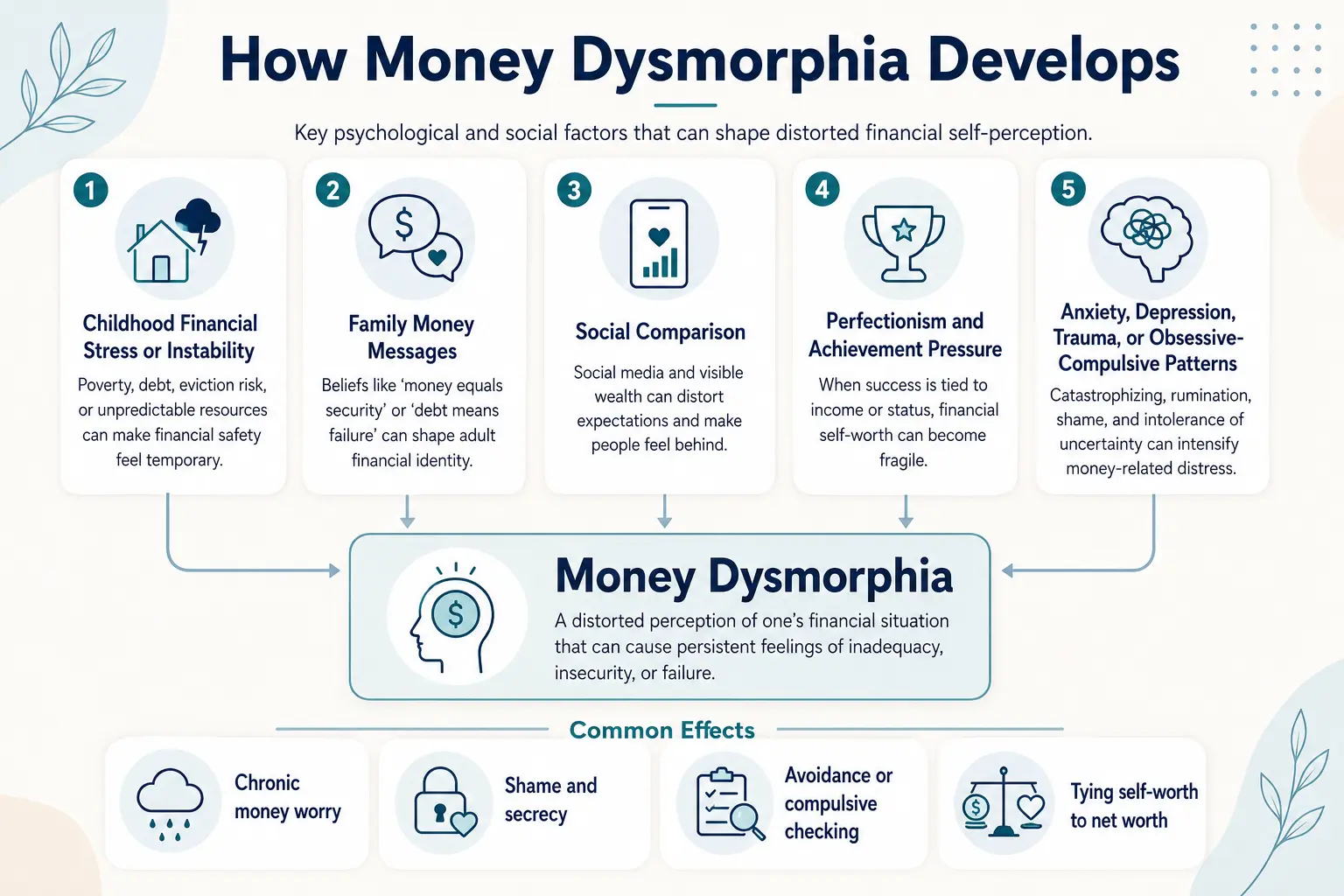
These factors often overlap. For clinicians, understanding the client’s history and current thought patterns can help clarify whether money-related distress is rooted in scarcity, comparison, shame, perfectionism, trauma, anxiety, or a combination of concerns.
Childhood financial stress or instability
Clients who grew up around poverty, debt, eviction risk, parental conflict about money, or unpredictable access to resources may internalize the belief that financial safety is always temporary.
Family money messages
Many people absorb explicit or unspoken beliefs such as “money equals security,” “debt means failure,” “successful people never struggle,” or “rest must be earned.” These beliefs can shape adult financial identity long after circumstances change.
Social comparison
Social media, influencer culture, and visible displays of wealth can distort expectations about what financial stability should look like. Clients may compare their private financial fears with someone else’s curated lifestyle.
Perfectionism and achievement pressure
Clients who equate success with income, productivity, or external markers of achievement may feel chronically inadequate, even when they are functioning well.
Anxiety, depression, trauma, or obsessive-compulsive patterns
Money dysmorphia may intensify when clients already experience catastrophizing, rumination, shame, avoidance, intrusive thoughts, or difficulty tolerating uncertainty.
How Money Dysmorphia Affects Mental Health
Money dysmorphia can create a cycle of emotional distress and avoidance. A client feels financially unsafe or inadequate, avoids looking directly at the financial issue, experiences short-term relief, and then feels more anxious because nothing has been clarified or resolved.
Over time, this cycle may contribute to:
- Chronic anxiety or panic around financial decisions
- Depressive thoughts related to failure, shame, or hopelessness
- Sleep problems caused by rumination
- Relationship conflict around spending, secrecy, control, or financial roles
- Avoidance of important life decisions
- Compulsive saving, spending, earning, checking, or reassurance-seeking
- Workaholism or burnout
- Reduced self-esteem and identity confusion
For clinicians, money-related distress can be easy to miss because clients may present with anxiety, shame, perfectionism, or relationship concerns without initially naming money as a central theme.
Money Dysmorphia vs. Money Anxiety, Financial Trauma, and Obsession with Money
Money dysmorphia overlaps with several related concepts, including money anxiety, financial trauma, and preoccupation with money. These experiences can occur together, but they are not exactly the same.
Money dysmorphia specifically centers on distorted financial self-perception. A client may feel financially unsafe, inadequate, or behind even when objective evidence does not fully support that belief.
Money anxiety, financial trauma, and money obsession may all contribute to that distorted perception, but each has a slightly different clinical focus.

Money Dysmorphia vs. Money Anxiety
Money anxiety refers to fear, worry, or stress about money. It may be based on current financial hardship, future uncertainty, debt, income instability, or past experiences.
Money dysmorphia is more specifically about a distorted perception of one’s financial situation or financial identity. A client may feel like a failure, feel chronically behind, or believe they are unsafe even when their actual financial circumstances are more stable than their emotional experience suggests.
Money Dysmorphia vs. Financial Trauma
Financial trauma refers to the emotional and behavioral impact of overwhelming, unsafe, or destabilizing financial experiences. These may include poverty, sudden financial loss, exploitation, bankruptcy, job loss, housing insecurity, or chronic scarcity.
Financial trauma can contribute to money dysmorphia when past instability causes a client to experience present-day finances through a lens of threat, scarcity, or shame. Even after circumstances improve, the client may continue to feel as though financial safety is temporary or impossible to trust.
Money Dysmorphia vs. Obsession with Money
Obsession with money may describe persistent preoccupation with earning, saving, spending, debt, comparison, or financial status. In some cases, this may overlap with obsessive-compulsive patterns, compulsive checking, reassurance-seeking, or avoidance.
Money dysmorphia may include obsessive or compulsive money-related behaviors, but the central issue is distorted financial self-perception. The client’s emotional experience of their financial situation does not match the full reality of their circumstances.
Why the Difference Matters Clinically
Distinguishing these patterns can help clinicians choose more targeted interventions. A client whose distress is rooted in financial trauma may need trauma-informed work around safety and scarcity. A client with intrusive money thoughts and compulsive checking may benefit from CBT, exposure-based strategies, or response prevention. A client whose core issue is distorted financial self-worth may need cognitive restructuring, values clarification, and self-compassion work.
In practice, these concerns often overlap. The clinical task is not to force a rigid label, but to understand what is driving the client’s distress and how money-related beliefs are affecting mood, behavior, relationships, and daily functioning.
How is Money Dysmorphia Treated?
Treatment for money dysmorphia often focuses on helping clients develop a more accurate, compassionate, and values-aligned relationship with money. Because money dysmorphia is not a formal diagnosis, treatment should be guided by the client’s presenting symptoms, functional impairment, history, and co-occurring mental health concerns.
Helpful treatment approaches may include:
- Cognitive behavioral therapy to identify and challenge distorted money beliefs
- Acceptance and commitment therapy to reconnect financial decisions with values
- Narrative therapy to explore and rewrite internalized money stories
- Trauma-informed therapy when financial fear is rooted in instability, loss, or deprivation
- Mindfulness and emotion regulation strategies for tolerating financial uncertainty
- Behavioral experiments to reduce avoidance or compulsive checking
- Financial therapy or collaboration with financial professionals when appropriate
The goal is not to convince clients that money does not matter. Money does matter. The clinical goal is to help clients separate financial facts from shame-based conclusions, reduce avoidance, and make decisions from a place of clarity rather than fear.
CBT Approaches for Money Dysmorphia: A Clinical Framework
Money dysmorphia is not a formal DSM diagnosis, but the thoughts and behaviors associated with it can often be addressed using established cognitive behavioral therapy techniques. The core clinical task is helping clients identify the distorted beliefs driving their financial self-perception, challenge the evidence for those beliefs, and build more accurate, flexible thinking patterns over time.
The framework below shows how clinicians can move from assessment to cognitive restructuring and behavior change when money-related beliefs are affecting self-worth, anxiety, or daily functioning.

Identifying Core Cognitive Distortions
Before restructuring can begin, clinicians need to help clients name what is happening. Money dysmorphia commonly involves several cognitive distortion patterns:
- All-or-nothing thinking: “If I’m not wealthy, I’m a failure.”
- Catastrophizing: “One financial setback will ruin everything I’ve built.”
- Mental filtering: “I overspent last month, which proves I’ll never be good with money.”
- Discounting the positive: “I paid off my debt, but I still don’t have nearly enough saved.”
- Emotional reasoning: “I feel broke, so I must be.”
Normalizing these as cognitive patterns — not character flaws or accurate assessments — is often the first step toward reducing shame and creating openness to restructuring work.
Cognitive Restructuring Techniques
Thought records are a foundational tool for this work. Clinicians can walk clients through documenting the triggering situation, the automatic thought, the emotion it generates, and a more balanced alternative.
For money dysmorphia specifically, it may help to add a column for evidence against the automatic thought. Clients are often surprised to find they have more evidence against their distorted beliefs than they initially recognize.
Socratic questioning can also help surface the assumptions beneath money-related beliefs. When a client says, “I’ll never have enough,” useful follow-up questions include:
- “What would ‘enough’ look like to you?”
- “How would you know when you had reached it?”
- “Where did you first learn that this amount was not sufficient?”
- “If a close friend were in your exact financial situation, would you see them as a failure?”
- “What facts support this belief, and what facts complicate it?”
Evidence-based reframes ask clients to actively identify financial strengths, successes, and responsible decisions. This is not meant to dismiss genuine financial concerns. Instead, it helps counterbalance a mental filter that only registers shortfalls, mistakes, or perceived failures.
This approach may be especially useful for clients who have achieved real financial milestones but cannot emotionally internalize them.
Behavioral Interventions
Cognitive work alone may not fully resolve the avoidance, reassurance-seeking, or shame that often accompanies money dysmorphia. Behavioral experiments can help clients test distorted beliefs against real experience.
Examples include:
- Graduated exposure to avoided financial tasks: For clients who avoid account statements, bills, budgets, or financial conversations, systematic exposure can reduce avoidance-driven anxiety over time. This might begin with a brief, clinician-supported review of a single statement or one manageable financial task.
- Safe spending experiments: Clients who experience guilt or anxiety around any personal spending can practice small, intentional purchases with structured reflection afterward. The goal is not impulsive spending, but helping the client observe whether the feared emotional or financial outcome actually occurs.
- Values-aligned financial behavior: Helping clients connect financial decisions to core values such as security, generosity, freedom, family, health, or rest can shift money from a measure of worth to a tool for living more purposefully.
- Reduced checking or reassurance-seeking: Clients who compulsively check balances, savings goals, credit scores, or financial apps may benefit from planned limits and response-prevention strategies. For example, a client might reduce account checking from several times per day to once daily, then gradually move toward a less anxiety-driven pattern.
- Approach-based financial routines: Instead of avoiding money tasks until anxiety spikes, clients can build predictable, time-limited routines for reviewing finances. Pairing these routines with grounding skills can help clients tolerate discomfort without reinforcing avoidance.
Treatment Goals for Money Dysmorphia
Clinicians can translate CBT work into measurable treatment goals such as:
- Client will identify recurring distorted beliefs about money and practice balanced alternative thoughts.
- Client will reduce avoidance of financial tasks through gradual exposure and structured coping strategies.
- Client will decrease compulsive account checking or reassurance-seeking behaviors.
- Client will identify values-based financial choices that support emotional well-being.
- Client will practice self-compassion when discussing financial history, debt, income, spending, or perceived financial mistakes.
How Clinicians Can Document Money Dysmorphia in Teratment
When documenting money dysmorphia-related concerns, clinicians should connect symptoms to functional impact, treatment interventions, and progress over time.
Documentation may include:
- Client’s reported money-related beliefs, fears, or avoidance patterns
- Emotional responses such as anxiety, shame, guilt, panic, or hopelessness
- Functional impact on relationships, work, sleep, decision-making, or daily routines
- Relevant history, including financial trauma, family money messages, or social comparison
- Interventions used, such as cognitive restructuring, grounding, psychoeducation, behavioral experiments, or values clarification
- Client response to interventions
- Progress toward treatment goals
Because money dysmorphia is not a formal diagnosis, clinicians should document it as a presenting concern, symptom pattern, or treatment theme rather than as a diagnostic label.
How ICANotes Supports Clinicians Treating Money-Related Anxiety and Shame
Treating money dysmorphia requires careful assessment, structured documentation, and individualized treatment planning. ICANotes helps behavioral health clinicians document money-related distress alongside related concerns such as anxiety, trauma, depression, compulsive behaviors, and relationship stress.
With ICANotes, clinicians can:
- Create customized intake prompts for financial stress, money shame, avoidance, and self-worth concerns
- Document cognitive distortions and client responses using structured progress notes
- Build measurable treatment goals around emotional regulation, avoidance reduction, and values-based decision-making
- Track interventions such as CBT, narrative therapy, grounding, psychoeducation, and behavioral experiments
- Maintain clear, compliant documentation for complex clinical presentations
When sensitive topics like money, shame, and self-worth enter the therapy room, structured documentation can help clinicians capture the full clinical picture while supporting consistent, client-centered care.
Documentation support for behavioral health clinicians
Document complex concerns like money dysmorphia with confidence
When clients present with financial shame, distorted self-worth, anxiety, avoidance, or trauma-related money beliefs, clear documentation matters. ICANotes helps behavioral health clinicians create structured notes, treatment plans, and progress documentation that support individualized care.
- Create treatment plans tied to symptoms, goals, and interventions
- Document CBT, trauma-informed care, and values-based interventions
- Save time with behavioral health-specific templates and workflows
Start your 30-day free trial
See how ICANotes supports clinical documentation for behavioral health care.
Frequently Asked Questions About Money Dysmorphia
Recent Posts







Dr. October Boyles
DNP, MSN, BSN, RN
About the Author
Dr. October Boyles is a behavioral health expert and clinical leader with extensive expertise in nursing, compliance, and healthcare operations. With a Doctor of Nursing Practice (DNP) and advanced degrees in nursing, she specializes in evidence-based practices, EHR optimization, and improving outcomes in behavioral health settings. Dr. Boyles is passionate about empowering clinicians with the tools and strategies needed to deliver high-quality, patient-centered care.