Blog > Emerging Trends > Political Obsession Disorder: Symptoms, Causes & Treatment
Political Obsession Disorder: How to Recognize and Treat an Unhealthy Obsession with Politics
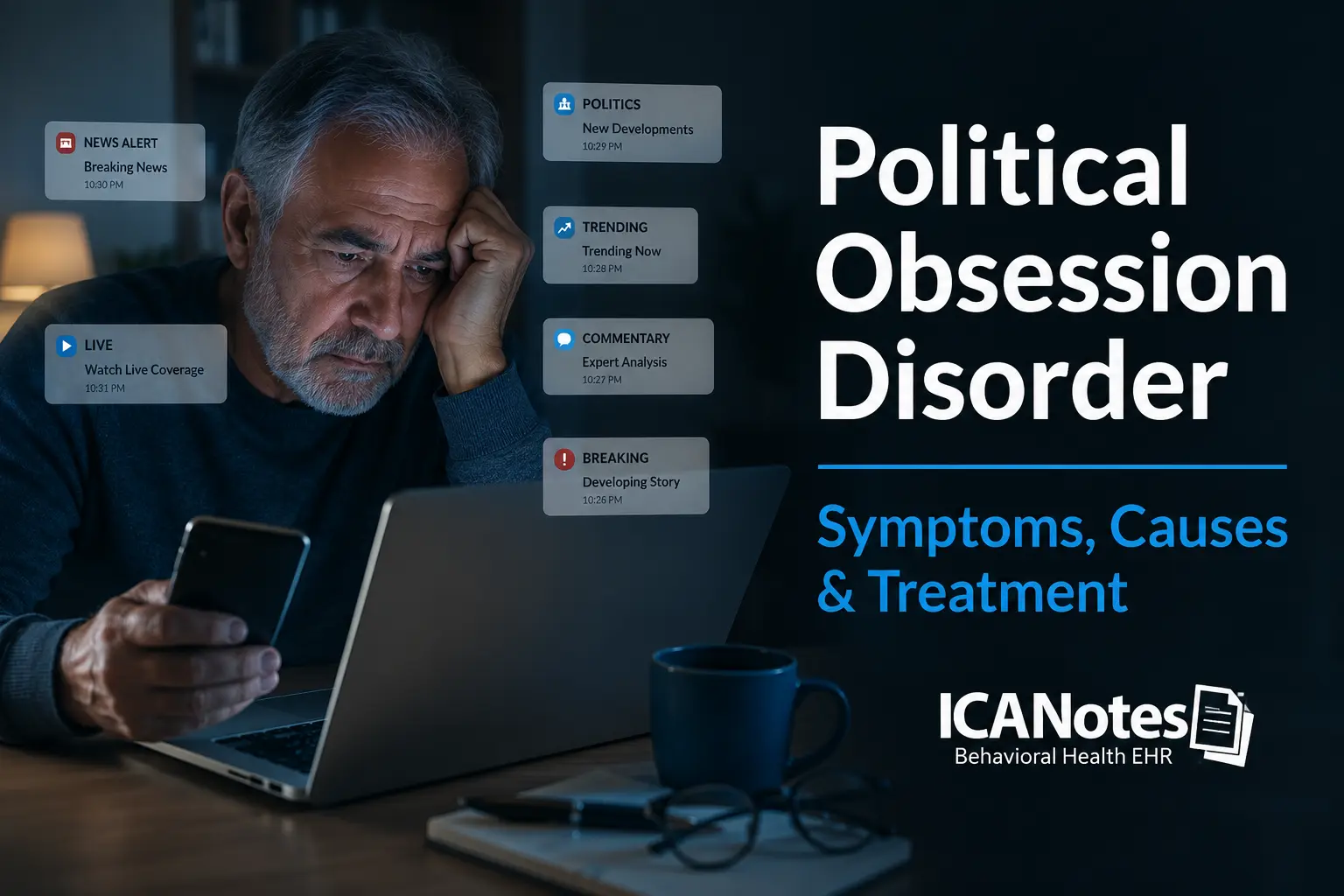
Political obsession disorder is a pattern of excessive preoccupation with political news, social media, and current events that interferes with daily functioning, relationships, sleep, or emotional well-being. While it is not a formal DSM-5 diagnosis, an unhealthy obsession with politics may overlap with anxiety, political OCD, compulsive news checking, or adjustment difficulties. This guide explains the symptoms, causes, assessment considerations, and evidence-based treatment strategies clinicians can use to help clients regain balance and reduce distress.


Last Updated: June 22, 2026

What You'll Learn
- What political obsession disorder is — and when political engagement becomes clinically significant
- How to identify political OCD, political psychosis, and other conditions that may present similarly
- Why political content can trigger compulsive checking, anxiety, and emotional dysregulation
- Five practical treatment approaches for reducing political stress and restoring balance
- Documentation and treatment planning strategies you can apply immediately in practice
- How to code and document politically driven distress when no standalone DSM-5 diagnosis exists
Contents
- What Is Political Obsession Disorder?
- Political Obsession Disorder vs. Normal Political Engagement
- Is Political Obsession a Form of Psychosis?
- Is Political Obsession a Form of OCD?
- The Psychology Behind an Unhealthy Obsession with Politics
- Clinical Strategies for Treating Political Obsession Disorder
- Clinical Caveats and Ethical Considerations
- How ICANotes Supports Treatment of Political Obsession Disorder
- FAQ: Political Obsession Disorder
Since 2016, behavioral health clinicians have watched a new presenting concern move from the margins of intake conversations to the center of treatment plans: clients who can't stop consuming, discussing, or worrying about politics — to the point that it strains relationships, disrupts sleep, or crowds out everything else in their lives. Clients rarely arrive describing it this way, but the pattern is familiar to anyone doing frontline clinical work. This guide defines political obsession disorder, distinguishes it from related presentations like political psychosis and political OCD, and walks through assessment, documentation, and treatment strategies you can use this week.
What Is Political Obsession Disorder?
Political obsession disorder describes a pattern of excessive preoccupation with political news, content, and discourse that interferes with daily functioning, relationships, sleep, or mood regulation. It is not a formal DSM-5 diagnosis, but clinicians increasingly see it as a presenting concern — often overlapping with generalized anxiety, OCD-like rumination, or adjustment difficulties tied to current events.
Political obsession disorder is a colloquial — not diagnostic — term clinicians and journalists have started using to describe an unhealthy fixation on political news and discourse. It typically shows up as compulsive checking of news and social media, intrusive thoughts about political outcomes, irritability or despair tied to the news cycle, and political content displacing other relationships or interests.
The pattern tracks with broader research on political stress: one community sample found that roughly a quarter of respondents reported politically-focused intrusive thoughts more than once a day (Cepeda et al., 2018). It isn't rare, and it isn't trivial — but it also isn't, on its own, a diagnosis you'll find in the DSM-5. That distinction matters for how you assess it, document it, and bill for it, which is why the next section draws a clear line between ordinary political engagement and the disorder-level pattern.
Political Obsession Disorder vs. Normal Political Engagement
Most clients who follow political news closely are not presenting with political obsession disorder. The distinction comes down to function, not frequency — how the behavior affects daily life, not how many hours it consumes. Use the comparison below as a quick clinical reference.
If a client's pattern lines up with the right-hand column across multiple domains — not just one bad week — it's worth exploring further, including screening for overlapping conditions like generalized anxiety, OCD, or adjustment difficulties.

Download the Political Stress Treatment Planning & Documentation Guide
Get practical tools for documenting and treating politically driven anxiety, OCD-spectrum rumination, adjustment difficulties, and compulsive news consumption.
- Diagnosis and ICD-10/Z-code crosswalk
- Sample DBT, CBT, and ACT treatment plan goals
- Neutral progress note language
- Medical necessity documentation checklist
Is Political Obsession a Form of Psychosis?
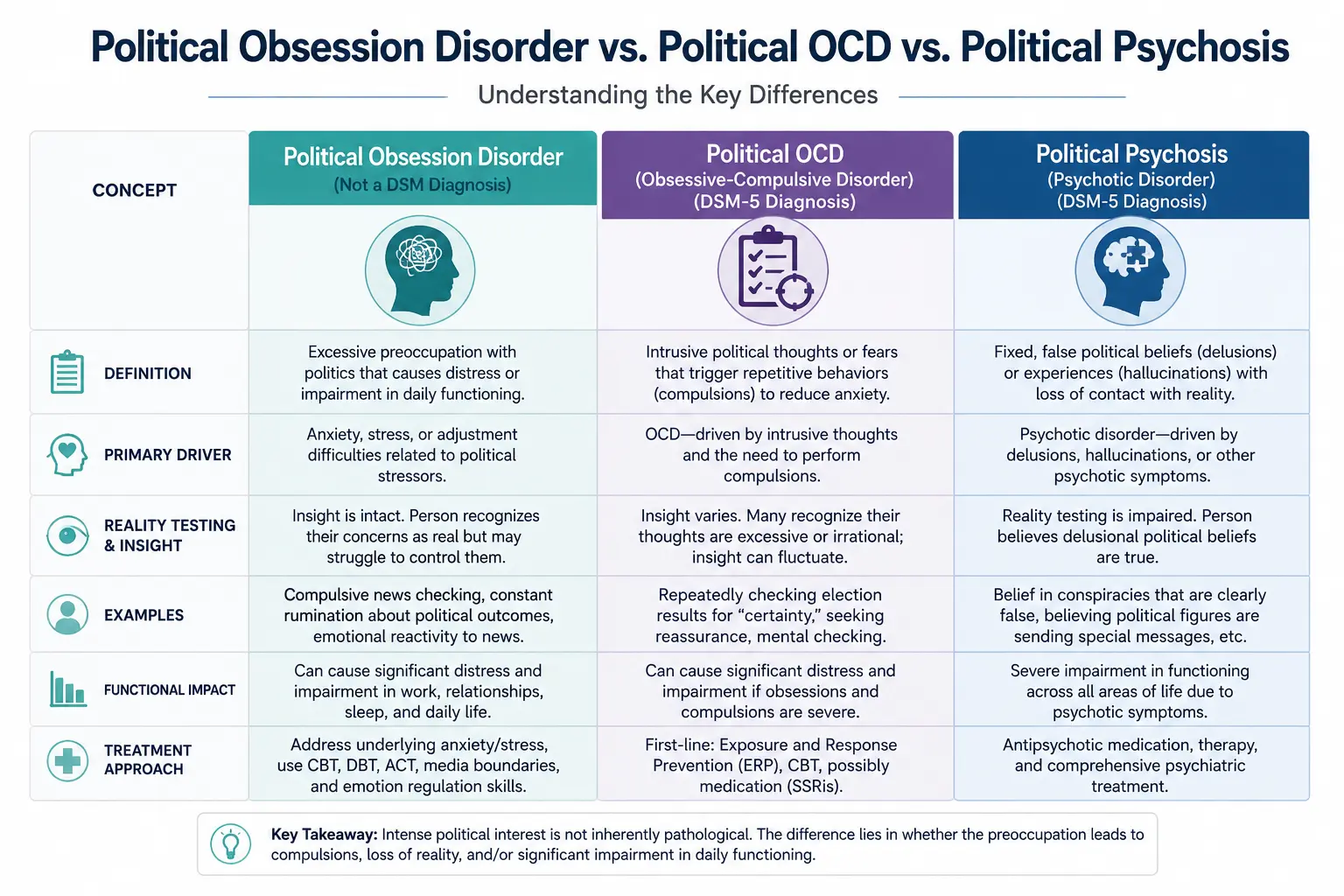
Key takeaway: Political obsession disorder may involve excessive political preoccupation and distress, but unlike political psychosis, reality testing remains intact. When repetitive checking and reassurance-seeking become central features, clinicians should also consider whether an OCD-spectrum presentation is driving the symptoms.
Is Political Obsession a Form of OCD?
There's more overlap here than with psychosis, and it's worth screening for directly. Obsessive-compulsive disorder involves intrusive, unwanted thoughts (obsessions) paired with repetitive behaviors aimed at reducing the distress those thoughts cause (compulsions). Political content can become the focus of exactly that cycle: intrusive worry about political outcomes, followed by compulsive news-checking, fact-checking, or reassurance-seeking that temporarily relieves the anxiety but reinforces the loop.
Research supports the overlap. The same 2018 study on politically-focused intrusive thoughts and ritualistic behaviors found that the pattern correlated with broader measures of obsessive-compulsive symptoms, anxiety, and depression (Cepeda et al., 2018). Separately, a 2024 study found that OCD-symptom severity was associated with ideological obsession across politically diverse U.S. samples — Democrats, Republicans, and others alike (Adam-Troian & Bélanger, 2024).
Clinically, the distinguishing question is the same one you'd ask for any OCD presentation: is the client trying to reduce distress through a repetitive behavior, and does that behavior provide only temporary relief before the cycle restarts? If so, treat it as you would any OCD presentation — exposure and response prevention (ERP) is the first-line, evidence-based approach, with media-consumption limits used as a specific exposure target. If the pattern is more diffuse worry without a clear compulsive behavior, generalized anxiety may be the better fit.
The Psychology Behind an Unhealthy Obsession with Politics
Several overlapping mechanisms explain why political content is so effective at hooking attention. News and social media platforms are built around variable reward — the next post might be outrageous, validating, or alarming, and that unpredictability keeps people checking. Political content also taps directly into identity: for many people, political affiliation functions as an in-group, and threats to that group, real or perceived, trigger the same vigilance response as a personal threat.
Uncertainty plays a role too. Political news cycles are inherently unresolved — there's always a next development, a next vote, a next ruling — which keeps the nervous system in a low-grade anticipatory state that's hard to switch off. For clients with an underlying vulnerability to anxiety or obsessive-compulsive patterns, that unresolved quality can become the perfect hook for rumination and compulsive checking.
None of this requires a partisan lens to treat. The clinical work is the same regardless of a client's politics: identify the function the behavior is serving — certainty-seeking, identity protection, distress reduction — and build alternative ways to meet that need.
Clinical Strategies for Treating Political Obsession Disorder
When clients present with a political obsession, the therapeutic goal is not to disengage them from civic life, but to reduce emotional overwhelm, compulsive behaviors, and identity fusion. The following interventions can help restore balance:
1. Validate the Underlying Emotions
Clients are often relieved to hear that their distress is a reasonable response to genuinely stressful events, not a personal failing or an overreaction. Validating the emotion — fear, anger, grief, helplessness — separates the feeling from the behavior, making the behavior easier to address without the client feeling judged for caring about the issue.
2. Use DBT Skills to Build Tolerance for Uncertainty
Distress tolerance and emotion regulation skills from dialectical behavior therapy translate directly to political stress. Encourage paced breathing or grounding before opening a news app, urge-surfing through the impulse to check for updates, and opposite-action when the urge is to doom-scroll rather than disengage.
3. Set Concrete Media and Digital Boundaries
Vague advice to “take a break from the news” rarely works. Concrete, scheduled boundaries do. Examples include checking news at two designated times per day instead of continuously, muting specific keywords or accounts, or moving news apps off the home screen. Treat this like any exposure-management plan: specific, measurable, and reviewed regularly.
4. Rebuild Identity Beyond Politics
When political identity expands to fill most of a client’s sense of self, treatment should include deliberately reinvesting in other meaningful roles and relationships — work, hobbies, faith, family, volunteerism, or creative pursuits. The goal is not to minimize civic engagement, but to restore balance so politics becomes one aspect of identity rather than the organizing principle of life.
5. Model and Coach Respectful Dialogue
Many clients’ distress is compounded by political conflict within close relationships. Coaching clients in respectful disagreement — separating the relationship from the disagreement, using “I” statements, establishing boundaries, and knowing when to pause a conversation — provides practical skills that can reduce relational strain and improve emotional well-being.
The framework below summarizes the core treatment strategies discussed above and can serve as a quick clinical reference.

Clinical Caveats and Ethical Considerations
Political topics are inherently charged, and clinicians must monitor their own reactions carefully. Use supervision to process personal biases or strong emotional responses. Refrain from sharing your own views, and focus instead on helping clients restore function, reduce distress, and reconnect with their values.
- Stay neutral on the politics, not the symptoms. Treatment targets the pattern of preoccupation and its functional impact — not a client's specific political beliefs or affiliation. Imposing your own political views, even implicitly, undermines the therapeutic relationship and isn't your role.
- Don't pathologize civic engagement. Caring about political outcomes, voting, volunteering, or staying informed are healthy behaviors. The clinical concern is the compulsive, distress-driven pattern around them — not the underlying values.
- Screen before you label. Because “political obsession disorder” isn't a DSM-5 diagnosis, rule out — or identify as co-occurring — generalized anxiety, OCD, adjustment disorder, and, rarely, psychotic-spectrum presentations before building a treatment plan, and document using the diagnosis that's actually driving the symptoms (see the FAQ below).
How ICANotes Supports Treatment of Political Obsession Disorder
Working with clients overwhelmed by politics requires documentation that captures nuance, emotional tone, and behavioral patterns. Because political obsession disorder isn't a standalone DSM-5 diagnosis, clinicians also need documentation that clearly connects symptoms, functional impairment, and the underlying diagnosis. ICANotes provides the tools behavioral health professionals need to document these cases thoroughly and defensibly.
1. Narrative Documentation with Clinical Precision
ICANotes’ menu-driven narrative engine makes it easy to document hopelessness, compulsive news checking, emotional dysregulation, social withdrawal, and other symptoms associated with political stress while maintaining individualized clinical detail. This helps ensure documentation accurately reflects the client's presentation and supports medical necessity.
2. Document Symptoms Under the Appropriate Diagnosis
Political obsession disorder is not a formal DSM-5 diagnosis. ICANotes helps clinicians document symptoms under the diagnosis actually driving the presentation — such as generalized anxiety disorder, OCD, or adjustment disorder — while also capturing relevant psychosocial stressors and contributing factors.
3. Treatment Planning Tools for DBT, CBT, and ACT
Whether you're helping clients build distress tolerance, challenge catastrophic thinking, or reduce compulsive news consumption, ICANotes makes it easy to document goals, interventions, and progress using evidence-based treatment planning tools.
4. Structured Progress Tracking
Political stress often fluctuates with elections, breaking news, and social media exposure. ICANotes helps clinicians track symptom patterns, monitor progress over time, and adjust treatment plans as client needs evolve.
5. Secure Telehealth and Practice Management
For clients who prefer remote care during periods of heightened political stress, ICANotes combines HIPAA-compliant telehealth, scheduling, documentation, and practice management tools in a single platform.
Document Complex Presentations with Confidence
Political obsession disorder may not be a formal DSM-5 diagnosis, but accurately documenting the underlying symptoms, functional impairment, and contributing stressors is essential. ICANotes helps behavioral health clinicians create detailed, defensible documentation while streamlining treatment planning and progress tracking.
Whether you're documenting anxiety, OCD-spectrum symptoms, adjustment difficulties, or politically driven stress, ICANotes gives you the tools to stay focused on client care instead of paperwork.
- Customizable treatment plans and goals
- Built-in DSM-5 and ICD-10 coding support
- Structured symptom and progress tracking
- Behavioral health-specific narrative documentation
- Integrated telehealth, scheduling, and practice management
Start Your Free Trial
No credit card required. Explore the behavioral health EHR built specifically for therapists, counselors, psychologists, psychiatrists, and group practices.

Frequently Asked Questions About Political Obsession Disorder
Conclusion: Political Obsession Disorder Is Real — and Treatable
Political obsession disorder isn't a diagnosis you'll find in the DSM-5, but the pattern it describes is real, increasingly common, and treatable. Whether the underlying driver is anxiety, OCD-spectrum symptoms, adjustment difficulties, or chronic stress, clinicians can help clients reduce compulsive news consumption, tolerate uncertainty more effectively, and build a healthier relationship with political engagement.
Because political obsession disorder is not a standalone diagnosis, accurate documentation and treatment planning are especially important. Clinicians must clearly connect symptoms, functional impairment, and psychosocial stressors to the underlying condition driving the presentation while maintaining neutral, objective clinical documentation.
ICANotes helps behavioral health professionals document complex presentations with confidence through customizable treatment plans, structured symptom tracking, built-in DSM-5 and ICD-10 coding support, and narrative documentation tools designed specifically for mental health care.
Ready to simplify documentation and treatment planning for presentations like political obsession disorder? Start your free 30-day ICANotes trial today.
Recent Posts




Donald Morrison
MSW, LCSW
About the Author
Donald Morrison graduated from UNC Charlotte in 2004. He has since worked as a school-based therapist, inpatient social work supervisor and outpatient clinician. Donald currently works in private practice, and he is also an adjunct faculty member at the UNC Charlotte School of Social Work. In addition, Donald serves as a clinical supervisor to LCSW associates, and he regularly presents at area mental health conferences and seminars.