Blog > Treatment Strategies > Couples Therapy Techniques and Interventions: A Clinical Guide for Therapists
Couples Therapy Techniques, Ground Rules & Interventions for Therapists
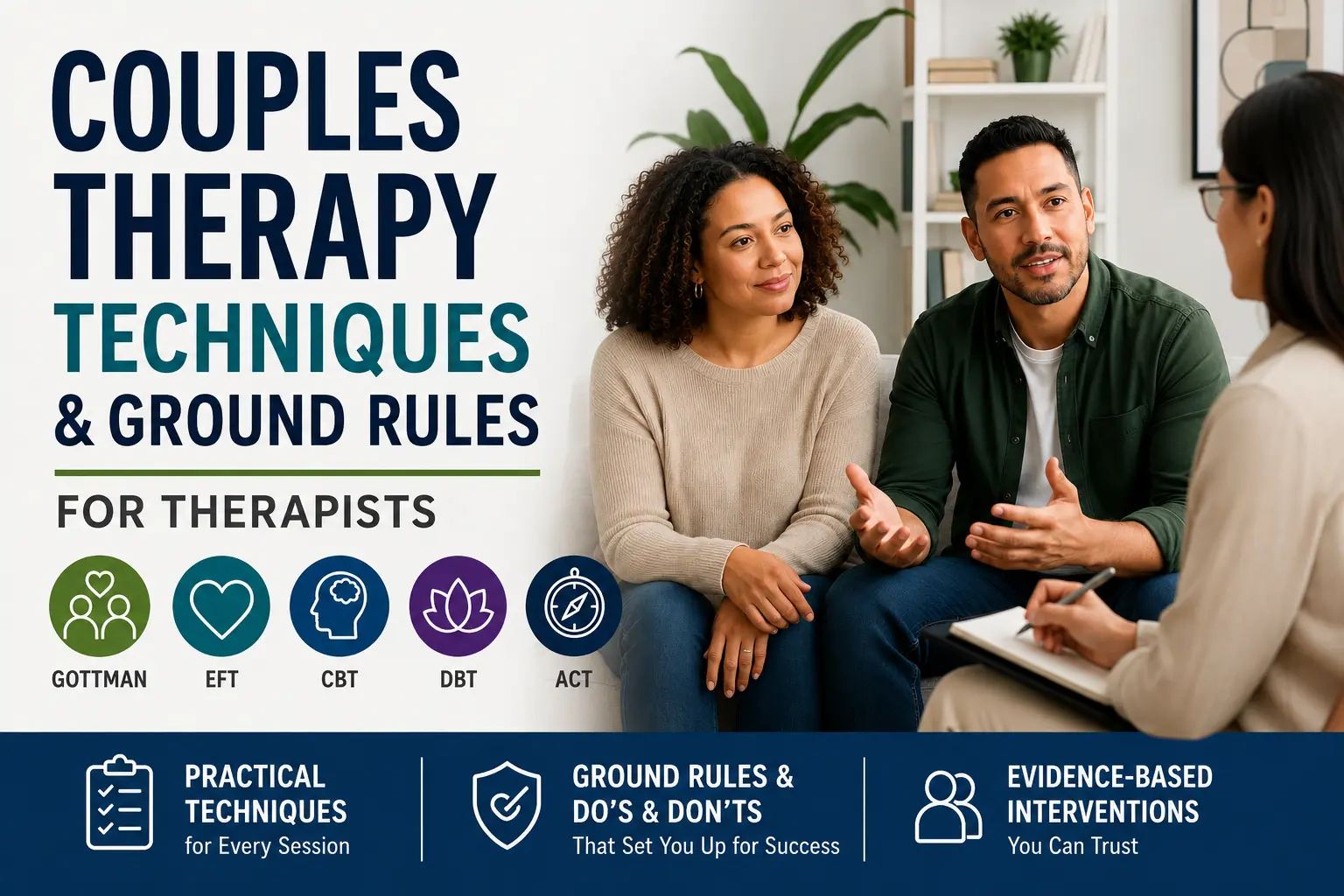
Discover practical couples therapy techniques, interventions, and session ground rules that can improve outcomes for couples in counseling. This clinician-focused guide covers communication strategies, conflict resolution skills, treatment planning, and evidence-based approaches including the Gottman Method, Emotionally Focused Therapy (EFT), Cognitive Behavioral Therapy (CBT), Dialectical Behavior Therapy (DBT), and Acceptance and Commitment Therapy (ACT). Use these proven techniques to create more structured, effective, and productive couples therapy sessions.


Last Updated: June 23, 2026
What You'll Learn
- How to use 8 evidence-based couples therapy techniques and interventions in clinical practice
- When to apply Gottman, EFT, CBT, DBT, and ACT approaches with couples
- Essential couples therapy ground rules that promote safety, structure, and productive communication
- Best practices for managing conflict, emotional escalation, and difficult session dynamics
- Practical communication exercises that help couples improve listening, empathy, and conflict resolution
- How to structure more focused, goal-oriented couples therapy sessions
- Key do's and don'ts for keeping sessions productive and clinically effective
- Answers to frequently asked questions about couples therapy techniques, interventions, and session management
Contents
Couples therapy requires more than strong clinical instincts. Successful outcomes often depend on a therapist's ability to apply evidence-based interventions, establish clear session ground rules, and create a structured environment where both partners can communicate safely and productively.
Whether you're helping couples rebuild trust after betrayal, improve communication, navigate recurring conflict, or strengthen emotional connection, the right techniques can help move treatment forward while reducing escalation in the therapy room.
This guide covers practical couples therapy techniques and interventions therapists can use in session, essential ground rules to establish from the start, common do's and don'ts, and strategies for structuring productive couples counseling sessions.
Evidence-Based Couples Therapy Techniques and Interventions
While strong therapeutic rapport and effective session management are essential, most successful couples therapists also rely on evidence-based techniques and interventions that help partners improve communication, strengthen emotional connection, and navigate conflict more productively. The following couples therapy techniques draw from some of the most widely used clinical approaches, including the Gottman Method, Emotionally Focused Therapy (EFT), Cognitive Behavioral Therapy (CBT), Dialectical Behavior Therapy (DBT), and Acceptance and Commitment Therapy (ACT). These interventions can be adapted to a variety of presenting concerns, from recurring arguments and emotional disconnection to trust issues and life transitions.
Couples Therapy Ground Rules: What to Establish Early
One of the most important predictors of a productive couples therapy session is the presence of clear, consistently enforced ground rules. Without structure, sessions can quickly become reactive, allowing criticism, defensiveness, and emotional escalation to overshadow therapeutic progress. Establishing couples therapy guidelines early helps create psychological safety, encourages respectful communication, and gives therapists a framework for managing difficult conversations. The following ground rules can help clinicians maintain a constructive therapeutic environment while supporting both partners equally.

No Secrets Between Partners
Clarify how individual disclosures will be handled before issues arise, so both partners understand the boundaries of conjoint sessions.
One Person Speaks at a Time
Set expectations around turn-taking to reduce interruptions, cross-talk, and escalation during difficult conversations.
No Name-Calling or Character Attacks
Keep the focus on specific behaviors and emotional impact rather than labels, insults, contempt, or personal attacks.
Stay on the Current Topic
Discourage partners from bringing unrelated past grievances into the current discussion, especially when emotions intensify.
Therapist May Pause Escalation
Obtain agreement that you may interrupt, slow down, redirect, or briefly pause the conversation when the session becomes unproductive.
Review Confidentiality Limits
Explain confidentiality expectations, mandatory reporting obligations, and how privacy is handled when working with two clients in the room.
Best Practices for Running Effective Couples Therapy Sessions
Evidence-based couples therapy techniques and interventions are most effective when they're delivered within a structured, goal-oriented therapeutic process. While specific modalities such as the Gottman Method, EFT, CBT, DBT, and ACT provide valuable tools for addressing relationship challenges, therapists must also create an environment that supports meaningful change. The following best practices can help clinicians maintain focus, strengthen the therapeutic alliance, manage difficult dynamics, and keep couples moving toward their treatment goals. Whether you're working with partners experiencing communication problems, trust issues, emotional disconnection, or recurring conflict, these strategies can help make couples therapy sessions more productive and effective.
Set Realistic Expectations
Couples often arrive at their first session expecting either a quick fix or, just as commonly, expecting therapy to fail the way previous attempts did. Before any technique-specific work begins, set realistic expectations about pace: meaningful change in a relationship typically takes weeks to months of consistent work, not a single session. Be direct that progress is rarely linear — couples will have strong sessions and difficult ones, and a setback in week six doesn’t erase the gains made in week three. Naming this upfront reduces the chance that either partner quietly disengages after a rough session, and gives you a shared, realistic benchmark to return to when motivation dips.
Remind Each Person to Focus on What They Can Do
It’s tempting for each partner to spend session time describing what the other person needs to change. Consistently redirect that energy inward: ask each partner what they, individually, can do differently this week, regardless of what their partner does. This isn’t about letting one partner off the hook — it’s about building two people who are each actively working on the relationship, rather than two people waiting for the other to go first. Reinforce this early and often; it’s one of the fastest ways to break a stuck blame cycle.
Reinforce Progress Frequently
Couples in conflict are prone to negativity bias — they remember the fight, not the moment they caught themselves before escalating. Make a habit of naming small wins out loud: a softer tone, a successful time-out, an apology offered without being prompted. Couples who can see incremental progress are far more likely to stay engaged in treatment than couples who only hear what’s still wrong.
Facilitate One Growth Area in Each Session
Couples in distress often want to address everything at once — finances, parenting, intimacy, in-laws — in a single 50-minute session. Resist the pull. Pick one growth area per session and stay with it. Trying to cover too much ground dilutes the work and leaves both partners feeling like nothing was actually resolved, even when real progress was made on one front.
Practice Skills Taught in Each Session
A technique introduced in session and never practiced rarely survives contact with a real argument at home. Build in time for the couple to actually rehearse a skill — a repair attempt, an “I” statement, an active-listening exchange — in the room, with you there to coach and adjust in real time. For more structured exercises you can assign between sessions, see 12 Effective Couples Therapy Activities for Stronger Relationships.
Develop a Clear Treatment Plan
Couples therapy without a documented treatment plan tends to drift session to session, reacting to whatever crisis came up that week. Set specific, measurable goals early — reducing the frequency of unresolved arguments, rebuilding a specific trust behavior, re-establishing a weekly check-in ritual — and revisit them periodically. For a full walkthrough of building and updating these goals, see Couples Therapy Treatment Goals & Plans: A Clinical Guide.
Keep Emotions Calm
Sessions that escalate into a real-time argument rarely produce insight — they mostly produce more material for the next fight. Set the expectation up front that you’ll interrupt and redirect if voices raise or the conversation turns into cross-talk, and have a specific de-escalation move ready: a structured pause, a breathing reset, or briefly separating the partners. Couples generally respond well to a therapist who keeps the room calm; it signals the session is a safe, structured space rather than another arena for the conflict.
Focus on Problem-Solving Skills
Once emotional reactivity is under control, shift the couple toward structured problem-solving: define the problem in neutral terms both partners agree on, brainstorm options without judging them, and agree on one option to try before the next session. Couples who learn this structure can use it long after treatment ends.
Explore Attachment and Family-of-Origin Patterns
A partner’s reaction to conflict — shutting down, escalating, leaving the room — often traces back to attachment patterns formed long before the relationship began. Building in time to explore each partner’s family-of-origin experiences with conflict and connection can reframe a “they’re doing this to hurt me” narrative into a more workable “this is an old pattern showing up here” narrative.
Redirect the Couple Away from Blame and Criticism
Blame-focused language (“you always,” “you never”) tends to escalate rather than resolve. When you hear it, redirect immediately to a specific behavior and a specific impact: “I felt dismissed when the conversation ended without a response,” rather than “you always shut me out.” This single redirection, repeated consistently, does much of the heavy lifting in lowering session-to-session conflict.
Prompt the Couple to Remember Positives
Distressed couples can lose access to why they’re together at all. Periodically prompt both partners to name something they appreciate about the other, or a specific positive memory, especially after a difficult exchange. This isn’t about glossing over real problems — it’s about keeping the relationship’s underlying foundation visible while you work on the parts that aren’t working.
What Does a Typical Couples Therapy Session Look Like?
New couples therapists — and couples starting therapy for the first time — often ask what an actual session looks like beyond “talking about problems.” While every clinician adapts this to their own style and modality, most effective couples sessions follow a similar arc:
- Check-in (5–10 min): each partner briefly shares how the week went and whether anything has shifted since the last session.
- Agenda-setting (5 min): the therapist and couple agree on the one growth area the session will focus on.
- Core intervention work (25–30 min): the bulk of the session — applying a specific technique or modality (see below) to the agreed-on issue, often including a live rehearsal of a skill.
- Processing and repair (5–10 min): time to de-escalate if the core work brought up strong emotion, and to name what went well.
- Homework and close (5 min): one specific, concrete task to practice before the next session, plus a quick recap.
Clear documentation of what happened in each phase — and why — also makes it far easier to track progress across sessions. See Couples Therapy Notes: Templates, Examples & Documentation Tips for templates that map directly onto this structure.
Working with Couples in Conflict?
Download the Couples Therapy Intervention Guide
✅ EFT, DBT, and ACT approaches tailored for couples
✅ Interventions for emotional reactivity, communication breakdowns, and betrayal recovery
✅ Tools to deepen connection, improve regulation, and align on values
Whether you're new to couples work or want to expand your toolbox, this guide helps you deliver more impactful therapy.
Couples Therapy Approaches & Interventions Therapists Should Know
Beyond the session-management techniques above, most effective couples therapists draw on one or more established, evidence-based modalities. Here’s a quick overview of the five most commonly used:

Gottman Method
Developed from Dr. John Gottman’s decades of observational research on married couples, the Gottman Method focuses on identifying and interrupting the “Four Horsemen” (criticism, contempt, defensiveness, and stonewalling), then rebuilding the friendship and shared-meaning systems underneath the conflict. It’s especially useful with couples whose conflict has become repetitive and entrenched.
Emotionally Focused Therapy (EFT)
EFT treats conflict as a symptom of insecure attachment — partners caught in a cycle of pursuing and withdrawing, or attacking and defending, because an underlying need for connection isn’t being met. The therapist helps both partners identify and express that need directly, rather than through the conflict behavior. For a deeper look at EFT’s stages and techniques, see Emotionally Focused Couples Therapy (EFCT): Techniques, Stages, and Clinical Applications.
Cognitive Behavioral Therapy (CBT)
Cognitive-behavioral couples therapy targets the distorted thoughts and learned behavior patterns that fuel conflict — for example, the assumption that a partner’s lateness is deliberate disrespect rather than a traffic jam. Couples learn to identify these automatic interpretations, test them against evidence, and replace unhelpful behavior patterns with structured communication exercises.
Dialectical Behavior Therapy (DBT)
Originally developed for emotion regulation, DBT’s skills — mindfulness, distress tolerance, and validation — translate directly to high-conflict couples whose arguments escalate quickly. It’s a strong fit when at least one partner struggles with intense emotional reactivity, or when conflict regularly turns explosive before either person can self-regulate.
Acceptance and Commitment Therapy (ACT)
ACT helps couples build psychological flexibility — the capacity to hold difficult thoughts and feelings without needing to fix or avoid them — and to act according to shared values even when the relationship is uncomfortable. It’s particularly useful for couples stuck avoiding a recurring hard topic, or facing a values misalignment that can’t simply be “solved.”
All five of these modalities — including when to use each one and specific techniques for your next session — are covered in detail in our free downloadable guide.
Do's and Don'ts of Couples Therapy: A Quick Recap
A condensed version of the techniques and best practices above, for a quick reference between sessions:
How ICANotes Supports Couples Therapists
Running an effective couples therapy practice means more than what happens in the room — it also means documentation that keeps pace with treatment plans, goals, and progress notes for two clients in every session. ICANotes’ behavioral health EHR includes couples- and family-therapy-ready note templates, built-in treatment plan tracking, and customizable progress notes, so you can spend session time on the techniques above instead of catching up on paperwork afterward.
Whether you're navigating emotionally charged sessions or documenting subtle shifts in relational dynamics, ICANotes gives you the structure, flexibility, and compliance support to provide high-quality care to couples.
Frequently Asked Questions About Couples Therapy Techniques
Recent Posts





Dr. October Boyles
DNP, MSN, BSN, RN
Dr. October Boyles is a behavioral health expert and clinical leader with extensive expertise in nursing, compliance, and healthcare operations. With a Doctor of Nursing Practice (DNP) and advanced degrees in nursing, she specializes in evidence-based practices, EHR optimization, and improving outcomes in behavioral health settings. Dr. Boyles is passionate about empowering clinicians with the tools and strategies needed to deliver high-quality, patient-centered care.