
Mental Compulsions in OCD: How to Identify and Treat Covert Rituals in ERP
Beyond handwashing: recognizing the hidden rituals that can keep exposure therapy stuck


Key Takeaways
- Careful functional assessment often uncovers covert compulsions when a client reports intrusive thoughts but few or no visible rituals; “Pure O” is an informal label, not a formal OCD subtype.
- Mental reviewing, silent reassurance, emotional or somatic checking, and repeated analysis can function as compulsions when they are used to reduce distress or obtain certainty.
- When ERP progress stalls despite consistent exposure practice, reassessing for covert rituals can reveal response-prevention targets that were previously missed.
- The most useful question is not simply what the client is thinking, but what the client is trying to accomplish with the thinking and what signals that the mental activity can stop.
- Attentional disengagement, metacognitive strategies, and I-CBT concepts can broaden case formulation, but each strategy needs functional scrutiny so it does not become another reassurance or avoidance ritual.
The Invisible Barrier in ERP
You've built the hierarchy carefully. Your client with contamination fears touches the doorknob and sits with the anxiety instead of washing. Over several weeks, washing decreases and the client learns that distress can be tolerated without the ritual. Then another client follows the exposure plan just as faithfully, shows little visible checking or reassurance seeking, and still seems stuck.
The difference may be happening entirely out of view. A client can complete an exposure while mentally reviewing, neutralizing, checking feelings, rehearsing reassuring phrases, or analyzing the feared possibility until it feels resolved. Those internal responses can serve the same short-term function as an observable compulsion.
For years, clinicians and clients have used the label “Pure O,” short for purely obsessional OCD, for presentations dominated by intrusive thoughts and few obvious rituals. OCD-UK describes “Pure O” as an informal, patient-generated label rather than a formal diagnostic category. Williams and colleagues similarly argued that the label can be misleading because many apparently obsessional presentations include mental compulsions or reassurance seeking.
In the DSM-IV field-trial sample analyzed by Williams et al., 96% of adults with OCD had both obsessions and compulsions, while 2% were classified as predominantly obsessional. Those findings do not prove that every person with OCD has an identifiable compulsion. They do reinforce a practical point: the absence of visible rituals should not be treated as evidence that compulsions are absent. Careful functional assessment may uncover covert reviewing, reassurance, checking, neutralizing, or avoidance that the client has not recognized as compulsive.
The National Institute of Mental Health estimates that OCD affects about 1.0% of U.S. adults in a given year and 1.6% over a lifetime. The available prevalence research does not establish what percentage of that population relies primarily on covert compulsions. In clinical samples, however, mental rituals are common enough that clinicians treating OCD should assess for them directly.
For clients whose rituals are primarily internal, a hierarchy that tracks only observable behavior may miss an important part of the response-prevention target. Follow the client's attention during and after a trigger: What happens next? What mental work is performed? What is the client trying to settle, prove, undo, or make feel certain?
Clinical Vignette: The Analyzing Trap
The case below is an illustrative composite drawn from common ERP presentations. It is not a real client, and any resemblance to a specific individual is coincidental.
Marcus, 32 — Intrusive Thoughts About Harm While Driving
Sought treatment for intrusive thoughts about hitting a pedestrian while driving. He had no history of accidents and little visible checking behavior. He did not pull over repeatedly, search local news for hit-and-run reports, or ask others for reassurance. On the surface, the presentation looked like what many clients call “Pure O.”
His clinician built a hierarchy that included driving exposures and imaginal exposure to the feared possibility of causing harm. Marcus completed the assignments consistently. Yet midway through treatment, his fear remained highly sticky.
The clinician stopped asking only whether Marcus had checked behaviorally and instead asked what he did mentally for the 20 minutes after an exposure. Marcus described replaying the drive turn by turn, reviewing every bump and pause, and comparing his memory against a mental list of signs that he might have struck someone. At the same time, he monitored his guilt: Did he feel guilty enough to indicate that something had happened? Or insufficiently guilty, which might prove that nothing had happened?
The review was not simply remembering. Its function was to eliminate uncertainty. Once the clinician identified that function, the replay and guilt monitoring became explicit response-prevention targets.
Research on common ERP pitfalls identifies ineffective handling of mental compulsions as a treatment problem. Mental rituals performed during or after exposure can interfere with response prevention and with opportunities to learn that feared outcomes can remain uncertain without being neutralized. Contemporary ERP literature emphasizes inhibitory learning and expectancy violation rather than requiring anxiety to decline within every exposure. The goal is not to make distress disappear on schedule; it is to create new learning without relying on the ritual to make the situation feel safe.
Marcus's case illustrates why completing an exposure is not enough by itself: when a covert ritual occurs during or immediately afterward, the response-prevention component of ERP may be compromised.
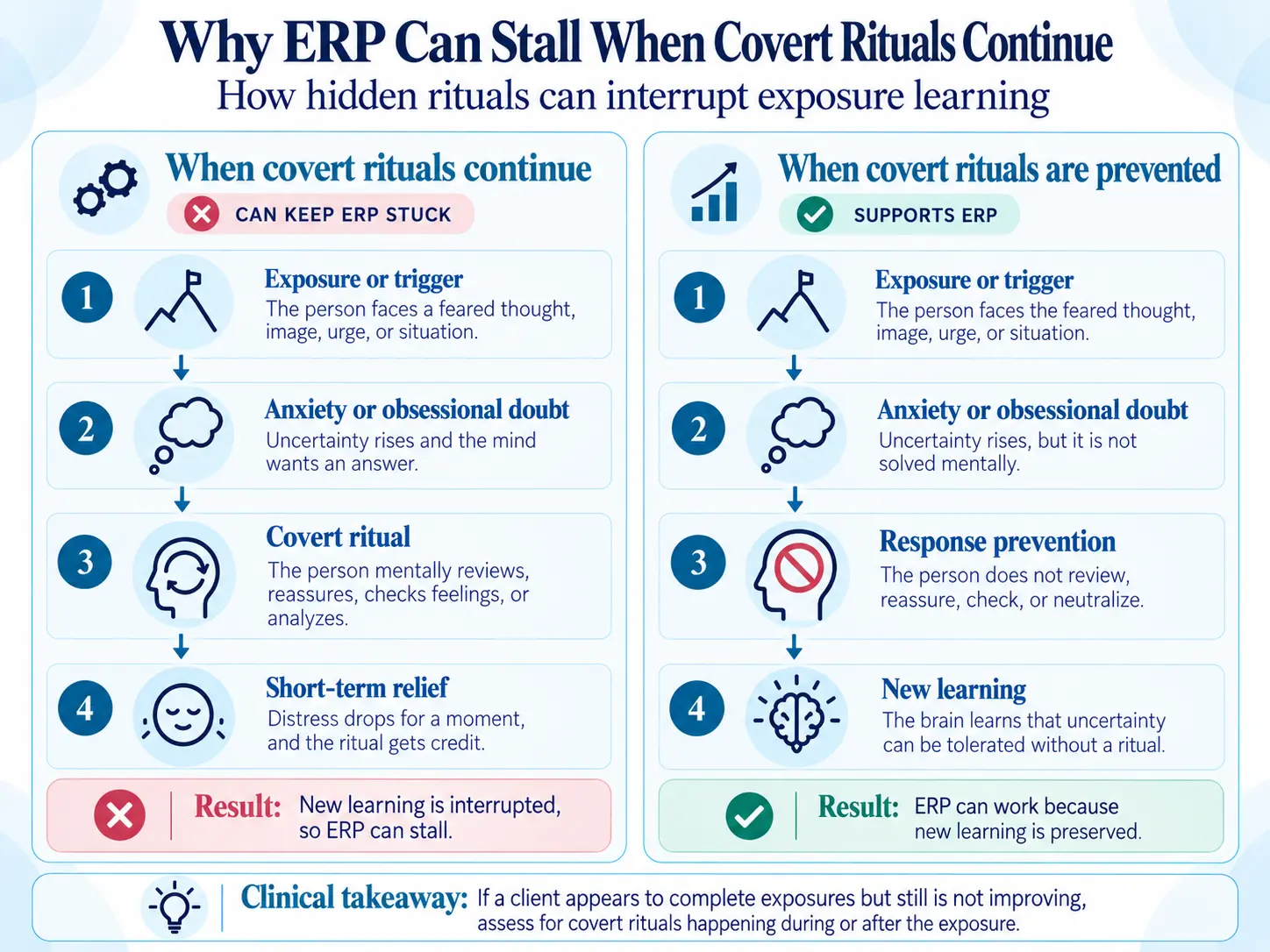
Recognizing that pattern starts with knowing what covert rituals can look like, because mental compulsions take several forms that clients may not initially identify as compulsive.
A Taxonomy of Mental Compulsions in OCD
Mental compulsions are internal actions performed in response to obsessional doubt or distress. Mancebo and colleagues describe mental rituals such as silently repeating words or phrases, praying, counting, mental checking, thinking “good” or “safe” thoughts, and neutralizing distressing images. Pinciotti and colleagues similarly identified mental review, replaying, checking, neutralizing, praying, and rewriting or replacing thoughts. Importantly, some clients do not recognize these activities as rituals until treatment makes their function explicit.
Clinical prevalence estimates vary by sample and definition. In one longitudinal treatment-seeking sample, 12.9% of participants reported mental rituals as their primary compulsion and another 20.4% reported current mental rituals that were not primary. Earlier studies reviewed by the authors reported different rates. These figures should be understood as clinical-sample findings, not population prevalence estimates for “Pure O.”
Four overlapping categories provide a useful framework for assessment:
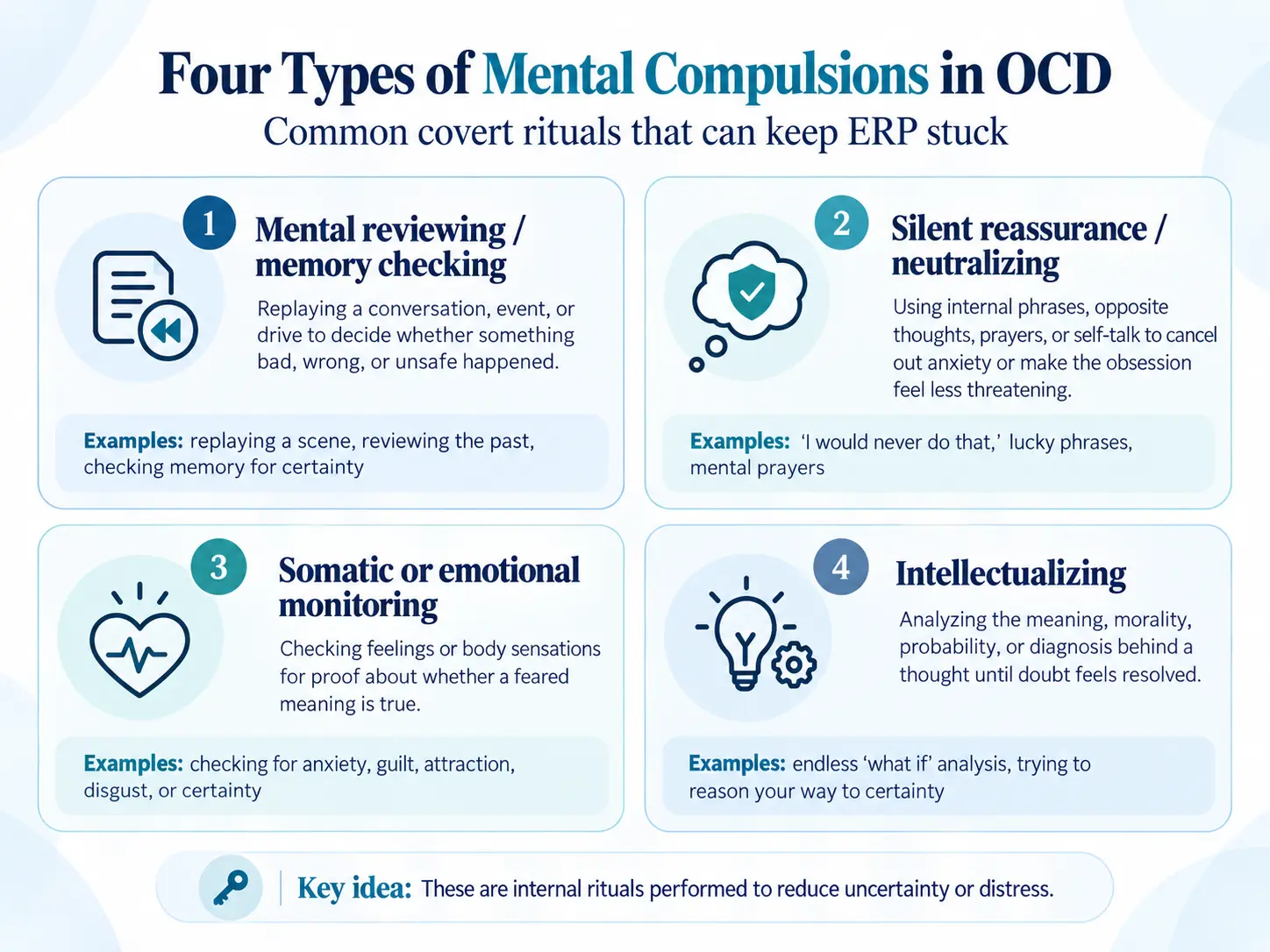
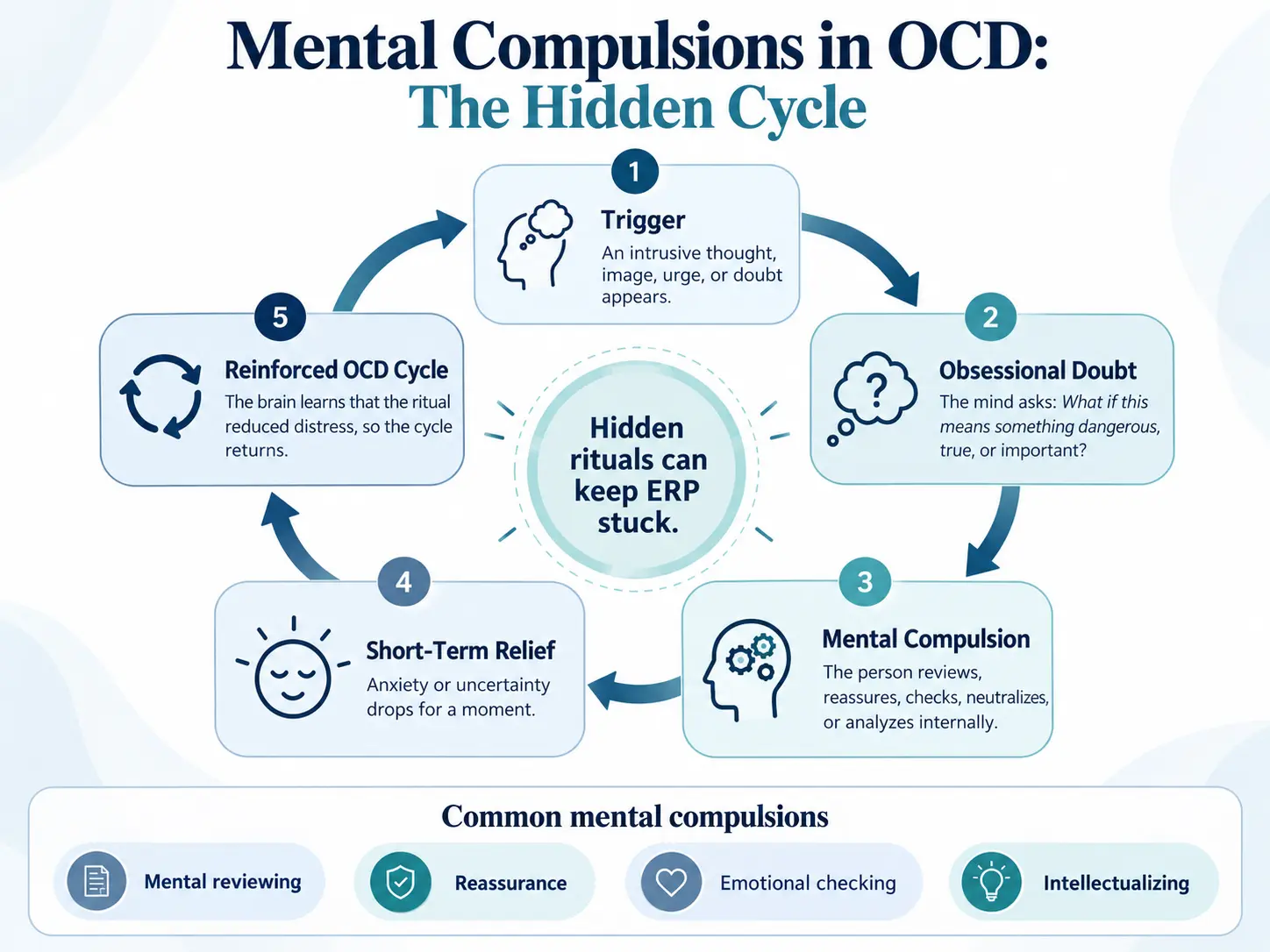
The visual above provides a quick overview of the four most common types of mental compulsions, while the table below adds more detail on how each one tends to appear in clinical practice.
| Compulsion type | What it can look like | Typical function |
|---|---|---|
| Mental reviewing / memory checking | Replaying a scene, conversation, drive, or decision to compare it with a mental standard of “safe,” “correct,” or complete. | Turns uncertainty about what happened into a search for certainty. |
| Mental reassurance / neutralizing | Silently repeating reassuring phrases, countering a thought with its opposite, praying as a ritual, or generating a “safe” explanation. | Attempts to reduce the emotional charge of the obsession or cancel its meaning. |
| Somatic or emotional monitoring | Scanning for anxiety, arousal, disgust, guilt, attraction, certainty, or another internal state and treating the feeling as evidence. | Uses a feeling or bodily reaction to answer an uncertain question. |
| Intellectualizing / unanswerable-question solving | Analyzing the meaning, morality, probability, diagnosis, or origin of a thought until the question feels resolved. | Substitutes repeated analysis for tolerating uncertainty. |
These categories frequently overlap. Marcus's replay combined memory checking with emotional monitoring: he examined both what he remembered and how guilty he felt. That overlap is why a single intake question such as “Do you have any rituals?” often misses important information. The client may answer “no” honestly because the activity feels like thinking, remembering, or problem solving rather than a compulsion.
OCD Mental Checking: When Reviewing Becomes a Compulsion
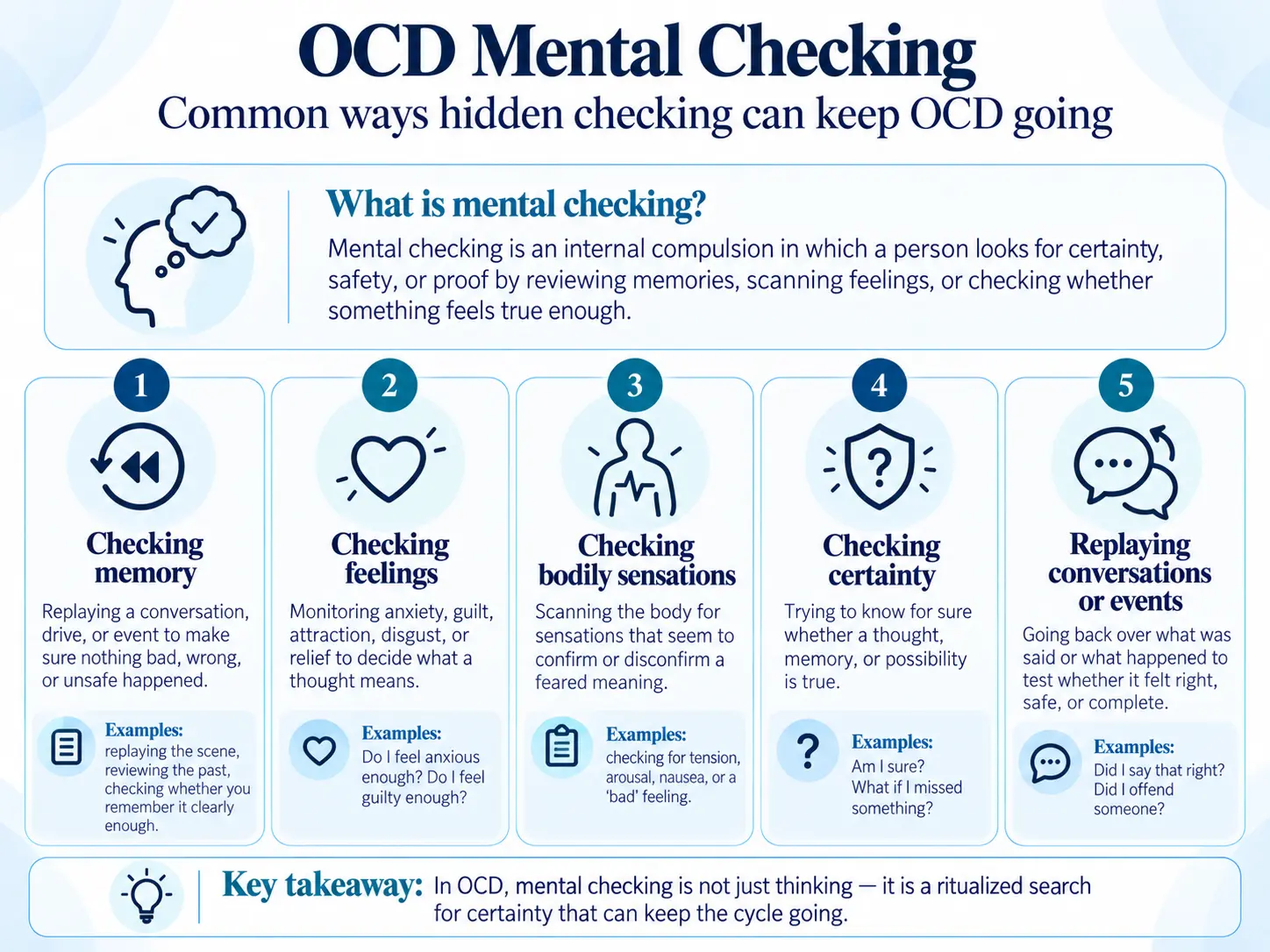
Mental checking is not limited to asking, “Did I lock the door?” internally. It can involve repeatedly testing memory, emotion, bodily sensation, intention, or certainty. The defining feature is functional: the person checks an internal source of information in an attempt to settle obsessional doubt.
- Replaying an event to determine whether something dangerous, immoral, or embarrassing happened.
- Testing memory for a detail that would prove safety or responsibility.
- Checking whether an intrusive thought “felt intentional.”
- Monitoring anxiety, guilt, arousal, attraction, or disgust for evidence about what the thought means.
- Rechecking whether a previous answer still feels certain enough.
A useful assessment question is: “What are you hoping the checking will tell you, and how do you know when you have checked enough?” If the endpoint is a feeling of certainty, safety, moral clarity, or internal “rightness,” the checking may be functioning as a compulsion.
How Does Treatment for “Pure O” OCD Address Mental Compulsions?
“Pure O” is not a separate DSM diagnosis or a formal OCD subtype. Clinically, the label is often used for presentations in which intrusive thoughts are prominent and rituals are less observable. Treatment therefore begins with a careful functional assessment rather than an assumption that response prevention is unnecessary.
When assessment identifies covert rituals, ERP can be adapted so that response prevention includes those internal behaviors. A driving exposure, for example, is not response prevention if the client spends the next 20 minutes mentally reconstructing the drive for reassurance. Similarly, an imaginal exposure may be followed by silent neutralizing, repeated prayer, feeling checks, or a new round of analysis.
Other evidence-based or emerging OCD treatment models may also inform the treatment plan. Metacognitive approaches emphasize changing the relationship to thoughts and disengaging from extended rumination. Inference-Based CBT focuses on the reasoning processes that generate obsessional doubt. These approaches are conceptually distinct from ERP, and treatment selection should reflect the client, clinician training, and the available evidence rather than treating any one model as universally necessary.
Uncover the Mental Rituals Keeping ERP Stuck
Use the Mental Compulsion Assessment Toolkit to identify covert rituals, plan stronger response-prevention targets, and track progress more clearly.
- Spot hidden reviewing, reassurance, checking, and intellectualizing
- Use structured questions to assess what the mental ritual is trying to accomplish
- Build response-prevention targets for exposures and the post-exposure window
- Give clients a practical Mental Compulsion Log to use between sessions
How to Identify Possible Mental Rituals During a Session
Because a mental compulsion is not directly observable, clinicians should be cautious about inferring one from appearance, eye movement, pauses, or body language. Behavioral observations may prompt curiosity, but the assessment rests on the client’s description of what happened internally and the function of that activity.
Language can provide useful openings for functional assessment. A client may say:
- “I just need to figure out…”
- “I was trying to convince myself that…”
- “I kept thinking back to see if…”
- “I needed to know whether I really felt…”
- “I went over it again to make sure…”
None of these phrases proves that a compulsion is occurring. The next step is to ask what the client was trying to accomplish. Did the mental activity reduce uncertainty or distress? Did it need to be repeated? What sign told the client that the process was complete? What happened when the client tried not to do it?
The Mental Compulsion Log
A simple log can make covert rituals easier to identify across sessions. Alongside the exposure or trigger, record what happened internally during the next several minutes: the client’s attention, reviewing, self-reassurance, feeling checks, mental neutralizing, avoidance, and the point at which the process stopped.
The International OCD Foundation’s ERP guidance emphasizes assessing obsessions, compulsions, and avoidance patterns when planning treatment. Revisit the log periodically rather than treating assessment as complete after intake, because clients may recognize previously unnoticed rituals as treatment progresses and old rituals are blocked.
| Log field | What to capture |
|---|---|
| Trigger or exposure | What happened? |
| Obsessional doubt | What did the client fear the event might mean? |
| Mental response | What did the client review, check, neutralize, analyze, or avoid? |
| Function | What uncertainty, feeling, or feared conclusion was the client trying to resolve? |
| Duration / endpoint | How long did it continue, and what sign indicated it could stop? |
| Response-prevention target | What would it look like to allow the uncertainty without performing the ritual? |
Covert Compulsions ERP Must Target: A Detection-to-Intervention Map
A useful case-formulation sequence is: trigger -> obsessional doubt -> covert ritual -> short-term relief or a temporary sense of certainty -> continued reliance on the ritual. The ritual is not maintained because it solves the feared problem reliably; it is maintained because it temporarily changes the client’s relationship to uncertainty.
| Ritual type | Example client language | Neutral follow-up question | Possible response-prevention target |
|---|---|---|---|
| Memory reviewing | “I keep replaying the scene until it feels accurate.” | “How long does the replay usually last, and what tells you it is finished?” | Allow uncertainty about the memory without replaying it to completion. |
| Mental reassurance / neutralizing | “I tell myself the opposite thought or search for the perfect answer.” | “What are you hoping the answer will settle?” | Refrain from mentally answering or canceling the obsession; allow the question to remain unresolved. |
| Somatic / emotional monitoring | “I check whether I feel anxious, certain, guilty, or disgusted enough.” | “What would it mean if the feeling were unclear or changed from moment to moment?” | Allow internal sensations and emotions to remain ambiguous without using them as evidence. |
| Intellectualizing | “I keep analyzing the meaning, morality, or probability until doubt disappears.” | “Has the analysis ever stayed finished, or does another version of the question return?” | Disengage from solving an inherently uncertain question and return to chosen activity without testing whether the doubt is gone. |
The neutral-question column matters. Asking “Are you doing a mental compulsion right now?” may invite a debate about whether a thought counts as a ritual. Functional questions gather more useful data: What did the thinking accomplish? What would happen if it remained incomplete? What made the client feel permitted to stop?
OCD Rumination Treatment: Targeting Mental Rituals During ERP
Not every extended thought process is an OCD compulsion. Clinicians need to distinguish reflection and practical problem solving from rumination that functions to neutralize doubt. The content may look similar; the purpose and endpoint are different.
| Process | Primary goal | Typical endpoint |
|---|---|---|
| Problem solving | Identify an actionable solution to a solvable problem. | Usually stops when a reasonable action or decision is identified. |
| Reflection | Understand or process an experience. | Can end even when some ambiguity remains. |
| OCD rumination / intellectualizing | Eliminate uncertainty, prove what a thought means, or obtain a feeling of certainty. | Continues, restarts, or shifts questions because certainty does not hold. |
This distinction changes the intervention. Practical problem solving may call for a decision. Healthy reflection may call for time and perspective. Compulsive rumination calls for response prevention: noticing the urge to solve the obsessional question without continuing the mental ritual until it “feels right.”
Attentional Disengagement Without Turning Attention Into Avoidance
Intrusive thoughts arise automatically. Extended rumination, by contrast, is a process clinicians can help clients learn to disengage from. IOCDF materials on mindfulness and metacognitive approaches describe noticing thoughts and sensations without trying to settle them and redirecting attention toward the present task.
The functional caution is essential. Redirecting attention is not meant to prove that the thought is harmless, force anxiety down, or test whether the obsession has stopped. If a client shifts attention repeatedly to check whether distress has disappeared, the strategy can become a new ritual.
Ask: “Are you returning attention to what you chose to do, or are you using the shift to find out whether the thought is gone or the anxiety is lower?” The wording matters less than the function.
Inference-Based CBT and Obsessional Doubt
Inference-Based Cognitive Behavioral Therapy (I-CBT) approaches OCD from a different conceptual angle than ERP. Aardema, O’Connor, Emmelkamp, Marchand, and Todorov described inferential confusion as a reasoning process in which imagined possibilities are given disproportionate weight relative to direct, reality-based information. I-CBT focuses on how obsessional doubt is constructed and on restoring trust in information grounded in the present situation.
A recent multisite randomized non-inferiority trial by Wolf and colleagues compared I-CBT with standard CBT for OCD and adds to a growing evidence base for the approach. IOCDF’s treatment guide likewise describes I-CBT’s assessment model, treatment modules, and current evidence limitations.
I-CBT should not be described as merely an add-on that clinicians generally use alongside ERP. It is a distinct treatment model that can be delivered without an ERP component. For a clinician reading this article, its greatest relevance is conceptual: it offers another framework for understanding obsessional doubt and inferential confusion, particularly when a client repeatedly privileges hypothetical possibilities over direct information. The current evidence base supports serious consideration of the model without establishing it as a universal replacement for ERP.
Practicing Uncertainty Without Turning the Script Into Reassurance
For a client caught in repeated analysis, arguing with the obsession can become additional material for the ritual. One response-prevention strategy is to acknowledge uncertainty briefly rather than continuing the debate: “Maybe. I do not know for certain, and I am not going to solve that question right now.”
The exact words are not the intervention. Their function is. If the client repeats the phrase until calm, scans for relief, or uses it as proof that nothing bad happened, the script has become reassurance in a different form. A more useful marker is whether the client can acknowledge uncertainty and return to chosen activity without checking whether the strategy worked.
Obsession vs. Mental Compulsion vs. Rumination
These terms are often blurred in everyday language. A functional comparison can help clinicians formulate what is happening rather than relying on labels alone.
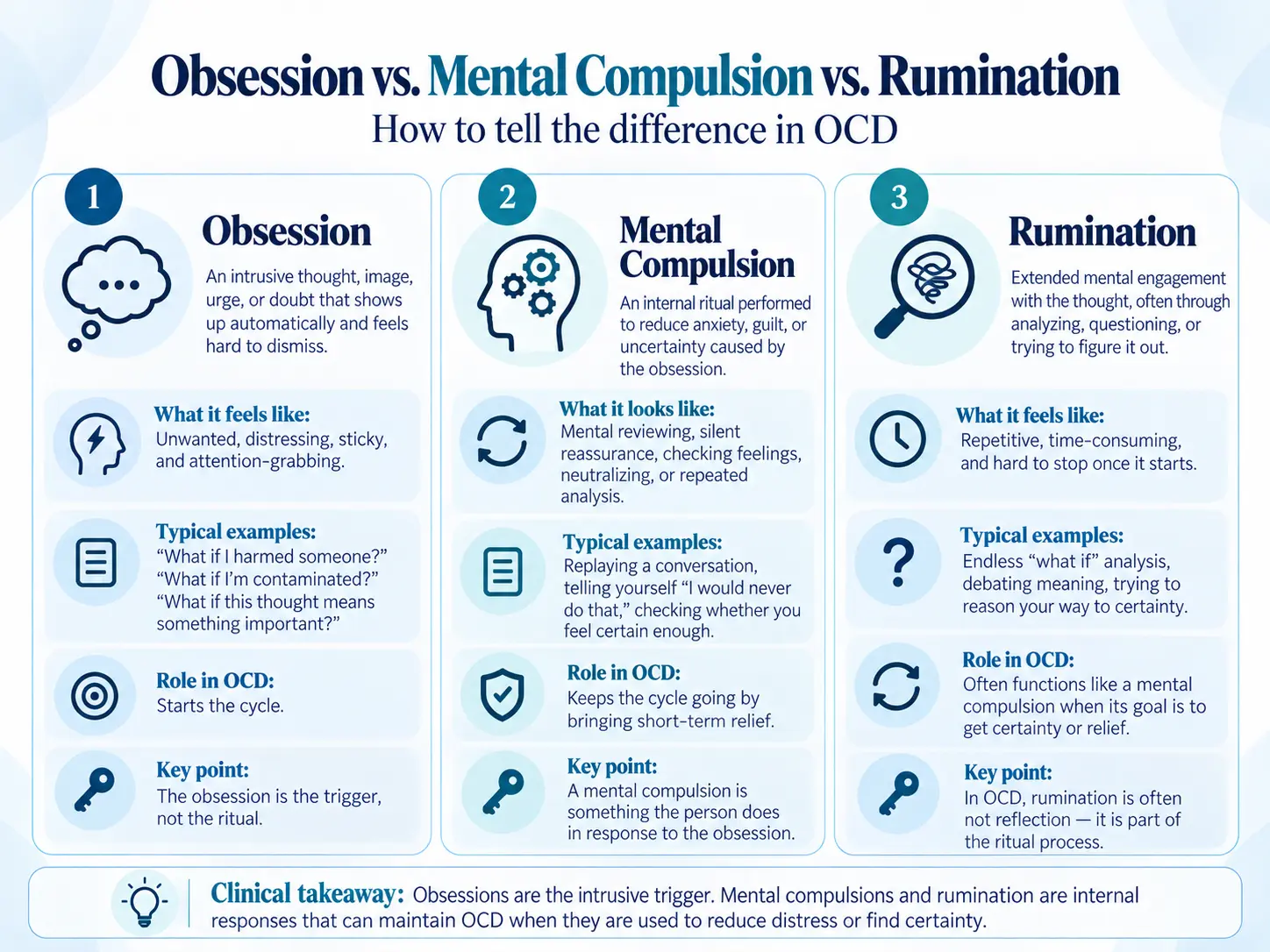
| Process | What it is | Common features | Clinical significance |
|---|---|---|---|
| Obsession | Intrusive thought, image, urge, or doubt. | Often arrives automatically and is experienced as unwanted or distressing. | Acts as the trigger or source of obsessional doubt. |
| Mental compulsion | Internal action performed in response to distress or doubt. | Reviewing, reassuring, neutralizing, checking, counting, praying, or analyzing. | Attempts to reduce distress, prevent a feared outcome, or obtain certainty; can maintain the OCD cycle. |
| Reflection / ordinary rumination | Extended thinking about an event or concern. | May involve analysis, meaning making, or problem solving. | Its role depends on function; it is more suggestive of a compulsion when the person feels driven to continue until uncertainty or distress is resolved. |
Documenting Covert Rituals Without Adding More Administrative Work
As previously hidden rituals emerge, the treatment record may need to capture changing obsessional themes, exposure targets, response-prevention strategies, the client’s response, and newly identified maintaining processes. That can become difficult when clinically important details are scattered across free-text notes.
A behavioral health EHR designed around structured clinical documentation can make those changes easier to track across sessions and support a clearer connection among symptoms, interventions, response, and the treatment plan.
ICANotes Behavioral Health EHR helps behavioral health clinicians document care with structured, menu-driven tools, integrated practice-management capabilities, and optional AI features. Start a 30-day free trial with no credit card required, or talk with the ICANotes team at 866-847-3590.
Document OCD Treatment With Clarity From Trigger to Response Prevention
Track emerging covert rituals, response-prevention targets, and treatment-plan changes across sessions with structured documentation built for behavioral health.
- Capture obsessions, compulsions, and avoidance patterns
- Link exposure targets to response-prevention strategies
- Track changing obsessional themes across sessions
- Start a 30-day free trial, no credit card required
See how ICANotes can support your clinical documentation workflows. Start your free 30-day trial, no credit card required.
Start Your Free 30-Day Trial
Frequently Asked Questions
What are mental compulsions in OCD?
What are examples of mental compulsions in OCD?
What is OCD mental checking?
Is rumination a compulsion in OCD?
Does “Pure O” OCD involve compulsions?
Why can ERP stall when mental compulsions are missed?
How is I-CBT different from ERP for OCD?
References
- Williams, M. T., et al. “The Myth of the Pure Obsessional Type in Obsessive-Compulsive Disorder.” https://pmc.ncbi.nlm.nih.gov/articles/PMC3227121/
- OCD-UK. “Does Pure O Exist?” https://www.ocduk.org/ocd/pure-o
- Mancebo, M. C., et al. “Prevalence and Clinical Characteristics of Mental Rituals in a Longitudinal Clinical Sample of OCD.” https://pmc.ncbi.nlm.nih.gov/articles/PMC3188668
- Pinciotti, C. M., et al. “Common Rituals in OCD and Implications for Treatment.” https://pmc.ncbi.nlm.nih.gov/articles/PMC10527485
- Thornton, P. Anxiety & Depression Association of America. “Demystifying Mental Compulsions and ‘Pure-O.’” https://adaa.org/learn-from-us/from-the-experts/blog-posts/consumer/demystifying-mental-compulsions-and-pure-o
- Cognitive Behavior Institute of Pennsylvania. “Mental Compulsions in OCD: What They Are & What Treatment May Look Like.” https://papsychotherapy.org/blogs/mental-compulsions-in-ocd-what-they-are-what-treatment-may-look-like
- International OCD Foundation. “Exposure and Response Prevention.” https://iocdf.org/about-ocd/ocd-treatment-guide/erp
- “Common Pitfalls in Exposure and Response Prevention for OCD.” https://pmc.ncbi.nlm.nih.gov/articles/PMC3423997
- “Exposure and Response Prevention in the Treatment of OCD: Current Perspectives.” https://pmc.ncbi.nlm.nih.gov/articles/PMC6935308
- Aardema, F., O’Connor, K., Emmelkamp, P., Marchand, A., & Todorov, C. “Inferential Confusion in Obsessive-Compulsive Disorder.” https://pubmed.ncbi.nlm.nih.gov/15680927
- Wolf, A., et al. “Inference-Based CBT versus CBT for OCD.” https://pmc.ncbi.nlm.nih.gov/articles/PMC11614422
- International OCD Foundation. “Inference-Based Cognitive Behavioral Therapy (I-CBT).” https://iocdf.org/about-ocd/ocd-treatment-guide/i-cbt
- International OCD Foundation. “Mindfulness and Cognitive Behavioral Therapy for OCD.” https://iocdf.org/expert-opinions/mindfulness-and-cognitive-behavioral-therapy-for-ocd
- International OCD Foundation. “Metacognitive Approaches to OCD Treatment.” https://iocdf.org/about-ocd/ocd-treatment-guide/metacognitive
- National Institute of Mental Health. “Obsessive-Compulsive Disorder” prevalence fact sheet. https://www.nimh.nih.gov/sites/default/files/documents/health/statistics/prevalence/file_5.pdf
Katie Cox
Katie Cox, MA, LPCC is a Licensed Professional Clinical Counselor with over 10 years of clinical experience working with adolescents and adults. Her areas of expertise include anxiety, depression, OCD, life transitions, self-esteem, career concerns, and women's mental health. Katie utilizes evidence-based, client-centered approaches to help individuals develop practical coping skills, increase emotional awareness, and achieve their personal goals. Through her clinical work and writing, she is committed to making mental health information accessible, practical, and empowering.