How to Choose an EHR for a Community Mental Health Center
Learn how to choose community mental health center EHR software that supports multi-program documentation, Medicaid billing, compliance, and coordinated care across outpatient, crisis, case management, PRP, and SUD services.


Community mental health centers run more programs under one roof than almost any other behavioral health setting. Outpatient therapy, psychiatric medication management, crisis response, case management, psychiatric rehabilitation, and substance use treatment often share the same building, the same clients, and the same overworked administrative team. If your agency's EHR was built for a solo therapist's caseload, you already know what happens next: duplicate charting, disconnected reports, and staff who spend evenings finishing notes they couldn't complete during an 8-hour shift.
This guide is for the people who have to fix that, and who will have to defend the decision afterward: clinical directors, IT and operations leads, and program managers evaluating community mental health center EHR software for agencies running roughly 50 to 200-plus staff across outpatient, crisis, case management, psychiatric rehabilitation program (PRP), and substance use disorder (SUD) services, most of it billed to Medicaid or funded by grants. If you searched for an EHR for a community mental health center expecting a straightforward feature list, the honest answer is that the selection criteria run deeper than most vendor pages let on.
Key Takeaways
- A community mental health center EHR software platform has to support one client record across multiple programs and service lines, not a single-provider workflow adapted with extra permissions.
- The Centers for Medicare & Medicaid Services (CMS) sets Conditions of Participation for CMHCs at 42 CFR 485.904 through 485.918, covering interdisciplinary treatment teams, active treatment plans, quality assessment and performance improvement (QAPI), and emergency preparedness. Your EHR should map directly to these obligations.
- According to the Office of the National Coordinator for Health IT's (ONC) 2024 data brief, 68% of substance use and mental health treatment facilities used an EHR only, 25% used both an EHR and paper charts, and just 19% participated in a health information exchange.
- CCBHC and CMHC are not the same designation, and the difference changes which requirements matter most in your EHR evaluation.
- The strongest way to protect your decision is a structured, scored live demo and a written 90-day implementation plan, not a features checklist alone.
What Is an EHR for a Community Mental Health Center, and How Is It Different From a Private-Practice EHR?
An EHR for a community mental health center has to do something a private-practice EHR was never asked to do: hold one longitudinal record for a client who might see a psychiatrist for medication management, a case manager for housing and benefits navigation, a PRP group facilitator twice a week, and a crisis clinician during an after-hours call, all inside the same agency. A private-practice EHR is built around a single clinician's caseload and a single billing relationship. A CMHC EHR has to coordinate across programs, funding streams, and supervisory structures without losing the thread of who did what, when, and under which treatment plan.
That difference shows up in the SERP for this topic. Most of the buyer's guides ranking for behavioral health EHR for CMHC organizations are written for solo and small-group practices, addiction treatment centers, or generic "behavioral health" organizations. Few of them walk through what it means to run outpatient, crisis, case management, PRP, and SUD programs as one operating model with one reporting structure to a state Medicaid agency and a set of grant funders. That operating model, not a longer feature list, is the real starting point for evaluating community mental health center EHR software.
CMHC or CCBHC? Why the Label Matters for Procurement
Not every community-based behavioral health provider is regulated the same way, and vendors sometimes blur the two. A Community Mental Health Center is a facility type recognized under Medicare's Conditions of Participation, codified at 42 CFR 485.904 through 485.918, which govern personnel qualifications, client rights, interdisciplinary treatment planning, QAPI, and emergency preparedness. A Certified Community Behavioral Health Clinic (CCBHC) is a separate, federally defined model created under the Protecting Access to Medicare Act of 2014, requiring a minimum of nine core outpatient services, including 24/7 mobile crisis response, according to the Substance Abuse and Mental Health Services Administration (SAMHSA). CCBHCs can operate under a Section 223 Medicaid demonstration, a SAMHSA expansion grant, or an independent state program.
| Dimension | CMHC | CCBHC |
|---|---|---|
| Regulatory basis | Medicare's Conditions of Participation, 42 CFR 485.904 through 485.918 | Federal model created under the Protecting Access to Medicare Act of 2014 |
| Core obligations | Personnel qualifications, client rights, interdisciplinary treatment planning, QAPI, emergency preparedness | A minimum of nine core outpatient services, including 24/7 mobile crisis response, per SAMHSA |
| Operating path | Recognized facility type under Medicare | Section 223 Medicaid demonstration, a SAMHSA expansion grant, or an independent state program |
Some agencies are both. If yours is either, know which set of obligations you're buying software against. A CMHC evaluation leans on the CMS Conditions of Participation described above. A CCBHC evaluation, when you're shopping specifically for an EHR for CCBHC operations, adds SAMHSA's nine-service reporting requirements on top of that. Ask any vendor, including ICANotes, to show you which set of requirements their reporting and documentation templates were actually built to support.
The Short Answer: A CMHC EHR Selection Checklist
If you read nothing else, evaluate any candidate for the best EHR for community mental health centers against this list before you schedule a demo:
- One record, multiple programs. Can outpatient, crisis, case management, PRP, and SUD staff all document in the same client chart with role-based permissions, rather than separate silos?
- Treatment plan linkage. Does every note connect back to an active, interdisciplinary treatment plan, the way CMS's Conditions of Participation require?
- Medicaid and grant reporting. Can the system produce the state Medicaid behavioral health EHR reports and grant-specific outcome exports your funders already require, not just standard claims?
- Sliding-scale and secondary billing. Does the sliding-scale billing behavioral health EHR workflow calculate client responsibility, then track that balance alongside Medicaid or grant coverage rather than as an afterthought?
- 42 CFR Part 2 workflow. Is this a genuinely 42 CFR Part 2 compliant EHR, with SUD consent capture, record segmentation, and disclosure logs, not just a compliance badge?
- Accreditation evidence. Is it CARF compliant EHR software in practice, able to export the documentation trail a CARF or Joint Commission surveyor will actually ask to see?
- Interoperability. Does behavioral health EHR interoperability here mean a real connection to your state's HIE, labs, e-prescribing/PDMP networks, and referral partners, or only a promise that it's "FHIR-ready"?
- Staff onboarding. Can a new hire chart correctly on day one using role-based templates, without shadowing a tenured staff member for weeks?
- Vendor references at your scale. Will the vendor connect you with an agency of similar staff count and payer mix, not just a logo wall?
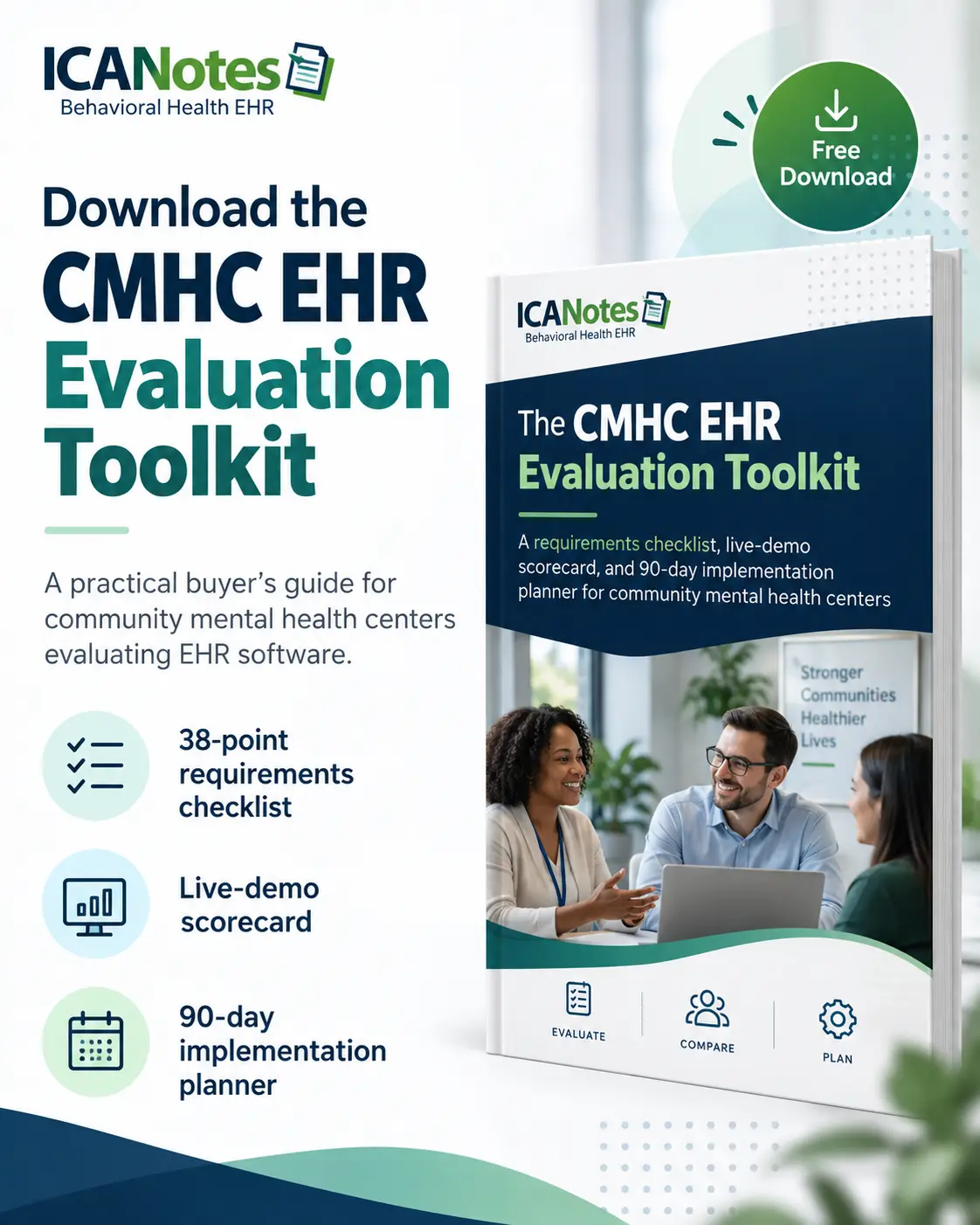
Free CMHC EHR Evaluation Toolkit
Take the guesswork out of choosing the right EHR for your community mental health center. Download our free toolkit to compare vendors, evaluate critical capabilities, and plan a successful implementation.
- Prioritize essential features with a 38-point EHR requirements checklist.
- Compare vendors confidently using structured questions and a side-by-side evaluation worksheet.
- Put software to the test with a live-demo scorecard covering nine critical clinical and operational workflows.
- Plan your transition with a practical 90-day implementation checklist.
Mapping Your Operating Model to EHR Requirements
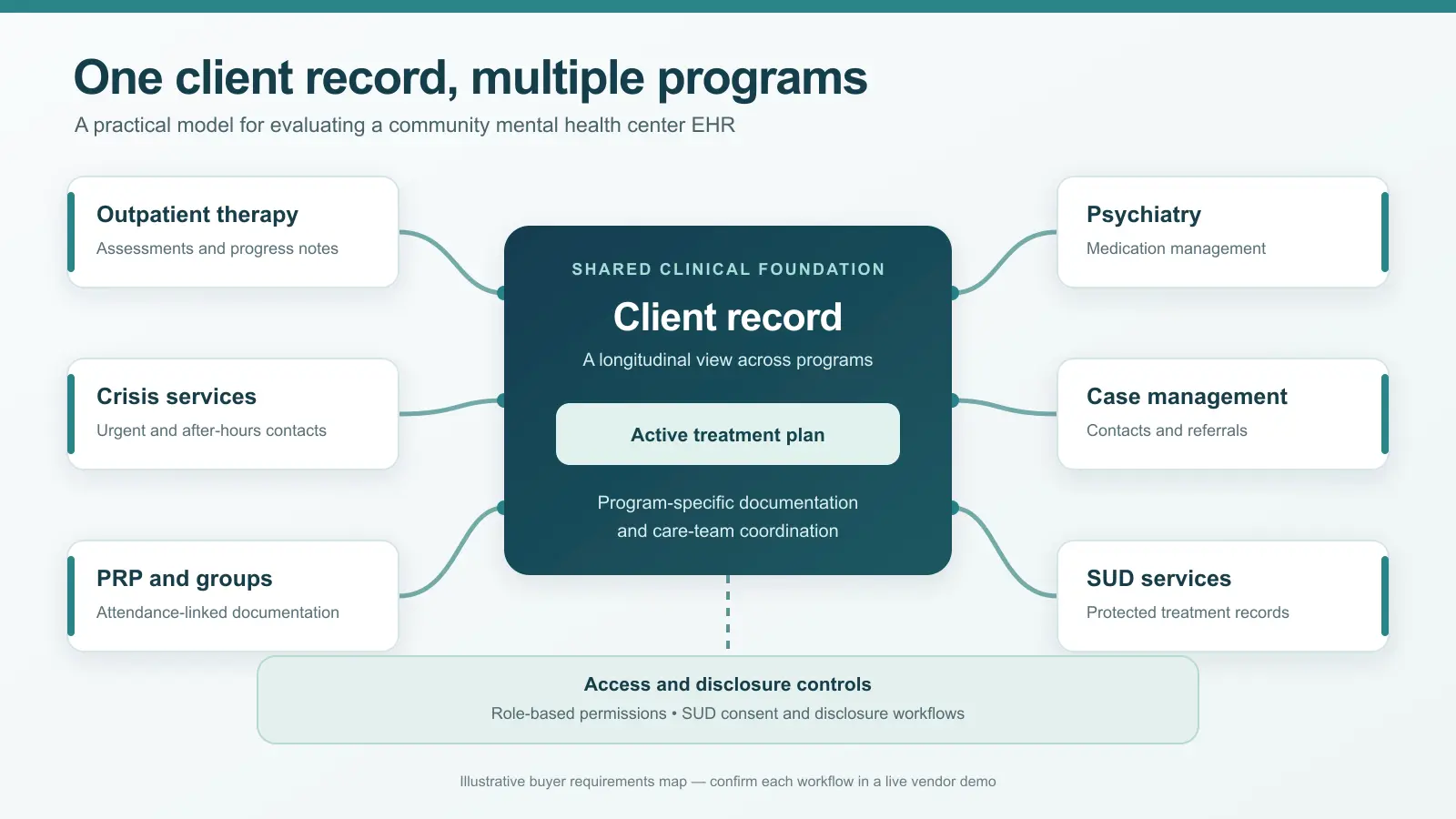
A CMHC's documentation needs are really a map of its service lines, and the EHR has to follow that map without forcing staff to re-enter the same information for every program.
Multi-program documentation
Outpatient therapy notes, psychiatric progress notes, case management contacts, PRP group notes, and SUD treatment notes all need their own structure, but they need to live in the same chart. When a psychiatrist orders a medication change, the case manager and group facilitator should see it without a phone call.
Care coordination
Interdisciplinary treatment teams are not optional under CMS's Conditions of Participation. Your EHR should let every discipline see the active treatment plan, log progress against it, and flag when a goal needs revision, in view of the whole team rather than one department.
Crisis services
Crisis contacts happen outside normal scheduling and often outside normal staffing. The system needs a fast intake path that still ties back to the client's existing record and treatment plan, so a crisis clinician isn't documenting blind at 2 a.m.
SUD and 42 CFR Part 2 programs
Substance use treatment records carry federal confidentiality protections that behavioral health records alone do not. Your EHR needs a way to segment that data, capture proper consent, and log every disclosure, a workflow addressed in more depth below.
PRP and group services
Psychiatric rehabilitation and group therapy both require attendance-linked documentation, since payer eligibility often depends on who actually attended a given session. A single group note should populate each attendee's individual chart without manual duplication.
Treatment plans as the connective layer
Every note type above should trace back to the same active treatment plan. That's what turns a pile of documentation into the "person-centered active treatment" CMS's Conditions of Participation actually require.
Medicaid, Grants, Sliding-Scale Billing, and State Reporting
Most community mental health centers are Medicaid-dependent, grant-dependent, or both, and that reality should shape the evaluation as much as clinical workflow does. The Kaiser Family Foundation's 2022 survey of state Medicaid officials found that mental health clinic services were a covered benefit in 44 responding states, with one state reporting no coverage and six states not reporting, evidence that a Medicaid behavioral health EHR claim from a vendor does not translate the same way in every state. Before you assume any vendor's "Medicaid support" applies to your state, ask them to walk through your specific state's authorization, billing modifier, and reporting rules in the demo.
A CMHC EHR should handle:
- Medicaid eligibility and managed-care authorizations, including behavioral-health carve-outs where your state routes mental health benefits through a separate managed care entity.
- Sliding-scale billing workflows that calculate client responsibility based on income and household size, then track that balance alongside Medicaid or grant coverage rather than as an afterthought.
- Secondary billing, since many CMHC clients carry Medicaid as secondary coverage after a primary payer or after a spend-down.
- Grant-specific outcome reporting, exported in the format your funders require, not just a generic productivity report.
- State reporting interfaces, since many states operate their own behavioral health data systems that expect specific extracts on a specific schedule.
California's public behavioral health system illustrates the operational scale involved: CalMHSA reports that 27 counties participate in its semi-statewide EHR program, reaching 35% of the state's Medi-Cal beneficiaries, according to CalMHSA. That is one state's approach to solving county-level Medicaid reporting at scale. Yours may look nothing like it, which is exactly why a state-specific reporting conversation belongs in your evaluation rather than a generic sales deck.
Interoperability: HIEs, FHIR/HL7, Labs, Pharmacies, Referral Partners, and State Systems
"Interoperable" gets used loosely in behavioral health software marketing. For a CMHC, it needs to mean something specific: can this system actually exchange data with the health information exchange (HIE) in your state, the labs and pharmacies your clients use, the primary care and hospital partners you coordinate with, and the state behavioral health data system you report to.
The gap is real. ONC's 2024 data brief, based on survey responses from 21,205 of 23,948 eligible facilities (a 90.4% response rate), found that only 19% of substance use and mental health treatment facilities participated in an HIE, while 67% reported no knowledge of one operating in their service area. If your agency is part of that majority, an EHR evaluation is also an opportunity to close that gap, not just preserve the status quo.
When you evaluate behavioral health EHR interoperability claims, ask for specifics rather than acronyms:
- Which HIE, if any, does the vendor already connect to in your state?
- Does the platform support FHIR and HL7 interfaces for lab and pharmacy data, or only claim general "API access"?
- Can referral information flow both directions with your primary care and hospital partners, or only out?
- What does the vendor's roadmap say about connecting to your specific state's behavioral health reporting system?
A vendor that answers with a named integration and a reference customer is telling you something different from a vendor that answers with a certification logo.
Compliance: HIPAA, 42 CFR Part 2, CMS Conditions of Participation, CARF, and the Joint Commission
Compliance in a CMHC setting is not a single checkbox. It's a stack of overlapping obligations, and your EHR needs to produce evidence for all of them, not just avoid violating them.
HIPAA sets the baseline for privacy, security, and access controls across every program in your agency.
42 CFR Part 2 governs substance use disorder treatment records specifically, and it is stricter than HIPAA in several respects. In daily operations, that means a genuinely 42 CFR Part 2 compliant EHR needs to support written consent capture before disclosure, segmentation of SUD records from the rest of the chart, restrictions on redisclosure by anyone who receives that data, a defined emergency-access process, and a complete, exportable disclosure log. A vendor that lists "42 CFR Part 2 compliant" as a bullet point should be able to walk you through each of those five elements in a live demo, not just confirm the badge.
CMS's Conditions of Participation for CMHCs, at 42 CFR 485.904 through 485.918, require an interdisciplinary treatment team, person-centered active treatment plans, a functioning quality assessment and performance improvement (QAPI) program, and emergency preparedness planning. Ask your EHR to show role-based permissions that support interdisciplinary access, treatment-plan-linked documentation, and exportable QAPI data, since those are the artifacts a CMS surveyor will expect to see.
CARF accreditation evaluates your organization's programs and evidence, not your software. What CARF compliant EHR software can do is generate the documentation trail CARF surveyors review: treatment plans updated on schedule, progress notes tied to those plans, and audit trails showing who documented what and when. Ask a vendor to show you a CARF-style documentation pull, not just a "CARF compliant" claim.
Joint Commission EHR compliance for behavioral health works the same way. The Joint Commission accredits more than 4,300 organizations under its behavioral health care manual, and its own resources on documentation compliance report that 66.37% of 1,811 behavioral health surveys in 2022 were not compliant with National Patient Safety Goal 15.01.01, the suicide-risk screening and documentation standard, according to a Joint Commission-published documentation resource. Treat that figure as evidence of how often documentation gaps, not clinical gaps, drive non-compliance, and let it shape what you ask an EHR to prove: structured suicide-risk screening tools, linked documentation, and an audit trail that shows the risk assessment was actually reviewed and acted on. Read our related guide on Joint Commission Compliance for Behavioral Health.
None of these accreditations live inside software. They live in how consistently your staff use it.
None of these accreditations live inside software. They live in how consistently your staff use it. That's the real argument for evaluating documentation burden and staff turnover as part of a compliance conversation, not a separate one. The Administration for Strategy and Performance (ASPE), in a report using 2020 N-MHSS data, found that information technology spending in behavioral health organizations averaged 1.8% of operating budgets, compared with 3.5% in general health care services, according to ONC's Behavioral Health and Health IT issue brief. That gap matters when you're deciding how much implementation and training support you can realistically fund, and it's a reason to weigh vendor training resources as heavily as feature lists.
Where ICANotes Fits Into This Model
Everything above describes what a CMHC needs from an EHR before any vendor enters the conversation. ICANotes was built exclusively for behavioral health, not adapted from a general medical record system, and several of its core capabilities map directly onto the operating model this guide describes.
For multi-program documentation, ICANotes offers menu-driven, customizable note templates covering Initial Assessments, Progress Notes, SOAP, BIRP, and DAP formats, Treatment Plans, Group Therapy Notes, Case Management and PRP notes, and Discharge Summaries, all inside a single client record. Documentation across a psychiatrist, a case manager, and a group facilitator can live in the same chart rather than in separate systems. For group and PRP services specifically, group note templates are designed to flow into each attendee's individual chart rather than requiring duplicate entry per client.
For clinical workload, ICANotes includes an ambient AI Scribe that listens during a session and drafts a compliant narrative note, with an average note completion time under three minutes according to ICANotes' own reported data, along with more than 100 built-in clinical rating scales, including the PHQ-9 and GAD-7, and DSM-5-aligned documentation. For prescribers on staff, e-prescribing with EPCS and PDMP integration supports psychiatric medication management within the same record used for therapy and case management notes.
For access and care coordination, role-based permissions let different disciplines see the parts of a shared chart relevant to their role, which supports the interdisciplinary access CMS's Conditions of Participation call for. Integrated, HIPAA-compliant telehealth is included on every plan, which matters for crisis follow-up and rural outreach without a separate telehealth contract. Billing functionality includes claims submission, ERA auto-posting, and secondary billing, relevant to agencies billing Medicaid as a secondary payer after another source. The platform holds ONC Health IT (Cures Act) certification.
That said, this guide's own checklist is the honest way to use this section: ask ICANotes, and any other vendor you evaluate, to demonstrate your state's specific Medicaid reporting rules, your grant funder's outcome format, and your 42 CFR Part 2 consent workflow directly in a live session. A features list, including this one, is a starting point for that conversation, not a substitute for it.
The Live-Demo Scorecard: What to Test Before You Sign
A sales demo shows you what a vendor wants you to see. A structured demo shows you what your staff will actually deal with. Before you sign anything, ask the vendor to perform these workflows live, in your own program's language, and score each one for clicks required, duplicate data entry, and whether the output is something you could hand to an auditor:
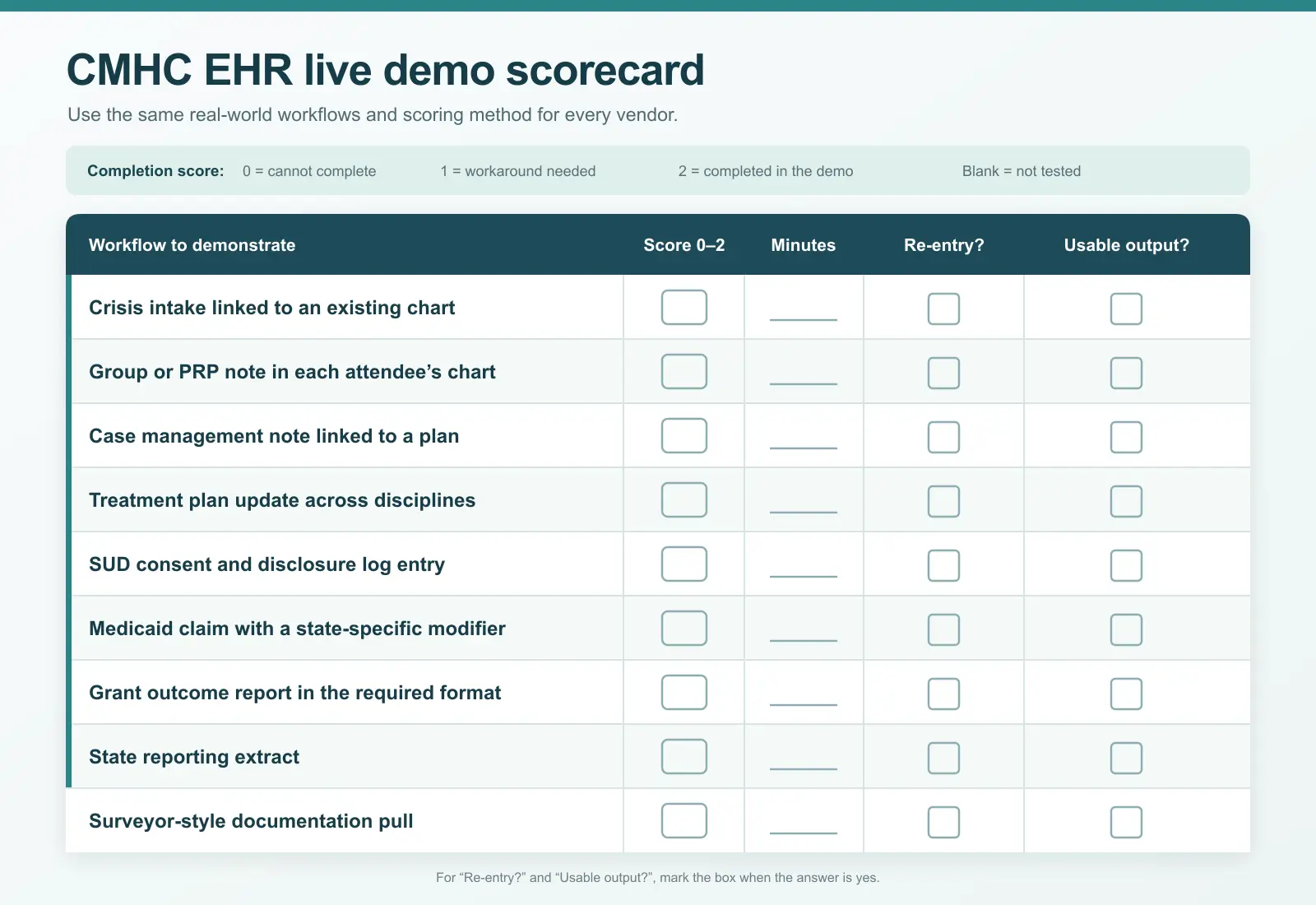
- A crisis intake that ties back to an existing client's chart.
- A group therapy or PRP note that populates multiple individual client records.
- A case management contact note linked to an active treatment plan.
- A treatment plan update reflecting a goal change across disciplines.
- An SUD consent capture and a corresponding disclosure log entry.
- A Medicaid claim, including any state-specific modifier your programs use.
- A grant outcome report in the format your funder actually requires.
- A state reporting extract, if your state operates its own behavioral health data system.
- A documentation pull that mirrors what a CARF or Joint Commission surveyor would request.
Score each item the same way you would score a clinical intervention: did it work, how long did it take, and would you trust the output in front of an auditor or a funder.
Your 90-Day Implementation and Migration Plan
Implementation risk is where CMHC-scale EHR decisions succeed or fail, and it deserves its own plan, built jointly by agency leadership, clinical leadership, IT, and billing.
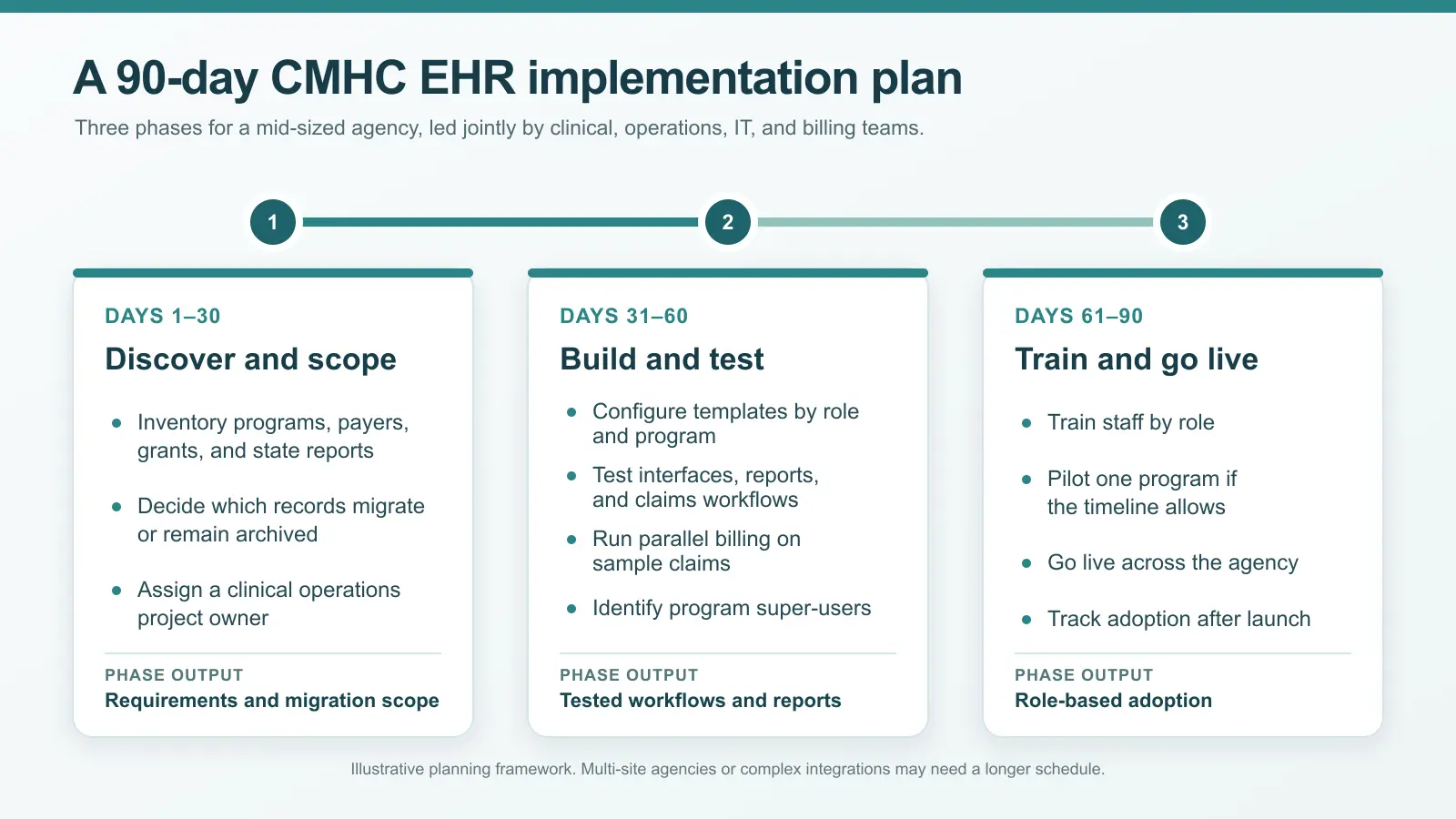
Days 1 to 30: Discovery
Inventory every program, payer, grant, and state reporting requirement your current system touches. Identify which historical records need to migrate versus which can be archived read-only. Assign an internal project owner from clinical operations, not IT alone, since documentation workflow decisions belong to clinicians and program managers.
Days 31 to 60: Build and test
Configure role-based templates by program. Test interfaces, including any state reporting extract, lab or pharmacy connection, and your primary payer's claims submission. Run parallel billing on a sample of claims before full cutover. Identify super-users in each program who will support their peers after go-live.
Days 61 to 90: Train, pilot, and go live
Train staff by role rather than in one generic session, since a crisis clinician and a billing specialist need almost nothing in common from the same training hour. Pilot the new system in one program before agency-wide rollout if your timeline allows it. Track adoption, not just go-live completion, since a staff member who reverts to old habits within two weeks is a bigger risk than a slow start.
Staff turnover deserves direct attention in this plan, not a footnote. Every CMHC leader already knows what happens when a trained staff member leaves: institutional knowledge about "how we actually chart X" walks out the door with them. Role-based templates, required fields, and built-in guidance reduce how much of that knowledge has to live in one person's head. Ask any vendor how a new hire, with no prior exposure to the system, would chart correctly on day one, and hold their answer to the same standard you'd hold a new clinical hire's orientation plan.
When a Small-Practice EHR or an Oversized Enterprise Platform Is the Wrong Fit
Not every EHR marketed to "behavioral health" is built for a CMHC, and it's worth naming both failure directions honestly.
A platform designed around a single clinician's caseload and cash-pay billing will struggle the moment you need interdisciplinary treatment teams, multi-program reporting, and Medicaid or grant-specific exports. You'll find yourself building workarounds for things the software assumes you don't need, like group attendance billing or state reporting extracts.
On the other end, an enterprise platform built for large hospital systems may bring reporting depth you don't need and an implementation timeline and cost structure sized for a much larger organization, along with a support model that assumes a dedicated internal IT department you may not have. If a vendor's own reference customers are all large hospital networks rather than agencies your size, ask directly whether their implementation and support model was actually built for a 50-to-200-plus-staff CMHC, or adapted from something bigger.
The right fit sits in between: a platform purpose-built for behavioral health operations at your scale, with implementation and training resources sized to your staff count and budget, not a generic practice tool stretched to cover an agency, or an enterprise system oversized for one.
See how one record can carry every program your CMHC runs
Start a free trial and test ICANotes against the checklist in this guide, from multi-program charting to 42 CFR Part 2 workflows.
- One client record across outpatient, crisis, PRP & SUD
- Treatment-plan-linked notes and role-based access
- Group notes that flow to each attendee's chart
- Secondary billing and claims for Medicaid payers
See how ICANotes can support your CMHC workflows. Start your free 30-day trial, no credit card required.
Start Your Free 30-Day Trial
Frequently Asked Questions
What is an EHR for a community mental health center?
What's the difference between a CMHC and a CCBHC?
Is 42 CFR Part 2 compliance a built-in EHR feature or something you configure?
How long does CMHC EHR implementation usually take?
Does an EHR make a CMHC CARF- or Joint Commission-accredited?
Choosing the right EHR is a decision your clinical staff, your billing team, your funders, and your next accreditation surveyor will all live with. A downloadable CMHC EHR requirements checklist or live-demo scorecard, built from the criteria in this guide, is the most useful next step for turning this article into a document you can actually bring into a vendor meeting or a board conversation. If that's a resource your team would use, it's worth requesting from any vendor you're evaluating, ICANotes included, before you sit down for a demo.
References
- 42 CFR Part 485, Subpart J: Conditions of Participation: Community Mental Health Centers (CMHCs), Electronic Code of Federal Regulations, Centers for Medicare & Medicaid Services, U.S. Department of Health and Human Services, January 1, 2024; https://www.ecfr.gov/current/title-42/part-485/subpart-J
- Electronic Health Record Adoption and Exchange Capabilities Among Substance Use and Mental Health Treatment Facilities, 2024, Data Brief No. 82, Office of the National Coordinator for Health Information Technology, U.S. Department of Health and Human Services, April 2026; https://www.healthit.gov/data/data-briefs/electronic-health-record-adoption-and-exchange-capabilities-among-substance-use-and-mental-health-treatment-facilities-2024
- Electronic Health Record Adoption and Exchange Capabilities Among Substance Use and Mental Health Treatment Facilities, 2024, Data Brief No. 82, Office of the National Coordinator for Health Information Technology, U.S. Department of Health and Human Services, April 2026; https://www.healthit.gov/data/data-briefs/electronic-health-record-adoption-and-exchange-capabilities-among-substance-use-and-mental-health-treatment-facilities-2024
- Certified Community Behavioral Health Clinics (CCBHCs); The History and Background of CCBHCs; CCBHC Criteria Frequently Asked Questions, Substance Abuse and Mental Health Services Administration, U.S. Department of Health and Human Services, August 5, 2026; April 23, 2026; and September 29, 2026, respectively. https://www.samhsa.gov/communities/certified-community-behavioral-health-clinics; https://www.samhsa.gov/communities/certified-community-behavioral-health-clinics/history-background; https://www.samhsa.gov/communities/certified-community-behavioral-health-clinics/ccbhc-faqs
- Medicaid Behavioral Health Services: Mental Health Clinic Services and Medicaid Coverage of Behavioral Health Services in 2022: Findings from a Survey of State Medicaid Programs, KFF, with Health Management Associates, March 17, 2023. https://www.kff.org/mental-health/medicaid-coverage-of-behavioral-health-services-in-2022-findings-from-a-survey-of-state-medicaid-programs/; https://www.kff.org/state-health-policy-data/state-indicator/medicaid-behavioral-health-services-mental-health-clinic-services
- Electronic Health Records, California Mental Health Services Authority, April 28, 2026; http://calmhsa.org/electronic-health-records
- The County Behavioral Health Semi-Statewide Electronic Health Record, CalMHSA, July 1, 2024; https://www.calmhsa.org/wp-content/uploads/2024/07/EHR-One-Sheet-2024.pdf
- Behavioral Health Care & Human Services Accreditation Program, The Joint Commission, https://www.jointcommission.org/en-us/accreditation-and-certification/health-care-settings/behavioral-health-care/
- Documentation of Care, Treatment, or Services in Behavioral Health Care and Human Services, Second Edition, Joint Commission Resources, a not-for-profit affiliate of The Joint Commission, February 27, 2024; https://digitalassets.jointcommission.org/api/public/content/assets/1/7/ebbh23_sample_pages.pdf
- Issue Brief: Behavioral Health and Health IT, Office of the National Coordinator for Health Information Technology, U.S. Department of Health and Human Services, October 25, 2013; https://healthit.gov/wp-content/uploads/2026/01/bhandhit_issue_brief.pdf
- Behavioral Health/Human Services Information Systems survey, Centerstone Research Institute, June 2009, cited by ONC in the issue brief.
- Health Information Technology Adoption and Utilization in Behavioral Health Settings: Final Report, ASPE, December 9, 2024: https://aspe.hhs.gov/reports/hit-adoption-behavioral-health
Dr. October Boyles
Dr. October Boyles is a behavioral health expert and clinical leader with extensive expertise in nursing, compliance, and healthcare operations. With a Doctor of Nursing Practice (DNP) and advanced degrees in nursing, she specializes in evidence-based practices, EHR optimization, and improving outcomes in behavioral health settings. Dr. Boyles is passionate about empowering clinicians with the tools and strategies needed to deliver high-quality, patient-centered care.