Blog > Treatment Strategies > Adaptive vs. Maladaptive Coping: Examples, Assessment & Treatment
Adaptive vs. Maladaptive Coping: How to Identify Unhealthy Patterns and Build Resilience
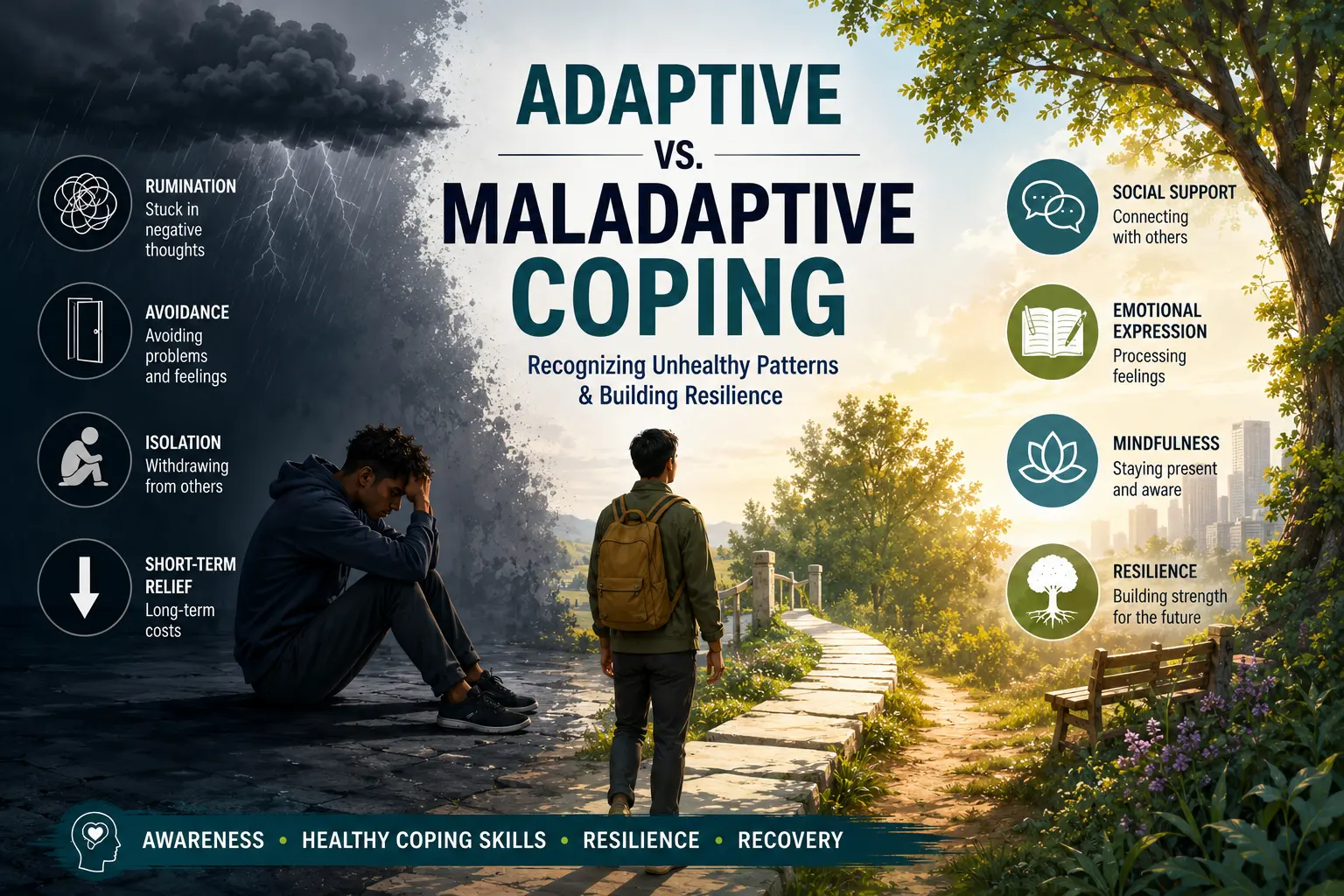
Understanding the difference between adaptive vs. maladaptive coping is essential for helping clients manage stress, improve mental health, and build long-term resilience. While maladaptive coping strategies such as avoidance, rumination, emotional suppression, and isolation may provide temporary relief, they often contribute to greater psychological distress over time. In contrast, adaptive coping strategies — including mindfulness, social support, emotional expression, problem-solving, and self-compassion — help individuals navigate challenges more effectively while supporting overall well-being. This guide explores common maladaptive coping examples, assessment techniques, evidence-based treatment approaches, and practical coping tools clinicians can use to strengthen healthy coping skills and resilience in clients across a variety of mental health conditions.


Last Updated: July 7, 2026

What You'll Learn
- The key differences between adaptive and maladaptive coping
- Why clients develop maladaptive coping patterns
- Common maladaptive coping examples seen in clinical practice
- Assessment questions for identifying coping styles and coping behaviors
- Evidence-based interventions for developing adaptive coping strategies
- Practical coping tools and healthy coping skills for building resilience
Contents
- Why Coping Matters in Mental Health Treatment
- Defining Adaptive and Maladaptive Coping
- Adaptive vs. Maladaptive Coping: A Comparison
- Common Maladaptive Coping Behaviors in Clinical Practice
- Why Clients Develop Maladaptive Coping Strategies
- Assessment: How to Identify Coping Patterns
- Clinical Case Example: Anxiety and Avoidance
- Evidence-Based Interventions for Replacing Maladaptive Coping
- Incorporating Coping Goals Into Treatment Plans
- Examples of Adaptive Coping Skills to Build in Treatment
- Building Long-Term Resilience
- Key Clinical Takeaways for Working with Coping Patterns
- FAQ: Adaptive vs Maladaptive Coping
Every coping strategy develops for a reason.
The client who drinks to wind down after a stressful shift isn’t irrational — they found something that works, at least in the short term. The teenager who withdraws after a family argument isn’t being difficult — they learned that disappearing is safer than conflict. The adult who perfects everything they touch isn’t high-achieving for its own sake — they discovered early that control reduces anxiety.
Many behaviors clinicians identify as maladaptive once served a genuinely protective function. Avoidance, emotional suppression, substance use, perfectionism, self-isolation — these patterns frequently emerge as reasonable attempts to reduce distress in the environments where clients learned them. The clinical challenge isn’t to judge these strategies, but to help clients recognize when previously protective behaviors have become barriers to recovery and to replace them with adaptive coping skills that support resilience and long-term functioning.
This post covers what clinicians need to know to assess coping patterns, understand their function, and intervene effectively.
What is Adaptive vs. Maladaptive Coping?
Adaptive vs. Maladaptive Coping: Key Definitions
Adaptive coping refers to thoughts and behaviors that help individuals manage stress effectively while supporting long-term psychological well-being.
Maladaptive coping refers to strategies that may reduce distress temporarily but ultimately worsen functioning, increase stress, or interfere with recovery.
These definitions build on Lazarus and Folkman’s (1984) transactional model of stress and coping, which distinguishes problem-focused coping (addressing the stressor directly) from emotion-focused coping (managing the emotional response), and frames both as adaptive or maladaptive depending on their function and consequences over time.
The distinction isn’t simply about whether a strategy “feels good” or “looks healthy” on the surface. What matters clinically is the function a behavior serves and its consequences over time — both short-term relief and long-term cost.
Why Coping Matters in Mental Health Treatment
Coping is one of the most consequential clinical targets across the diagnostic spectrum. The ways clients manage stress directly influence symptom severity, day-to-day functioning, the quality of their relationships, and how they respond to treatment.
Consider how coping patterns manifest across common presentations:
- Anxiety disorders: Avoidance and safety behaviors reduce distress in the moment but prevent disconfirmation of feared outcomes, maintaining and strengthening the anxiety cycle over time (Salkovskis, 1991).
- Depression: Withdrawal and behavioral disengagement decrease opportunities for positive reinforcement, deepening low mood — part of why behavioral activation is so effective at reversing it (Ekers et al., 2014).
- Trauma: Numbing, dissociation, and hypervigilance were often survival adaptations — but they persist long after the threat has passed, and shame-driven withdrawal can maintain or worsen posttraumatic symptoms (Taylor, 2015).
- Substance use disorders: Many clients with SUDs are using substances as emotion regulation tools, consistent with the self-medication model of addiction (Khantzian, 1997).
- Chronic illness and grief: When distress is prolonged and real, coping strategies determine whether a client builds resilience or develops secondary complications like depression and social isolation.
Across all of these, resilience building depends on identifying which coping strategies are helping and which are maintaining the problem.
Defining Adaptive and Maladaptive Coping
What Makes a Coping Strategy Adaptive?
Adaptive coping strategies share several key characteristics: they reduce distress without creating secondary problems, support functioning rather than impairing it, align with the client’s values, and are sustainable over time. Most importantly, adaptive strategies build resilience — they strengthen a client’s capacity to manage future stressors.
Examples of adaptive coping strategies:
- Problem solving and action planning
- Seeking social support
- Mindfulness and present-moment awareness
- Physical exercise
- Emotional expression (journaling, talking it through)
- Self-compassion practices
- Meaning-making and values clarification
What Makes a Coping Strategy Maladaptive?
Maladaptive coping strategies typically offer real short-term relief — this is what makes them so persistent. The problem is that they create longer-term costs: impaired functioning, increased emotional vulnerability, reinforcement of avoidance patterns, and interference with treatment progress.
Common maladaptive coping examples:
- Substance use
- Emotional suppression
- Rumination
- Self-isolation
- Behavioral avoidance
- Self-harm
- Perfectionism and overcontrol
Adaptive vs. Maladaptive Coping: A Comparison
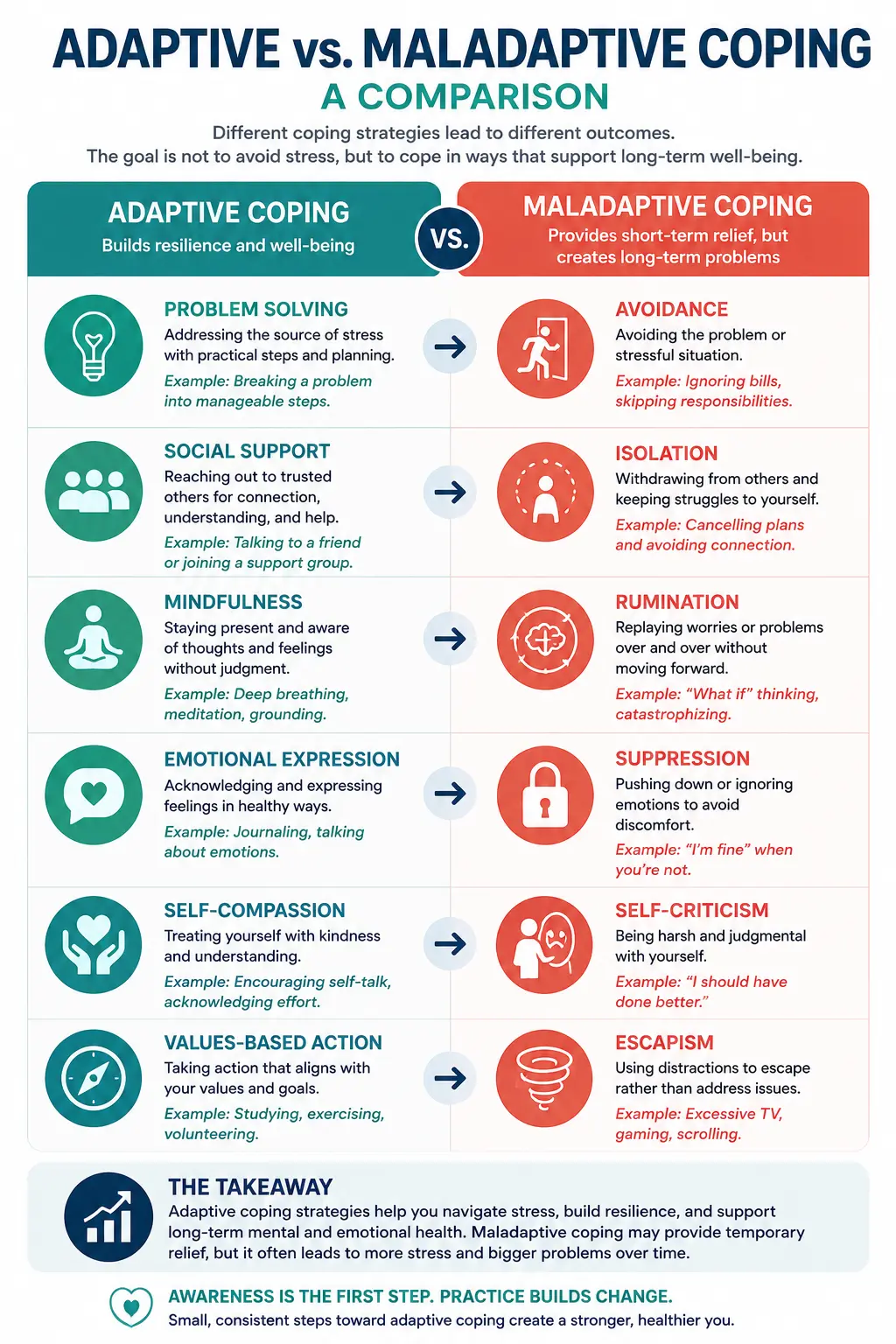
Not all coping strategies are equally effective over time. While maladaptive coping strategies often provide immediate relief from stress, anxiety, or emotional discomfort, they can create additional challenges that ultimately worsen mental health and functioning. Adaptive coping strategies, on the other hand, help individuals manage distress while building resilience, improving emotional regulation, and supporting long-term well-being. The comparison below highlights common examples of adaptive and maladaptive coping and the different outcomes they tend to produce.
| Adaptive Coping | Maladaptive Coping |
|---|---|
| Problem solving | Avoidance |
| Social support | Isolation |
| Mindfulness | Rumination |
| Emotional expression | Emotional suppression |
| Self-compassion | Self-criticism |
| Behavioral activation | Withdrawal |
| Values-driven action | Escapism |
| Distress tolerance skills | Impulsive behavior |
The following visual summarizes some of the most common differences between adaptive and maladaptive coping strategies and highlights how coping choices can influence long-term functioning and resilience.
Context Matters: When Coping Exists in the Gray Area
While the distinction between adaptive and maladaptive coping is clinically useful, real-life coping is often more nuanced. The same coping strategy may be adaptive in one situation and maladaptive in another depending on the context, duration, flexibility, and consequences.
For example, temporarily suppressing emotions during a medical emergency may help someone function effectively under pressure. Avoiding reminders of a traumatic event in the immediate aftermath of trauma may provide needed stabilization. Even distraction can be helpful when distress becomes overwhelming and immediate problem-solving is not possible.
Problems arise when these strategies become rigid, automatic, or the primary way a person responds to stress. Clinicians should evaluate coping patterns based not only on the behavior itself but also on whether it supports or interferes with long-term functioning, recovery, and psychological flexibility.
Common Maladaptive Coping Behaviors in Clinical Practice
Maladaptive coping behaviors often develop as understandable attempts to manage overwhelming emotions, stress, trauma, or uncertainty. While these coping strategies may provide temporary relief, they frequently create unintended long-term consequences that maintain or worsen psychological distress. Understanding the function these behaviors serve is essential for effective assessment and treatment. The examples below highlight some of the most common maladaptive coping patterns encountered in clinical practice and why they can become barriers to recovery and resilience.
Avoidance
Avoidance is one of the most clinically significant maladaptive coping patterns. It takes several forms: behavioral avoidance (not going to places, not doing activities), experiential avoidance (suppressing thoughts and feelings), and safety behaviors (actions that prevent full engagement with feared situations).
Avoidance works immediately — it reduces anxiety in the short term. But safety-seeking behavior is logically tied to the perception of threat, which means it prevents the spontaneous disconfirmation of feared outcomes and maintains the anxiety cycle (Salkovskis, 1991). Over time, the world gets smaller.
Rumination
Rumination is sometimes confused with reflective problem solving, but the distinction matters clinically. Reflection is purposeful, time-limited, and action-oriented. Rumination is repetitive, passive, and focused on distress itself — replaying what went wrong, rehearsing worst-case scenarios, asking “why” questions that don’t lead anywhere productive.
Rumination is strongly linked to both anxiety and depression. In anxiety, it often takes the form of worry. In depression, it manifests as repetitive self-critical thinking. Research indicates rumination exacerbates depression, impairs problem solving, interferes with instrumental behavior, and erodes social support (Nolen-Hoeksema et al., 2008).
Emotional Suppression
Suppressing emotions can feel like strength — “keeping it together,” not burdening others, staying in control. But the long-term consequences are significant: classic experimental work found that suppression increases sympathetic nervous system arousal even while leaving the subjective experience of negative emotion intact (Gross & Levenson, 1993). What gets pushed down doesn’t disappear — it tends to intensify.
Substance Use
For many clients, substance use functions as emotional regulation. The self-medication model (Khantzian, 1997) is clinically useful here: clients often use alcohol, cannabis, opioids, or stimulants to manage specific emotional states tied to difficulties regulating affect, self-esteem, relationships, and self-care. Over time, the substance becomes the primary coping tool while tolerance builds, consequences accumulate, and alternative coping skills remain undeveloped.
Self-Isolation
Withdrawal from others is one of the most common coping responses to depression, trauma, and shame. Shame frequently drives a self-reinforcing cycle: clients avoid social connection to minimize shame, then experience further shame about the isolation that results (Taylor, 2015). This matters because social connection is one of the most robust, causally-supported protective factors for mental and physical health (Holt-Lunstad, 2024) — isolation cuts clients off from the very resource that would most help them.
Perfectionism and Overcontrol
Often overlooked as a maladaptive coping strategy, perfectionism functions as anxiety management. If everything is done correctly and nothing is left to chance, maybe nothing bad will happen. Research on overcontrolled personality features links perfectionism and emotional inhibition to greater interpersonal problems and personality disorder severity (Dimaggio et al., 2018). These strategies may look like high functioning from the outside, but they come at significant cost: chronic stress, relational rigidity, vulnerability to shame when mistakes occur, and an inability to tolerate uncertainty.
Why Clients Develop Maladaptive Coping Strategies
Coping Strategies Are Usually Adaptive at First
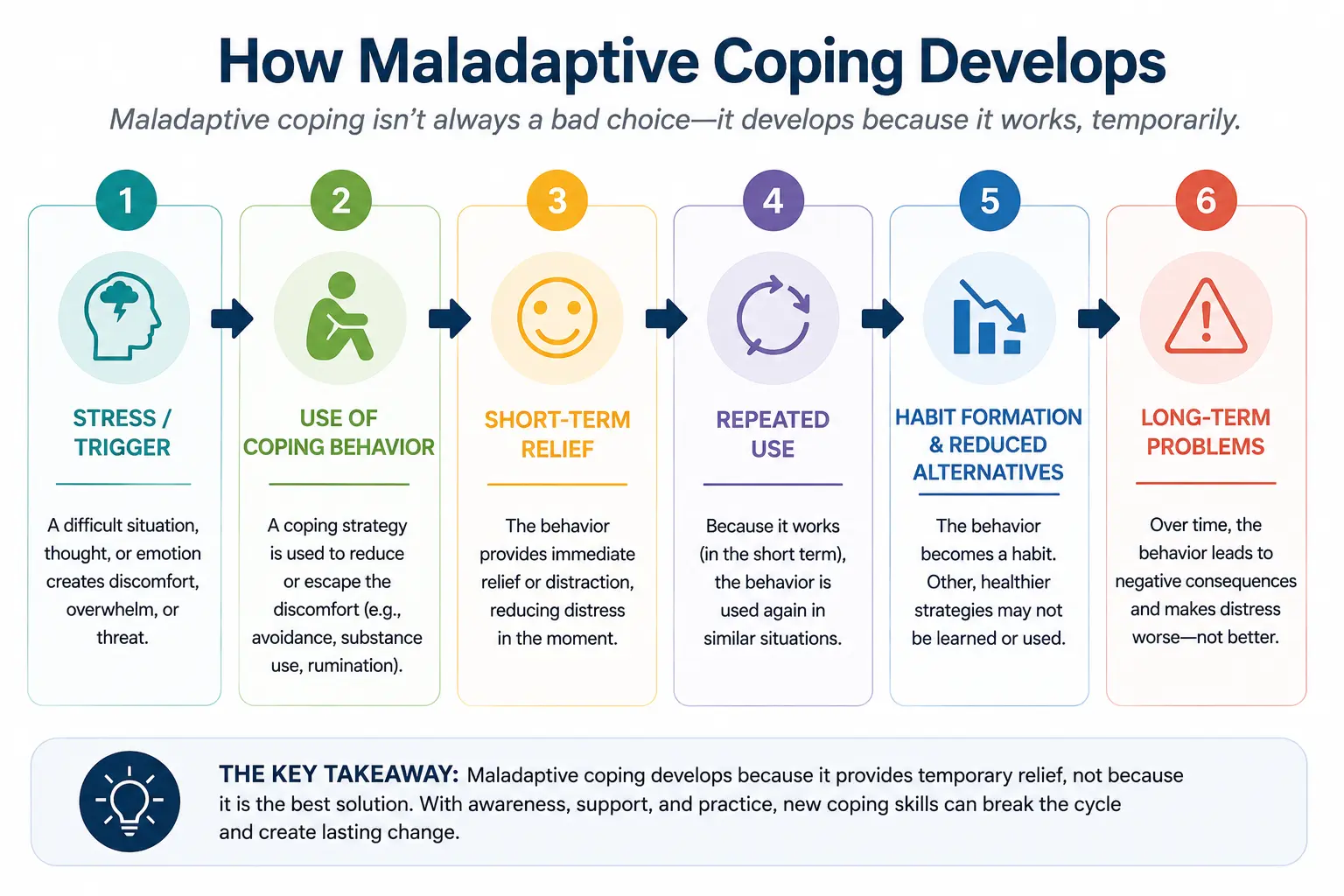
“Maladaptive coping rarely develops because people are irrational. It develops because it works — temporarily.”
Understanding why a client adopted a coping strategy is more clinically useful than simply labeling it as problematic. Several pathways commonly contribute:
- Childhood learning and family modeling. Children learn how to manage distress by watching the adults around them. If primary caregivers handled stress through drinking, avoidance, emotional shutdown, or explosive anger, those patterns become the template.
- Trauma adaptations. Many maladaptive coping behaviors are survival strategies that developed in the context of real threat. Emotional numbing, dissociation, hypervigilance, people-pleasing — these responses helped clients survive impossible situations. The nervous system continues to deploy them long after the threat has passed.
- Reinforcement processes. Avoidance, suppression, and substance use are all negatively reinforced — they reduce an aversive state. Mowrer’s (1951) two-factor learning theory remains the foundational account of why avoidance behaviors, once learned, are so resistant to change: each successful avoidance reinforces the behavior before the client has a chance to learn the feared outcome wouldn’t have occurred.
- Cultural and social influences. Clients receive messages about emotions from their culture, religion, family, and community. “Toughen up.” “Don’t air your problems.” “Feelings are weakness.” These messages shape which emotional states are acceptable to express and which must be managed privately.
- Neurobiology of stress. Under acute stress, the brain prioritizes immediate threat reduction over long-term consequence evaluation. The strategies that have historically worked fastest are the ones the brain reaches for first.
Trauma and Coping: Survival Strategies That Outlive the Threat
Many behaviors labeled as maladaptive coping were originally adaptive survival responses. Emotional numbing, hypervigilance, dissociation, people-pleasing, perfectionism, and avoidance often emerge in environments where safety, predictability, or emotional support were limited.
The nervous system learns quickly when survival is at stake. Behaviors that once protected a person from danger may continue long after the original threat has passed. What was once protective can eventually become restrictive, interfering with relationships, emotional regulation, and daily functioning.
Viewing coping through a trauma-informed lens helps clinicians move away from judgment and toward curiosity. Understanding how a coping strategy developed is often the first step toward helping clients replace it with healthier alternatives.
Assessment: How to Identify Coping Patterns
Effective assessment begins with curiosity rather than judgment. Coping strategies often make sense when viewed in the context of a client's experiences, environment, and emotional needs. Rather than focusing solely on whether a behavior is adaptive or maladaptive, clinicians should explore the purpose it serves, the relief it provides, and the costs it creates over time. By understanding both the short-term benefits and long-term consequences of a client's coping patterns, clinicians can identify opportunities to build healthier coping skills that support resilience and recovery.
Coping Assessment Tools for Clinicians
While clinical interviews remain the foundation of assessment, several validated instruments can help clinicians better understand how clients respond to stress and adversity.
Commonly used coping assessments include:
- Brief COPE Inventory – Brief-COPE Measures a range of adaptive and maladaptive coping responses, including active coping, emotional support, self-distraction, denial, and substance use.
- Coping Strategies Inventory (CSI) – The CSI evaluates both problem-focused and emotion-focused coping patterns.
- Ways of Coping Questionnaire (WCQ) – WCQ assesses coping processes used in response to specific stressful situations.
- Functional Analysis and Clinical Interviewing – Often the most clinically useful approach, focusing on what triggers a coping behavior, the relief it provides, and its long-term consequences.
These tools can complement clinical judgment and help identify patterns that may not emerge through symptom assessment alone.
Clinical Assessment Questions
- What do you do when stress starts to feel overwhelming?
- What helps you feel better in the short term?
- What helps you feel better in the long run? Are those the same things?
- What do you find yourself avoiding when you’re struggling?
- Who do you turn to when you’re having a hard time? What gets in the way of reaching out?
- Are there things you do to cope that you’re concerned about or feel conflicted about?
- Have these coping strategies changed over time?
A Simple Functional Analysis Framework
When evaluating any coping behavior, clinicians can ask four key questions:
- What stressor triggered the behavior?
- What relief or benefit did the behavior provide?
- What were the short-term and long-term costs?
- What alternative coping skill could serve the same function?
This framework shifts the focus from judging a behavior as “good” or “bad” to understanding why it exists and what need it is attempting to meet.
The visual framework below illustrates how clinicians can move beyond symptom identification to understand the function a coping behavior serves and identify healthier alternatives.

Functional analysis helps clinicians identify the factors that maintain coping behaviors and uncover opportunities for intervention. By examining triggers, short-term rewards, long-term consequences, and alternative responses, clinicians can help clients replace maladaptive coping strategies with more adaptive ways of meeting the same underlying needs.
Warning Signs of Maladaptive Coping
| Warning Sign | What It May Look Like |
|---|---|
| Increasing avoidance | Escalating distress despite coping |
| Relationship impairment | Reduced functioning at work/home |
| Shame or secrecy about a behavior | Dependency — unable to manage without it |
| Secondary consequences | Health, legal, or social consequences; resistance to exploring alternatives |

Clinical Case Example: Anxiety and Avoidance
Client
A 29-year-old marketing professional presenting with panic disorder.
Presenting Problem
After experiencing a panic attack while driving on the highway eight months ago, she began avoiding highway driving, then surface street driving, then commuting entirely. She had declined two promotions and stopped attending social events that required travel.
Initial Coping Function
Avoidance reduced acute anxiety and prevented further panic attacks in the short term. It made sense. It worked — immediately.
What Avoidance Cost Her
She was unable to attend her sister’s wedding out of state. Her world had contracted significantly. Secondary depression was developing.
Treatment Approach
- Psychoeducation on the anxiety cycle and the role of avoidance in maintaining panic
- Gradual exposure hierarchy developed collaboratively
- Behavioral activation to reconnect with valued activities
- Emotion regulation and distress tolerance skills
- Cognitive restructuring to address catastrophic beliefs about panic symptoms
Outcome
Over 14 sessions, she completed her exposure hierarchy, resumed driving independently, and attended her nephew’s school play out of town. Panic frequency decreased significantly and functional confidence had substantially returned.
Evidence-Based Interventions for Replacing Maladaptive Coping
Helping clients replace maladaptive coping patterns requires more than simply identifying what is not working. Effective treatment focuses on building alternative coping skills that address the same underlying needs while supporting long-term psychological health and functioning. Fortunately, clinicians have a range of evidence-based interventions available to reduce avoidance, strengthen emotional regulation, increase psychological flexibility, and build resilience. The approaches below have strong empirical support and can be adapted across a variety of mental health conditions, treatment settings, and client populations.
Cognitive Behavioral Therapy (CBT)
CBT targets the cognitive distortions that support avoidance and unhelpful behavior patterns — catastrophizing, all-or-nothing thinking, fortune telling — and uses behavioral experiments to test beliefs and reduce avoidance. Exposure-based components are particularly effective for anxiety-driven avoidance.
Acceptance and Commitment Therapy (ACT)
ACT directly targets experiential avoidance — the tendency to suppress, escape, or control unwanted internal experiences. Rather than teaching clients to challenge difficult thoughts and feelings, ACT builds psychological flexibility through six core processes, including acceptance, cognitive defusion, and values-based committed action (Hayes et al., 2006).
Behavioral Activation (BA)
Behavioral activation is particularly effective for depression-related withdrawal. By systematically increasing contact with rewarding, meaningful activities, BA counters the avoidance-depression cycle. A meta-analysis of 26 randomized controlled trials found BA significantly more effective than control conditions and comparable to full CBT (Ekers et al., 2014). Behavior change often precedes mood change — motivation is not a prerequisite.
Dialectical Behavior Therapy (DBT)
DBT’s skills training modules are among the most practical coping tools available in clinical practice. The emotion regulation module builds capacity to identify, understand, and modulate emotional experiences. The distress tolerance module provides crisis survival skills applicable across a wide range of presentations. The original randomized trial of DBT found fewer incidences of self-harm, greater treatment retention, and fewer inpatient psychiatric days compared to treatment as usual (Linehan et al., 1991).
Problem-Solving Therapy (PST)
PST is a structured intervention that builds problem-focused coping skills. It teaches clients to define problems clearly, generate solutions, evaluate options, implement a plan, and review the outcome. A meta-analysis of randomized trials found a significant treatment effect for PST in depression and anxiety (Cuijpers et al., 2007), particularly when maladaptive coping is tied to a sense of helplessness.
Self-Compassion Training
Self-criticism, perfectionism, and shame are common features of maladaptive coping. Self-compassion training — drawing on Neff’s (2003) model of self-kindness, common humanity, and mindfulness — helps clients develop a kinder relationship with their own suffering, reducing the shame spiral that blocks honest self-assessment and change.
Incorporating Coping Goals Into Treatment Plans
Identifying maladaptive coping patterns is only the beginning. Effective treatment planning translates assessment findings into measurable goals, objectives, and interventions that help clients develop healthier alternatives. Because coping challenges can present differently across diagnoses, treatment plans should be tailored to the function a coping behavior serves and the specific barriers it creates. The examples below illustrate how clinicians can incorporate adaptive coping goals into treatment planning for anxiety, depression, and trauma-related presentations.
Example 1: Anxiety and Avoidance
- Identify avoidance triggers and patterns.
- Practice distress tolerance skills during anxiety.
- Complete graduated exposure exercises.
- Increase use of social support when overwhelmed.
- Cognitive Behavioral Therapy (CBT)
- Exposure-based interventions
- Acceptance and Commitment Therapy (ACT)
- Behavioral activation
- Psychoeducation on the anxiety cycle
Example 2: Depression and Social Withdrawal
- Identify early warning signs of withdrawal.
- Schedule and complete two meaningful activities each week.
- Increase contact with supportive individuals.
- Practice emotion-focused coping skills during periods of low mood.
- Behavioral Activation (BA)
- Cognitive Behavioral Therapy (CBT)
- Activity scheduling
- Social support enhancement
- Self-compassion exercises
Example 3: Trauma and Emotional Suppression
- Increase awareness of emotional triggers.
- Practice grounding and emotion regulation techniques.
- Identify safe opportunities for emotional expression.
- Reduce reliance on avoidance behaviors.
- Trauma-informed CBT
- Acceptance and Commitment Therapy (ACT)
- DBT emotion regulation skills
- Grounding techniques
- Mindfulness-based interventions
Although the specific goals and interventions may vary, effective coping-focused treatment plans share a common objective: helping clients replace short-term survival strategies with adaptive coping skills that support long-term functioning, resilience, and psychological well-being. By targeting coping directly, clinicians can often create meaningful improvements across multiple symptom domains and areas of daily life.
Examples of Adaptive Coping Skills to Build in Treatment
Adaptive coping skills help clients manage stress, regulate emotions, and navigate challenges without creating additional problems or impairing functioning. Unlike maladaptive coping strategies that often prioritize short-term relief, adaptive coping approaches support long-term well-being, resilience, and psychological flexibility. While no single coping skill works for every person or situation, helping clients develop a diverse coping toolkit increases their ability to respond effectively to life's inevitable stressors. The examples below represent practical, evidence-based coping skills that clinicians can incorporate into treatment planning and skills development across a wide range of mental health concerns.
Problem-Focused Strategies
- Action planning and prioritization
- Time management and task breakdown
- Boundary setting and assertive communication
- Problem-solving frameworks
Emotion-Focused Strategies
- Mindfulness and present-moment awareness
- Journaling and expressive writing
- Acceptance and cognitive defusion
- Deep breathing, progressive muscle relaxation, and somatic techniques
Relationship-Based Strategies
- Proactively seeking support
- Participation in group therapy or peer support
- Strengthening social networks and accountability relationships
- Asking for help
Meaning-Based Strategies
- Values clarification and committed action
- Spirituality and faith practices, where relevant to the client
- Purpose-driven engagement with work or community
- Post-traumatic growth frameworks for clients with significant adversity
When Healthy Coping Becomes Avoidance
Even adaptive coping skills can become unhelpful when used rigidly or as a way to avoid difficult emotions.
Examples include:
- Using mindfulness to disconnect from emotions rather than experience them.
- Exercising excessively to escape distress.
- Journaling repeatedly without taking meaningful action.
- Constantly seeking self-help information instead of practicing new behaviors.
- Attending therapy sessions without applying skills between sessions.
The goal is not perfection but flexibility. Adaptive coping supports engagement with life and valued activities rather than helping clients escape from them.
Building Long-Term Resilience
Developing adaptive coping skills is one of the most effective ways to strengthen resilience over time. While coping strategies help clients manage immediate stressors, resilience reflects a broader capacity to adapt, recover, and continue moving forward in the face of adversity. Resilience is not the absence of stress, trauma, or emotional pain — it is the ability to navigate those experiences without becoming overwhelmed by them. By helping clients build psychological flexibility, emotional awareness, supportive relationships, and effective coping habits, clinicians can foster resilience that supports long-term mental health and well-being.
Resilience Is a Skill, Not a Trait
One of the most clinically important reframes clinicians can offer: resilience is not something people either have or don’t have. It is not a personality characteristic or a sign of a fortunate childhood. As the American Psychological Association (2024) notes, resilience involves behaviors, thoughts, and actions that anyone can learn and develop. Resilience develops through repeated practice of adaptive coping skills in the context of real stress. It can be built, at any age, with the right support.
Five Factors That Strengthen Resilience
Research consistently points to several core factors that help individuals adapt to stress, recover from setbacks, and maintain psychological well-being. While resilience is influenced by many personal and environmental factors, clinicians can actively help clients strengthen specific skills and capacities that support long-term resilience.
The resilience framework below highlights five evidence-supported areas that contribute to adaptive coping, emotional regulation, and psychological flexibility.
Each of these resilience factors can be strengthened through intentional practice and targeted clinical interventions. Together, they create a foundation for navigating adversity and maintaining mental health over time.

Each of these resilience factors can be strengthened through intentional practice and targeted clinical interventions. Together, they create a foundation for adaptive coping, emotional regulation, and long-term psychological flexibility.
1. Psychological Flexibility
The capacity to respond to stress with awareness and adaptability rather than rigid reaction. Build through ACT-based interventions, mindfulness practices, and helping clients widen their repertoire of responses.
2. Social Connection
Social connection is a causal protective factor for mental and physical health, with strength, consistency, and biological plausibility across the literature (Holt-Lunstad, 2024). Strong, trusting relationships buffer against stress and provide practical and emotional resources. Interventions: identify barriers to connection, target social engagement skills, consider group therapy modalities.
3. Emotional Awareness
The ability to accurately identify, label, and tolerate emotional experience. Clients with limited emotional awareness are more likely to act impulsively or avoid. Interventions may include emotion identification exercises, feelings vocabulary development, and mindfulness of emotional body sensations.
4. Self-Compassion
Clients who respond to their own suffering with warmth recover more quickly from setbacks than those who respond with self-criticism. Interventions may include Neff’s three-component model of mindfulness, common humanity, and self-kindness; loving-kindness meditation; and the self-compassion break.
5. Effective Problem Solving
The ability to face stressors directly, generate options, and take purposeful action. Clients who perceive themselves as capable of influencing their circumstances are significantly more resilient. Interventions may include problem-solving therapy, behavioral experiments, and incremental mastery experiences.
Daily Habits That Build Resilience
Resilience develops through consistent practice, not occasional insight. Small daily behaviors can strengthen a person's capacity to tolerate stress, recover from setbacks, and adapt to changing circumstances.
Examples include:
- Maintaining consistent sleep and wake schedules
- Engaging in regular physical activity
- Practicing mindfulness or relaxation techniques
- Staying connected with supportive relationships
- Participating in meaningful activities aligned with personal values
- Practicing self-compassion during setbacks
- Setting realistic goals and celebrating progress
Over time, these habits create a foundation that makes adaptive coping more accessible when significant stressors arise.
Key Clinical Takeaways for Working With Coping Patterns
After assessing coping patterns, understanding their function, and developing targeted interventions, clinicians are left with an important question: What principles should guide this work across clients and diagnoses? The following clinical considerations summarize some of the most important lessons about adaptive and maladaptive coping and can help inform assessment, treatment planning, and resilience-building efforts.
- Adaptive coping is not about eliminating distress. The goal is not a life without discomfort — it is a life where distress is tolerable, manageable, and not the driver of every major decision.
- A coping strategy can be adaptive in one context and maladaptive in another. Emotional suppression in a hospital trauma bay might be appropriate. The same suppression applied chronically in a personal relationship is not.
- Most maladaptive coping began as a reasonable attempt to survive. Clients who feel understood rather than judged are more likely to engage in the difficult work of change.
- Replacing coping strategies works better than simply eliminating them. When targeting a maladaptive coping behavior, simultaneously develop a more adaptive alternative that serves a similar function.
- Resilience develops through repeated behavioral practice. It is not insight alone that builds resilience — treatment should be structured to create opportunities for practice in the presence of real stress.
Frequently Asked Questions About Adaptive vs Maladaptive Coping
Recent Posts





Katie Cox
MA, LPCC
About the Author
Katie Cox, MA, LPCC is a Licensed Professional Clinical Counselor with over 10 years of clinical experience working with adolescents and adults. Her areas of expertise include anxiety, depression, OCD, life transitions, self-esteem, career concerns, and women's mental health. Katie utilizes evidence-based, client-centered approaches to help individuals develop practical coping skills, increase emotional awareness, and achieve their personal goals. Through her clinical work and writing, she is committed to making mental health information accessible, practical, and empowering.