Blog > Documentation > Documentation Audit Checklist for Behavioral Health
The Behavioral Health Documentation Audit Checklist: Lessons From 5,000+ Chart Reviews
A strong documentation audit checklist is essential for behavioral health clinicians who want to reduce audit risk, improve compliance, and ensure accurate reimbursement. Drawing on insights from over 5,000 chart reviews, this guide breaks down the most common documentation gaps auditors identify — from medical necessity and treatment planning to billing alignment and diagnosis accuracy. Whether you're conducting an internal clinical documentation audit or preparing for an external review, this checklist helps you identify risk areas early and strengthen your documentation practices with confidence.


Last Updated: April 23, 2026
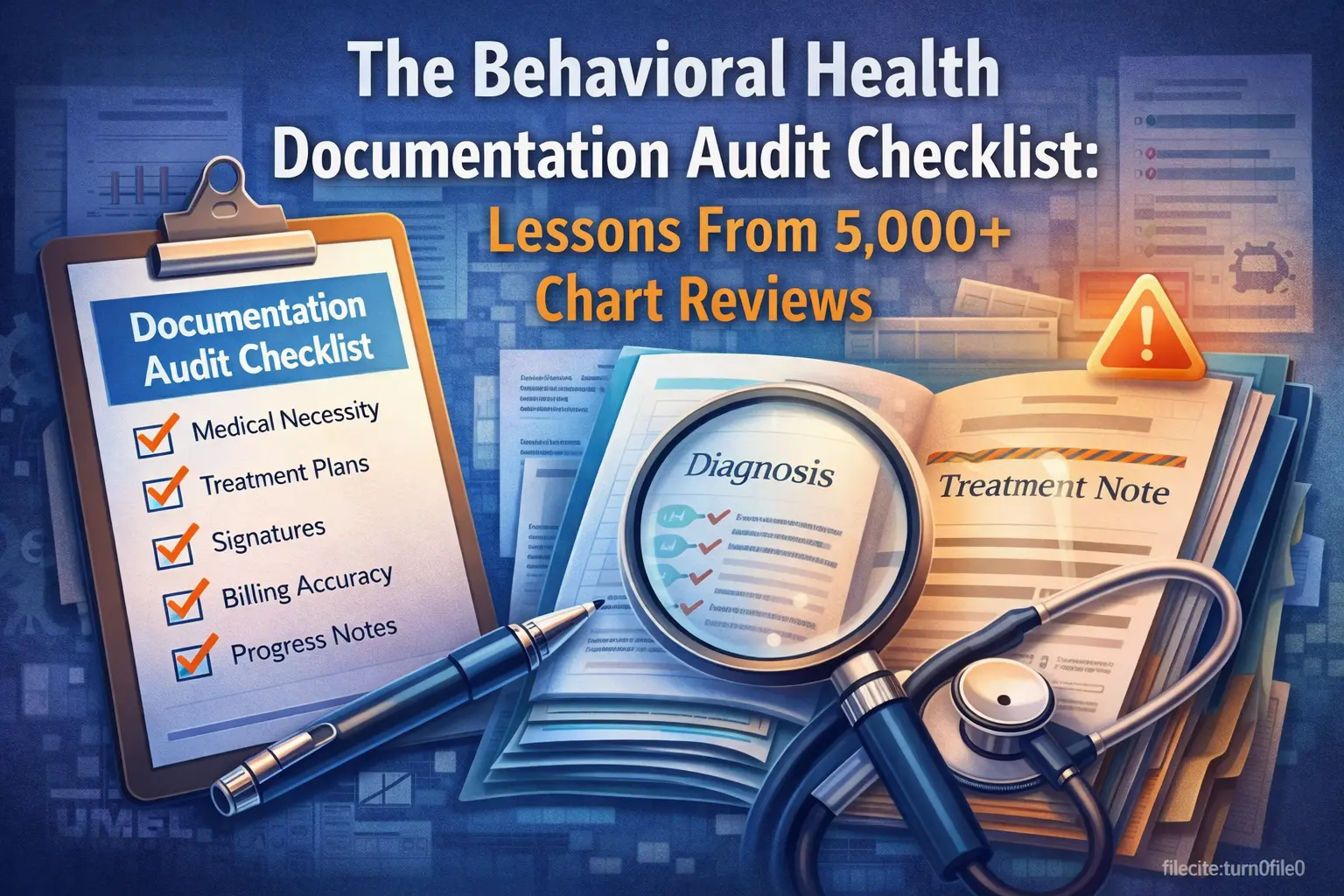
In my experience auditing more than 5,000 clinical charts, I have seen the same patterns repeat again and again. Most audit findings are not caused by one catastrophic mistake. They are caused by a handful of recurring issues in documentation, billing, and medical necessity that quietly build risk over time.
That is why having a reliable documentation audit checklist matters. Whether you are conducting your own internal clinical documentation audit or preparing for an external review, knowing what auditors look for — and where behavioral health documentation requirements are most often missed — can dramatically reduce your exposure.
The good news is that these problems are often preventable. Below is a checklist drawn from the most common audit findings I have encountered, organized by risk area so you can review your own charts systematically.
1. Medical Necessity Documentation
If I had to name the single biggest issue that puts clinicians at risk during a clinical documentation audit, it would be medical necessity. A chart can look polished, but if it does not clearly show why the patient needed the service, payers may deny the claim or question the entire course of treatment.
Medical necessity is not just a billing concept. It is the foundation for the clinical rationale behind the visit, the treatment plan, and the level of service billed. When the documentation does not clearly connect the patient’s symptoms, diagnosis, and intervention, the claim becomes vulnerable. For a deeper dive into medical necessity documentation, see our full guide on medical necessity in behavioral health.
Medical Necessity Checklist
- The note clearly states why the patient was seen and what symptoms or functional impairment justified the visit.
- The intervention provided is documented and logically connected to the presenting problem.
- The treatment plan supports the service delivered and the level of care billed.
- The level of service is appropriate given the documented complexity and time.
- There is a clear clinical narrative linking diagnosis, symptoms, intervention, and progress.
2. Treatment Plan Completeness
Treatment plans are one of the first places auditors look during a clinical documentation audit. A strong treatment plan shows measurable goals, specific interventions, and a logical connection to the diagnosis and presenting problem. When plans are vague, generic, or outdated, they create doubt about whether care is medically necessary and clinically directed.
Common problems include goals that are too broad to measure, interventions that do not match the diagnosis, plans that are copied forward without meaningful updates, and missing documentation of progress toward measurable objectives.
Treatment Plan Checklist
- Goals are specific, measurable, and tied to the diagnosis and presenting problem.
- Interventions are individualized and clearly matched to the identified goals.
- The plan has been updated to reflect current progress, setbacks, or changes in clinical presentation.
- There is documented evidence of progress toward objectives or a clinical rationale for continuing the current approach.
- The treatment plan is not a copy-forward from a previous period without meaningful revision.
3. Signatures and Required Acknowledgments
An often-overlooked area of behavioral health documentation requirements is the completion of required signatures and acknowledgments. Depending on the setting, payer, or internal policy, an unsigned treatment plan can create serious compliance problems — even when the clinical work itself is appropriate.
Missing signatures can signal that the plan was never properly reviewed, that the patient was not engaged in the treatment process, or that the chart does not meet payer-specific documentation requirements. Small administrative gaps like these can become large billing problems during an audit.
Signatures Checklist
- The treatment plan is signed by the clinician responsible for the plan of care.
- Patient or guardian signatures or acknowledgments are obtained where required by the payer or setting.
- Supervisory co-signatures are present where applicable (e.g., for provisionally licensed clinicians).
- Signatures are dated and correspond to the correct service period.
4. Billing and Documentation Alignment
Billing issues are a major source of audit findings. Auditors expect the billed code to match what was documented, and for the documentation to support the intensity, complexity, and duration of the service. When billing and documentation are not aligned, auditors view the claim as unreliable — even if the clinical intent was appropriate.
Common examples of mismatch include billing a higher level of service than the note supports, billing based on time when time is not documented clearly, using diagnosis codes that are not supported by the assessment, and billing psychotherapy or add-on services without adequate documentation of the service delivered.
Accurate billing starts with a clear understanding of CPT coding fundamentals. If you need a refresher, review our CPT code basics guide to ensure your documentation fully supports the services billed.
Billing Alignment Checklist
- The CPT code billed matches the service described in the note.
- If billing is time-based, start and stop times or total time are clearly documented.
- The diagnosis code on the claim is supported by the clinical assessment and progress note.
- Add-on services (e.g., interactive complexity, crisis codes) have separate supporting documentation.
- The documented level of complexity justifies the level of service billed.
5. Diagnosis Accuracy and Specificity
Diagnoses should reflect what the clinician knows at the time of the encounter. If the note says “rule out bipolar disorder” or “possible ADHD,” that uncertainty should not be translated into a confirmed diagnosis code. In a clinical documentation audit, inaccurate coding can distort medical necessity, support inappropriate billing, and create patterns that attract further review.
A better approach is to code symptoms, behaviors, or unspecified conditions when the diagnosis is still being clarified. That preserves both clinical integrity and coding accuracy.
Diagnosis Accuracy Checklist
- The diagnosis code reflects the clinician’s current clinical judgment, not a provisional or rule-out impression.
- When a diagnosis is uncertain, symptom-level or unspecified codes are used rather than a confirmed diagnosis.
- The diagnosis is coded to the highest level of specificity supported by the documentation.
- The billed diagnosis is consistent across the treatment plan, progress note, and claim.
What a Clinical Documentation Audit Actually Examines
Auditors are not just looking for isolated mistakes. They are looking for patterns. A single weak note may be explainable. A repeated pattern of unsupported diagnosis coding, incomplete treatment plans, and mismatched billing tells a different story.
That is why regular chart review matters. It helps identify small issues before they become claim denials, repayment requests, recoupment activity, or formal compliance findings. Learn more about the importance of regular chart audits in our guide to clinical chart reviews.
Using a documentation audit checklist like the one above during routine internal reviews is one of the most effective ways to catch these patterns early — before an external auditor does.
When to Bring in Expert Chart Review
While a documentation audit checklist is a strong first step, there are times when an outside perspective makes a real difference. ICANotes offers private chart consultation services designed to review charts, identify risk, and provide practical recommendations to strengthen documentation and compliance.
Our consultation services are confidential. We review your charts, offer specific suggestions, and help protect your practice from preventable audit risk. Unlike many consulting services, ours are affordably priced for ICANotes customers, so clinicians and practices can access expert-level support without paying premium consulting rates.
What You Gain From Expert Chart Review
- Identification of documentation gaps before an external audit surfaces them.
- Stronger medical necessity language and treatment plan structure.
- Alignment between billing codes and clinical documentation.
- Reduced denials and compliance risk across your practice.
- Better documentation habits built across your clinical team.
For many practices, outside review is not just a corrective tool. It is a preventive strategy that pays for itself in reduced denials and avoided audit findings.

Frequently Asked Questions About Clinical Documentation Audits
▸ How often should I conduct a clinical documentation audit?
▸ What are the most common behavioral health documentation requirements that get missed?
▸ Can a documentation audit checklist prevent all audit risk?
▸ What is included in a clinical documentation audit?
Related Posts




Dr. October Boyles
DNP, MSN, BSN, RN
About the Author
Dr. October Boyles is a behavioral health expert and clinical leader with extensive expertise in nursing, compliance, and healthcare operations. With a Doctor of Nursing Practice (DNP) and advanced degrees in nursing, she specializes in evidence-based practices, EHR optimization, and improving outcomes in behavioral health settings. Dr. Boyles is passionate about empowering clinicians with the tools and strategies needed to deliver high-quality, patient-centered care.