Blog > Treatment Strategies > Orthorexia Nervosa: Symptoms, DSM-5 Status & Treatment
Orthorexia Nervosa: A Clinical Guide to Symptoms, DSM-5 Status & Treatment
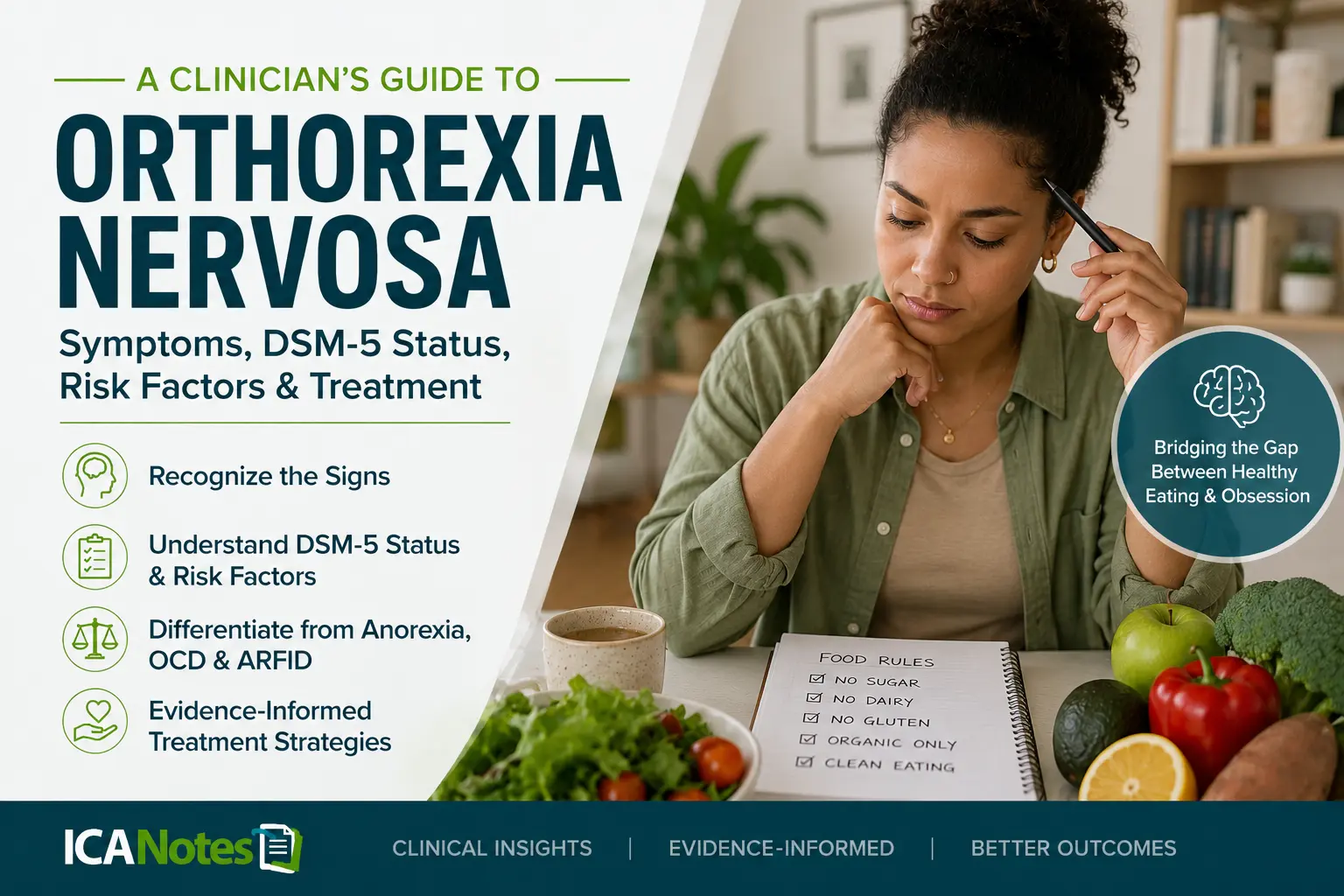
Orthorexia nervosa is a disordered eating pattern characterized by an obsessive focus on healthy eating, rigid food rules, and significant distress when dietary standards cannot be maintained. Although orthorexia nervosa is not currently recognized as an official DSM-5 diagnosis, researchers have proposed diagnostic criteria that distinguish it from anorexia nervosa, OCD, and ARFID. This clinical guide explores orthorexia nervosa symptoms, risk factors, health consequences, differential diagnosis, and evidence-informed treatment approaches, including CBT, ACT, DBT, and multidisciplinary care strategies for behavioral health clinicians.


Last Updated: June 12, 2026

Key Takeaways
- Orthorexia nervosa is characterized by an obsessive focus on healthy eating, rigid food rules, and significant distress when those rules cannot be followed.
- Orthorexia is not currently recognized as an official DSM-5 diagnosis, though proposed diagnostic criteria were established through a 2022 international expert consensus study.
- Common risk factors include perfectionism, obsessive-compulsive traits, emotion dysregulation, and exposure to diet culture and healthism.
- Symptoms often include excessive time spent planning meals, avoidance of foods perceived as unhealthy, anxiety around eating, and social impairment.
- Orthorexia differs from anorexia nervosa because the primary focus is food quality and purity rather than weight, body image, or caloric restriction.
- Treatment typically involves psychotherapy, nutritional rehabilitation, medical monitoring, and multidisciplinary collaboration.
Contents
- Orthorexia Nervosa and the DSM-5: Current Status
- Who is at Risk for Developing Orthorexia Nervosa?
- The Role of Diet Culture and Healthism
- Signs and Symptoms of Orthorexia Nervosa
- Physical Health Consequences of Orthorexia Nervosa
- Orthorexia Nervosa vs. Related Diagnoses
- Treatment for Orthorexia Nervosa
- FAQ: Orthorexia Nervosa
- How ICANotes Helps Document Orthorexia Treatment
When clients or colleagues talk about "eating clean" or "eating healthy," the conversation typically reflects something positive: a genuine effort to feel better and take care of the body. But for some individuals, a focus on healthy eating can quietly evolve from a wellness practice into a consuming, rigid preoccupation that damages mental health, strains relationships, and undermines the very health it was meant to promote.
This is the clinical picture of orthorexia nervosa: a disordered eating pattern defined not by restriction for weight control, but by an obsessive drive to eat "correctly." While orthorexia nervosa is not yet recognized as an official diagnosis in the DSM-5, it is increasingly seen as a serious mental and physical health concern that behavioral health clinicians are encountering more frequently in their practices.
This post provides a comprehensive clinical overview: proposed diagnostic criteria, psychological and sociocultural risk factors, symptoms, physical health consequences, differential diagnosis, and current best practices for treatment and documentation.
What is Orthorexia Nervosa?
Orthorexia nervosa was first described by Dr. Steven Bratman in 1997. The term combines the Greek "ortho" (correct) and "orexia" (appetite) to describe what he observed in patients with a pathological fixation on eating rightfully. Unlike eating disorders driven primarily by weight, body shape, or calorie restriction, orthorexia centers on food quality — the perceived purity, healthfulness, or "cleanness" of what is consumed.
At the individual level, orthorexia can begin as earnest health awareness. A client may eliminate processed foods, then artificial additives, then non-organic produce, then entire food groups — each step feeling justified and even virtuous. Over time, the rules become rigid and inflexible, the mental space devoted to food planning and anxiety expands, and what began as wellness becomes a source of significant distress and impairment. Like most clinical concerns, severity exists on a spectrum, but it is the degree of rigidity, distress, and functional impairment that distinguishes orthorexia from health-conscious eating.
Clinical note: Orthorexia nervosa is distinct from health-conscious eating in both degree and impact. The distinguishing feature is not what the person avoids, but how consuming, rigid, and impairing the behavior becomes.
Orthorexia Nervosa and the DSM-5: Current Status
Current Status of Orthorexia nervosa in the dsm-5
Orthorexia nervosa is not currently listed in the DSM-5. However, a growing body of research and a 2022 international consensus study have proposed standardized diagnostic criteria, and many clinicians and researchers expect it to eventually be recognized as a formal diagnosis — likely within the DSM-5 Feeding and Eating Disorders category.
The delay in formal recognition reflects ongoing scientific debate: What symptoms specifically define orthorexia and reliably distinguish it from anorexia nervosa, OCD, and ARFID? What threshold separates a health-conscious lifestyle from a clinical disorder? What validated assessment tools can measure it consistently across populations?
Despite these open questions, orthorexia nervosa is widely acknowledged as a serious concern. Researchers including Bratman, Dunn, and Donini have each proposed diagnostic frameworks. A landmark Delphi study involving 47 experts from 14 countries reached consensus on a working definition and proposed criteria in 2022 (Donini et al.), providing the most rigorously developed framework to date.
Field experts anticipate that with continued research, orthorexia nervosa will eventually be added to the DSM — most likely within the Feeding and Eating Disorders category alongside anorexia nervosa, bulimia nervosa, binge eating disorder, and ARFID. Formal recognition would improve access to treatment and support clinical training and reimbursement pathways.
Free Clinical Download
Get the Orthorexia Nervosa Assessment & Treatment Toolkit
Download this practical resource for behavioral health clinicians, including orthorexia assessment guidance, differential diagnosis considerations, treatment planning support, and documentation tips.
- Review proposed diagnostic criteria and DSM-5 status
- Differentiate orthorexia from anorexia, OCD, and ARFID
- Use screening questions and treatment goals in clinical practice
- Support clearer documentation for eating disorder care
Download the Free Guide
Complete the form below to access the PDF.
Who is at Risk for Developing Orthorexia Nervosa?
Orthorexia nervosa can affect individuals across genders, ages, and backgrounds. However, research suggests that a combination of psychological and sociocultural factors creates meaningful vulnerability. Known risk factors include:
- Perfectionism, rigid self-standards, and a strong need for control
- High levels of emotion dysregulation
- Obsessive-compulsive disorder or significant OCD features
- A personal or family history of disordered eating or an eating disorder
- High exposure to diet culture and "healthism" content in media or online communities — particularly wellness influencers, clean eating accounts, and content that frames food choices in moral terms
For many individuals, orthorexia begins with what feels like reasonable health awareness — a desire to prevent illness, manage a diagnosed condition, or optimize well-being. It is the progressive narrowing of acceptable foods, the increasing rigidity of rules, and the escalating distress when those rules are threatened that signals the transition from healthy interest to clinical concern.
The Role of Diet Culture and Healthism
Understanding orthorexia nervosa requires understanding the cultural environment in which it develops. Two intersecting social forces play a significant role in its emergence.
Diet Culture
Diet culture refers to a system of beliefs that equates thinness and "clean" eating with health and moral virtue, promotes food and weight control as primary wellness pursuits, and normalizes disordered relationships with eating. While the term has gained clinical traction in recent years, the phenomenon it describes has longstanding roots in Western health discourse.
Healthism
Healthism extends these ideas by framing health as the supreme personal responsibility — something entirely within individual control and a reflection of one's character. When social media amplifies both frameworks through wellness influencers, fear-based nutrition content, and community praise for restrictive eating, the environment becomes highly conducive to orthorexic thinking for individuals who are already predisposed.
For clinicians, recognizing the cultural context is important not only for understanding how orthorexia develops, but for providing psychoeducation that helps clients examine the messages they have internalized and disentangle wellness from disordered behavior.
Signs and Symptoms of Orthorexia Nervosa
The 2022 Delphi consensus study — involving 47 experts from 14 countries — proposed a working definition that organizes orthorexia's symptom profile into three domains. While these criteria are not yet formally adopted in the DSM, they represent the most robust clinical consensus available.
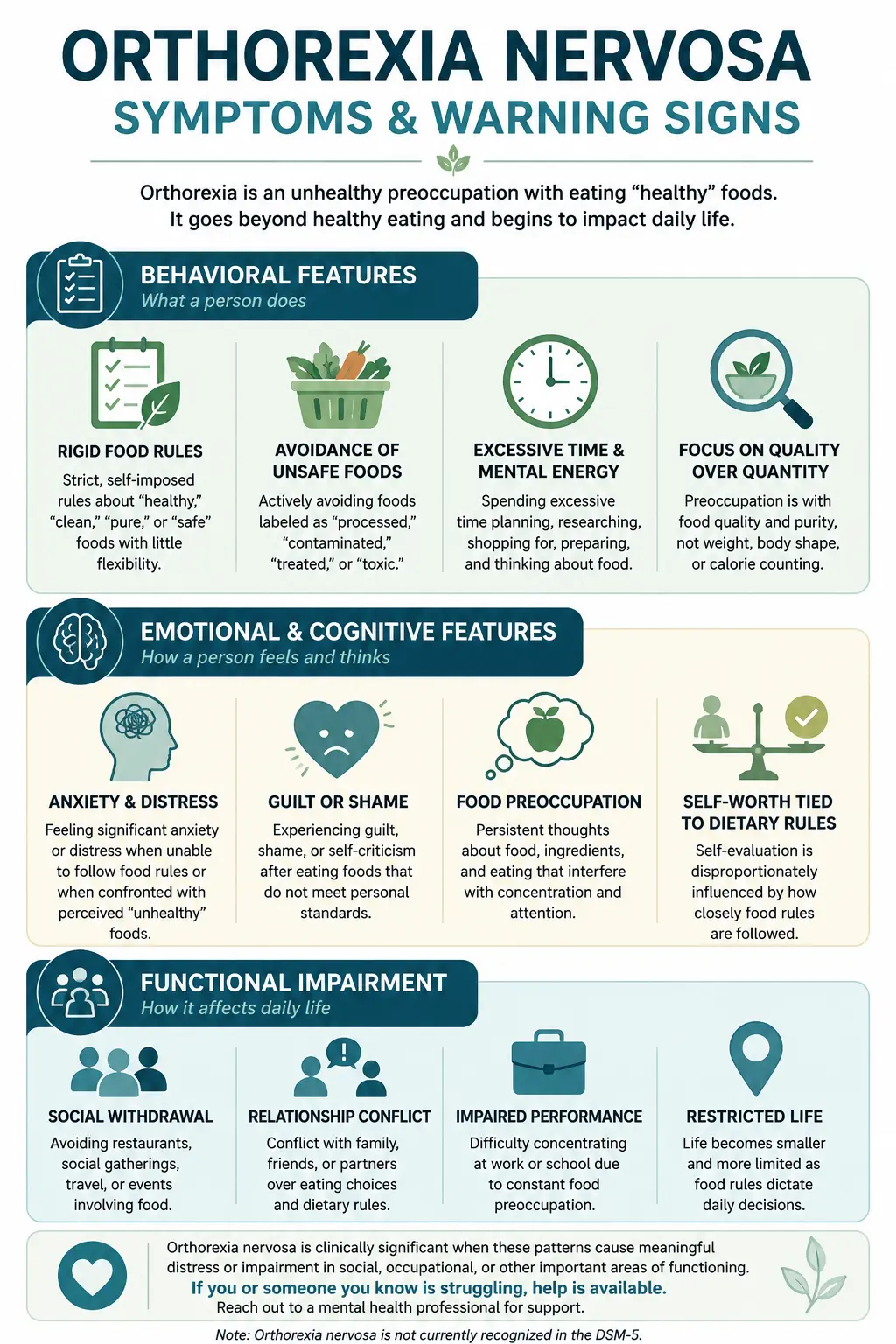
Core Behavioral Features
- A strong and persistent preoccupation with eating behavior centered on food quality rather than quantity
- Self-imposed, rigid, and inflexible food rules with strict adherence to foods perceived as “healthy,” “pure,” “clean,” “organic,” or “safe”
- Active avoidance of foods categorized as “processed,” “contaminated,” “treated,” or “toxic”
- Excessive time devoted to planning, obtaining, preparing, and eating food
Emotional & Cognitive Features
- Significant anxiety or emotional distress when confronted with food perceived as unhealthy or when food rules cannot be followed
- Persistent cognitive preoccupation with food and eating that impairs concentration and attention
- Guilt or shame following any violation of dietary rules
- Self-evaluation that is disproportionately influenced by adherence to dietary standards
Functional Impairment
Orthorexia nervosa becomes clinically significant when these patterns lead to meaningful distress or impairment in social, occupational, or other important areas of functioning. Common presentations include avoiding restaurants, social meals, or travel because of food concerns; experiencing conflict in relationships over dietary requirements; struggling to concentrate at work due to food preoccupation; and developing physical health consequences from increasingly restrictive dietary rules.
The infographic below summarizes the most common orthorexia nervosa symptoms, including behavioral warning signs, emotional distress, and functional impairment.
Physical Health Consequences of Orthorexia Nervosa
Despite being motivated by a genuine desire for health, orthorexia nervosa frequently produces the very physical harm the individual is trying to prevent. Because the disorder is organized around food quality rather than caloric restriction per se, nutritional deficiencies are common and can be serious — even in clients who appear to be consuming adequate calories.
Nutritional Deficiencies
Nutritional deficiencies are among the most consistent physical consequences. Depending on which food categories have been eliminated, clients may present with deficiencies in protein, essential fats, fat-soluble vitamins A, D, E, and K, B vitamins, calcium, and iron. In orthorexia, caloric intake may be normal while micronutrient intake is severely compromised.
Social & Occupational Impairment
Avoiding restaurants, social gatherings, travel, and communal meals progressively shrinks a person's functional world. Work and academic performance may suffer as food preoccupation consumes cognitive resources. Relationships are often strained as others struggle to accommodate escalating dietary requirements.
Gastrointestinal Consequences
Gastrointestinal consequences can emerge from overuse of raw, high-fiber, or heavily elimination-based diets. Some clients develop hypersensitivities or functional GI symptoms that reinforce dietary restrictions, creating a self-perpetuating cycle of avoidance.
Cardiovascular & Musculoskeletal Impacts
Cardiovascular and musculoskeletal impacts, including electrolyte imbalances, cardiac arrhythmias, and bone density loss, have been documented in more severe presentations, particularly when orthorexic eating patterns produce significant caloric restriction alongside nutritional gaps.
Because orthorexia nervosa is not yet a formal DSM diagnosis, clinicians often encounter it alongside or in place of other eating disorder diagnoses. Understanding how it differs from related conditions is essential for accurate assessment and appropriate treatment planning.
Orthorexia nervosa can resemble both anorexia nervosa and ARFID, making differential diagnosis challenging. The comparison chart below highlights the key distinctions between orthorexia, anorexia, and avoidant/restrictive food intake disorder (ARFID), including motivation, body image concerns, food restriction patterns, and DSM-5 status.
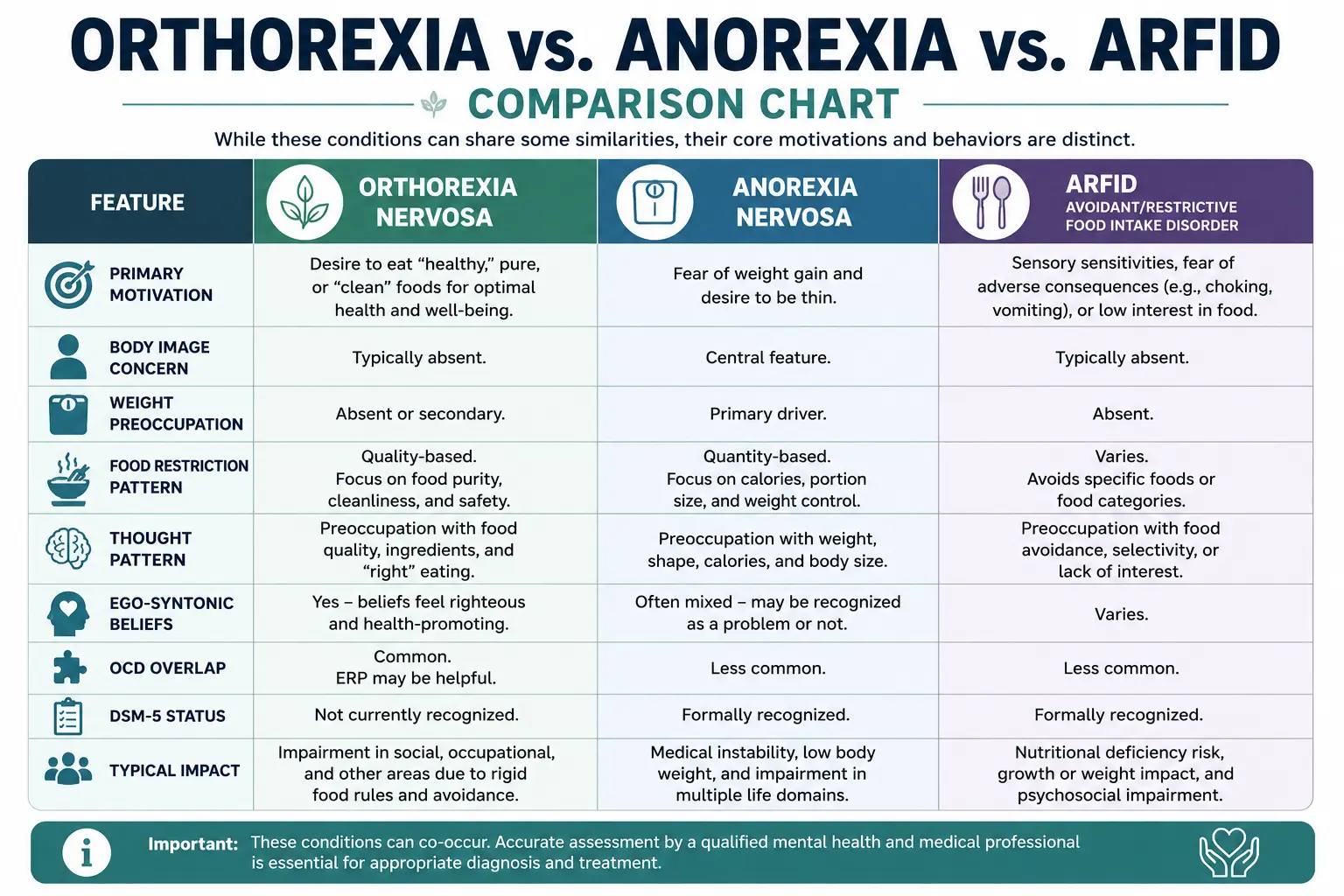
It is worth noting that orthorexia frequently co-occurs with OCD, anxiety disorders, and other eating disorders. The presence of orthorexic features does not rule out a co-occurring DSM diagnosis, and clinicians should assess for the full range of relevant conditions during intake.
Treatment for Orthorexia Nervosa
There are no evidence-based treatment protocols specifically validated for orthorexia nervosa, as it has not yet achieved formal diagnostic status. However, clinical consensus supports a multidisciplinary, individualized approach drawing on eating disorder and anxiety disorder treatment frameworks. Current best practices suggest the following structure:
Psychotherapy Approaches
Cognitive Behavioral Therapy (CBT) is the most widely recommended psychotherapy modality for orthorexia. In this context, CBT focuses on identifying and restructuring the rigid, black-and-white thinking patterns that underlie dietary rules ("this food is contaminated," "eating that will harm me"). Behavioral components include graduated exposure to avoided or feared foods, behavioral experiments designed to test health beliefs, and structured reduction of time devoted to food planning and preparation. For clients with significant OCD features, Exposure and Response Prevention (ERP) — a specific CBT protocol — is particularly relevant, using systematic food exposures alongside prevention of compulsive checking or compensatory behaviors.
Acceptance and Commitment Therapy (ACT) offers an important complement to CBT, particularly for clients whose orthorexia is intertwined with perfectionism and identity. ACT techniques support cognitive defusion — creating psychological distance from health-focused thoughts without needing to challenge their content directly — and values clarification, helping clients reconnect with areas of life that orthorexia has crowded out: relationships, spontaneity, creative pursuits, and vocational engagement. Committed action work grounds behavioral change in personal values rather than health anxiety.
Dialectical Behavior Therapy (DBT) is well-suited for clients with significant emotion dysregulation, which research identifies as a meaningful risk factor for orthorexia. DBT skills in distress tolerance (managing anxiety when food rules cannot be followed), emotion regulation (identifying and modulating food-related anxiety), and interpersonal effectiveness (navigating social eating situations without withdrawal or conflict) address dimensions of the disorder that CBT and ACT do not specifically target.
Family education and family therapy are important treatment components, particularly for adolescents and young adults, or for clients whose family system has organized itself around the client's dietary requirements. Psychoeducation helps family members understand orthorexia as a clinical concern rather than a personal choice, and reduces accommodation behaviors that inadvertently reinforce orthorexic patterns.
The Multidisciplinary Treatment Team
Because orthorexia nervosa affects psychological, nutritional, and physical health, treatment is most effective when delivered through a multidisciplinary care model. The framework below illustrates the distinct roles of the therapist, registered dietitian, and medical provider in supporting orthorexia recovery and restoring a flexible, balanced relationship with food.
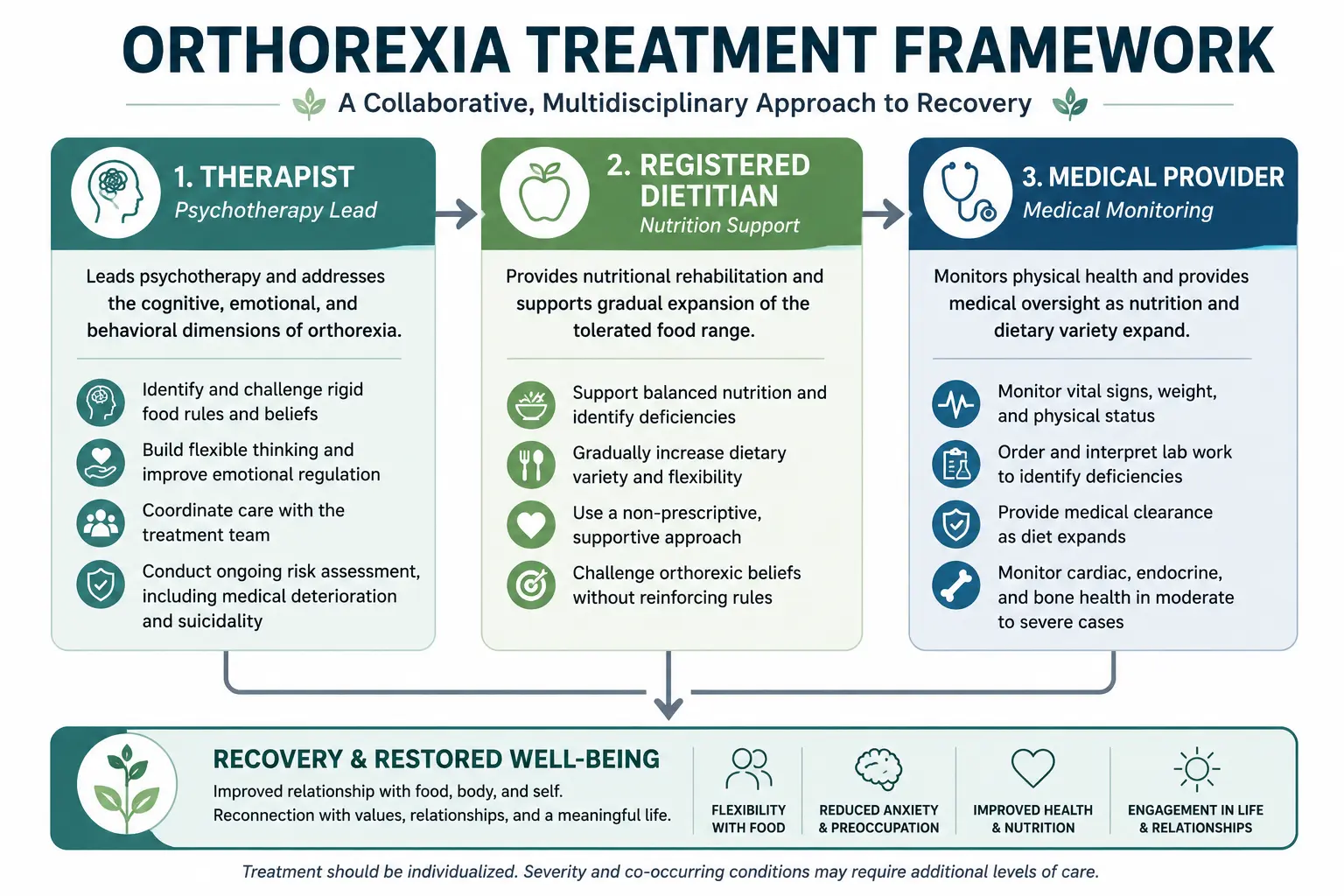
Effective treatment for orthorexia nervosa typically requires coordinated care across three disciplines:
Mental Health Therapist
The mental health therapist leads psychotherapy, addresses the cognitive and emotional dimensions of orthorexia, and coordinates with other team members. The therapist is also responsible for ongoing risk assessment, including monitoring for medical deterioration and suicidality.
Registered Dietitian
The registered dietitian, ideally one with eating disorder specialization, provides nutritional rehabilitation, supports the client in gradually expanding their tolerated food range, and addresses specific nutritional deficiencies. Nutrition work should be conducted in a non-prescriptive, supportive manner so it does not reinforce orthorexic beliefs.
Medical Physician or Nurse Practitioner
The medical physician or nurse practitioner monitors physical health, orders and interprets laboratory work to identify nutritional deficiencies, and provides medical clearance as the client's diet expands. Medical monitoring is especially important when nutritional compromise may affect cardiac, endocrine, or bone health.
Effective team communication — through shared records, coordinated goals, and regular case consultation — is essential. ICANotes supports multidisciplinary documentation with shared access to treatment plans, progress notes, and clinical assessments across team members.
Building a Treatment Plan for Orthorexia
Initial assessment should include a thorough eating history (dietary rules, avoided foods, time devoted to food-related activities), evaluation of functional impairment across life domains, medical history and current nutritional status, comorbid diagnoses (especially OCD, anxiety disorders, and other eating disorders), and assessment of the client's insight and motivation for treatment.
Treatment goals should be developed collaboratively and organized across three domains:
Behavioral Goals
Increase dietary flexibility; reduce time spent planning, preparing, or researching food; and re-engage in social eating situations that orthorexia has led the client to avoid.
Cognitive Goals
Challenge and loosen rigid food beliefs; develop a more nuanced, contextual relationship with health and eating; and reduce the degree to which self-evaluation is tied to dietary purity.
Interpersonal & Functional Goals
Rebuild participation in social meals, relationships, and activities; and support return to prior occupational or academic functioning.
Progress monitoring should include regular assessment of dietary flexibility, time devoted to food-related behaviors, quality of life, and functional impairment. Standardized tools such as the Dusseldorf Orthorexia Scale (DOS) or the Bratman Orthorexia Test (BOT) can provide structured benchmarks across sessions.
Related: Eating Disorder Treatment Plan and Note Writing Tips
Recovery and What to Expect
Recovery from orthorexia nervosa is achievable, though it is often non-linear. Clients may make meaningful progress in psychotherapy while still experiencing significant anxiety in social eating situations; nutritional rehabilitation may precede but not immediately resolve the cognitive and emotional dimensions of the disorder. Clinicians should prepare clients and their families for this reality.
Recovery typically includes: a meaningful reduction in the time and mental energy devoted to food planning; the ability to eat outside of self-imposed rules in some situations without prolonged distress; re-engagement in social eating and relationships; and an improved sense of overall quality of life. Relapse prevention planning that identifies personal triggers — stressors, social media exposure, health scares — and reinforces alternative coping strategies is an important component of longer-term treatment.
Frequently Asked Questions About Orthorexia Nervosa
+ Is orthorexia nervosa in the DSM-5?
No. Orthorexia nervosa is not currently listed in the DSM-5 as an official diagnosis. However, it is widely recognized by clinicians and researchers as a serious concern. A 2022 consensus study involving 47 international experts proposed standardized diagnostic criteria, and researchers anticipate it may eventually be added to the DSM — likely within the Feeding and Eating Disorders category.
+ What are the symptoms of orthorexia nervosa?
Orthorexia is characterized by a strong preoccupation with eating "healthy," self-imposed rigid food rules, avoidance of foods deemed impure or unhealthy, excessive time spent planning and preparing food, significant anxiety when those rules are violated, guilt after eating non-approved foods, and meaningful impairment in social, occupational, or other areas of functioning. Unlike most other eating disorders, orthorexia is motivated by food quality rather than weight, body image, or caloric restriction.
+ How is orthorexia different from anorexia nervosa?
The key distinction is motivation. Anorexia nervosa is driven by fear of weight gain, body image disturbance, and caloric restriction. Orthorexia is driven by a belief that certain foods are harmful, impure, or unhealthy, and a desire to eat "correctly" for health. A person with orthorexia may have no concern about weight or caloric intake — their restriction is organized around food quality, not quantity. That said, both conditions can co-occur, and symptom overlap requires careful differential assessment.
+ What treatments are available for orthorexia nervosa?
There are no evidence-based treatment protocols specifically validated for orthorexia nervosa yet. Clinical consensus supports a multidisciplinary approach including psychotherapy, nutrition counseling with a registered dietitian specializing in eating disorders, and medical monitoring. CBT, ACT, and DBT are commonly used modalities, adapted to address the health-focused beliefs and food quality preoccupation that define orthorexia.
+ Who is most at risk for developing orthorexia nervosa?
Research identifies several risk factors: perfectionism and a strong need for control, elevated emotion dysregulation, OCD or obsessive-compulsive features, a personal or family history of disordered eating, and high exposure to diet culture or healthism content in media and online communities. That said, orthorexia can affect individuals across genders, ages, and socioeconomic backgrounds.
How ICANotes Helps Clinicians Document Orthorexia Treatment
Treating orthorexia nervosa — particularly within a multidisciplinary team — requires documentation that is thorough, consistent, and accessible across providers. ICANotes simplifies this process with pre-configured, menu-driven templates designed for eating disorder diagnosis and treatment, including tools for documenting complex symptom profiles, coordinating care across disciplines, and tracking progress against individualized treatment goals.
For clinicians working with clients who present with orthorexia alongside OCD, anxiety disorders, or mood disorders, ICANotes supports co-documentation of multiple conditions without duplicating effort. Built-in assessment tools, eating disorder treatment plan templates, and progress note frameworks allow clinicians to focus on delivering high-quality care while maintaining clinically relevant and compliant records. Whether you are tracking shifts in dietary flexibility, monitoring nutritional status, or coordinating with a dietitian and physician, ICANotes keeps the full clinical picture organized and accessible.
Try ICANotes Free
Simplify Eating Disorder Documentation
Treating orthorexia nervosa often requires careful assessment, treatment planning, progress tracking, and collaboration across a multidisciplinary care team. ICANotes helps behavioral health clinicians document complex eating disorder presentations with efficient, clinically focused templates.
- Document symptoms, functional impairment, and co-occurring conditions
- Create individualized eating disorder treatment plans
- Track progress across therapy, nutrition, and medical coordination
- Spend less time charting and more time focused on client care
Start Your Free Trial
No credit card required.
Recent Posts






Katie Bendel
LCSW
About the Author
Katie Bendel, LCSW is a licensed clinical social worker, therapist, writer, and speaker with more than 10 years of experience in the mental health field. She has worked across outpatient, residential, assessment, and aftercare settings, supporting individuals and families affected by eating disorders, substance use disorders, anxiety, trauma, and mood disorders. Katie currently works in both clinical practice and behavioral health education, helping connect clinicians, clients, and communities with evidence-based mental health resources and support.