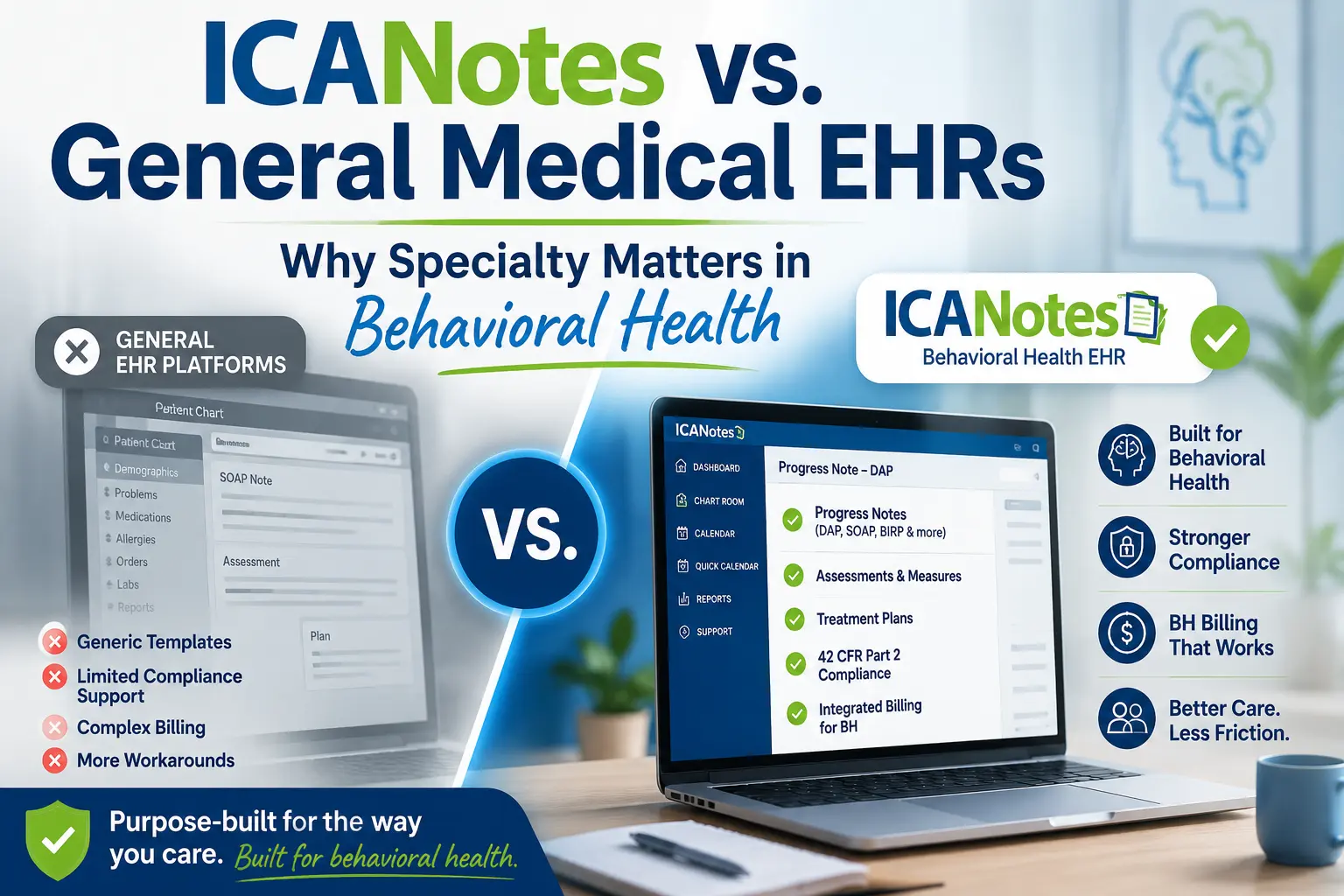
Best EHR for Multi-Provider Behavioral Health Practices in 2026
Compare five EHR platforms for multi-provider behavioral health practices based on the operational capabilities that matter most as teams grow, including documentation governance, supervision, role-based permissions, shared scheduling, billing, reporting, implementation, and total cost.


The best EHR for a multi-provider behavioral health practice depends on the organization's clinical and operational needs. ICANotes is designed specifically for behavioral health teams that want documentation, prescribing, scheduling, billing, and practice operations in one system. TherapyNotes offers transparent group pricing and detailed user roles, while SimplePractice may appeal to smaller teams seeking a familiar self-service platform. Valant emphasizes centralized operations for larger and multi-site organizations, and Practice Fusion may be relevant for medical groups that include behavioral health.
Key takeaways
- A multi-provider EHR should support the entire practice, not just individual clinicians. Evaluate documentation governance, supervision, role-based permissions, shared scheduling, billing, reporting, and implementation together.
- Standardization becomes more important as the practice grows. Look for tools that help clinicians follow consistent documentation and workflow standards without limiting clinical judgment.
- Role-based access and supervision workflows deserve hands-on testing. During a demo, verify how the system handles supervisors, co-signatures, schedulers, billers, administrators, and clinicians with different access needs.
- Published seat price does not equal total cost. Factor in implementation, migration, claims, payment processing, telehealth, prescribing, messaging, AI tools, and other add-ons before comparing platforms.
- The strongest fit depends on your practice model. ICANotes is designed specifically for behavioral health group practices that want documentation, prescribing, scheduling, billing, and reporting in one system, while other platforms may be better suited to different practice sizes, specialties, or operational models.
Why growing practices outgrow solo clinician workflows
A solo clinician can keep many documentation rules in memory. A group practice cannot depend on every clinician remembering the same template, payer expectation, naming convention, and follow up step. As a roster grows, documentation standards drift unless the system reinforces them.
New clinicians bring habits from previous roles. Supervisors need consistent records for review and co signature. Billing staff need documentation that supports the service reported on a claim. Schedulers need practice wide calendars without unnecessary access to clinical notes. These are system design problems, not simply training problems.
Growth also changes how work is assigned and reviewed. Practices need to manage caseload visibility, coverage, supervisor relationships, co signatures, clinician onboarding, payer enrollment, and access changes without relying on spreadsheets or individual memory.
What best means for a multi-provider behavioral health practice
No platform is the best fit for every organization. A two-clinician therapy practice, a psychiatric group, and a multi-site IOP program place different demands on an EHR. Strong group practice systems tend to share the following characteristics.
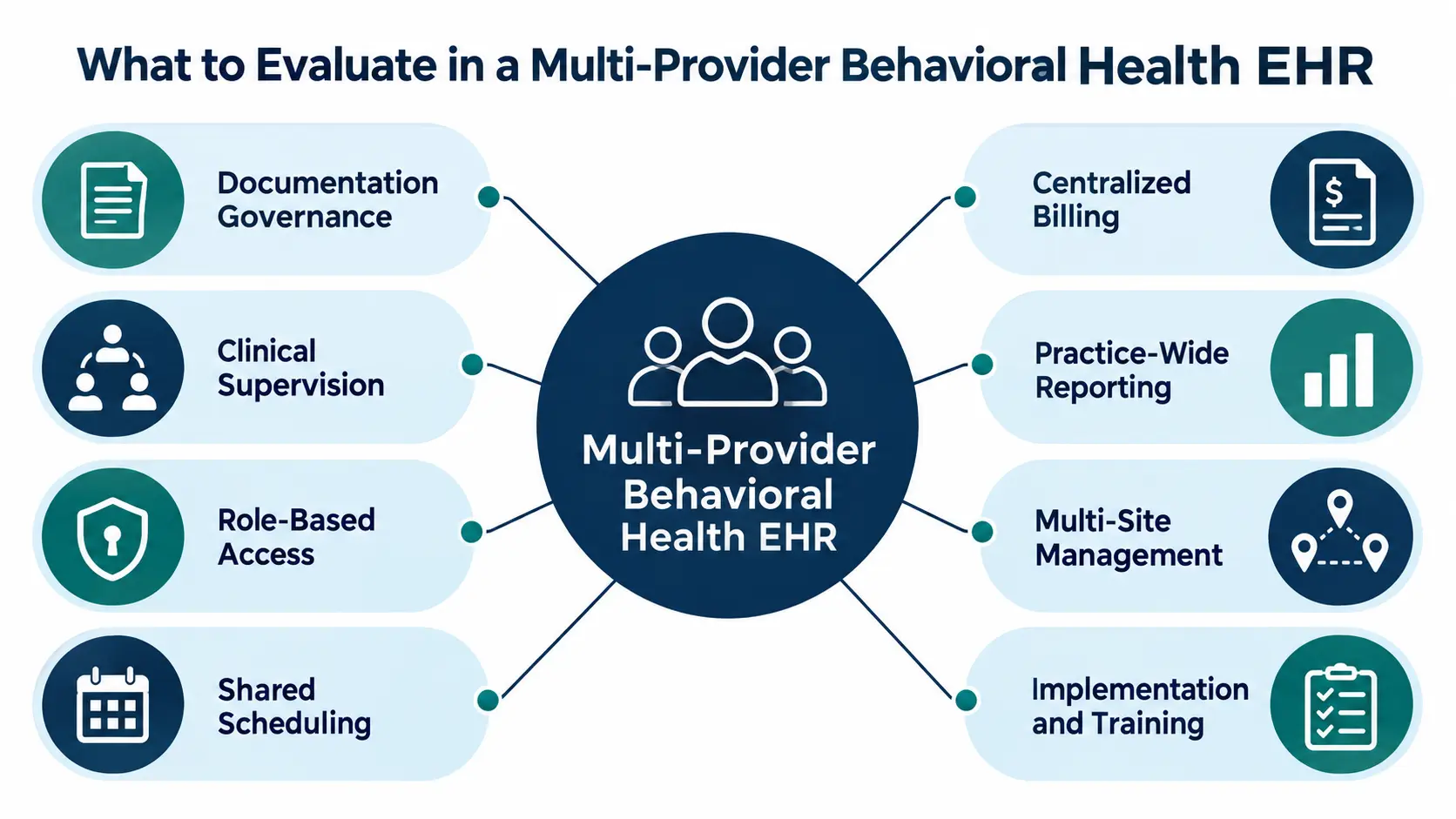
- Shared documentation standards. Templates create a consistent structure while allowing clinicians to document the individual encounter accurately.
- Supervision and quality control. Supervisors can review, return, co sign, and monitor documentation without receiving unnecessary access to every record.
- Role based access. Clinicians, supervisors, billers, schedulers, and administrators receive access appropriate to their duties.
- Shared scheduling and coverage. Authorized staff can view provider availability, locations, appointment status, and coverage needs in one system.
- Centralized billing and reporting. Leadership can monitor claims, collections, documentation status, and operational trends across clinicians and locations.
- Transparent total cost. The practice can model licenses, implementation, claims, telehealth, prescribing, and optional services before signing.
- Practical implementation support. Data migration, configuration, training, and go live responsibilities are documented before the transition begins.

Choose the Right EHR for Your Growing Behavioral Health Practice
Get the free Multi-Provider EHR Evaluation Toolkit Bundle to compare vendors more objectively, test the workflows that matter most, and plan for a smoother implementation.
- Put every vendor through the same live workflow tests for supervision, permissions, scheduling, billing, and reporting
- Score competing EHRs using a weighted evaluation workbook based on your practice’s priorities
- Compare real costs beyond the base subscription, including implementation, migration, claims, telehealth, and add-ons
- Use the implementation-readiness checklist to prepare for migration, training, testing, and go-live
How we evaluated the platforms
This comparison reviews publicly available first party vendor pages and support documentation accessed through September 14 2026. We compared documentation controls, user roles, supervision, scheduling, billing, reporting, multi site operation, prescribing, implementation, support, and published pricing. The analysis does not represent hands on usability testing. When current first party documentation was unavailable or contradictory, the limitation is stated rather than treated as proof that a feature does not exist.
Pricing estimates use published base rates and one representative plan. They exclude claims, payment processing, telehealth, prescribing, implementation, and other add-ons unless stated. Buyers should request a written quote and a live workflow demonstration before making a decision.
Best fit by practice type
| Platform | Likely fit | Published pricing | Notable strength | What to verify |
|---|---|---|---|---|
| ICANotes | Multi-provider behavioral health practices that want documentation, prescribing, scheduling, billing, and reporting in one behavioral health-specific system | $45–$213/provider by role; add-ons vary | Behavioral health-specific documentation, multi-provider scheduling, role-based access, prescribing, billing, and reporting | Model telehealth, AI Scribe, claims, prescribing, and implementation costs for your clinician mix |
| TherapyNotes | Small to mid-sized behavioral health group practices that want clear team pricing and defined staff roles | $79 first clinician + $50 each additional clinician | Detailed clinician, scheduler, biller, administrator, and supervisor roles; multiple-location support | Confirm Enterprise thresholds and add-on costs at your intended team size |
| SimplePractice | Smaller group practices that prioritize ease of use and a familiar self-service workflow | $99 Plus base + clinician rates by team size | Multiple locations, shared templates, client sharing, and defined roles | Confirm total cost as clinicians and adjacent services are added |
| Valant | Larger or more operationally complex behavioral health organizations, including multi-site programs | Custom quote | Centralized scheduling, permissions, reporting, billing, and cross-location administration | Request a detailed quote because total cost cannot be modeled from public pricing |
| Practice Fusion | Medical groups that include behavioral health alongside broader medical services | $199 per provider per month with annual commitment | General medical EHR with staff access levels and shared templates | Verify current behavioral health and larger-group functionality because some supporting pages are older |
ICANotes
ICANotes is designed around behavioral health documentation and practice operations. Its group practice page describes shared templates, multi-provider scheduling, role-based access, integrated billing, assessment tools, reporting, and support for multidisciplinary teams working across multiple sites. Its practice management page adds centralized scheduling, billing, patient portal, messaging, and administrative workflows.
The platform also documents EPCS and PDMP workflows for prescribing clinicians. Published role-based prices range from $45 to $213 per provider per month. Telehealth and AI Scribe are listed separately, and claim-related costs vary, so groups should model the actual mix of clinician roles and add-ons using the current pricing page.
Valant
Valant is positioned for behavioral health organizations that need centralized clinical and administrative operations. Its group practice page describes shared clinical records, scheduling, billing, assessments, outcomes, and collaboration across provider specialties.
For multi-site organizations, Valant documents multi account access and role based permissions along with scheduling views by provider, facility, program, and room. Its public pricing page does not provide numeric rates, so implementation, telehealth, AI, reporting, and revenue cycle costs should be separated in a written quote.
TherapyNotes
TherapyNotes combines clear team pricing with detailed role separation. Its user role documentation distinguishes clinicians, schedulers, billers, clinical administrators, and supervisors, while its multiple location guide connects location selection to scheduling, reminders, billing forms, and claims.
TherapyNotes also advertises personalized onboarding, eligible record imports, and 24 hour support on its support page. Its public pricing and support pages disagree on whether Enterprise begins at 20 or 30 users, so larger practices should confirm the applicable tier in writing.
SimplePractice
SimplePractice supports multiple office locations, practice-wide settings, shared templates, client sharing, billing, and several clinician and administrative roles. Its group practice setup guide and clinician role documentation explain how owners configure team access and shared workflows.
A multi-clinician practice must use Plus. Standard base and clinician rates are published in the pricing FAQ, while the live sales page may display promotional pricing. Confirm the effective subscription, claims, prescribing, practice manager, and other service fees in writing.
Practice Fusion
Practice Fusion publishes a price of $199 per provider per month with an annual commitment. Its current pricing page describes included signing and non-signing staff accounts, and its help center documents administrator assigned access levels.
The clearest public claims about large practices and behavioral health appear on a 2010 large medical group page and a 2016 psychiatry page. Those pages describe multiple providers, locations, staff, shared templates, and psychiatric content, but buyers should verify that the current product and commercial terms still match those older pages. Billing services should be priced separately from the base EHR license.
Documentation governance and clinical supervision
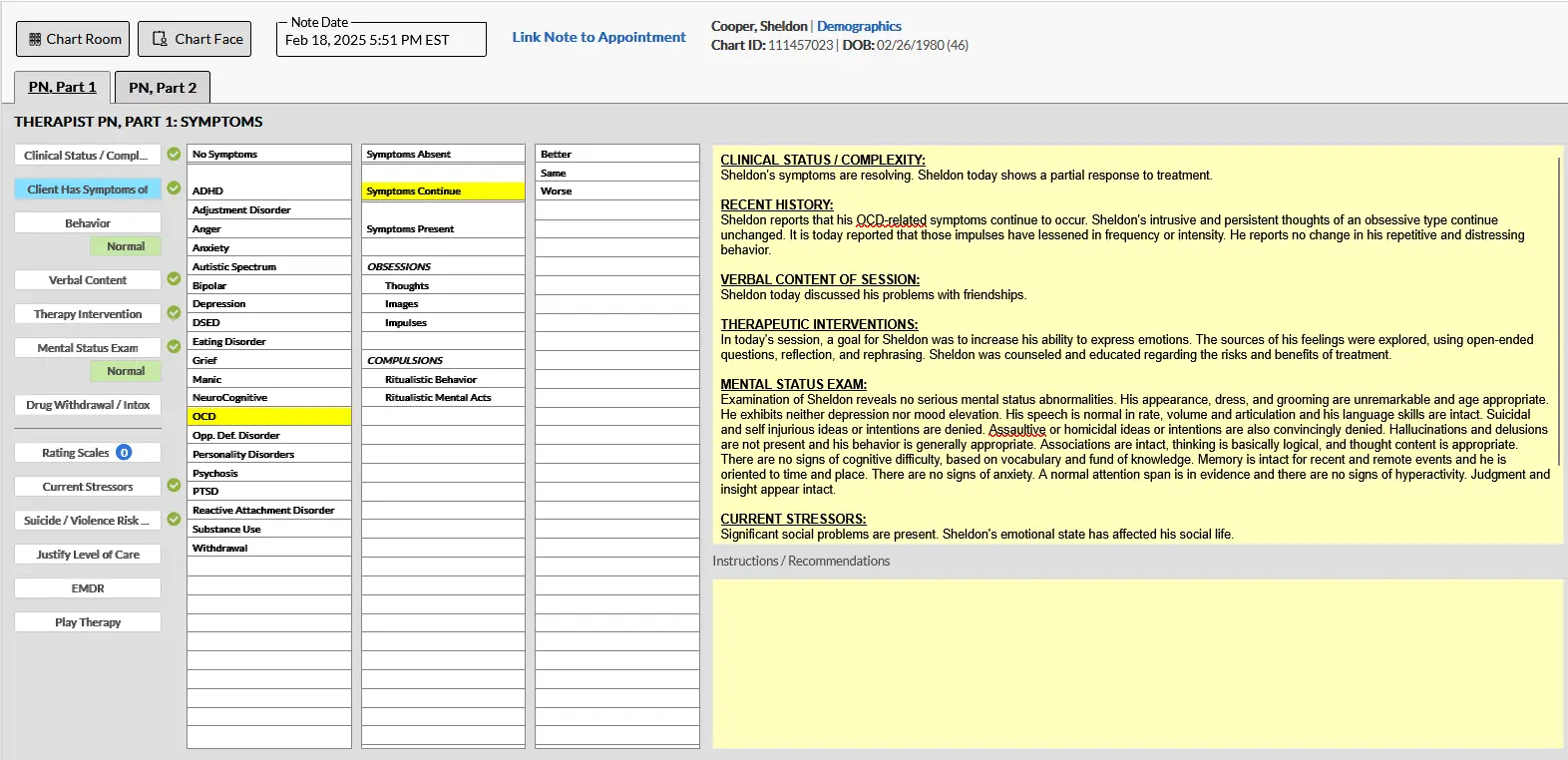
Multi-provider practices need more than customizable note templates. They need a controlled way to standardize required sections, terminology, signatures, treatment plan updates, and documentation timelines while preserving the clinician's professional judgment.
Supervision workflows should identify which notes require review, route them to the correct supervisor, preserve the original author, record comments or corrections, and show whether documentation is pending, returned, or signed. Practice leaders should also be able to monitor incomplete notes and expiring treatment plans without opening every chart individually.
This test reveals more about multi-provider readiness than a generic template tour.
During a demonstration, create two clinicians with different supervisors, route a note for review, return it for correction, complete a co-signature, and run a report of unsigned or overdue documentation. This test reveals more about multi-provider readiness than a generic template tour.
Specialty workflows remain a separate fit test
A practice should also test any service line that materially affects its operations, such as psychiatry, substance use treatment, residential care, or group programming. Those workflows belong in the final decision, but they should not replace the core multi-provider evaluation. Practices that run recurring therapy groups can use the separate group therapy EHR comparison for a deeper workflow review.
Illustrative base license costs by practice size
The estimates below show how published base license pricing may scale as a practice grows. They are illustrative only and are not vendor quotes. Costs for claims, payment processing, prescribing, telehealth, implementation, AI tools, and other optional services are excluded unless otherwise noted.
| Clinicians | ICANotes (Non-Prescribing Clinician) | TherapyNotes Group | SimplePractice Plus | Practice Fusion |
|---|---|---|---|---|
| 5 | $375 | $279 | $469 | $995 |
| 10 | $750 | $529 | $819 | $1,990 |
| 25 | $1,875 | $1,279 | $1,824 | $4,975 |
| 50 | $3,750 | $2,529 | $3,549 | $9,950 |
ICANotes uses the illustrative $75 Non-Prescribing Clinician rate. TherapyNotes uses $79 for the first clinician plus $50 for each additional clinician. SimplePractice uses a $99 Plus base plus $74 per clinician for 2 to 5 clinicians, $72 for 6 to 15, and $69 for 16 or more. Practice Fusion uses $199 per provider. TherapyNotes publishes conflicting Enterprise thresholds of 20 and 30 users across two first party pages; confirm the applicable tier before budgeting.
Permissions and multi-site control
Role-based access should match the work each person performs. A clinician may need only assigned client records. A supervisor may need review and co-signature rights for supervisees. A scheduler needs practice calendars without unrestricted clinical access. A biller needs the information required to manage claims without automatically receiving access to every clinical detail.
During a demonstration, test the exact role combinations your organization uses. Also confirm whether an administrator can see schedules, billing status, and reporting across locations without switching accounts. Request documentation for access logs, account termination, permission changes, and emergency access.
Implementation checklist
A group practice should agree on migration scope, responsibilities, testing, and support before choosing a go live date.
Confirm migration scope
List the record types that will transfer, including demographics, insurance, treatment plans, notes, medications, documents, authorizations, balances, and audit history.
Test permissions
Map clinicians, supervisors, billers, schedulers, and administrators to the new permission model and test each role.
Protect the billing cycle
Validate clearinghouse enrollment, payer connections, claim creation, remittance posting, and patient balances before retiring the previous system.
Run a multi-provider scenario
Create clinician and supervisor accounts, route a note for review, test coverage scheduling, and verify that billing and reporting reflect the correct provider.
Train by role
Train each role on the tasks it performs instead of placing the entire staff in one generic session.
Define go live readiness
Set measurable acceptance criteria and an escalation path for unresolved migration, access, or claim issues.
Privacy and security questions for an EHR vendor
HIPAA does not certify a particular EHR as compliant. A regulated practice remains responsible for its own risk analysis, policies, configuration, and use of the system. When a cloud EHR creates, receives, maintains, or transmits electronic protected health information on behalf of a covered entity, the parties generally need an appropriate business associate agreement. See the HHS cloud computing guidance.
- Will the vendor sign a business associate agreement that covers the services and subcontractors in scope
- How are access, authentication, audit logs, backups, recovery, and account termination handled
- Which security and privacy features require configuration or additional fees
- How can the practice export records and audit information during a migration or contract termination
- How does the system separate psychotherapy notes when a practice uses them
Psychotherapy notes have a narrow HIPAA definition and receive additional protections when maintained separately from the medical record. See the HHS Privacy Rule summary. Practices should obtain legal or compliance advice for their specific obligations.
Where ICANotes fits
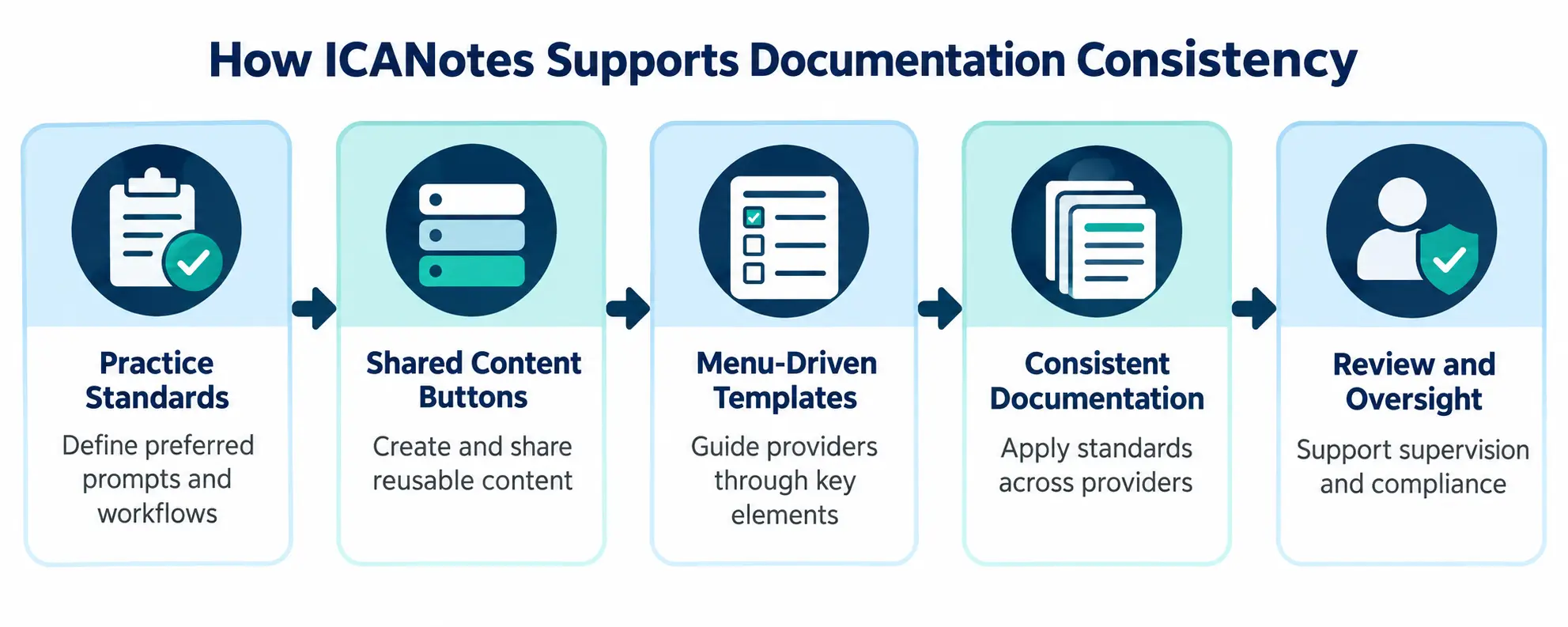
ICANotes is most relevant to teams that want a behavioral-health-specific record rather than a general medical EHR or a collection of disconnected tools. Its menu driven behavioral health content templates and shared custom content buttons help practice leaders standardize preferred prompts, terminology, and workflows across providers. This supports documentation consistency and the practice's compliance program while preserving clinical judgment. Multi provider scheduling, role-based access, prescribing, billing, reporting, patient engagement, and telehealth are available within the same platform.
Role-based pricing also lets a practice model therapists, part-time clinicians, prescribers, and documentation-only users differently. That can be useful for a team whose users do not all require the same clinical capabilities, but the organization should include telehealth, AI Scribe, claims, prescribing, and implementation needs in its total cost estimate.
The deciding test should mirror the practice's operating model. Configure real clinician and administrative roles, review shared schedules, route documentation for supervision, and inspect reporting across providers and locations before choosing a platform.
See the workflow in ICANotes
Explore how ICANotes handles documentation, permissions, shared scheduling, billing, reporting, and prescribing for a growing behavioral health team. Some features, including ePrescribing and insurance claim submission, are not available during the trial period.
- Standardize templates across every provider
- Route notes for supervision and co-signature
- Role-based access for schedulers and billers
- Reporting across providers and locations
See how ICANotes can support your multi-provider workflows. Start your free 30-day trial, no credit card required.
Start Your Free 30-Day Trial
Frequently Asked Questions
Which EHR is best for a behavioral health group practice
What should a multi provider practice evaluate
Which EHR is a strong fit for a psychiatric group
How should an EHR support clinical supervision
Do multi-provider practices need multi site features
How much does an EHR cost for a group practice
How can a group switch EHRs without disrupting billing
References
- Valant plans and pricing
- Valant group practice suite
- Valant multi franchise practice management
- Valant scheduling
- TherapyNotes pricing
- TherapyNotes pricing and subscription details
- TherapyNotes user roles
- TherapyNotes multiple locations
- TherapyNotes support and onboarding
- SimplePractice pricing FAQ
- SimplePractice group practice setup
- SimplePractice clinician roles
- Practice Fusion pricing
- Practice Fusion access levels
- Practice Fusion large medical groups published in 2010
- Practice Fusion psychiatry EHR published in 2016
- ICANotes group practice EHR
- ICANotes practice management
- ICANotes features
- ICANotes pricing
- ICANotes ePrescribing EPCS and PDMP
- HHS HIPAA and cloud computing guidance
- HHS Privacy Rule summary
Dr. October Boyles
Dr. October Boyles is a behavioral health expert and clinical leader with extensive expertise in nursing, compliance, and healthcare operations. With a Doctor of Nursing Practice (DNP) and advanced degrees in nursing, she specializes in evidence-based practices, EHR optimization, and improving outcomes in behavioral health settings. Dr. Boyles is passionate about empowering clinicians with the tools and strategies needed to deliver high-quality, patient-centered care.