Blog > Treatment Strategies > Problem-Focused vs. Emotion-Focused Coping: Key Differences, Examples & Clinical Applications
Problem-Focused vs. Emotion-Focused Coping: Understanding the Two Most Important Coping Styles in Mental Health Treatment
Problem-focused coping and emotion-focused coping are two of the most important coping styles used in mental health treatment. While problem-focused coping helps clients address controllable stressors through action and problem-solving, emotion-focused coping helps them manage emotional responses to situations they cannot change. In this guide, mental health clinicians will learn the key differences between problem-focused and emotion-focused coping, review real-world examples of each approach, explore evidence-based coping interventions, and discover practical strategies for helping clients build adaptive coping skills and resilience.


Last Updated: June 23, 2026

What You'll Learn
- The differences between problem-focused and emotion-focused coping
- When each coping style is most effective
- Problem-focused coping examples and emotion-focused coping examples commonly used in therapy
- How adaptive coping strategies differ from maladaptive coping patterns
- Evidence-based coping interventions clinicians can use in treatment
- A practical framework for helping clients choose the right coping strategy for a given situation
- How to incorporate coping skills into treatment planning and clinical practice
Contents
- What is Problem-Focused Coping?
- What is Emotion-Focused Coping?
- Problem-Focused vs. Emotion-Focused Coping: Key Differences
- Coping Interventions Clinicians Can Use
- Helping Clients Choose the Right Coping Strategy
- Building Adaptive Coping Skills Over Time
- FAQ: Problem Focused vs Emotion Focused Coping
Many clients arrive in therapy believing they need to "fix" their emotions — as if distress itself is the problem. Others pour all their energy into solving problems that may be entirely outside their control, growing increasingly frustrated when their efforts don't bring relief. Neither approach alone leads to lasting psychological well-being.
Effective coping rarely happens by accident. As mental health professionals, we teach coping skills routinely, but understanding why certain strategies work in some situations and fail in others is what distinguishes adequate treatment from truly effective care.
Two of the most extensively studied frameworks in coping research are problem-focused coping and emotion-focused coping, first systematically described by psychologists Richard Lazarus and Susan Folkman in their landmark 1984 work on stress and coping. These two approaches differ fundamentally in what they target: one aims to change the stressor itself, while the other aims to change how a person responds emotionally to that stressor.
By the end of this article, clinicians will understand the clinical definitions of both coping styles, when each approach is most effective and why, concrete clinical examples for both modalities, how to integrate both into treatment planning, and how to help clients build a balanced, flexible coping repertoire.
What Are Coping Strategies for Mental Health?
What Are Coping Strategies for Mental Health?
Coping strategies for mental health are the thoughts, behaviors, and emotional regulation techniques people use to manage stress, reduce distress, and respond to difficult situations. Effective coping strategies may focus on solving the problem, managing the emotional response, or using both approaches depending on whether the stressor can be changed.
Defining Coping in Clinical Practice
Coping strategies are the cognitive and behavioral efforts individuals use to manage internal and external demands that exceed their available resources. In clinical terms, coping encompasses everything a client does — intentionally or habitually — in response to stress.
The psychological significance of coping cannot be overstated. Research consistently links adaptive coping patterns to greater resilience, more effective emotional regulation, faster recovery from adversity, and reduced symptom severity across a broad range of mental health conditions including depression, anxiety disorders, PTSD, and adjustment disorders.
Adaptive vs. Maladaptive Coping
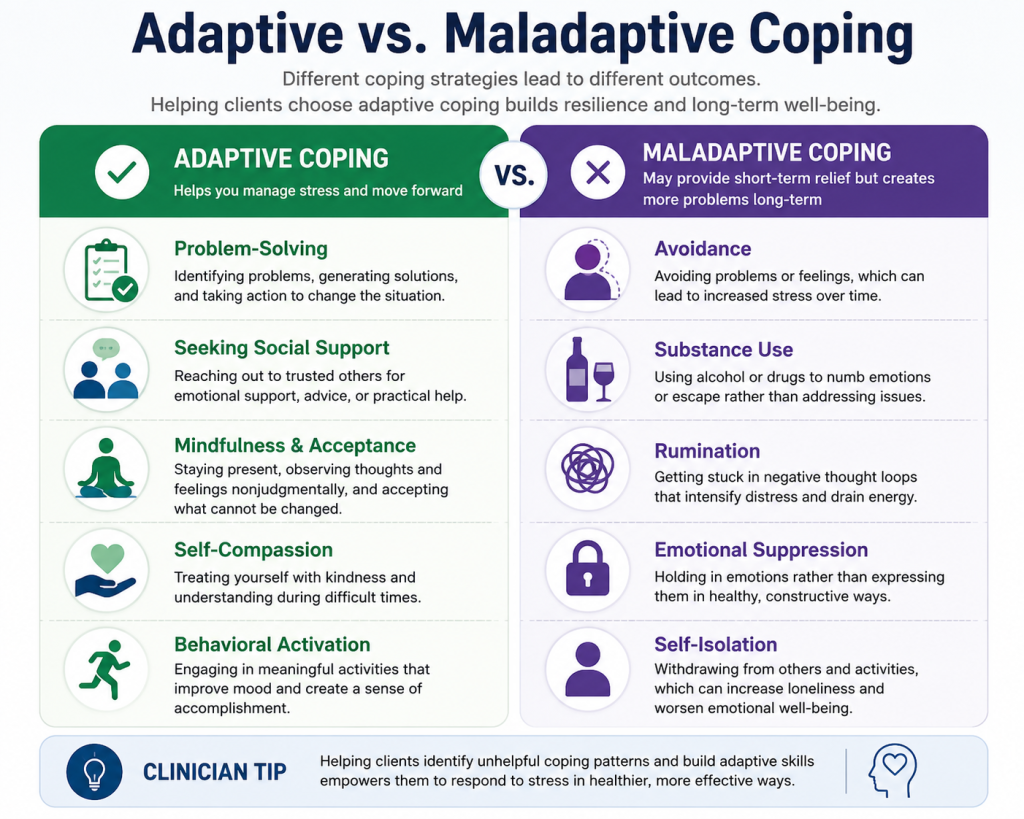
Before examining problem-focused and emotion-focused coping specifically, it is important to establish a foundational principle: no coping strategy is inherently good or bad. Effectiveness is always context-dependent. Both problem-focused and emotion-focused coping can function adaptively or maladaptively depending on the situation and the client's level of flexibility.
Maladaptive coping refers to strategies that may reduce distress in the short term but worsen outcomes over time. Common examples include substance use and self-medication, avoidance and behavioral withdrawal, emotional suppression, rumination, and self-destructive behaviors.
Adaptive coping involves strategies that build resilience and support long-term functioning — active problem-solving, seeking instrumental and emotional support, cognitive reappraisal, acceptance, mindfulness, and behavioral activation. A client who problem-solves when facing grief, or emotionally processes when facing a fixable workplace conflict, is applying the right approach in the wrong context — and that mismatch is a frequent source of ongoing distress.
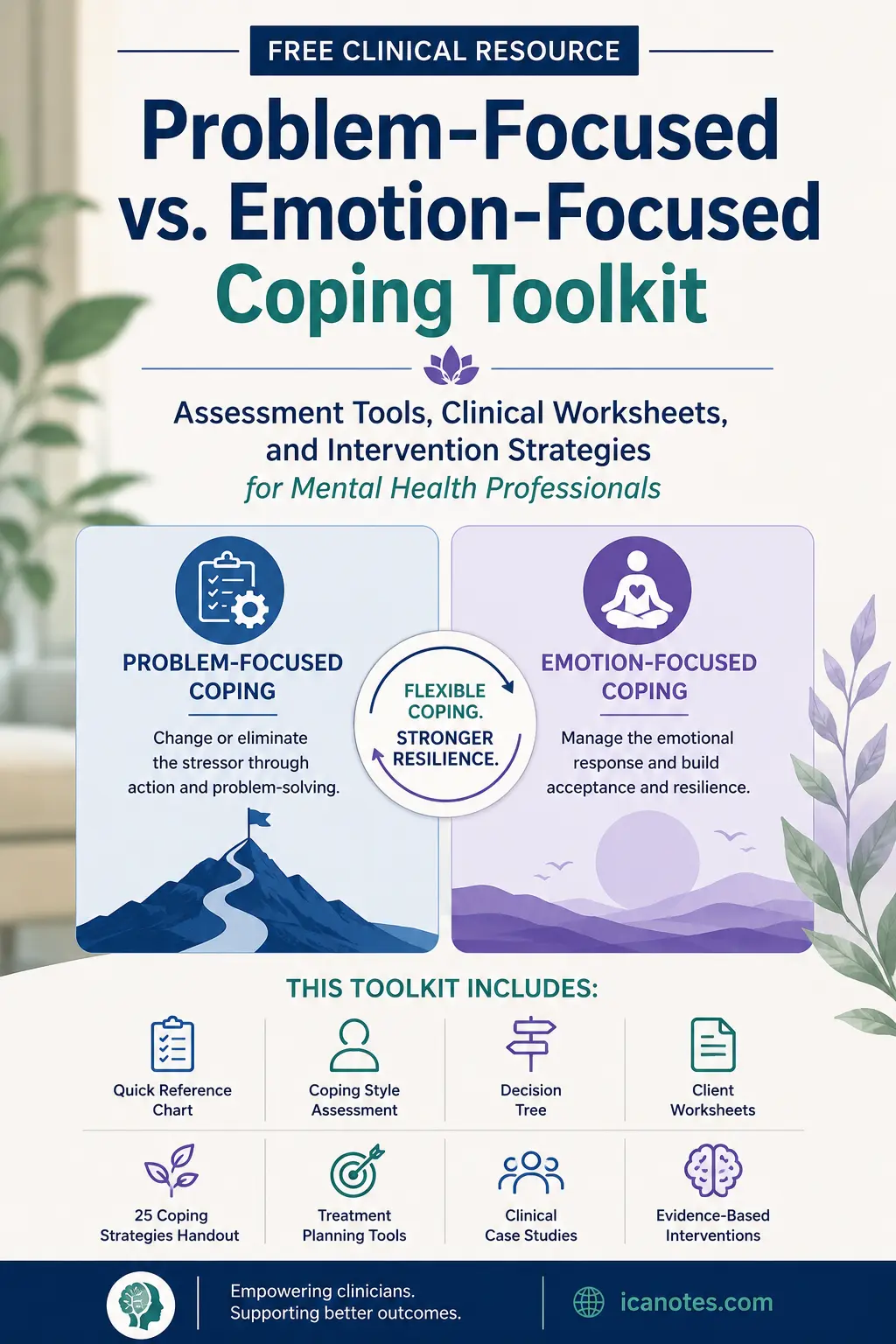
Free Clinical Resource
Download the Problem-Focused vs. Emotion-Focused Coping Toolkit
Get practical assessment tools, clinical worksheets, coping decision trees, treatment planning resources, and case studies to help clients build adaptive coping skills and resilience.
Inside the toolkit: Quick reference chart, coping style assessment, decision tree, client worksheets, 25 coping strategies handout, treatment planning tools, and clinical case studies.
What is Problem-Focused Coping?
Definition and Core Goal
Problem-focused coping involves taking direct, purposeful action to address, reduce, or eliminate the source of stress. The underlying logic is straightforward: if the stressor can be changed, it should be. Rather than dwelling on the emotional discomfort a stressor creates, clients using problem-focused strategies channel their energy into modifying the situation itself — gathering information, making plans, developing new skills, and taking concrete steps toward resolution.
When Problem-Focused Coping Works Best
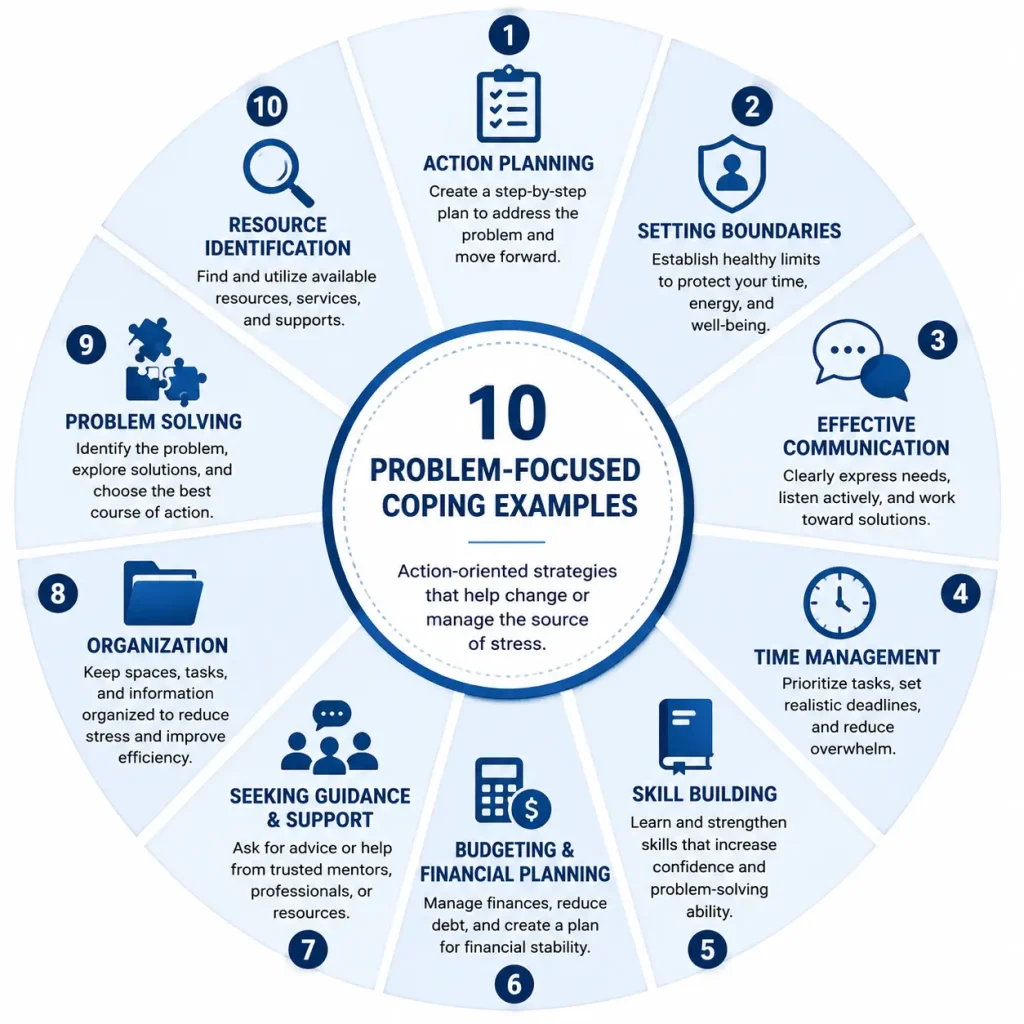
Problem-focused coping is most effective when the stressor is controllable and within the client's sphere of influence, actionable in concrete and practical ways, temporary or potentially resolvable, and practical rather than existential in nature. Common clinical presentations well-suited to this approach include financial difficulties, workplace conflicts, time management challenges, relationship communication breakdowns, and academic or professional performance concerns.
10 Problem-Focused Coping Examples
What is Emotion-Focused Coping?
Definition and Core Goal
Emotion-focused coping aims to regulate the emotional response to a stressor rather than changing the stressor itself. It recognizes a core clinical truth: not all problems can or should be solved. Sometimes the healthiest thing a client can do is learn to tolerate, process, and ultimately accept what cannot be changed.
Where problem-focused coping targets the external situation, emotion-focused coping targets the internal experience — the feelings, thoughts, and physiological responses that arise in the presence of a stressor.
When Emotion-Focused Coping Works Best
Emotion-focused coping is most effective when the stressor is outside the client's control, permanent or irreversible, uncertain or unpredictable, or existential and meaning-laden in nature. Common presentations include grief and bereavement, chronic illness and disability, trauma and its aftermath, natural disasters, waiting periods for medical diagnoses, post-divorce adjustment, and aging-related losses.
10 Emotion-Focused Coping Examples

Problem-Focused vs. Emotion-Focused Coping: Key Differences
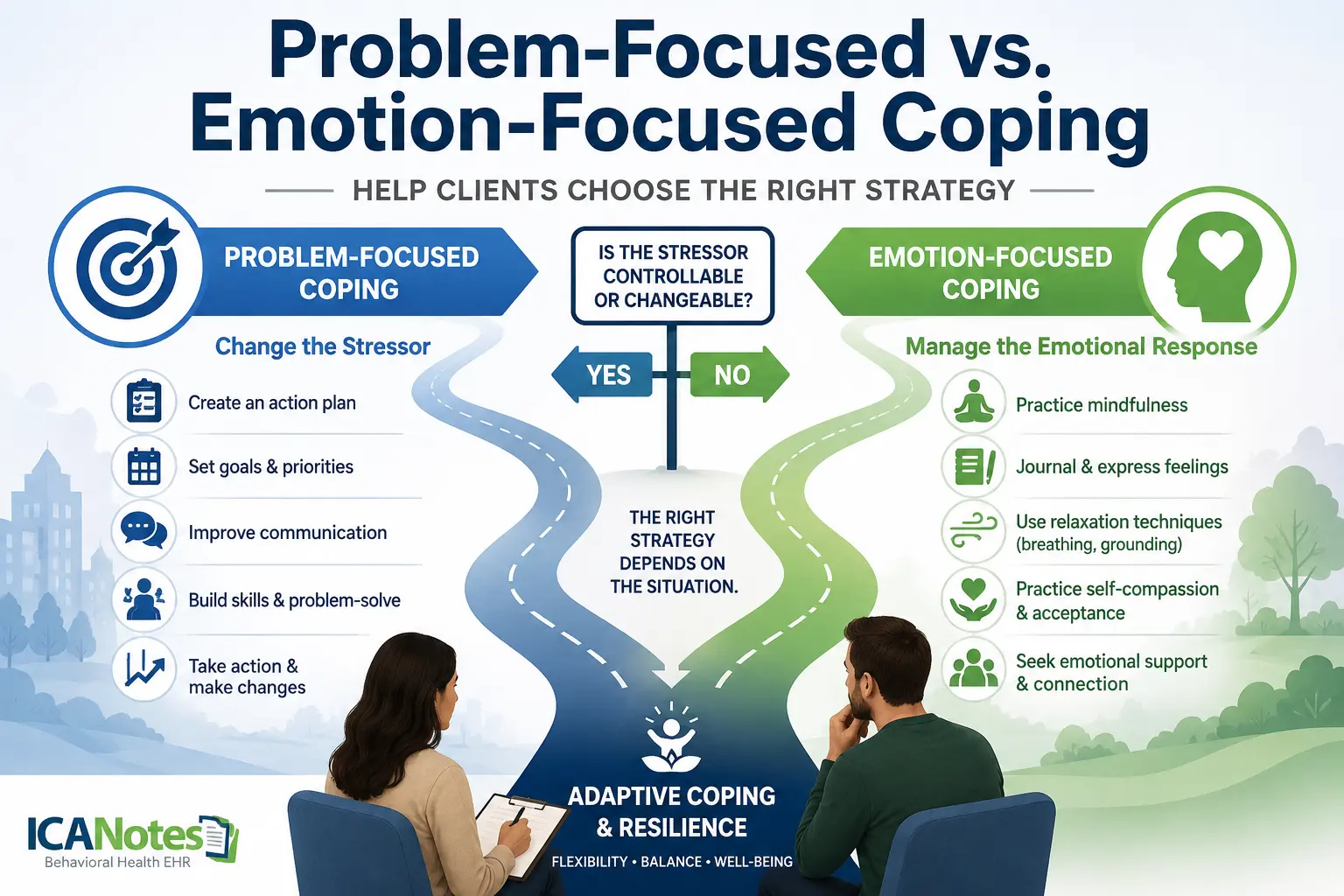
While problem-focused coping and emotion-focused coping are often presented as competing approaches, they are best understood as complementary tools that serve different purposes. The key distinction lies in what each strategy is designed to address. Problem-focused coping targets the source of stress itself, while emotion-focused coping targets the emotional response that the stressor creates.
Neither approach is inherently superior. The effectiveness of a coping strategy depends largely on the nature of the stressor. When a situation is controllable, action-oriented strategies such as problem-solving, communication, and planning can reduce distress by changing the circumstances. When a stressor is uncontrollable or irreversible, strategies such as acceptance, mindfulness, self-compassion, and emotional processing are often more beneficial because they help clients adapt to what cannot be changed.
For mental health clinicians, the goal is not to teach clients to rely exclusively on one coping style. Rather, it is to help them develop the flexibility to recognize which situations call for action, which call for acceptance, and when a combination of both approaches is most appropriate.
| Feature | Problem-Focused Coping | Emotion-Focused Coping |
|---|---|---|
| Goal | Change or eliminate the stressor | Manage the emotional response to the stressor |
| Best For | Controllable, actionable situations | Uncontrollable, permanent, or uncertain situations |
| Orientation | Action-oriented | Emotion-oriented |
| Example Strategy | Creating a budget, setting boundaries, improving communication | Mindfulness, acceptance, self-compassion, emotional support |
| Therapy Focus | Problem-solving therapy, behavioral activation, SMART goals | ACT, DBT emotion regulation, mindfulness-based interventions |
| Risk When Overused | Frustration or demoralization when problems cannot be solved | Avoidance of practical action on solvable problems |
Why Clients Often Need Both
One of the most clinically significant insights in coping research is that the healthiest, most resilient individuals do not choose between problem-focused and emotion-focused coping — they use both, flexibly, depending on what each situation demands.
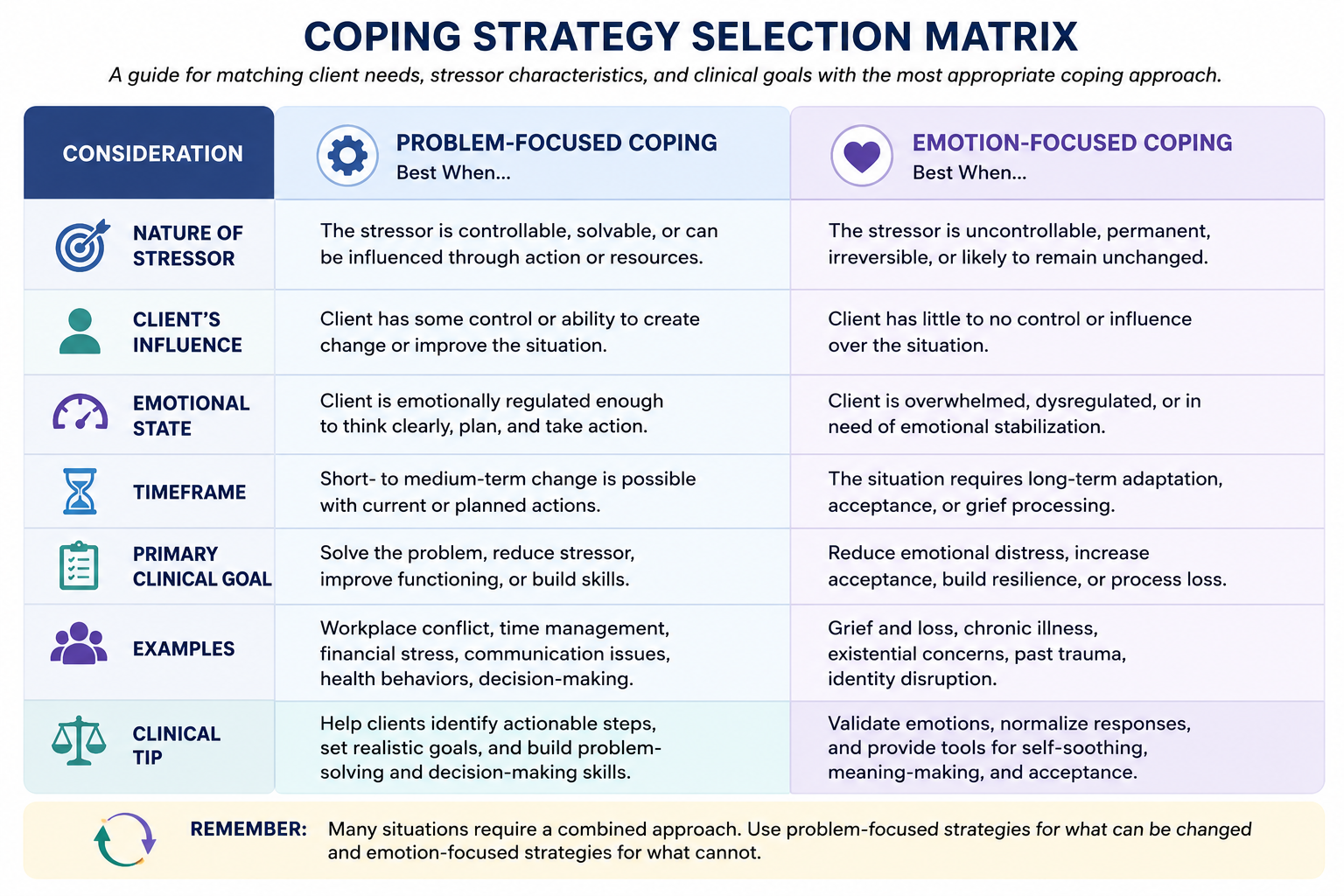
The Dual Approach in Practice
A client facing sudden job loss illustrates how both coping styles work synergistically. Emotion-focused strategies — mindfulness, self-compassion, grounding — provide the psychological stability needed to engage productively in problem-solving. Problem-focused strategies — updating the resume, reaching out to professional contacts, developing a structured job search plan — provide forward momentum and a sense of agency that supports emotional recovery. Neither approach alone is sufficient.
Coping Interventions Clinicians Can Use
Helping Clients Choose the Right Coping Strategy
Helping clients develop metacognitive coping awareness — knowing not just how to cope, but when to use which strategy — is one of the most transferable skills a therapist can build. The following decision-making framework provides a practical starting point.
Coping Strategy Decision Tree
Can the stressor realistically be changed or reduced?
Yes
The situation is within the client’s control or can be meaningfully influenced by their actions.
Use problem-focused coping: action planning, boundary setting, communication skills, SMART goals, or problem-solving therapy.
No
The situation is outside the client’s control, permanent, irreversible, or cannot be solved through direct action.
Use emotion-focused coping: mindfulness, acceptance, journaling, self-compassion, grounding, or emotional support.
Partially
Some parts of the stressor can be changed, while other parts must be accepted or emotionally processed.
Use a combined approach: act on what is controllable while using emotion-focused strategies for what cannot be changed.
Clinical reminder: If the client is too emotionally dysregulated to problem-solve, begin with stabilization first. Grounding, breathing, or other emotion-focused coping tools may help the client return to a regulated state before moving into problem-solving.
Building Adaptive Coping Skills Over Time
Assessing Current Coping Patterns
Expanding a client's coping repertoire begins with a clear-eyed assessment of existing coping behaviors. Useful assessment questions include:
- "What do you typically do when you're feeling stressed or overwhelmed?"
- "Does that strategy help you in the short term? What about long term?"
- "Are there emotions you find yourself avoiding? How do you avoid them?"
- "Are there problems in your life you keep trying to fix but can't seem to resolve?"
Expanding the Coping Toolbox
Resilient coping is not a fixed trait — it is a flexible skill set developed through intentional practice and therapeutic support. Key elements include flexibility (the ability to shift between strategies as circumstances change), psychological resilience (the capacity to recover from adversity, which research links to repertoire breadth rather than any single strategy), and emotional intelligence (the ability to accurately identify and respond to emotional states, which emotion-focused coping directly builds over time).
Documenting Coping Interventions in Clinical Practice
Teaching coping skills is only part of effective treatment. Clinicians must also document the rationale for intervention selection, client response, treatment goals, and progress over time. Whether you're introducing problem-solving techniques, mindfulness exercises, behavioral activation, or emotion regulation skills, clear documentation supports continuity of care, treatment planning, and compliance.
Document Coping Interventions Without the Documentation Burden
See How ICANotes Supports Behavioral Health Documentation
Teaching coping skills is only part of effective treatment. Clinicians must also document intervention selection, treatment goals, client response, and progress over time.
ICANotes helps behavioral health professionals document problem-focused coping interventions, emotion-focused coping strategies, treatment plans, and progress notes with workflows designed specifically for mental health practice.
With ICANotes you can:
- Document coping interventions quickly
- Create treatment plans with measurable goals
- Track client progress over time
- Streamline behavioral health documentation
- Reduce time spent on paperwork
Try ICANotes Free
Experience behavioral health documentation software built specifically for clinicians.
Frequently Asked Questions About Problem-Focused vs. Emotion-Focused Coping
Choosing the Right Coping Strategy Matters
Problem-focused and emotion-focused coping represent two complementary pillars of adaptive stress management. Problem-focused coping changes stressors; emotion-focused coping manages the emotional response to them. Both are essential. The most resilient clients are not those who have mastered one approach, but those who have learned to deploy both with flexibility and discernment.
As clinicians, our role is not simply to teach coping skills — it is to help clients develop the wisdom to know which skills are called for in a given moment. That wisdom, cultivated through targeted interventions and reflective therapeutic work, is itself one of the most powerful protective factors in long-term mental health.
Equipped with a clear understanding of when each coping style is most effective, clinicians can help clients move beyond trial-and-error coping toward a more intentional, adaptive, and sustainable approach to managing the inevitable stressors of life.
Recent Posts






Katie Cox
MA, LPCC
About the Author
Katie Cox, MA, LPCC is a Licensed Professional Clinical Counselor with over 10 years of clinical experience working with adolescents and adults. Her areas of expertise include anxiety, depression, OCD, life transitions, self-esteem, career concerns, and women's mental health. Katie utilizes evidence-based, client-centered approaches to help individuals develop practical coping skills, increase emotional awareness, and achieve their personal goals. Through her clinical work and writing, she is committed to making mental health information accessible, practical, and empowering.