Blog > Emerging Trends > AI Tools for Therapists: Practical Uses, Benefits & Ethical Considerations
AI Tools for Therapists: How to Save Time While Staying Ethical and Compliant
AI tools for therapists can help streamline clinical documentation, treatment planning, assessments, scheduling, and practice management, allowing behavioral health clinicians to spend less time on administrative tasks and more time with clients. This guide explores the most common AI tools used in therapy practices, their benefits and limitations, HIPAA compliance considerations, ethical concerns, and best practices for using AI responsibly without replacing clinical judgment.


Last Updated: June 8, 2026
What You'll Learn
- What AI tools for therapists are and how they support behavioral health practices
- The most common types of AI tools, including documentation, treatment planning, assessment, and practice management solutions
- How AI can help reduce administrative burden, improve efficiency, and support clinician well-being
The benefits and limitations of using AI in therapy and behavioral health settings - Key HIPAA compliance, privacy, and ethical considerations when evaluating AI tools
- Best practices for using AI responsibly without compromising clinical judgment or client care
- How to identify AI solutions that are secure, compliant, and appropriate for behavioral health workflows
Artificial intelligence is no longer a distant concept for behavioral health clinicians — it is already reshaping how therapists, counselors, and psychiatrists manage their practices. From session documentation to treatment planning to scheduling, AI tools for therapists are increasingly woven into the daily fabric of clinical work.
That said, the promise of AI in mental health comes with important caveats. These tools are not clinical decision-makers, and they cannot replicate the nuanced judgment, therapeutic relationship, or human insight that define effective care. What they can do — when selected carefully and used responsibly — is reduce the administrative burden that contributes to clinician burnout, documentation backlog, and inefficiency.
This guide offers a practical, balanced overview of AI tools available to behavioral health clinicians: what they do, how they can help, where they fall short, and how to use them in a way that protects your clients and your practice.
What Are AI Tools for Therapists?
AI tools for therapists refer to a broad category of software applications that use artificial intelligence — including machine learning, natural language processing, and automation — to support clinical and administrative functions in a mental health practice.
These tools generally do not make clinical decisions. Instead, they help clinicians work faster, write more consistently, stay organized, and spend less time on tasks that pull them away from client care. Common application areas include:
- Clinical documentation and progress notes
- Session summarization
- Treatment planning and goal development
- Assessment and screening support
- Scheduling, billing, and practice management automation
- Psychoeducation and therapeutic material creation
The key distinction to keep in mind: AI is a support tool, not a clinician. It should augment your practice — never replace your judgment.
Free Download
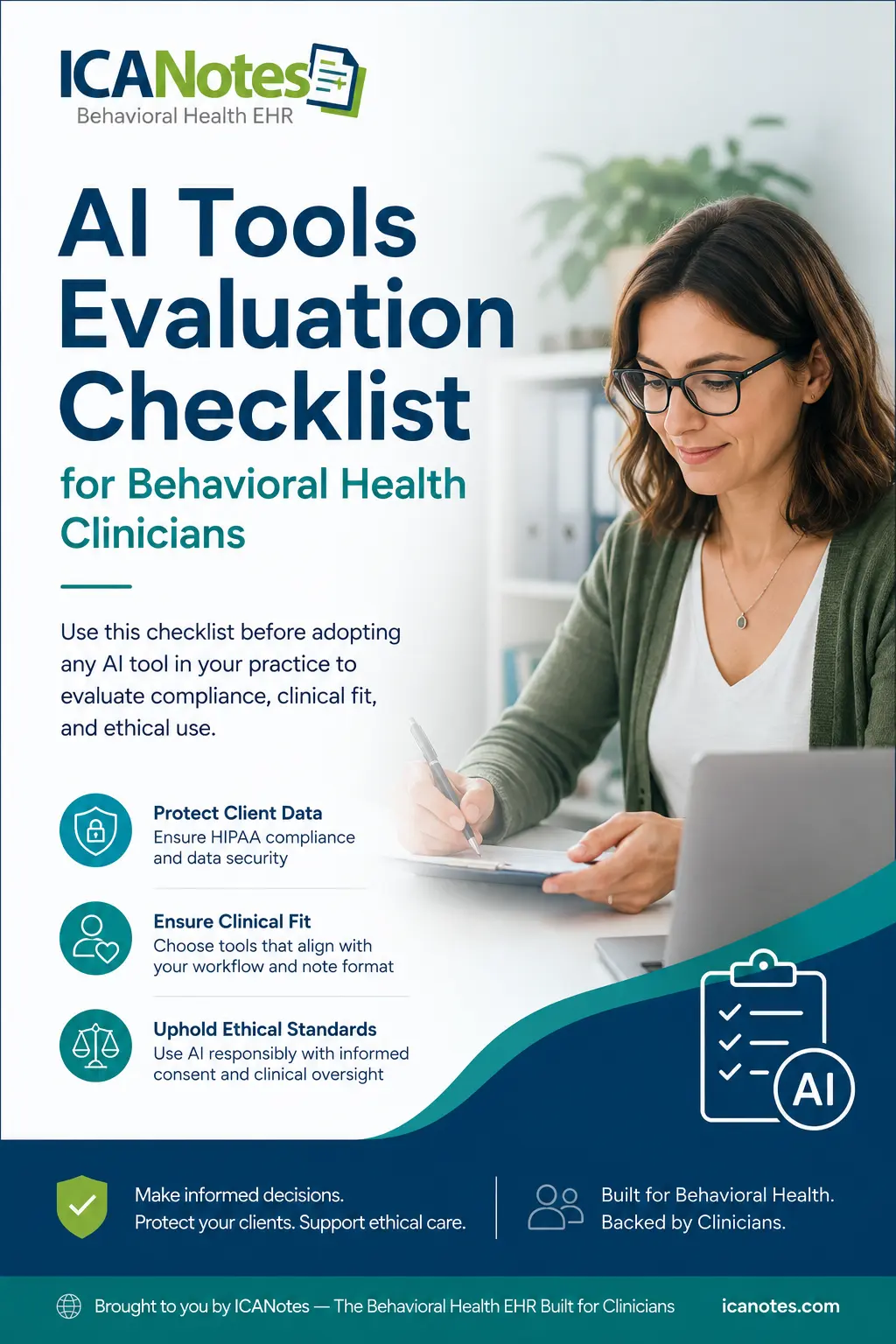
Evaluate AI Tools Before You Adopt Them
Download the AI Tools Evaluation Checklist for Behavioral Health Clinicians to assess HIPAA compliance, clinical fit, data security, and ethical use before adding AI to your practice.
- Review HIPAA and data security requirements
- Identify red flags before choosing an AI vendor
- Use a fill-in practice policy template for responsible AI use
Types of AI Tools for Therapists
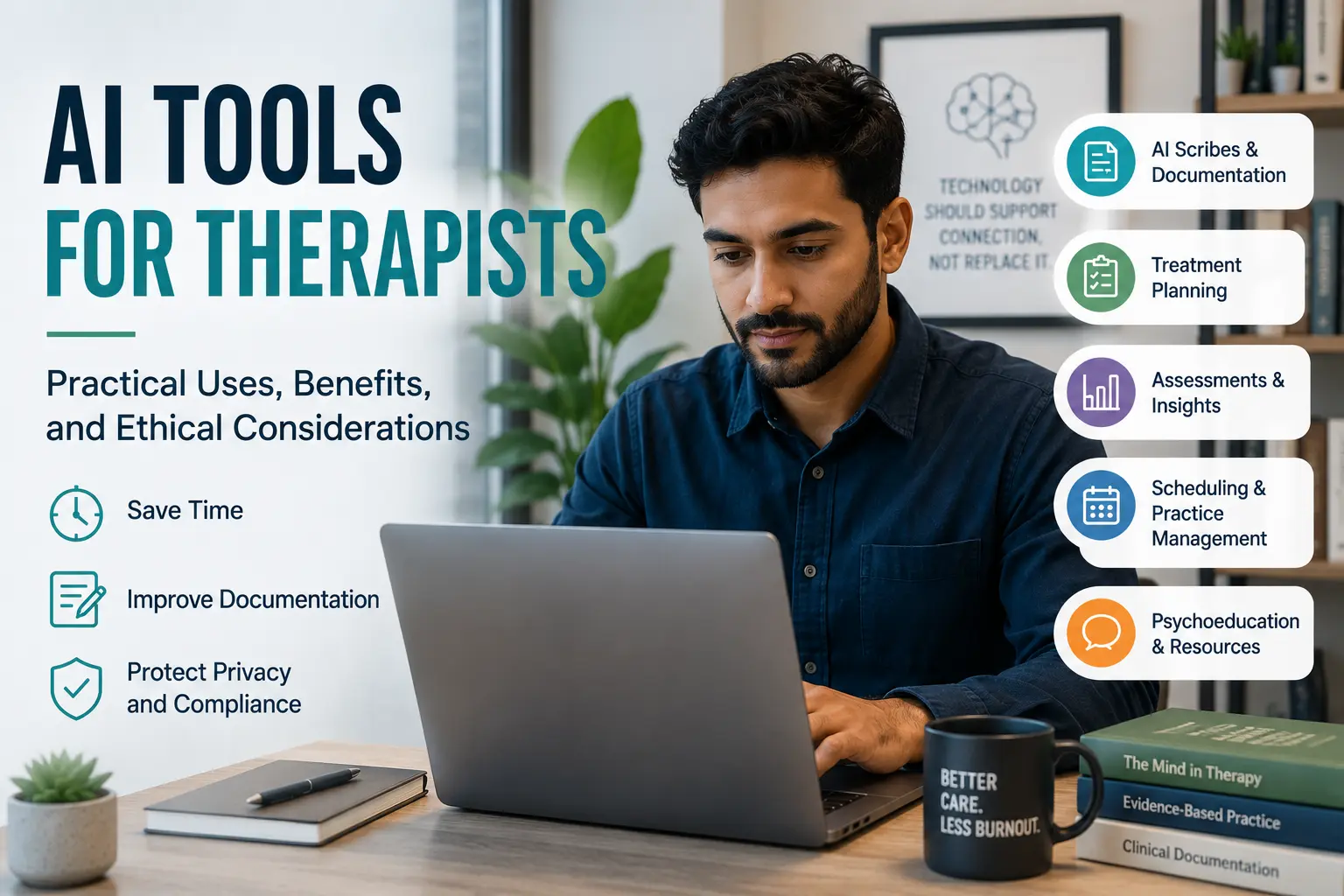
AI tools can support many aspects of a behavioral health practice. The infographic below highlights the most common categories therapists use today.
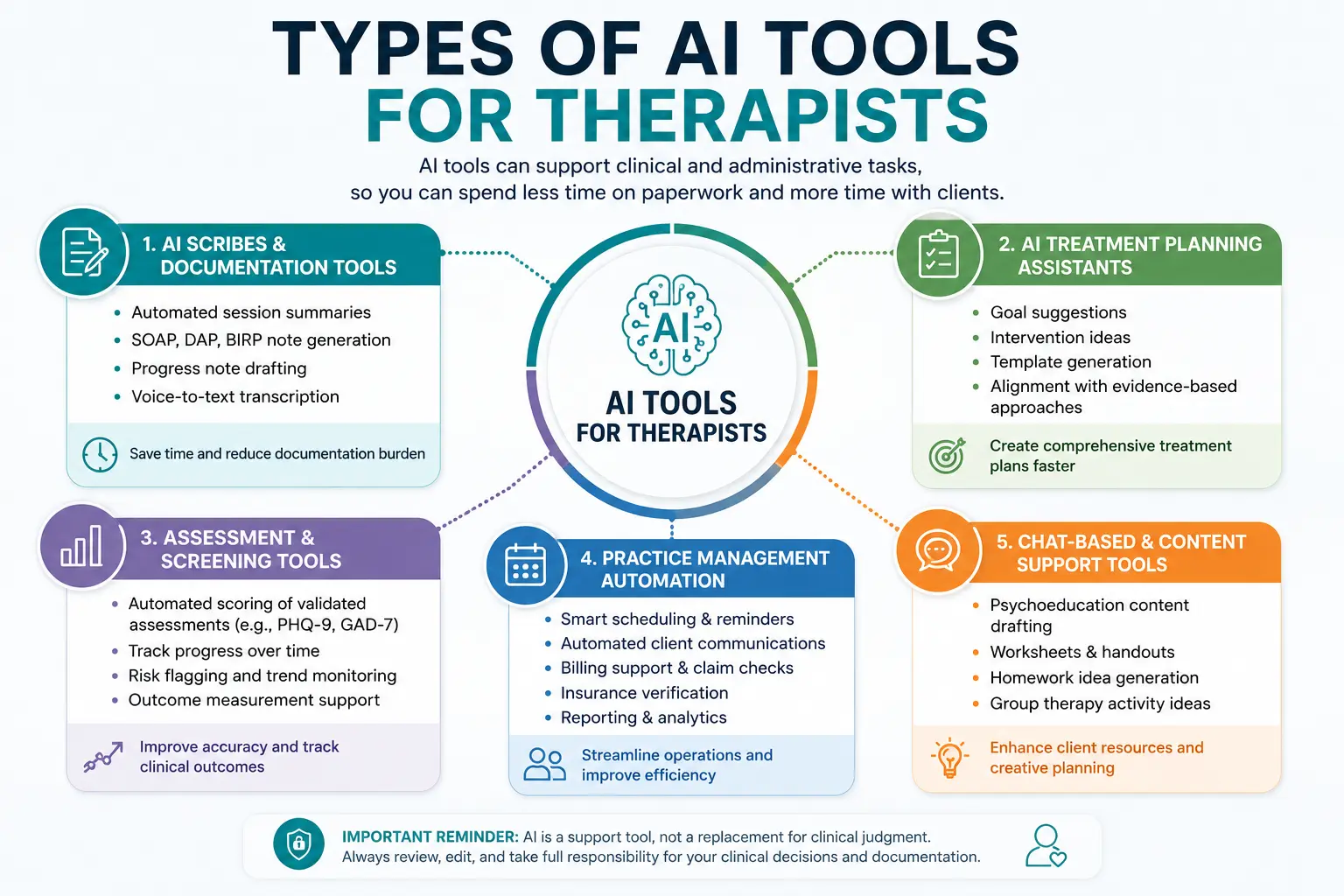
1. AI Scribes and Clinical Documentation Tools
AI-powered documentation tools are among the most widely adopted in behavioral health. These tools can generate draft progress notes, session summaries, and structured notes (SOAP, DAP, BIRP) based on session data — either entered manually or captured via transcription.
For clinicians who spend hours after sessions completing paperwork, this can be a significant time saver. Some EHR platforms — including ICANotes — have built AI-assisted documentation features directly into their clinical workflow, allowing clinicians to generate compliant, structured notes within the same system they use to manage their practice. Because these tools are embedded in a HIPAA-compliant EHR, they avoid the data security concerns that can arise when using standalone AI writing tools.
Important note: AI-generated notes are drafts. Clinicians should always review, edit, and sign off on every note before it becomes part of the official record.
2. AI Treatment Planning Assistants
Treatment planning is one of the more time-intensive clinical tasks, particularly for clinicians managing large caseloads or working in agency settings. AI treatment planning tools can suggest goal language, intervention options, and structured templates based on presenting diagnoses or clinical themes.
These tools do not replace clinical assessment or individualized care planning. They can, however, help clinicians get a starting point on paper faster and ensure that documentation meets payer or regulatory standards. Again, the quality of the output depends heavily on the quality of the input — and the clinician's final review.
3. Assessment and Screening Support Tools
AI is also being applied to standardized assessment workflows. Some platforms offer automated scoring for validated instruments (PHQ-9, GAD-7, PCL-5), flagging elevated scores or changes from previous administrations to support clinical decision-making.
Risk assessment tools are an emerging area, though one that warrants careful evaluation. AI-assisted risk flagging may support documentation and monitoring, but clinicians should never rely on algorithmic output as a substitute for a structured clinical risk assessment.
4. Practice Management Automation
Beyond the consulting room, AI is streamlining the business side of behavioral health practice. Intelligent scheduling tools can reduce no-shows through automated reminders and optimize appointment availability. Billing automation tools can flag claim errors, suggest appropriate CPT codes, and track outstanding balances — reducing revenue cycle delays without requiring billing expertise.
For group practice owners and agency administrators, these tools can meaningfully reduce administrative overhead and improve operational consistency across multiple clinicians.
5. Chat-Based and Content Support Tools
General-purpose AI tools like large language models can assist therapists in creating client-facing materials: psychoeducation handouts, between-session homework prompts, worksheet templates, and group therapy exercises. While these tools are not purpose-built for clinical settings, they can be useful for drafting starting points that clinicians then customize for their clients.
Caution: Never enter identifiable client information into a general-purpose AI tool. These platforms are not HIPAA-covered entities and are not appropriate for any use that involves protected health information.
Benefits of AI in Therapy Practices
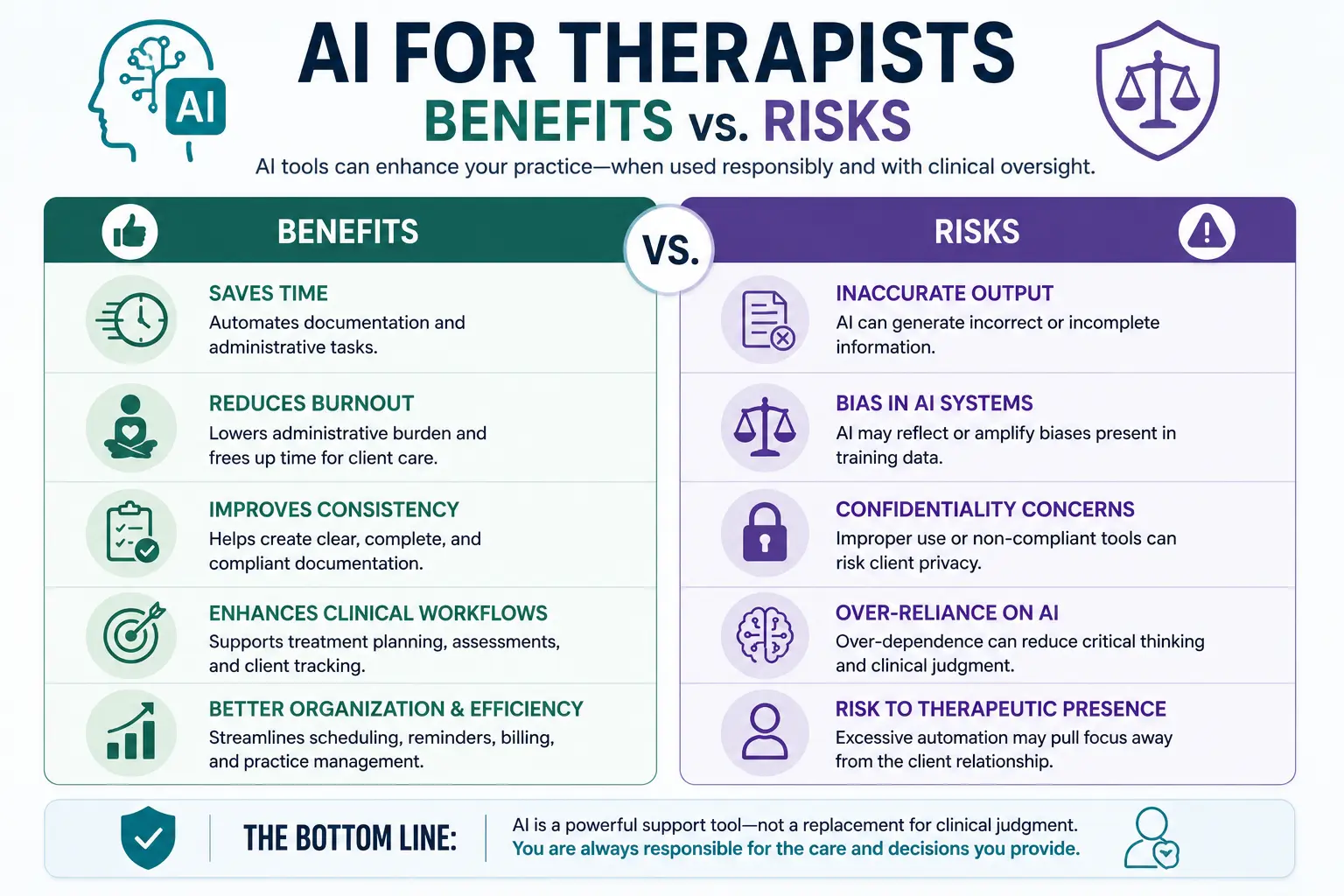
When implemented thoughtfully, AI tools can deliver real, measurable benefits to behavioral health practices:
- Reduced administrative time. Clinicians commonly report spending 30–50% of their working hours on documentation and administrative tasks. AI-assisted note generation can compress that time significantly, returning hours to client care or personal time.
- More consistent documentation. AI tools that use structured note templates help ensure documentation meets payer requirements and captures the right elements, reducing audit risk and claim denials.
- Faster treatment planning. Goal and intervention suggestions can help clinicians draft treatment plans more quickly, particularly useful for high-volume caseloads.
- Lower risk of burnout. Documentation overload is a leading contributor to clinician burnout. Tools that reduce after-hours charting can improve work-life balance and clinician well-being.
- Better practice organization. Automation in scheduling, billing, and reminders reduces the cognitive load of managing a practice, leaving more mental bandwidth for clinical work.
While AI can improve efficiency and reduce administrative burden, therapists should also understand the potential risks before incorporating these tools into their workflow.
Ethical and Legal Considerations
The adoption of AI in clinical settings raises genuine ethical and legal questions that every clinician should understand before integrating these tools into their practice.
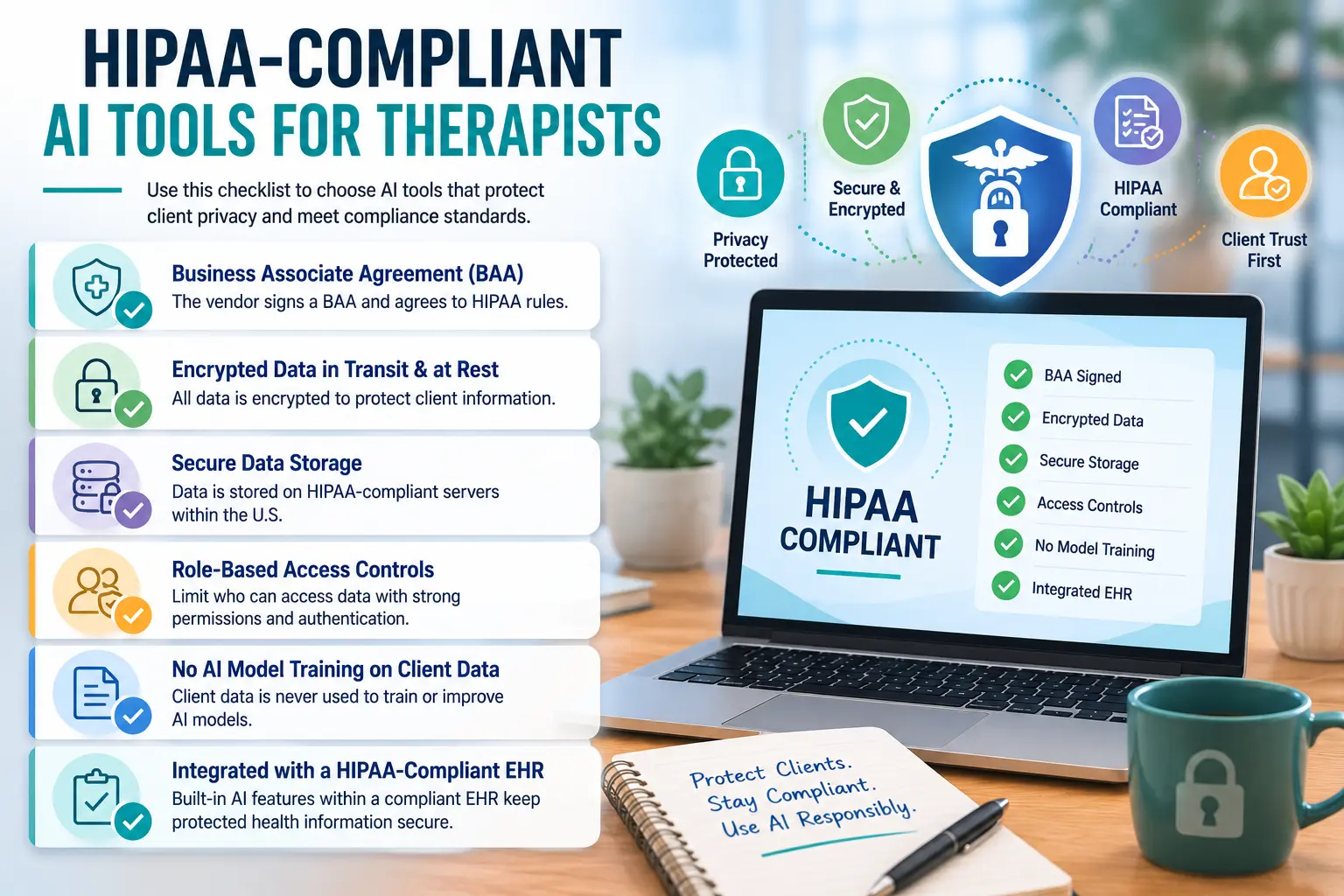
HIPAA compliance and data security. Any AI tool that processes protected health information (PHI) must operate within a HIPAA-compliant framework. This means the vendor must offer a signed Business Associate Agreement (BAA) and demonstrate appropriate data security practices. Tools that are integrated within a compliant EHR — rather than operating as standalone applications — generally carry fewer risks in this regard. When evaluating AI tools, use the checklist below to verify that the platform meets basic HIPAA and security requirements.
Informed consent. Many professional ethics codes and some state regulations now require clinicians to inform clients when AI is used in their care, particularly in documentation. Check your licensing board's guidelines and consider updating your intake paperwork to include a disclosure about AI-assisted documentation practices.
Data storage and third-party access. When using any AI tool, know where your data is stored, who can access it, and how long it is retained. Avoid tools that use client session data to train their AI models without explicit client consent — this is both an ethical and a potential legal concern.
Avoiding over-reliance. The convenience of AI-generated output can create a temptation to accept suggestions without sufficient review. This is particularly risky in documentation: a note that inaccurately represents what occurred in a session — even if generated by AI — is the clinician's professional and legal responsibility.
Clinical responsibility always rests with the therapist. AI tools do not hold licenses. They cannot be held accountable for clinical decisions or documentation errors. Whatever the AI produces, you are accountable for what enters your client's record.
Limitations of AI Tools in Behavioral Health
A realistic assessment of AI tools for therapists requires acknowledging their limitations alongside their benefits.
- AI cannot replicate clinical judgment. The ability to read a room, track subtle shifts in a client's presentation, hold a therapeutic frame, or navigate a crisis in real time is uniquely human. AI tools do not assess, do not form a therapeutic alliance, and do not make clinical decisions.
- AI-generated summaries can be inaccurate. Transcription and summarization tools can miss nuance, introduce errors, or produce outputs that don't reflect what was actually discussed in a session. Every generated note requires clinician review before it becomes part of the record.
- Bias in AI systems. AI tools are trained on existing data, which can reflect historical biases in mental health care — including underrepresentation of certain populations, diagnostic patterns, and cultural contexts. Clinicians should be alert to how AI-generated language may not reflect culturally responsive or affirming practice.
- Confidentiality risks with non-compliant tools. Using general consumer AI tools with any PHI — even inadvertently — can expose a practice to HIPAA liability.
- Over-automation can reduce therapeutic presence. Clinicians who become overly focused on AI-assisted documentation during or immediately after sessions may find it affects their capacity to be fully present with clients.
How Therapists Can Use AI Responsibly
The goal is not to avoid AI — it is to integrate it in a way that enhances your practice without compromising client care or professional standards. Here are practical guidelines:
- Use AI for drafting, not diagnosing. AI tools are appropriate for generating note drafts, treatment plan frameworks, and administrative content. They are not appropriate for making or supporting diagnostic conclusions.
- Review and edit every output. Treat AI-generated content as a first draft, not a finished product. Read every note before signing. Correct errors and add clinical nuance that the AI missed.
- Stick to HIPAA-compliant tools. Prioritize AI tools that are built into your EHR or that offer a signed BAA. If you are uncertain whether a tool is compliant, treat it as non-compliant and do not use it with PHI. EHR-integrated AI features — such as those available in ICANotes — are designed with compliance built in, making them a safer default for documentation tasks.
- Be transparent with clients. Disclose the use of AI in documentation through your informed consent process. Clients have a right to know how their session information is being processed.
- Develop a clear practice policy. Document how you use AI in your practice, which tools you use, and what safeguards are in place. This is good practice risk management and demonstrates professional accountability.
- Stay current. AI in healthcare is evolving quickly. Professional associations including APA and NASW are developing updated guidance. Make it a practice to review relevant ethics codes and state board guidelines periodically.
How ICANotes Supports Responsible, HIPAA-Compliant AI Use
For behavioral health professionals, responsible AI adoption starts with choosing tools designed for clinical care, not generic automation. The ICANotes+ AI Scribe is built specifically for mental health documentation, helping therapists, counselors, and psychiatrists reduce charting time while maintaining clinician oversight, privacy, and compliance.
Unlike AI tools that store session recordings or full transcripts indefinitely, ICANotes+ AI Scribe uses a privacy-first approach. It processes audio in real time to generate a structured clinical note, then discards the recording. The only artifact that remains is the note the clinician reviews, edits, and signs — helping reduce the risk of creating a parallel record outside the official chart.
ICANotes+ AI Scribe is also built directly into the ICANotes EHR workflow, so clinicians do not need to copy and paste protected health information into a separate tool or reformat generic AI output into a clinical note. Notes are generated in formats designed for therapy and psychiatry, supporting a more efficient documentation process while keeping the clinician in control.
From a compliance standpoint, ICANotes+ AI Scribe is HIPAA-compliant by design, with Business Associate Agreements in place with U.S.-based AI providers and encryption for data in transit and at rest. ICANotes also supports informed consent by providing standard consent language and documentation tools for clinicians using AI-assisted note-taking.
Most importantly, ICANotes treats AI as a documentation aid — not a replacement for clinical judgment. Clinicians remain responsible for reviewing, editing, and signing every AI-generated note before it becomes part of the medical record. This approach allows behavioral health professionals to save time while preserving the accuracy, accountability, and ethical standards that quality care requires.
Related: What You Actually Want in an Ambient AI Scribe (Especially in Mental Health)
Related Resources
Explore more ICANotes resources on AI, clinical documentation, informed consent, and the future of behavioral health care.
Frequently Asked Questions About AI Tools for Therapists
Recent Posts


Dr. October Boyles
DNP, MSN, BSN, RN
About the Author
Dr. October Boyles is a behavioral health expert and clinical leader with extensive expertise in nursing, compliance, and healthcare operations. With a Doctor of Nursing Practice (DNP) and advanced degrees in nursing, she specializes in evidence-based practices, EHR optimization, and improving outcomes in behavioral health settings. Dr. Boyles is passionate about empowering clinicians with the tools and strategies needed to deliver high-quality, patient-centered care.