Blog > Treatment Strategies > Couples Therapy Treatment Goals & Plans: A Clinical Guide
Couples Therapy Treatment Goals and Plans: A Complete Clinical Guide
Writing an effective couples therapy treatment plan requires more than general goals like “improve communication.” Clinicians need measurable, behavior-based objectives that connect relational work to the identified patient’s diagnosis. This guide explains how to structure couples therapy treatment goals, outlines the key components of a treatment plan for couples therapy, and includes a sample treatment plan for couples therapy that clinicians can adapt for real-world practice.


Last Updated: March 23, 2026


What You'll Learn
- How to write measurable couples therapy treatment goals that demonstrate clinical progress
- The core components of a couples therapy treatment plan required by insurers and supervisors
- Common goal categories in couples counseling (communication, conflict, attachment, trust)
- Examples of strong vs. weak couples therapy treatment goals
- A sample treatment plan for couples therapy with timelines and measurable indicators
- Documentation strategies that help clinicians track relational progress across sessions
Contents
- The Clinical Foundation: Diagnosis and the Identified Patient
- What Strong Couples Therapy Treatment Goals Look Like
- Common Couples Therapy Treatment Goal Categories
- Sample Treatment Plan for Couples Therapy
- Key Elements of a Complete Couples Therapy Treatment Plan
- The Documentation Challenge in Couples Therapy
- How ICANotes Supports Couples Therapy Treatment Planning
- FAQ: Couples Therapy Treatment Goals
Couples therapy is some of the most complex and rewarding work in behavioral health. Two individuals enter your office carrying separate histories, attachment patterns, trauma narratives, and nervous system responses — yet the focus of treatment is neither person alone. It is the interaction between them.
That complexity deserves documentation that rises to meet it. Yet many clinicians are still building couples therapy treatment plans from scratch or adapting individual therapy templates that were never designed for relational work. The result is often treatment plans that are clinically sincere but practically vague — goals like "improve communication" that lack behavioral markers, measurable criteria, or defined timelines.
This guide covers what couples therapy treatment goals should include, how to structure a treatment plan for couples therapy, and provides a sample treatment plan for couples therapy you can adapt for your own practice. If you’re looking to improve your overall mental health documentation or streamline your progress notes workflow, this guide will help.
Why Structured Couples Therapy Treatment Plans Matter
When treatment goals are not specific, it becomes difficult to evaluate progress, adjust interventions, or demonstrate the clinical direction of care. This affects both clinicians and clients. Couples who cannot see measurable targets often lose momentum. Clinicians without clear benchmarks may find sessions drifting into repeated processing without observable change. Research on goal planning in mental health treatment confirms that collaborative goal-setting — including formulating specific goals, ongoing evaluation of progress, and shared decision-making — improves engagement, satisfaction, and outcomes for clients.¹
A well-constructed couples therapy treatment plan does five things:
- Identifies measurable relational goals connected to the presenting diagnosis
- Connects relational interventions to symptom reduction in the identified patient
- Defines observable behavioral indicators of progress
- Establishes timelines for reassessment
- Guides the clinical focus of sessions over time
Structured treatment planning is not about rigidity. It is about direction. When goals are measurable, both partners understand what progress looks like — and that clarity strengthens therapeutic momentum rather than reducing the emotional depth of the work. Studies also suggest that psychotherapy is more effective when goals are individually defined rather than built around broad, standardized symptom measures — making personalization a clinical imperative, not just a preference.²
The Clinical Foundation: Diagnosis and the Identified Patient
In most couples therapy cases, one partner is the identified patient, and relational distress is connected to a diagnosable condition. Common diagnoses in couples therapy treatment plans include:
- Adjustment Disorder with Depressed Mood or Anxious Mood (F43.2x)
- Major Depressive Disorder (F32.x / F33.x)
- Generalized Anxiety Disorder (F41.1)
- PTSD (F43.10)
- Relationship Distress with Spouse or Intimate Partner (Z63.0)
The treatment plan must intentionally connect relational interventions to the presenting symptoms of the identified patient. When that clinical link is missing, treatment can feel conceptually meaningful but clinically untethered. Payers, supervisors, and licensing boards expect to see how the relational work directly addresses the documented diagnosis.
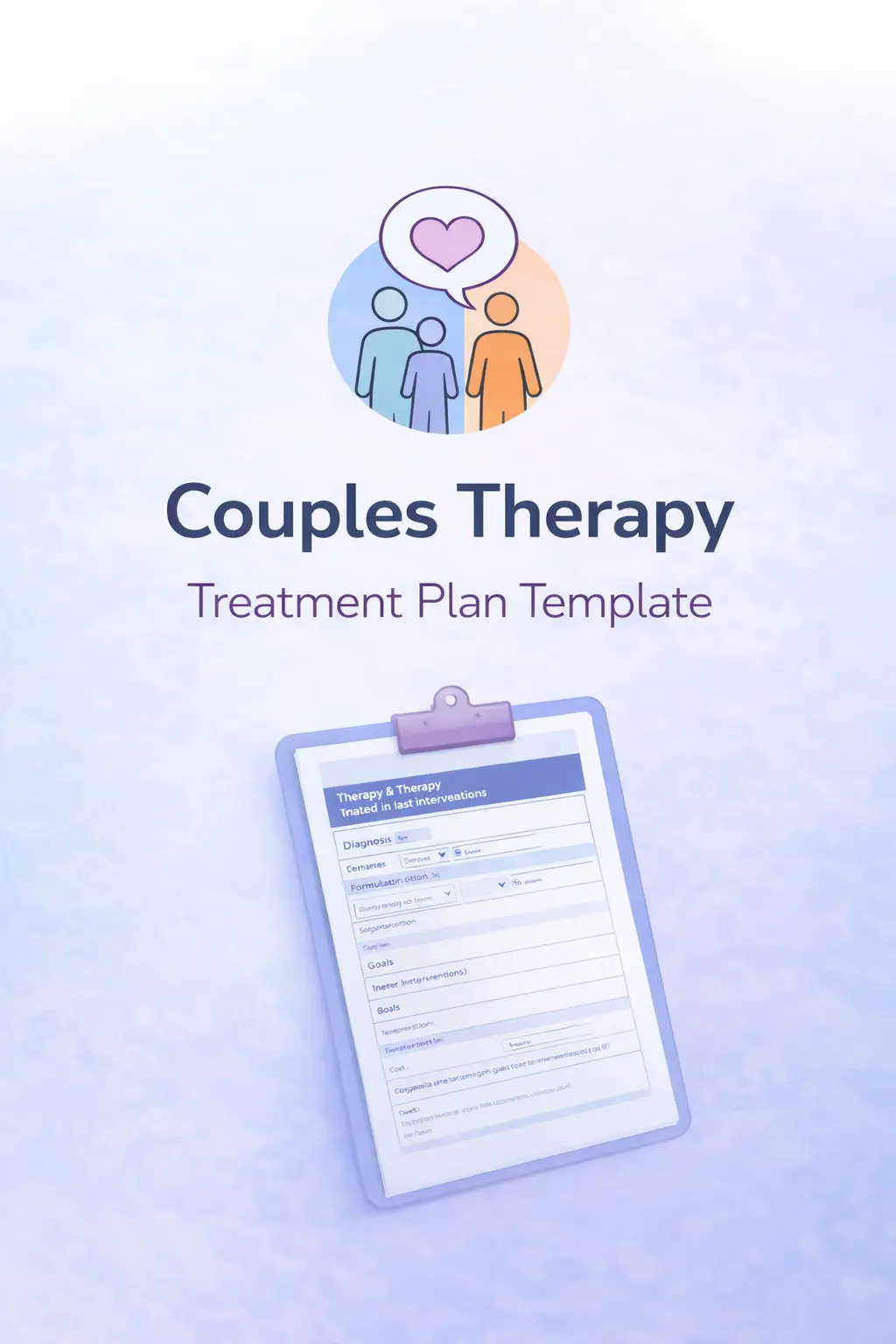
Download the Couples Therapy Treatment Plan Template
Give clinicians a faster way to create structured, measurable couples therapy documentation with this fillable template and goal bank.
What’s inside:
- Fillable treatment plan framework
- Diagnosis and formulation sections
- Measurable goals and timelines
- Interventions and reassessment fields
- Bonus measurable goal bank for couples therapy
Get the Free Template
Instant download — editable template + goal bank.
What Strong Couples Therapy Treatment Goals Look Like
Vague goals are one of the most common documentation problems in couples work. The language feels clinical, but it does not translate into observable, trackable outcomes. Here is the difference between weak and strong treatment goals:
Weak vs. Strong Couples Therapy Treatment Goals
Notice that strong couples therapy treatment goals share four qualities: they are behavioral (describing observable actions, not internal states), measurable (tied to frequency, duration, or session-based observation), time-bound (with a defined reassessment window), and clinically linked (connected to the presenting diagnosis or symptom cluster).
This same level of specificity is also critical when writing couples therapy notes and ensuring documentation holds up during audits or reviews. If you're looking to improve your documentation quality overall, see our clinical documentation tips for audit readiness.
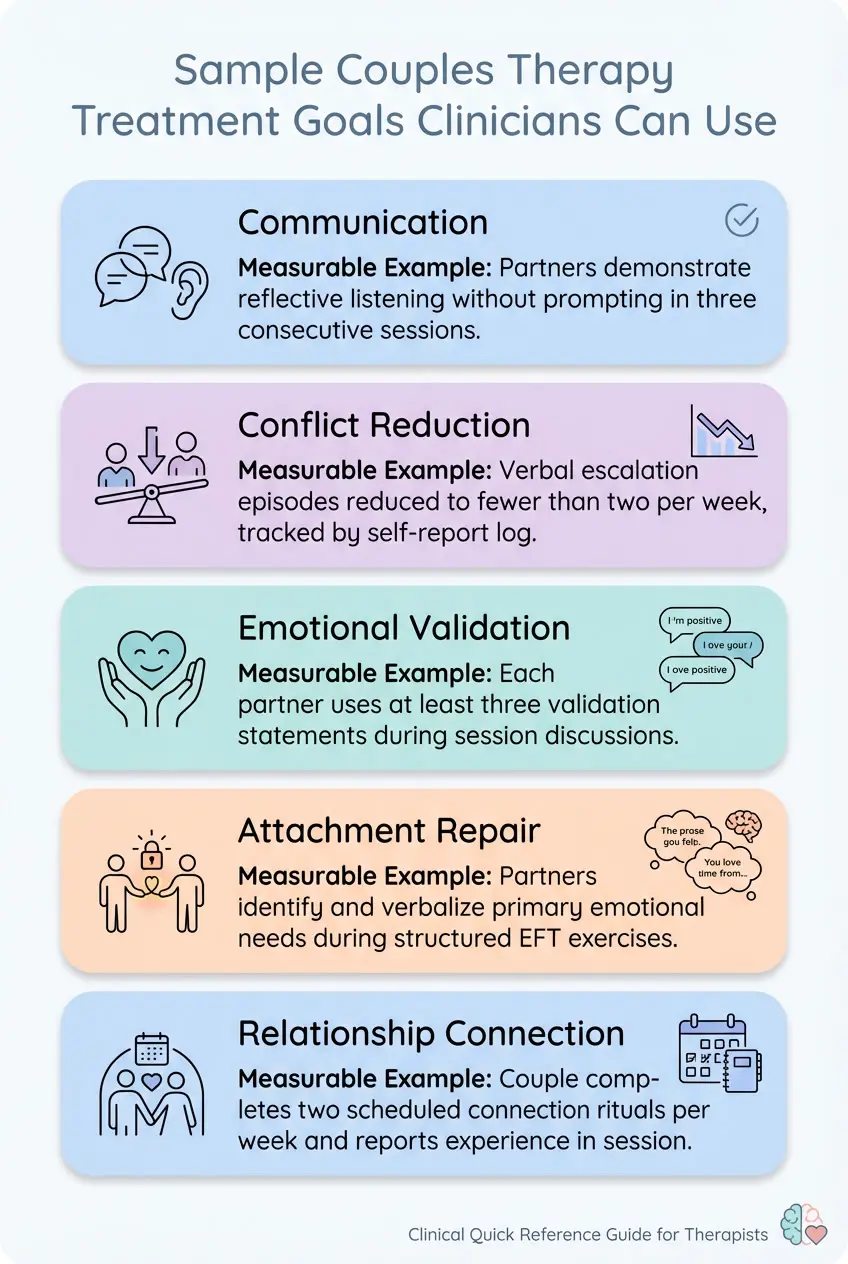
Couples Therapy Treatment Goal Examples Clinicians Can Use
Clinicians often find it easier to write measurable documentation when they can reference concrete examples. The following examples illustrate how couples therapy treatment goals can be written in behavioral, observable language that supports clinical documentation and progress tracking.
Writing clear couples therapy treatment goals helps clinicians measure progress, guide interventions, and maintain structured documentation throughout treatment.
Common Couples Therapy Treatment Goal Categories
When building treatment plans for couples therapy, goals typically fall into one or more of the following clinical domains:
1. Communication and Active Listening
- Demonstrate reflective listening techniques in session
- Reduce interrupting and cross-talk during conflict discussions
- Increase use of "I" statements vs. blaming language
2. Conflict Management and De-escalation
- Implement a structured time-out protocol during high-conflict episodes
- Reduce verbal aggression frequency
- Identify and interrupt negative interaction cycles (e.g., pursue-withdraw)
3. Emotional Validation and Repair
- Increase frequency of verbal validation statements
- Demonstrate repair attempts after conflict within 24 hours
- Identify each partner's primary emotional needs and express them directly
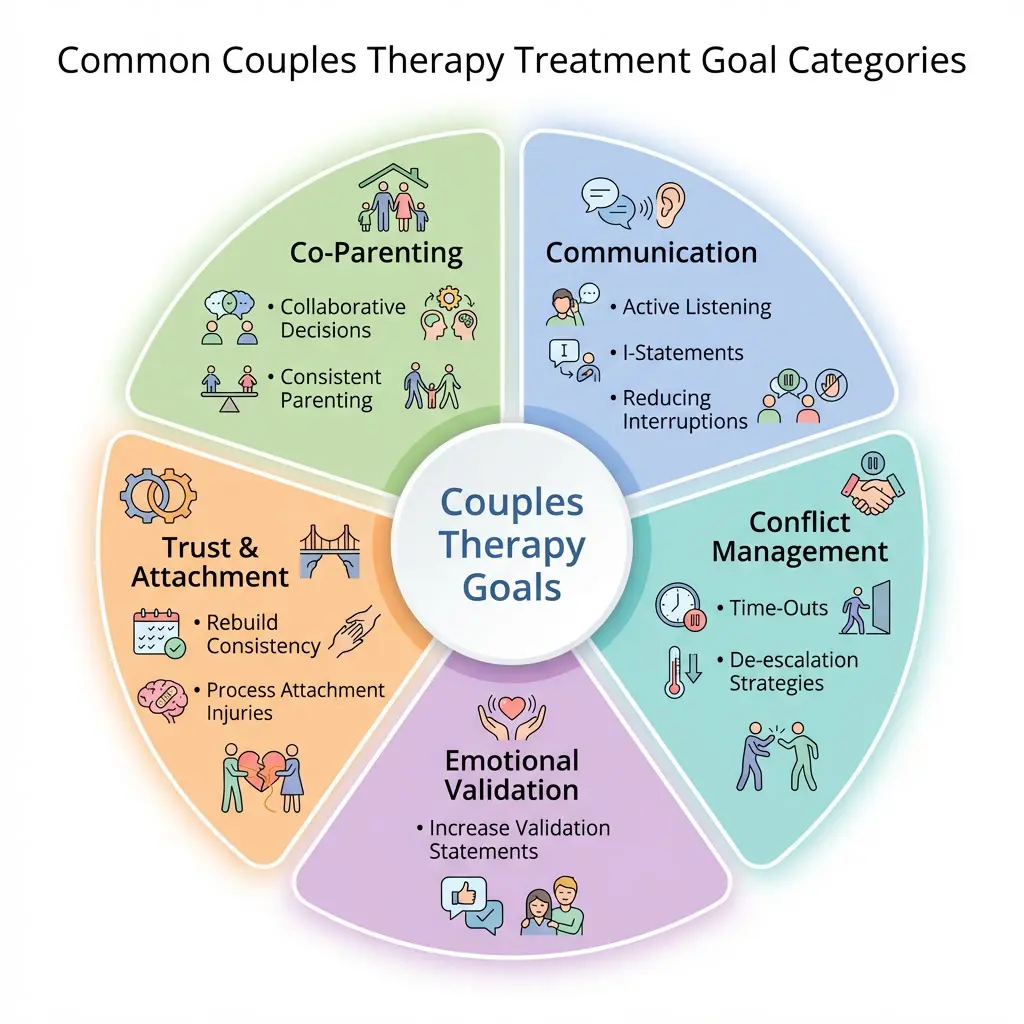
4. Trust and Attachment
- Rebuild predictability and consistency through behavioral commitments
- Process attachment injuries using a structured protocol (e.g., Emotionally Focused Therapy Hold Me Tight conversations)³
- Increase physical and emotional availability between sessions
5. Co-parenting and Shared Functioning
- Establish consistent parenting approach for identified behavioral concern
- Reduce triangulation of children in partner conflict
- Improve collaborative decision-making around household responsibilities
Sample Treatment Plan for Couples Therapy
The following is a sample treatment plan for couples therapy that demonstrates how measurable goals, observable indicators, and clinical timelines work together. This example uses a presenting diagnosis of Adjustment Disorder with Depressed Mood in the identified patient, with co-occurring relationship distress.
Note: This sample is illustrative. A complete treatment plan should be individualized based on assessment findings, clinical judgment, and the couple's specific goals and strengths.
This structure demonstrates what insurers, supervisors, and licensing boards expect to see: a clear link between the relational work and the clinical diagnosis, with observable markers that make progress trackable over time.
The following examples illustrate measurable couples therapy treatment goals clinicians can adapt when developing a treatment plan.
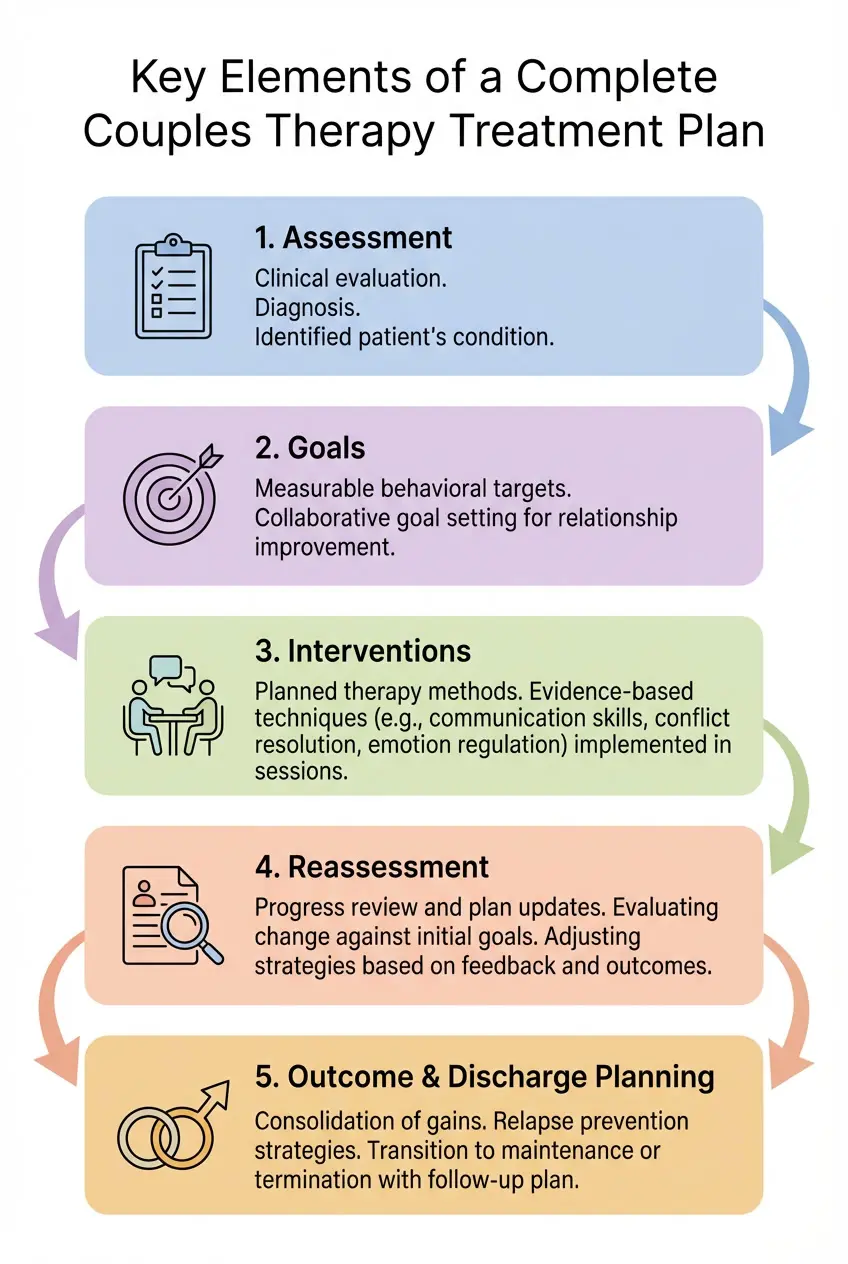
Key Elements of a Complete Couples Therapy Treatment Plan
Whether you are building a couples counseling treatment plan from scratch or adapting a template, a well-structured plan provides a clear roadmap for treatment. It connects assessment findings to measurable goals and ensures that interventions are intentionally aligned with the couple’s presenting concerns. When these elements are clearly documented, clinicians can track progress more effectively and demonstrate the clinical direction of care.
A comprehensive couples therapy treatment plan typically includes the following components:
1. Identifying Information
Document the identified patient, both partners’ names, referral source, and the presenting concerns that brought the couple into therapy. This section establishes the clinical context for treatment and clarifies who is considered the primary client of record when insurance billing is involved.
2. Diagnosis
Include DSM-5-TR diagnosis codes for the identified patient, along with any relevant relational Z-codes such as Relationship Distress with Spouse or Intimate Partner (Z63.0). The diagnosis provides the clinical foundation for the treatment plan and helps demonstrate the medical necessity of therapy services.
3. Clinical Formulation
Provide a brief summary describing the couple’s relational dynamics and how those dynamics relate to the presenting symptoms. This section often highlights interaction patterns, attachment styles, communication habits, and environmental stressors that contribute to the current relationship distress.
4. Measurable Treatment Goals
List three to five treatment goals written in measurable, behavioral terms. Strong goals define what change will look like in observable ways, such as reduced conflict frequency, improved communication behaviors, or increased emotional validation between partners. Each goal should include a measurable indicator and a timeline for review.
5. Interventions
Specify the therapeutic approaches and techniques that will be used to help the couple achieve the stated goals. Examples may include Emotionally Focused Therapy (EFT), Gottman Method interventions, communication skills training, conflict de-escalation protocols, or psychoeducation related to attachment and emotional regulation.
6. Reassessment Schedule
Establish a timeline for formally reviewing treatment goals and evaluating progress. Many clinicians reassess treatment plans every 8 to 12 sessions or approximately every 90 days, updating goals as needed to reflect the couple’s evolving therapeutic needs.
7. Discharge Criteria
Define the conditions under which treatment goals will be considered achieved. This may include improved communication patterns, reduced conflict escalation, increased relational stability, or the couple’s transition to maintenance or follow-up care.
A well-designed couples therapy treatment plan not only guides clinical work but also provides a clear framework for documenting progress over time. When goals, interventions, and reassessment points are clearly structured, clinicians can maintain therapeutic focus while helping couples see measurable evidence of change.
The Documentation Challenge in Couples Therapy
Writing thoughtful, individualized treatment plans takes time — particularly when you want goals to be measurable, clinically precise, and tailored to each couple's unique presentation. Over time, that cognitive load contributes to documentation fatigue. When documentation feels burdensome, it competes with therapeutic presence and clinical energy.
This is a real issue. Many clinicians report spending as much time on documentation as on direct clinical work. For couples therapists, the problem is compounded by the fact that most electronic health records were not designed with couples work in mind. You are often forced to adapt individual therapy templates, write everything free-text, or develop your own workaround systems.
The friction is unnecessary — and it has a solution.
Many clinicians experience documentation fatigue when treatment plans and progress notes must be written from scratch. Structured EHR systems designed for behavioral health can dramatically streamline this workflow.
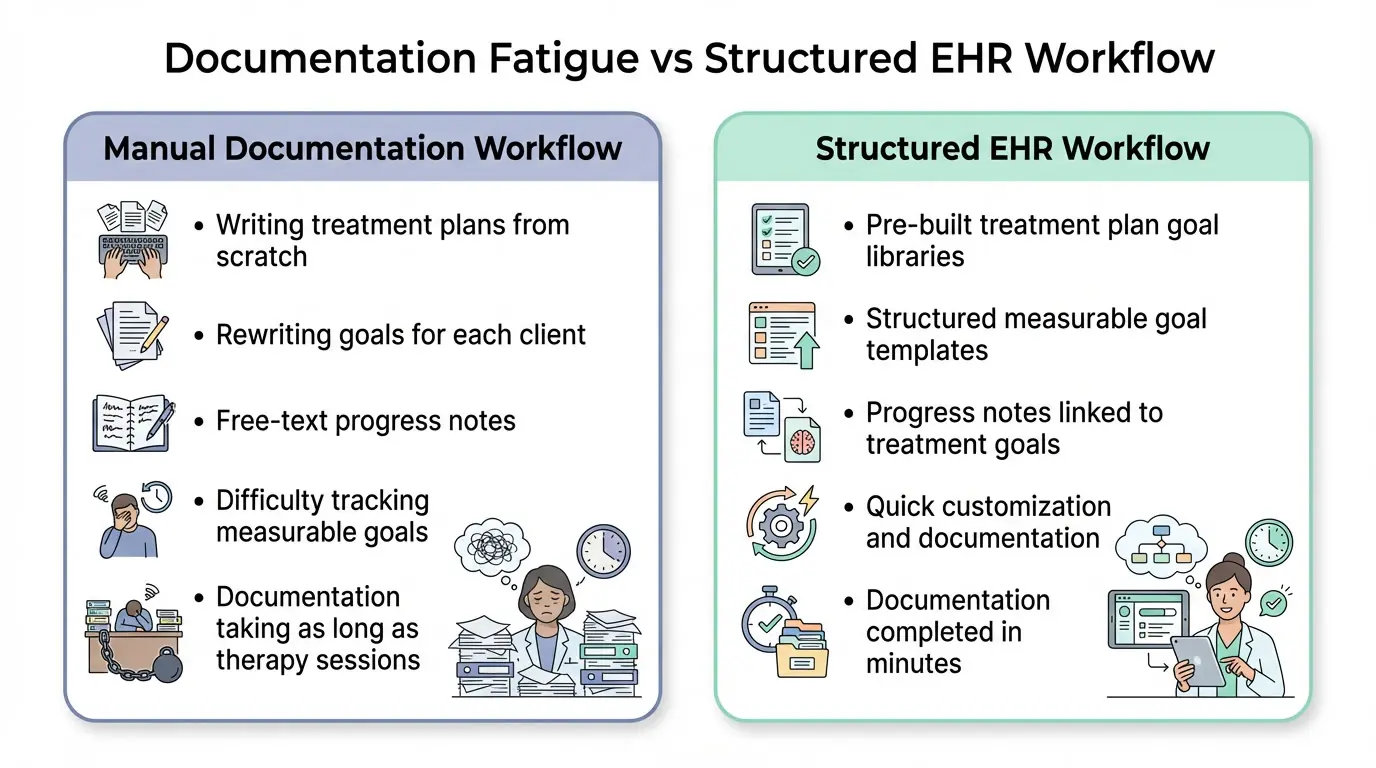
Structured EHR systems help clinicians create couples therapy treatment plans and progress notes faster while maintaining clear measurable treatment goals.
How ICANotes Supports Couples Therapy Treatment Planning
ICANotes was designed specifically for behavioral health clinicians, and it includes dedicated couples therapy treatment plans and couples therapy progress notes within a single, unified chart — something most EMRs do not offer.
Inside ICANotes, you will find:
- Pre-built couples therapy treatment plan goal libraries — measurable, clinically grounded, and immediately usable
- Behavioral frequency indicators, observable session markers, and defined reassessment timeframes built into the goal structure
- A menu-driven interface for customizing goals, adjusting timelines, and adding free-text refinements
- Integrated couples therapy progress notes linked directly to treatment plan goals
- Single-chart documentation for both partners — no workarounds, no adapting individual templates
Because ICANotes integrates notes with the treatment plan, documentation becomes aligned rather than fragmented. You can document which goal was addressed in session, which intervention was implemented, and how each partner responded — all without rebuilding the clinical framework at every visit.
Structured couples therapy treatment plans in ICANotes take minutes, not hours. The efficiency is built into the system design, but so is the clinical depth. You are not sacrificing quality for speed. You are working from a clinically sound foundation that supports both.
If documentation fatigue is slowing down your clinical workflow, a structured EHR can make a significant difference.
Simplify Couples Therapy Documentation with ICANotes
Stop piecing together treatment plans and progress notes from generic templates. ICANotes gives behavioral health clinicians structured documentation tools designed to support measurable treatment goals, integrated progress notes, and faster charting.
Why clinicians choose ICANotes for couples therapy documentation
- Create couples therapy treatment plans in minutes
- Use structured goal libraries with measurable clinical language
- Link progress notes directly to treatment plan goals
- Customize documentation without starting from scratch
- Keep couples therapy notes and treatment plans in one behavioral health-specific system
“ICANotes helps our clinicians document faster without sacrificing quality. The structured workflows make treatment planning and progress notes far easier to manage.”
Behavioral health practice user
Start your free 30-day trial and see how much easier it can be to build structured, clinically sound couples therapy documentation.
Start Your Free Trial
Final Thoughts: Documentation That Reflects the Depth of the Work
Couples therapy touches attachment systems, parenting environments, emotional regulation, trauma activation, and long-term relational stability. The documentation should reflect that level of seriousness.
When couples therapy treatment goals are structured, measurable, and thoughtfully constructed, they provide a roadmap for intervention rather than a summary of intention. They support clinical depth. They also help couples see and recognize their own progress — which increases engagement and reinforces therapeutic momentum.
What gets measured improves. That applies to documentation just as much as it applies to relationships.
Related Couples Therapy Resources
Explore additional guidance on couples therapy for marriage and family therapists.

Frequently Asked Questions: Couples Therapy Treatment Goals
Related Posts






Dr. October Boyles
DNP, MSN, BSN, RN
About the Author
Dr. October Boyles is a behavioral health expert and clinical leader with extensive expertise in nursing, compliance, and healthcare operations. With a Doctor of Nursing Practice (DNP) and advanced degrees in nursing, she specializes in evidence-based practices, EHR optimization, and improving outcomes in behavioral health settings. Dr. Boyles is passionate about empowering clinicians with the tools and strategies needed to deliver high-quality, patient-centered care.